
|
|
|
|
Bosra
|
| |
|
| |
Bosra (also Bostra, Busrana, Bozrah, Bozra, Busra Eski Sam, Busra ash-Sham, Nova Trajana Bostra) is an ancient city administratively belonging to the Daraa Governorate in southern Syria. It is a major archaeological site and has been declared a UNESCO World Heritage Site.
settlement was first mentioned in the documents of Tutmose III and Akhenaton (14th century BC).

Discussion
Ask a question about 'Bosra'
Start a new discussion about 'Bosra'
Answer questions from other users
|
Encyclopedia
Bosra (also Bostra, Busrana, Bozrah, Bozra, Busra Eski Sam, Busra ash-Sham, Nova Trajana Bostra) is an ancient city administratively belonging to the Daraa Governorate in southern Syria. It is a major archaeological site and has been declared a UNESCO World Heritage Site.
History
The settlement was first mentioned in the documents of Tutmose III and Akhenaton (14th century BC). Bosra was the first Nabatean city in the 2nd century BC. The Nabatean Kingdom was conquered by Cornelius Palma, a general of Trajan, in 106.
Under the Roman Empire, Bosra was renamed Nova Trajana Bostra, and was the residence of the legio III Cyrenaica and capital of the Roman province Arabia Petraea. The city flourished and became a major metropolis at the juncture of several trade routes, including the Roman road to the Red Sea. The two Councils of Arabia were held at Bostra in 246 and 247 AD. The city continued under the Byzantine Empire, was conquered by the Sassanid Persians in the early 7th century, and finally conquered by the forces of the Rashidun Caliphate under Khalid ibn Walid in the Battle of Bosra in 634.
Bosra played an important part in the early life of the Prophet of Islam, Mohammed as described in the entry for the Christian Monk, Bahira
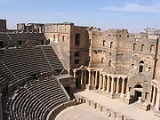
Today, Bosra is a major archaeological site, containing ruins from Roman, Byzantine, and Muslim times. The city features what is thought to be the best-preserved Roman theater in the world. Every year there is a national music festival hosted in the theater.
Bosra today
Of the city which once counted 80,000 inhabitants, there remains today only a village of striking beauty settled among the ruins. The second century Roman theater, constructed probably under Trajan, is the only monument of this type with its upper gallery in the form of a covered portico which has been integrally preserved.
This unique monument, enclosed by the walls and towers of a splendid citadel, fortified between 481 and 1231 A.D, alone would suffice for the glory of Bosra. However, Nabatean and Roman monuments, Christian churches, mosques and Madrasahs all equally as celebrated, are to be found within the half ruined enceinte of the city. The structure of this monument a central plan with eastern apses flanked by 2 sacristies exerted a decisive influence on the evolution of Christian architectural forms, and to a certain extent on Islamic Forms as well. Al-Omari Mosque of Bosra is one of the oldest surviving mosques in Islamic history.
Close by are the Kharaba Bridge and the Gemarrin Bridge, both Roman bridges.
Notable people from Bosra
Ancient Roman theater
Other ruins
External links
- - 360 degree interactive imaging
|
| |
|
|