


Divan

Encyclopedia
Islam
Islam . The most common are and . : Arabic pronunciation varies regionally. The first vowel ranges from ~~. The second vowel ranges from ~~~...
ic states, or its chief official (see dewan
Dewan
The originally Persian title of dewan has, at various points in Islamic history, designated various differing though similar functions.-Etymology:...
).
Etymology
The word is recorded in English since 1586, meaning "Oriental council of state," from TurkishTurkish language
Turkish is a language spoken as a native language by over 83 million people worldwide, making it the most commonly spoken of the Turkic languages. Its speakers are located predominantly in Turkey and Northern Cyprus with smaller groups in Iraq, Greece, Bulgaria, the Republic of Macedonia, Kosovo,...
divan, from Arabic diwan, is a Middle-Persian loan-word in Arabic and was borrowed also at an earlier date into Armenian dīvān "bundle of written sheets, small book, collection of poems" (as in the Divan-i Hafiz), related to debir "writer." Sense evolved through "book of accounts," to "office of accounts," "custom house," "council chamber," then to "long, cushioned seat," such as are found along the walls in Middle Eastern council chambers. The modern French, Spanish, Italian words douane, aduana, dogana respectively (meaning "customs") also come from diwan.
Council
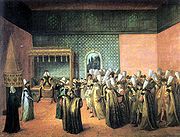
The word first appears in the ninth-century descriptions of the caliphate of Omar I (A.D. 634-644). Great wealth, gained from the Muslim conquests, was pouring into Medina, and a system of business management and administration became necessary. This was copied from the Persians (whose Sassanid empire was being conquered and islamised under Umar) and given the Persian name divan. Later, as the state became more complicated, the term was extended over all the government bureaus.The divan of the Sublime Porte was for many years the council of the Ottoman Empire
Ottoman Empire
The Ottoman EmpireIt was usually referred to as the "Ottoman Empire", the "Turkish Empire", the "Ottoman Caliphate" or more commonly "Turkey" by its contemporaries...
.
It consisted of the Grand Vizier
Grand Vizier
Grand Vizier, in Turkish Vezir-i Azam or Sadr-ı Azam , deriving from the Arabic word vizier , was the greatest minister of the Sultan, with absolute power of attorney and, in principle, dismissable only by the Sultan himself...
, who presided when the Sultan was absent, and other vizier
Vizier
A vizier or in Arabic script ; ; sometimes spelled vazir, vizir, vasir, wazir, vesir, or vezir) is a high-ranking political advisor or minister in a Muslim government....
s, kazaskers, nisanci
Nisanci
Nisanci was a high post in Ottoman bureaucracy . The word nisancı literally means court calligrapher or sealer and the original duty of the nisancı was to seal royal precepts.-History:...
, defterdar
Defterdar
Defterdars were top officials in charge of the finances in the Ottoman Empire, including heads of the Ottoman provincial treasuries; they were responsible for defters....
, and occasionally the Janissary
Janissary
The Janissaries were infantry units that formed the Ottoman sultan's household troops and bodyguards...
Ağa.
The Assemblies of the Danubian Principalities
Danubian Principalities
Danubian Principalities was a conventional name given to the Principalities of Moldavia and Wallachia, which emerged in the early 14th century. The term was coined in the Habsburg Monarchy after the Treaty of Küçük Kaynarca in order to designate an area on the lower Danube with a common...
under Ottoman rule were also called "divan" (see Akkerman Convention
Akkerman Convention
The Akkerman Convention was a treaty signed on October 7, 1826 between the Russian and the Ottoman Empires in the Budjak citadel of Akkerman . It imposed that the hospodars of Moldavia and Wallachia be elected by their respective Divans for seven-year terms, with the approval of both Powers...
, ad hoc Divan).
In Javanese
Javanese language
Javanese language is the language of the Javanese people from the central and eastern parts of the island of Java, in Indonesia. In addition, there are also some pockets of Javanese speakers in the northern coast of western Java...
and related languages, the cognate Dewan is the standard word for chamber, as in the Dewan Perwakilan Rakyat or Chamber of People's Representatives.
Ministerial departments
In the sultanate of MoroccoMorocco
Morocco , officially the Kingdom of Morocco , is a country located in North Africa. It has a population of more than 32 million and an area of 710,850 km², and also primarily administers the disputed region of the Western Sahara...
, several portfolio Ministries had a title based on Diwan:
- Diwan al-Alaf: ministry of War.
- Diwan al-Bar: 'ministry of the Sea', i.e. (overseas=) Foreign ministry.
- Diwan al-Shikayat (or - Chikayat): ministry of Complaints.
Halls
"Divan" refers to two types of palatial buildings in Indian courts.They tend to occur in pairs in the Mughal
Mughal Empire
The Mughal Empire , or Mogul Empire in traditional English usage, was an imperial power from the Indian Subcontinent. The Mughal emperors were descendants of the Timurids...
imperial capitals; the most famous ones are in Agra Fort
Agra Fort
Agra Fort, is a monument situated at Agra, is a UNESCO World Heritage site located in Agra, Uttar Pradesh, India. It is about 2.5 km northwest of its more famous sister monument, the Taj Mahal...
, but there are others in Red Fort, Delhi
Delhi
Delhi , officially National Capital Territory of Delhi , is the largest metropolis by area and the second-largest by population in India, next to Mumbai. It is the eighth largest metropolis in the world by population with 16,753,265 inhabitants in the Territory at the 2011 Census...
and Fatehpur Sikri
Fatehpur Sikri
Fatehpur Sikri is a city and a municipal board in Agra district in the state of Uttar Pradesh, India. Built near the much older Sikri, the historical city of Fatehabad, as it was first named, was constructed by Mughal emperor Akbar beginning in 1570...
and certain other princely capitals such as Amber and also in Lahore Fort
Lahore Fort
The Lahore Fort, locally referred to as Shahi Qila is citadel of the city of Lahore, Punjab, Pakistan. It is located in the northwestern corner of the Walled City of Lahore...
Pakistan
Pakistan
Pakistan , officially the Islamic Republic of Pakistan is a sovereign state in South Asia. It has a coastline along the Arabian Sea and the Gulf of Oman in the south and is bordered by Afghanistan and Iran in the west, India in the east and China in the far northeast. In the north, Tajikistan...
.
Dīwān-e-Ām
(Persian ديوان عام), also Divan-i-Aam. The court's Hall of Public Audience, where the ruler held mass audience. He would sit on his throne facing petitioners. His minister would assemble the petitions and refer them to the Dīwān-e-Khās for private audience.Dīwān-e-Khās
(Persian ديوان خاص). A court's Hall of Private Audience, smaller than the Dīwān-e-Ām. Here envoys and other honored guests were granted a personal audience with the ruler. At AgraAgra
Agra a.k.a. Akbarabad is a city on the banks of the river Yamuna in the northern state of Uttar Pradesh, India, west of state capital, Lucknow and south from national capital New Delhi. With a population of 1,686,976 , it is one of the most populous cities in Uttar Pradesh and the 19th most...
, the Dīwān-e-Khās was a small red sandstone building near the Dīwān-e-Ām.
West-Eastern Divan Orchestra
The West-Eastern DivanWest-Eastern Divan
The West-Eastern Divan is a youth orchestra based in Sevilla, Spain, consisting of musicians from countries in the Middle East, of Egyptian, Iranian, Israeli, Jordanian, Lebanese, Palestinian, Syrian and Spanish background...
Orchestra is a youth orchestra consisting of musicians from countries in the Middle East, bringing together young musicians from Egypt, Iran, Israel, Jordan, Lebanon, Palestine, and Syria. It was founded in 1999 by the Argentine-Israeli conductor Daniel Barenboim
Daniel Barenboim
Daniel Barenboim, KBE is an Argentinian-Israeli pianist and conductor. He has served as music director of several major symphonic and operatic orchestras and made numerous recordings....
and the late Palestinian-American academic and author Edward Said
Edward Said
Edward Wadie Saïd was a Palestinian-American literary theorist and advocate for Palestinian rights. He was University Professor of English and Comparative Literature at Columbia University and a founding figure in postcolonialism...
.