


Baibars

Encyclopedia
Baibars or Baybars nicknamed Abu l-Futuh (Arabic: أبو الفتوح) (1223 – July 1, 1277, Damascus), was a Mamluk
Sultan of Egypt
. He was one of the commanders of the forces which inflicted a devastating defeat on the Seventh Crusade
of King Louis IX of France
and he led the vanguard of the Egyptian army at the Battle of Ain Jalut
in 1260, which marked the first substantial defeat of the Mongol army and is considered a turning point in history. His reign marked the start of an age of Mamluk dominance in the Eastern Mediterranean and solidified the durability of their military system. He managed to pave the way for the end of the Crusader presence in Syria
and to unite Egypt
and Syria into one powerful state that was able to fend off threats from both Crusaders
and Mongols
. As Sultan, Baibars also engaged in a combination of diplomacy and military action which allowed the Mamluks to greatly expand their empire.
, Baibars was a Kipchak people/Cuman. It was said that he was captured by the Mongols
on the Kipchak steppe and sold as a slave, ending up in Syria
.
His first master, the Turkish emir
of Hama
, was suspicious of Baibars because of his unusual appearance (he was fair-skinned, very tall and had a cataract
in one of his bluish eyes). Baibars was quickly sold to a Mamluk officer whose name is Aydekin al bondouqdar, and sent to Egypt
, where he became a bodyguard to the Ayyubid ruler As-Salih Ayyub
.
 Baibars was a commander of the Mamluk
s in around 1250, when he defeated the Seventh Crusade
of Louis IX of France
. He was still a commander under Sultan Qutuz
at the Battle of Ain Jalut
in 1260, when he decisively defeated the Mongols. After the battle Sultan Qutuz was assassinated while on a hunting expedition. It was said that Baibars was involved in the assassination because he expected to be rewarded with the governorship of Aleppo
for his military success; but Qutuz, fearing his ambition, refused to give such a post and disappointed him. Baibars succeeded Qutuz as Sultan
of Egypt.
, starting with the Principality of Antioch
, which had become a vassal state of the Mongols
, and participated in attacks against Islamic targets in Damascus and Syria.
In 1263, Baibars attacked Acre
, the capital of the remnant of the Kingdom of Jerusalem
, but was unable to take it. Nevertheless, he defeated the Crusaders in many other battles (Arsuf
, Athlith, Haifa
, Safad, Jaffa, Ashkalon, Caesarea).
In 1266 Baibars invaded the Christian country of Cilician Armenia, which, under King Hethum I, had submitted to the Mongol Empire. This isolated Antioch and Tripoli, led by Hetum's son-in-law, Prince Bohemond VI. In 1268, Baibars besieged Antioch
, capturing the city on May 18. Baibars had promised to spare the lives of the inhabitants, but broke his promise and had the city razed, killing or enslaving the population upon surrender. This tactic was common in Baibars' campaigns, and was largely responsible for the swiftness of his victories. Antioch's ruler, Prince Bohemund VI of Antioch
, was then left with no territories except the County of Tripoli
. Because Prince Bohemund was away during this attack, he was not there to witness the slaughter of his subjects, and so Baibars wrote him a detailed letter describing exactly what methods of torture and brutality he had visited upon the people of Antioch.
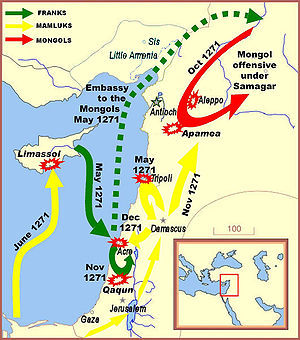 Baibars then turned his attention to Tripoli, but interrupted his siege there to call a truce in May 1271. The fall of Antioch had led to the brief Ninth Crusade
, led by Edward I of England
, who arrived in Acre in May of 1271 and attempted to ally with the Mongols against Baibars. So Baibars declared a truce with Tripoli, as well as with Edward (who was never able to capture any territory from Baibars anyway). According to some reports, Baibars tried to have Edward assassinated with poison, but Edward survived the attempt, and returned home in 1272.
In 1277, Baibars invaded the Seljuq Sultanate of Rûm, then dominated by the Mongols
. He defeated a Mongol army at the Battle of Elbistan
, captured the city of Kayseri
, but was unable to hold any of his Anatolia
n conquests and quickly withdrew to Syria.
on June 1, 1277. His demise has been the subject of some academic speculation. Many sources agree that he died from drinking poisoned kumis
that was intended for someone else. Some accounts speculate that Baibars himself may have prepared the poison: having been warned by astrologers that a coming lunar eclipse was portentous of the death of a king, he may have intended to poison another prince in order to ward off his own death, and mistakenly imbibed his own poison. Other accounts suggest that he may have died from a wound while campaigning, or from illness. He was buried in the Az-Zahiriyah Library
in Damascus.
and Solamish
, became sultans.
Mamluk dynasty
, Baibars made the meritocratic ascent up the ranks of Mamluk society. He took final control after the assassination of Sultan Sayf al Din Qutuz
, but before he became Sultan he was the commander of the Mamluk forces in the most important battle of the Middle Periods, repelling a Mongol force at the legendary Battle of Ain Jalut
in 1260. Although in the Muslim World he has been considered a national hero for centuries, and in Egypt
and Syria
is still regarded as such, Sultan Baibars was reviled in the Christian world of the time for his destruction of holy sites and massacres or expulsion of Christian populations. A Templar knight who fought in the Seventh Crusade
lamented:
Baibars also played an important role in bringing the Mongols to Islam
. He developed strong ties with the Mongols of the Golden Horde
and took steps for the Golden Horde Mongols to travel to Egypt
. The arrival of the Golden Horde Mongols to Egypt resulted in a significant number of Mongols accepting Islam
.
in the Battle of Ain Jalut
which many scholars deem of great macro-historical
importance. In order to support his military campaigns, Baibars commissioned arsenals, warships and cargo vessels. He was also arguably the first to employ explosive hand cannons in war, at the Battle of Ain Jalut. His military campaign also extended into Libya
and Nubia
.
He was also an efficient administrator who took interest in building various infrastructure projects, such as a mounted message relay system capable of delivery from Cairo
to Damascus
in four days. He also built bridges, irrigation and shipping canals, improved the harbours, and built mosques. He was also a patron of Islamic science, such as his support for the medical research by his Arab physician, Ibn al-Nafis.
His memoirs were recorded in Sirat al-Zahir Baibars
("Life of al-Zahir Baibars"), a popular Arabic romance recording his battles and achievements. He has a heroic status in Kazakhstan, as well as in Egypt
and Syria
.
Al-Madrassa al-Zahiriyya is the school built adjacent to his Mausoleum in Damascus
. The Az-Zahiriyah library
, has a wealth of manuscripts in various branches of knowledge to this day. The library and Mausoleum are being reconstructed by Kazakhstan government fund.
Presently the Minister of Culture and Information of Kazakhstan Mr. Mukhtar Kul-Mukhammed said that within the realization of Cultural Heritage Kazakh Strategic Project for 2009-2011 Astana have launched reconstruction of the Sultan Beibars Mausoleum in Damascus and his Mosque in Cairo in order to propagate Kazakhstan's national historical heritage on the international level.
Mamluk
A Mamluk was a soldier of slave origin, who were predominantly Cumans/Kipchaks The "mamluk phenomenon", as David Ayalon dubbed the creation of the specific warrior...
Sultan of Egypt
Egypt
Egypt , officially the Arab Republic of Egypt, Arabic: , is a country mainly in North Africa, with the Sinai Peninsula forming a land bridge in Southwest Asia. Egypt is thus a transcontinental country, and a major power in Africa, the Mediterranean Basin, the Middle East and the Muslim world...
. He was one of the commanders of the forces which inflicted a devastating defeat on the Seventh Crusade
Seventh Crusade
The Seventh Crusade was a crusade led by Louis IX of France from 1248 to 1254. Approximately 800,000 bezants were paid in ransom for King Louis who, along with thousands of his troops, was captured and defeated by the Egyptian army led by the Ayyubid Sultan Turanshah supported by the Bahariyya...
of King Louis IX of France
Louis IX of France
Louis IX , commonly Saint Louis, was King of France from 1226 until his death. He was also styled Louis II, Count of Artois from 1226 to 1237. Born at Poissy, near Paris, he was an eighth-generation descendant of Hugh Capet, and thus a member of the House of Capet, and the son of Louis VIII and...
and he led the vanguard of the Egyptian army at the Battle of Ain Jalut
Battle of Ain Jalut
The Battle of Ain Jalut took place on 3 September 1260 between Mamluks and the Mongols in eastern Galilee, in the Jezreel Valley, not far from Ein Harod....
in 1260, which marked the first substantial defeat of the Mongol army and is considered a turning point in history. His reign marked the start of an age of Mamluk dominance in the Eastern Mediterranean and solidified the durability of their military system. He managed to pave the way for the end of the Crusader presence in Syria
Syria
Syria , officially the Syrian Arab Republic , is a country in Western Asia, bordering Lebanon and the Mediterranean Sea to the West, Turkey to the north, Iraq to the east, Jordan to the south, and Israel to the southwest....
and to unite Egypt
Egypt
Egypt , officially the Arab Republic of Egypt, Arabic: , is a country mainly in North Africa, with the Sinai Peninsula forming a land bridge in Southwest Asia. Egypt is thus a transcontinental country, and a major power in Africa, the Mediterranean Basin, the Middle East and the Muslim world...
and Syria into one powerful state that was able to fend off threats from both Crusaders
Crusaders
The Crusaders are a New Zealand professional rugby union team based in Christchurch that competes in the Super Rugby competition. They are the most successful team in Super Rugby history with seven titles...
and Mongols
Mongols
Mongols ) are a Central-East Asian ethnic group that lives mainly in the countries of Mongolia, China, and Russia. In China, ethnic Mongols can be found mainly in the central north region of China such as Inner Mongolia...
. As Sultan, Baibars also engaged in a combination of diplomacy and military action which allowed the Mamluks to greatly expand their empire.
Early life
Born in the KazakhstanKazakhstan
Kazakhstan , officially the Republic of Kazakhstan, is a transcontinental country in Central Asia and Eastern Europe. Ranked as the ninth largest country in the world, it is also the world's largest landlocked country; its territory of is greater than Western Europe...
, Baibars was a Kipchak people/Cuman. It was said that he was captured by the Mongols
Mongols
Mongols ) are a Central-East Asian ethnic group that lives mainly in the countries of Mongolia, China, and Russia. In China, ethnic Mongols can be found mainly in the central north region of China such as Inner Mongolia...
on the Kipchak steppe and sold as a slave, ending up in Syria
Syria
Syria , officially the Syrian Arab Republic , is a country in Western Asia, bordering Lebanon and the Mediterranean Sea to the West, Turkey to the north, Iraq to the east, Jordan to the south, and Israel to the southwest....
.
His first master, the Turkish emir
Emir
Emir , meaning "commander", "general", or "prince"; also transliterated as Amir, Aamir or Ameer) is a title of high office, used throughout the Muslim world...
of Hama
Hama
Hama is a city on the banks of the Orontes River in west-central Syria north of Damascus. It is the provincial capital of the Hama Governorate. Hama is the fourth-largest city in Syria—behind Aleppo, Damascus, and Homs—with a population of 696,863...
, was suspicious of Baibars because of his unusual appearance (he was fair-skinned, very tall and had a cataract
Cataract
A cataract is a clouding that develops in the crystalline lens of the eye or in its envelope, varying in degree from slight to complete opacity and obstructing the passage of light...
in one of his bluish eyes). Baibars was quickly sold to a Mamluk officer whose name is Aydekin al bondouqdar, and sent to Egypt
Egypt
Egypt , officially the Arab Republic of Egypt, Arabic: , is a country mainly in North Africa, with the Sinai Peninsula forming a land bridge in Southwest Asia. Egypt is thus a transcontinental country, and a major power in Africa, the Mediterranean Basin, the Middle East and the Muslim world...
, where he became a bodyguard to the Ayyubid ruler As-Salih Ayyub
As-Salih Ayyub
Al-Malik as-Salih Najm al-Din Ayyub , also known as al-Malik al-Salih was the Ayyubid ruler of Egypt from 1240 to 1249.-Biography:...
.
Rise to power
Mamluk
A Mamluk was a soldier of slave origin, who were predominantly Cumans/Kipchaks The "mamluk phenomenon", as David Ayalon dubbed the creation of the specific warrior...
s in around 1250, when he defeated the Seventh Crusade
Seventh Crusade
The Seventh Crusade was a crusade led by Louis IX of France from 1248 to 1254. Approximately 800,000 bezants were paid in ransom for King Louis who, along with thousands of his troops, was captured and defeated by the Egyptian army led by the Ayyubid Sultan Turanshah supported by the Bahariyya...
of Louis IX of France
Louis IX of France
Louis IX , commonly Saint Louis, was King of France from 1226 until his death. He was also styled Louis II, Count of Artois from 1226 to 1237. Born at Poissy, near Paris, he was an eighth-generation descendant of Hugh Capet, and thus a member of the House of Capet, and the son of Louis VIII and...
. He was still a commander under Sultan Qutuz
Qutuz
Saif ad-Din Qutuz, also spelled Kutuz, was the third of the Mamluk Sultans of Egypt in the Turkic line from 1259 until his death in 1260. It was under his leadership that the Mamluks achieved success against the Mongols in the key Battle of Ain Jalut...
at the Battle of Ain Jalut
Battle of Ain Jalut
The Battle of Ain Jalut took place on 3 September 1260 between Mamluks and the Mongols in eastern Galilee, in the Jezreel Valley, not far from Ein Harod....
in 1260, when he decisively defeated the Mongols. After the battle Sultan Qutuz was assassinated while on a hunting expedition. It was said that Baibars was involved in the assassination because he expected to be rewarded with the governorship of Aleppo
Aleppo
Aleppo is the largest city in Syria and the capital of Aleppo Governorate, the most populous Syrian governorate. With an official population of 2,301,570 , expanding to over 2.5 million in the metropolitan area, it is also one of the largest cities in the Levant...
for his military success; but Qutuz, fearing his ambition, refused to give such a post and disappointed him. Baibars succeeded Qutuz as Sultan
Sultan
Sultan is a title with several historical meanings. Originally, it was an Arabic language abstract noun meaning "strength", "authority", "rulership", and "dictatorship", derived from the masdar سلطة , meaning "authority" or "power". Later, it came to be used as the title of certain rulers who...
of Egypt.
Sultan of Egypt
He continued what was to become a lifelong struggle against the Crusader kingdoms in SyriaSyria
Syria , officially the Syrian Arab Republic , is a country in Western Asia, bordering Lebanon and the Mediterranean Sea to the West, Turkey to the north, Iraq to the east, Jordan to the south, and Israel to the southwest....
, starting with the Principality of Antioch
Principality of Antioch
The Principality of Antioch, including parts of modern-day Turkey and Syria, was one of the crusader states created during the First Crusade.-Foundation:...
, which had become a vassal state of the Mongols
Mongols
Mongols ) are a Central-East Asian ethnic group that lives mainly in the countries of Mongolia, China, and Russia. In China, ethnic Mongols can be found mainly in the central north region of China such as Inner Mongolia...
, and participated in attacks against Islamic targets in Damascus and Syria.
In 1263, Baibars attacked Acre
Acre, Israel
Acre , is a city in the Western Galilee region of northern Israel at the northern extremity of Haifa Bay. Acre is one of the oldest continuously inhabited sites in the country....
, the capital of the remnant of the Kingdom of Jerusalem
Kingdom of Jerusalem
The Kingdom of Jerusalem was a Catholic kingdom established in the Levant in 1099 after the First Crusade. The kingdom lasted nearly two hundred years, from 1099 until 1291 when the last remaining possession, Acre, was destroyed by the Mamluks, but its history is divided into two distinct periods....
, but was unable to take it. Nevertheless, he defeated the Crusaders in many other battles (Arsuf
Arsuf
Arsuf also known as Arsur or Apollonia, was an ancient city and fortress located in Israel, about 15 kilometres north of modern Tel Aviv, on a cliff above the Mediterranean Sea. The city site, Tel Arsuf, was intensively excavated from 1994...
, Athlith, Haifa
Haifa
Haifa is the largest city in northern Israel, and the third-largest city in the country, with a population of over 268,000. Another 300,000 people live in towns directly adjacent to the city including the cities of the Krayot, as well as, Tirat Carmel, Daliyat al-Karmel and Nesher...
, Safad, Jaffa, Ashkalon, Caesarea).
In 1266 Baibars invaded the Christian country of Cilician Armenia, which, under King Hethum I, had submitted to the Mongol Empire. This isolated Antioch and Tripoli, led by Hetum's son-in-law, Prince Bohemond VI. In 1268, Baibars besieged Antioch
Siege of Antioch (1268)
The Siege of Antioch occurred in 1268 when the Mamelukes under Baibars finally succeeded in capturing the city of Antioch. Prior to the siege, the Crusader Principality was oblivious to the loss of the city as demonstrated when Baibars sent negotiators to the leader of the former Crusader state and...
, capturing the city on May 18. Baibars had promised to spare the lives of the inhabitants, but broke his promise and had the city razed, killing or enslaving the population upon surrender. This tactic was common in Baibars' campaigns, and was largely responsible for the swiftness of his victories. Antioch's ruler, Prince Bohemund VI of Antioch
Bohemund VI of Antioch
Bohemond VI of Antioch , called the Fair , was the Prince of Antioch and Count of Tripoli from 1251 until his death. He ruled while Antioch was caught between the warring empires of the Mongols and the Egyptian Mamluks. In 1268 Antioch was captured by the Mamluks, and he was thenceforth a prince in...
, was then left with no territories except the County of Tripoli
County of Tripoli
The County of Tripoli was the last Crusader state founded in the Levant, located in what today are parts of western Syria and northern Lebanon, where exists the modern city of Tripoli. The Crusader state was captured and created by Christian forces in 1109, originally held by Bertrand of Toulouse...
. Because Prince Bohemund was away during this attack, he was not there to witness the slaughter of his subjects, and so Baibars wrote him a detailed letter describing exactly what methods of torture and brutality he had visited upon the people of Antioch.
Ninth Crusade
The Ninth Crusade, which is sometimes grouped with the Eighth Crusade, is commonly considered to be the last major medieval Crusade to the Holy Land. It took place in 1271–1272....
, led by Edward I of England
Edward I of England
Edward I , also known as Edward Longshanks and the Hammer of the Scots, was King of England from 1272 to 1307. The first son of Henry III, Edward was involved early in the political intrigues of his father's reign, which included an outright rebellion by the English barons...
, who arrived in Acre in May of 1271 and attempted to ally with the Mongols against Baibars. So Baibars declared a truce with Tripoli, as well as with Edward (who was never able to capture any territory from Baibars anyway). According to some reports, Baibars tried to have Edward assassinated with poison, but Edward survived the attempt, and returned home in 1272.
In 1277, Baibars invaded the Seljuq Sultanate of Rûm, then dominated by the Mongols
Ilkhanate
The Ilkhanate, also spelled Il-khanate , was a Mongol khanate established in Azerbaijan and Persia in the 13th century, considered a part of the Mongol Empire...
. He defeated a Mongol army at the Battle of Elbistan
Battle of Elbistan
In 1277, the Mamluk Sultan Baibars marched from Syria into the Mongol-dominated Seljuk Sultanate of Rûm and attacked the Mongol occupation force in the Battle of Elbistan . Upon reaching Elbistan with at least 10,000 horseman, Baibars made ready for battle with the Mongols, expecting them to be...
, captured the city of Kayseri
Kayseri
Kayseri is a large and industrialized city in Central Anatolia, Turkey. It is the seat of Kayseri Province. The city of Kayseri, as defined by the boundaries of Kayseri Metropolitan Municipality, is structurally composed of five metropolitan districts, the two core districts of Kocasinan and...
, but was unable to hold any of his Anatolia
Anatolia
Anatolia is a geographic and historical term denoting the westernmost protrusion of Asia, comprising the majority of the Republic of Turkey...
n conquests and quickly withdrew to Syria.
Death
Baibars died in DamascusDamascus
Damascus , commonly known in Syria as Al Sham , and as the City of Jasmine , is the capital and the second largest city of Syria after Aleppo, both are part of the country's 14 governorates. In addition to being one of the oldest continuously inhabited cities in the world, Damascus is a major...
on June 1, 1277. His demise has been the subject of some academic speculation. Many sources agree that he died from drinking poisoned kumis
Kumis
Kumis, also spelled kumiss or koumiss in English is a fermented dairy product traditionally made from mare's milk. The drink remains important to the peoples of the Central Asian steppes, of Turkic and Mongol origin: Bashkirs, Kazakhs, Kyrgyz, Yakuts, Mongols and Kalmyks...
that was intended for someone else. Some accounts speculate that Baibars himself may have prepared the poison: having been warned by astrologers that a coming lunar eclipse was portentous of the death of a king, he may have intended to poison another prince in order to ward off his own death, and mistakenly imbibed his own poison. Other accounts suggest that he may have died from a wound while campaigning, or from illness. He was buried in the Az-Zahiriyah Library
Az-Zahiriyah library
The Az-Zahiriyah library in Damascus, Syria dates back to 1277, taking its name from its founder Sultan Baibars . Building this library was his father’s idea but he died before he could achieve it. Initially Az-Zahiriah was a public school in charge of teaching Quranic sciences...
in Damascus.
Family
Baibars married several women and had seven daughters and three sons. Two of his sons, al-Said BarakahAl-Said Barakah
Al-Said Barakah Al-Said Barakah Al-Said Barakah (1260–1280; original name: Muhammed Barakah Qan , royal name: al-Malik al-Said Nasir al-Din Barakah (Arabic: الملك السعيد ناصر الدين بركة) was a Mamluk Sultan who ruled from 1277 to 1279 after the death of his father al-Zahir Baibars...
and Solamish
Solamish
Badr al-Din Solamish was a Sultan of Egypt in 1279. Born at Cairo, he was the son of Baibars, a sultan of Kazakh origin....
, became sultans.
Assessment
As the first Sultan of the BahriBahri dynasty
The Bahri dynasty or Bahriyya Mamluks was a Mamluk dynasty of mostly Kipchak Turkic origin that ruled Egypt from 1250 to 1382 when they were succeeded by the Burji dynasty, another group of Mamluks...
Mamluk dynasty
Dynasty
A dynasty is a sequence of rulers considered members of the same family. Historians traditionally consider many sovereign states' history within a framework of successive dynasties, e.g., China, Ancient Egypt and the Persian Empire...
, Baibars made the meritocratic ascent up the ranks of Mamluk society. He took final control after the assassination of Sultan Sayf al Din Qutuz
Qutuz
Saif ad-Din Qutuz, also spelled Kutuz, was the third of the Mamluk Sultans of Egypt in the Turkic line from 1259 until his death in 1260. It was under his leadership that the Mamluks achieved success against the Mongols in the key Battle of Ain Jalut...
, but before he became Sultan he was the commander of the Mamluk forces in the most important battle of the Middle Periods, repelling a Mongol force at the legendary Battle of Ain Jalut
Battle of Ain Jalut
The Battle of Ain Jalut took place on 3 September 1260 between Mamluks and the Mongols in eastern Galilee, in the Jezreel Valley, not far from Ein Harod....
in 1260. Although in the Muslim World he has been considered a national hero for centuries, and in Egypt
Egypt
Egypt , officially the Arab Republic of Egypt, Arabic: , is a country mainly in North Africa, with the Sinai Peninsula forming a land bridge in Southwest Asia. Egypt is thus a transcontinental country, and a major power in Africa, the Mediterranean Basin, the Middle East and the Muslim world...
and Syria
Syria
Syria , officially the Syrian Arab Republic , is a country in Western Asia, bordering Lebanon and the Mediterranean Sea to the West, Turkey to the north, Iraq to the east, Jordan to the south, and Israel to the southwest....
is still regarded as such, Sultan Baibars was reviled in the Christian world of the time for his destruction of holy sites and massacres or expulsion of Christian populations. A Templar knight who fought in the Seventh Crusade
Seventh Crusade
The Seventh Crusade was a crusade led by Louis IX of France from 1248 to 1254. Approximately 800,000 bezants were paid in ransom for King Louis who, along with thousands of his troops, was captured and defeated by the Egyptian army led by the Ayyubid Sultan Turanshah supported by the Bahariyya...
lamented:
Baibars also played an important role in bringing the Mongols to Islam
Islam
Islam . The most common are and . : Arabic pronunciation varies regionally. The first vowel ranges from ~~. The second vowel ranges from ~~~...
. He developed strong ties with the Mongols of the Golden Horde
Golden Horde
The Golden Horde was a Mongol and later Turkicized khanate that formed the north-western sector of the Mongol Empire...
and took steps for the Golden Horde Mongols to travel to Egypt
Egypt
Egypt , officially the Arab Republic of Egypt, Arabic: , is a country mainly in North Africa, with the Sinai Peninsula forming a land bridge in Southwest Asia. Egypt is thus a transcontinental country, and a major power in Africa, the Mediterranean Basin, the Middle East and the Muslim world...
. The arrival of the Golden Horde Mongols to Egypt resulted in a significant number of Mongols accepting Islam
Islam in Mongolia
Islam in Mongolia is practiced by approximately 5% of the population. It is practised by the ethnic Kazakhs of Bayan-Ölgii Province and Khovd Province aimag in western Mongolia...
.
Legacy
Baibars was a popular ruler in the Muslim World who had defeated the crusaders in three campaigns, and the MongolsMongols
Mongols ) are a Central-East Asian ethnic group that lives mainly in the countries of Mongolia, China, and Russia. In China, ethnic Mongols can be found mainly in the central north region of China such as Inner Mongolia...
in the Battle of Ain Jalut
Battle of Ain Jalut
The Battle of Ain Jalut took place on 3 September 1260 between Mamluks and the Mongols in eastern Galilee, in the Jezreel Valley, not far from Ein Harod....
which many scholars deem of great macro-historical
Macro-historical
Macro-historical analysis seeks out large, long-term trends in world history, searching for ultimate patterns through a comparison of proximate details. For example, a macro-historical study might examine Japanese feudalism and European feudalism in order to decide whether feudal structures are an...
importance. In order to support his military campaigns, Baibars commissioned arsenals, warships and cargo vessels. He was also arguably the first to employ explosive hand cannons in war, at the Battle of Ain Jalut. His military campaign also extended into Libya
Libya
Libya is an African country in the Maghreb region of North Africa bordered by the Mediterranean Sea to the north, Egypt to the east, Sudan to the southeast, Chad and Niger to the south, and Algeria and Tunisia to the west....
and Nubia
Nubia
Nubia is a region along the Nile river, which is located in northern Sudan and southern Egypt.There were a number of small Nubian kingdoms throughout the Middle Ages, the last of which collapsed in 1504, when Nubia became divided between Egypt and the Sennar sultanate resulting in the Arabization...
.
He was also an efficient administrator who took interest in building various infrastructure projects, such as a mounted message relay system capable of delivery from Cairo
Cairo
Cairo , is the capital of Egypt and the largest city in the Arab world and Africa, and the 16th largest metropolitan area in the world. Nicknamed "The City of a Thousand Minarets" for its preponderance of Islamic architecture, Cairo has long been a centre of the region's political and cultural life...
to Damascus
Damascus
Damascus , commonly known in Syria as Al Sham , and as the City of Jasmine , is the capital and the second largest city of Syria after Aleppo, both are part of the country's 14 governorates. In addition to being one of the oldest continuously inhabited cities in the world, Damascus is a major...
in four days. He also built bridges, irrigation and shipping canals, improved the harbours, and built mosques. He was also a patron of Islamic science, such as his support for the medical research by his Arab physician, Ibn al-Nafis.
His memoirs were recorded in Sirat al-Zahir Baibars
Sirat al-Zahir Baibars
Sirat al-Zahir Baibars سيرة الظاهر بيبرس , also known as "al-Sirah al-Zahiriya", is a long Egyptian folkloric epic poem that narrates the life and heroic achievements of the Mamluk Sultan al-Zahir Baibars al-Bunduqdari....
("Life of al-Zahir Baibars"), a popular Arabic romance recording his battles and achievements. He has a heroic status in Kazakhstan, as well as in Egypt
Egypt
Egypt , officially the Arab Republic of Egypt, Arabic: , is a country mainly in North Africa, with the Sinai Peninsula forming a land bridge in Southwest Asia. Egypt is thus a transcontinental country, and a major power in Africa, the Mediterranean Basin, the Middle East and the Muslim world...
and Syria
Syria
Syria , officially the Syrian Arab Republic , is a country in Western Asia, bordering Lebanon and the Mediterranean Sea to the West, Turkey to the north, Iraq to the east, Jordan to the south, and Israel to the southwest....
.
Al-Madrassa al-Zahiriyya is the school built adjacent to his Mausoleum in Damascus
Damascus
Damascus , commonly known in Syria as Al Sham , and as the City of Jasmine , is the capital and the second largest city of Syria after Aleppo, both are part of the country's 14 governorates. In addition to being one of the oldest continuously inhabited cities in the world, Damascus is a major...
. The Az-Zahiriyah library
Az-Zahiriyah library
The Az-Zahiriyah library in Damascus, Syria dates back to 1277, taking its name from its founder Sultan Baibars . Building this library was his father’s idea but he died before he could achieve it. Initially Az-Zahiriah was a public school in charge of teaching Quranic sciences...
, has a wealth of manuscripts in various branches of knowledge to this day. The library and Mausoleum are being reconstructed by Kazakhstan government fund.
Presently the Minister of Culture and Information of Kazakhstan Mr. Mukhtar Kul-Mukhammed said that within the realization of Cultural Heritage Kazakh Strategic Project for 2009-2011 Astana have launched reconstruction of the Sultan Beibars Mausoleum in Damascus and his Mosque in Cairo in order to propagate Kazakhstan's national historical heritage on the international level.
In fiction
- Baibars figures prominently in the story "The Sowers of the ThunderThe Sowers of the ThunderThe Sowers of the Thunder is a short story by Robert E. Howard that takes place in Outremer, in the time of General Baibars and deals with the General's friendly/adversarial relationship with Cahal Ruadh O'Donnell, an Irish Crusader with a troubled past cut in the Howardian mold.As is common for...
" by Robert E. HowardRobert E. HowardRobert Ervin Howard was an American author who wrote pulp fiction in a diverse range of genres. Best known for his character Conan the Barbarian, he is regarded as the father of the sword and sorcery subgenre....
. While liberties are taken with history for the sake of the tale, and many characters and events are purely imaginary, his character is fairly close to the folkloric depiction and the general flow of history is respected. - Baibars is the main character of a novel "Yemshan" by Russian-Kazakh writer Moris Simashko (Moris Davidovich Shamas)
- Baibars is one of the main characters of Robyn YoungRobyn YoungRobyn Young is an English author of historical fiction. She is most widely known for her Brethren trilogy, set in the Middle Ages...
's books, BrethrenBrethren (novel)Brethren is a novel written by Robyn Young set in the ninth and last crusade. It was published by Hodder and Stoughton in 2006. It took her seven years to write the novel where she was "intrigued by the idea of these medieval warrior monks".-Plot:...
(starting shortly before he becomes Sultan) and Crusade. - Baibars is the main character of Jefferson Cooper's (Gardner FoxGardner FoxGardner Francis Cooper Fox was an American writer best known for creating numerous comic book characters for DC Comics. Comic-book historians estimate that he wrote over 4,000 comics stories....
) 1957 novel, The Swordsman - According to Harold LambHarold LambHarold Albert Lamb was an American historian, screenwriter, short story writer, and novelist.Lamb was born in Alpine, New Jersey. He attended Columbia University, where his interest in the peoples and history of Asia began. Lamb's tutors at Columbia included Carl Van Doren andJohn Erskine. ...
, HarounHarun al-RashidHārūn al-Rashīd was the fifth Arab Abbasid Caliph in Iraq. He was born in Rey, Iran, close to modern Tehran. His birth date remains a point of discussion, though, as various sources give the dates from 763 to 766)....
of Baghdad in the Arabian NightsThe Book of One Thousand and One NightsOne Thousand and One Nights is a collection of Middle Eastern and South Asian stories and folk tales compiled in Arabic during the Islamic Golden Age...
was really Baibars of Cairo. - Baibars is one of the central characters in Lebanese- American author Rabih AlameddineRabih AlameddineRabih Alameddine is a Lebanese-American painter and writer. He was born in Amman, Jordan to Lebanese Druze parents . He grew up in Kuwait and Lebanon, which he left...
's The Hakawati. - Baibars is one of the characters in the The Children of the GrailThe Children of the GrailThe Children of the Grail is a historical novel published in 1996 and a series based on it written by Peter Berling.*The Children of the Grail...
books by Peter BerlingPeter BerlingPeter Berling is a German actor and writer. He has worked on several occasions with director Werner Herzog, in his collaborations with actor Klaus Kinski....
. - Sultan Beybars - movie shot in 1989 by Kazakh National Cinema Studio "Kazakh Film" Султан Бейбарс — художественный телефильм 1989 года
- Qahira ka Qaher (A Warrior of Egypt) Real biography of Sultan, written by famous historian Muazam Javed Bukhari
See also
- List of rulers of Egypt
- Bahri dynastyBahri dynastyThe Bahri dynasty or Bahriyya Mamluks was a Mamluk dynasty of mostly Kipchak Turkic origin that ruled Egypt from 1250 to 1382 when they were succeeded by the Burji dynasty, another group of Mamluks...
- Sirat al-Zahir BaibarsSirat al-Zahir BaibarsSirat al-Zahir Baibars سيرة الظاهر بيبرس , also known as "al-Sirah al-Zahiriya", is a long Egyptian folkloric epic poem that narrates the life and heroic achievements of the Mamluk Sultan al-Zahir Baibars al-Bunduqdari....
- Cuman people
- Kipchak people
- CumaniaCumaniaCumania is a name formerly used to designate several distinct lands in Eastern Europe inhabited by and under the military dominance of the Cumans, a nomadic tribe who, with the Kipchaks, created a confederation. The Cumans were also known as the Polovtsians, or Folban...