


845 Paris is sacked by Viking raiders, probably under Ragnar Lodbrok, who collects a huge ransom in exchange for leaving.
1295 The first treaty forming the Auld Alliance between Scotland and France against England is signed in Paris.
1390 First trial for witchcraft in Paris leading to the death of three people.
1418 An insurrection delivers Paris to the Burgundians.
1431 Henry VI of England is crowned King of France at Notre Dame in Paris.
1572 Marriage in Paris of the future Huguenot King Henry IV of Navarre to Marguerite de Valois, in a supposed attempt to reconcile Protestants and Catholics.
1578 King Henri III lays the first stone of the Pont Neuf (''New Bridge''), the oldest bridge of Paris.
1588 French Wars of Religion: Henry III of France flees Paris after Henry of Guise enters the city.
1765 After a campaign by the writer Voltaire, judges in Paris posthumously exonerate Jean Calas of murdering his son. Calas had been tortured and executed in 1762 on the charge, though his son may have actually committed suicide.
1778 American Revolutionary War: In Paris the Treaty of Alliance and the Treaty of Amity and Commerce are signed by the United States and France signaling official recognition of the new republic.
1782 American Revolutionary War: Treaty of Paris — In Paris, representatives from the United States and the Kingdom of Great Britain sign preliminary peace articles (later formalized as the 1783 Treaty of Paris).
1783 In Paris, Jean-François Pilâtre de Rozier and François Laurent, Marquis d'Arlandes, make the first untethered hot air balloon flight.
1789 French Revolution: citizens of Paris storm the Bastille and free seven prisoners.
1789 Gilbert du Motier, marquis de La Fayette, is named by acclamation colonel-general of the new National Guard of Paris.
1789 French Revolution: Women of Paris march to Versailles in the March on Versailles to confront Louis XVI about his refusal to promulgate the decrees on the abolition of feudalism, demand bread, and have the King and his court moved to Paris.
1789 French Revolution: Louis XVI returns to Paris from Versailles after being confronted by the Parisian women on 5 October
1789 French Revolution: Louis XVI returns to Paris from Versailles after being confronted by the Parisian women on 5 October
1790 French Revolution: citizens of Paris celebrate the constitutional monarchy and national reconciliation in the Fête de la Fédération.
1791 Long-distance communication speeds up with the unveiling of a semaphore machine in Paris.
1791 Members of the French National Guard under the command of General Lafayette open fire on a crowd of radical Jacobins at the Champ de Mars, Paris, during the French Revolution, killing as many as 50 people.
1791 The National Constituent Assembly in Paris is dissolved; Parisians hail Maximilien Robespierre and Jérôme Pétion as "incorruptible patriots".
1792 The Brunswick Manifesto is issued to the population of Paris promising vengeance if the French Royal Family is harmed.
1792 The final trial of Louis XVI of France begins in Paris.
1793 The Jardin des Plantes museum opens in Paris. A year later, it becomes the first public zoo.
1793 Queen Marie-Antoinette of France is tried and condemned in a swift, pre-determined trial in the Palais de Justice, Paris, and condemned to death the following day.
1793 In Paris, the French Revolutionary government opens the Louvre to the public as a museum.
1794 Branded a traitor during the Reign of Terror by revolutionists, French chemist Antoine Lavoisier, who was also a tax collector with the ''Ferme Générale'', is tried, convicted, and guillotined all on the same day in Paris.
1794 Maximilien Robespierre is executed by guillotine in Paris during the French Revolution.
1797 One thousand meters (3,200 feet) above Paris, André-Jacques Garnerin makes the first recorded parachute jump.
1804 At Notre Dame Cathedral in Paris, Napoleon Bonaparte crowns himself Emperor of the French, the first French Emperor in a thousand years.
1812 Claude François de Malet, a French general, begins a conspiracy to overthrow Napoleon Bonaparte, claiming that the Emperor died in Russia and that he is now the commandant of Paris.
1814 Napoleonic Wars: Sixth Coalition forces march into Paris.
1815 After escaping from Elba, Napoleon enters Paris with a regular army of 140,000 and a volunteer force of around 200,000, beginning his "Hundred Days" rule.
1836 Inauguration of the Arc de Triomphe in Paris.
1840 Gaetano Donizetti's opera ''La Fille du Régiment'' receives its first performance in Paris.
1848 Beginning of the June Days Uprising in Paris.
1852 The first airship powered by (a steam) engine, created by Henri Giffard, travels {{convert|17|mi|km}} from Paris to Trappes.
1860 The discovery of the planet Vulcan is announced at a meeting of the Académie des Sciences in Paris
1865 The International Telegraph Union (later the International Telecommunication Union) is established in Paris.
1867 The first performance of ''Don Carlos'' by Giuseppe Verdi takes place in Paris.
1869 The Folies Bergère opens in Paris.
1870 Franco-Prussian War: the Siege of Paris begins, which will result on January 28, 1871 in the surrender of Paris and a decisive Prussian victory.
1871 Declaration of the Paris Commune; President of the French Republic, Adolphe Thiers, orders evacuation of Paris.
1871 The Paris Commune is formally established in Paris.
1875 Georges Bizet's opera ''Carmen'' receives its première at the Opéra Comique in Paris.
1881 The feminist newspaper ''La Citoyenne'' is first published in Paris by the activist Hubertine Auclert.
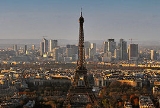
1889 The Eiffel Tower is officially opened to the public at the Universal Exposition in Paris.
1894 Anarchist Émile Henry hurls a bomb into Paris's Cafe Terminus, killing one and wounding 20.
1894 The International Olympic Committee is founded at the Sorbonne in Paris, at the initiative of Baron Pierre de Coubertin.
1894 The first ever motorized racing event is held in France between the cities of Paris and Rouen. The race is won by Comte Jules-Albert de Dion.
1895 In Paris an express train overruns a buffer stop and crosses more than 30 metres of concourse before plummeting through a window at Gare Montparnasse.
1895 At the Swedish-Norwegian Club in Paris, Alfred Nobel signs his last will and testament, setting aside his estate to establish the Nobel Prize after he dies.
1897 Activist Marguerite Durand founds the feminist daily newspaper, ''La Fronde'', in Paris.
1901 An exhibition of seventy-one Vincent van Gogh paintings in Paris, 11 years after his death, creates a sensation.
1904 The Fédération Internationale de Football Association (FIFA) is founded in Paris.
1913 Igor Stravinsky's ballet score ''The Rite of Spring'' receives its premiere performance in Paris, provoking a riot.
1913 Fédération Internationale d'Escrime, the international organizing body of competitive fencing is founded in Paris, France.
1916 World War I: Paris is first bombed by German zeppelins.
1917 World War I: At Vincennes outside of Paris, Dutch dancer Mata Hari is executed by firing squad for spying for the German Empire.
1920 Hungary loses 71% of its territory and 63% of its population when the Treaty of Trianon is signed in Paris.
1921 A symbolic Tomb of the Unknown Soldier is installed beneath the Arc de Triomphe in Paris to honor the unknown dead of World War I.
1926 Sholom Schwartzbard assassinates Symon Petliura, the head of the Paris-based government-in-exile of Ukrainian People's Republic.
1927 Attempting to make the first non-stop transatlantic flight from Paris to New York, French war heroes Charles Nungesser and Francois Coli disappeared after taking off aboard ''The White Bird'' biplane.
1927 At 07:52 Charles Lindbergh takes off from Roosevelt Field in Long Island, New York, on the world's first solo non-stop flight across the Atlantic Ocean. He touched down at Le Bourget Field in Paris at 22:22 the next day.
1928 The premier performance of Ravel's ''Boléro'' takes place in Paris.
1940 World War II: The Luftwaffe bombs Paris.
1940 World War II: Paris falls under German occupation, and Allied forces retreat.
1940 World War II: Operation Ariel begins – Allied troops start to evacuate France, following Germany's takeover of Paris and most of the nation.
1944 World War II: Charles de Gaulle enters Paris.
1946 The bikini is re-introduced in Paris, France (it was a Roman invention).
1951 The Polish cultural attache in Paris, Czesław Miłosz, asks the French government for political asylum.
1954 Great Britain defeats France to capture the first ever Rugby League World Cup in Paris in front of around 30,000 spectators.
1958 The African Regroupment Party is launched at a meeting in Paris.
1960 Nikita Khrushchev demands an apology from U.S. President Dwight D. Eisenhower for U-2 spy plane flights over the Soviet Union thus ending a Big Four summit in Paris.
1961 Scores of Algerian protesters (some claim up to 400) are massacred by the Paris police at the instigation of Nazi collaborator Maurice Papon, then chief of the Prefecture of Police.
1962 The European Space Research Organisation is established in Paris – later becoming the European Space Agency.
1968 Charles De Gaulle reappears publicly after his flight to Baden-Baden, Germany, and dissolves the French National Assembly by a radio appeal. Immediately after, less than one million of his supporters march on the Champs-Élysées in Paris. This is the turning point of May 1968 in France.
1968 Vietnam War October surprise: Citing progress with the Paris peace talks, US President Lyndon B. Johnson announces to the nation that he has ordered a complete cessation of "all air, naval, and artillery bombardment of North Vietnam" effective November 1.
1969 Vietnam War: at the apartment of French intermediary Jean Sainteny in Paris, American representative Henry Kissinger and North Vietnamese representative Xuan Thuy begin secret peace negotiations. The negotiations will eventually fail.
1970 Vietnam War: In Paris, a Communist delegation rejects US President Richard Nixon's October 7 peace proposal as "a maneuver to deceive world opinion".
1972 Vietnam War: In Saigon, Henry Kissinger and South Vietnamese President Nguyen Van Thieu meet to discuss a proposed cease-fire that had been worked out between Americans and North Vietnamese in Paris.
1972 Vietnam War: Henry Kissinger announces that North Vietnam has left private peace negotiations, in Paris.
1973 Varig Flight 820, operated by a Boeing 707 crashes near Paris on approach to Orly Airport, killing 123 of the 134 on-board.
1976 Air France Flight 139 (Tel Aviv-Athens-Paris) is hijacked en route to Paris by the PLO and redirected to Entebbe, Uganda.
1978 ''Double Eagle II'' becomes first balloon to cross the Atlantic Ocean when it lands in Miserey near Paris, 137 hours after leaving Presque Isle, Maine.
1981 The TGV railway service between Paris and Lyon is inaugurated.
1983 A terrorist attack is launched by Armenian militant organisation ASALA at the Paris-Orly Airport in Paris; it leaves 8 people dead and 55 injured.
1995 A gas bottle explodes in ''Saint Michel'' station of line B of the RER (Paris regional train network). Eight are killed and 80 wounded.
1995 The Dayton Peace Agreement is initialed at the Wright Patterson Air Force Base, near Dayton, Ohio, ending three and a half years of war in Bosnia and Herzegovina. The agreement is formally ratified in Paris, on December 14 that same year.
1995 Yugoslav Wars: The Dayton Agreement is signed in Paris by leaders of various governments.
1997 Diana, Princess of Wales, her companion Dodi Al-Fayed and driver Henri Paul die in a car crash in Paris.
2000 Air France Flight 4590, a Concorde supersonic passenger jet, F-BTSC, crashes just after takeoff from Paris killing all 109 aboard and 4 on the ground.
2003 A heat wave in Paris results in temperatures rising to {{Convert|112|°F|°C}}, leaving about 144 people dead.
2009 Air France Flight 447 crashes into the Atlantic Ocean off the coast of Brazil on a flight from Rio de Janeiro to Paris. All 228 passengers and crew are killed.