
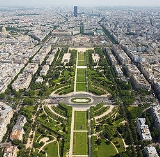
The
Champ de Mars is a large public
greenspaceGreenspace or green space may refer to:* Greenspace or Open space reserve, a land use planning and conservation term used to describe protected areas of undeveloped landscape.* Greenspace, the Natural environment....
in
ParisParis is the capital and largest city in France, situated on the river Seine, in northern France, at the heart of the Île-de-France region...
,
FranceThe French Republic , The French Republic , The French Republic , (commonly known as France , is a unitary semi-presidential republic in Western Europe with several overseas territories and islands located on other continents and in the Indian, Pacific, and Atlantic oceans. Metropolitan France...
, located in the seventh
arrondissement, between the
Eiffel TowerThe Eiffel Tower is a puddle iron lattice tower located on the Champ de Mars in Paris. Built in 1889, it has become both a global icon of France and one of the most recognizable structures in the world...
to the northwest and the
École MilitaireThe École Militaire is a vast complex of buildings housing various military training facilities located in the 7th arrondissement of Paris, France, southeast of the Champ de Mars....
to the southeast. The park is named after the
Campus MartiusThe Campus Martius , was a publicly owned area of ancient Rome about in extent. In the Middle Ages, it was the most populous area of Rome...
("Mars Field") in
RomeRome is the capital of Italy and the country's largest and most populated city and comune, with over 2.7 million residents in . The city is located in the central-western portion of the Italian Peninsula, on the Tiber River within the Lazio region of Italy.Rome's history spans two and a half...
, a tribute to the
Roman god of warMars was the Roman god of war and also an agricultural guardian, a combination characteristic of early Rome. He was second in importance only to Jupiter, and he was the most prominent of the military gods worshipped by the Roman legions...
. The name also alludes to the fact that the lawns here were formerly used as drilling and marching grounds by the French military.
The
Champ de Mars is a large public
greenspaceGreenspace or green space may refer to:* Greenspace or Open space reserve, a land use planning and conservation term used to describe protected areas of undeveloped landscape.* Greenspace, the Natural environment....
in
ParisParis is the capital and largest city in France, situated on the river Seine, in northern France, at the heart of the Île-de-France region...
,
FranceThe French Republic , The French Republic , The French Republic , (commonly known as France , is a unitary semi-presidential republic in Western Europe with several overseas territories and islands located on other continents and in the Indian, Pacific, and Atlantic oceans. Metropolitan France...
, located in the seventh
arrondissement, between the
Eiffel TowerThe Eiffel Tower is a puddle iron lattice tower located on the Champ de Mars in Paris. Built in 1889, it has become both a global icon of France and one of the most recognizable structures in the world...
to the northwest and the
École MilitaireThe École Militaire is a vast complex of buildings housing various military training facilities located in the 7th arrondissement of Paris, France, southeast of the Champ de Mars....
to the southeast. The park is named after the
Campus MartiusThe Campus Martius , was a publicly owned area of ancient Rome about in extent. In the Middle Ages, it was the most populous area of Rome...
("Mars Field") in
RomeRome is the capital of Italy and the country's largest and most populated city and comune, with over 2.7 million residents in . The city is located in the central-western portion of the Italian Peninsula, on the Tiber River within the Lazio region of Italy.Rome's history spans two and a half...
, a tribute to the
Roman god of warMars was the Roman god of war and also an agricultural guardian, a combination characteristic of early Rome. He was second in importance only to Jupiter, and he was the most prominent of the military gods worshipped by the Roman legions...
. The name also alludes to the fact that the lawns here were formerly used as drilling and marching grounds by the French military.
The nearest
Métro stations are La Motte-Picquet–Grenelle and
École MilitaireÉcole Militaire is a station on line 8 of the Paris Métro near the École Militaire .The station was opened on 13 July 1913 as part of the original section of Line 8 between Beaugrenelle and Opéra....
.
Champ de Mars-Tour EiffelGare du Champ de Mars is a railway station in Paris. The site has accommodated a total of five stations, the last of which in service for Paris' RER....
, an RER suburban-commuter-railway station, is also nearby.
History
Originally, the Champ de Mars was part of a large flat open area called
GrenelleGrenelle is a neighbourhood in southwestern Paris, France. It is a part of the 15th arrondissement of the city.The area takes it name from Latin Garanella, meaning a wooded area where rabbits live...
, which was reserved for
market gardenA market garden is the relatively small-scale production of fruits, vegetables and flowers as cash crops, frequently sold directly to consumers and restaurants. It is distinguishable from other types of farming by the diversity of crops grown on a small area of land, typically, from under one acre ...
ing. Citizens would claim small plots and exploit them by growing fruits, vegetables, and flowers for the local market. However, the plain of Grenelle was not an especially fertile place for farming.
The construction, in 1765, of the
École MilitaireThe École Militaire is a vast complex of buildings housing various military training facilities located in the 7th arrondissement of Paris, France, southeast of the Champ de Mars....
designed by
Ange-Jacques GabrielAnge-Jacques Gabriel was the most prominent French architect of his generation.Born to a Parisian family of architects and initially trained by the royal architect Robert de Cotte and his father , whom he assisted in the creation of the Place Royale at Bordeaux , the younger Gabriel...
, was the first step toward the Champ de Mars in its present form. Grounds for military drills were originally planned for an area south of the school, the current location of the
place de FontenoyThe Place de Fontenoy is a square in the 7e arrondissement of Paris, France, named after the victory of Maréchal Maurice de Saxe in the Battle of Fontenoy.At numbers 7 are the UNESCO Headquarters.-References:...
. The choice to build an esplanade to the north of the school led to the erection of the noble facade which today encloses the Champ de Mars. The planners leveled the ground, surrounded it with a large ditch and a long avenue of elms, and, as a final touch, the esplanade was enclosed by a fine grille-work fence.
The
Isle of SwansThe île des Cygnes or île Maquerelle was an island on the river Seine in Paris. It was in the north-west part of the 7th arrondissement, between rue de l'Université and the Seine, les Invalides and the Champ de Mars...
, formerly a riverine islet at the location of the northeastern foot of the
Eiffel TowerThe Eiffel Tower is a puddle iron lattice tower located on the Champ de Mars in Paris. Built in 1889, it has become both a global icon of France and one of the most recognizable structures in the world...
, was, for the sake of symmetry and pleasing perspectives, attached to the shore. (Note that the Isle of Swans discussed here should not be confused with the Isle of Swans that sits in the middle of the Seine downstream and around the next bend in the river, between the fifteenth and sixteenth arrondissements.)
Jacques CharlesJacques Alexandre César Charles was a French inventor, scientist, mathematician, and balloonist.Charles and the Robert brothers launched the world's first hydrogen-filled balloon in August 1783, then in December 1783, Charles and his co-pilot Nicolas-Louis Robert ascended to a height of about...
and the
Robert brothersLes Frères Robert were two French brothers. Anne-Jean Robert , and Nicolas-Louis Robert , The brothers were the engineers who built the world's first hydrogen balloon for professor Jacques Charles; it flew from central Paris on...
launched the world's first hydrogen-filled balloon from the Champ-de-Mars on August 27, 1783.
This place witnessed the spectacle and pageantry of some of the most well-remembered festivals of the
French RevolutionThe French Revolution , sometimes distinguished as the 'Great French Revolution' , was a period of radical social and political upheaval in France and Europe. The absolute monarchy that had ruled France for centuries collapsed in three years...
. On July 14, 1790, the first "Federation Day" celebration (
fête de la Fédération), now known as
Bastille DayBastille Day is the name given in English-speaking countries to the French National Day, which is celebrated on 14 July of each year. In France, it is formally called La Fête Nationale and commonly le quatorze juillet...
, was held on the Champ de Mars, exactly one year after the storming of the prison. The following year, on July 17, 1791, the
massacre on the Champ de MarsDuring the French Revolution, on 17 July 1791, the Champ de Mars in Paris was the site of a massacre, the . On that day, the National Constituent Assembly issued a decree that the king, Louis XVI, would remain king under a constitutional monarchy...
took place.
Jean Sylvain Bailly, the first mayor of Paris, became a victim of his own revolution and was guillotined there on 12 November 1793.
The Champ de Mars was also the site of the
Festival of the Supreme BeingThe Cult of the Supreme Being was a form of deism established in France by Maximilien Robespierre during the French Revolution. It was intended to become the state religion of the new French Republic.- Origins :...
on June 8, 1794. With a design by the painter
Jacques-Louis DavidJacques-Louis David was an influential French painter in the Neoclassical style, considered to be the preeminent painter of the era...
, a massive "Altar of the Nation" was built atop an artificial mountain and surmounted by a "Tree of Liberty". The festival is regarded as the most successful of its type in the Revolution.
The Champ de Mars was the site of
Expositions UniversellesWorld's fair, World fair, Universal Exposition, and World Expo are various large public exhibitions held in different parts of the world. The first Expo was held in The Crystal Palace in Hyde Park, London, United Kingdom, in 1851, under the title "Great Exhibition of the Works of Industry of All...
in
1867The Exposition Universelle of 1867 was a World Exposition held in Paris, France, in 1867.-Conception:In 1864, Emperor Napoleon III decreed that an international exposition should be held in Paris in 1867. A commission was appointed with Prince Jerome Napoleon as president, under whose direction...
,
1878The third Paris World's Fair, called an Exposition Universelle in French, was held from 1 May through to 10 November 1878. It celebrated the recovery of France after the 1870 Franco-Prussian War.-Construction:...
,
1889The Exposition Universelle of 1889 was a World's Fair held in Paris, France from 6 May to 31 October 1889.It was held during the year of the 100th anniversary of the storming of the Bastille, an event traditionally considered as the symbol for the beginning of the French Revolution...
, and
1900The Exposition Universelle of 1900 was a world's fair held in Paris, France, from April 15 to November 12, 1900, to celebrate the achievements of the past century and to accelerate development into the next...
.
Use in film and television
Champ de Mars was used as a filming location in the 1985
James BondJames Bond, code name 007, is a fictional character created in 1953 by writer Ian Fleming, who featured him in twelve novels and two short story collections. There have been a six other authors who wrote authorised Bond novels or novelizations after Fleming's death in 1964: Kingsley Amis,...
film
A View to a KillA View to a Kill is the fourteenth spy film of the James Bond series, and the seventh and last to star Roger Moore as the fictional MI6 agent James Bond. Although the title is adapted from Ian Fleming's short story "From a View to a Kill", the film is the fourth Bond film after The Spy Who Loved...
, in which Bond (played for the last time by
Roger MooreSir Roger George Moore KBE , is an English actor, perhaps best known for portraying British secret agent James Bond in seven films from 1973 to 1985. He also portrayed Simon Templar in the long-running British television series The Saint.-Early life:Moore was born in Stockwell, London...
) drove a Renault 11 taxi which he had hijacked at the
Eiffel TowerThe Eiffel Tower is a puddle iron lattice tower located on the Champ de Mars in Paris. Built in 1889, it has become both a global icon of France and one of the most recognizable structures in the world...
in pursuit of a mysterious assassin later revealed to be
MaydayMayday is a distress signalMayday or May Day may also refer to:* May Day, a holiday on or around May 1** International Workers' Day* Mayday, Colorado- Music :* Mayday , an electronic music festival* Mayday...
(
Grace JonesGrace Jones is a Jamaican-American singer, model and actress.Jones secured a record deal with Island Records in 1977, which resulted in a string of dance-club hits. In the late 1970s, she adapted the emerging electronic music style and adopted a severe, androgynous look with square-cut hair and...
).