
Encyclopedia
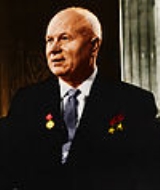
Nikita Sergeyevich Khrushchyov was the leader of the
Soviet Union after the death of
Joseph Stalin. He was
First Secretary of the
Communist Party of the Soviet Union from 1953 to 1964 and Chairman of the Council of Ministers from 1958 to 1964. He was removed from power by his party colleagues in 1964 and replaced by
Leonid Brezhnev. He spent the last seven years of his life under close supervision of the
KGB.
He is famous for his "knot of war" analogy which was directed towards
President John F. Kennedy during the
Cuban Missile Crisis: "Mr. President, we and you ought not to pull on the ends of the rope in which you have tied the knot of war, because the more the two of us pull, the tighter the knot will be tied. And a moment may come when that knot will be tied so tight that even he who tied it will not have the strength to untie it, and then it will be necessary to cut that knot, and what that would mean is not for me to explain to you".
Early days
Nikita Khrushchev was born in the village of Kalinovka, Dmitriyev Uyezd,
Kursk Guberniya,
Russian Empire, now occupied by the present-day
Kursk Oblast in
Russia. His father was the peasant Sergei Nicaronovich Khrushchev. In 1908, his family moved to
Yuzovka, what is now
Donetsk,
Ukraine. Although he was apparently highly intelligent, he only received approximately two years of
education as a child and probably only became fully literate in his late twenties or early thirties.
He was trained, and worked, as a joiner in various factories and mines. During
World War I, Khrushchev became involved in
trade union activities, and, after the
Bolshevik revolution in 1917, he fought in the
Red Army. He became a Party member in 1918 and worked at various management and Party positions in
Donbass and
Kiev.
In 1931, Khrushchev was transferred to Moscow and, in 1935, he became 1st Secretary of the Moscow City Committee of VKP. In 1938, he became the 1st Secretary of the Central Committee of the
Ukrainian Communist Party.
Beginning in 1934, Khrushchev was a member of the Central Committee of the Communist Party of the Soviet Union, and he was a member of Politburo from 1939.
Great Patriotic War
During the
Great Patriotic War , Khrushchev served as a
zampolit with the equivalent rank of Lieutenant General.
In the months following the
German invasion, in 1941, Khrushchev, as a local party leader, was coordinating the defense of Ukraine, but was dismissed and recalled to Moscow after surrendering Kiev. Later, he was a political commissar at the
Battle of Stalingrad and was the senior political officer in the south of the Soviet Union throughout the war time period - at
Kursk, entering
Kiev on liberation, and in the suppression of the
Bandera nationalists of the Ukrainian Nationalist Organisation, who had earlier allied with the
Nazis before fighting them in the Western Ukraine.
Rise to power
After Stalin's death in March 1953, there was a power struggle between different factions within the party. Initially
Lavrenty Beria controlled much of the political realm by merging the Ministry of Internal Affairs and State security. Fearing that Beria would eventually kill him and others,
Georgy Malenkov,
Lazar Kaganovich,
Vyacheslav Molotov, Nikolai Bulganin and others united under Khrushchev to denounce Beria and remove him from power. With Beria imprisoned awaiting execution , Malenkov was the heir apparent. Khrushchev was not nearly as powerful as he would eventually become even after his promotion. Few of the top members of the Central Committee saw the ambition lurking within him. Becoming party leader on September 7 of that year, and eventually rising above his rivals, Khrushchev's leadership marked a crucial transition for the Soviet Union. He pursued a course of reform and shocked delegates to the 20th Party Congress on February 23, 1956 by making his famous Secret Speech denouncing the "
cult of personality" that surrounded Stalin, although he himself had no small part in cultivating it, and accusing Stalin of the crimes committed during the Great Purges. This effectively alienated Khrushchev from the more conservative elements of the Party, but he managed to defeat what he termed the Anti-Party Group after they failed in a bid to oust him from the party leadership in 1957.
In 1958, Khrushchev replaced Bulganin as prime minister and established himself as the undisputed leader of both state and party. He became Premier of the Soviet Union on March 27, 1958. Khruschev promoted reform of the Soviet system and began to place an emphasis on the production of consumer goods rather than on heavy industry.
In 1959, during
Richard Nixon's journey to the Soviet Union, he took part in what was later known as the
Kitchen Debate. Khrushchev reciprocated the visit that September, spending thirteen days in the United States. His new attitude towards the West as a rival instead of as an evil entity alienated
Mao Zedong's China. The Soviet Union and the People's Republic of China, too, would later be involved in a similar "cold war" triggered by the
Sino-Soviet Split in 1960.
In 1961, Khrushchev approved plans proposed by
East German leader
Walter Ulbricht to build the
Berlin Wall, thereby reinforcing the Cold War division of Germany and wider
Europe.
Khrushchev's personality
Khrushchev was regarded by his political enemies in the Soviet Union as boorish, with a reputation for interrupting speakers to insult them. The Politburo accused him once of 'hare-brained scheming' - referring to his erratic policies. He regularly humiliated the Soviet
nomenklatura, or ruling elite, with his gaffes. He once branded Mao, who was at odds with Khruschev ever since the denunciation of Stalin at the 1956 Congress, an "old boot". In Mandarin, the word "boot" is regularly used to describe a prostitute or immoral woman. The Soviet leader also famously condemned his
Bulgarian counterpart, making several xenophobic comments about the Bulgarian people as well.
Khrushchev's blunders were partially the result of his limited formal education. Although intelligent, as his political enemies also admitted after he had defeated them, and certainly cunning, he lacked knowledge and understanding of the world outside of his direct experience and so would often prove easy to manipulate for scientific hucksters that knew how to appeal to his vanity and prejudices. For example, he was a supporter of
Trofim Lysenko even after the Stalin years and became convinced that the Soviet Union's agricultural crises could be solved through the planting of
maize on the same scale as the United States, failing to realize that the differences in climate and soil made this inadvisable.
Khrushchev repeatedly disrupted the proceedings in the
United Nations General Assembly in September-October 1960 by pounding his fists on the desk and shouting in
Russian. On September 29, 1960, Khrushchev twice interrupted a speech by British Prime Minister
Harold Macmillan by shouting out and pounding his desk. The unflappable Macmillan famously commented over his shoulder to Frederick Boland, the Assembly President , that if Mr. Khrushchev wished to continue, he would like a translation.
At the United Nations two weeks later, in one of the most surreal moments in Cold War history, the premier waved his shoe and banged it on his desk, adding to the lengthening list of antics with which he had been nettling the General Assembly. During a debate over a Russian resolution decrying colonialism, he was infuriated by a statement, expressed from the rostrum by Lorenzo Sumulong. The
Filipino delegate had charged the Soviets with employing a double standard, pointing to their domination of Eastern Europe as an example of the very type of colonialism their resolution criticized. Mr. Khrushchev thereupon pulled off his right shoe, stood up, brandishing it at the Philippine delegate on the other side of the hall. The enraged Khrushchev accused Mr. Sumulong of being "????? ? ?????????? ????????????" , which was translated as "a jerk, a stooge and a lackey of imperialism". The chaotic scene finally ended when General Assembly President Frederick Boland broke his gavel calling the meeting to order, but not before the image of Khrushchev as a hotheaded buffoon was indelibly etched into America’s collective memory. At another occasion, Khrushchev said in reference to capitalism, "?? ??? ?????????!", translated to "We will bury you". This phrase, ambiguous both in the
English language and in the
Russian language, was interpreted in several ways.
Forced retirement
Khrushchev's rivals in the party deposed him at a Central Committee meeting on October 14 1964. His removal was largely prompted by his erratic and cantankerous behaviour, which was regarded by the Party as a tremendous embarrassment on the international stage. The Communist Party subsequently accused Khrushschev of making political mistakes, such as mishandling the 1962
Cuban missile crisis and disorganizing the Soviet economy, especially in the agricultural sector.
Following his ousting, Khrushchev spent seven years under house arrest. He died at his home in
Moscow on September 11, 1971 and is interred in the
Novodevichy Cemetery,
Moscow, Russia.
Key political actions

- In his Secret Speech, Krushchev denounced Stalin for his personality cult and his regime for "violation of Leninist norms of legality", marking the onset of the Khrushchev Thaw.
- Dissolved the Cominform organization and reconciled with Josip Broz Tito, which ended the Informbiro period in the history of Yugoslavia.
- Established the Warsaw Pact in 1955 in response to the formation of NATO.
- Ordered the 1956 Soviet military intervention in Hungary .
- Ceded Crimea from the Russian SFSR to the Ukrainian SSR in 1955.
- Provided support for Egypt against the West during the 1956 Suez Crisis.
- Promoted the doctrine of "Peaceful co-existence" in the foreign policy, accompanied by the slogan "To catch up and overtake the West" in internal policy.
- Triggered Sino-Soviet Split by talks with the U.S. and refusing to support the Chinese nuclear program.
- Initiated the Soviet space program that launched Sputnik I and Yuri Gagarin, getting a head start in the space race. Participated in negotiations with U.S. President John F. Kennedy for a joint moon program, negotiations that ended when Kennedy was assassinated in 1963.
- Cancelled a summit meeting over the Gary Powers U-2 incident
The
U-2 Crisis of 1960 occurred when an American [i] U-2 [i] spy [i] ...
.
Key economic actions
- Second wave of the reclamation of virgin and abandoned lands .
- Introduction of sovnarkhozes, , regional organizations, in an attempt to combat the centralization and departmentalism of the ministries
- Reorganization of agriculture, with preference given to sovkhozes , including conversion of kolkhozes into sovkhozes, introduction of maize .
- Coping with housing crisis by quickly building millions of apartments according to simplified floor plans, dubbed khrushchovkas.
- Created a minimum wage in 1956.
- Redenomination of the ruble 10:1 in 1961.
Legacy
On the positive side, he was admired for his efficiency and for maintaining an economy which, during the 1950s and 1960s, had growth rates higher than most Western countries, contrasted with the stagnation beginning with his successors. He is also renowned for his liberalisation policies, whose results began with the widespread exoneration of political sentences.
With Khrushchev's amnesty program, the former political prisoners and their surviving relatives could now live a normal life without the infamous "wolf ticket".
His policies also increased the importance of the consumer, since Khrushchev himself placed more resources in the production of consumer goods and housing instead of heavy industry, precipitating a rapid rise in living standards.
The arts also benefited from this environment of liberalisation, where works like Solzhenitsyn's
One Day in the Life of Ivan Denisovich is a novel by Aleksandr Solzhenitsyn [i], originally publishe ...
created an attitude of dissent that would escalate during the subsequent Brezhnev-Kosygin era.
He also allowed
Eastern Europe to have a greater freedom of action in their domestic and external affairs, without the intervention of the Soviet Union.
His
De-Stalinization caused a huge impact on young Communists of the day. Khrushchev encouraged more liberal communist leaders to replace hard-line Stalinists throughout the Eastern bloc. Alexander Dubcek, who became the leader of
Czechoslovakia in January 1968, accelerated the process of liberalisation in his own country with his
Prague Spring programme.
Mikhail Gorbachev, who became the Soviet Union's leader in 1985, was inspired by it and it became evident with his policies of glasnost and
perestroika. Khrushchev is sometimes cited as "the last great reformer" among Soviet leaders before Gorbachev.
On the negative side, he was criticized for his ruthless crackdown of the
1956 revolution in Hungary, despite the fact that he and
Zhukov were pushing against intervention up until the declaration of withdrawal from the
Warsaw Pact, and also for encouraging the East German authorities to set up the notorious
Berlin Wall in August 1961. He also had very poor diplomatic skills, giving him the reputation of being a rude, uncivilised peasant in the West and as an irresponsible clown in his own country. He had also renewed persecutions against the
Russian Orthodox Church, publicly promising that by 1980 "I will show you the last priest!"
His methods of administration, although efficient, were also known to be erratic since they threatened to disband a large number of Stalinist-era agencies. He made a dangerous gamble in 1962 over Cuba, which almost made a Third World War inevitable. Agriculture barely kept up with population growth, as bad harvests mixed with good ones, culminating with a disastrous one in 1963 that was triggered by bad weather. All this damaged his prestige after 1962 and was enough for the Central Committee, Khrushchev's critical base for support, to take action against him. They used his right-hand man
Leonid Brezhnev to lead the bloodless coup.
Due to the results of his policies, as well as the increasingly regressive attitude of his successors, he became more popular after he gave up power, which led many dissidents to view his era with nostalgia as his successors began discrediting or slowing down his reforms.
Other information
Since he spent much time working in Ukraine, Khrushchev gave off the impression of being Ukrainian. He supported this image by wearing Ukrainian national shirts.
Due to various Reforms of Russian orthography, the
? letter is often replaced by
? in writing. Hence
Khrushchev is the standard English transliteration, even though it is more closely rendered as
Khrushchyov.
Khrushchev's eldest son Leonid died in 1943 during the Great Patriotic War. His younger son Sergei emigrated to the United States and is now an American citizen and a Professor at
Brown University's
Watson Institute for International Studies. He often speaks to American audiences to share his memories of the "other" side of the
Cold War.
Khrushchev's first wife, Yefrosinya, died in 1921 of hunger and exhaustion during the famine following the
Russian Civil War; she had borne Leonid and a daughter, Julia. His second wife was Nina Petrovna Kukharchuk , whom he married in 1924; besides Sergei, they had two daughters, Rada and Lena.
Books
- William Taubman: Khrushchev: The Man and His Era - London, Free Press, 2004
- Khrushchev Remembers: The Glasnost Tapes - translated and edited by Jerrold L. Schecter, Boston, Little Brown, 1990
- Khrushchev Remembers - edited by Strobe Talbott, 1970
- Khrushchev, Sergei N.: "Nikita Khrushchev and the Creation of a Superpower", Penn State Press, 2000.
- Nazi Hunter The Wiesenthal files by Levy, Alan 1993, 2002 barnes and noble books
Part III, Raoul Wallenberg. Chapter 19. pg 202. The Wallenberg disappearance.
- Khrushchev, Sergie N., translated by William Taubman: "Khrushchev on Khrushchev", Little, Brown and Company, 1990.
In fiction
- The video game features Khrushchev shortly before his ousting by Brezhnev, demanding that the United States prove they had nothing to do with a nuclear explosion caused by the game's primary antagonist, Volgin, or he will be forced to take military action against the United States. Volgin is a member of the Brezhnev faction who wants to replace Khrushchev with Brezhnev.
- In the 2001 motion picture Enemy at the Gates is a 2001 [i] movie [i] directed by Jean-Jacques Annaud [i], ad...
, a dramatization of the Battle of Stalingrad, Khrushchev is portrayed by British actor Bob Hoskins, though his surname is spelled as Krushchev in the closing credits. - He's mentioned in Billy Joel's history-themed song "We Didn't Start the Fire".
- Is mentioned numerous times in the Queen song Killer Queen.
- The Sting song "Russians" mentions Khrushchev.
External links
- , by Nina Khrushcheva , New Statesman, Oct. 2, 2000.
- , Film chronicles the plot to expel Nikita Khrushchev from his post as KPSS Secretary General.