


International Telecommunication Union

Encyclopedia

United Nations
The United Nations is an international organization whose stated aims are facilitating cooperation in international law, international security, economic development, social progress, human rights, and achievement of world peace...
which is responsible for information and communication technologies
Information and communication technologies
Information and communications technology or information and communication technology, usually abbreviated as ICT, is often used as an extended synonym for information technology , but is usually a more general term that stresses the role of unified communications and the integration of...
. ITU coordinates the shared global use of the radio spectrum
Radio spectrum
Radio spectrum refers to the part of the electromagnetic spectrum corresponding to radio frequencies – that is, frequencies lower than around 300 GHz ....
, promotes international cooperation in assigning satellite orbits, works to improve telecommunication infrastructure in the developing world and establishes worldwide standards.
ITU also organizes worldwide and regional exhibitions and forums, such as ITU TELECOM WORLD, bringing together representatives of government and the telecommunications and ICT industry to exchange ideas, knowledge and technology.
The ITU is active in areas including broadband Internet, latest-generation wireless technologies, aeronautical and maritime navigation, radio astronomy, satellite-based meteorology, convergence in fixed-mobile phone, Internet access, data, voice, TV broadcasting, and next-generation networks.
ITU is based in Geneva, Switzerland, is a member of the United Nations Development Group and its membership includes 193 Member States and around 700 Sector Members and Associates.
ITU sectors
The ITU comprises three sectors, each managing a different aspect of the matters handled by the Union, as well as ITU Telecom:Radiocommunication (ITU-R
ITU-R
The ITU Radiocommunication Sector is one of the three sectors of the International Telecommunication Union and is responsible for radio communication....
): Managing the international radio-frequency spectrum and satellite orbit resources is at the heart of the work of the ITU Radiocommunication Sector (ITU-R).
Standardization (ITU-T
ITU-T
The ITU Telecommunication Standardization Sector is one of the three sectors of the International Telecommunication Union ; it coordinates standards for telecommunications....
): ITU's standards-making efforts are its best-known — and oldest — activity; known prior to 1992 as the International Telephone and Telegraph Consultative Committee or CCITT (from its French name "Comité consultatif international téléphonique et télégraphique")
Development (ITU-D
ITU-D
The ITU Telecommunication Development] Sector is one of the three sectors of the International Telecommunication Union ; it is responsible for creating policies, regulation and providing training programs and financial strategies in developing countries.Created in 1992, its secretariat is the...
): Established to help spread equitable, sustainable and affordable access to information and communication technologies (ICT).
ITU TELECOM: ITU Telecom organizes major events for the world's ICT community. ITU Telecom World 2011 is ITU Telecom's 40th Anniversary with the first event in 1971.
A permanent General Secretariat, headed by the Secretary General, manages the day-to-day work of the Union and its sectors.
The ITU's mission
The ITU's mission is to enable the growth and sustained development of telecommunications and information networks, and to facilitate universal access so that people everywhere can participate in, and benefit from, the emerging information society and global economy. The ITU assists in mobilizing the technical, financial, and human resources required to make this vision real.For the last 20 years, ITU has been coordinating efforts of government and industry and private sector in the development of a global broadband multimedia international mobile telecommunication system, known as IMT. Since 2000, the world has seen the introduction of the first family of standards derived from the IMT concept. Since May 2007, there are more than 1 billion IMT-2000 subscribers in the world. IMT-Advanced provides a global platform on which to build the next generations of mobile services - fast data access, unified messaging and broadband multimedia - in the form of exciting new interactive services.
A major priority of the ITU is bridging the so-called "digital divide" by building adequate and safe information and communication infrastructure and developing confidence in the use of cyberspace through enhanced online security.
The ITU also concentrates on strengthening emergency communications for disaster prevention and mitigation, especially in less developed regions.
Legal framework of ITU
The basic texts of the ITU are adopted by the Plenipotentiary Conference. In addition to the Constitution and Convention, the consolidated basic texts include the Optional Protocol on the settlement of disputes, the Decisions, Resolutions and Recommendations in force, as well as the General Rules of Conferences, Assemblies and Meetings of the Union.Leadership
The ITU is headed by a Secretary-General, who is elected to a four-year term by the member states at the plenipotentiary conferencePlenipotentiary
The word plenipotentiary has two meanings. As a noun, it refers to a person who has "full powers." In particular, the term commonly refers to a diplomat fully authorized to represent his government as a prerogative...
.
At the 17th Plenipotentiary Conference (2006) in Antalya
Antalya
Antalya is a city on the Mediterranean coast of southwestern Turkey. With a population 1,001,318 as of 2010. It is the eighth most populous city in Turkey and country's biggest international sea resort.- History :...
, Turkey
Turkey
Turkey , known officially as the Republic of Turkey , is a Eurasian country located in Western Asia and in East Thrace in Southeastern Europe...
, the ITU's member states elected Dr Hamadoun Touré
Hamadoun Touré
Dr. Hamadoun Touré of Mali has been Secretary General of the International Telecommunication Union , the specialized agency of the United Nations dedicated to information and communication technologies , since 2007. He was re-elected for a second four-year term in 2010...
of Mali
Mali
Mali , officially the Republic of Mali , is a landlocked country in Western Africa. Mali borders Algeria on the north, Niger on the east, Burkina Faso and the Côte d'Ivoire on the south, Guinea on the south-west, and Senegal and Mauritania on the west. Its size is just over 1,240,000 km² with...
as Secretary-General of the Union. He was re-elected for a second four-year term at the 18th Plenipotentiary Conference (2010) in Guadalajara
Guadalajara
Guadalajara may refer to:In Mexico:*Guadalajara, Jalisco, the capital of the state of Jalisco and second largest city in Mexico**Guadalajara Metropolitan Area*University of Guadalajara, a public university in Guadalajara, Jalisco...
, Mexico
Mexico
The United Mexican States , commonly known as Mexico , is a federal constitutional republic in North America. It is bordered on the north by the United States; on the south and west by the Pacific Ocean; on the southeast by Guatemala, Belize, and the Caribbean Sea; and on the east by the Gulf of...
.
Directors and Secretaries-General of ITU
| Directors of ITU | |||
|---|---|---|---|
| Name | Beginning of Term | End of Term | Country |
| Louis Curchod | 1 January 1869 | 24 May 1872 |  Switzerland Switzerland |
| Karl Lendi | 24 May 1872 | 12 January 1873 | Switzerland |
| Louis Curchod | 23 February 1873 | 18 October 1889 | Switzerland |
| August Frey | 25 February 1890 | 28 June 1890 | Switzerland |
| Timotheus Rothen | 25 November 1890 | 11 February 1897 | Switzerland |
| Emil Frey Emil Frey Emil Johann Rudolf Frey was a Swiss politician, soldier in the American Civil War and member of the Swiss Federal Council .-Early life:... |
11 March 1897 | 1 August 1921 | Switzerland |
| Henri Étienne | 2 August 1921 | 16 December 1927 | Switzerland |
| Joseph Räder | 1 February 1928 | 30 October 1934 | Switzerland |
| Franz von Ernst | 1 January 1935 | 1 January 1949 | Switzerland |
| Secretaries general | |||
| Léon Mulatier | 1 January 1950 | 1 January 1953 |  Early Modern France Early Modern France |
| Marco Aurelio Andrada | 1 January 1954 | 18 June 1958 |  Argentina Argentina |
| Gerald C. Cross | 1 January 1964 | 29 October 1965 |  United States United States |
| Manohar Balaji Sarwate | 30 October 1965 | 19 February 1967 |  India India |
| Mohamed Ezzedine Mili | 20 October 1967 | 31 December 1982 |  Tunisia Tunisia |
| Richard E. Butler | 1 January 1983 | 31 October 1989 |  Australia Australia |
| Pekka Tarjanne | 1 November 1989 | 31 January 1999 |  Finland Finland |
| Yoshio Utsumi Yoshio Utsumi was the secretary-general of the International Telecommunication Union, 1998-2006.He was born in Japan in 1942, and earned his Bachelor in law at the University of Tokyo, and a Master of Arts in Political Science from the University of Chicago.... |
1 February 1999 | 31 December 2006 |  Japan Japan |
| Hamadoun Touré Hamadoun Touré Dr. Hamadoun Touré of Mali has been Secretary General of the International Telecommunication Union , the specialized agency of the United Nations dedicated to information and communication technologies , since 2007. He was re-elected for a second four-year term in 2010... |
1 January 2007 | present |  Mali Mali |
Membership
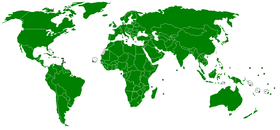
Vatican City
Vatican City , or Vatican City State, in Italian officially Stato della Città del Vaticano , which translates literally as State of the City of the Vatican, is a landlocked sovereign city-state whose territory consists of a walled enclave within the city of Rome, Italy. It has an area of...
.
Observers are: Palestinian territories
Non-members are: Palau
Palau
Palau , officially the Republic of Palau , is an island nation in the Pacific Ocean, east of the Philippines and south of Tokyo. In 1978, after three decades as being part of the United Nations trusteeship, Palau chose independence instead of becoming part of the Federated States of Micronesia, a...
(the only UN member state not to be a member), Cook Islands
Cook Islands
The Cook Islands is a self-governing parliamentary democracy in the South Pacific Ocean in free association with New Zealand...
, Niue
Niue
Niue , is an island country in the South Pacific Ocean. It is commonly known as the "Rock of Polynesia", and inhabitants of the island call it "the Rock" for short. Niue is northeast of New Zealand in a triangle between Tonga to the southwest, the Samoas to the northwest, and the Cook Islands to...
, and the states with limited recognition.
The most recent member to join is South Sudan
South Sudan
South Sudan , officially the Republic of South Sudan, is a landlocked country located in the Sahel region of northeastern Africa. It is also part of the North Africa UN sub-region. Its current capital is Juba, which is also its largest city; the capital city is planned to be moved to the more...
, which became a member on 14 July 2011.
Membership of ITU is open to governments, which may join the Union as Member States, as well as to private organizations like carriers, equipment manufacturers, funding bodies, research and development organizations and international and regional telecommunication organizations, which can join ITU as Sector Members.
Private companies and other organizations may elect to join one or more of the Union’s three Sectors, according to their particular sphere of interest. ITU Sector Members also develop the technical standards which will underpin future telecommunication systems and shape tomorrow’s networks and services.
Finally, Sector Members gain privileged access to restricted first-hand information which can prove highly valuable in their business planning.
World Summit on the Information Society
The ITU was the lead organizing agency of the World Summit on the Information Society (WSIS), a United Nations summit aiming at bridging the digital divide and turning it into digital opportunity for all. WSIS provided a global forum on the theme of ICTs (Information and Communication Technologies) for development. WSIS was a pledge for building a people-centered development-oriented Information Society. Other big themes of the Summit were Internet governance and Financial mechanisms for meeting the challenges of ICTs for development.The idea of holding WSIS came from the Tunisian President Ben Ali
Zine El Abidine Ben Ali
Zine El Abidine Ben Ali is a Tunisian political figure who was the second President of Tunisia from 1987 to 2011. Ben Ali was appointed Prime Minister in October 1987, and he assumed the Presidency on 7 November 1987 in a bloodless coup d'état that ousted President Habib Bourguiba, who was...
on the ITU Plenipotentiary Conference in Minneapolis in 1998. The process was launched late in 2002 on the initiative of Kofi Annan
Kofi Annan
Kofi Atta Annan is a Ghanaian diplomat who served as the seventh Secretary-General of the UN from 1 January 1997 to 31 December 2006...
. The first phase of the WSIS summit took place in December 2003 in Geneva
Geneva
Geneva In the national languages of Switzerland the city is known as Genf , Ginevra and Genevra is the second-most-populous city in Switzerland and is the most populous city of Romandie, the French-speaking part of Switzerland...
and the second and final phase took place in Tunis
Tunis
Tunis is the capital of both the Tunisian Republic and the Tunis Governorate. It is Tunisia's largest city, with a population of 728,453 as of 2004; the greater metropolitan area holds some 2,412,500 inhabitants....
in November 2005.
WSIS Stocktaking Process was initiated in 2004. The WSIS Stocktaking Process is a follow-up to WSIS. Its purpose is to provide a register of activities carried out by governments, international organizations, the business sector, civil society and other entities, in order to highlight the progress made since that landmark event. Following § 120 of TAIS, ITU has been maintaining the WSIS Stocktaking database as a publicly accessible system providing information on ICT-related initiatives and projects with reference to the 11 WSIS Action Lines.
See also

- Global Cybersecurity Agenda (GCA)
- Inter-American Telecommunication CommissionInter-American Telecommunication CommissionThe Inter-American Telecommunication Commission or Comisión Interamericana de Telecomunicaciones is an entity of the Organization of American States...
(CITEL) - ITU Radiocommunication Sector (ITU-R)ITU-RThe ITU Radiocommunication Sector is one of the three sectors of the International Telecommunication Union and is responsible for radio communication....
- ITU Telecommunication Development Sector (ITU-D)ITU-DThe ITU Telecommunication Development] Sector is one of the three sectors of the International Telecommunication Union ; it is responsible for creating policies, regulation and providing training programs and financial strategies in developing countries.Created in 1992, its secretariat is the...
- ITU Telecommunication Standardization Sector (ITU-T)ITU-TThe ITU Telecommunication Standardization Sector is one of the three sectors of the International Telecommunication Union ; it coordinates standards for telecommunications....
- ITU-R Recommendations
- ITU-T Recommendations
- Telephone numbers in the European UnionTelephone numbers in the European UnionAll country calling codes for the European Union countries start with +3x or +4x. The international access code has been standardised as 00.*Zone 3**+30 – Greece**+31 – The Netherlands**+32 – Belgium**+33 – France**+34 – Spain**+350 – Gibraltar – not EU...
- X.509X.509In cryptography, X.509 is an ITU-T standard for a public key infrastructure and Privilege Management Infrastructure . X.509 specifies, amongst other things, standard formats for public key certificates, certificate revocation lists, attribute certificates, and a certification path validation...
- Working Group on Internet GovernanceWorking Group on Internet GovernanceThe Working Group on Internet Governance was a United Nations multistakeholder Working group initiated after the 2003 World Summit on the Information Society first phase Summit in Geneva to agree on the future of Internet governance....
(WGIG) - WSIS Stocktaking Platform
External links
- ITU official site
- History of ITU Portal (official site)
- ITU Telecom World 2011
- ITU defines the future of mobile communications
- U.N. Summit to Focus on Internet – Washington Post article about ICANNICANNThe Internet Corporation for Assigned Names and Numbers is a non-profit corporation headquartered in Marina del Rey, California, United States, that was created on September 18, 1998, and incorporated on September 30, 1998 to oversee a number of Internet-related tasks previously performed directly...
and the United Nations' ITU relationship