
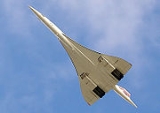
Aérospatiale-BAC Concorde was a
turbojet-powered
supersonicSupersonic speed is a rate of travel of an object that exceeds the speed of sound . For objects traveling in dry air of a temperature of 20 °C this speed is approximately 343 m/s, 1,125 ft/s, 768 mph or 1,235 km/h. Speeds greater than five times the speed of sound are often...
passenger
airlinerAn airliner is a large fixed-wing aircraft for transporting passengers and cargo. Such aircraft are operated by airlines. Although the definition of an airliner can vary from country to country, an airliner is typically defined as an aircraft intended for carrying multiple passengers in commercial...
, a
supersonic transportA supersonic transport is a civilian supersonic aircraft designed to transport passengers at speeds greater than the speed of sound. The only SSTs to see regular service to date have been Concorde and the Tupolev Tu-144. The last passenger flight of the Tu-144 was in June 1978 with its last ever...
(SST). It was a product of an Anglo-French government treaty, combining the manufacturing efforts of
AérospatialeAérospatiale was a French aerospace manufacturer that built both civilian and military aircraft, rockets and satellites. It was originally known as Société Nationale Industrielle Aérospatiale...
and the
British Aircraft CorporationThe British Aircraft Corporation was a British aircraft manufacturer formed from the government-pressured merger of English Electric Aviation Ltd., Vickers-Armstrongs , the Bristol Aeroplane Company and Hunting Aircraft in 1960. Bristol, English Electric and Vickers became "parents" of BAC with...
. First flown in 1969, Concorde entered service in 1976 and continued commercial flights for 27 years.
Among other destinations, Concorde flew regular
transatlantic flightTransatlantic flight is the flight of an aircraft across the Atlantic Ocean. A transatlantic flight may proceed east-to-west, originating in Europe or Africa and terminating in North America or South America, or it may go in the reverse direction, west-to-east...
s from London Heathrow (British Airways) and Paris-Charles de Gaulle Airport (Air France) to
New York JFKJohn F. Kennedy International Airport is an international airport located in the borough of Queens in New York City, about southeast of Lower Manhattan. It is the busiest international air passenger gateway to the United States, handling more international traffic than any other airport in North...
, profitably flying these routes at record speeds, in less than half the time of other airliners.
With only 20 aircraft built, their development represented a substantial economic loss, in addition to which
Air FranceAir France , stylised as AIRFRANCE, is the French flag carrier headquartered in Tremblay-en-France, , and is one of the world's largest airlines. It is a subsidiary of the Air France-KLM Group and a founding member of the SkyTeam global airline alliance...
and British Airways were subsidised by their governments to buy them. As a result of the type’s
only crashAir France Flight 4590 was a Concorde flight operated by Air France which was scheduled to run from Charles de Gaulle International Airport near Paris, to John F. Kennedy International Airport in New York City. On 2000, it crashed in Gonesse, France. All one hundred passengers and nine crew...
on 25 July 2000 and other factors, its retirement flight was on 26 November 2003.
Concorde's name reflects the development agreement between the United Kingdom and France. In the UK, any or all of the type—unusual for an aircraft—are known simply as "Concorde", sans article. The aircraft is regarded by many as an aviation icon and an engineering marvel.
Concept
In the late 1950s, the United Kingdom, France, United States, and
Soviet UnionThe Soviet Union , officially the Union of Soviet Socialist Republics , was a constitutionally socialist state that existed in Eurasia between 1922 and 1991....
were considering developing supersonic transport. The British
Bristol Aeroplane CompanyThe Bristol Aeroplane Company, originally the British and Colonial Aeroplane Company, was both one of the first and one of the most important British aviation companies, designing and manufacturing both airframes and aero engines...
and the French
Sud AviationSud-Aviation was a French state-owned aircraft manufacturer, originating from the merger of Sud-Est and Sud-Ouest on March 1, 1957...
were both working on designs, called the
Type 223The Bristol Aeroplane Company Type 223 was an early design for a supersonic transport. In the late 1950s and early 1960s the company studied a number of models as part of a large British inter-company effort funded by the government. These models eventually culminated in the Type 223, a...
and
Super-CaravelleThe Sud Aviation Super-Caravelle was an early design for a supersonic transport. Unlike most competing designs which envisioned larger trans-Atlantic aircraft and led to the likes of the Boeing 2707, the Super-Caravelle was a much smaller, shorter range design intended to replace their earlier and...
, respectively. Both were largely funded by their respective governments. The British design was for a thin-winged delta shape (which owed much to work by
Dietrich KüchemannDietrich Küchemann CBE FRS FRAeS was a German aerodynamicist who made several important contributions to the advancement of high-speed flight...
, then at the
Royal Aircraft EstablishmentThe Royal Aircraft Establishment , was a British research establishment, known by several different names during its history, that eventually came under the aegis of the UK Ministry of Defence , before finally losing its identity in mergers with other institutions.The first site was at Farnborough...
) for a transatlantic-ranged aircraft for about 100 people, while the French were intending to build a medium-range aircraft.
The designs were both ready to start prototype construction in the early 1960s, but the cost was so great that the British government made it a requirement that
British Aircraft CorporationThe British Aircraft Corporation was a British aircraft manufacturer formed from the government-pressured merger of English Electric Aviation Ltd., Vickers-Armstrongs , the Bristol Aeroplane Company and Hunting Aircraft in 1960. Bristol, English Electric and Vickers became "parents" of BAC with...
(which had been formed in 1960 as a consolidation of British aircraft companies, including the Bristol Aeroplane Company) look for international co-operation. Approaches were made to a number of countries, but only France showed real interest. The development project was negotiated as an international
treatyA treaty is an express agreement under international law entered into by actors in international law, namely sovereign states and international organizations. A treaty may also be known as an agreement, protocol, covenant, convention or exchange of letters, among other terms...
between the two countries rather than a commercial agreement between companies and included a clause, originally asked for by the UK, imposing heavy penalties for cancellation. A draft treaty was signed on 29 November 1962. By this time, both companies had been merged into new ones; thus, the Concorde project was between the
British Aircraft CorporationBritish Aerospace plc was a UK aircraft, munitions and defence-systems manufacturer. Its head office was in the Warwick House in the Farnborough Aerospace Centre in Farnborough, Hampshire...
and Aérospatiale. At first the new consortium intended to produce one long range and one short range version. However, prospective customers showed no interest in the short-range version and it was dropped. The consortium secured orders (i.e., non-binding options) for over 100 of the long-range version from the major airlines of the day:
Pan AmPan American World Airways, commonly known as Pan Am, was the principal and largest international air carrier in the United States from 1927 until its collapse on December 4, 1991...
,
BOACThe British Overseas Airways Corporation was the British state airline from 1939 until 1946 and the long-haul British state airline from 1946 to 1974. The company started life with a merger between Imperial Airways Ltd. and British Airways Ltd...
and Air France were the launch customers, with six Concordes each. Other airlines in the order book included
Panair do BrasilPanair do Brasil is a defunct airline of Brazil. Between 1945 and 1965 it was considered to be the largest carrier not only in Brazil but in all of Latin America.-NYRBA do Brasil :...
,
Continental AirlinesContinental Airlines was a major American airline now merged with United Airlines. On May 3, 2010, Continental Airlines, Inc. and UAL, Inc. announced a merger via a stock swap, and on October 1, 2010, the merger closed and UAL changed its name to United Continental Holdings, Inc...
,
Japan Airlinesis an airline headquartered in Shinagawa, Tokyo, Japan. It is the flag carrier of Japan and its main hubs are Tokyo's Narita International Airport and Tokyo International Airport , as well as Nagoya's Chūbu Centrair International Airport and Osaka's Kansai International Airport...
,
LufthansaDeutsche Lufthansa AG is the flag carrier of Germany and the largest airline in Europe in terms of overall passengers carried. The name of the company is derived from Luft , and Hansa .The airline is the world's fourth-largest airline in terms of overall passengers carried, operating...
,
American AirlinesAmerican Airlines, Inc. is the world's fourth-largest airline in passenger miles transported and operating revenues. American Airlines is a subsidiary of the AMR Corporation and is headquartered in Fort Worth, Texas adjacent to its largest hub at Dallas/Fort Worth International Airport...
,
United AirlinesUnited Air Lines, Inc., is the world's largest airline with 86,852 employees United Air Lines, Inc., is the world's largest airline with 86,852 employees United Air Lines, Inc., is the world's largest airline with 86,852 employees (which includes the entire holding company United Continental...
,
Air IndiaAir India is the flag carrier airline of India. It is part of the government of India owned Air India Limited . The airline operates a fleet of Airbus and Boeing aircraft serving Asia, Australia, Europe and North America. Its corporate office is located at the Air India Building at Nariman...
,
Air CanadaAir Canada is the flag carrier and largest airline of Canada. The airline, founded in 1936, provides scheduled and charter air transport for passengers and cargo to 178 destinations worldwide. It is the world's tenth largest passenger airline by number of destinations, and the airline is a...
,
BraniffBraniff International Airways was an American airline that operated from 1928 until 1982, primarily in the midwestern and southwestern U.S., South America, Panama, and in its later years also Asia and Europe...
,
Singapore AirlinesSingapore Airlines Limited is the flag carrier airline of Singapore. Singapore Airlines operates a hub at Changi Airport and has a strong presence in the Southeast Asia, East Asia, South Asia, and "Kangaroo Route" markets...
,
Iran AirIran Air , formally Airline of the Islamic Republic of Iran is the flag carrier airline of Iran, operating services to 60 destinations, 35 international and 25 domestic. The cargo fleet operates services to 20 scheduled and 5 charter destinations...
, Olympic Airways,
QantasQantas Airways Limited is the flag carrier of Australia. The name was originally "QANTAS", an initialism for "Queensland and Northern Territory Aerial Services". Nicknamed "The Flying Kangaroo", the airline is based in Sydney, with its main hub at Sydney Airport...
,
CAACThe Civil Aviation Administration of China , formerly the General Administration of Civil Aviation of China , is the aviation authority under the Ministry of Transport of the People's Republic of China. It oversees civil aviation and investigates aviation accidents and incidents...
,
Middle East AirlinesMiddle East Airlines – Air Liban S.A.L. , more commonly known as Middle East Airlines , is the national flag-carrier airline of Lebanon, with its head office in Beirut, near Beirut Rafic Hariri International Airport...
and
TWATrans World Airlines was an American airline that existed from 1925 until it was bought out by and merged with American Airlines in 2001. It was a major domestic airline in the United States and the main U.S.-based competitor of Pan American World Airways on intercontinental routes from 1946...
.
Design work was supported by a research programme that investigated the characteristics of the low ratio delta wing. The supersonic
BAC 211The Fairey Delta 2 or FD2 was a British supersonic research aircraft produced by the Fairey Aviation Company in response to a specification from the Ministry of Supply for investigation into flight and control at transonic and supersonic speeds.The aircraft was the first to exceed 1000mph, and...
tested the high speed range while the
Handley Page HP.115|-See also:-References:NotesBibliography* Barfield, Norman. "Aérospatiale/BAC Concorde." Aircraft in Profile, Volume 14. Windsor, Berkshire, UK: Profile Publications, 1974. ISBN 0-85383-023-1....
served for low speeds.
Naming
Reflecting the treaty between the British and French governments which led to Concorde's construction, the name
Concorde is from the French word
concorde (kɔ̃kɔʁd), which has an English equivalent,
concord (ˈkɒŋkɔrd). Both words mean
agreement,
harmony or
union.
The aircraft was initially referred to in the UK as
Concorde, with the French spelling, but was officially changed to
Concord by
Harold MacmillanMaurice Harold Macmillan, 1st Earl of Stockton, OM, PC was Conservative Prime Minister of the United Kingdom from 10 January 1957 to 18 October 1963....
in response to a perceived slight by
Charles de GaulleCharles André Joseph Marie de Gaulle was a French general and statesman who led the Free French Forces during World War II. He later founded the French Fifth Republic in 1958 and served as its first President from 1959 to 1969....
. In 1967, at the French roll-out in
ToulouseToulouse is a city in the Haute-Garonne department in southwestern FranceIt lies on the banks of the River Garonne, 590 km away from Paris and half-way between the Atlantic Ocean and the Mediterranean Sea...
the British Government Minister for Technology,
Tony BennAnthony Neil Wedgwood "Tony" Benn, PC is a British Labour Party politician and a former MP and Cabinet Minister.His successful campaign to renounce his hereditary peerage was instrumental in the creation of the Peerage Act 1963...
announced that he would change the spelling back to
Concorde. This created a nationalist uproar that died down when Benn stated that the suffixed ‹e› represented "Excellence, England, Europe and
Entente (Cordiale)The Entente Cordiale was a series of agreements signed on 8 April 1904 between the United Kingdom and the French Republic. Beyond the immediate concerns of colonial expansion addressed by the agreement, the signing of the Entente Cordiale marked the end of almost a millennium of intermittent...
." In his memoirs, he recounts a tale of a letter from an irate Scotsman claiming: "[Y]ou talk about 'E' for England, but part of it is made in Scotland." Given Scotland’s contribution of providing the nose cone for the aircraft, Benn replied, "[I]t was also 'E' for 'Écosse' (the French name for Scotland) — and I might have added 'e' for extravagance and 'e' for escalation as well!"
Concorde also acquired an unusual
nomenclatureNomenclature is a term that applies to either a list of names or terms, or to the system of principles, procedures and terms related to naming - which is the assigning of a word or phrase to a particular object or property...
for an aircraft. In common usage in the United Kingdom, the type is known as
Concorde without an
articleAn article is a word that combines with a noun to indicate the type of reference being made by the noun. Articles specify the grammatical definiteness of the noun, in some languages extending to volume or numerical scope. The articles in the English language are the and a/an, and some...
, rather than
the Concorde or a Concorde.
Testing
Construction of two prototypes began in February 1965: 001, built by Aerospatiale at Toulouse, and 002, by BAC at
FiltonFilton is a town in South Gloucestershire, England, situated on the northern outskirts of the city of Bristol, about from the city centre. Filton lies in Bristol postcode areas BS7 and BS34. The town centres upon Filton Church, which dates back to the 12th century and is a grade II listed building...
,
BristolBristol is a city, unitary authority area and ceremonial county in South West England, with an estimated population of 433,100 for the unitary authority in 2009, and a surrounding Larger Urban Zone with an estimated 1,070,000 residents in 2007...
. Concorde 001 made its first test flight from Toulouse on 2 March 1969, piloted by André Turcat, and first went supersonic on 1 October. The first UK-built Concorde flew from Filton to
RAF FairfordRAF Fairford is a Royal Air Force station in Gloucestershire, England. It is a standby airfield, not in everyday use. Its most prominent use in recent years has been as an airfield for United States Air Force B-52s during the 2003 Iraq War, Operation Allied Force in 1999, and the first Gulf War in...
on 9 April 1969, piloted by
Brian TrubshawErnest Brian Trubshaw, CBE, MVO was a notable test pilot, and the first British pilot to fly Concorde, in April 1969....
. Both prototypes were presented to the public for the first time on 7–8 June 1969 at the Paris Airshow. As the flight programme progressed, 001 embarked on a sales and demonstration tour on 4 September 1971, which was also the first transatlantic crossing of Concorde. Concorde 002 followed suit on 2 June 1972 with a tour of the Middle and Far East. Concorde 002 made the first visit to the United States in 1973, landing at the new Dallas/Fort Worth Regional Airport to mark that airport’s opening.
These trips led to orders for over 70 aircraft, but a combination of factors led to order cancellations: the
1973 oil crisisThe 1973 oil crisis started in October 1973, when the members of Organization of Arab Petroleum Exporting Countries or the OAPEC proclaimed an oil embargo. This was "in response to the U.S. decision to re-supply the Israeli military" during the Yom Kippur war. It lasted until March 1974. With the...
, financial difficulties of airlines, a spectacular Paris Le Bourget air show crash of the competing Soviet
Tupolev Tu-144The Tupolev Tu-144 was a Soviet supersonic transport aircraft and remains one of only two SSTs to enter commercial service, the other being the Concorde...
, and environmental concerns such as the
sonic boomA sonic boom is the sound associated with the shock waves created by an object traveling through the air faster than the speed of sound. Sonic booms generate enormous amounts of sound energy, sounding much like an explosion...
,
takeoffTakeoff is the phase of flight in which an aerospace vehicle goes from the ground to flying in the air.For horizontal takeoff aircraft this usually involves starting with a transition from moving along the ground on a runway. For balloons, helicopters and some specialized fixed-wing aircraft , no...
-noise and pollution. By 1976 four nations remained as prospective buyers: Britain, France, China, and Iran. In the end only Air France and British Airways (the successor to BOAC) took up their orders, with the two governments taking a cut of any profits made. IranAir's orders were canceled after the Islamic Revolution. In the case of BA, 80% of the profit was kept by the government until 1984 in return for a state loan to buy the aircraft.
The United States cancelled the
Boeing 2707The Boeing 2707 was developed as the first American supersonic transport . After winning a competition for a government-funded contract to build an American SST, Boeing began development at its facilities in Seattle, Washington...
, its supersonic transport programme, in 1971. Industry observers in France and the United Kingdom suggested that part of the American opposition to Concorde on grounds of noise pollution was orchestrated, or at least encouraged, by the United States Government, out of spite at not being able to propose a viable competitor, despite President
John F. KennedyJohn Fitzgerald "Jack" Kennedy , often referred to by his initials JFK, was the 35th President of the United States, serving from 1961 until his assassination in 1963....
's impassioned 1963 statement of commitment. Other countries, such as India and Malaysia, ruled out Concorde supersonic overflights stating noise concerns.
Demonstration and test flights were flown from 1974 onwards. The testing of Concorde set records that have not been surpassed; the prototype, pre-production and first production aircraft undertook 5,335 flight hours; 2,000 test hours were at supersonic speeds. During one such test flight, on 7 November 1974, 001 performed the fastest civil flight across the North Atlantic, setting a record that still stands. Unit costs were £23 million (US$46 million, EUR 50 million) in 1977, and development costs were six times the projected amount.
General features
Concorde is an
ogivalAn ogive is the roundly tapered end of a two-dimensional or three-dimensional object.-Applied physical science and engineering:In ballistics or aerodynamics, an ogive is a pointed, curved surface mainly used to form the approximately streamlined nose of a bullet or other projectile.The traditional...
(also "ogee") delta-winged aircraft with four
OlympusThe Rolls-Royce/Snecma Olympus 593 was a reheated turbojet which powered the supersonic airliner Concorde. Initially a joint project between Bristol Siddeley and Snecma based on Bristol's Olympus engine, Rolls-Royce Limited acquired Bristol making it a division of Rolls-Royce.Until Concorde's...
engines based on those employed in the RAF's
Avro VulcanThe Avro Vulcan, sometimes referred to as the Hawker Siddeley Vulcan, was a jet-powered delta wing strategic bomber, operated by the Royal Air Force from 1956 until 1984. Aircraft manufacturer A V Roe & Co designed the Vulcan in response to Specification B.35/46. Of the three V bombers produced,...
strategic bomberA strategic bomber is a heavy bomber aircraft designed to drop large amounts of ordnance onto a distant target for the purposes of debilitating an enemy's capacity to wage war. Unlike tactical bombers, which are used in the battle zone to attack troops and military equipment, strategic bombers are...
. Concorde was the first airliner to have an (in this case, analogue)
fly-by-wireFly-by-wire is a system that replaces the conventional manual flight controls of an aircraft with an electronic interface. The movements of flight controls are converted to electronic signals transmitted by wires , and flight control computers determine how to move the actuators at each control...
flight-control system; the avionics of Concorde were unique because it was the first commercial aircraft to employ hybrid circuits. The principal designer for the project was Pierre Satre, with
Sir Archibald RussellArchibald George Blomefield Russell, CVO, FSA was an English art historian and a long-serving officer of arms at the College of Arms in London.-Early life:...
as his deputy.
Concorde pioneered the following technologies:
For high speed and optimisation of flight:
- Double delta (ogee
An ogee is a curve , shaped somewhat like an S, consisting of two arcs that curve in opposite senses, so that the ends are parallel....
/ogival) shaped wings
- Variable engine air intake system controlled by digital computers
- Supercruise
Supercruise is sustained supersonic flight of an aircraft with a useful cargo, passenger, or weapons load performed efficiently and without the use of afterburners ....
capability
- Thrust-by-wire engines, predecessor of today’s FADEC
Full Authority Digital Engine Control is a system consisting of a digital computer, called an electronic engine controller or engine control unit , and its related accessories that control all aspects of aircraft engine performance...
-controlled engines
- Droop-nose
The Droop Nose was a distinctive feature of both Concorde, the Moxon and the Tu-144. When these aircraft were in service, the pilot would lower the nose to improve visibility of the runway and taxiways. When in flight, the nose would be raised. Concorde also had a moving visor that would slide into...
section for better landing visibility
For weight-saving and enhanced performance:
- Mach
Mach number is the speed of an object moving through air, or any other fluid substance, divided by the speed of sound as it is in that substance for its particular physical conditions, including those of temperature and pressure...
2.04 (~2170 kilometres per hour (1,348.4 mph)) cruising speed for optimum fuel consumption (supersonic drag minimum although turbojet engines are more efficient at higher speed)
- Mainly aluminium construction for low weight and conventional manufacture (higher speeds would have ruled out aluminium)
- Full-regime autopilot
An autopilot is a mechanical, electrical, or hydraulic system used to guide a vehicle without assistance from a human being. An autopilot can refer specifically to aircraft, self-steering gear for boats, or auto guidance of space craft and missiles...
and autothrottleAn autothrottle allows a pilot to control the power setting of an aircraft's engines by specifying a desired flight characteristic, rather than manually controlling fuel flow...
allowing "hands off" control of the aircraft from climbout to landing
- Fully electrically controlled analogue fly-by-wire flight controls systems
- High-pressure hydraulic system of 28 MPa (4,000 lbf/in²) for lighter hydraulic components
- Complex Air Data Computer (ADC) for the automated monitoring and transmission of aerodynamic measurements (total pressure, static pressure, angle of attack, side-slip).
- Fully electrically controlled analogue brake-by-wire
Drive-by-wire technology in automotive industry replaces the traditional mechanical and hydraulic control systems with electronic control systems using electromechanical actuators and human-machine interfaces such as pedal and steering feel emulators...
system
- Pitch trim by shifting fuel around the fuselage for centre-of-gravity control
- Parts made using "sculpture milling
A milling machine is a machine tool used to machine solid materials. Milling machines are often classed in two basic forms, horizontal and vertical, which refers to the orientation of the main spindle. Both types range in size from small, bench-mounted devices to room-sized machines...
", reducing the part count while saving weight and adding strength.
- Lack of an auxiliary power unit
An auxiliary power unit is a device on a vehicle that provides energy for functions other than propulsion. They are commonly found on large aircraft, as well as some large land vehicles.-Function:...
, as Concorde would only visit large airports where ground air start carts are available.
Engines
Concorde needed to fly long distances to be economically viable; this required high efficiency. Turbofan engines were rejected due to their larger cross-section producing excessive drag.
Turbojets were found to be the best choice of engines. The engine used was the twin spool
Rolls-Royce/Snecma Olympus 593The Rolls-Royce/Snecma Olympus 593 was a reheated turbojet which powered the supersonic airliner Concorde. Initially a joint project between Bristol Siddeley and Snecma based on Bristol's Olympus engine, Rolls-Royce Limited acquired Bristol making it a division of Rolls-Royce.Until Concorde's...
, a development of the Bristol engine first used for the Avro Vulcan bomber, and developed into an afterburning supersonic variant for the
BAC TSR-2The British Aircraft Corporation TSR-2 was a cancelled Cold War strike and reconnaissance aircraft developed by the British Aircraft Corporation for the Royal Air Force in the late 1950s and early 1960s...
strike bomber.
The intake design for Concorde’s engines was critical. Conventional jet engines can take in air at only around Mach 0.5; therefore the air has to be slowed from the Mach 2.0 airspeed that enters the engine intake. In particular, Concorde needed to control the shock waves that this reduction in speed generates to avoid damage to the engines. This was done by a pair of
intake rampAn intake ramp is a rectangular, plate-like device within the air intake of a jet engine, designed to generate a shock wave to aid the inlet compression process at supersonic speeds. The ramp sits at an acute angle to deflect the intake air from the longitudinal direction...
s and an auxiliary spill door, whose position moved in-flight to slow transiting air. The effectiveness of the intake system is such that, during supersonic flight, 63% of the aircraft's thrust is attributed to the intakes whilst the exhaust nozzles generate 29% and the engines just 8% of the thrust.
Engine failure causes problems on conventional subsonic aircraft; not only does the aircraft lose thrust on that side but the engine creates drag, causing the aircraft to yaw and bank in the direction of the failed engine. If this had happened to Concorde at supersonic speeds, it could theoretically cause a catastrophic failure of the airframe. During an engine failure, air intake needs are virtually zero, so in Concorde, the immediate effects of the engine failure were countered by the opening of the auxiliary spill door and the full extension of the ramps, which deflected the air downwards past the engine, gaining lift and streamlining the engine, minimising the drag effects of the failed engine. Although computer simulations predicted considerable problems, in practice Concorde could shut down both engines on the same side of the aircraft at Mach 2 without the predicted difficulties. Concorde pilots were routinely trained to handle double engine failure.
The aircraft used reheat (
afterburnerThe AfterBurner is a lighting solution for the Game Boy Advance system that was created by Triton-Labs.Originally, portablemonopoly.net was a website created to petition Nintendo to put some kind of light in their Game Boy Advance system...
s) at takeoff and to pass through the
transonicTransonic speed is an aeronautics term referring to the condition of flight in which a range of velocities of airflow exist surrounding and flowing past an air vehicle or an airfoil that are concurrently below, at, and above the speed of sound in the range of Mach 0.8 to 1.2, i.e. 600–900 mph...
regime (i.e., "go supersonic") between Mach 0.95 and Mach 1.7, and were switched off at all other times. Due to jet engines being
highly inefficient at low speedsIn aircraft and rocket design, overall propulsive efficiency \eta is the efficiency, in percent, with which the energy contained in a vehicle's propellant is converted into useful energy, to replace losses due to air drag, gravity, and acceleration. It can also be stated as the proportion of the...
, Concorde burned two tonnes of fuel (almost 2% of the maximum fuel load) taxiing to the runway. To conserve fuel only the two outer engines were run after landing for taxiing.
Heating issues
Besides engines, the hottest part of the structure of any supersonic aircraft is the
noseThe term nose cone is used to refer to the forwardmost section of a rocket, guided missile or aircraft. The cone is shaped to offer minimum aerodynamic resistance...
. The engineers used
Hiduminium R.R. 58The Hiduminium or R.R. alloys are a series of high-strength, high-temperature aluminium alloys, developed for aircraft use by Rolls-Royce before World War II. They were manufactured and later developed by High Duty Alloys Ltd....
, an aluminium alloy, throughout the aircraft due to its familiarity, cost and ease of construction. The highest temperature that aluminium could sustain over the life of the aircraft was 127 °C (260.6 °F), which limited the top speed to Mach 2.02. Concorde went through two cycles of heating and cooling during a flight, first cooling down as it gained altitude, then heating up after going supersonic. The reverse happened when descending and slowing down. This had to be factored into the metallurgical modelling. A test rig was built that repeatedly heated up a full-size section of the wing, and then cooled it, and periodically samples of metal were taken for testing.
Owing to the heat generated by compression of air as Concorde travelled supersonically, the fuselage would extend by as much as 300 mm (almost 1 ft), the most obvious manifestation of this being a gap that opened up on the flight deck between the
flight engineerFlight engineers work in three types of aircraft: fixed-wing , rotary wing , and space flight .As airplanes became even larger requiring more engines and complex systems to operate, the workload on the two pilots became excessive during certain critical parts of the flight regime, notably takeoffs...
's console and the bulkhead. On some aircraft that conducted a retiring supersonic flight, the flight engineers placed their caps in this expanded gap, wedging the cap when it shrunk again. To keep the cabin cool, Concorde used the fuel as a
heat sinkA heat sink is a term for a component or assembly that transfers heat generated within a solid material to a fluid medium, such as air or a liquid. Examples of heat sinks are the heat exchangers used in refrigeration and air conditioning systems and the radiator in a car...
for the heat from the air conditioning, the same method also cooled the hydraulics. During supersonic flight the surfaces forward from the cockpit became heated, a visor was used to deflect much of this heat from directly reaching the cockpit.
Concorde had
liveryAircraft livery is a paint scheme applied to an aircraft, generally to fuselage, wings, empennage , or jet engines. Most airlines have a standard paint scheme for their aircraft fleet, usually prominently displaying the airline logo or name. From time to time special liveries are introduced, for...
restrictions; the majority of the surface had to be covered with a
highly reflective whiteAnti-flash white is a brilliant white color commonly seen on United States, British and Soviet nuclear bombers. The purpose of the color was to reflect some of the thermal radiation from a nuclear explosion, protecting the aircraft and its occupants....
paint to avoid overheating the aluminium structure due to heating effects from supersonic flight at Mach 2. In 1996, Air France briefly painted F-BTSD in a predominantly blue livery (with the exception of the wings) in a promotional deal with
PepsiPepsi is a carbonated soft drink that is produced and manufactured by PepsiCo...
. In this paint scheme, Air France were advised to remain at Mach 2 for no more than 20 minutes at a time, but there was no restriction at speeds under Mach 1.7. F-BTSD was used because it was not scheduled for any long flights that required extended Mach 2 operations.
Structural issues
Due to the high speeds at which Concorde travelled, large forces were applied to the aircraft's structure during banks and turns. This caused twisting and the distortion of the aircraft’s structure. In addition there were concerns over maintaining precise control at supersonic speeds; both of these issues were resolved by active ratio changes between the inboard and outboard elevons, varying at differing speeds including supersonic. Only the innermost elevons, which are attached to the stiffest area of the wings, were active at high speed. Additionally, the narrow fuselage meant that the aircraft flexed. This was visible from the rear passengers’ viewpoints.
When any aircraft passes the critical mach of that particular airframe, the centre of pressure shifts rearwards. This causes a pitch down force on the aircraft if the centre of mass remains where it was. The engineers designed the wings in a specific manner to reduce this shift, but there was still a shift of about 2 metres. This could have been countered by the use of
trim controlsAn airfoil or aerofoil is the shape of a wing or blade or sail as seen in cross-section....
, but at such high speeds this would have caused a dramatic increase in the drag on the aircraft. Instead, the distribution of fuel along the aircraft was shifted during acceleration and deceleration to move the centre of mass, effectively acting as an auxiliary trim control.
Range
In order to travel between London and New York, or Washington, non-stop, Concorde was developed to have the greatest supersonic range of any aircraft. This was achieved by a combination of engines which were highly efficient at supersonic speeds (the world's most energy-efficient jet engine), a slender fuselage with high
fineness ratioFineness ratio is a term used in naval architecture and aerospace engineering to describe the overall shape of a streamlined body. Specifically, it is the ratio of the length of a body to its maximum width; shapes that are "short and fat" have a low fineness ratio, those that are "long and skinny"...
, and a complex wing shape delivering a high lift to drag ratio. This also required carrying only a modest payload and a high fuel capacity, and the aircraft was trimmed with precision to avoid unnecessary drag.
Nevertheless, soon after Concorde began flying, a Concorde "B" model was designed with slightly larger fuel capacity and slightly larger wings with
leading edge slatsSlats are aerodynamic surfaces on the leading edge of the wings of fixed-wing aircraft which, when deployed, allow the wing to operate at a higher angle of attack. A higher coefficient of lift is produced as a result of angle of attack and speed, so by deploying slats an aircraft can fly at slower...
to improve aerodynamic performance at all speeds. It featured more powerful engines with sound deadening and without the fuel-hungry and noisy reheat. It was speculated that it was reasonably possible to create an engine with up to 25% gain in efficiency over the Rolls-Royce/Snecma Olympus 593. This would have given 500 mi (805 km) additional range and a greater payload, making new commercial routes possible. This was cancelled due in part to poor sales of Concorde, but also to the rising cost of aviation fuel in the 1970s.
Increased radiation exposure
The high altitude at which Concorde cruised meant passengers received almost twice the
fluxIn the various subfields of physics, there exist two common usages of the term flux, both with rigorous mathematical frameworks.* In the study of transport phenomena , flux is defined as flow per unit area, where flow is the movement of some quantity per time...
of extraterrestrial ionising radiation as those travelling on a conventional long-haul flight. Upon Concorde's introduction, it was speculated that this exposure during supersonic travels would increase the likelihood of skin cancer. However, due to the proportionally reduced flight time, the overall
equivalent doseThe equivalent absorbed radiation dose, usually shortened to equivalent dose, is a computed average measure of the radiation absorbed by a fixed mass of biological tissue, that attempts to account for the different biological damage potential of different types of ionizing radiation...
would normally be
less than a conventional flight over the same distance. Unusual
solar activitySolar variation is the change in the amount of radiation emitted by the Sun and in its spectral distribution over years to millennia. These variations have periodic components, the main one being the approximately 11-year solar cycle . The changes also have aperiodic fluctuations...
might lead to an increase in incident radiation. To prevent incidents of excessive radiation exposure the flight deck had a radiometer and an instrument to measure the rate of decrease of radiation. If the radiation level became too high, Concorde would descend below 47000 feet (14,325.6 m).
Cabin pressurisation
Airliner cabins were usually maintained at a pressure equivalent to 6,000–8,000 feet (1,800–2,400 m) elevation. Concorde’s pressurisation was set to an altitude at the lower end of this range, 6000 feet (1,828.8 m). Concorde’s maximum cruising altitude was 60000 feet (18,288 m); subsonic airliners typically cruise below 40000 feet (12,192 m). Above 50000 feet (15,240 m), the lack of air pressure would give a "
time of useful consciousnessTime of useful consciousness is defined as the amount of time an individual is able to perform flying duties efficiently in an environment of inadequate oxygen supply...
" in even a conditioned athlete of no more than 10–15 seconds. A sudden reduction in cabin pressure is hazardous to all passengers and crew. At Concorde’s altitude, the air density is very low; a breach of cabin integrity would result in a loss of pressure severe enough so that the plastic emergency oxygen masks installed on other passenger jets would not be effective, and passengers would quickly suffer from
hypoxiaHypoxia, or hypoxiation, is a pathological condition in which the body as a whole or a region of the body is deprived of adequate oxygen supply. Variations in arterial oxygen concentrations can be part of the normal physiology, for example, during strenuous physical exercise...
despite quickly donning them. Concorde was equipped with smaller windows to reduce the rate of loss in the event of a breach, a reserve air supply system to augment cabin air pressure, and a rapid descent procedure to bring the aircraft to a safe altitude. The FAA enforces minimum emergency descent rates for aircraft and made note of Concorde’s higher operating altitude, concluding that the best response to a loss of pressure would be a rapid descent.
Continuous Positive Airway PressurePositive airway pressure is a mode of respiratory ventilation used primarily in the treatment of sleep apnea, for which it was first developed. PAP ventilation is also commonly used for those who are critically ill in hospital with respiratory failure, and in newborn infants...
would have delivered pressurised oxygen directly to the pilots through masks.
Flight characteristics
While commercial jets take eight hours to fly from New York to Paris, the average supersonic flight time on the transatlantic routes was just under 3.5 hours. Concorde had a maximum cruise altitude of 18300 metres (60,039 ft) and an average cruise speed of Mach 2.02, about 1155 knots (2140 km/h or 1334 mph), more than twice the speed of conventional aircraft.
With no other civil traffic operating at its cruising altitude of about 56000 ft (17,068.8 m), dedicated
oceanic airwaysNorth Atlantic Tracks are trans-Atlantic routes that stretch from the northeast of North America to western Europe across the Atlantic Ocean. They ensure aircraft are separated over the ocean, where there is little radar coverage...
or "tracks" were used by Concorde to cross the Atlantic. Due to the nature of high altitude winds, these SST tracks were fixed in terms of their co-ordinates, unlike the
North Atlantic TracksNorth Atlantic Tracks are trans-Atlantic routes that stretch from the northeast of North America to western Europe across the Atlantic Ocean. They ensure aircraft are separated over the ocean, where there is little radar coverage...
at lower altitudes whose co-ordinates alter daily according to forecast weather patterns. Concorde would also be cleared in a 15000 feet (4,572 m) block, allowing for a slow climb from 45,000 to 60000 ft (18,288 m) during the oceanic crossing as the fuel load gradually decreased. In regular service, Concorde employed an efficient
cruise-climb flight profile following take-off.
The delta-shaped wings forced Concorde to attain a higher
angle of attackAngle of attack is a term used in fluid dynamics to describe the angle between a reference line on a lifting body and the vector representing the relative motion between the lifting body and the fluid through which it is moving...
at low speeds than conventional aircraft, but it allowed the formation of large low pressure vortices over the entire upper wing surface, maintaining lift. The normal landing speed was 170 miles per hour (274 km/h). Because of this high angle, during a landing approach Concorde was on the "back side" of the
drag forceParasitic drag is drag caused by moving a solid object through a fluid medium . Parasitic drag is made up of many components, the most prominent being form drag...
curve, where raising the nose would increase the sink rate, the aircraft was thus largely flown on the throttle and was fitted with an autothrottle to reduce the pilot's workload.
Brakes and undercarriage
Because of the way Concorde's delta-wing generated lift, the undercarriage had to be unusually strong. At
rotationIn aviation, rotation refers to the action of applying back pressure to a control device, such as a yoke, side-stick or centre stick, to lift the nose wheel off the ground during the takeoff roll...
, Concorde would rise to a high angle of attack, about 18 degrees. Prior to rotation the wing generated almost no lift, unlike typical aircraft wings. Combined with the high airspeed at rotation (199
KIASIndicated airspeed is the airspeed read directly from the airspeed indicator on an aircraft, driven by the pitot-static system. IAS is directly related to calibrated airspeed , which is the IAS corrected for instrument and installation errors....
), this increased the stresses on the rear undercarriage in a way that was initially unexpected during the development and required a major redesign. Due to the high alpha needed at rotation, a small set of wheels were added aft to prevent tailstrikes. The rear main undercarriage units swing towards each other to be stowed but due to their great height also need to retract telescopically before swinging in order to clear each other when stowed.
Additionally, due to the high average takeoff speed of 250 miles per hour (402.3 km/h), Concorde needed upgraded brakes. Like most airliners, Concorde has
anti-skid brakingAn anti-lock braking system is a safety system that allows the wheels on a motor vehicle to continue interacting tractively with the road surface as directed by driver steering inputs while braking, preventing the wheels from locking up and therefore avoiding skidding.An ABS generally offers...
– a system which prevents the tres from losing traction when the brakes are applied for greater control during roll-out. The brakes, developed by
DunlopDunlop Rubber was a company based in the United Kingdom which manufactured tyres and other rubber products for most of the 20th century. It was acquired by BTR plc in 1985. Since then, ownership of the Dunlop trade-names has been fragmented.-Early history:...
, were the first carbon-based brakes used on an airliner. They could bring Concorde to a stop from an aborted takeoff within one mile (1600 m) when weighing up to 185 tons (188 tonnes) and travelling at 190 miles per hour (305.8 km/h). This braking manoeuvre brought the brakes to temperatures of 300–500 °C, requiring several hours for cooling.
Droop nose
Concorde’s drooping nose enabled the aircraft to switch between being streamlined to reduce drag and achieve optimum aerodynamic efficiency, and not obstructing the pilot's view during taxi, takeoff, and landing operations. Due to the high angle of attack the long pointed nose obstructed the view and necessitated the capability to droop. The droop nose was accompanied by a moving visor that retracted into the nose prior to being lowered. When the nose was raised to horizontal, the visor would raise in front of the cockpit windscreen for aerodynamic streamlining.
A controller in the cockpit allowed the visor to be retracted and the nose to be lowered to 5° below the standard horizontal position for taxiing and takeoff. Following takeoff and after clearing the airport, the nose and visor were raised. Prior to landing, the visor was again retracted and the nose lowered to 12.5° below horizontal for maximum visibility. Upon landing the nose was raised to the five-degree position to avoid the possibility of damage. On rare occasions, the aircraft could take off with the nose fully down.
A final position had the visor retracted into the nose but the nose in the standard horizontal position. This setup was used for cleaning the windscreen and for short subsonic flights. The two prototype Concordes had two fixed "glass holes" on their retractable visors. The
Federal Aviation AdministrationThe Federal Aviation Administration is the national aviation authority of the United States. An agency of the United States Department of Transportation, it has authority to regulate and oversee all aspects of civil aviation in the U.S...
objected to the restrictive visibility and demanded a design change before it would permit Concorde to serve US airports, which led to the redesigned visor used on the production and the four pre-production aircraft (101, 102, 201, and 202). The nose window and visor glass needed to endure temperatures in excess of 100°C at supersonic flight were developed by
TriplexPilkington Group Limited is a multinational glass manufacturing company headquartered in St Helens, United Kingdom. It is a subsidiary of the Japan-based NSG Group...
. The droop nose was developed by
Marshall of Cambridge (Engineering) LtdThe Marshall companies have been internationally associated with aerospace engineering for nearly a century. The company employs over 1,800 people and is based on an site with of covered hangar space...
http://www.flightglobal.com/pdfarchive/view/1971/1971%20-%201503.html.
Scheduled flights
Scheduled flights began on 21 January 1976 on the London–Bahrain and Paris–
RioRio de Janeiro , commonly referred to simply as Rio, is the capital city of the State of Rio de Janeiro, the second largest city of Brazil, and the third largest metropolitan area and agglomeration in South America, boasting approximately 6.3 million people within the city proper, making it the 6th...
(via
DakarDakar is the capital city and largest city of Senegal. It is located on the Cap-Vert Peninsula on the Atlantic coast and is the westernmost city on the African mainland...
) routes, with BA flights using the "
SpeedbirdSpeedbird is a call sign used by British Airways during air traffic control procedures, as well as the name for the stylised Imperial Airways and later, British Overseas Airways Corporation emblem.-History:...
Concorde" callsign to notify air traffic control of the aircraft’s unique abilities and restrictions, but the French using their normal callsigns. The Paris-
CaracasCaracas , officially Santiago de León de Caracas, is the capital and largest city of Venezuela; natives or residents are known as Caraquenians in English . It is located in the northern part of the country, following the contours of the narrow Caracas Valley on the Venezuelan coastal mountain range...
route (via
AzoresThe Archipelago of the Azores is composed of nine volcanic islands situated in the middle of the North Atlantic Ocean, and is located about west from Lisbon and about east from the east coast of North America. The islands, and their economic exclusion zone, form the Autonomous Region of the...
) began on 10 April. The US Congress had just banned Concorde landings in the US, mainly due to citizen protest over sonic booms, preventing launch on the coveted
transatlanticThe Atlantic Ocean is the second-largest of the world's oceanic divisions. With a total area of about , it covers approximately 20% of the Earth's surface and about 26% of its water surface area...
routes. The US Secretary of Transportation,
William ColemanWilliam Thaddeus Coleman, Jr. was the fourth United States Secretary of Transportation, from March 7, 1975 to January 20, 1977, and the second African American to serve in the Cabinet...
, gave permission for Concorde service to
Washington Dulles International AirportWashington Dulles International Airport is a public airport in Dulles, Virginia, 26 miles west of downtown Washington, D.C. The airport serves the Baltimore-Washington-Northern Virginia metropolitan area centered on the District of Columbia. It is named after John Foster Dulles, Secretary of...
, and Air France and British Airways simultaneously began service to Dulles on 24 May 1976.
When the US ban on JFK Concorde operations was lifted in February 1977, New York banned Concorde locally. The ban came to an end on 17 October 1977 when the
Supreme Court of the United StatesThe Supreme Court of the United States is the highest court in the United States. It has ultimate appellate jurisdiction over all state and federal courts, and original jurisdiction over a small range of cases...
declined to overturn a lower court’s ruling rejecting efforts by the
Port AuthorityThe Port Authority of New York and New Jersey is a bi-state port district, established in 1921 through an interstate compact, that runs most of the regional transportation infrastructure, including the bridges, tunnels, airports, and seaports, within the Port of New York and New Jersey...
and a grass-roots campaign led by
Carol BermanCarol Berman is a New York Democratic Party politician from Lawrence, in Nassau County, New York, United States, who served in the New York State Senate from 1979 to 1984. Berman first achieved attention for her efforts to prevent the landing of Concorde and other supersonic transports at nearby...
to continue the ban. In spite of complaints about noise, the noise report noted that
Air Force OneAir Force One is the official air traffic control call sign of any United States Air Force aircraft carrying the President of the United States. In common parlance the term refers to those Air Force aircraft whose primary mission is to transport the president; however, any U.S. Air Force aircraft...
, at the time a Boeing VC-137, was louder than Concorde at subsonic speeds and during takeoff and landing. Scheduled service from Paris and London to New York’s John F. Kennedy Airport began on 22 November 1977.
In 1977, British Airways and
Singapore AirlinesSingapore Airlines Limited is the flag carrier airline of Singapore. Singapore Airlines operates a hub at Changi Airport and has a strong presence in the Southeast Asia, East Asia, South Asia, and "Kangaroo Route" markets...
shared a Concorde for flights between London and Singapore International Airport via Bahrain. The aircraft, BA’s Concorde G-BOAD, was painted in Singapore Airlines livery on the port side and British Airways livery on the starboard side. The service was discontinued after three return flights because of noise complaints from the
Malaysian government; it could only be reinstated on a new route bypassing Malaysian airspace in 1979. A dispute with India prevented Concorde from reaching supersonic speeds in Indian airspace, so the route was eventually declared not viable and discontinued in 1980.
During the
Mexican oil boomThe Mexican Oil Boom was an oil boom from 1977 to 1981 which eventually led to a disastrous crash that lasted for most the 1980s, driving the economy to a payment default and a big deficit correction as oil prices fell.- Pre Boom Period :...
, Air France flew Concorde twice weekly to Mexico City’s Benito Juárez International Airport via Washington, DC, or New York City, from September 1978 to November 1982. The worldwide economic crisis during that period resulted in this route’s cancellation; the last flights were almost empty. The routing between Washington or New York and Mexico City included a deceleration, from Mach 2.02 to Mach 0.95, to cross Florida subsonically and avoid creating a sonic boom over the state; Concorde then re-accelerated back to high speed while crossing the Gulf of Mexico. On 1 April 1989, on an around-the-world luxury tour charter, British Airways implemented changes to this routing that allowed G-BOAF to maintain Mach 2.02 by passing around Florida to the east and south. Periodically Concorde visited the region on similar chartered flights to Mexico City and Acapulco.
From 1978 to 1980,
Braniff International AirwaysBraniff International Airways was an American airline that operated from 1928 until 1982, primarily in the midwestern and southwestern U.S., South America, Panama, and in its later years also Asia and Europe...
leased 10 Concordes, five each from Air France and British Airways. These were used on subsonic flights between
Dallas-Fort WorthDallas/Fort Worth International Airport is located between the cities of Dallas and Fort Worth, Texas, and is the busiest airport in the U.S. state of Texas...
and
Washington Dulles International AirportWashington Dulles International Airport is a public airport in Dulles, Virginia, 26 miles west of downtown Washington, D.C. The airport serves the Baltimore-Washington-Northern Virginia metropolitan area centered on the District of Columbia. It is named after John Foster Dulles, Secretary of...
, flown by Braniff flight crews. Air France and British Airways crews then took over for the continuing supersonic flights to London and Paris. The aircraft were registered in both the United States and their home countries; the European registration was covered while being operated by Braniff, retaining full AF/BA liveries. The flights were not profitable and typically less than 50% booked, forcing Braniff to end its tenure as the only US Concorde operator in May 1980.
BA buys its Concordes outright
By around 1981 in the UK, the future for Concorde looked bleak. The British government had lost money operating Concorde every year, and moves were afoot to cancel the service entirely. A cost projection came back with greatly reduced metallurgical testing costs because the test rig for the wings had built up enough data to last for 30 years and could be shut down. Despite this, the government was not keen to continue. In late 1983, the managing director of BA,
Sir John KingJohn Leonard King, Baron King of Wartnaby was a businessman famous for leading British Airways from an inefficient, nationalised company to one of the most successful airlines of recent times...
, convinced the government to sell the aircraft outright to (the then state owned, later privatised) BA for £16.5 million plus the first year’s profits.
Sir John King realised that he had a premier product that was underpriced, and after carrying out a market survey, British Airways discovered that customers thought Concorde was more expensive than it actually was (because most customers' companies paid for flights). Ticket prices were progressively raised to match these perceptions. It is reported that British Airways then ran Concorde at a profit, unlike their French counterpart. British Airways's profits have been reported to be up to £50 million in the most profitable years, with a total revenue of £1.75 billion, before costs of £1 billion.
Between 1984 and 1991, British Airways flew a thrice-weekly Concorde service between London and Miami, stopping at Washington’s Dulles International Airport. Until 2003, Air France and British Airways continued to operate the New York services daily. Concorde routinely flew to
Grantley Adams International AirportGrantley Adams International Airport , is found in Seawell, Christ Church on the island of Barbados. The former name of the airport was Seawell Airport before being dedicated in honour of the first Premier of Barbados, Sir Grantley Herbert Adams in 1976. The airport's timezone is GMT –4, and is...
,
BarbadosBarbados is an island country in the Lesser Antilles. It is in length and as much as in width, amounting to . It is situated in the western area of the North Atlantic and 100 kilometres east of the Windward Islands and the Caribbean Sea; therein, it is about east of the islands of Saint...
, during the winter holiday season. Air France also used Concorde on flights to
DenpasarDenpasar is the capital city of the province of Bali, Indonesia. It has a rapidly expanding population of 788,445 in 2010, up from 533,252 in the previous decade. It is located at .-History:...
, Indonesia, from early 1988 into the 1990s, when the route to Denpasar was terminated and replaced by conventional services to
JakartaJakarta is the capital and largest city of Indonesia. Officially known as the Special Capital Territory of Jakarta, it is located on the northwest coast of Java, has an area of , and a population of 9,580,000. Jakarta is the country's economic, cultural and political centre...
. The Jakarta route was considered for service by Concorde, but Jakarta's airport did not meet the requirements for the aircraft.
Prior to the Air France Paris crash, several UK and French tour operators operated charter flights to European destinations on a regular basis; the charter business was viewed as lucrative by British Airways and Air France.
Concorde Flight 4590 crash
On 25 July 2000, Air France Flight 4590, registration F-BTSC, crashed in
GonesseGonesse is a commune in the northeastern suburbs of Paris, France. It is located from the centre of Paris.The commune lies immediately north of Le Bourget Airport and southwest of Charles de Gaulle International Airport.-History:...
, France, killing all 100 passengers and nine crew members on board the flight, and four people on the ground. It was the only fatal incident involving Concorde.
According to the official investigation conducted by the French accident investigation bureau (BEA), the crash was caused by a
titaniumTitanium is a chemical element with the symbol Ti and atomic number 22. It has a low density and is a strong, lustrous, corrosion-resistant transition metal with a silver color....
strip that fell from a
Continental AirlinesContinental Airlines was a major American airline now merged with United Airlines. On May 3, 2010, Continental Airlines, Inc. and UAL, Inc. announced a merger via a stock swap, and on October 1, 2010, the merger closed and UAL changed its name to United Continental Holdings, Inc...
DC-10The McDonnell Douglas DC-10 is a three-engine widebody jet airliner manufactured by McDonnell Douglas. The DC-10 has range for medium- to long-haul flights, capable of carrying a maximum 380 passengers. Its most distinguishing feature is the two turbofan engines mounted on underwing pylons and a...
that had taken off minutes earlier. This metal fragment punctured a
tyreA tire or tyre is a ring-shaped covering that fits around a wheel rim to protect it and enable better vehicle performance by providing a flexible cushion that absorbs shock while keeping the wheel in close contact with the ground...
on Concorde's left main wheel bogie during takeoff. The tyre exploded, a piece of rubber hit the fuel tank, and while the fuel tank was not punctured, the impact caused a shock-wave which caused one of the fuel valves in the wing to burst open. This caused a major fuel leak from the tank, which then ignited due to sparking electrical landing gear wiring severed by another piece of the same tyre. The crew shut down engine number 2 in response to a fire warning, and with engine number 1 surging and producing little power, the aircraft was unable to gain height or speed. The aircraft entered a rapid pitch-up then a violent descent, rolling left and crashing tail-low into the Hotelissimo Hotel in Gonesse. On 6 December 2010, Continental Airlines and John Taylor, one of their mechanics, were found guilty of involuntary manslaughter.
Prior to the accident, Concorde had been arguably the safest operational passenger airliner in the world in terms of passenger deaths-per-kilometres travelled with zero, but with a history of tyre explosions 60 times higher than subsonic jets. Safety improvements were made in the wake of the crash, including more secure electrical controls,
KevlarKevlar is the registered trademark for a para-aramid synthetic fiber, related to other aramids such as Nomex and Technora. Developed at DuPont in 1965, this high strength material was first commercially used in the early 1970s as a replacement for steel in racing tires...
lining to the fuel tanks and specially developed burst-resistant tyres.
The first flight after the modifications departed from
London HeathrowLondon Heathrow Airport or Heathrow , in the London Borough of Hillingdon, is the busiest airport in the United Kingdom and the third busiest airport in the world in terms of total passenger traffic, handling more international passengers than any other airport around the globe...
on 17 July 2001, piloted by BA Chief Concorde Pilot
Mike Bannister. During the 3-hour 20-minute flight over the mid-Atlantic towards Iceland, Bannister attained Mach 2.02 and 60000 ft (18,288 m) before returning to
RAF Brize NortonRAF Brize Norton in Oxfordshire, about west north-west of London, is the largest station of the Royal Air Force. It is close to the settlements of Brize Norton, Carterton and Witney....
. The test flight, intended to resemble the London–New York route, was declared a success and was watched on live TV, and by crowds on the ground at both locations. The first flight with passengers after the accident took place on 11 September 2001, which landed shortly before the World Trade Center attacks in the United States. This was not a revenue flight, as all the passengers were BA employees.
Normal commercial operations resumed on 7 November 2001 by BA and AF (aircraft G-BOAE and F-BTSD), with service to New York JFK, where passengers were welcomed by the mayor
Rudy GiulianiRudolph William Louis "Rudy" Giuliani KBE is an American lawyer, businessman, and politician from New York. He served as Mayor of New York City from 1994 to 2001....
.
Retirement
On 10 April 2003, Air France and British Airways simultaneously announced that they would retire Concorde later that year. They cited low passenger numbers following the 25 July 2000 crash, the
slump in air travelMajor economic effects arose from the September 11 attacks, with initial shock causing global stock markets to drop sharply. The attacks themselves caused approximately $40 billion in insurance losses, making it one of the largest insured events ever....
following 11 September 2001, and rising maintenance costs. Although Concorde was technologically advanced when introduced in the 1970s, 30 years later its analogue cockpit was dated. There had been little commercial pressure to upgrade Concorde due to a lack of competing aircraft, unlike other airliners of the same era such as the Boeing 747. By its retirement, it was the last aircraft in British Airways' fleet that had a flight engineer; other aircraft, such as the modernised 747-400, had eliminated the role.
On the same day,
Sir Richard BransonSir Richard Charles Nicholas Branson is an English business magnate, best known for his Virgin Group of more than 400 companies....
offered to buy British Airways’ Concorde fleet at their "original price of £1" for service with
Virgin Atlantic AirwaysVirgin Atlantic Airways Limited is a British airline owned by Sir Richard Branson's Virgin Group and Singapore Airlines...
. Branson claimed this to be the same token price that British Airways had paid the British Government; however, BA denied this and refused the offer. The aircraft were bought for £26 million each with money lent from the government, who in turn took 80% of the profits. Subsequently BA bought two aircraft for a book value of £1 as part of the £16.5 million buy out in 1983. Branson wrote in
The EconomistThe Economist is an English-language weekly news and international affairs publication owned by The Economist Newspaper Ltd. and edited in offices in the City of Westminster, London, England. Continuous publication began under founder James Wilson in September 1843...
(23 October 2003) that his final offer was "over £5 million" and that he had intended to operate the fleet "for many years to come". The chances for keeping Concorde in service were stifled by Airbus's lack of support for continued maintenance.
It has been suggested that Concorde was not withdrawn for the reasons usually given but that it became apparent during the grounding of Concorde that the airlines could make more revenue carrying first class passengers subsonically. Rob Lewis suggested that the Air France retirement of its Concorde fleet was the result of a conspiracy between Air France Chairman
Jean-Cyril SpinettaJean-Cyril Spinetta is a French businessman currently Chairman of the airline Air France and the holding company Air France-KLM Group and of the nuclear company AREVA.-Early life and formation:...
and Airbus CEO
Noel ForgeardNoël Forgeard is a French industrialist and former joint CEO of EADS.-Appointment:From April 1998 until June 2005 Forgeard was CEO of the aircraft manufacturer Airbus SAS.In late 2004 he was nominated as the next French CEO of EADS...
, and stemmed as much from a fear of being found criminally liable under French law for future Concorde accidents as from simple economics. A lack of commitment to Concorde from Director of Engineering Alan MacDonald was cited as having undermined BA’s resolve to continue operating Concorde.
Air France
Air France made their final commercial Concorde landing in the United States in New York City from Paris on 30 May 2003. During the following week, on 2 and 3 June 2003, F-BTSD flew a final round-trip from Paris to New York for airline staff and long-time employees in the airline's Concorde operations. Air France's final Concorde flight took place on 27 June 2003 when F-BVFC retired to Toulouse.
An
auctionAn auction is a process of buying and selling goods or services by offering them up for bid, taking bids, and then selling the item to the highest bidder...
of Concorde parts and memorabilia for Air France was held at
Christie'sChristie's is an art business and a fine arts auction house.- History :The official company literature states that founder James Christie conducted the first sale in London, England, on 5 December 1766, and the earliest auction catalogue the company retains is from December 1766...
in Paris on 15 November 2003; 1,300 people attended, and several lots exceeded their predicted values. French Concorde F-BVFC was retired to Toulouse and kept functional for a short time after the end of service, in case taxi runs were required in support of the French judicial enquiry into the 2000 crash. The aircraft is now fully retired and no longer functional.
French Concorde F-BTSD has been retired to the "
Musée de l'Air et de l'EspaceThe French Air and Space Museum is a French museum, located in the south-eastern edge of Le Bourget Airport, north of Paris, and in the commune of Le Bourget. It was created in 1919 from a proposition of Albert Caquot .-Description:Occupying over of land and hangars, it is one of the oldest...
" at
Le BourgetLe Bourget is a commune in the northeastern suburbs of Paris, France. It is located from the center of Paris.A very small part of Le Bourget airport lies on the territory of the commune of Le Bourget, which nonetheless gave its name to the airport. Most of the airport lies on the territory of the...
(near Paris) and, unlike the other museum Concordes, a few of the systems are being kept functional. For instance, the famous "droop nose" can still be lowered and raised. This led to rumours that they could be prepared for future flights for special occasions.
French Concorde F-BVFB currently rests at the
Auto & Technik Museum SinsheimThe Auto & Technik Museum Sinsheim is a technology museum in Sinsheim, Germany. Opened in 1981, it is run by a registered association called "Auto & Technik Museum Sinsheim e.V." which also runs the Technik Museum Speyer. , it has more than 3,000 exhibits and an exhibition area of more than 50,000 m²...
at
SinsheimSinsheim is a town in southwestern Germany, in the Rhine Neckar Area of the state Baden-Württemberg about 22 kilometers southeast of Heidelberg and about 28 kilometers northwest of Heilbronn in the district Rhein-Neckar. It consists of a city center and 11 suburbs with a total population of 35,605...
, Germany, after its last flight from Paris to Baden-Baden, followed by a spectacular transport to
SinsheimSinsheim is a town in southwestern Germany, in the Rhine Neckar Area of the state Baden-Württemberg about 22 kilometers southeast of Heidelberg and about 28 kilometers northwest of Heilbronn in the district Rhein-Neckar. It consists of a city center and 11 suburbs with a total population of 35,605...
via barge and road. The museum also has a Tu-144 on display – this is the only place where both supersonic airliners can be seen together.
British Airways
British Airways conducted a North American farewell tour in October 2003. G-BOAG visited
Toronto Pearson International AirportToronto Pearson International Airport is an international airport serving Toronto, Ontario, Canada; its metropolitan area; and the Golden Horseshoe, an urban agglomeration that is home to 8.1 million people – approximately 25% of Canada's population...
on 1 October, after which it flew to New York’s John F. Kennedy International Airport. G-BOAD visited
BostonBoston is the capital of and largest city in Massachusetts, and is one of the oldest cities in the United States. The largest city in New England, Boston is regarded as the unofficial "Capital of New England" for its economic and cultural impact on the entire New England region. The city proper had...
’s
Logan International AirportGeneral Edward Lawrence Logan International Airport is located in the East Boston neighborhood of Boston, Massachusetts . It covers , has six runways, and employs an estimated 16,000 people. It is the 19th busiest airport in the United States.Boston serves as a focus city for JetBlue Airways...
on 8 October, and G-BOAG visited
Washington Dulles International AirportWashington Dulles International Airport is a public airport in Dulles, Virginia, 26 miles west of downtown Washington, D.C. The airport serves the Baltimore-Washington-Northern Virginia metropolitan area centered on the District of Columbia. It is named after John Foster Dulles, Secretary of...
on 14 October. It has been claimed that G-BOAD’s flight from
London HeathrowLondon Heathrow Airport or Heathrow , in the London Borough of Hillingdon, is the busiest airport in the United Kingdom and the third busiest airport in the world in terms of total passenger traffic, handling more international passengers than any other airport around the globe...
to Boston set a transatlantic flight record of 3 hours, 5 minutes, 34 seconds. However the fastest transatlantic flight was from Heathrow to
New YorkNew York is a state in the Northeastern region of the United States. It is the nation's third most populous state. New York is bordered by New Jersey and Pennsylvania to the south, and by Connecticut, Massachusetts and Vermont to the east...
JFK airport on 7 February 1996, taking only 2 hours, 52 minutes, 59 seconds.
In a week of farewell flights around the
United KingdomThe United Kingdom of Great Britain and Northern IrelandIn the United Kingdom and Dependencies, other languages have been officially recognised as legitimate autochthonous languages under the European Charter for Regional or Minority Languages...
, Concorde visited
BirminghamBirmingham is a city and metropolitan borough in the West Midlands of England. It is the most populous British city outside the capital London, with a population of 1,036,900 , and lies at the heart of the West Midlands conurbation, the second most populous urban area in the United Kingdom with a...
on 20 October,
BelfastBelfast is the capital of and largest city in Northern Ireland. By population, it is the 14th biggest city in the United Kingdom and second biggest on the island of Ireland . It is the seat of the devolved government and legislative Northern Ireland Assembly...
on 21 October,
ManchesterManchester is a city and metropolitan borough in Greater Manchester, England. According to the Office for National Statistics, the 2010 mid-year population estimate for Manchester was 498,800. Manchester lies within one of the UK's largest metropolitan areas, the metropolitan county of Greater...
on 22 October,
CardiffCardiff is the capital, largest city and most populous county of Wales and the 10th largest city in the United Kingdom. The city is Wales' chief commercial centre, the base for most national cultural and sporting institutions, the Welsh national media, and the seat of the National Assembly for...
on 23 October and
EdinburghEdinburgh is the capital city of Scotland, the second largest city in Scotland, and the eighth most populous in the United Kingdom. The City of Edinburgh Council governs one of Scotland's 32 local government council areas. The council area includes urban Edinburgh and a rural area...
on 24 October. Each day the aircraft made a return flight out and back into Heathrow to the cities, often overflying them at low altitude. On 22 October, both Concorde flight BA9021C, a special from
ManchesterManchester is a city and metropolitan borough in Greater Manchester, England. According to the Office for National Statistics, the 2010 mid-year population estimate for Manchester was 498,800. Manchester lies within one of the UK's largest metropolitan areas, the metropolitan county of Greater...
, and BA002 from
New YorkNew York is a state in the Northeastern region of the United States. It is the nation's third most populous state. New York is bordered by New Jersey and Pennsylvania to the south, and by Connecticut, Massachusetts and Vermont to the east...
landed simultaneously on both of Heathrow's runways. On 23 October 2003,
the QueenElizabeth II is the constitutional monarch of 16 sovereign states known as the Commonwealth realms: the United Kingdom, Canada, Australia, New Zealand, Jamaica, Barbados, the Bahamas, Grenada, Papua New Guinea, the Solomon Islands, Tuvalu, Saint Lucia, Saint Vincent and the Grenadines, Belize,...
consented to the illumination of
Windsor CastleWindsor Castle is a medieval castle and royal residence in Windsor in the English county of Berkshire, notable for its long association with the British royal family and its architecture. The original castle was built after the Norman invasion by William the Conqueror. Since the time of Henry I it...
, an honour reserved for state events and visiting dignitaries, as Concorde's last west-bound commercial flight departed London.
British AirwaysBritish Airways is the flag carrier airline of the United Kingdom, based in Waterside, near its main hub at London Heathrow Airport. British Airways is the largest airline in the UK based on fleet size, international flights and international destinations...
retired its Concorde fleet on 24 October. G-BOAG left New York to a fanfare similar to that given for Air France’s F-BTSD, while two more made round trips, G-BOAF over the Bay of Biscay, carrying VIP guests including former Concorde pilots, and G-BOAE to Edinburgh. The three aircraft then circled over London, having received special permission to fly at low altitude, before landing in sequence at Heathrow. The captain of the New York to London flight was Mike Bannister. G-BOAE (212) took its retirement flight on 17 November 2003 from Heathrow to
Grantley Adams International AirportGrantley Adams International Airport , is found in Seawell, Christ Church on the island of Barbados. The former name of the airport was Seawell Airport before being dedicated in honour of the first Premier of Barbados, Sir Grantley Herbert Adams in 1976. The airport's timezone is GMT –4, and is...
on Barbados, where the plane is now on display.
All of BA's Concorde fleet have been grounded, drained of hydraulic fluid and their airworthiness certificates withdrawn. Jock Lowe, ex-chief Concorde pilot and manager of the fleet estimated in 2004 that it would cost £10–15 million to make G-BOAF airworthy again. BA maintain ownership and have stated that they will not fly again due to a lack of support from Airbus. On 1 December 2003,
BonhamsBonhams is a privately owned British auction house founded in 1793. It is the third largest auctioneer after Sotheby's and Christie's, and conducts around 700 auctions per year. It has 700 employees....
held an auction of British Airways’ Concorde artifacts, including a nose cone, at Kensington Olympia in London. Proceeds of around £750,000 were raised, with the majority going to charity. In 2007, BA announced that the advertising spot at Heathrow where a 40% scale model of Concorde was located would not be retained; the model is now on display at the
Brooklands MuseumBrooklands Museum is an independent charitable trust, established in 1987, whose aim is to conserve, protect and interpret the unique heritage of the Brooklands site. It is located south of Weybridge, Surrey and was first opened regularly in 1991 on of the original 1907 motor-racing circuit...
.
Restoration
Although only used for spares after being retired from test flying and trials work in 1981, Concorde G-BBDG was dismantled and transported by road from
FiltonFilton is a town in South Gloucestershire, England, situated on the northern outskirts of the city of Bristol, about from the city centre. Filton lies in Bristol postcode areas BS7 and BS34. The town centres upon Filton Church, which dates back to the 12th century and is a grade II listed building...
then restored from essentially a shell at the
Brooklands MuseumBrooklands Museum is an independent charitable trust, established in 1987, whose aim is to conserve, protect and interpret the unique heritage of the Brooklands site. It is located south of Weybridge, Surrey and was first opened regularly in 1991 on of the original 1907 motor-racing circuit...
in
SurreySurrey is a county in the South East of England and is one of the Home Counties. The county borders Greater London, Kent, East Sussex, West Sussex, Hampshire and Berkshire. The historic county town is Guildford. Surrey County Council sits at Kingston upon Thames, although this has been part of...
.
One of the youngest Concordes (F-BTSD) is on display at Le Bourget Air and Space Museum in Paris. In February 2010, it was announced that the museum and a group of volunteer Air France technicians intend to restore F-BTSD so it can taxi under its own power. On 29 May 2010, it was reported that a group comprising the British Save Concorde Group and the French Olympus 593 had begun work on inspecting the engines of a Concorde at Le Bourget Air and Space Museum, with the intent to restore the plane to be able to fly again in demonstrations and air shows. Flying in the opening ceremony for the 2012 London Olympics is also a goal.
Environmental
Prior to Concorde’s flight trials, the developments made by the civil aviation industry were largely accepted by governments and their respective electorates. The opposition to Concorde’s noise, particularly on the eastern coast of the United States, forged a new political agenda on both sides of the Atlantic, with scientists and technology experts across a multitude of industries beginning to take the environmental and social impact more seriously. Although Concorde led directly to the introduction of a general noise abatement programme for aircraft flying out of John F. Kennedy Airport, many found that Concorde was quieter than expected, partly due to the pilots temporarily throttling back their engines (known as "noise abatement" – spoken by the pilots as the command "Noise" during take off) to reduce noise during overflight of residential areas. Even before the launch of revenue earning services, it had been noted that Concorde was quieter than several aircraft already commonly in service at that time.
Concorde produced nitrogen oxides in its exhaust, which, despite complicated chemical interactions with other ozone-depleting chemicals, are understood to result in degradation to the
ozone layerThe ozone layer is a layer in Earth's atmosphere which contains relatively high concentrations of ozone . This layer absorbs 97–99% of the Sun's high frequency ultraviolet light, which is potentially damaging to the life forms on Earth...
at the
stratosphericThe stratosphere is the second major layer of Earth's atmosphere, just above the troposphere, and below the mesosphere. It is stratified in temperature, with warmer layers higher up and cooler layers farther down. This is in contrast to the troposphere near the Earth's surface, which is cooler...
altitudes it cruised. It has been pointed out that other, lower-flying, airliners produce ozone during their flights in the troposphere, but vertical transit of gases between the layers is restricted. The small fleet operated meant overall ozone-layer degradation caused by Concorde was negligible.
Concorde’s technical leap forward boosted the public’s understanding of conflicts between technology and the environment as well as the awareness of the complex decision analysis processes that surround such conflicts. In France, the use of
acoustic fencingA noise barrier is an exterior structure designed to protect sensitive land uses from noise pollution...
alongside
TGVThe TGV is France's high-speed rail service, currently operated by SNCF Voyages, the long-distance rail branch of SNCF, the French national rail operator....
tracks might not have been achieved without the 1970s controversy over aircraft noise. In the UK, the CPRE have issued
tranquillityTranquillity is the quality or state of being tranquil; calmness; serenity n. The word tranquillity appears in numerous texts ranging from the religious writings of Buddhism, where the term passaddhi refers to tranquillity of the body, thoughts and consciousness on the path to enlightenment, to an...
maps since 1990.
Public perception
Concorde was normally perceived as a privilege of the rich, but special circular or one-way (with return by other flight or ship) charter flights were arranged to bring a trip within the means of moderately well-off enthusiasts. It is a symbol of great national pride to many in the UK and France; in France it was thought of as a French aircraft, in the UK as British.
The aircraft was usually referred to by the British as simply "Concorde". Whilst in France it was known as "le Concorde" due to "le", the definite article, used in
French grammarFrench grammar is the grammar of the French language, which is similar to that of the other Romance languages.French is a moderately inflected language...
to introduce the name of a ship or aircraft, and the capital being used to distinguish a
proper name"A proper name [is] a word that answers the purpose of showing what thing it is that we are talking about" writes John Stuart Mill in A System of Logic , "but not of telling anything about it"...
from a common noun of the same spelling. In French, the common noun
concorde means "agreement, harmony, or peace". Concorde’s pilots and British Airways in official publications often refer to Concorde both in the singular and plural as "she" or "her".
As a symbol of national pride, an example from the BA fleet made occasional
flypastFlypast is a term used in the United Kingdom, the Commonwealth, and other countries to denote ceremonial or honorific flights by groups of aircraft and, rarely, by a single aircraft...
s at selected Royal events, major air shows and other special occasions, sometimes in formation with the
Red ArrowsThe Red Arrows, officially known as the Royal Air Force Aerobatic Team, is the aerobatics display team of the Royal Air Force based at RAF Scampton, but due to move to RAF Waddington in 2011...
. On the final day of commercial service, public interest was so great that grandstands were erected at Heathrow Airport. Significant numbers of people attended the final landings; the event received widespread media coverage.
37 years after her first test flight, Concorde was announced the winner of the Great British Design Quest organised by the BBC and the
Design MuseumDesign Museum is a museum by the River Thames near Tower Bridge in central London, England. The museum covers product, industrial, graphic, fashion and architectural design. It was founded in 1989 and claims to be the first museum of modern design...
. A total of 212,000 votes were cast with Concorde beating design icons such as the
MiniThe Mini is a small car that was made by the British Motor Corporation and its successors from 1959 until 2000. The original is considered a British icon of the 1960s, and its space-saving front-wheel-drive layout influenced a generation of car-makers...
, mini skirt,
Jaguar E-typeThe Jaguar E-Type or XK-E is a British automobile, manufactured by Jaguar between 1961 and 1975. Its combination of good looks, high performance, and competitive pricing established the marque as an icon of 1960s motoring...
,
Tube mapThe Tube map is a schematic transit map representing the lines and stations of London's rapid transit railway systems, namely the London Underground , the Docklands Light Railway and London Overground....
and the
Supermarine SpitfireThe Supermarine Spitfire is a British single-seat fighter aircraft that was used by the Royal Air Force and many other Allied countries throughout the Second World War. The Spitfire continued to be used as a front line fighter and in secondary roles into the 1950s...
.
Records
The fastest transatlantic airliner flight was from
New York JFKJohn F. Kennedy International Airport is an international airport located in the borough of Queens in New York City, about southeast of Lower Manhattan. It is the busiest international air passenger gateway to the United States, handling more international traffic than any other airport in North...
to London Heathrow on 7 February 1996 by British Airways' G-BOAD in 2 hours, 52 minutes, 59 seconds from takeoff to touchdown. Concorde also set other records, including the official
FAIThe Fédération Aéronautique Internationale is the world governing body for air sports and aeronautics and astronautics world records. Its head office is in Lausanne, Switzerland. This includes man-carrying aerospace vehicles from balloons to spacecraft, and unmanned aerial vehicles...
"Westbound Around the World" and "Eastbound Around the World" world air speed records. On 12–13 October 1992, in commemoration of the 500th anniversary of Columbus’ first New World landing, Concorde Spirit Tours (USA) chartered Air France Concorde F-BTSD and circumnavigated the world in 32 hours 49 minutes and 3 seconds, from Lisbon, Portugal, including six refuelling stops at
Santo DomingoSanto Domingo, known officially as Santo Domingo de Guzmán, is the capital and largest city in the Dominican Republic. Its metropolitan population was 2,084,852 in 2003, and estimated at 3,294,385 in 2010. The city is located on the Caribbean Sea, at the mouth of the Ozama River...
,
AcapulcoAcapulco is a city, municipality and major sea port in the state of Guerrero on the Pacific coast of Mexico, southwest from Mexico City. Acapulco is located on a deep, semi-circular bay and has been a port since the early colonial period of Mexico’s history...
, Honolulu, Guam,
BangkokBangkok is the capital and largest urban area city in Thailand. It is known in Thai as Krung Thep Maha Nakhon or simply Krung Thep , meaning "city of angels." The full name of Bangkok is Krung Thep Mahanakhon Amon Rattanakosin Mahintharayutthaya Mahadilok Phop Noppharat Ratchathani Burirom...
, and
Bahrain' , officially the Kingdom of Bahrain , is a small island state near the western shores of the Persian Gulf. It is ruled by the Al Khalifa royal family. The population in 2010 stood at 1,214,705, including 235,108 non-nationals. Formerly an emirate, Bahrain was declared a kingdom in 2002.Bahrain is...
.
The eastbound record was set by the same Air France Concorde (F-BTSD) under charter to Concorde Spirit Tours in the USA on 15–16 August 1995. This promotional flight circumnavigated the world from New York/JFK International Airport in 31 hours 27 minutes 49 seconds, including six refuelling stops at
ToulouseToulouse is a city in the Haute-Garonne department in southwestern FranceIt lies on the banks of the River Garonne, 590 km away from Paris and half-way between the Atlantic Ocean and the Mediterranean Sea...
,
DubaiDubai is a city and emirate in the United Arab Emirates . The emirate is located south of the Persian Gulf on the Arabian Peninsula and has the largest population with the second-largest land territory by area of all the emirates, after Abu Dhabi...
, Bangkok, Andersen AFB in
GuamGuam is an organized, unincorporated territory of the United States located in the western Pacific Ocean. It is one of five U.S. territories with an established civilian government. Guam is listed as one of 16 Non-Self-Governing Territories by the Special Committee on Decolonization of the United...
, Honolulu, and
AcapulcoAcapulco is a city, municipality and major sea port in the state of Guerrero on the Pacific coast of Mexico, southwest from Mexico City. Acapulco is located on a deep, semi-circular bay and has been a port since the early colonial period of Mexico’s history...
. By its 30th flight anniversary on 2 March 1999 Concorde had clocked up 920,000 flight hours, with more than 600,000 supersonic, much more than all of the other supersonic aircraft in the Western world combined.
On its way to the Museum of Flight, G-BOAG set a New York City-to-Seattle speed record of 3 hours, 55 minutes, and 12 seconds.
Comparison with other supersonic aircraft
The only other supersonic airliner in direct competition with Concorde was the Soviet
Tupolev Tu-144The Tupolev Tu-144 was a Soviet supersonic transport aircraft and remains one of only two SSTs to enter commercial service, the other being the Concorde...
, which was nicknamed "Concordski" by Western Europeans for its outward similarity to Concorde. It had been alleged that Soviet
espionageEspionage or spying involves an individual obtaining information that is considered secret or confidential without the permission of the holder of the information. Espionage is inherently clandestine, lest the legitimate holder of the information change plans or take other countermeasures once it...
efforts had resulted in the theft of Concorde blueprints, ostensibly to assist in the design of the Tu-144. As a result of a rushed development programme, the first Tu-144 prototype was substantially different from the preproduction machines, but both were cruder and less refined than Concorde. The Tu-144
S had a significantly shorter range than Concorde, due to its low-bypass turbofan engines. The aircraft had poor control at low speeds because of a simpler supersonic wing design; in addition the Tu-144 required parachutes to land while Concorde used anti-lock brakes. The Tu-144 had two crashes, one at the
1973 Paris Air ShowThe 1973 Paris Air Show crash was the crash of the second production Tupolev Tu-144 at Goussainville, Val-d'Oise, France, which killed all six crew and a further eight people on the ground. The crash at the Paris Air Show on 3 June 1973 damaged the development program of the Tupolev Tu-144, also...
, and another during a pre-delivery test flight in May 1978.
Later production Tu-144 versions were more refined and competitive. They had retractable canards for better low-speed control, turbojet engines providing nearly the fuel efficiency and similar range to Concorde and a top speed of Mach 2.35. The passenger service commenced in November 1977, but after the 1978 crash the aircraft was taken out of service. The aircraft had an inherently unsafe structural design as a consequence of an automated production method chosen in order to simplify and speed up the manufacturing.
The American designs, the
Boeing 2707The Boeing 2707 was developed as the first American supersonic transport . After winning a competition for a government-funded contract to build an American SST, Boeing began development at its facilities in Seattle, Washington...
and the
Lockheed L-2000The Lockheed L-2000 was Lockheed Corporation's entry in a government-funded competition to build the United States' first supersonic transport in the 1960s. The L-2000 lost the contract to the Boeing 2707, but that competing design was ultimately canceled for political, environmental and economic...
were to have been larger, with seating for up to 300 people. Running a few years behind Concorde, the winning Boeing 2707 was redesigned to a cropped delta layout; the extra cost of these changes helped to kill the project. The operation of US military aircraft such as the
XB-70 ValkyrieThe North American Aviation XB-70 Valkyrie was the prototype version of the proposed B-70 nuclear-armed deep-penetration strategic bomber for the United States Air Force's Strategic Air Command...
and
B-58 HustlerThe Convair B-58 Hustler was the first operational supersonic jet bomber capable of Mach 2 flight. The aircraft was designed by Convair engineer Robert H. Widmer and developed for the United States Air Force for service in the Strategic Air Command during the 1960s...
had shown that sonic booms were quite capable of reaching the ground, and the experience from the
Oklahoma City sonic boom testsThe Oklahoma City sonic boom tests, also known as Operation Bongo II, refer to a controversial experiment in which 1,253 sonic booms were carried out over Oklahoma City, Oklahoma over a period of six months in 1964...
led to the same environmental concerns that hindered the commercial success of Concorde. The American government cancelled the project in 1971, after having spent more than $1 billion.
The only other large supersonic aircraft comparable to Concorde are strategic bombers, principally the Russian
Tupolev Tu-22The Tupolev Tu-22 was the first supersonic bomber to enter production in the Soviet Union. Manufactured by Tupolev, the Tu-22 entered service with the Soviet military in the 1960s, and the last examples were retired during the 1990s...
/
Tu-22MThe Tupolev Tu-22M is a supersonic, swing-wing, long-range strategic and maritime strike bomber developed by the Soviet Union. Significant numbers remain in service with the Russian Air Force....
and
Tu-160The Tupolev Tu-160 is a supersonic, variable-sweep wing heavy strategic bomber designed by the Tupolev Design Bureau in the Soviet Union. Although several civil and military transport aircraft are larger in overall dimensions, the Tu-160 is currently the world's largest combat aircraft, largest...
and the American B-1B Lancer.
Replacements in development
The desire for a second-generation supersonic aircraft has remained within some elements of the aviation industry, and several concepts emerged quickly following the retirement of Concorde.
In November 2003,
EADSThe European Aeronautic Defence and Space Company N.V. is a global pan-European aerospace and defence corporation and a leading defence and military contractor worldwide...
—the parent company of
AirbusAirbus SAS is an aircraft manufacturing subsidiary of EADS, a European aerospace company. Based in Blagnac, France, surburb of Toulouse, and with significant activity across Europe, the company produces around half of the world's jet airliners....
—announced that it was considering working with Japanese companies to develop a larger, faster replacement for Concorde. In October 2005,
JAXAThe , or JAXA, is Japan's national aerospace agency. Through the merger of three previously independent organizations, JAXA was formed on October 1, 2003, as an Independent Administrative Institution administered by the Ministry of Education, Culture, Sports, Science and Technology and the...
, the Japan Aerospace eXploration Agency, undertook aerodynamic testing of a scale model of an airliner designed to carry 300 passengers at Mach 2 (working name
NEXST). If pursued to commercial deployment, it would be expected to be in service around 2020–2025. On 18 June 2011, the
Zero Emission High Speed TransportThe Zero Emission Hyper Sonic Transport or ZEHST is a supersonic passenger airliner project by EADS and Japan. It can be seen as a descendent of the Concorde airliner....
or
ZEHST concept aircraft was unveiled by
EADSThe European Aeronautic Defence and Space Company N.V. is a global pan-European aerospace and defence corporation and a leading defence and military contractor worldwide...
at the
Paris Air ShowThe Paris Air Show is the world's oldest and largest air show. Established in 1909, it is currently held every odd year at Le Bourget Airport in north Paris, France...
. The ZEHST, a
hypersonicIn aerodynamics, a hypersonic speed is one that is highly supersonic. Since the 1970s, the term has generally been assumed to refer to speeds of Mach 5 and above...
aircraft to be capable of 3,000 mph (4,800 km/h), is a result of the collaboration efforts between EADS and Japan.
The British company
Reaction Engines LimitedReaction Engines Limited is a British aerospace company based in Oxfordshire, England.- History & personnel :Reaction Engines was founded in 1989 by Alan Bond and Richard Varvill and John Scott-Scott...
, with 50% EU money, has been engaged in a research programme called
LAPCATLAPCAT was a 36 month European FP6 study to examine ways to produce engines for a Mach 4-8 hypersonic aircraft. The project ended in April 2008...
, which examined a design for a hydrogen-fuelled plane carrying 300 passengers called the
A2|-See also:-External links:* *...
, potentially capable of flying at Mach 5+ non-stop from Brussels to Sydney in 4.6 hours. The follow-on research effort,
LAPCAT II began in 2008 and is to last four years.
In May 2008, it was reported that
AerionAerion Corporation is an American aerospace firm founded by Robert Bass and based in Reno, Nevada. Aerion continues research the group began more than 20 years ago, with the current focus on the design of a practical and efficient supersonic business jet employing patented natural laminar flow ...
Corporation had $3 billion of pre-order sales on its
Aerion SBJ|-See also:-External links:* * * Aviation Week & Space Technology* *...
supersonic business jet. In late 2010, the project continued with a testbed flight of a section of the wing.
Supersonic Aerospace InternationalSupersonic Aerospace International, LLC is an American aerospace firm. The company was begun in 2001 by Michael Paulson, son of Gulfstream Aerospace founder Allen Paulson...
's Quiet Supersonic Transport was a 12 passenger design from
Lockheed MartinLockheed Martin is an American global aerospace, defense, security, and advanced technology company with worldwide interests. It was formed by the merger of Lockheed Corporation with Martin Marietta in March 1995. It is headquartered in Bethesda, Maryland, in the Washington Metropolitan Area....
that was to cruise at Mach 1.6, and was to have created a sonic boom only 1% as strong as that generated by Concorde.
Operators
Air FranceAir France , stylised as AIRFRANCE, is the French flag carrier headquartered in Tremblay-en-France, , and is one of the world's largest airlines. It is a subsidiary of the Air France-KLM Group and a founding member of the SkyTeam global airline alliance...
British AirwaysBritish Airways is the flag carrier airline of the United Kingdom, based in Waterside, near its main hub at London Heathrow Airport. British Airways is the largest airline in the UK based on fleet size, international flights and international destinations...
Braniff International AirwaysBraniff International Airways was an American airline that operated from 1928 until 1982, primarily in the midwestern and southwestern U.S., South America, Panama, and in its later years also Asia and Europe...
(short term lease)
Singapore AirlinesSingapore Airlines Limited is the flag carrier airline of Singapore. Singapore Airlines operates a hub at Changi Airport and has a strong presence in the Southeast Asia, East Asia, South Asia, and "Kangaroo Route" markets...
(short term
wet leaseAircraft leases are a number of types of leases used by airlines and other aircraft operators. Airlines lease aircraft from other airlines or leasing companies for two main reasons; to operate aircraft without the financial burden of buying them, and to provide temporary increase in capacity...
)
Specifications
See also
- XB-70 Valkyrie
The North American Aviation XB-70 Valkyrie was the prototype version of the proposed B-70 nuclear-armed deep-penetration strategic bomber for the United States Air Force's Strategic Air Command...
External links