

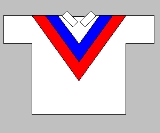
Great Britain national rugby league team

Encyclopedia
The Great Britain national rugby league team represents the United Kingdom
in rugby league football. Administered by the Rugby Football League
(RFL), the team is nicknamed "The Lions" or "Great Britain Lions".
In 2006, the RFL announced that after the 2007 All Golds Tour
the Great Britain team would no longer compete on a regular basis, and that players would be able to represent England
, Wales
and Scotland
at Test level. It is planned that the Great Britain team will come together in future only for occasional tours.
on three occasions: 1954
, 1960
and 1972
. Since 1995
the RFL have preferred to send the home nations
as separate teams for World Cup purposes. Great Britain continued to compete as a test playing nation both home and away (unlike the British and Irish Lions
rugby union
team, who are a touring team that play every four years). They competed against Australia for the Ashes, and New Zealand
for the Baskerville Shield
, as well the Tri-Nations
series with both Australia and New Zealand. Great Britain also played in series and tours against other nations such as France
, Papua New Guinea
and Fiji
.
XIII in reference to the name of the sport's governing body. After 1922 the name the Lions was first used. In 1948 the team became known as Great Britain for the Ashes Series. During the 1990s the Rugby Football League expanded this to Great Britain and Northern Ireland, and the jersey bore the name British Isles XIII. In 2004 the words "...and Northern Ireland" were dropped from the title, though the Irish shamrock continued to form part of the RFL's crest
and British Isles XIII remained on the jersey. At matches, the team was represented by the Union Flag
and the singing of God Save the Queen
, both symbols of the United Kingdom
. The practice of a UK-wide team being called Great Britain has a precedent with the Great British Olympic
team, though the formal name of the Olympic team includes "and Northern Ireland". The team continued to compete until the 2007 All Golds Tour
: henceforth, the Great Britain team will now be reserved for Lions tours of the Southern Hemisphere
. According to Richard Lewis, chairman of the Rugby Football League:
, known simply as the "Northern Union" side. Their first ever match was a win against a touring New Zealand side in January, 1908. The following season Great Bitain played host to the Australian side. The Northern Union's first match against the Kangaroos was a 22-all draw.
In June, 1910 the Northern Union embarked on its successful first tour of Australasia
.
Great Britain defeated a touring Australian side 2-1 in the 1921–22 Rugby league Ashes series.
The team travelled to Australia again on the HMS Indomitable in 1946 for the first post-war tour.
In 1954 the first ever Rugby League World Cup
was held in France and Great Britain were the winners. They came second in the 1957 World Cup in Australia and history was made when the returning French and British squads visited South Africa and played a series of exhibition matches in Benoni
, Durban
and East London
, all of which were won by the British.
The Lions won the next World Cup in 1960.
In 2002 Great Britain suffered their wost ever defeat at the hands of the Australians when they went down 64-10 in Sydney.
More recently, Great Britain enjoyed a three nil series whitewash of the touring New Zealand side in the 2007 All Golds tour
.
United Kingdom
The United Kingdom of Great Britain and Northern IrelandIn the United Kingdom and Dependencies, other languages have been officially recognised as legitimate autochthonous languages under the European Charter for Regional or Minority Languages...
in rugby league football. Administered by the Rugby Football League
Rugby Football League
The Rugby Football League is the governing body for professional rugby league football in England. Based at Red Hall in Leeds, it administers the England national rugby league team, the Challenge Cup, Super League and the Rugby League Championships...
(RFL), the team is nicknamed "The Lions" or "Great Britain Lions".
In 2006, the RFL announced that after the 2007 All Golds Tour
2007 All Golds Tour
The 2007 All Golds Tour was conducted as part of the celebrations of a century of rugby league in New Zealand. It was a re-creation of the original New Zealand rugby league tour of Great Britain in 1907. The New Zealand Kiwis toured Great Britain and France playing four test matches. They lost the...
the Great Britain team would no longer compete on a regular basis, and that players would be able to represent England
England national rugby league team
The England national rugby league team represent England in international rugby league football tournaments. The team has now seen a revival, having largely formed from the Great Britain team, who also represented Wales, Scotland and Ireland. The team is run under the auspices of the Rugby Football...
, Wales
Wales national rugby league team
The Wales national rugby league team represent Wales in international rugby league football matches. Currently the team is seventh in the RLIF World Rankings. The team were run under the auspices of the Rugby Football League, but an independent body, Wales Rugby League, now runs the team from...
and Scotland
Scotland national rugby league team
The Scotland national rugby league team represent Scotland in international rugby league football tournaments. The team is run under the auspices of the Scotland Rugby League, and are nicknamed The Bravehearts. Scotland are not regarded as a test nation...
at Test level. It is planned that the Great Britain team will come together in future only for occasional tours.
Competitions
Great Britain were one of the strongest teams in rugby league, though usually playing second fiddle to Australia. They won the Rugby League World CupRugby League World Cup
The Rugby League World Cup is an international rugby league competition contested by members of the Rugby League International Federation . It has been held nearly once every 4 years on average since its inaugural tournament in France in 1954...
on three occasions: 1954
1954 Rugby League World Cup
The first Rugby League World Cup was held in France in 1954 and officially known as the "Rugby World Cup". The prime motivators behind the idea of holding a rugby league world cup were the French, who were short of money following the seizing of their assets by the rugby union in World War II.The...
, 1960
1960 Rugby League World Cup
The 1960 Rugby League World Cup was the third staging of the tournament and the first Rugby league World Cup to be held in Great Britain. The same format as used in 1957 was used, with a group stage leading to a final table....
and 1972
1972 Rugby League World Cup
The sixth Rugby League World Cup was held in France in October and November of 1972. Australia started as the favourites to retain the trophy they had won just two years previously. New Zealand had beaten all three of the other nations in 1971 and France were expected to be tough opponents on their...
. Since 1995
1995 Rugby League World Cup
The 1995 Rugby League World Cup was held during October in the United Kingdom. It was the eleventh staging of the Rugby League World Cup and was marketed as the Halifax Centenary World Cup, reflecting the tournament's sponsorship and the fact that 1995 marked the 100th birthday of the sport...
the RFL have preferred to send the home nations
Home Nations
Home Nations is a collective term with one of two meanings depending on the context. Politically, it means the nations of the constituent countries of the United Kingdom...
as separate teams for World Cup purposes. Great Britain continued to compete as a test playing nation both home and away (unlike the British and Irish Lions
British and Irish Lions
The British and Irish Lions is a rugby union team made up of players from England, Scotland, Ireland and Wales...
rugby union
Rugby union
Rugby union, often simply referred to as rugby, is a full contact team sport which originated in England in the early 19th century. One of the two codes of rugby football, it is based on running with the ball in hand...
team, who are a touring team that play every four years). They competed against Australia for the Ashes, and New Zealand
New Zealand national rugby league team
The New Zealand national rugby league team has represented New Zealand in rugby league football since intercontinental competition began for the sport in 1907. Administered by the New Zealand Rugby League, they are commonly known as the Kiwis, after the native bird of that name...
for the Baskerville Shield
Baskerville Shield
The Baskerville Shield is a trophy awarded to the winner of rugby league test series between Great Britain and New Zealand. It named in honour of Albert Henry Baskerville, who organised the first ever tour by New Zealand of Great Britain in 1907....
, as well the Tri-Nations
Rugby League Tri-Nations
The Rugby League Tri-Nations was a rugby league tournament involving the top three nations in the sport: Australia, Great Britain and New Zealand...
series with both Australia and New Zealand. Great Britain also played in series and tours against other nations such as France
France national rugby league team
The France national rugby league team represent France in international rugby league tournaments. They are also sometimes referred to as "Les Tricolores" or more commonly "Les Chanticleers"...
, Papua New Guinea
Papua New Guinea national rugby league team
The Papua New Guinea national rugby league team represents Papua New Guinea internationally in the sport of rugby league football.In Papua New Guinea, Rugby league is highly popular and is regarded as the country’s national sport. The national side are known as the Kumuls...
and Fiji
Fiji national rugby league team
-Competitions:Fiji have participated in:*Pacific Cup *World Cup *World Sevens *Superleague World Nines *Superleague Oceania Tournament *Pacific Rim Competition -Results:...
.
Titles, selection and identity
The team was originally known as the Northern UnionRugby Football League
The Rugby Football League is the governing body for professional rugby league football in England. Based at Red Hall in Leeds, it administers the England national rugby league team, the Challenge Cup, Super League and the Rugby League Championships...
XIII in reference to the name of the sport's governing body. After 1922 the name the Lions was first used. In 1948 the team became known as Great Britain for the Ashes Series. During the 1990s the Rugby Football League expanded this to Great Britain and Northern Ireland, and the jersey bore the name British Isles XIII. In 2004 the words "...and Northern Ireland" were dropped from the title, though the Irish shamrock continued to form part of the RFL's crest
Heraldry
Heraldry is the profession, study, or art of creating, granting, and blazoning arms and ruling on questions of rank or protocol, as exercised by an officer of arms. Heraldry comes from Anglo-Norman herald, from the Germanic compound harja-waldaz, "army commander"...
and British Isles XIII remained on the jersey. At matches, the team was represented by the Union Flag
Flag of the United Kingdom
The United Kingdom of Great Britain and Northern Ireland uses as its national flag the royal banner known as the Union Flag or, popularly, Union Jack. The current design of the Union Flag dates from the union of Ireland and Great Britain in 1801...
and the singing of God Save the Queen
God Save the Queen
"God Save the Queen" is an anthem used in a number of Commonwealth realms and British Crown Dependencies. The words of the song, like its title, are adapted to the gender of the current monarch, with "King" replacing "Queen", "he" replacing "she", and so forth, when a king reigns...
, both symbols of the United Kingdom
United Kingdom
The United Kingdom of Great Britain and Northern IrelandIn the United Kingdom and Dependencies, other languages have been officially recognised as legitimate autochthonous languages under the European Charter for Regional or Minority Languages...
. The practice of a UK-wide team being called Great Britain has a precedent with the Great British Olympic
Olympic Games
The Olympic Games is a major international event featuring summer and winter sports, in which thousands of athletes participate in a variety of competitions. The Olympic Games have come to be regarded as the world’s foremost sports competition where more than 200 nations participate...
team, though the formal name of the Olympic team includes "and Northern Ireland". The team continued to compete until the 2007 All Golds Tour
2007 All Golds Tour
The 2007 All Golds Tour was conducted as part of the celebrations of a century of rugby league in New Zealand. It was a re-creation of the original New Zealand rugby league tour of Great Britain in 1907. The New Zealand Kiwis toured Great Britain and France playing four test matches. They lost the...
: henceforth, the Great Britain team will now be reserved for Lions tours of the Southern Hemisphere
Southern Hemisphere
The Southern Hemisphere is the part of Earth that lies south of the equator. The word hemisphere literally means 'half ball' or "half sphere"...
. According to Richard Lewis, chairman of the Rugby Football League:
- "It will bring consistency. What I am passionate about is the international game being consistent. To me, it has always been illogical that we play as Great Britain for three or four years, and when the World Cup comes along, suddenly we become England. In the major competitions, which will be most years, we will play as England. That will also allow Scotland and Wales to develop. We have then floated the concept of Great Britain to tour in 2010. It would be a tour as opposed to playing a formal competition, and I wouldn't restrict that to just Australia and New Zealand."
- "Next year (2007) will be the last time Great Britain will play. They will be England after that."
History
Initially Great Britain were represented by a team made up of players from the Northern Rugby Football UnionRugby Football League
The Rugby Football League is the governing body for professional rugby league football in England. Based at Red Hall in Leeds, it administers the England national rugby league team, the Challenge Cup, Super League and the Rugby League Championships...
, known simply as the "Northern Union" side. Their first ever match was a win against a touring New Zealand side in January, 1908. The following season Great Bitain played host to the Australian side. The Northern Union's first match against the Kangaroos was a 22-all draw.
In June, 1910 the Northern Union embarked on its successful first tour of Australasia
1910 Great Britain Lions tour of Australia and New Zealand
The 1910 Great Britain Lions tour of Australia and New Zealand was the first international tour of the Great Britain national rugby league team, "The Lions". They played the second ever Ashes series against Australia before travelling to Auckland to take on New Zealand...
.
Great Britain defeated a touring Australian side 2-1 in the 1921–22 Rugby league Ashes series.
The team travelled to Australia again on the HMS Indomitable in 1946 for the first post-war tour.
In 1954 the first ever Rugby League World Cup
Rugby League World Cup
The Rugby League World Cup is an international rugby league competition contested by members of the Rugby League International Federation . It has been held nearly once every 4 years on average since its inaugural tournament in France in 1954...
was held in France and Great Britain were the winners. They came second in the 1957 World Cup in Australia and history was made when the returning French and British squads visited South Africa and played a series of exhibition matches in Benoni
Benoni, Gauteng
Benoni is a city with 654,509 inhabitants on the East Rand in the South African province of Gauteng. Since 2000, it has been part of the Ekurhuleni Metropolitan Municipality.- History :...
, Durban
Durban
Durban is the largest city in the South African province of KwaZulu-Natal and the third largest city in South Africa. It forms part of the eThekwini metropolitan municipality. Durban is famous for being the busiest port in South Africa. It is also seen as one of the major centres of tourism...
and East London
London
London is the capital city of :England and the :United Kingdom, the largest metropolitan area in the United Kingdom, and the largest urban zone in the European Union by most measures. Located on the River Thames, London has been a major settlement for two millennia, its history going back to its...
, all of which were won by the British.
The Lions won the next World Cup in 1960.
In 2002 Great Britain suffered their wost ever defeat at the hands of the Australians when they went down 64-10 in Sydney.
More recently, Great Britain enjoyed a three nil series whitewash of the touring New Zealand side in the 2007 All Golds tour
2007 All Golds Tour
The 2007 All Golds Tour was conducted as part of the celebrations of a century of rugby league in New Zealand. It was a re-creation of the original New Zealand rugby league tour of Great Britain in 1907. The New Zealand Kiwis toured Great Britain and France playing four test matches. They lost the...
.
See also
- List of Great Britain national rugby league team players
- England rugby league team
- Scotland rugby league team
- Wales rugby league team
- Ireland national rugby league teamIreland national rugby league teamThe Ireland national rugby league team, known as the Wolfhounds, represent the island of Ireland in rugby league football. The team is organized by Rugby League Ireland and are accredited as an affiliate member of the Rugby League International Federation...