
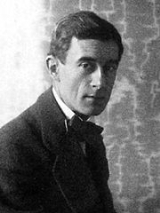
Joseph-Maurice Ravel was a French composer known especially for his melodies, orchestral and instrumental
texturesIn music, texture is the way the melodic, rhythmic, and harmonic materials are combined in a composition , thus determining the overall quality of sound of a piece...
and effects. Much of his
piano musicPiano Music is a suite of four short pieces composed by Alexina Louie in 1982 for the Alliance for Canadian New Music Projects. The four pieces are The Enchanted Bells, Changes, Distant Memories, and Once upon a time....
,
chamber musicChamber music is a form of classical music, written for a small group of instruments which traditionally could be accommodated in a palace chamber. Most broadly, it includes any art music that is performed by a small number of performers with one performer to a part...
,
vocal musicVocal music is a genre of music performed by one or more singers, with or without instrumental accompaniment, in which singing provides the main focus of the piece. Music which employs singing but does not feature it prominently is generally considered instrumental music Vocal music is a genre of...
and orchestral music has entered the standard concert repertoire.
Ravel's piano compositions, such as
Jeux d'eau,
MiroirsMiroirs, or "Reflections" is a suite for solo piano written by French impressionist composer Maurice Ravel between 1904 and 1905. First performed by Ricardo Viñes in 1906, Miroirs contains five movements, each dedicated to a fellow member of the French impressionist group, Les...
,
Le tombeau de CouperinLe tombeau de Couperin is a suite for solo piano by Maurice Ravel, composed between 1914 and 1917, in six movements. Each movement is dedicated to the memory of friends of the composer who had died fighting in World War I...
and
Gaspard de la nuitGaspard de la nuit: Trois poèmes pour piano d'après Aloysius Bertrand is a piece for solo piano by Maurice Ravel, written in 1908. It has three movements, each based on a poem by Aloysius Bertrand...
, demand considerable
virtuosityA virtuoso is an individual who possesses outstanding technical ability in the fine arts, at singing or playing a musical instrument. The plural form is either virtuosi or the Anglicisation, virtuosos, and the feminine form sometimes used is virtuosa...
from the performer, and his
orchestral musicAn orchestra is a sizable instrumental ensemble that contains sections of string, brass, woodwind, and percussion instruments. The term orchestra derives from the Greek ορχήστρα, the name for the area in front of an ancient Greek stage reserved for the Greek chorus...
, including
Daphnis et ChloéDaphnis et Chloé is a ballet with music by Maurice Ravel. Ravel described it as a "symphonie choréographique" . The scenario was adapted by Michel Fokine from an eponymous romance by the Greek writer Longus thought to date from around the 2nd century AD...
and his arrangement of
Modest MussorgskyModest Petrovich Mussorgsky was a Russian composer, one of the group known as 'The Five'. He was an innovator of Russian music in the romantic period...
's
Pictures at an ExhibitionPictures at an Exhibition is a suite in ten movements composed for piano by Russian composer Modest Mussorgsky in 1874.The suite is Mussorgsky's most famous piano composition, and has become a showpiece for virtuoso pianists...
, uses a variety of sound and
instrumentationIn music, instrumentation refers to the particular combination of musical instruments employed in a composition, and to the properties of those instruments individually...
.
Ravel is perhaps known best for his orchestral work
BoléroBoléro is a one-movement orchestral piece by Maurice Ravel . Originally composed as a ballet commissioned by Russian ballerina Ida Rubinstein, the piece, which premiered in 1928, is Ravel's most famous musical composition....
(1928), which he considered trivial and once described as "a piece for orchestra without music".
According to
SACEMSociété des auteurs, compositeurs et éditeurs de musique is a French professional association collecting payments of artists’ rights and distributing the rights to the original songwriters, composers and music publishers.-History:...
, Ravel's
estateAn estate is the net worth of a person at any point in time. It is the sum of a person's assets - legal rights, interests and entitlements to property of any kind - less all liabilities at that time. The issue is of special legal significance on a question of bankruptcy and death of the person...
earns more
royaltiesRoyalties are usage-based payments made by one party to another for the right to ongoing use of an asset, sometimes an intellectual property...
than that of any other French composer. According to international copyright law, Ravel's works have been in the
public domainWorks are in the public domain if the intellectual property rights have expired, if the intellectual property rights are forfeited, or if they are not covered by intellectual property rights at all...
since January 1, 2008, in most countries. In France, owing to anomalous
copyrightCopyright is a legal concept, enacted by most governments, giving the creator of an original work exclusive rights to it, usually for a limited time...
law extensions to account for the two world wars, they will not enter the
public domainWorks are in the public domain if the intellectual property rights have expired, if the intellectual property rights are forfeited, or if they are not covered by intellectual property rights at all...
until 2015.
Early life
Ravel was born in the
BasqueThe French Basque Country or Northern Basque Country situated within the western part of the French department of the Pyrénées-Atlantiques constitutes the north-eastern part of the Basque Country....
town of
CiboureCiboure is a commune in the Pyrénées-Atlantiques department in south-western France.It lies across the river Nivelle from the harbour of Saint-Jean-de-Luz....
, France, near
BiarritzBiarritz is a city which lies on the Bay of Biscay, on the Atlantic coast, in south-western France. It is a luxurious seaside town and is popular with tourists and surfers....
, close to the border with Spain, in 1875. His mother, Marie Delouart, was of
BasqueThe Basques as an ethnic group, primarily inhabit an area traditionally known as the Basque Country , a region that is located around the western end of the Pyrenees on the coast of the Bay of Biscay and straddles parts of north-central Spain and south-western France.The Basques are known in the...
descent and grew up in
MadridMadrid is the capital and largest city of Spain. The population of the city is roughly 3.3 million and the entire population of the Madrid metropolitan area is calculated to be 6.271 million. It is the third largest city in the European Union, after London and Berlin, and its metropolitan...
, Spain, while his father, Joseph Ravel, was a Swiss inventor and industrialist from French
Haute-SavoieHaute-Savoie is a French department in the Rhône-Alpes region of eastern France. It borders both Switzerland and Italy. The capital is Annecy. To the north is Lake Geneva and Switzerland; to the south and southeast are the Mont Blanc and Aravis mountain ranges and the French entrance to the Mont...
. Both were Catholics and they provided a happy and stimulating household for their children. Some of Joseph's inventions were quite important, including an early internal-combustion engine and a notorious
circusA circus is commonly a travelling company of performers that may include clowns, acrobats, trained animals, trapeze acts, musicians, hoopers, tightrope walkers, jugglers, unicyclists and other stunt-oriented artists...
machine, the "Whirlwind of Death", an automotive
loop-the-loopLoop-the-Loop is the 16th single of the J-pop singer KOTOKO, release on October 20, 2010. The title track is used as the opening theme for the anime series Motto To Love-Ru, the sequel to the anime adaptation of To Love-Ru....
that was quite a success until a fatal accident at the
Barnum & Bailey CircusRingling Bros. and Barnum & Bailey Circus is an American circus company. The company was started when the circus created by James Anthony Bailey and P. T. Barnum was merged with the Ringling Brothers Circus. The Ringling brothers purchased the Barnum & Bailey Circus in 1907, but ran the circuses...
in 1903. Joseph delighted in taking his sons to factories to see the latest mechanical devices, and he also had a keen interest in music and culture. Ravel substantiated his father's early influence by stating later, “As a child, I was sensitive to music—to every kind of music.”
Ravel was very fond of his mother, and her Basque-Spanish heritage was a strong influence on his life and music. Among his earliest memories are folk songs she sang to him. The family moved to Paris three months after the birth of Maurice, and there his younger brother Édouard was born. Édouard became his father’s favorite and also became an engineer. At age six, Maurice began piano lessons with Henry Ghys and received his first instruction in
harmonyIn music, harmony is the use of simultaneous pitches , or chords. The study of harmony involves chords and their construction and chord progressions and the principles of connection that govern them. Harmony is often said to refer to the "vertical" aspect of music, as distinguished from melodic...
,
counterpointIn music, counterpoint is the relationship between two or more voices that are independent in contour and rhythm and are harmonically interdependent . It has been most commonly identified in classical music, developing strongly during the Renaissance and in much of the common practice period,...
, and composition with Charles-René. His earliest public piano recital was in 1889 at age fourteen.
Though obviously talented at the piano, Ravel demonstrated a preference for composing. He was particularly impressed by the new
RussiaRussia or , officially known as both Russia and the Russian Federation , is a country in northern Eurasia. It is a federal semi-presidential republic, comprising 83 federal subjects...
n works conducted by
Nikolai Rimsky-KorsakovNikolai Andreyevich Rimsky-Korsakov was a Russian composer, and a member of the group of composers known as The Five.The Five, also known as The Mighty Handful or The Mighty Coterie, refers to a circle of composers who met in Saint Petersburg, Russia, in the years 1856–1870: Mily Balakirev , César...
at the
Exposition Universelle in 1889The Exposition Universelle of 1889 was a World's Fair held in Paris, France from 6 May to 31 October 1889.It was held during the year of the 100th anniversary of the storming of the Bastille, an event traditionally considered as the symbol for the beginning of the French Revolution...
. The foreign music at the exhibition also had a great influence on Ravel’s contemporaries
Erik SatieÉric Alfred Leslie Satie was a French composer and pianist. Satie was a colourful figure in the early 20th century Parisian avant-garde...
,
Emmanuel ChabrierEmmanuel Chabrier was a French Romantic composer and pianist. Although known primarily for two of his orchestral works, España and Joyeuse marche, he left an important corpus of operas , songs, and piano music as well...
, and most significantly
Claude DebussyClaude-Achille Debussy was a French composer. Along with Maurice Ravel, he was one of the most prominent figures working within the field of impressionist music, though he himself intensely disliked the term when applied to his compositions...
. That year Ravel also met
Ricardo ViñesRicardo Viñes was a Spanish pianist. He first publicly performed many important works by Maurice Ravel, Claude Debussy, Erik Satie, Manuel de Falla, Déodat de Séverac and Isaac Albéniz. He was also the piano teacher of composer Francis Poulenc and pianist Léo-Pol Morin.He was born in Lleida,...
, who would become one of his best friends, one of the foremost interpreters of his piano music, and an important link between Ravel and Spanish music. The students shared an appreciation for
Richard WagnerWilhelm Richard Wagner was a German composer, conductor, theatre director, philosopher, music theorist, poet, essayist and writer primarily known for his operas...
, the Russian school, and the writings of
Edgar Allan PoeEdgar Allan Poe was an American author, poet, editor and literary critic, considered part of the American Romantic Movement. Best known for his tales of mystery and the macabre, Poe was one of the earliest American practitioners of the short story and is considered the inventor of the detective...
,
Charles BaudelaireCharles Baudelaire was a French poet who produced notable work as an essayist, art critic, and pioneering translator of Edgar Allan Poe. His most famous work, Les Fleurs du mal expresses the changing nature of beauty in modern, industrializing Paris during the nineteenth century...
, and
Stéphane MallarméStéphane Mallarmé , whose real name was Étienne Mallarmé, was a French poet and critic. He was a major French symbolist poet, and his work anticipated and inspired several revolutionary artistic schools of the early 20th century, such as Dadaism, Surrealism, and Futurism.-Biography:Stéphane...
.
The Conservatoire and early career
Ravel’s parents encouraged his musical pursuits and sent him to the
Conservatoire de ParisThe Conservatoire de Paris is a college of music and dance founded in 1795, now situated in the avenue Jean Jaurès in the 19th arrondissement of Paris, France...
, first as a preparatory student and eventually as a piano major. His teachers included
Émile DescombesÉmile Descombes was a French pianist and teacher.Little is known about his life, except that he is variously described as an "associate", "disciple" and possibly even one of the last pupils, of Frédéric Chopin....
. He received a first prize in the piano student competition in 1891. Overall, however, he was not successful academically even as his musicianship matured dramatically. Considered “very gifted”, Ravel was also called “somewhat heedless” in his studies. Around 1893, Ravel created his earliest compositions, and he was introduced by his father to the café pianist
Erik SatieÉric Alfred Leslie Satie was a French composer and pianist. Satie was a colourful figure in the early 20th century Parisian avant-garde...
, whose distinctive personality and unorthodox musical experiments proved influential.
Ravel was not a "
bohemianBohemianism is the practice of an unconventional lifestyle, often in the company of like-minded people, with few permanent ties, involving musical, artistic or literary pursuits...
" and evidenced little of the typical trauma of adolescence. At twenty years of age, Ravel was already "self-possessed, a little aloof, intellectually biased, given to mild banter." He dressed like a
dandyA dandy is a man who places particular importance upon physical appearance, refined language, and leisurely hobbies, pursued with the appearance of nonchalance in a cult of Self...
and was meticulous about his appearance and demeanor. Short in stature, light in frame, and bony in features, Ravel had the "appearance of a well-dressed jockey". His large head seemed suitably matched to his great intellect. He was well-read and later accumulated a library of over 1,000 volumes. In his younger adulthood, Ravel was usually bearded in the fashion of the day, though later he dispensed with all whiskers. Though reserved, Ravel was sensitive and self-critical, and had a mischievous sense of humor. He became a life-long tobacco smoker in his youth, and he enjoyed strongly flavored meals, fine wine, and spirited conversation.
After failing to meet the requirement of earning a competitive medal in three consecutive years, Ravel was expelled in 1895. He turned down a music professorship in
TunisiaTunisia , officially the Tunisian RepublicThe long name of Tunisia in other languages used in the country is: , is the northernmost country in Africa. It is a Maghreb country and is bordered by Algeria to the west, Libya to the southeast, and the Mediterranean Sea to the north and east. Its area...
then returned to the Conservatoire in 1898 and started his studies with
Gabriel FauréGabriel Urbain Fauré was a French composer, organist, pianist and teacher. He was one of the foremost French composers of his generation, and his musical style influenced many 20th century composers...
, determined to focus on composing rather than piano playing. He studied composition with Fauré until he was dismissed from the class in 1900 for having won neither the
fugueIn music, a fugue is a compositional technique in two or more voices, built on a subject that is introduced at the beginning in imitation and recurs frequently in the course of the composition....
nor the composition prize. He remained an auditor with Fauré until he left the Conservatoire in 1903. Ravel found his teacher’s personality and methods sympathetic and they remained friends and colleagues. He also undertook private studies with
André GedalgeAndré Gedalge , was an influential French composer and teacher.- Biography :André Gedalge was born at 75 rue des Saints-Pères, in Paris, where he first worked as a bookseller and editor specializing in livres de prix for public schools...
, whom he later stated was responsible for "the most valuable elements of my technique." Ravel studied the ability of each instrument carefully in order to determine the possible effects, and was sensitive to their color and
timbreIn music, timbre is the quality of a musical note or sound or tone that distinguishes different types of sound production, such as voices and musical instruments, such as string instruments, wind instruments, and percussion instruments. The physical characteristics of sound that determine the...
. This may account for his success as an orchestrator and as a
transcriberIn music, transcription can mean notating a piece or a sound which was previously unnotated, as, for example, an improvised jazz solo. Further examples include ethnomusicological notation of oral traditions of folk music, such as Béla Bartók's and Ralph Vaughan Williams' collections of the national...
of his own piano works and those of other composers, such as
MussorgskyModest Petrovich Mussorgsky was a Russian composer, one of the group known as 'The Five'. He was an innovator of Russian music in the romantic period...
,
DebussyClaude-Achille Debussy was a French composer. Along with Maurice Ravel, he was one of the most prominent figures working within the field of impressionist music, though he himself intensely disliked the term when applied to his compositions...
and
SchumannRobert Schumann, sometimes known as Robert Alexander Schumann, was a German composer, aesthete and influential music critic. He is regarded as one of the greatest and most representative composers of the Romantic era....
.
His first significant work,
HabaneraThe habanera is a genre of Cuban popular dance music of the 19th century. It is a creolized form which developed from the contradanza. It has a characteristic "Habanera rhythm", and is performed with sung lyrics...
for two pianos, was later transcribed into the well-known third movement of his
Rapsodie espagnoleRapsodie espagnole is an orchestral rhapsody written by Maurice Ravel. Composed between 1907 and 1908, the Rapsodie represents one of Ravel's first major works for orchestra....
, which he dedicated to
Charles-Wilfrid de BériotCharles-Wilfrid de Bériot was a French pianist, teacher and composer.He was born in Paris in 1833, the son of the violinist Charles Auguste de Bériot and his then common-law wife, the famed soprano Maria Malibran Charles-Wilfrid de Bériot (12 February 183322 October 1914) was a French pianist,...
, another of his professors at the Conservatoire. His first published work was
Menuet antiqueMenuet antique is a piece for solo piano composed by Maurice Ravel. The original piano version was written in 1895 and orchestrated by the composer in 1929...
, dedicated to and premiered by Viñes. In 1899, Ravel conducted his first orchestral piece,
Shéhérazade, and was greeted by a raucous mixture of boos and applause. Critics termed the piece "a jolting debut: a clumsy plagiarism of the Russian School" and called Ravel a “mediocrely gifted
debutanteA débutante is a young lady from an aristocratic or upper class family who has reached the age of maturity, and as a new adult, is introduced to society at a formal "début" presentation. It should not be confused with a Debs...
... who will perhaps become something if not someone in about ten years, if he works hard.”
As the most gifted composer of his class and as a leader, with Debussy, of avant-garde French music, Ravel would continue to have a difficult time with the critics for some time to come.
Around 1900, Ravel joined with a number of innovative young artists, poets, critics, and musicians who were referred to as the
ApachesLes Apaches or was a group of French musicians, writers and artists which formed around 1900. Members of the group included:* Edouard Benedictus, painter and composer* M.D...
(hooligans), a name coined by Viñes to represent his band of "artistic outcasts". The group met regularly until the beginning of World War I and the members often inspired each other with intellectual argument and performances of their works before the group. For a time, the influential group included
Igor StravinskyIgor Fyodorovich Stravinsky ; 6 April 1971) was a Russian, later naturalized French, and then naturalized American composer, pianist, and conductor....
and
Manuel de FallaManuel de Falla y Matheu was a Spanish Andalusian composer of classical music. With Isaac Albéniz, Enrique Granados and Joaquín Turina he is one of Spain's most important musicians of the first half of the 20th century....
. One of the first works Ravel performed for the Apaches was
Jeux d'eau, his first piano masterpiece and clearly a pathfinding impressionistic work. Viñes performed the public premiere of this piece and Ravel's other early masterpiece
Pavane pour une infante défuntePavane pour une infante défunte is a well-known piece written for solo piano by the French composer Maurice Ravel in 1899 when he was studying composition at the Conservatoire de Paris under Gabriel Fauré. Ravel also published an orchestrated version of the Pavane in 1910...
in 1902.
During his years at the Conservatoire, Ravel tried numerous times to win the prestigious
Prix de RomeThe Prix de Rome was a scholarship for arts students, principally of painting, sculpture, and architecture. It was created, initially for painters and sculptors, in 1663 in France during the reign of Louis XIV. It was an annual bursary for promising artists having proved their talents by...
, but to no avail; he was probably considered too radical by the conservatives, including Director
Théodore DuboisFrançois-Clément Théodore Dubois was a French composer, organist and music teacher.-Biography:Théodore Dubois was born in Rosnay in Marne. He studied first under Louis Fanart and later at the Paris Conservatoire under Ambroise Thomas. He won the Prix de Rome in 1861...
. One of Ravel's submitted pieces, the String Quartet in F, probably modeled on
Debussy’s QuartetClaude Debussy wrote his sole String Quartet in G minor, Op. 10 in 1893.-Background:The previous year Debussy had abandoned the opera Rodrigue et Chimène...
(1893), is now a standard work of chamber music, though at the time it was criticized and found lacking academically. In 1905, Ravel's final year of eligibility for the Prix de Rome, Ravel did not even pass the preliminary test, despite being favored to win one of the two first prizes available. Instead, all six selected finalists were students of Charles Lenepveu, a member of the jury and heir apparent of Dubois as director of the Conservatoire. The scandal – named the "Ravel Affair" by the Parisian press – engaged the entire artistic community, pitting conservatives against the avant-garde, and eventually caused the resignation of Dubois and his replacement by Fauré instead of Lenepveu, a vindication of sorts for Ravel.
Alfred EdwardsAlfred Charles Edwards was a journalist and magnate of the French press.-Life:The son of Charles Edwards and his French wife Emilie Caporal , Alfred Edwards studied in Paris before beginning his press career with Le Figaro in...
, editor of
Le MatinLe Matin is a daily newspaper published by Edipresse in Lausanne, Switzerland. The French language tabloid has a circulation of 69,350 and a readership of 331,000.The Sunday edition Le Matin dimanche has a circulation of 207,945....
, who had taken particular interest in the incident, took Ravel on a seven-week canal trip on his yacht
Aimée through the
Low CountriesThe Low Countries are the historical lands around the low-lying delta of the Rhine, Scheldt, and Meuse rivers, including the modern countries of Belgium, the Netherlands, Luxembourg and parts of northern France and western Germany....
in June and July of 1905, the first time Ravel traveled abroad. Though deprived of the opportunity to study in Rome, the decade after the scandal proved to be Ravel's most productive, and included his "Spanish period".
Ravel and Debussy
Ravel met Debussy in the 1890s. Debussy was older than Ravel by some twelve years and his pioneering
Prélude à l'après-midi d'un faunePrélude à l'après-midi d'un faune , commonly known by its English title Prelude to the Afternoon of a Faun, is a symphonic poem for orchestra by Claude Debussy, approximately 10 minutes in duration...
was influential among the younger musicians including Ravel, who were impressed by the new language of impressionism. In 1900, Ravel was invited to Debussy’s home and they played each other’s works. Viñes became the preferred piano performer for both composers and a go-between. The two composers attended many of the same musical events and were performed at the same concerts. Ravel and the Apaches were strong supporters of Debussy’s controversial public debut of his unconventional opera
Pelléas et MélisandePelléas et Mélisande is an opera in five acts with music by Claude Debussy. The French libretto was adapted from Maurice Maeterlinck's Symbolist play Pelléas et Mélisande...
, which garnered Debussy both fame and scorn.
The two musicians also appreciated much the same musical heritage and operated in the same artistic milieu, but they differed in terms of personality and their approach to music. Debussy was considered more spontaneous and casual in his composing while Ravel was more attentive to form and craftsmanship. Even though they worked independently of one another, because they employed differing means to similar ends, and because superficial similarities and even some more substantive ones are evident, the public and the critics associated them more than the facts warranted.
Ravel wrote that Debussy’s “genius was obviously one of great individuality, creating its own laws, constantly in evolution, expressing itself freely, yet always faithful to French tradition. For Debussy, the musician and the man, I have had profound admiration, but by nature I am different from Debussy.” Ravel further stated, “I think I have always personally followed a direction opposed to that of the
symbolismSymbolism was a late nineteenth-century art movement of French, Russian and Belgian origin in poetry and other arts. In literature, the style had its beginnings with the publication Les Fleurs du mal by Charles Baudelaire...
of Debussy.”
They admired each other’s music and Ravel even played Debussy’s work in public on occasion. However, Ravel did criticize Debussy sometimes, particularly regarding his orchestration, and he once said, "If I had the time, I would reorchestrate
La merLa mer, trois esquisses symphoniques pour orchestre , or simply La mer , is an orchestral composition by the French composer Claude Debussy. It was started in 1903 in France and completed in 1905 on the English Channel coast in Eastbourne...
."
By 1905, factions formed for each composer and the two groups began feuding in public. Disputes arose as to questions of chronology about their respective works and who influenced whom. The public tension caused personal estrangement. As Ravel said, “It is probably better after all for us to be on frigid terms for illogical reasons.” Ravel stoically absorbed superficial comparisons with Debussy promulgated by biased critics, including Pierre Lalo, an anti-Ravel critic who stated, “Where M. Debussy is all sensitivity, M. Ravel is all insensitivity, borrowing without hesitation not only technique but the sensitivity of other people.” During 1913, in a remarkable coincidence, both Ravel and Debussy independently produced and published musical settings for poems by
Stéphane MallarméStéphane Mallarmé , whose real name was Étienne Mallarmé, was a French poet and critic. He was a major French symbolist poet, and his work anticipated and inspired several revolutionary artistic schools of the early 20th century, such as Dadaism, Surrealism, and Futurism.-Biography:Stéphane...
, again provoking comparisons of their work and their perceived influence on each other, which continued even after Debussy’s death five years later.
Early major works
The next of Ravel’s piano compositions to become famous was
MiroirsMiroirs, or "Reflections" is a suite for solo piano written by French impressionist composer Maurice Ravel between 1904 and 1905. First performed by Ricardo Viñes in 1906, Miroirs contains five movements, each dedicated to a fellow member of the French impressionist group, Les...
(Mirrors, 1905), five piano pieces which marked a “
harmonicIn music, harmony is the use of simultaneous pitches , or chords. The study of harmony involves chords and their construction and chord progressions and the principles of connection that govern them. Harmony is often said to refer to the "vertical" aspect of music, as distinguished from melodic...
evolution” and which one commentator described as “intensely descriptive and pictorial. They banish all sentiment in expression but offer to the listener a number of refined sensory elements which can be appreciated according to his imagination.” Next was his
Histoires naturelles (Nature Stories), five humorous songs evoking the presence of five animals. Two years later, Ravel completed his
Rapsodie espagnoleRapsodie espagnole is an orchestral rhapsody written by Maurice Ravel. Composed between 1907 and 1908, the Rapsodie represents one of Ravel's first major works for orchestra....
, his first major "Spanish" piece, written first for piano four hands and then scored for orchestra. Though it employs folk-like melodies, no actual folk songs are quoted. It premiered in 1908 to generally good reviews, with one critic stating that it was "one of the most interesting novelties of the season", while Pierre Lalo (as usual) reacted negatively, calling it "laborious and pedantic". Next followed Ravel's music for the opera
L'heure espagnoleL'heure espagnole is a one-act opera, described as a comédie musicale, with music by Maurice Ravel to a French libretto by Franc-Nohain, based on his play of the same name first performed at the Théâtre de l'Odéon on 28 October 1904...
(The Spanish Hour), full of humor and rich in color, employing a wide variety of instruments and their characteristic qualities, including the
tromboneThe trombone is a musical instrument in the brass family. Like all brass instruments, sound is produced when the player’s vibrating lips cause the air column inside the instrument to vibrate...
,
sarrusophoneThe sarrusophone is a family of transposing musical instruments patented and placed into production by Pierre-Louis Gautrot in 1856. It was named after the French bandmaster Pierre-Auguste Sarrus who is credited with the concept of the instrument...
,
tubaThe tuba is the largest and lowest-pitched brass instrument. Sound is produced by vibrating or "buzzing" the lips into a large cupped mouthpiece. It is one of the most recent additions to the modern symphony orchestra, first appearing in the mid-19th century, when it largely replaced the...
,
celestaThe celesta or celeste is a struck idiophone operated by a keyboard. Its appearance is similar to that of an upright piano or of a large wooden music box . The keys are connected to hammers which strike a graduated set of metal plates suspended over wooden resonators...
,
xylophoneThe xylophone is a musical instrument in the percussion family that consists of wooden bars struck by mallets...
, and
bellsA bell is a simple sound-making device. The bell is a percussion instrument and an idiophone. Its form is usually a hollow, cup-shaped object, which resonates upon being struck...
. The libretto was by
Franc-NohainMaurice Étienne Legrand, who published under the pseudonym Franc-Nohain was a French librettist and poet. He is best known for his libretti for Maurice Ravel's opera L'heure espagnole and for numerous operettas by Claude Terrasse.Maurice Étienne Legrand was born in 1872 in Corbigny; his father...
, after his own comedy of the same name.
Ravel further extended his mastery of impressionistic piano music with
Gaspard de la nuitGaspard de la nuit: Trois poèmes pour piano d'après Aloysius Bertrand is a piece for solo piano by Maurice Ravel, written in 1908. It has three movements, each based on a poem by Aloysius Bertrand...
, based on a collection by the same name by
Aloysius BertrandLouis-Jacques-Napoléon “Aloysius” Bertrand was a French poet instrumental in the introduction of the prose poem into French literature and is credited with inspiring later Symbolist poets...
, with some influence from the writings of
Edgar Allan PoeEdgar Allan Poe was an American author, poet, editor and literary critic, considered part of the American Romantic Movement. Best known for his tales of mystery and the macabre, Poe was one of the earliest American practitioners of the short story and is considered the inventor of the detective...
, particularly in the second part. Viñes, as usual, performed the premiere but his performance displeased Ravel, and their relationship became strained from then on. For future premieres, Ravel replaced Viñes with
Marguerite LongMarguerite Long was a French pianist and teacher.Marguerite Marie-Charlotte Long was born in Nîmes. She studied with Henri Fissot at the Paris Conservatoire, taking a premier prix in 1891, and privately with Antoine François Marmontel...
. Also unhappy with the conservative musical establishment which was discouraging performance of new music, around this time Ravel, Fauré, and some of his pupils formed the Société musicale indépendante (SMI). In 1910, the society presented the premiere of Ravel’s
Ma mère l'oyeMa mère l'oye is a musical work by French composer Maurice Ravel.-Piano versions:Ravel originally wrote Ma mère l'oye as a piano duet for the Godebski children, Mimi and Jean, ages 6 and 7. Ravel dedicated this work for four hands to the children...
(Mother Goose) in its original piano duet version. With this work, Ravel followed in the tradition of Schumann, Mussorgsky, and Debussy, who also created memorable works of childhood themes. In 1912, Ravel's
Ma mère l'oye was performed as a ballet (with added music) after being first transcribed from piano to orchestra. Looking to expand his contacts and career, Ravel made his first foreign tours to England and
ScotlandScotland is a country that is part of the United Kingdom. Occupying the northern third of the island of Great Britain, it shares a border with England to the south and is bounded by the North Sea to the east, the Atlantic Ocean to the north and west, and the North Channel and Irish Sea to the...
during 1909 and 1911.
Daphnis et Chloé
Ravel began work with impresario
Sergei DiaghilevSergei Pavlovich Diaghilev , usually referred to outside of Russia as Serge, was a Russian art critic, patron, ballet impresario and founder of the Ballets Russes, from which many famous dancers and choreographers would arise.-Early life and career:...
during 1909 for the ballet
Daphnis et ChloéDaphnis et Chloé is a ballet with music by Maurice Ravel. Ravel described it as a "symphonie choréographique" . The scenario was adapted by Michel Fokine from an eponymous romance by the Greek writer Longus thought to date from around the 2nd century AD...
commissioned by Diaghilev with the lead danced by the famous ballet dancer and choreographer
Vaslav NijinskyVaslav Nijinsky was a Russian ballet dancer and choreographer of Polish descent, cited as the greatest male dancer of the 20th century. He grew to be celebrated for his virtuosity and for the depth and intensity of his characterizations...
. Diaghilev had taken Paris by storm the previous year in his Parisian opera debut,
Boris GodunovBoris Godunov is an opera by Modest Mussorgsky . The work was composed between 1868 and 1873 in Saint Petersburg, Russia. It is Mussorgsky's only completed opera and is considered his masterpiece. Its subjects are the Russian ruler Boris Godunov, who reigned as Tsar during the Time of Troubles,...
.
Daphnis et Chloé took three years to complete, with conflicts constantly arising among the principal artists, including
Léon BakstLéon Samoilovitch Bakst was a Russian painter and scene- and costume designer. He was a member of the Sergei Diaghilev circle and the Ballets Russes, for which he designed exotic, richly coloured sets and costumes...
(sets and costumes),
Michel FokineMichel Fokine was a groundbreaking Russian choreographer and dancer.-Biography:...
(libretto), and Ravel (music). In frustration, Diaghilev nearly cancelled the project. The ballet had an unenthusiastic reception and lasted only two performances, only to be revived to acclaim a year later.
Igor StravinskyIgor Fyodorovich Stravinsky ; 6 April 1971) was a Russian, later naturalized French, and then naturalized American composer, pianist, and conductor....
called
Daphnis et Chloé "one of the most beautiful products of all French music" and author Burnett James claims that it is "Ravel's most impressive single achievement, as it is his most opulent and confident orchestral score". The work is notable for its rhythmic diversity, lyricism, and evocations of nature. The score utilizes a large orchestra and two
chorusesA choir, chorale or chorus is a musical ensemble of singers. Choral music, in turn, is the music written specifically for such an ensemble to perform.A body of singers who perform together as a group is called a choir or chorus...
, one onstage and one offstage. So exhausting was the effort to score the ballet that Ravel's health deteriorated, with a diagnosis of
neurastheniaNeurasthenia is a psycho-pathological term first used by George Miller Beard in 1869 to denote a condition with symptoms of fatigue, anxiety, headache, neuralgia and depressed mood...
soon forcing him to rest for several months. During 1914, just as World War I began, Ravel composed his
Piano TrioMaurice Ravel's Trio for piano, violin and cello is a chamber work composed in 1914. Dedicated to Ravel's counterpoint teacher André Gedalge, the trio was first performed in Paris in January 1915, by Alfredo Casella , Gabriel Willaume , and Louis Feuillard...
(for piano, violin, and cello) with its Basque themes. The piece, difficult to play well, is considered a masterpiece among trio works.
War years
Although he considered his small stature and light weight an advantage to becoming an aviator, and he tried every means of securing service as a
flyerAn aviator is a person who flies an aircraft. The first recorded use of the term was in 1887, as a variation of 'aviation', from the Latin avis , coined in 1863 by G. de la Landelle in Aviation Ou Navigation Aérienne...
, during the First World War Ravel was not allowed to enlist as a pilot because of his age and weak health. Instead, he became a truck driver stationed at the
VerdunVerdun is a city in the Meuse department in Lorraine in north-eastern France. It is a sub-prefecture of the department.Verdun is the biggest city in Meuse, although the capital of the department is the slightly smaller city of Bar-le-Duc.- History :...
front. At one point Ravel's unit engaged a German unit that included a young
Adolf HitlerAdolf Hitler was an Austrian-born German politician and the leader of the National Socialist German Workers Party , commonly referred to as the Nazi Party). He was Chancellor of Germany from 1933 to 1945, and head of state from 1934 to 1945...
. With his mother’s death in 1917, his fondest relationship ended and he fell into a “horrible despair”, adding to his ill health and the general gloom over the suffering endured by the people of his country during the war. However, during the war years, Ravel did manage some compositions, including one of his most popular works,
Le tombeau de CouperinLe tombeau de Couperin is a suite for solo piano by Maurice Ravel, composed between 1914 and 1917, in six movements. Each movement is dedicated to the memory of friends of the composer who had died fighting in World War I...
, a commemoration of the musical ideals of
François CouperinFrançois Couperin was a French Baroque composer, organist and harpsichordist. He was known as Couperin le Grand to distinguish him from other members of the musically talented Couperin family.-Life:Couperin was born in Paris...
, the early 18th century composer, which premiered in 1919. Each movement is dedicated to a friend of Ravel's who died in the war, with the final movement dedicated to the deceased husband of Ravel’s favorite pianist Marguerite Long. During the war, the Ligue Nationale pour la Defense de la Musique Française (National League for the Defense of French Music) was formed but Ravel, despite his strong antipathy for the German aggression, declined to join stating:
“it would be dangerous for French composers to ignore systematically the works of their foreign colleagues, and thus form themselves into a sort of national coterie: our musical art, so rich at the present time, would soon degenerate and become isolated by its own academic formulas.”
Ravel was exhausted and lacking creative spirit at the war’s end in 1918. With the death of Debussy and the emergence of Satie, Schoenberg, and Stravinsky, modern classical music had a new style to which Ravel would shortly re-group and make his contribution.
1920s
Around 1920, Diaghilev commissioned Ravel to write
La valseLa valse, un poème choréographique pour orchestre , is a work written by Maurice Ravel from February 1919 until 1920 ; it was conceived as a ballet but is now more often heard as a concert work...
(The Waltz), originally named
Wien (Vienna), which was to be used for a projected ballet. The piece, conceived many years earlier, became a
waltzThe waltz is a ballroom and folk dance in time, performed primarily in closed position.- History :There are several references to a sliding or gliding dance,- a waltz, from the 16th century including the representations of the printer H.S. Beheim...
with a
macabreIn works of art, macabre is the quality of having a grim or ghastly atmosphere. Macabre works emphasize the details and symbols of death....
undertone, famous for its “fantastic and fatal whirling”. However, it was rejected by Diaghilev as “not a ballet. It’s a portrait of ballet”. Ravel, hurt by the comment, ended the relationship. Subsequently, it became a popular concert work and when the two men met again in 1925, Ravel refused to shake Diaghilev's hand. Diaghilev challenged Ravel to a
duelA duel is an arranged engagement in combat between two individuals, with matched weapons in accordance with agreed-upon rules.Duels in this form were chiefly practised in Early Modern Europe, with precedents in the medieval code of chivalry, and continued into the modern period especially among...
, but friends persuaded Diaghilev to recant. The two never met again.
In 1920, the French government awarded Ravel the
Légion d'honneurThe Legion of Honour, or in full the National Order of the Legion of Honour is a French order established by Napoleon Bonaparte, First Consul of the Consulat which succeeded to the First Republic, on 19 May 1802...
, but he refused it. The next year, he retired to the French countryside where he continued to write music, albeit even less prolifically, but in more tranquil surroundings. He returned regularly to Paris for performances and socializing, and increased his foreign concert tours. Ravel maintained his influential participation with the SMI which continued its active role of promoting new music, particularly of British and American composers such as
Arnold BaxSir Arnold Edward Trevor Bax, KCVO was an English composer and poet. His musical style blended elements of romanticism and impressionism, often with influences from Irish literature and landscape. His orchestral scores are noted for their complexity and colourful instrumentation...
,
Ralph Vaughan WilliamsRalph Vaughan Williams OM was an English composer of symphonies, chamber music, opera, choral music, and film scores. He was also a collector of English folk music and song: this activity both influenced his editorial approach to the English Hymnal, beginning in 1904, in which he included many...
,
Aaron CoplandAaron Copland was an American composer, composition teacher, writer, and later in his career a conductor of his own and other American music. He was instrumental in forging a distinctly American style of composition, and is often referred to as "the Dean of American Composers"...
, and
Virgil ThomsonVirgil Thomson was an American composer and critic. He was instrumental in the development of the "American Sound" in classical music...
. With Debussy’s death, Ravel became perceived popularly as the main composer of French classical music. As Fauré stated in a letter to Ravel in October 1922, “I am happier than you can imagine about the solid position which you occupy and which you have acquired so brilliantly and so rapidly. It is a source of joy and pride for your old professor.” In 1922, Ravel completed his
Sonata for Violin and Cello. Dedicated to Debussy’s memory, the work features the thinner texture popular with the younger postwar composers.
The English, in particular, lauded Ravel, as
The TimesThe Times is a British daily national newspaper, first published in London in 1785 under the title The Daily Universal Register . The Times and its sister paper The Sunday Times are published by Times Newspapers Limited, a subsidiary since 1981 of News International...
reported April 16, 1923, “Since the death of Debussy, he has represented to English musicians the most vigorous current in modern French music." In reality, however, Ravel’s own music was no longer considered
au courant in France. Satie had become the inspiring force for the new generation of French composers known as
Les SixLes six is a name, inspired by The Five, given in 1920 by critic Henri Collet in an article titled "" to a group of six composers working in Montparnasse whose music is often seen as a reaction against the musical style of Richard Wagner and impressionist music.-Members:Formally, the Groupe des...
. Ravel was fully aware of this, and was mostly effective in preventing a serious breach between his generation of musicians and the younger group.
In post-war Paris, American musical influence was strong.
JazzJazz is a musical style that originated at the beginning of the 20th century in African American communities in the Southern United States. It was born out of a mix of African and European music traditions. From its early development until the present, jazz has incorporated music from 19th and 20th...
particularly was played in the cafes and became popular, and French composers including Ravel and
Darius MilhaudDarius Milhaud was a French composer and teacher. He was a member of Les Six—also known as The Group of Six—and one of the most prolific composers of the 20th century. His compositions are influenced by jazz and make use of polytonality...
were applying jazz elements to their work. Also in vogue was a return to simplicity in orchestration and a transition from the great scale of the works of
Gustav MahlerGustav Mahler was a late-Romantic Austrian composer and one of the leading conductors of his generation. He was born in the village of Kalischt, Bohemia, in what was then Austria-Hungary, now Kaliště in the Czech Republic...
and
Richard StraussRichard Georg Strauss was a leading German composer of the late Romantic and early modern eras. He is known for his operas, which include Der Rosenkavalier and Salome; his Lieder, especially his Four Last Songs; and his tone poems and orchestral works, such as Death and Transfiguration, Till...
.
Igor StravinskyIgor Fyodorovich Stravinsky ; 6 April 1971) was a Russian, later naturalized French, and then naturalized American composer, pianist, and conductor....
and
Sergei ProkofievSergei Sergeyevich Prokofiev was a Russian composer, pianist and conductor who mastered numerous musical genres and is regarded as one of the major composers of the 20th century...
were in the ascendant, and
Arnold SchoenbergArnold Schoenberg was an Austrian composer, associated with the expressionist movement in German poetry and art, and leader of the Second Viennese School...
's experiments were leading music into
atonalityAtonality in its broadest sense describes music that lacks a tonal center, or key. Atonality in this sense usually describes compositions written from about 1908 to the present day where a hierarchy of pitches focusing on a single, central tone is not used, and the notes of the chromatic scale...
. These trends posed challenges for Ravel, always a slow and deliberate composer, who desired to keep his music relevant but still revered the past. This may have played a part in his declining output and longer composing time during the 1920s.
Around 1922, Ravel completed his famous orchestral arrangement of
Mussorgsky’sModest Petrovich Mussorgsky was a Russian composer, one of the group known as 'The Five'. He was an innovator of Russian music in the romantic period...
Pictures at an ExhibitionPictures at an Exhibition is a suite in ten movements composed for piano by Russian composer Modest Mussorgsky in 1874.The suite is Mussorgsky's most famous piano composition, and has become a showpiece for virtuoso pianists...
, commissioned by
Serge KoussevitzkySerge Koussevitzky , was a Russian-born Jewish conductor, composer and double-bassist, known for his long tenure as music director of the Boston Symphony Orchestra from 1924 to 1949.-Early career:...
, which through its widespread popularity brought Ravel great fame and substantial profit. The first half of the 1920s was a particularly lean period for composing but Ravel did complete successful concert tours to Amsterdam, Milan, London, Madrid, and Vienna, which also boosted his fame. By 1925, by virtue of the unwelcomed pressure of a performance deadline, he finally finished his opera
L'enfant et les sortilègesL'enfant et les sortilèges: Fantaisie lyrique en deux parties is an opera in one act, with music by Maurice Ravel to a libretto by Colette. It is Ravel's second opera, his first being L'heure espagnole...
, with its significant jazz and
ragtimeRagtime is an original musical genre which enjoyed its peak popularity between 1897 and 1918. Its main characteristic trait is its syncopated, or "ragged," rhythm. It began as dance music in the red-light districts of American cities such as St. Louis and New Orleans years before being published...
accents. Famed writer
ColetteColette was the surname of the French novelist and performer Sidonie-Gabrielle Colette . She is best known for her novel Gigi, upon which Lerner and Loewe based the stage and film musical comedies of the same title.-Early life and marriage:Colette was born to retired military officer Jules-Joseph...
provided the libretto. Around this time, he also completed
Chansons madécasses, the summit of his vocal art.
In 1927, Ravel’s String Quartet received its first complete recording. By this time Ravel, like
Edward ElgarSir Edward William Elgar, 1st Baronet OM, GCVO was an English composer, many of whose works have entered the British and international classical concert repertoire. Among his best-known compositions are orchestral works including the Enigma Variations, the Pomp and Circumstance Marches, concertos...
, had become convinced of the importance of recording his works, especially with his input and direction. He made recordings nearly every year from then until his death. That same year, he completed and premiered his Sonata for Violin and Piano, his last chamber work, with its second movement (titled “Blues”) gaining much attention.
Ravel also served as a juror with
Florence Meyer BlumenthalFlorence Meyer Blumenthal was a philanthropist who founded the Fondation franco-américaine Florence Blumenthal , which awarded the Prix Blumenthal from 1919-1954 to painters, sculptors, decorators, engravers, writers, and musicians — to promote Franco- American relations.For their altruism,...
in awarding the
Prix BlumenthalThe Prix Blumenthal was a grant or stipend awarded through the philanthropy of Florence Meyer Blumenthal — and the foundation she created, Fondation franco-américaine Florence Blumenthal — to discover young French artists, aid them financially, and in the process draw the United States...
, a grant given between 1919 and 1954 to young French painters, sculptors, decorators, engravers, writers, and musicians.
American tour
After two months of planning, in 1928 Ravel made a four-month concert tour in North America, for a promised minimum of $10,000 (approximately $, adjusted for inflation). In New York City, he received a standing ovation, unlike any of his unenthusiastic premieres in Paris. His all-Ravel concert in Boston was equally acclaimed. The noted critic
Olin Downes Olin Downes was an American music critic.He studied piano, music theory, and music criticism in New York and Boston, and it was in those two cities that he made his career as a music critic—first with the Boston Post and then with the New York Times...
wrote, “Mr. Ravel has pursued his way as an artist quietly and very well. He has disdained superficial or meretricious effects. He has been his own most unsparing critic.” Ravel conducted most of the leading orchestras in the U.S. from coast to coast and visited twenty-five cities.
He also met the American composer
George GershwinGeorge Gershwin was an American composer and pianist. Gershwin's compositions spanned both popular and classical genres, and his most popular melodies are widely known...
in New York and went with him to hear jazz in
HarlemHarlem is a neighborhood in the New York City borough of Manhattan, which since the 1920s has been a major African-American residential, cultural and business center. Originally a Dutch village, formally organized in 1658, it is named after the city of Haarlem in the Netherlands...
, probably hearing some of the famous jazz musicians such as
Duke EllingtonEdward Kennedy "Duke" Ellington was an American composer, pianist, and big band leader. Ellington wrote over 1,000 compositions...
. There is a story that when Gershwin met Ravel, he mentioned that he would like to study with the French composer. According to Gershwin, the Frenchman retorted, "Why do you want to become a second-rate Ravel when you are already a first-rate Gershwin?"
The second part of the story has Ravel asking Gershwin how much money he made. Upon hearing Gershwin's reply, Ravel suggested that maybe
he should study with Gershwin. This tale may well be apocryphal: Gershwin seems also to have told a near-identical story about a conversation with
Arnold SchoenbergArnold Schoenberg was an Austrian composer, associated with the expressionist movement in German poetry and art, and leader of the Second Viennese School...
, and some have claimed it was with
Igor StravinskyIgor Fyodorovich Stravinsky ; 6 April 1971) was a Russian, later naturalized French, and then naturalized American composer, pianist, and conductor....
. (See
George GershwinGeorge Gershwin was an American composer and pianist. Gershwin's compositions spanned both popular and classical genres, and his most popular melodies are widely known...
.) In any event, this had to have been before Ravel wrote
BoléroBoléro is a one-movement orchestral piece by Maurice Ravel . Originally composed as a ballet commissioned by Russian ballerina Ida Rubinstein, the piece, which premiered in 1928, is Ravel's most famous musical composition....
, which became financially very successful for him.
Ravel then visited New Orleans and imbibed the jazz scene there as well. His admiration of
jazzJazz is a musical style that originated at the beginning of the 20th century in African American communities in the Southern United States. It was born out of a mix of African and European music traditions. From its early development until the present, jazz has incorporated music from 19th and 20th...
, increased by his American visit, caused him to include some jazz elements in a few of his later compositions, especially the two
piano concertoA piano concerto is a concerto written for piano and orchestra.See also harpsichord concerto; some of these works are occasionally played on piano...
s. The great success of his American tour made Ravel famous internationally.
Final years
After returning to France, Ravel composed his most famous and controversial orchestral work
BoléroBoléro is a one-movement orchestral piece by Maurice Ravel . Originally composed as a ballet commissioned by Russian ballerina Ida Rubinstein, the piece, which premiered in 1928, is Ravel's most famous musical composition....
, originally called
Fandango. Ravel called it “an experiment in a very special and limited direction”. He stated his idea for the piece, “I am going to try to repeat it a number of times on different orchestral levels but without any development.” He conceived of it as an accompaniment to a ballet and not as an orchestral piece as, in his own opinion, “it has no music in it”, and was somewhat taken aback by its popular success. A public dispute began with conductor
Arturo ToscaniniArturo Toscanini was an Italian conductor. One of the most acclaimed musicians of the late 19th and 20th century, he was renowned for his intensity, his perfectionism, his ear for orchestral detail and sonority, and his photographic memory...
. The Italian maestro, taking liberties with Ravel’s strict instructions, conducted the piece at a faster tempo and with an “accelerando at the finish”. Ravel insisted “I don’t ask for my music to be interpreted, but only that it should be played.” In the end, the feuding only helped to increase the work’s fame. A Hollywood film titled
BoleroBolero is a musical drama film starring George Raft and Carole Lombard. The movie was a rare chance for Raft to star and to play a dancer, which had been his profession in New York City, rather than a gangster. The film takes its title from the Maurice Ravel composition Boléro .-Plot:The film...
(1934), starring
Carole LombardCarole Lombard was an American actress. She was particularly noted for her comedic roles in the screwball comedies of the 1930s...
and
George RaftGeorge Raft was an American film actor and dancer identified with portrayals of gangsters in crime melodramas of the 1930s and 1940s...
, made major use of the theme. Ravel made one of the few recordings of his own music when he conducted his
Boléro with the
Lamoureux OrchestraThe Orchestre Lamoureux officially known as the Société des Nouveaux-Concerts and also known as the Concerts Lamoureux) is an orchestral concert society which once gave weekly concerts by its own orchestra, founded in Paris by Charles Lamoureux in 1881...
in 1930.
Remarkably, Ravel composed both of his
piano concertoA piano concerto is a concerto written for piano and orchestra.See also harpsichord concerto; some of these works are occasionally played on piano...
s simultaneously. He completed the
Concerto for the Left HandThe Piano Concerto for the Left Hand in D major was composed by Maurice Ravel between 1929 and 1930, concurrently with his Piano Concerto in G. It was commissioned by the Austrian pianist, Paul Wittgenstein, who lost his right arm during World War I....
first. The work was commissioned by Austrian pianist
Paul WittgensteinPaul Wittgenstein was an Austrian-born concert pianist, who became known for his ability to play with just his left hand, after he lost his right arm during the First World War. He devised novel techniques, including pedal and hand-movement combinations, that allowed him to play chords previously...
, who had lost his right arm during World War I. Ravel was inspired by the technical challenges of the project. As Ravel stated, “In a work of this kind, it is essential to give the impression of a texture no thinner than that of a part written for both hands.” At the premiere of the work, Ravel, not proficient enough to perform the work with only his left hand, played two-handed and Wittgenstein was reportedly underwhelmed by it. But later Wittgenstein stated, “Only much later, after I’d studied the concerto for months, did I become fascinated by it and realized what a great work it was.” In 1933, Wittgenstein played the work in concert for the first time to instant acclaim. Critic Henry Prunières wrote, “From the opening measures, we are plunged into a world in which Ravel has but rarely introduced us.”
The other piano concerto was completed a year later. Its lighter tone follows the models of
MozartWolfgang Amadeus Mozart , baptismal name Johannes Chrysostomus Wolfgangus Theophilus Mozart , was a prolific and influential composer of the Classical era. He composed over 600 works, many acknowledged as pinnacles of symphonic, concertante, chamber, piano, operatic, and choral music...
,
Domenico ScarlattiGiuseppe Domenico Scarlatti was an Italian composer who spent much of his life in the service of the Portuguese and Spanish royal families. He is classified as a Baroque composer chronologically, although his music was influential in the development of the Classical style...
, and
Saint-SaënsCharles-Camille Saint-Saëns was a French Late-Romantic composer, organist, conductor, and pianist. He is known especially for The Carnival of the Animals, Danse macabre, Samson and Delilah, Piano Concerto No. 2, Cello Concerto No. 1, Havanaise, Introduction and Rondo Capriccioso, and his Symphony...
, and also makes use of jazz-like themes. Ravel dedicated the work to his favorite pianist,
Marguerite LongMarguerite Long was a French pianist and teacher.Marguerite Marie-Charlotte Long was born in Nîmes. She studied with Henri Fissot at the Paris Conservatoire, taking a premier prix in 1891, and privately with Antoine François Marmontel...
, who played it and popularized it across Europe in over twenty cities, and they recorded it together in 1932. EMI later reissued the 1932 recording on
LPThe LP, or long-playing microgroove record, is a format for phonograph records, an analog sound storage medium. Introduced by Columbia Records in 1948, it was soon adopted as a new standard by the entire record industry...
and CD. Although Ravel was listed as the conductor on the original
78-rpm discsA gramophone record, commonly known as a phonograph record , vinyl record , or colloquially, a record, is an analog sound storage medium consisting of a flat disc with an inscribed, modulated spiral groove...
, it is possible he merely supervised the recording.
Ravel, ever modest, was bemused by the critics' sudden favor of him since his American tour: “Didn’t I represent to the critics for a long time the most perfect example of insensitivity and lack of emotion?... And the successes they have given me in the past few years are just as unimportant.”
Illness and death
In 1932, Ravel suffered a major blow to the head in a taxi accident. This injury was not considered serious at the time. However, afterwards he began to experience
aphasiaAphasia is an impairment of language ability. This class of language disorder ranges from having difficulty remembering words to being completely unable to speak, read, or write....
-like symptoms and was frequently absent-minded. He had begun work on music for a film,
Adventures of Don QuixoteAdventures of Don Quixote is the English title of a film adaptation of the classic Miguel de Cervantes novel, directed by Georg Wilhelm Pabst, starring the famous operatic bass Feodor Chaliapin. Although the film stars Chaliapin, it is not an opera; however, he does sing three songs in it. It is...
(1933) from
Miguel de CervantesMiguel de Cervantes Saavedra was a Spanish novelist, poet, and playwright. His magnum opus, Don Quixote, considered the first modern novel, is a classic of Western literature, and is regarded amongst the best works of fiction ever written...
's celebrated novel, featuring the Russian bass
Feodor ChaliapinFeodor Ivanovich Chaliapin was a Russian opera singer. The possessor of a large and expressive bass voice, he enjoyed an important international career at major opera houses and is often credited with establishing the tradition of naturalistic acting in his chosen art form.During the first phase...
and directed by
G. W. Pabst-Biography:Pabst was born in Raudnitz, Bohemia, Austria-Hungary , the son of a railroad employee.Returning from the United States, he was in France when World War I began...
. When Ravel became unable to compose, and could not write down the musical ideas he heard in his mind, Pabst hired
Jacques IbertJacques François Antoine Ibert was a French composer. Having studied music from an early age, he studied at the Paris Conservatoire and won its top prize, the Prix de Rome at his first attempt, despite studies interrupted by his service in World War I.Ibert pursued a successful composing career,...
. However, three songs for baritone and orchestra that Ravel composed for the film were later published under the title
Don Quichotte a Dulcinée, and have been performed and recorded.
On April 8, 2008, the
New York Times published an article suggesting Ravel may have been in the early stages of
frontotemporal dementiaFrontotemporal dementia is a clinical syndrome caused by degeneration of the frontal lobe of the brain and may extend back to the temporal lobe...
during 1928, and this might account for the repetitive nature of
Boléro.
This accords with an earlier article, published in a journal of neurology, that closely examines Ravel's clinical history and argues that his works
Boléro and
Piano Concerto for the Left HandThe Piano Concerto for the Left Hand in D major was composed by Maurice Ravel between 1929 and 1930, concurrently with his Piano Concerto in G. It was commissioned by the Austrian pianist, Paul Wittgenstein, who lost his right arm during World War I....
both indicate the impacts of neurological disease. This is contradicted somewhat, however, by the earlier cited comments by Ravel about how he created the deliberately repetitious theme for
Boléro.
In late 1937, Ravel consented to experimental brain surgery. One hemisphere of his brain was re-inflated with
serous fluidIn physiology, the term serous fluid is used for various bodily fluids that are typically pale yellow and transparent, and of a benign nature, that fill the inside of body cavities. Serous fluid originates from serous glands, with secretions enriched with proteins and water. Serous fluid may also...
. He awoke from the surgery, called for his brother Édouard, lapsed into a coma and died shortly afterwards at the age of 62. Ravel probably died as a result of the brain surgery, with the underlying cause arguably being a
brain injuryTraumatic brain injury , also known as intracranial injury, occurs when an external force traumatically injures the brain. TBI can be classified based on severity, mechanism , or other features...
caused by the automobile accident in 1932, and not from a
brain tumorA brain tumor is an intracranial solid neoplasm, a tumor within the brain or the central spinal canal.Brain tumors include all tumors inside the cranium or in the central spinal canal...
as some believe. This confusion may arise because his friend
George GershwinGeorge Gershwin was an American composer and pianist. Gershwin's compositions spanned both popular and classical genres, and his most popular melodies are widely known...
had died from a brain tumor only five months earlier. Ravel was buried with his parents in a
graniteGranite is a common and widely occurring type of intrusive, felsic, igneous rock. Granite usually has a medium- to coarse-grained texture. Occasionally some individual crystals are larger than the groundmass, in which case the texture is known as porphyritic. A granitic rock with a porphyritic...
tomb at the cemetery at
Levallois-PerretLevallois-Perret is a commune in the northwestern suburbs of Paris, France. It is located from the centre of Paris.-Name:The name Levallois-Perret comes from two housing developments, Champerret and Village Levallois , and which resulted in the incorporation of the...
, a suburb of northwest Paris.
Personal life
Ravel is not known to have had any intimate relationships, and his personal life, and especially his
sexualitySexual orientation describes a pattern of emotional, romantic, or sexual attractions to the opposite sex, the same sex, both, or neither, and the genders that accompany them. By the convention of organized researchers, these attractions are subsumed under heterosexuality, homosexuality,...
, remains a mystery. Ravel made a remark at one time suggesting that because he was such a perfectionist composer, so devoted to his work, he could never have a lasting intimate relationship with anyone. However, according to close friend and student
Manuel RosenthalManuel Rosenthal was a French composer and conductor who held leading positions with musical organizations in France and America...
, he asked violinist Hélène Jourdan-Mourhange to marry him, although she dismissed him, saying 'No, Maurice, I'm extremely fond of you, as you know, but only as a friend, and I couldn't possibly consider marrying you.' He is quoted as saying "The only love affair I have ever had was with music". Some of his friends suggested that Ravel frequented the
bordelloBrothels are business establishments where patrons can engage in sexual activities with prostitutes. Brothels are known under a variety of names, including bordello, cathouse, knocking shop, whorehouse, strumpet house, sporting house, house of ill repute, house of prostitution, and bawdy house...
s of Paris, but no factual evidence has ever been found to substantiate this rumor.
A recent hypothesis presented by David Lamaze, a composition teacher at the Conservatoire de Rennes in France, is that he hid in his music representations of the nickname and the name of Misia Godebska, transcribed into two groups of notes, Godebska = G D E B A and Misia = Mi + Si + A = E B A. He was invited onto her boat during a 1905 cruise on the
Rhine after his failure at the
Prix de RomeThe Prix de Rome was a scholarship for arts students, principally of painting, sculpture, and architecture. It was created, initially for painters and sculptors, in 1663 in France during the reign of Louis XIV. It was an annual bursary for promising artists having proved their talents by...
, for which her husband,
Alfred EdwardsAlfred Charles Edwards was a journalist and magnate of the French press.-Life:The son of Charles Edwards and his French wife Emilie Caporal , Alfred Edwards studied in Paris before beginning his press career with Le Figaro in...
, organized a scandal in the newspapers. This same man owned the
Casino de ParisThe Casino de Paris, located at 16, rue de Clichy, in the 9th arrondissement is one of the well known music halls of Paris, with a history dating back to the 18th century. Contrary to what the name might suggest, it is a performance venue, not a gambling house...
where the Ravel family had a number staged,
Tourbillon de la mort (A Car Somersault). The family of her half-brother, Cipa Godebski, is said to have been like a second family for Ravel. In 1907 on Misia's boat
L'Aimée, Ravel completed
L'heure espagnoleL'heure espagnole is a one-act opera, described as a comédie musicale, with music by Maurice Ravel to a French libretto by Franc-Nohain, based on his play of the same name first performed at the Théâtre de l'Odéon on 28 October 1904...
and the
Rapsodie espagnoleRapsodie espagnole is an orchestral rhapsody written by Maurice Ravel. Composed between 1907 and 1908, the Rapsodie represents one of Ravel's first major works for orchestra....
, and at the premiere of
Daphnis et ChloéDaphnis et Chloé is a ballet with music by Maurice Ravel. Ravel described it as a "symphonie choréographique" . The scenario was adapted by Michel Fokine from an eponymous romance by the Greek writer Longus thought to date from around the 2nd century AD...
, Ravel arrived late and did not go to his box but to Misia's, where he offered her a
Japanese dollJapanese traditional dolls are known by the name in Japan, which literally means human shape.There are various types of Japanese dolls, some representing children and babies, some the imperial court, warriors and heroes, fairy-tale characters, gods and demons, and also people of the daily life of...
. In her memoirs, Misia hid all these facts.
Musical sources
Active during a period of great artistic innovations and diversification, Ravel benefited from many sources and influences, though his music defies any facile classification. As
Vladimir JankélévitchVladimir Jankélévitch was a French philosopher and musicologist.- Biography :Jankélévitch was the son of Russian Jewish parents, who had emigrated to France....
notes in his biography, "no influence can claim to have conquered him entirely […]. Ravel remains ungraspable behind all these masks which the snobbery of the century has attempted to impose."
Ravel's musical language was ultimately very original, neither absolutely modernist nor impressionist. Like Debussy, Ravel categorically refused this description of “impressionist” which he believed was reserved exclusively for painting.
Ravel was a remarkable synthesist of disparate styles. His music matured early into his innovative and distinct style. As a student, he studied the scores of composers of the past methodically: as he stated, "in order to know one's own craft, one must study the craft of others." Though he liked the new French music, during his youth Ravel still felt fond of the older French styles of
FranckCésar-Auguste-Jean-Guillaume-Hubert Franck was a composer, pianist, organist, and music teacher who worked in Paris during his adult life....
and the
RomanticismRomanticism was an artistic, literary and intellectual movement that originated in the second half of the 18th century in Europe, and gained strength in reaction to the Industrial Revolution...
of
BeethovenLudwig van Beethoven was a German composer and pianist. A crucial figure in the transition between the Classical and Romantic eras in Western art music, he remains one of the most famous and influential composers of all time.Born in Bonn, then the capital of the Electorate of Cologne and part of...
and
WagnerWilhelm Richard Wagner was a German composer, conductor, theatre director, philosopher, music theorist, poet, essayist and writer primarily known for his operas...
. Or, as Viñes put it, discussing Ravel's aesthetics (not his religion):
"He is, moreover, very complicated, there being in him a mixture of Middle AgesThe Middle Ages is a periodization of European history from the 5th century to the 15th century. The Middle Ages follows the fall of the Western Roman Empire in 476 and precedes the Early Modern Era. It is the middle period of a three-period division of Western history: Classic, Medieval and Modern...
Catholicism and satanicSatanism is a group of religions that is composed of a diverse number of ideological and philosophical beliefs and social phenomena. Their shared feature include symbolic association with, admiration for the character of, and even veneration of Satan or similar rebellious, promethean, and...
impiety, but also a love of Art and Beauty which guide him and which make him react candidly."
Certain aspects of his music can be considered to belong to the tradition of 18th century French classicism beginning with
CouperinFrançois Couperin was a French Baroque composer, organist and harpsichordist. He was known as Couperin le Grand to distinguish him from other members of the musically talented Couperin family.-Life:Couperin was born in Paris...
and
RameauJean-Philippe Rameau was one of the most important French composers and music theorists of the Baroque era. He replaced Jean-Baptiste Lully as the dominant composer of French opera and is also considered the leading French composer for the harpsichord of his time, alongside François...
as in
Le Tombeau de CouperinLe tombeau de Couperin is a suite for solo piano by Maurice Ravel, composed between 1914 and 1917, in six movements. Each movement is dedicated to the memory of friends of the composer who had died fighting in World War I...
. The uniquely 19th century French sensibilities of
FauréGabriel Urbain Fauré was a French composer, organist, pianist and teacher. He was one of the foremost French composers of his generation, and his musical style influenced many 20th century composers...
and
ChabrierEmmanuel Chabrier was a French Romantic composer and pianist. Although known primarily for two of his orchestral works, España and Joyeuse marche, he left an important corpus of operas , songs, and piano music as well...
are reflected in
Sérénade grotesque,
Pavane pour une infante défuntePavane pour une infante défunte is a well-known piece written for solo piano by the French composer Maurice Ravel in 1899 when he was studying composition at the Conservatoire de Paris under Gabriel Fauré. Ravel also published an orchestrated version of the Pavane in 1910...
, and
Menuet antiqueMenuet antique is a piece for solo piano composed by Maurice Ravel. The original piano version was written in 1895 and orchestrated by the composer in 1929...
, while pieces such as
Jeux d'eauJeux d'eau or "water games", is an umbrella term in the history of gardens for the "water features" that were introduced into mid-16th century Mannerist Italian gardens...
, and the String Quartet in F owe something to the innovations of
SatieÉric Alfred Leslie Satie was a French composer and pianist. Satie was a colourful figure in the early 20th century Parisian avant-garde...
and
DebussyClaude-Achille Debussy was a French composer. Along with Maurice Ravel, he was one of the most prominent figures working within the field of impressionist music, though he himself intensely disliked the term when applied to his compositions...
. The virtuosity and poetry of
Gaspard de la nuitGaspard de la nuit: Trois poèmes pour piano d'après Aloysius Bertrand is a piece for solo piano by Maurice Ravel, written in 1908. It has three movements, each based on a poem by Aloysius Bertrand...
and
Concerto for the left handThe Piano Concerto for the Left Hand in D major was composed by Maurice Ravel between 1929 and 1930, concurrently with his Piano Concerto in G. It was commissioned by the Austrian pianist, Paul Wittgenstein, who lost his right arm during World War I....
hint at
LisztFranz Liszt ; ), was a 19th-century Hungarian composer, pianist, conductor, and teacher.Liszt became renowned in Europe during the nineteenth century for his virtuosic skill as a pianist. He was said by his contemporaries to have been the most technically advanced pianist of his age...
and
ChopinFrédéric François Chopin was a Polish composer and virtuoso pianist. He is considered one of the great masters of Romantic music and has been called "the poet of the piano"....
. His admiration for American
jazzJazz is a musical style that originated at the beginning of the 20th century in African American communities in the Southern United States. It was born out of a mix of African and European music traditions. From its early development until the present, jazz has incorporated music from 19th and 20th...
is echoed in
L'enfant et les sortilègesL'enfant et les sortilèges: Fantaisie lyrique en deux parties is an opera in one act, with music by Maurice Ravel to a libretto by Colette. It is Ravel's second opera, his first being L'heure espagnole...
, the Violin Sonata and the Piano Concerto in G, while the Russian school of music inspired homage in
"À la manière de BorodinAlexander Porfiryevich Borodin was a Russian Romantic composer and chemist of Georgian–Russian parentage. He was a member of the group of composers called The Five , who were dedicated to producing a specifically Russian kind of art music...
" and the orchestration of
MussorgskyModest Petrovich Mussorgsky was a Russian composer, one of the group known as 'The Five'. He was an innovator of Russian music in the romantic period...
's
Pictures at an ExhibitionPictures at an Exhibition is a suite in ten movements composed for piano by Russian composer Modest Mussorgsky in 1874.The suite is Mussorgsky's most famous piano composition, and has become a showpiece for virtuoso pianists...
. Additionally, he variously cited
MozartWolfgang Amadeus Mozart , baptismal name Johannes Chrysostomus Wolfgangus Theophilus Mozart , was a prolific and influential composer of the Classical era. He composed over 600 works, many acknowledged as pinnacles of symphonic, concertante, chamber, piano, operatic, and choral music...
,
Saint-SaënsCharles-Camille Saint-Saëns was a French Late-Romantic composer, organist, conductor, and pianist. He is known especially for The Carnival of the Animals, Danse macabre, Samson and Delilah, Piano Concerto No. 2, Cello Concerto No. 1, Havanaise, Introduction and Rondo Capriccioso, and his Symphony...
,
SchubertFranz Peter Schubert was an Austrian composer.Although he died at an early age, Schubert was tremendously prolific. He wrote some 600 Lieder, nine symphonies , liturgical music, operas, some incidental music, and a large body of chamber and solo piano music...
and
SchoenbergArnold Schoenberg was an Austrian composer, associated with the expressionist movement in German poetry and art, and leader of the Second Viennese School...
as inspirations for various pieces.
Musical style
Ravel's music was innovative, though he did not follow the contemporary trend towards
atonalityAtonality in its broadest sense describes music that lacks a tonal center, or key. Atonality in this sense usually describes compositions written from about 1908 to the present day where a hierarchy of pitches focusing on a single, central tone is not used, and the notes of the chromatic scale...
, as pioneered by
SchoenbergArnold Schoenberg was an Austrian composer, associated with the expressionist movement in German poetry and art, and leader of the Second Viennese School...
. Instead, he applied the
aestheticsAesthetics is a branch of philosophy dealing with the nature of beauty, art, and taste, and with the creation and appreciation of beauty. It is more scientifically defined as the study of sensory or sensori-emotional values, sometimes called judgments of sentiment and taste...
of the new French school of
ChabrierEmmanuel Chabrier was a French Romantic composer and pianist. Although known primarily for two of his orchestral works, España and Joyeuse marche, he left an important corpus of operas , songs, and piano music as well...
,
SatieÉric Alfred Leslie Satie was a French composer and pianist. Satie was a colourful figure in the early 20th century Parisian avant-garde...
, and particularly
DebussyClaude-Achille Debussy was a French composer. Along with Maurice Ravel, he was one of the most prominent figures working within the field of impressionist music, though he himself intensely disliked the term when applied to his compositions...
. Ravel's compositions rely upon
modalIn the theory of Western music since the ninth century, mode generally refers to a type of scale. This usage, still the most common in recent years, reflects a tradition dating to the middle ages, itself inspired by the theory of ancient Greek music.The word encompasses several additional...
melodies instead of using the major or minor scales for their predominant harmonic language. He preferred modes with major or minor flavors; for example, the
MixolydianMixolydian mode may refer to one of three things: the name applied to one of the ancient Greek harmoniai or tonoi, based on a particular octave species or scale; one of the medieval church modes; a modern musical mode or diatonic scale, related to the medieval mode.-Greek Mixolydian:The idea of a...
instead of the
major scaleIn music theory, the major scale or Ionian scale is one of the diatonic scales. It is made up of seven distinct notes, plus an eighth which duplicates the first an octave higher. In solfege these notes correspond to the syllables "Do, Re, Mi, Fa, Sol, La, Ti/Si, ", the "Do" in the parenthesis at...
, and the
AeolianThe Aeolian mode is a musical mode or, in modern usage, a diatonic scale called the natural minor scale.The word "Aeolian" in the music theory of ancient Greece was an alternative name for what Aristoxenus called the Low Lydian tonos , nine semitones...
instead of the harmonic minor. As a result, there are virtually no leading tones in his output. Melodically, he tended to favor two modes: the
DorianDue to historical confusion, Dorian mode or Doric mode can refer to three very different musical modes or diatonic scales, the Greek, the medieval, and the modern.- Greek Dorian mode :...
and the
PhrygianThe Phrygian mode can refer to three different musical modes: the ancient Greek tonos or harmonia sometimes called Phrygian, formed on a particular set octave species or scales; the Medieval Phrygian mode, and the modern conception of the Phrygian mode as a diatonic scale, based on the latter...
. Following the teachings of
GédalgeAndré Gedalge , was an influential French composer and teacher.- Biography :André Gedalge was born at 75 rue des Saints-Pères, in Paris, where he first worked as a bookseller and editor specializing in livres de prix for public schools...
, Ravel placed high importance on melody, once stating to Vaughan Williams, that there is "an implied melodic outline in all vital music."
In no way dependent on exclusively traditional modal practices, Ravel used extended harmonies and intricate modulations. He was fond of
chords of the ninth and eleventhIn music, extended chords are tertian chords or triads with notes extended, or added, beyond the seventh. Ninth, eleventh, and thirteenth chords are extended chords...
, and his characteristic harmonies are largely the result of a fondness for unresolved appoggiaturas, such as in the
Valses nobles et sentimentales.
He was inspired by various dances, his favorite being the
minuetA minuet, also spelled menuet, is a social dance of French origin for two people, usually in 3/4 time. The word was adapted from Italian minuetto and French menuet, and may have been from French menu meaning slender, small, referring to the very small steps, or from the early 17th-century popular...
, composing the
Menuet sur le nom d'HaydnMenuet sur le nom d'Haydn is a minuet written by Maurice Ravel in 1909 to mark the centenary of Joseph Haydn's death.-Description:The piece is only 54 bars long and lasts for about a minute and a half. The theme is based on Haydn's own name as a five-note motif...
in 1908, to commemorate the centenary of the death of
Joseph HaydnFranz Joseph Haydn , known as Joseph Haydn , was an Austrian composer, one of the most prolific and prominent composers of the Classical period. He is often called the "Father of the Symphony" and "Father of the String Quartet" because of his important contributions to these forms...
. Other forms from which Ravel drew material include the forlane,
rigaudonThe rigaudon is a French baroque dance with a lively duple metre. The music is similar to that of a bourrée, but the rigaudon is rhythmically simpler with regular phrases ....
,
waltzA waltz, or valse from the French term, is a piece of music in triple meter, most often written in time signature but sometimes in 3/8 or 3/2...
, czardas,
habaneraThe habanera is a genre of Cuban popular dance music of the 19th century. It is a creolized form which developed from the contradanza. It has a characteristic "Habanera rhythm", and is performed with sung lyrics...
,
passacagliaThe passacaglia is a musical form that originated in early seventeenth-century Spain and is still used by contemporary composers. It is usually of a serious character and is often, but not always, based on a bass-ostinato and written in triple metre....
, and the boléro.
He believed that composers should be aware of both individual and national consciousness. For him, Basque music was influential. He intended to write an earlier concerto,
Zazpiak Bat, but it was never finished. The title is a result of his Basque heritage: meaning 'The Seven Are One' (see
Zazpiak BatZazpiak Bat is a motto attributed to Basque explorer Antoine-Thomson d'Abbadie in the nineteenth century, from the Basque words zazpiak meaning 'the seven' and bat meaning 'one', translates as "the seven [are] one" and refers to the seven Basque Country traditional provinces...
), it refers to the seven Basque regions, and was a motto often used in association with the idea of a Basque nation. Instead, Ravel abandoned the piece, using its nationalistic themes and rhythms in some of his other pieces. Ravel also used other folk themes including Hebraic,
GreekGreek is an independent branch of the Indo-European family of languages. Native to the southern Balkans, it has the longest documented history of any Indo-European language, spanning 34 centuries of written records. Its writing system has been the Greek alphabet for the majority of its history;...
, and
HungarianHungarian is a Uralic language, part of the Ugric group. With some 14 million speakers, it is one of the most widely spoken non-Indo-European languages in Europe....
.
Ravel has almost always been considered one of the two great French
impressionistImpressionism in music was a tendency in European classical music, mainly in France, which appeared in the late nineteenth century and continued into the middle of the twentieth century. Similarly to its precursor in the visual arts, musical impressionism focuses on a suggestion and an atmosphere...
composers, the other being Debussy. In reality Ravel was much more than an Impressionist (and in fact he resented being labelled as such). For example, he made extensive use of rollicking jazz tunes in his Piano Concerto in G Major in the first and third movements. Ravel also imitates
PaganiniNiccolò Paganini was an Italian violinist, violist, guitarist, and composer. He was one of the most celebrated violin virtuosi of his time, and left his mark as one of the pillars of modern violin technique...
's and
LisztFranz Liszt ; ), was a 19th-century Hungarian composer, pianist, conductor, and teacher.Liszt became renowned in Europe during the nineteenth century for his virtuosic skill as a pianist. He was said by his contemporaries to have been the most technically advanced pianist of his age...
's virtuoso gypsy themes and technique in
Tzigane. In his
À la manière de...Borodine (
In the manner of...BorodinAlexander Porfiryevich Borodin was a Russian Romantic composer and chemist of Georgian–Russian parentage. He was a member of the group of composers called The Five , who were dedicated to producing a specifically Russian kind of art music...
), Ravel plays with the ability to both mimic and remain original. In a more complex situation,
A la maniere de...Emmanuel ChabrierEmmanuel Chabrier was a French Romantic composer and pianist. Although known primarily for two of his orchestral works, España and Joyeuse marche, he left an important corpus of operas , songs, and piano music as well...
/Paraphrase sur un air de GounodCharles-François Gounod was a French composer, known for his Ave Maria as well as his operas Faust and Roméo et Juliette.-Biography:...
("Faust IIème acte"), Ravel takes on a theme from Gounod's
FaustFaust is a drame lyrique in five acts by Charles Gounod to a French libretto by Jules Barbier and Michel Carré from Carré's play Faust et Marguerite, in turn loosely based on Johann Wolfgang von Goethe's Faust, Part 1...
and arranges it in the style of Chabrier. He also composed short pieces in the manner of
HaydnFranz Joseph Haydn , known as Joseph Haydn , was an Austrian composer, one of the most prolific and prominent composers of the Classical period. He is often called the "Father of the Symphony" and "Father of the String Quartet" because of his important contributions to these forms...
and his teacher
FauréGabriel Urbain Fauré was a French composer, organist, pianist and teacher. He was one of the foremost French composers of his generation, and his musical style influenced many 20th century composers...
. Even in writing in the style of others, Ravel's own voice as a composer remained distinct.
Ravel considered himself in many ways a
classicistClassicism, in the arts, refers generally to a high regard for classical antiquity, as setting standards for taste which the classicists seek to emulate. The art of classicism typically seeks to be formal and restrained: of the Discobolus Sir Kenneth Clark observed, "if we object to his restraint...
. He often relied on traditional forms, such as the
ternary formTernary form, sometimes called song form, is a three-part musical form, usually schematicized as A-B-A. The first and third parts are musically identical, or very nearly so, while the second part in some way provides a contrast with them...
, as well as traditional structures as ways of presenting his new melodic and rhythmic content, and his innovative
harmoniesIn music, harmony is the use of simultaneous pitches , or chords. The study of harmony involves chords and their construction and chord progressions and the principles of connection that govern them. Harmony is often said to refer to the "vertical" aspect of music, as distinguished from melodic...
. Ravel stated, "If I were called upon to do so, I would ask to be allowed to identify myself with the simple pronouncements made by
MozartWolfgang Amadeus Mozart , baptismal name Johannes Chrysostomus Wolfgangus Theophilus Mozart , was a prolific and influential composer of the Classical era. He composed over 600 works, many acknowledged as pinnacles of symphonic, concertante, chamber, piano, operatic, and choral music...
... He confined himself to saying that there is nothing that music cannot undertake to do, or dare, or portray, provided it continues to charm and always remain music." He often masked the sections of his structure with
transitionsIn music, the transition is the middle section or formal function, while the main theme is the beginning, and the subordinate theme is the ending...
that disguised the beginnings of the motif. This is apparent in his
Valses nobles et sentimentalesThe Valses nobles et sentimentales is a suite of waltzes composed by Maurice Ravel. The piano version was published in 1911, and an orchestral version was published in 1912. The suite contains an eclectic blend of Impressionist and Modernist music, which is especially evident in the orchestrated...
– inspired by
Franz SchubertFranz Peter Schubert was an Austrian composer.Although he died at an early age, Schubert was tremendously prolific. He wrote some 600 Lieder, nine symphonies , liturgical music, operas, some incidental music, and a large body of chamber and solo piano music...
's collections,
Valses nobles and Valses sentimentalesFranz Schubert wrote about a hundred waltzes for piano solo. Particular well known among these are two named collections, the 34 Valses Sentimentales and the 12 Valses Nobles ....
– where the seven movements begin and end without pause, and in his chamber music where many movements are in
sonata-allegro formSonata form is a large-scale musical structure used widely since the middle of the 18th century . While it is typically used in the first movement of multi-movement pieces, it is sometimes used in subsequent movements as well—particularly the final movement...
, hiding the change from
developmental sectionsIn European classical music, musical development is a process by which a musical idea is communicated in the course of a composition. It refers to the transformation and restatement of initial material, and is often contrasted with musical variation, which is a slightly different means to the same...
to
recapitulationIn music theory, the recapitulation is one of the sections of a movement written in sonata form. The recapitulation occurs after the movement's development section, and typically presents once more the musical themes from the movement's exposition...
.
From his own experience, Ravel was cognizant of the effect of new music on the ears of the public and he insightfully wrote:
On the initial performance of a new musical composition, the first impression of the public is generally one of reaction to the more superficial elements of its music, that is to say, to its external manifestations rather than to its inner content…often it is not until years after, when the means of expression have finally surrendered all their secrets, that the real inner emotion of the music becomes apparent to the listener.
Methods
His own composing method was craftsman-like and perfectionistic.
Igor StravinskyIgor Fyodorovich Stravinsky ; 6 April 1971) was a Russian, later naturalized French, and then naturalized American composer, pianist, and conductor....
once referred to Ravel as "the most perfect of Swiss watchmakers", a reference to the intricacy and precision of Ravel's works. Ravel, who sometimes spent years refining a piece, said, “My objective, therefore, is technical perfection. I can strive unceasingly to this end, since I am certain of never being able to attain it. The important thing is to get nearer to it all the time.”
More specifically he stated:
”In my own compositions I judge a long period of conscious gestation necessary. During this interval I come progressively, and with growing precision, to see the form and the evolution that the final work will take in its tonality. Thus I can be occupied for several years without writing a single note of the work, after which composition goes relatively quickly. But one must spend much time in eliminating all that could be regarded as superfluous in order to realize as completely as possible the definitive clarity so much desired. The moment arrives when new conceptions must be formulated for the final composition, but they cannot be artificially forced for they come only of their own accord, often deriving their original from some far-off perception and only manifesting themselves after long years.”
Many of his most innovative compositions were developed first as piano music. Ravel used this miniaturist approach to build up his architecture with many finely wrought strokes. To fill the requirements of larger works, he multiplied the number of small building blocks. This demonstrates the great regard he had for the piano traditions of
CouperinFrançois Couperin was a French Baroque composer, organist and harpsichordist. He was known as Couperin le Grand to distinguish him from other members of the musically talented Couperin family.-Life:Couperin was born in Paris...
,
ScarlattiGiuseppe Domenico Scarlatti was an Italian composer who spent much of his life in the service of the Portuguese and Spanish royal families. He is classified as a Baroque composer chronologically, although his music was influential in the development of the Classical style...
, Mozart, Chopin and
LisztLiszt is a Hungarian surname. Notable persons with that surname include:* Franz Liszt , Hungarian composer and pianist* Adam Liszt , father of Franz Liszt* Anna Liszt , mother of Franz Liszt...
. For example,
Gaspard de la nuit can be viewed as an extension of Liszt’s virtuosity and advanced harmonics. Even Ravel’s most difficult pieces, however, are marked by elegance and refinement.
Walter GiesekingWalter Wilhelm Gieseking was a French-born German pianist and composer.-Biography:Born in Lyon, France, the son of a German doctor and lepidopterist, Gieseking first started playing the piano at the age of four, but without formal instruction...
found some of Ravel’s piano works to be among the most difficult pieces for the instrument but always based on “musically perfectly logical concepts”; not just technically demanding but also requiring the right expression.
Ravel’s great regard as an orchestrator is also based on his thorough methods. He usually notated the string parts first and insisted that the string section “sound perfectly in and of itself”. In writing for the other sections, he often preferred to score
in tutti to produce a full, clear resonance. To add surprise and added color, the melody might start with one instrument and be continued with another.
Because of his perfectionism and methods, Ravel’s musical output over four decades is quite small. Most of his works were thought out over considerable lengths of time, then notated quickly, and refined painstakingly. When a piece would not progress, he would abandon a piece until inspired anew. There are only about sixty compositions in all, of which slightly more than half are instrumental. Ravel’s body of work includes pieces for piano, chamber works, two piano concerti, ballet music, opera, and song cycles. Though wide-ranging in his music, Ravel avoided the symphonic form as well as religious themes and forms.
Ravel crafted his manuscripts meticulously, and relentlessly polished and corrected them. He destroyed hundreds of sketches and even re-copied entire autographs to correct one mistake. Early printed editions of his works were prone to errors so he worked painstakingly with his publisher, Durand, to correct them.
Pianist and conductor
Though a competent pianist, Ravel decided early on to have virtuosi, like
Ricardo ViñesRicardo Viñes was a Spanish pianist. He first publicly performed many important works by Maurice Ravel, Claude Debussy, Erik Satie, Manuel de Falla, Déodat de Séverac and Isaac Albéniz. He was also the piano teacher of composer Francis Poulenc and pianist Léo-Pol Morin.He was born in Lleida,...
, premiere and perform his work. As his career evolved, however, Ravel was again called upon to play his own piano music, and to conduct his larger works, particularly during a tour, both of which he considered chores in the same mold as "circus performances". Only rarely did he conduct works of other composers. One London critic stated "His baton is not the magician's wand of a virtuoso conductor. He just stood there beating time and keeping watch." As to how his music was to be played, Ravel was always clear and direct with his instructions.
Transcriber and orchestrator
Ravel was and is a leading figure in the art of
transcriptionIn music, transcription can mean notating a piece or a sound which was previously unnotated, as, for example, an improvised jazz solo. Further examples include ethnomusicological notation of oral traditions of folk music, such as Béla Bartók's and Ralph Vaughan Williams' collections of the national...
and
orchestrationOrchestration is the study or practice of writing music for an orchestra or of adapting for orchestra music composed for another medium...
. During his life Ravel studied the ability of each orchestral instrument carefully in order to determine its possible effects while being sensitive to individual color and timbre. Ravel regarded orchestration as a task separate from composition, involving distinct technical skills. He was always careful to ensure that the writing for each family of instruments worked in isolation as well as in the complete ensemble. While he disapproved of tampering with his own works once completed, orchestration gave him the opportunity to view works in a different context. Among the most famous of his orchestral transcriptions is his own
Le Tombeau de CouperinLe tombeau de Couperin is a suite for solo piano by Maurice Ravel, composed between 1914 and 1917, in six movements. Each movement is dedicated to the memory of friends of the composer who had died fighting in World War I...
(1917) of which he orchestrated the Prelude, Forlane, Minuet, and Rigaudon movements in 1919. The orchestral version clarifies the harmonic language of the suite and brings sharpness to its classical dance rhythms.
Modest MussorgskyModest Petrovich Mussorgsky was a Russian composer, one of the group known as 'The Five'. He was an innovator of Russian music in the romantic period...
's
Pictures at an ExhibitionPictures at an Exhibition is a suite in ten movements composed for piano by Russian composer Modest Mussorgsky in 1874.The suite is Mussorgsky's most famous piano composition, and has become a showpiece for virtuoso pianists...
is best known through its orchestration by Ravel. In this version, produced in 1922, Ravel omits the
Promenade between
"Samuel" Goldenberg und "Schmuÿle" and
Limoges and applies artistic license to some particulars of dynamics and notation as well as putting forth the virtuoso effort of a master colourist throughout.
Musical influence
Ravel was always a supporter of young musicians, through his society and associations and through his personal individual advice and his help in securing performance dates. His closest students included
Maurice DelageMaurice Delage was a French composer and pianist.Delage was born and died in Paris. A student of Ravel and member of Les Apaches, he was influenced by travels to India and the East. Ravel's "La vallée des cloches" from Miroirs was dedicated to Delage.Delage's best known piece is Quatre poèmes...
,
Manuel RosenthalManuel Rosenthal was a French composer and conductor who held leading positions with musical organizations in France and America...
,
Ralph Vaughan WilliamsRalph Vaughan Williams OM was an English composer of symphonies, chamber music, opera, choral music, and film scores. He was also a collector of English folk music and song: this activity both influenced his editorial approach to the English Hymnal, beginning in 1904, in which he included many...
,
Alexis Roland-ManuelAlexis Roland-Manuel was a French composer and critic, though he is remembered mainly for his work in the latter area.-Biography:...
and
Vlado PerlemuterVlado Perlemuter was a Lithuanian-born French pianist.-Biography:Vlado Perlemuter was born to a Polish Jewish family, the third of four sons, in Kovno, Russia . At the age of three, he lost the use of his left eye in an accident.His family settled in France in 1907...
. Ravel modeled his teaching methods after his own teacher
Gabriel FauréGabriel Urbain Fauré was a French composer, organist, pianist and teacher. He was one of the foremost French composers of his generation, and his musical style influenced many 20th century composers...
, avoiding formulas and emphasizing individualism. Ravel's preferred way of teaching would be to have a conversation with his students and demonstrate his points at the piano. He was rigorous and demanding in teaching counterpoint and fugue, as he revered
Johann Sebastian BachJohann Sebastian Bach was a German composer, organist, harpsichordist, violist, and violinist whose sacred and secular works for choir, orchestra, and solo instruments drew together the strands of the Baroque period and brought it to its ultimate maturity...
without reservation. But in all other areas, he considered
MozartWolfgang Amadeus Mozart , baptismal name Johannes Chrysostomus Wolfgangus Theophilus Mozart , was a prolific and influential composer of the Classical era. He composed over 600 works, many acknowledged as pinnacles of symphonic, concertante, chamber, piano, operatic, and choral music...
the ideal, with the perfect balance between "classical symmetry and the element of surprise", and with works of clarity, perfect craftsmanship, and measured amounts of lyricism. Often Ravel would challenge a student with "What would Mozart do?" and then ask the student to invent his own solution.
Though never a paid critic as
DebussyClaude-Achille Debussy was a French composer. Along with Maurice Ravel, he was one of the most prominent figures working within the field of impressionist music, though he himself intensely disliked the term when applied to his compositions...
had been, Ravel had strong opinions on historical and contemporary music and musicians, which influenced his younger contemporaries. In creating his own music, he tended to avoid the more monumental composers as models, finding relatively little kinship with or inspiration from
BeethovenLudwig van Beethoven was a German composer and pianist. A crucial figure in the transition between the Classical and Romantic eras in Western art music, he remains one of the most famous and influential composers of all time.Born in Bonn, then the capital of the Electorate of Cologne and part of...
,
BrahmsJohannes Brahms was a German composer and pianist, and one of the leading musicians of the Romantic period. Born in Hamburg, Brahms spent much of his professional life in Vienna, Austria, where he was a leader of the musical scene...
,
TchaikovskyPyotr Ilyich Tchaikovsky Pyotr Ilyich Tchaikovsky Pyotr Ilyich Tchaikovsky (Russian: Пётр Ильи́ч Чайко́вский ; often "Peter Ilich Tchaikovsky" in English. His names are also transliterated "Piotr" or "Petr"; "Ilitsch", "Il'ich" or "Illyich"; and "Tschaikowski", "Tschaikowsky", "Chajkovskij"...
,
Hector BerliozHector Berlioz was a French Romantic composer, best known for his compositions Symphonie fantastique and Grande messe des morts . Berlioz made significant contributions to the modern orchestra with his Treatise on Instrumentation. He specified huge orchestral forces for some of his works; as a...
, or
FranckCésar-Auguste-Jean-Guillaume-Hubert Franck was a composer, pianist, organist, and music teacher who worked in Paris during his adult life....
. However, as an outspoken commentator on the Romantic giants, he found much of Beethoven "exasperating",
WagnerWilhelm Richard Wagner was a German composer, conductor, theatre director, philosopher, music theorist, poet, essayist and writer primarily known for his operas...
's influence "pernicious" and Berlioz's harmony "clumsy". He had considerable admiration for other 19th century masters such as
ChopinFrédéric François Chopin was a Polish composer and virtuoso pianist. He is considered one of the great masters of Romantic music and has been called "the poet of the piano"....
,
LisztFranz Liszt ; ), was a 19th-century Hungarian composer, pianist, conductor, and teacher.Liszt became renowned in Europe during the nineteenth century for his virtuosic skill as a pianist. He was said by his contemporaries to have been the most technically advanced pianist of his age...
,
MendelssohnJakob Ludwig Felix Mendelssohn Barthóldy , use the form 'Mendelssohn' and not 'Mendelssohn Bartholdy'. The Grove Dictionary of Music and Musicians gives ' Felix Mendelssohn' as the entry, with 'Mendelssohn' used in the body text...
, and
SchubertFranz Peter Schubert was an Austrian composer.Although he died at an early age, Schubert was tremendously prolific. He wrote some 600 Lieder, nine symphonies , liturgical music, operas, some incidental music, and a large body of chamber and solo piano music...
. Despite what he considered its technical deficiencies, Ravel was a strong advocate of Russian music and praised its spontaneity, orchestral color, and
exoticismExoticism is a trend in art and design, influenced by some ethnic groups or civilizations since the late 19th-century. In music exoticism is a genre in which the rhythms, melodies, or instrumentation are designed to evoke the atmosphere of far-off lands or ancient times Exoticism (from 'exotic')...
.
Notable compositions
- Menuet antique
Menuet antique is a piece for solo piano composed by Maurice Ravel. The original piano version was written in 1895 and orchestrated by the composer in 1929...
(piano, 1895, orchestrated in 1929)
- Shéhérazade
Shéhérazade is the title of two works by the French composer Maurice Ravel.Shéhérazade, ouverture de féerie, written in 1898 but unpublished, is a work for orchestra intended as the overture for an opera of the same name...
(ouverture de féerie) (1897)
- Pavane pour une infante défunte
Pavane pour une infante défunte is a well-known piece written for solo piano by the French composer Maurice Ravel in 1899 when he was studying composition at the Conservatoire de Paris under Gabriel Fauré. Ravel also published an orchestrated version of the Pavane in 1910...
("PavaneThe pavane, pavan, paven, pavin, pavian, pavine, or pavyn is a slow processional dance common in Europe during the 16th century .A pavane is a slow piece of music which is danced to in pairs....
for a dead infanta") (piano 1899, orchestra 1910)
- Jeux d'eau (piano, 1901)
- String Quartet in F major (1902–3)
- Shéhérazade
Shéhérazade is the title of two works by the French composer Maurice Ravel.Shéhérazade, ouverture de féerie, written in 1898 but unpublished, is a work for orchestra intended as the overture for an opera of the same name...
(orchestral song cycle, 1903) Setting poems by his friend Tristan KlingsorTristan Klingsor, birth name Léon Leclère , was a French poet, musician, painter and art critic, best known for his artistic association with the composer Maurice Ravel.His pseudonym, combining the names of Wagner's hero Tristan and his villain Klingsor...
- Sonatine
Sonatine is a piano work written by Maurice Ravel. Although Ravel wrote in his autobiography that he wrote the Sonatine after Miroirs, it seems to have been written between 1903 and 1905...
(piano, 1903–1905)
- Introduction and Allegro
Introduction and Allegro for Harp, Flute, Clarinet and String Quartet was written by Maurice Ravel in 1905...
(pedal harpThe pedal harp is a large and technically modern harp, designed primarily for classical music and played either solo, as part of chamber ensembles, as soloist with or as a section or member in an orchestra...
, flute, clarinet, string quartet, 1905)
- Miroirs
Miroirs, or "Reflections" is a suite for solo piano written by French impressionist composer Maurice Ravel between 1904 and 1905. First performed by Ricardo Viñes in 1906, Miroirs contains five movements, each dedicated to a fellow member of the French impressionist group, Les...
("Reflections") (piano, 1905):
- Noctuelles ("Night moths")
- Oiseaux tristes ("Sad birds")
- Une barque sur l'océan ("A boat on the ocean"; orchestrated 1906)
- Alborada del Gracioso ("Dawn song of the jester"; orchestrated 1918)
- La vallée des cloches ("Valley of the bells")
- Histoires naturelles ("Tales from nature") (song cycle for voice and piano, text by Jules Renard, 1906)
- Pièce en forme de Habanera (bass voice and piano, 1907)
- Rapsodie espagnole
Rapsodie espagnole is an orchestral rhapsody written by Maurice Ravel. Composed between 1907 and 1908, the Rapsodie represents one of Ravel's first major works for orchestra....
("Spanish RhapsodyA rhapsody in music is a one-movement work that is episodic yet integrated, free-flowing in structure, featuring a range of highly contrasted moods, colour and tonality. An air of spontaneous inspiration and a sense of improvisation make it freer in form than a set of variations...
") (orchestra, 1907)
- L'heure espagnole
L'heure espagnole is a one-act opera, described as a comédie musicale, with music by Maurice Ravel to a French libretto by Franc-Nohain, based on his play of the same name first performed at the Théâtre de l'Odéon on 28 October 1904...
("The Spanish Hour") (opera, 1907–1909)
- Gaspard de la nuit
Gaspard de la nuit: Trois poèmes pour piano d'après Aloysius Bertrand is a piece for solo piano by Maurice Ravel, written in 1908. It has three movements, each based on a poem by Aloysius Bertrand...
("Demons of the night") (piano, 1908)
- Ma Mère l'Oye
Ma mère l'oye is a musical work by French composer Maurice Ravel.-Piano versions:Ravel originally wrote Ma mère l'oye as a piano duet for the Godebski children, Mimi and Jean, ages 6 and 7. Ravel dedicated this work for four hands to the children...
("Mother GooseThe familiar figure of Mother Goose is an imaginary author of a collection of fairy tales and nursery rhymes which are often published as Mother Goose Rhymes. As a character, she appears in one "nursery rhyme". A Christmas pantomime called Mother Goose is often performed in the United Kingdom...
") (piano duet 1908–1910, orchestrated 1911, expanded into ballet 1912)
- Daphnis et Chloé
Daphnis et Chloé is a ballet with music by Maurice Ravel. Ravel described it as a "symphonie choréographique" . The scenario was adapted by Michel Fokine from an eponymous romance by the Greek writer Longus thought to date from around the 2nd century AD...
("Daphnis and Chloé") (ballet, 1909–1912)
- Trois Poèmes de Stéphane Mallarmé
Stéphane Mallarmé , whose real name was Étienne Mallarmé, was a French poet and critic. He was a major French symbolist poet, and his work anticipated and inspired several revolutionary artistic schools of the early 20th century, such as Dadaism, Surrealism, and Futurism.-Biography:Stéphane...
, (voice, piano, flute/piccolo, clarinet/bass clarinet and string quartet, 1913)
- Valses nobles et sentimentales
The Valses nobles et sentimentales is a suite of waltzes composed by Maurice Ravel. The piano version was published in 1911, and an orchestral version was published in 1912. The suite contains an eclectic blend of Impressionist and Modernist music, which is especially evident in the orchestrated...
("Noble and Sentimental WaltzThe waltz is a ballroom and folk dance in time, performed primarily in closed position.- History :There are several references to a sliding or gliding dance,- a waltz, from the 16th century including the representations of the printer H.S. Beheim...
es") (piano 1911, orchestra 1912)
- Piano Trio
Maurice Ravel's Trio for piano, violin and cello is a chamber work composed in 1914. Dedicated to Ravel's counterpoint teacher André Gedalge, the trio was first performed in Paris in January 1915, by Alfredo Casella , Gabriel Willaume , and Louis Feuillard...
A minor (1914)
- Le Tombeau de Couperin
Le tombeau de Couperin is a suite for solo piano by Maurice Ravel, composed between 1914 and 1917, in six movements. Each movement is dedicated to the memory of friends of the composer who had died fighting in World War I...
("TombeauA tombeau is a musical composition commemorating the death of a notable individual. The term derives from the French word for "tomb" or "tombstone". The vast majority of tombeaux date from the 17th century and were composed for lute or other plucked string instruments...
for CouperinFrançois Couperin was a French Baroque composer, organist and harpsichordist. He was known as Couperin le Grand to distinguish him from other members of the musically talented Couperin family.-Life:Couperin was born in Paris...
"; piano 1914–1917; movements I, III, IV and V orchestrated 1919)
- I. Prelude
- II. Fugue
- III. Forlane
- IV. Rigaudon
- V. Minuet
- VI. Toccata
- La Valse
La valse, un poème choréographique pour orchestre , is a work written by Maurice Ravel from February 1919 until 1920 ; it was conceived as a ballet but is now more often heard as a concert work...
(choreographic poem, 1906–1914 and 1919–1920)
- Sonata for Violin and Cello in C Major (1920–1922)
- Chansons Madécasses ("Songs of Madagascar
The Republic of Madagascar is an island country located in the Indian Ocean off the southeastern coast of Africa...
") (voice, flute, cello and piano, text by Evariste Parny, 1926)
- L'enfant et les sortilèges
L'enfant et les sortilèges: Fantaisie lyrique en deux parties is an opera in one act, with music by Maurice Ravel to a libretto by Colette. It is Ravel's second opera, his first being L'heure espagnole...
("The Child and the Spells", lyric fantasy, 1920–1925, librettoA libretto is the text used in an extended musical work such as an opera, operetta, masque, oratorio, cantata, or musical. The term "libretto" is also sometimes used to refer to the text of major liturgical works, such as mass, requiem, and sacred cantata, or even the story line of a...
by ColetteColette was the surname of the French novelist and performer Sidonie-Gabrielle Colette . She is best known for her novel Gigi, upon which Lerner and Loewe based the stage and film musical comedies of the same title.-Early life and marriage:Colette was born to retired military officer Jules-Joseph...
1917)
- Tzigane (violin and piano, 1924)
- Sonata for Violin and Piano in G major (1923–1927)
- Fanfare (1927; for the children's ballet L'Éventail de Jeanne
L'éventail de Jeanne is a children's ballet choreographed in 1927 by Alice Bourgat and Yvonne Franck.The music is a collaborative work by ten French composers, each of whom contributed a stylised dance in classic form:...
, to which ten French composers each contributed a dance)
- Boléro
Boléro is a one-movement orchestral piece by Maurice Ravel . Originally composed as a ballet commissioned by Russian ballerina Ida Rubinstein, the piece, which premiered in 1928, is Ravel's most famous musical composition....
(ballet, 1928)
- Piano Concerto for the Left Hand
The Piano Concerto for the Left Hand in D major was composed by Maurice Ravel between 1929 and 1930, concurrently with his Piano Concerto in G. It was commissioned by the Austrian pianist, Paul Wittgenstein, who lost his right arm during World War I....
in D major (1929–1930; composed for Paul WittgensteinPaul Wittgenstein was an Austrian-born concert pianist, who became known for his ability to play with just his left hand, after he lost his right arm during the First World War. He devised novel techniques, including pedal and hand-movement combinations, that allowed him to play chords previously...
)
- Piano Concerto in G (1929–1931)
- Don Quichotte à Dulcinée ("Serenade
In music, a serenade is a musical composition, and/or performance, in someone's honor. Serenades are typically calm, light music.The word Serenade is derived from the Italian word sereno, which means calm....
of Don Quixote to Dulcinea"Dulcinea del Toboso" is a fictional character who is referred to in Miguel de Cervantes' novel Don Quixote. Seeking the traditions of the knights-errant of old, Don Quixote finds a true love whom he calls Dulcinea. She is a simple peasant in his home town, but Quixote imagines her to be the most...
"; voice and piano, 1932–1933)
Media depictions
- Canadian filmmaker Larry Weinstein has produced two documentaries about Ravel, Ravel (1987) and Ravel's Brain (2001). The second of these two films dramatizes the musician's illness and death.
- Maurice Ravel is played as a "bit role" by actor Oscar Loraine in the 1945 Gershwin
George Gershwin was an American composer and pianist. Gershwin's compositions spanned both popular and classical genres, and his most popular melodies are widely known...
film biography Rhapsody in BlueRhapsody in Blue is a 1945 fictionalized screen biography of the American composer and musician George Gershwin . Starring Robert Alda as Gershwin, the film features a few of Gershwin's acquaintances playing themselves...
.
See also
Compositions by Maurice Ravel
- Expressionism
Expressionism was a modernist movement, initially in poetry and painting, originating in Germany at the beginning of the 20th century. Its typical trait is to present the world solely from a subjective perspective, distorting it radically for emotional effect in order to evoke moods or ideas...
- Impressionist music
Impressionism in music was a tendency in European classical music, mainly in France, which appeared in the late nineteenth century and continued into the middle of the twentieth century. Similarly to its precursor in the visual arts, musical impressionism focuses on a suggestion and an atmosphere...
- Ravel scale
Further reading
| volume = 25
| issue = Contemporary Musicians
| publisher=Thomson Gale
| location = Farmington Hills, MI
}}
Free Scores
Miscellaneous
Recordings