


Bikini

Encyclopedia
The bikini is typically a women's two-piece swimsuit
. One part of the attire covers the breast
s and the other part covers the crotch
and part of or the entire buttocks
, leaving an uncovered area between the two. Merriam–Webster describes the bikini as "a woman's scanty two-piece bathing suit" or "a man's brief swimsuit". It is often worn in hot weather, while swimming or sunbathing. The shapes of both parts of a bikini resemble women's underwear, and the lower part can range from revealing thong
or g-string
to briefs.
While two-piece bathing suits had been worn on the beach before, the modern bikini was invented by French engineer Louis Réard
in 1946. He named it after Bikini Atoll
in the Pacific, the site of the Operation Crossroads
nuclear weapon tests in July that year.
The bikini is perhaps the most popular female beachwear around the globe, according to French fashion historian Olivier Saillard due to "the power of women, and not the power of fashion". As he explains, "The emancipation of swimwear has always been linked to the emancipation of women." By the mid 2000s, bikinis had become a $811 million business annually, according to the NPD Group
, a consumer and retail information company. The bikini has boosted spin-off services like bikini waxing and the suntanning industries.
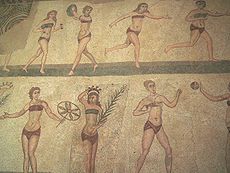 Predecessors of the bikini date to antiquity
, in Çatalhöyük
and the Greco-Roman world
. Art dating from the Diocletian period (286-305 AD) in Villa Romana del Casale
, Sicily
depicts women in garments resembling bikinis in mosaics on the floor. The images of ten women, dubbed the "Bikini Girls", exercising in clothing that would pass as bikinis today are the most replicated mosaic among the 37 million colored tiles at the site. Archeological finds, particularly in Pompeii
, show the Roman goddess Venus
wearing a bikini. A statue of Venus in a bikini was found in a cupboard in the southwest corner in Casa della Venere, others were found in the front hall. A statue of Venus was recovered from the tablinum
of the House of Julia Felix
, and another from an atrium
at the garden at Via Dell'Abbondanza
.
The groundwork for the modern bikini began to be laid in 1907, when Australian swimmer and performer Annette Kellerman
was arrested on a Boston
beach for wearing a form-fitting one-piece swimsuit, which became an accepted beach attire for women by 1910. In 1913, inspired by the introduction of women into Olympic swimming, designer Carl Jantzen made the first functional two-piece swimwear, a close-fitting one-piece with shorts on the bottom and short sleeves on top. By the 1930s, necklines plunged at the back, sleeves disappeared and sides were cut away. Hollywood endorsed the new glamour with films such as Neptune's Daughter
in which Esther Williams
wore provocatively named costumes such as "Double Entendre" and "Honey Child". With new materials like latex
and nylon
, by 1934 the swimsuit started hugging the body and had shoulder straps to lower for tanning.
 By the early 1940s two-piece swimsuits were frequent on American beaches. Hollywood stars such as Ava Gardner
, Rita Hayworth
and Lana Turner
tried similar swimwear or beachwear. Pin ups of Hayworth and Esther Williams
in the costume were widely distributed.
Finally, the modern bikini was introduced by French engineer Louis Réard
and fashion designer Jacques Heim
in Paris in 1946. Réard was a car engineer but by 1946 he was running his mother's lingerie boutique near Les Folies Bergères in Paris. Heim was working on a new kind of beach costume. It comprised two pieces, the bottom large enough to cover its wearer's navel. In May 1946, he advertised the bathing suit, known as the "Atome," as the world's "smallest bathing suit". Réard named his swimsuit the "bikini", taking the name from the Bikini Atoll
, one of a series of islands in the South Pacific where testing on the new atomic bomb was occurring that summer. Historians assume Reard termed his swimsuit the "bikini" because he believed its revealing style would create reactions among people similar to those created by America’s atomic bomb in Japan just one summer earlier. Réard sliced the top off the bottoms and advertised it as "smaller than the smallest swimsuit". Réard could not find a model to wear his design. He ended up hiring Micheline Bernardini
, a nude dancer
from the Casino de Paris. That bikini, a string bikini with a g-string
back of 30 square inches (194 cm²) of cloth with newspaper type printed across, was introduced on July 5 at Piscine Molitor
, a public pool in Paris. Heim's design was the first worn on the beach, but clothing was given its name by Réard.
From a 1949 Los Angeles Times
report: "The bathing beauty queen—blond Bebe Shopp
, 18, of Hopkins, Minn.—got an enthusiastic welcome in Paris, but she said she hasn't changed her mind about French swim suits. ... 'I don't approve of Bikini suits for American girls,' Bebe told her French interviewers. 'The French girls can wear them if they want to, but I still don't approve of them on American girls." Brigitte Bardot
is recognized for popularizing bikini swimwear in early films such as Manina (Woman without a Veil)
(1952) in her appearances at Cannes and in many photo shoots. with Bardot identified as the original Cannes bathing beauty.
, bikini bottom), camikini (camisole
top and bikini bottom) and hikini. Since fashions of different centuries exist beside one another in early 21st century, though it is possible to imagine a woman combining a bikini and a 1910 bathing costume.
Bikini tops come in different styles and cuts, including a halter-style neck that offers more coverage and support, a strapless bandeau
, a rectangular strip of fabric covering the breasts that minimizes large breasts, a top with cups similar to a push-up bra, and the more traditional triangle cups that lift and shape the breasts. Bikini bottoms vary in style and cut and in the amount of coverage they offer, coverage ranging anywhere from complete underwear-style coverage, as in the case of more modest bottom pieces like briefs, shorts, or briefs with a small skirt-panel attached, to almost full exposure, as in the case of the thong bikini. Skimpier styles have narrow sides, including V-cut (in front), French cut (with high-cut sides) and low-cut string (with string sides). In just one major fashion show in 1985 were two-piece suits with cropped tank tops
instead of the usual skimpy bandeaux, suits that are bikinis in front and one-piece in back, suspender straps
, ruffle
s, and daring, navel-baring cutouts. Subsequent variations on the theme include the monokini, tankini, string bikini, thong, slingshot, minimini, teardrop, and micro.
or knickers. For men, a bikini is a type of undergarment that is smaller and more revealing than men's briefs.
. Female athletes who play beach volleyball
professionally usually wear two-pieces. These bikinis are designed with functionality rather than fashion in mind.
, sparking controversy, with some sports officials considering it exploitative and unpractical in colder weather, and athletes admitting that the regulation uniform is intended to be "sexy" and to draw attention. Dancers, sex appeal and bikinis worn by women players as much as athletic ability made beach volleyball the fifth largest television audience of all the sports at the Games at Bondi Beach
in Australia in 2000 Olympics. The popularity of Dead or Alive: Xtreme Beach Volleyball, a video game for Xbox
, was attributed to the scantily clad women.
, a US high-jumper, wore a black leather bikini instead of a track suit, at Sydney 2000 Summer Olympics
. Runner Florence Griffith-Joyner
mixed bikini bottoms with one-legged tights
in Seoul 1988 Summer Olympics
, which earned her more attention than her record breaking in Women's 200 meters. Towns like Porto Seguro
in Brazil has become an attraction for beach athletics in bikini for the tourists.
contest after watching them playing beach volleyball in skimpy bikinis. In the 2004 and 2008 Olympic Games
, inclusion of bikini-clad athletes raised eyebrows, while a controversy broke out around bikini-clad cheerleaders performing at a beach volleyball match. Bikinis stirred up a controversy at the 2006 Asian Games
at Doha, Qatar, and the Iraqi teams refused to wear such clothing. In the 2007 South Pacific Games
, players were made to wear shorts and cropped sports tops instead of bikinis. In the West Asian Games
2006, bikini-bottoms were banned for female athletes, who were asked to wear long shorts. String bikinis and other skimpy clothes are also common in surfing
, paving the way for some hooliganism
in the past. In May 2011, Barcelona
, Spain
made it illegal to wear bikinis in public except in areas near the beaches. Violators face fines of between 120 and 300 euros.

, men's underwear, or similar garments. Men's bikinis can have both high or low side panels, string sides or tie sides, and most lack a button or flap front. Many do not have a visible waistband like briefs. Suits less than 1.5 inches wide at the hips are less common for sporting purposes and are most often worn for recreation, fashion
, and sun tanning
. An example of this style, known as the posing brief, is the standard for competitions in the sport of bodybuilding
. Male punk rock
musicians have performed on the stage wearing women's bikini briefs. The 2000 Bollywood
film Hera Pheri shows men sunbathing in bikinis, who were mistakenly believed to be girls from a distance by the protagonist.
Swimsuits shown in men's wear collections by Giorgio Armani
, Dolce & Gabbana
or Paul Smith
have tended to be black and snug fitting, throwbacks to the designs of the 1930s and '40s, while Gianni Versace
's ads with their heroic depictions of Miami bathers in contrast to popular, sports-inspired beach wear—bright and baggy Bermudas or boxer shorts. The Greek designer Nikos Apostolopoulos put a different spin on his bathing suits (for both sexes, but with the focus on the male), making them anatomical creations, cut and stitched to outline the body and its sexual characteristics.
Bikini tops for men are seen as an amusement factor.
.jpg)
when he donned one in the film Borat
. The buzz around the film started building during the Cannes Film Festival
in May 2006, when Baron Cohen posed in character on the beach in a neon green mankini, alongside four models. A garden gnome
in the 2011 film Gnomeo and Juliet
was also shown wearing a mankini, which gets referred to as a Borat-Mankini by newspapers.
Swimsuit
A swimsuit, bathing suit, or swimming costume is an item of clothing designed to be worn by men, women or children while they are engaging in a water-based activity or water sports, such as swimming, water polo, diving, surfing, water skiing, or during activities in the sun, such as sun bathing.A...
. One part of the attire covers the breast
Breast
The breast is the upper ventral region of the torso of a primate, in left and right sides, which in a female contains the mammary gland that secretes milk used to feed infants.Both men and women develop breasts from the same embryological tissues...
s and the other part covers the crotch
Crotch
The term crotch may be used to describe the region of an object where it splits into two or more limbs. This can include trees, animals, buildings, in wiring diagrams, etc....
and part of or the entire buttocks
Buttocks
The buttocks are two rounded portions of the anatomy, located on the posterior of the pelvic region of apes and humans, and many other bipeds or quadrupeds, and comprise a layer of fat superimposed on the gluteus maximus and gluteus medius muscles. Physiologically, the buttocks enable weight to...
, leaving an uncovered area between the two. Merriam–Webster describes the bikini as "a woman's scanty two-piece bathing suit" or "a man's brief swimsuit". It is often worn in hot weather, while swimming or sunbathing. The shapes of both parts of a bikini resemble women's underwear, and the lower part can range from revealing thong
Thong (clothing)
The thong is a garment generally worn as either underwear or as a swimsuit in many industrialized societies around the world. It may also be worn for traditional ceremonies or competitions such as sumo wrestling...
or g-string
G-string
A G-string is a type of thong underwear or swimsuit, a narrow piece of cloth, leather, or plastic, that covers or holds the genitals, passes between the buttocks, and is attached to a band around the hips, worn as swimwear or underwear by women and men...
to briefs.
While two-piece bathing suits had been worn on the beach before, the modern bikini was invented by French engineer Louis Réard
Louis Réard
Louis Réard was a French automobile engineer who invented the bikini in 1946.-Invention of bikini:Although Réard was an engineer, he was running his mother's shoe shop Les Folies Bergères in Paris by 1946. Réard and Jacques Heim, his rival designer, were competing to produce the world's smallest...
in 1946. He named it after Bikini Atoll
Bikini Atoll
Bikini Atoll is an atoll, listed as a World Heritage Site, in the Micronesian Islands of the Pacific Ocean, part of Republic of the Marshall Islands....
in the Pacific, the site of the Operation Crossroads
Operation Crossroads
Operation Crossroads was a series of nuclear weapon tests conducted by the United States at Bikini Atoll in mid-1946. It was the first test of a nuclear weapon after the Trinity nuclear test in July 1945...
nuclear weapon tests in July that year.
The bikini is perhaps the most popular female beachwear around the globe, according to French fashion historian Olivier Saillard due to "the power of women, and not the power of fashion". As he explains, "The emancipation of swimwear has always been linked to the emancipation of women." By the mid 2000s, bikinis had become a $811 million business annually, according to the NPD Group
NPD Group
The NPD Group, Inc. is a leading North American market research company. The NPD Group consistently ranks among the top 25 market research companies in the independent Honomichl Top 50 report, which the media and the research industry acknowledge as a credible source of information on the market...
, a consumer and retail information company. The bikini has boosted spin-off services like bikini waxing and the suntanning industries.
History
Ancient history
Ancient history is the study of the written past from the beginning of recorded human history to the Early Middle Ages. The span of recorded history is roughly 5,000 years, with Cuneiform script, the oldest discovered form of coherent writing, from the protoliterate period around the 30th century BC...
, in Çatalhöyük
Çatalhöyük
Çatalhöyük was a very large Neolithic and Chalcolithic settlement in southern Anatolia, which existed from approximately 7500 BCE to 5700 BCE...
and the Greco-Roman world
Greco-Roman world
The Greco-Roman world, Greco-Roman culture, or the term Greco-Roman , when used as an adjective, as understood by modern scholars and writers, refers to those geographical regions and countries that culturally were directly, protractedly and intimately influenced by the language, culture,...
. Art dating from the Diocletian period (286-305 AD) in Villa Romana del Casale
Villa Romana del Casale
Villa Romana del Casale is a Roman villa built in the first quarter of the 4th century and located about 5 km outside the town of Piazza Armerina, Sicily, southern Italy...
, Sicily
Sicily
Sicily is a region of Italy, and is the largest island in the Mediterranean Sea. Along with the surrounding minor islands, it constitutes an autonomous region of Italy, the Regione Autonoma Siciliana Sicily has a rich and unique culture, especially with regard to the arts, music, literature,...
depicts women in garments resembling bikinis in mosaics on the floor. The images of ten women, dubbed the "Bikini Girls", exercising in clothing that would pass as bikinis today are the most replicated mosaic among the 37 million colored tiles at the site. Archeological finds, particularly in Pompeii
Pompeii
The city of Pompeii is a partially buried Roman town-city near modern Naples in the Italian region of Campania, in the territory of the comune of Pompei. Along with Herculaneum, Pompeii was destroyed and completely buried during a long catastrophic eruption of the volcano Mount Vesuvius spanning...
, show the Roman goddess Venus
Venus (mythology)
Venus is a Roman goddess principally associated with love, beauty, sex,sexual seduction and fertility, who played a key role in many Roman religious festivals and myths...
wearing a bikini. A statue of Venus in a bikini was found in a cupboard in the southwest corner in Casa della Venere, others were found in the front hall. A statue of Venus was recovered from the tablinum
Tablinum
In Roman architecture, a tablinum was a room generally situated on one side of the atrium and opposite to the entrance; it opened in the rear on to the peristyle, with either a large window or only an anteroom or curtain...
of the House of Julia Felix
House of Julia Felix
Julia Felix, Felix a Roman cognomen meaning "The Fortunate One" was an epithet of the dictator L. Cornelius Sulla and his descendants in the Republican period. In the Imperial period it was a name involving luck as well as one of the most common cognomina and slave names.-Background:Julia Felix...
, and another from an atrium
Atrium (architecture)
In modern architecture, an atrium is a large open space, often several stories high and having a glazed roof and/or large windows, often situated within a larger multistory building and often located immediately beyond the main entrance doors...
at the garden at Via Dell'Abbondanza
House of Loreius Tiburtinus
The House of Loreius Tiburtinus is renowned for its meticulous and well preserved artwork as well as its large gardens. It is located in the famed Roman city of Pompeii...
.
The groundwork for the modern bikini began to be laid in 1907, when Australian swimmer and performer Annette Kellerman
Annette Kellerman
Annette Marie Sarah Kellerman was an Australian professional swimmer, vaudeville and film star, and writer...
was arrested on a Boston
Boston
Boston is the capital of and largest city in Massachusetts, and is one of the oldest cities in the United States. The largest city in New England, Boston is regarded as the unofficial "Capital of New England" for its economic and cultural impact on the entire New England region. The city proper had...
beach for wearing a form-fitting one-piece swimsuit, which became an accepted beach attire for women by 1910. In 1913, inspired by the introduction of women into Olympic swimming, designer Carl Jantzen made the first functional two-piece swimwear, a close-fitting one-piece with shorts on the bottom and short sleeves on top. By the 1930s, necklines plunged at the back, sleeves disappeared and sides were cut away. Hollywood endorsed the new glamour with films such as Neptune's Daughter
Neptune's Daughter (1949 film)
Neptune's Daughter is a 1949 musical romantic comedy film released by Metro-Goldwyn-Mayer starring Esther Williams, Red Skelton, Ricardo Montalbán, Betty Garrett, Keenan Wynn, Xavier Cugat and Mel Blanc...
in which Esther Williams
Esther Williams
Esther Jane Williams is a retired American competitive swimmer and MGM movie star.Williams set multiple national and regional swimming records in her late teens as part of the Los Angeles Athletic Club swim team...
wore provocatively named costumes such as "Double Entendre" and "Honey Child". With new materials like latex
Latex
Latex is the stable dispersion of polymer microparticles in an aqueous medium. Latexes may be natural or synthetic.Latex as found in nature is a milky fluid found in 10% of all flowering plants . It is a complex emulsion consisting of proteins, alkaloids, starches, sugars, oils, tannins, resins,...
and nylon
Nylon
Nylon is a generic designation for a family of synthetic polymers known generically as polyamides, first produced on February 28, 1935, by Wallace Carothers at DuPont's research facility at the DuPont Experimental Station...
, by 1934 the swimsuit started hugging the body and had shoulder straps to lower for tanning.
Ava Gardner
Ava Lavinia Gardner was an American actress.She was signed to a contract by MGM Studios in 1941 and appeared mainly in small roles until she drew attention with her performance in The Killers . She became one of Hollywood's leading actresses, considered one of the most beautiful women of her day...
, Rita Hayworth
Rita Hayworth
Rita Hayworth was an American film actress and dancer who attained fame during the 1940s as one of the era's top stars...
and Lana Turner
Lana Turner
Lana Turner was an American actress.Discovered and signed to a film contract by MGM at the age of sixteen, Turner first attracted attention in They Won't Forget . She played featured roles, often as the ingenue, in such films as Love Finds Andy Hardy...
tried similar swimwear or beachwear. Pin ups of Hayworth and Esther Williams
Esther Williams
Esther Jane Williams is a retired American competitive swimmer and MGM movie star.Williams set multiple national and regional swimming records in her late teens as part of the Los Angeles Athletic Club swim team...
in the costume were widely distributed.
Finally, the modern bikini was introduced by French engineer Louis Réard
Louis Réard
Louis Réard was a French automobile engineer who invented the bikini in 1946.-Invention of bikini:Although Réard was an engineer, he was running his mother's shoe shop Les Folies Bergères in Paris by 1946. Réard and Jacques Heim, his rival designer, were competing to produce the world's smallest...
and fashion designer Jacques Heim
Jacques Heim
Jacques Heim was a Parisian designer and manufacturer of women's furs and couture, whose maison de couture opened in 1930 and closed in 1969....
in Paris in 1946. Réard was a car engineer but by 1946 he was running his mother's lingerie boutique near Les Folies Bergères in Paris. Heim was working on a new kind of beach costume. It comprised two pieces, the bottom large enough to cover its wearer's navel. In May 1946, he advertised the bathing suit, known as the "Atome," as the world's "smallest bathing suit". Réard named his swimsuit the "bikini", taking the name from the Bikini Atoll
Bikini Atoll
Bikini Atoll is an atoll, listed as a World Heritage Site, in the Micronesian Islands of the Pacific Ocean, part of Republic of the Marshall Islands....
, one of a series of islands in the South Pacific where testing on the new atomic bomb was occurring that summer. Historians assume Reard termed his swimsuit the "bikini" because he believed its revealing style would create reactions among people similar to those created by America’s atomic bomb in Japan just one summer earlier. Réard sliced the top off the bottoms and advertised it as "smaller than the smallest swimsuit". Réard could not find a model to wear his design. He ended up hiring Micheline Bernardini
Micheline Bernardini
Micheline Bernardini is a former nude dancer at the Casino de Paris before being chosen by Louis Réard to model the first modern-day bikini on July 5, 1946 at Piscine Molitor in Paris.-The first bikini:...
, a nude dancer
Stripper
A stripper is a professional erotic dancer who performs a contemporary form of striptease at strip club establishments, public exhibitions, and private engagements. Unlike in burlesque, the performer in the modern Americanized form of stripping minimizes the interaction of customer and dancer,...
from the Casino de Paris. That bikini, a string bikini with a g-string
G-string
A G-string is a type of thong underwear or swimsuit, a narrow piece of cloth, leather, or plastic, that covers or holds the genitals, passes between the buttocks, and is attached to a band around the hips, worn as swimwear or underwear by women and men...
back of 30 square inches (194 cm²) of cloth with newspaper type printed across, was introduced on July 5 at Piscine Molitor
Piscine Molitor
Piscine Molitor is an abandoned swimming pool complex located in Porte Molitor, 16th arrondissement of Paris, Île-de-France, Paris, France. It is next to the park Bois de Boulogne, and between Stade Roland Garros and Parc des Princes...
, a public pool in Paris. Heim's design was the first worn on the beach, but clothing was given its name by Réard.
From a 1949 Los Angeles Times
Los Angeles Times
The Los Angeles Times is a daily newspaper published in Los Angeles, California, since 1881. It was the second-largest metropolitan newspaper in circulation in the United States in 2008 and the fourth most widely distributed newspaper in the country....
report: "The bathing beauty queen—blond Bebe Shopp
BeBe Shopp
BeBe Shopp, from Hopkins, Minnesota, was Miss America in 1948. was the first Miss America crowned in an evening gown after the pageant was resurrected in 1935.-Famous Quote:...
, 18, of Hopkins, Minn.—got an enthusiastic welcome in Paris, but she said she hasn't changed her mind about French swim suits. ... 'I don't approve of Bikini suits for American girls,' Bebe told her French interviewers. 'The French girls can wear them if they want to, but I still don't approve of them on American girls." Brigitte Bardot
Brigitte Bardot
Brigitte Anne-Marie Bardot is a French former fashion model, actress, singer and animal rights activist. She was one of the best-known sex-symbols of the 1960s.In her early life, Bardot was an aspiring ballet dancer...
is recognized for popularizing bikini swimwear in early films such as Manina (Woman without a Veil)
Manina, the Girl in the Bikini
When a 25-year-old Parisian student, Gérard Morere, hears a lecture about a treasure Troilus lost at sea after the Peloponnesian War, he thinks he knows where it is, thanks to a discovery he made five years before when diving near the island of Levezzi...
(1952) in her appearances at Cannes and in many photo shoots. with Bardot identified as the original Cannes bathing beauty.
Bikini variants
The bikini has spawned many stylistic variations. A regular bikini is defined as a two pieces of garments that cover the groin and buttocks at the lower end and the breasts in the upper end. Some bikinis can offer a large amount of coverage, while other bikinis provide only the barest minimum. Topless variants may still be considered bikinis, although technically no longer two-piece swimsuits. Along with a variation in designs, the term bikini was followed by an often hilarious lexicon including the monokini (top part missing), seekini (transparent bikini), tankini (tank topTank top
Tank top may refer to:* a type of sleeveless shirt worn by men and women * a sleeveless sweater, also known as a sweater vest * the plating forming the inner bottom of a ship hull...
, bikini bottom), camikini (camisole
Camisole
A camisole is a sleeveless undergarment for women, normally extending to the waist. The camisole is usually made of satin, nylon, or cotton.- Historical definition :...
top and bikini bottom) and hikini. Since fashions of different centuries exist beside one another in early 21st century, though it is possible to imagine a woman combining a bikini and a 1910 bathing costume.
Bikini tops come in different styles and cuts, including a halter-style neck that offers more coverage and support, a strapless bandeau
Bandeau
- General Attire :A bandeau , is a strapless garment worn around a woman's breasts. It may be fastened in the front or back or be sufficiently elastic so as to have no fastener at all. In a strict sense a bandeau has but two edges, although it is sometimes manufactured with a detachable halter...
, a rectangular strip of fabric covering the breasts that minimizes large breasts, a top with cups similar to a push-up bra, and the more traditional triangle cups that lift and shape the breasts. Bikini bottoms vary in style and cut and in the amount of coverage they offer, coverage ranging anywhere from complete underwear-style coverage, as in the case of more modest bottom pieces like briefs, shorts, or briefs with a small skirt-panel attached, to almost full exposure, as in the case of the thong bikini. Skimpier styles have narrow sides, including V-cut (in front), French cut (with high-cut sides) and low-cut string (with string sides). In just one major fashion show in 1985 were two-piece suits with cropped tank tops
Crop top
A crop top is a T-shirt or blouse with the lower part cut off, showing of some of the abdomen. The half shirt is a kind of shirt that is cut off from the bottom of the chest....
instead of the usual skimpy bandeaux, suits that are bikinis in front and one-piece in back, suspender straps
Suspenders
Suspenders or braces are fabric or leather straps worn over the shoulders to hold up trousers. Straps may be elasticated, either entirely or only at attachment ends and most straps are of woven cloth forming an X or Y shape at the back. Braces are typically attached to trousers with buttons...
, ruffle
Ruffle
In sewing and dressmaking, a ruffle, frill, or furbelow is a strip of fabric, lace or ribbon tightly gathered or pleated on one edge and applied to a garment, bedding, or other textile as a form of trimming...
s, and daring, navel-baring cutouts. Subsequent variations on the theme include the monokini, tankini, string bikini, thong, slingshot, minimini, teardrop, and micro.
Bikini underwear
Types of underwear worn by both men and women are identified as bikini underwear, similar in size and revealing nature to the bottom half of a bikini bathing suit. For women, bikini underwear can refer to virtually any tight, skimpy, or revealing undergarment that provides less coverage to the midsection than traditional underwear, pantiesPanties
Panties are a form of underwear, usually light and snug-fitting, designed to be worn by women or girls in the area directly below the waist. Typical components include an elastic waistband, a crotch panel to cover the genital area , and a pair of leg openings which, like the waistband, are often...
or knickers. For men, a bikini is a type of undergarment that is smaller and more revealing than men's briefs.
Sports bikini
There is evidence of ancient Roman women playing Expulsim Ludere, an early version of handballTeam handball
Handball is a team sport in which two teams of seven players each pass a ball to throw it into the goal of the other team...
. Female athletes who play beach volleyball
Beach volleyball
Beach volleyball, or sand volleyball, is an Olympic team sport played by two teams of two players on a sand court divided by a net.Like volleyball, the object of the game is to send the ball over the net in order to ground it on the opponent’s court, and to prevent the same effort by the opponent....
professionally usually wear two-pieces. These bikinis are designed with functionality rather than fashion in mind.
Beach volleyball
In 1994, the bikini became the official uniform of women's Olympic beach volleyballBeach volleyball
Beach volleyball, or sand volleyball, is an Olympic team sport played by two teams of two players on a sand court divided by a net.Like volleyball, the object of the game is to send the ball over the net in order to ground it on the opponent’s court, and to prevent the same effort by the opponent....
, sparking controversy, with some sports officials considering it exploitative and unpractical in colder weather, and athletes admitting that the regulation uniform is intended to be "sexy" and to draw attention. Dancers, sex appeal and bikinis worn by women players as much as athletic ability made beach volleyball the fifth largest television audience of all the sports at the Games at Bondi Beach
Bondi Beach, New South Wales
Bondi Beach is a popular beach and the name of the surrounding suburb in Sydney, Australia. Bondi Beach is located 7 kilometres east of the Sydney central business district, in the local government area of Waverley Council, in the Eastern Suburbs...
in Australia in 2000 Olympics. The popularity of Dead or Alive: Xtreme Beach Volleyball, a video game for Xbox
Xbox
The Xbox is a sixth-generation video game console manufactured by Microsoft. It was released on November 15, 2001 in North America, February 22, 2002 in Japan, and March 14, 2002 in Australia and Europe and is the predecessor to the Xbox 360. It was Microsoft's first foray into the gaming console...
, was attributed to the scantily clad women.
Athletics
Often the women in athletics also wear bikinis, not much larger than in beach volleyball. Amy AcuffAmy Acuff
Amy Lyn Acuff is a track and field athlete from the United States. A high jump specialist, she competed in the 1996, 2000, 2004, and 2008 Summer Olympics as a member of USA Track and Field...
, a US high-jumper, wore a black leather bikini instead of a track suit, at Sydney 2000 Summer Olympics
2000 Summer Olympics
The Sydney 2000 Summer Olympic Games or the Millennium Games/Games of the New Millennium, officially known as the Games of the XXVII Olympiad, were an international multi-sport event which was celebrated between 15 September and 1 October 2000 in Sydney, New South Wales, Australia...
. Runner Florence Griffith-Joyner
Florence Griffith-Joyner
Florence Griffith-Joyner , also known as Flo-Jo was an American track and field athlete. She is considered the "fastest woman of all time" based on the fact that she still holds the world record for both the 100 metres and 200 metres, both set in 1988 and never seriously challenged...
mixed bikini bottoms with one-legged tights
Tights
Tights are a kind of cloth leg garment, most often sheathing the body from about the waist to the feet with a more or less tight fit, hence the name....
in Seoul 1988 Summer Olympics
1988 Summer Olympics
The 1988 Summer Olympics, officially known as the Games of the XXIV Olympiad, were an all international multi-sport events celebrated from September 17 to October 2, 1988 in Seoul, South Korea. They were the second summer Olympic Games to be held in Asia and the first since the 1964 Summer Olympics...
, which earned her more attention than her record breaking in Women's 200 meters. Towns like Porto Seguro
Porto Seguro
Porto Seguro is a municipality in the Brazilian state of Bahia. It is the site where the Portuguese explorer Pedro Álvares Cabral first set foot on Brazilian soil on April 22, 1500...
in Brazil has become an attraction for beach athletics in bikini for the tourists.
Controversy
Skimpy bikinis have been a major component of marketing women's sports, raising some objections. In 2007, fans voted for contestants in the WWE DivaWWE Diva
Diva is a term used by World Wrestling Entertainment , an American professional wrestling promotion, to refer to its female talent. The term is applied to women who appear as wrestlers, managers or valets, backstage interviewers, or ring announcers....
contest after watching them playing beach volleyball in skimpy bikinis. In the 2004 and 2008 Olympic Games
Olympic Games
The Olympic Games is a major international event featuring summer and winter sports, in which thousands of athletes participate in a variety of competitions. The Olympic Games have come to be regarded as the world’s foremost sports competition where more than 200 nations participate...
, inclusion of bikini-clad athletes raised eyebrows, while a controversy broke out around bikini-clad cheerleaders performing at a beach volleyball match. Bikinis stirred up a controversy at the 2006 Asian Games
Asian Games
The Asian Games, officially known as Asiad, is a multi-sport event held every four years among athletes from all over Asia. The Games were regulated by the Asian Games Federation from the first Games in New Delhi, India, until the 1978 Games. Since the 1982 Games they have been organised by the...
at Doha, Qatar, and the Iraqi teams refused to wear such clothing. In the 2007 South Pacific Games
South Pacific Games
The Pacific Games is a multi-sport event, much like the Olympics , with participation exclusively from countries around the South Pacific. It is held every four years and began in 1963, hosted by Suva, Fiji.- Concept :The idea of holding the South Pacific Games originated with Dr A.H...
, players were made to wear shorts and cropped sports tops instead of bikinis. In the West Asian Games
West Asian Games
West Asian Games are a bi-annual multi-sport event held among the athletes from West Asia.At present, WAG are joined by thirteen members namely Bahrain, Iran, Iraq, Jordan, Kuwait, Lebanon, Oman, Palestine, Qatar, Saudi Arabia, Syria, United Arab Emirates, and Yemen.The West Asian Games were first...
2006, bikini-bottoms were banned for female athletes, who were asked to wear long shorts. String bikinis and other skimpy clothes are also common in surfing
Surfing
Surfing' is a surface water sport in which the surfer rides a surfboard on the crest and face of a wave which is carrying the surfer towards the shore...
, paving the way for some hooliganism
Hooliganism
Hooliganism refers to unruly, destructive, aggressive and bullying behaviour. Such behaviour is commonly associated with sports fans. The term can also apply to general rowdy behaviour and vandalism, often under the influence of alcohol and/or drugs....
in the past. In May 2011, Barcelona
Barcelona
Barcelona is the second largest city in Spain after Madrid, and the capital of Catalonia, with a population of 1,621,537 within its administrative limits on a land area of...
, Spain
Spain
Spain , officially the Kingdom of Spain languages]] under the European Charter for Regional or Minority Languages. In each of these, Spain's official name is as follows:;;;;;;), is a country and member state of the European Union located in southwestern Europe on the Iberian Peninsula...
made it illegal to wear bikinis in public except in areas near the beaches. Violators face fines of between 120 and 300 euros.
Men's bikini
The term men's bikini is used to describe types of men's swimsuitsSwim briefs
A swim brief, or racing brief, refers to any briefs style male swimsuit such as those worn in competitive swimming and diving. The popularity of the Australian Speedo brand racing brief has led to the use of its name to refer to any racing brief, regardless of the maker...
, men's underwear, or similar garments. Men's bikinis can have both high or low side panels, string sides or tie sides, and most lack a button or flap front. Many do not have a visible waistband like briefs. Suits less than 1.5 inches wide at the hips are less common for sporting purposes and are most often worn for recreation, fashion
Fashion
Fashion, a general term for a currently popular style or practice, especially in clothing, foot wear, or accessories. Fashion references to anything that is the current trend in look and dress up of a person...
, and sun tanning
Sun tanning
Sun tanning or simply tanning is the process whereby skin color is darkened or tanned. The process is most often a result of exposure to ultraviolet radiation from the sun or from artificial sources, such as a tanning bed, but can also be a result of windburn or reflected light...
. An example of this style, known as the posing brief, is the standard for competitions in the sport of bodybuilding
Bodybuilding
Bodybuilding is a form of body modification involving intensive muscle hypertrophy. An individual who engages in this activity is referred to as a bodybuilder. In competitive and professional bodybuilding, bodybuilders display their physiques to a panel of judges, who assign points based on their...
. Male punk rock
Punk rock
Punk rock is a rock music genre that developed between 1974 and 1976 in the United States, the United Kingdom, and Australia. Rooted in garage rock and other forms of what is now known as protopunk music, punk rock bands eschewed perceived excesses of mainstream 1970s rock...
musicians have performed on the stage wearing women's bikini briefs. The 2000 Bollywood
Bollywood
Bollywood is the informal term popularly used for the Hindi-language film industry based in Mumbai , Maharashtra, India. The term is often incorrectly used to refer to the whole of Indian cinema; it is only a part of the total Indian film industry, which includes other production centers producing...
film Hera Pheri shows men sunbathing in bikinis, who were mistakenly believed to be girls from a distance by the protagonist.
Swimsuits shown in men's wear collections by Giorgio Armani
Giorgio Armani
Giorgio Armani is an Italian fashion designer, particularly noted for his menswear. He is known today for his clean, tailored lines. He formed his company, Armani, in 1975, and by 2001 was acclaimed as the most successful designer to come out of Italy, with an annual turnover of $1.6 billion and a...
, Dolce & Gabbana
Dolce & Gabbana
Dolce & Gabbana is an Italian luxury industry fashion house. The company was started by the Italian designers Domenico Dolce and Stefano Gabbana in Milan, Italy. By 2005 their turnover was €597 million....
or Paul Smith
Paul Smith (fashion designer)
Sir Paul Smith jr, RDI, is an English fashion designer, whose business and reputation is founded upon his menswear. He is both commercially successful and highly respected within the fashion industry....
have tended to be black and snug fitting, throwbacks to the designs of the 1930s and '40s, while Gianni Versace
Gianni Versace
Gianni Versace was an Italian fashion designer and founder of Gianni Versace S.p.A., an international fashion house, which produces accessories, fragrances, makeup and home furnishings as well as clothes. He also designed costumes for the theatre and films, and was a friend of Madonna, Elton John,...
's ads with their heroic depictions of Miami bathers in contrast to popular, sports-inspired beach wear—bright and baggy Bermudas or boxer shorts. The Greek designer Nikos Apostolopoulos put a different spin on his bathing suits (for both sexes, but with the focus on the male), making them anatomical creations, cut and stitched to outline the body and its sexual characteristics.
Bikini tops for men are seen as an amusement factor.
Mankini
Mankini is a type of sling bikini worn by men. It was popularized by Sacha Baron CohenSacha Baron Cohen
Sacha Noam Baron Cohen is an English stand-up comedian, actor, writer, and voice artist. He is most widely known for his portrayal of three unorthodox fictional characters: Ali G, Borat, and Brüno...
when he donned one in the film Borat
Borat
Borat Sagdiyev is a satirical fictional character invented and performed by English comedian Sacha Baron Cohen...
. The buzz around the film started building during the Cannes Film Festival
Cannes Film Festival
The Cannes International Film Festival , is an annual film festival held in Cannes, France, which previews new films of all genres including documentaries from around the world. Founded in 1946, it is among the world's most prestigious and publicized film festivals...
in May 2006, when Baron Cohen posed in character on the beach in a neon green mankini, alongside four models. A garden gnome
Garden gnome
A garden gnome or lawn gnome is a figurine of a small humanoid creature, usually wearing a pointy hat, produced for the purpose of ornamentation and protection from evil sorcery, typically of gardens or on lawns....
in the 2011 film Gnomeo and Juliet
Gnomeo and Juliet
Gnomeo & Juliet is a 2011 computer-animated family comedy film based on William Shakespeare's play Romeo and Juliet. The film is directed by Kelly Asbury, and the two main characters are voiced by James McAvoy and Emily Blunt. The film was released on , 2011.-Plot:Mrs. Montague and Mr. Capulet are...
was also shown wearing a mankini, which gets referred to as a Borat-Mankini by newspapers.
See also
- Bikini in popular cultureBikini in popular cultureThe bikini appears in competitions, films, magazines, music, literature, magazines and even video games. Despite the easy availability of more revealing glamor imagery, bikini modeling remains popular and can still stir controversy. Portrayals of the bikini in popular culture led, to a large...
- Bikini waxingBikini waxingBikini waxing is the epilation of body hair in and around the pubic region, commonly by women, by the use of wax. With certain styles of women's swimwear, pubic hair may become visible around the crotch area of a swimsuit. Visible pubic hair is widely culturally disapproved of and considered to be...
- BurqiniBurqiniA burqini swimsuit is a type of swimsuit for women designed by Lebanese Australian Aheda Zanetti under the company name Ahiida....
- Men's bikini
- MonokiniMonokiniA monokini, sometimes referred to as a unikini, is a woman's one-piece garment comprising only the lower half of a bikini, leaving the breasts uncovered...
- SwimsuitSwimsuitA swimsuit, bathing suit, or swimming costume is an item of clothing designed to be worn by men, women or children while they are engaging in a water-based activity or water sports, such as swimming, water polo, diving, surfing, water skiing, or during activities in the sun, such as sun bathing.A...
- TankiniTankiniThe tankini is a bathing suit combining a tank top, mostly made of spandex-and-cotton or Lycra-and-nylon, and a bikini bottom introduced in the late 1990s. This type of swimwear is considered by some to provide modesty closer to a one piece suit with the convenience of a two piece suit, as the...
- White bikini of Ursula AndressWhite bikini of Ursula AndressThe White bikini of Ursula Andress was a white bikini worn by Ursula Andress as Honey Ryder in the 1962 James Bond film, Dr. No...