

Dayton Agreement

Encyclopedia
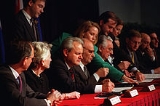
The General Framework Agreement for Peace in Bosnia and Herzegovina, also known as the Dayton Agreement, Dayton Accords, Paris Protocol or Dayton-Paris Agreement, is the peace agreement reached at Wright-Patterson Air Force Base
near Dayton, Ohio
in November 1995, and formally signed in Paris
on December 14, 1995. These accords put an end to the three and a half year long war in Bosnia
, one of the armed conflicts in the former Socialist Federative Republic of Yugoslavia
.
, the August 1995 Croatia
n military Operation Storm
and its aftermath, the government military offensive against the Republika Srpska
, in concert with NATO's Operation Deliberate Force. During September and October 1995, many of the world powers (especially the USA and Russia
), gathered in the Contact Group
, applied intense pressure to the leaders of the three sides to attend the negotiations in Dayton, Ohio
.
The conference took place from November 1 to November 21, 1995. The main participants from the region were Serbia
n President Slobodan Milošević
(representing the Bosnian Serb interests due to absence of Karadžić
), Croatia
n President Franjo Tuđman, and Bosnia
n President Alija Izetbegović
with Bosnian Foreign Minister Muhamed Sacirbey
.
The peace conference was led by U.S. Secretary of State Warren Christopher
, and negotiator Richard Holbrooke
with two Co-Chairmen in the form of EU Special Representative Carl Bildt
and the First Deputy Foreign Minister of Russia Igor Ivanov
. A key participant in the US delegation was General Wesley Clark
(later to become NATO's Supreme Allied Commander Europe (SACEUR) in 1997). The UK military representative was Col Arundell David Leakey
(later to become Commander of EUFOR in 2005). Paul Williams
, through the Public International Law & Policy Group
(PILPG) served as legal counsel to the Bosnian Government delegation during the negotiations.
The secure site was chosen for several reasons: remove them from the luxury and media of Europe/Washington DC and to securely house over 800 staff and attendants. Curbing the participants' ability to negotiate via the media was also an important consideration. Richard Holbrooke
wanted to stop the posturing and walls that can be built up due to early leaks to the press.
After having been initialled in Dayton, Ohio on November 21, 1995, the full and formal agreement was signed in Paris
on December 14, 1995 also by French President Jacques Chirac
, U.S. President Bill Clinton
, UK Prime Minister John Major
, German Chancellor Helmut Kohl
and Russian Prime Minister Viktor Chernomyrdin
.
, and to endorse regional balance in and around the former Republic of Yugoslavia (art. V, annex 1-B), thus in a regional perspective.
The present political divisions of Bosnia and Herzegovina
and its structure of government
were agreed upon as part the constitution that makes up Annex 4 of the General Framework Agreement concluded at Dayton. A key component of this was the delineation of the Inter-Entity Boundary Line
, to which many of the tasks listed in the Annexes referred.
The State of Bosnia Herzegovina was set as of the Federation of Bosnia-Herzegovina and of the Republika Srpska
. Bosnia and Herzegovina is a complete state, as opposed to a confederation; no entity or entities could ever be separated from Bosnia and Herzegovina. Although highly decentralised in its Entities, it would still retain a central government, with a rotating State Presidency, a central bank and a constitutional court.
The agreement mandated a wide range of international organizations to monitor, oversee, and implement components of the agreement. The NATO-led IFOR
(Implementation Force) was responsible for implementing military aspects of the agreement and deployed on the 20th December 1995, taking over the forces of the UNPROFOR. The Office of the High Representative
was charged with the task of civil implementation. The OSCE was charged with organising the first free elections in 1996
.
to annul several decisions and to confirm one decision of the Supreme Court of the Republic of Bosnia and Herzegovina and, more importantly, to review the constitutionality of the General Framework Agreement for Peace in Bosnia and Herzegovina, since they alleged that the agreement violated the Constitution of Bosnia and Herzegovina
in a way that it undermined the integrity of the state and that it may cause the dissolution of Bosnia and Herzegovina
. The Court reached the conclusion that it is not competent to decide the disputes in regards to the mentioned decisions, since the applicants were not subjects that were identified in Article VI.3 (a) of the Constitution, in regard to those who can refer disputes to the Court. The Court also rejected the other request stating:
This was one of the early cases in which the Court had to deal with the question of the legal nature of the Constitution. By making the remark in the manner of obiter dictum
concerning the Annex IV (the Constitution) and the rest of the peace agreement, the Court actually "established the ground for legal unity" of the entire peace agreement, which further implied that all the annexes are in the hierarchical equality. In later decisions the Court confirmed this by using other annexes of the peace agreement as a direct base for the analysis and not only in the context of systematic interpretation of the Annex IV. However, since the Court rejected the presented request of the appellants, it did not go into details concerning the controversial questions of the legality of the process in which the new Constitution (Annex IV) came to power, and replaced the former Constitution of the Republic of Bosnia and Herzegovina. The Court used the same reasoning to dismiss the similar claim in a later case.
28% (14,505 km2) and Bosnian Croats 25% (12,937 km2).
Bosnian Serbs got large tracts of mountainous territories back (4% of Bosnian Croats and some small amounts from Bosniaks), but they were pressured to surrender Sarajevo and some vital Eastern Bosnian/Herzegovian positions. All in all by changing quality to quantity their percentage grew to 49% (48 if excluding the Brčko District, 24,526 km2) from a little bit more than 46% prior to Dayton.
Bosniaks got most of Sarajevo
, and some important positions in eastern Bosnia and Herzegovina while they lost only a few locations on mount Ozren
and in western Bosnia. Their percentage grew from 28% prior to Dayton to 30% and they greatly upheld quality of the gotten land. Large tracts of prewar Bosniak (and Bosnian Croat) inhabited lands remained under Bosnian Serb Control.
Bosnian Croats gave most (4% of BiH territories) back to the Bosnian Serbs (9% of today's RS), and also retreated from Una-Sana canton as well Donji Vakuf
(in Central Bosnia canton) municipality afterward. Small enlargement of Posavina canton (Odžak
and parts of Domaljevac municipality) has not changed the fact that after Dayton Bosnian Croats controlled just 21% of Bosnia and Herzegovina (10,640 km2) especially when compared to more than 25% prior to Dayton. It is important to note that one of the most important Bosnian Croat territories (Posavina
with Bosanski Brod
, Bosanski Šamac, Derventa
and Modriča
) was still left out of Bosnian Croat control.
:
Una-Sana Canton
:
West Herzegovina Canton
:
Herzegovina-Neretva Canton
:
Central Bosnia Canton
:
Zenica-Doboj Canton
:
Tuzla Canton
:
Posavina Canton
:
Bosnian Podrinje Canton
:
Sarajevo Canton
:
Brčko District
was divided;
Despite this, the Dayton Agreement proved to be a highly flexible instrument, allowing Bosnia and Herzegovina to move from an early post-conflict phase through reconstruction and consolidation, passing from a consociationalist
approach to a more integrationist one. Many scholars refers to it as "the most impressive example of conflict resolution".
Wolfgang Petritsch
, OHR
, has argued that the Dayton framework has allowed the international community
to move "from statebuilding via institutions and capacity-building to identity building", putting Bosnia "on the road to Brussels"
Nevertheless, Dayton's three main shortcomings may be traced as to:
According to University of Leipzig
professor and Bosnian Academy of Sciences and Arts
member Edin Šarčević, the current legal structure of the agreement does not abide by the basic principles of international law
and the secular concept of national citizenship
, making the Bosnian territorial and political situation continually unstable and fractious since its implementation in 1995.
Wright-Patterson Air Force Base
Wright-Patterson Air Force Base is a United States Air Force base in Greene and Montgomery counties in the state of Ohio. It includes both Wright and Patterson Fields, which were originally Wilbur Wright Field and Fairfield Aviation General Supply Depot. Patterson Field is located approximately...
near Dayton, Ohio
Dayton, Ohio
Dayton is the 6th largest city in the U.S. state of Ohio and the county seat of Montgomery County, the fifth most populous county in the state. The population was 141,527 at the 2010 census. The Dayton Metropolitan Statistical Area had a population of 841,502 in the 2010 census...
in November 1995, and formally signed in Paris
Paris
Paris is the capital and largest city in France, situated on the river Seine, in northern France, at the heart of the Île-de-France region...
on December 14, 1995. These accords put an end to the three and a half year long war in Bosnia
Bosnian War
The Bosnian War or the War in Bosnia and Herzegovina was an international armed conflict that took place in Bosnia and Herzegovina between April 1992 and December 1995. The war involved several sides...
, one of the armed conflicts in the former Socialist Federative Republic of Yugoslavia
Yugoslav wars
The Yugoslav Wars were a series of wars, fought throughout the former Yugoslavia between 1991 and 1995. The wars were complex: characterized by bitter ethnic conflicts among the peoples of the former Yugoslavia, mostly between Serbs on the one side and Croats and Bosniaks on the other; but also...
.
Negotiation and signature
Though the basic concepts of the Dayton Agreement began to appear in international talks since 1992, the negotiations were initiated following the unsuccessful previous peace efforts and arrangementsPeace plans offered before and during the Bosnian War
Four major peace plans were offered before and during the Bosnian-Herzegovina War, commonly known as the Bosnian War, by European Community and United Nations diplomats before the conflict was settled by the Dayton Agreement in 1995....
, the August 1995 Croatia
Croatia
Croatia , officially the Republic of Croatia , is a unitary democratic parliamentary republic in Europe at the crossroads of the Mitteleuropa, the Balkans, and the Mediterranean. Its capital and largest city is Zagreb. The country is divided into 20 counties and the city of Zagreb. Croatia covers ...
n military Operation Storm
Operation Storm
Operation Storm is the code name given to a large-scale military operation carried out by Croatian Armed Forces, in conjunction with the Army of the Republic of Bosnia and Herzegovina, to gain back control of parts of Croatia which had been claimed by separatist ethnic Serbs, since early...
and its aftermath, the government military offensive against the Republika Srpska
Republika Srpska
Republika Srpska is one of two main political entities of Bosnia and Herzegovina, the other being the Federation of Bosnia and Herzegovina...
, in concert with NATO's Operation Deliberate Force. During September and October 1995, many of the world powers (especially the USA and Russia
Russia
Russia or , officially known as both Russia and the Russian Federation , is a country in northern Eurasia. It is a federal semi-presidential republic, comprising 83 federal subjects...
), gathered in the Contact Group
Contact Group
The Contact Group is the name for an informal grouping of influential countries that have a significant interest in policy developments in the Balkans. The Contact Group is composed of United States, United Kingdom, France, Germany, Italy, and Russia. It was first created in response to the war...
, applied intense pressure to the leaders of the three sides to attend the negotiations in Dayton, Ohio
Dayton, Ohio
Dayton is the 6th largest city in the U.S. state of Ohio and the county seat of Montgomery County, the fifth most populous county in the state. The population was 141,527 at the 2010 census. The Dayton Metropolitan Statistical Area had a population of 841,502 in the 2010 census...
.
The conference took place from November 1 to November 21, 1995. The main participants from the region were Serbia
Serbia
Serbia , officially the Republic of Serbia , is a landlocked country located at the crossroads of Central and Southeast Europe, covering the southern part of the Carpathian basin and the central part of the Balkans...
n President Slobodan Milošević
Slobodan Milošević
Slobodan Milošević was President of Serbia and Yugoslavia. He served as the President of Socialist Republic of Serbia and Republic of Serbia from 1989 until 1997 in three terms and as President of the Federal Republic of Yugoslavia from 1997 to 2000...
(representing the Bosnian Serb interests due to absence of Karadžić
Radovan Karadžic
Radovan Karadžić is a former Bosnian Serb politician. He is detained in the United Nations Detention Unit of Scheveningen, accused of war crimes committed against Bosnian Muslims and Bosnian Croats during the Siege of Sarajevo, as well as ordering the Srebrenica massacre.Educated as a...
), Croatia
Croatia
Croatia , officially the Republic of Croatia , is a unitary democratic parliamentary republic in Europe at the crossroads of the Mitteleuropa, the Balkans, and the Mediterranean. Its capital and largest city is Zagreb. The country is divided into 20 counties and the city of Zagreb. Croatia covers ...
n President Franjo Tuđman, and Bosnia
Bosnia and Herzegovina
Bosnia and Herzegovina , sometimes called Bosnia-Herzegovina or simply Bosnia, is a country in Southern Europe, on the Balkan Peninsula. Bordered by Croatia to the north, west and south, Serbia to the east, and Montenegro to the southeast, Bosnia and Herzegovina is almost landlocked, except for the...
n President Alija Izetbegović
Alija Izetbegovic
Alija Izetbegović was a Bosniak activist, lawyer, author, philosopher and politician, who, in 1990, became the first president of Bosnia and Herzegovina. He served in this role until 1996, when he became a member of the Presidency of Bosnia and Herzegovina, serving until 2000...
with Bosnian Foreign Minister Muhamed Sacirbey
Muhamed Sacirbey
Muhamed Sacirbey is a Bosnian American lawyer, businessman and diplomat. Sacirbey rose to prominence in the 1990s when Bosnia and Herzegovina appointed him to be its ambassador to the United Nations. Sacirbey also served briefly as the Bosnian foreign minister...
.
The peace conference was led by U.S. Secretary of State Warren Christopher
Warren Christopher
Warren Minor Christopher was an American lawyer, diplomat and politician. During Bill Clinton's first term as President, Christopher served as the 63rd Secretary of State. He also served as Deputy Attorney General in the Lyndon Johnson administration, and as Deputy Secretary of State in the Jimmy...
, and negotiator Richard Holbrooke
Richard Holbrooke
Richard Charles Albert Holbrooke was an American diplomat, magazine editor, author, professor, Peace Corps official, and investment banker....
with two Co-Chairmen in the form of EU Special Representative Carl Bildt
Carl Bildt
, Honorary KCMG is a Swedish politician, diplomat and nobleman. Formerly Prime Minister of Sweden from 1991 to 1994 and leader of the liberal conservative Moderate Party from 1986 to 1999, Bildt has served as Swedish Minister for Foreign Affairs since 6 October 2006...
and the First Deputy Foreign Minister of Russia Igor Ivanov
Igor Ivanov
Igor Sergeyevich Ivanov is a Russian politician and was Russian Foreign Minister from 1998 to 2004.- Early life :...
. A key participant in the US delegation was General Wesley Clark
Wesley Clark
Wesley Kanne Clark, Sr., is a retired general of the United States Army. Graduating as valedictorian of the class of 1966 at West Point, he was awarded a Rhodes Scholarship to the University of Oxford where he obtained a degree in Philosophy, Politics and Economics, and later graduated from the...
(later to become NATO's Supreme Allied Commander Europe (SACEUR) in 1997). The UK military representative was Col Arundell David Leakey
David Leakey
Lieutenant-General Arundell David Leakey CMG, CBE is a former British military commander. He was Director General of the European Union Military Staff in the Council of the European Union, Brussels...
(later to become Commander of EUFOR in 2005). Paul Williams
Paul Williams (professor)
Paul R. Williams holds the Rebecca Grazier Professorship in Law and International Relations at American University, where he teaches in the School of International Service and the Washington College of Law...
, through the Public International Law & Policy Group
Public International Law & Policy Group
The Public International Law & Policy Group is a non-profit organization, operating as a global pro bono law firm providing free legal assistance to developing states and sub-state entities involved in conflicts. To facilitate the utilization of this legal assistance, PILPG also provides policy...
(PILPG) served as legal counsel to the Bosnian Government delegation during the negotiations.
The secure site was chosen for several reasons: remove them from the luxury and media of Europe/Washington DC and to securely house over 800 staff and attendants. Curbing the participants' ability to negotiate via the media was also an important consideration. Richard Holbrooke
Richard Holbrooke
Richard Charles Albert Holbrooke was an American diplomat, magazine editor, author, professor, Peace Corps official, and investment banker....
wanted to stop the posturing and walls that can be built up due to early leaks to the press.
After having been initialled in Dayton, Ohio on November 21, 1995, the full and formal agreement was signed in Paris
Paris
Paris is the capital and largest city in France, situated on the river Seine, in northern France, at the heart of the Île-de-France region...
on December 14, 1995 also by French President Jacques Chirac
Jacques Chirac
Jacques René Chirac is a French politician who served as President of France from 1995 to 2007. He previously served as Prime Minister of France from 1974 to 1976 and from 1986 to 1988 , and as Mayor of Paris from 1977 to 1995.After completing his studies of the DEA's degree at the...
, U.S. President Bill Clinton
Bill Clinton
William Jefferson "Bill" Clinton is an American politician who served as the 42nd President of the United States from 1993 to 2001. Inaugurated at age 46, he was the third-youngest president. He took office at the end of the Cold War, and was the first president of the baby boomer generation...
, UK Prime Minister John Major
John Major
Sir John Major, is a British Conservative politician, who served as Prime Minister of the United Kingdom and Leader of the Conservative Party from 1990–1997...
, German Chancellor Helmut Kohl
Helmut Kohl
Helmut Josef Michael Kohl is a German conservative politician and statesman. He was Chancellor of Germany from 1982 to 1998 and the chairman of the Christian Democratic Union from 1973 to 1998...
and Russian Prime Minister Viktor Chernomyrdin
Viktor Chernomyrdin
Viktor Stepanovich Chernomyrdin was the founder and the first chairman of the Gazprom energy company, the longest serving Prime Minister of Russia and Acting President of Russia for a day in 1996. He was a key figure in Russian politics in the 1990s, and a great contributor to the Russian...
.
Content of the agreement
The agreement's main purpose is to promote peace and stability in Bosnia and HerzegovinaBosnia and Herzegovina
Bosnia and Herzegovina , sometimes called Bosnia-Herzegovina or simply Bosnia, is a country in Southern Europe, on the Balkan Peninsula. Bordered by Croatia to the north, west and south, Serbia to the east, and Montenegro to the southeast, Bosnia and Herzegovina is almost landlocked, except for the...
, and to endorse regional balance in and around the former Republic of Yugoslavia (art. V, annex 1-B), thus in a regional perspective.
The present political divisions of Bosnia and Herzegovina
Political divisions of Bosnia and Herzegovina
The political divisions of Bosnia and Herzegovina were created by the Dayton Agreement, which recognized a second tier of government in Bosnia and Herzegovina comprising two entities—a joint Federation of Bosnia and Herzegovina and the Republika Srpska -- each presiding over roughly one half of...
and its structure of government
Politics of Bosnia and Herzegovina
Politics of Bosnia and Herzegovina takes place in a framework of a parliamentary representative democratic republic, whereby the Council of Ministers of Bosnia and Herzegovina is the head of government, and of a multi-party system. Executive power is exercised by the government. Legislative power...
were agreed upon as part the constitution that makes up Annex 4 of the General Framework Agreement concluded at Dayton. A key component of this was the delineation of the Inter-Entity Boundary Line
Inter-Entity Boundary Line
The Inter-Entity Boundary Line divides Bosnia and Herzegovina into two entities, the Republika Srpska and the Federation of Bosnia and Herzegovina...
, to which many of the tasks listed in the Annexes referred.
The State of Bosnia Herzegovina was set as of the Federation of Bosnia-Herzegovina and of the Republika Srpska
Republika Srpska
Republika Srpska is one of two main political entities of Bosnia and Herzegovina, the other being the Federation of Bosnia and Herzegovina...
. Bosnia and Herzegovina is a complete state, as opposed to a confederation; no entity or entities could ever be separated from Bosnia and Herzegovina. Although highly decentralised in its Entities, it would still retain a central government, with a rotating State Presidency, a central bank and a constitutional court.
The agreement mandated a wide range of international organizations to monitor, oversee, and implement components of the agreement. The NATO-led IFOR
IFOR
The Implementation Force was a NATO-led multinational peacekeeping force in Bosnia and Herzegovina under a one-year mandate from 20 December 1995 to 20 December 1996 under the codename Operation Joint Endeavour. Its task was to implement the military Annexes of The General Framework Agreement for...
(Implementation Force) was responsible for implementing military aspects of the agreement and deployed on the 20th December 1995, taking over the forces of the UNPROFOR. The Office of the High Representative
High Representative for Bosnia and Herzegovina
The High Representative for Bosnia and Herzegovina, with the Office of the High Representative in Bosnia and Herzegovina, was created in 1995 immediately after the Dayton Peace Agreement to oversee the civilian implementation of this agreement. The High Representative and the OHR represent the...
was charged with the task of civil implementation. The OSCE was charged with organising the first free elections in 1996
Bosnia and Herzegovina general election, 1996
General elections were held in Bosnia and Herzegovina on 14 September 1996. The elections for the House of Representatives elections were divided into two; one for the Federation of Bosnia and Herzegovina and one for Republika Srpska. In the presidential election, each of the three national...
.
Decision of the Constitutional Court of Bosnia and Herzegovina
On 13 October 1997, the Croatian 1861 Law Party and the Bosnia-Herzegovina 1861 Law Party requested the Constitutional Court of Bosnia and HerzegovinaConstitutional Court of Bosnia and Herzegovina
The Constitutional Court of Bosnia and Herzegovina is a special court sui generis, whose main role is to be the interpreter and guardian of the Constitution of Bosnia and Herzegovina, as stated in Article VI, paragraph 3 of the Constitution , and it is considered to be the highest judicial...
to annul several decisions and to confirm one decision of the Supreme Court of the Republic of Bosnia and Herzegovina and, more importantly, to review the constitutionality of the General Framework Agreement for Peace in Bosnia and Herzegovina, since they alleged that the agreement violated the Constitution of Bosnia and Herzegovina
Constitution of Bosnia and Herzegovina
The Constitution of Bosnia and Herzegovina is the highest legal document of Bosnia and Herzegovina. The current Constitution is the Annex 4 of The General Framework Agreement for Peace in Bosnia and Herzegovina, also known as the Dayton Agreement, signed in Paris on 14 December 1995...
in a way that it undermined the integrity of the state and that it may cause the dissolution of Bosnia and Herzegovina
Bosnia and Herzegovina
Bosnia and Herzegovina , sometimes called Bosnia-Herzegovina or simply Bosnia, is a country in Southern Europe, on the Balkan Peninsula. Bordered by Croatia to the north, west and south, Serbia to the east, and Montenegro to the southeast, Bosnia and Herzegovina is almost landlocked, except for the...
. The Court reached the conclusion that it is not competent to decide the disputes in regards to the mentioned decisions, since the applicants were not subjects that were identified in Article VI.3 (a) of the Constitution, in regard to those who can refer disputes to the Court. The Court also rejected the other request stating:
This was one of the early cases in which the Court had to deal with the question of the legal nature of the Constitution. By making the remark in the manner of obiter dictum
Obiter dictum
Obiter dictum is Latin for a statement "said in passing". An obiter dictum is a remark or observation made by a judge that, although included in the body of the court's opinion, does not form a necessary part of the court's decision...
concerning the Annex IV (the Constitution) and the rest of the peace agreement, the Court actually "established the ground for legal unity" of the entire peace agreement, which further implied that all the annexes are in the hierarchical equality. In later decisions the Court confirmed this by using other annexes of the peace agreement as a direct base for the analysis and not only in the context of systematic interpretation of the Annex IV. However, since the Court rejected the presented request of the appellants, it did not go into details concerning the controversial questions of the legality of the process in which the new Constitution (Annex IV) came to power, and replaced the former Constitution of the Republic of Bosnia and Herzegovina. The Court used the same reasoning to dismiss the similar claim in a later case.
Territorial changes
Before the Dayton agreement Bosnian Serbs controlled about 46% of Bosnia and Herzegovina (23,687 km2), BosniaksBosniaks
The Bosniaks or Bosniacs are a South Slavic ethnic group, living mainly in Bosnia and Herzegovina, with a smaller minority also present in other lands of the Balkan Peninsula especially in Serbia, Montenegro and Croatia...
28% (14,505 km2) and Bosnian Croats 25% (12,937 km2).
Bosnian Serbs got large tracts of mountainous territories back (4% of Bosnian Croats and some small amounts from Bosniaks), but they were pressured to surrender Sarajevo and some vital Eastern Bosnian/Herzegovian positions. All in all by changing quality to quantity their percentage grew to 49% (48 if excluding the Brčko District, 24,526 km2) from a little bit more than 46% prior to Dayton.
Bosniaks got most of Sarajevo
Sarajevo
Sarajevo |Bosnia]], surrounded by the Dinaric Alps and situated along the Miljacka River in the heart of Southeastern Europe and the Balkans....
, and some important positions in eastern Bosnia and Herzegovina while they lost only a few locations on mount Ozren
Ozren
Ozren is a mountain in northern Bosnia and Herzegovina. It lies between cities of Doboj and Zavidovići, partly in the Republika Srpska and partly in the Federation entity....
and in western Bosnia. Their percentage grew from 28% prior to Dayton to 30% and they greatly upheld quality of the gotten land. Large tracts of prewar Bosniak (and Bosnian Croat) inhabited lands remained under Bosnian Serb Control.
Bosnian Croats gave most (4% of BiH territories) back to the Bosnian Serbs (9% of today's RS), and also retreated from Una-Sana canton as well Donji Vakuf
Donji Vakuf
Donji Vakuf is a town and municipality in central Bosnia and Herzegovina, located between Jajce, Bugojno and Travnik. It is under the administration of the Federation of Bosnia and Herzegovina.-Settlements:• Babin Potok• Babino Selo...
(in Central Bosnia canton) municipality afterward. Small enlargement of Posavina canton (Odžak
Odžak
Odžak is a town in the northern part of Bosnia and Herzegovina, located near the river Sava, from the border with Croatia. Odžak is in the Posavina Canton of the Federation of Bosnia and Herzegovina.-Demographics:...
and parts of Domaljevac municipality) has not changed the fact that after Dayton Bosnian Croats controlled just 21% of Bosnia and Herzegovina (10,640 km2) especially when compared to more than 25% prior to Dayton. It is important to note that one of the most important Bosnian Croat territories (Posavina
Posavina
Posavina is a Slavic name for the region of the Sava river basin in Croatia, Bosnia and Herzegovina, and Serbia that is adjacent or near the Sava river itself.-History:...
with Bosanski Brod
Bosanski Brod
Brod also known as Bosanski Brod is a town and municipality located on the south bank of the river Sava in the northern part of Bosnia and Herzegovina. It is situated in the north-western part of the Republika Srpska and the western part of the Posavina region.-Name:Prior to the Bosnian War it...
, Bosanski Šamac, Derventa
Derventa
Derventa is the name of a town and municipality of Bosnia and Herzegovina in the northern part of Republika Srpska just northwest of the town of Doboj, in the Posavina region...
and Modriča
Modrica
Modriča is a city and municipality in Bosnia and Herzegovina, in Republika Srpska entity. It is located near the towns of Šamac, Derventa and Doboj...
) was still left out of Bosnian Croat control.
Control of Republika Srpska
- About 89.5%(22,059 km2) was under control of Bosnian Serbs
- About 9% (2,117 km2) of today's territories of Republika Srpska was controlled by Bosnian Croat forces; mainly in municipalities of, ŠipovoŠipovoŠipovo is a town and municipality in central Bosnia and Herzegovina. It is situated in the western part of the Republika Srpska entity and the southern part of the Bosanska Krajina region. The municipality covers an area of , much of which is forested. The Glogovac monastery of the Serb Orthodox...
, PetrovacPetrovacPetrovac can refer to:* Petrovac , town and municipality in Serbia* Petrovac , town in municipality of Budva, Montenegro* Petrovac , municipality in Republika Srpska, Bosnia and Herzegovina...
, Istočni DrvarIstocni DrvarIstočni Drvar is a municipality in western Republika Srpska, Bosnia and Herzegovina. It is situated in the western part of the Republika Srpska entity and the central part of the Bosanska Krajina region...
, JezeroJezeroJajce or Jezero is a village and a municipality in western Republika Srpska, Bosnia and Herzegovina. It is situated in the western part of the Republika Srpska entity. The Government of Bosnia and Herzegovina uses both Jajce and Jezero as the official names of the municipality...
, Kupres (RS)Kupres (Republika Srpska)Kupres , also known as Kupres Republike Srpske , is a municipality in western Bosnia and Herzegovina. It is situated in the western part of the Republika Srpska entity, bordering the region of Bosanska Krajina to the north...
and part of Banja LukaBanja Luka-History:The name "Banja Luka" was first mentioned in a document dated February 6, 1494, but Banja Luka's history dates back to ancient times. There is a substantial evidence of the Roman presence in the region during the first few centuries A.D., including an old fort "Kastel" in the centre of...
municipality - About 1.5% (350 km2) of today's territories of RS was controlled by Bosniak forces; mainly some villages in Ozren (Doboj and PetrovoPetrovo, Bosnia and HerzegovinaBosansko Petrovo Selo or Petrovo is a town and relatively young municipality located in northern Bosnia and Herzegovina...
municipalities), and western Bosnia (KrupaKrupaKrupa may refer to:People:* Gene Krupa, a Polish-American drummer* Joanna Krupa, a Polish model and actress* Michael Krupa, a Polish war hero/author* Olek Krupa, a Polish actor* Urszula Krupa, a Polish politicianPlaces:...
, and parts of Novi Grad and Oštra LukaOštra LukaOštra Luka is a village and a municipality in Bosnia and Herzegovina. The municipality is situated in the northwestern part of the Republika Srpska entity and the central part of the Bosanska Krajina region...
municipalities)
Control of the Federation of Bosnia and Herzegovina
- About 53% (13,955 km2) of the Federation of Bosnia and Herzegovina was under Bosniak control
- About 41% (10,720 km2) of the Federation of Bosnia and Herzegovina was under Bosnian Croat control
- About 6% (1,435 km2) was under control of Bosnian Serbs
Cantons
Canton 10Canton 10
Canton 10 or County 10 is the tenth canton of the Federation of Bosnia and Herzegovina, located in the western part of Bosnia and Herzegovina. The capital of County and its president is in Kupres...
:
- was almost completely under control of Bosnian Croats (4,924 km2)
- Bosniaks controlled some points east of Kupres (10 km2)
Una-Sana Canton
Una-Sana Canton
The Una-Sana Canton is one of the 10 cantons of Bosnia and Herzegovina. It is located in the northwest of the country and has been named after the rivers Una and Sana. The center of canton government is Bihać.-Population:...
:
- was almost completely under control of Bosniaks (3,925 km2)
- Bosnian Croats controlled some mountain passes on the southern parts of Bosanski Petrovac and Bihać municipalities (200 km2)
West Herzegovina Canton
West Herzegovina Canton
The West Herzegovina Canton or West Herzegovina County is one of the 10 cantons of Bosnia and Herzegovina.-Geography and population:It is located in the south of the country. It has a total area of 1,362 km2 and 81,523 inhabitants...
:
- was completely under Bosnian Croat control (1,362 km2)
Herzegovina-Neretva Canton
Herzegovina-Neretva Canton
The Herzegovina-Neretva Canton is one of the 10 cantons of Bosnia and Herzegovina. The canton mainly comprises the Neretva river valley area and parts of Herzegovina west of Mostar, its administrative center.-Municipalities:...
:
- was divided, more than half was under Bosnian Croat control (2,525 km2)
- northern and central parts were under Bosniak control (1,666 km2)
- eastern mountains where under Bosnian Serb control (210 km2)
Central Bosnia Canton
Central Bosnia Canton
The Central Bosnia Canton is one of the ten cantons of The Federation of Bosnia and Herzegovina.-Geography:It is located in the center of the country, to the west of Sarajevo...
:
- was divided, a bit more than a third was under Bosnian Croat control (1,099 km2)
- rest was under control of Bosniaks (2,090 km2)
Zenica-Doboj Canton
Zenica-Doboj Canton
The Zenica-Doboj Canton is one of the cantons of the Federation of Bosnia and Herzegovina.-Geography:This canton is situated in the central part of Bosnia and Herzegovina. The cantonal capital is Zenica and the other town mentioned in the name is Doboj, which is in Republika Srpska, but part of the...
:
- was largely under Bosniak control (2,843 km2)
- there were some small enclaves like ŽepčeŽepceŽepče is a town and municipality in central Bosnia and Herzegovina, located between Doboj and Zenica. It is administratively part of the Zenica-Doboj Canton of the Federation of Bosnia and Herzegovina.-About Žepče:...
, Usora, Daštansko under Bosnian Croat control (400 km2) - eastern mountains were under Bosnian Serb control (100 km2)
Tuzla Canton
Tuzla Canton
The Tuzla Canton is a canton of the Federation of Bosnia and Herzegovina, an entity in Bosnia and Herzegovina. The cantonal seat is in Tuzla.-Municipalities:...
:
- was largely under Bosniak control (2,544 km2)
- there were some villages in GradačacGradacacGradačac is a town and municipality in the northeastern part of Bosnia and Herzegovina, located roughly south of the Sava river. Administratively, Gradačac is part of the Tuzla Canton of the Federation of Bosnia and Herzegovina...
municipality under Bosnian Croat control (5 km2) - and some villages in DobojDobojDoboj is a city and a municipality in northern Bosnia and Herzegovina, situated in the northern part of the Republika Srpska entity on the river Bosna. Doboj is the largest national railway junction; as such, the seats of the Republika Srpska Railways, and the Railways Corporation of Bosnia and...
and Gračanica municipalities under Bosnian Serb control (100 km2)
Posavina Canton
Posavina Canton
The Posavina Canton is a canton of the Federation of Bosnia and Herzegovina. It is the smallest canton, with an area of only 325 km² populated by 43,588 people , 83% of them are Croats. Its capital city is Orašje The Posavina Canton is a canton of the Federation of Bosnia and Herzegovina. It is...
:
- was mostly under Bosnian Croat control (205 km2)
- Bosnian Serbs controlled OdžakOdžakOdžak is a town in the northern part of Bosnia and Herzegovina, located near the river Sava, from the border with Croatia. Odžak is in the Posavina Canton of the Federation of Bosnia and Herzegovina.-Demographics:...
and parts of Domaljevac municipalities (120 km2)
Bosnian Podrinje Canton
Bosnian Podrinje Canton
The Bosnian Podrinje Canton is one of the 10 cantons of the Federation of Bosnia and Herzegovina, an entity in Bosnia and Herzegovina.-Geography:It is located in the eastern central part of the country, in the region of Podrinje...
:
- was mostly under Bosniak control (405 km2)
- Bosnian Serbs controlled areas which linked it with Sarajevo (100 km2)
Sarajevo Canton
Sarajevo Canton
The Sarajevo Canton is a canton of the Federation in Bosnia and Herzegovina. The capital is Sarajevo.The Canton is basically the metro area of the city it is named after that is inside the Federation...
:
- was mostly under Bosnian Serbs control (800 km2)
- while Bosniaks controlled some southern suburbs and most of the city itself (477 km2)
Brčko District
Brcko District
Brčko District in northeastern Bosnia and Herzegovina is a neutral, self-governing administrative unit, under the sovereignty of Bosnia and Herzegovina...
was divided;
- Bosniaks controlled most of its southern parts (200 km2)
- Bosnian Serbs its northern parts (193 km2)
- While Bosnian Croats controlled the rest, part near OrašjeOrašjeOrašje is a town in the northern part of Bosnia and Herzegovina, located on the river Sava on the border with Croatia. Orašje is the center of the Posavina Canton of the Federation of Bosnia and Herzegovina...
municipality and two enclaves on southern parts of municipality (100 km2)
Analysis and criticism
The immediate purpose of the agreement was to freeze the military confrontation, and prevent them at all costs from resuming. It was thefore defined as a "construction of necessity".Despite this, the Dayton Agreement proved to be a highly flexible instrument, allowing Bosnia and Herzegovina to move from an early post-conflict phase through reconstruction and consolidation, passing from a consociationalist
Consociationalism
Consociationalism is a form of government involving guaranteed group representation, and is often suggested for managing conflict in deeply divided societies...
approach to a more integrationist one. Many scholars refers to it as "the most impressive example of conflict resolution".
Wolfgang Petritsch
Wolfgang Petritsch
Wolfgang Petritsch is an Austrian diplomat of Slovene ethnicity. He was born to a Carinthian Slovene family in Klagenfurt and spent his childhood in a partially Slovene, partially German-speaking environment. He has a PhD from the University of Vienna and was a Fulbright Scholar at the University...
, OHR
High Representative for Bosnia and Herzegovina
The High Representative for Bosnia and Herzegovina, with the Office of the High Representative in Bosnia and Herzegovina, was created in 1995 immediately after the Dayton Peace Agreement to oversee the civilian implementation of this agreement. The High Representative and the OHR represent the...
, has argued that the Dayton framework has allowed the international community
International community
The international community is a term used in international relations to refer to all peoples, cultures and governments of the world or to a group of them. The term is used to imply the existence of common duties and obligations between them...
to move "from statebuilding via institutions and capacity-building to identity building", putting Bosnia "on the road to Brussels"
Nevertheless, Dayton's three main shortcomings may be traced as to:
- enabling international actors (such as the OHRHigh Representative for Bosnia and HerzegovinaThe High Representative for Bosnia and Herzegovina, with the Office of the High Representative in Bosnia and Herzegovina, was created in 1995 immediately after the Dayton Peace Agreement to oversee the civilian implementation of this agreement. The High Representative and the OHR represent the...
), unaccountable to BiH's citizens, to shape the agenda of post-war transition, up to enacting punishment over local political actors - leaving each ethnic group discontent with the results: the Bosnian Serbs for the somehow limited results (although strongly favored in statistical terms), such as the arbitration over the Brcko districtBrcko DistrictBrčko District in northeastern Bosnia and Herzegovina is a neutral, self-governing administrative unit, under the sovereignty of Bosnia and Herzegovina...
; the BosniaksBosniaksThe Bosniaks or Bosniacs are a South Slavic ethnic group, living mainly in Bosnia and Herzegovina, with a smaller minority also present in other lands of the Balkan Peninsula especially in Serbia, Montenegro and Croatia...
for ignoring the human rights issues such as the Srebrenica massacreSrebrenica massacreThe Srebrenica massacre, also known as the Srebrenica genocide, refers to the July 1995 killing, during the Bosnian War, of more than 8,000 Bosniaks , mainly men and boys, in and around the town of Srebrenica in Bosnia and Herzegovina, by units of the Army of Republika Srpska under the command of...
and recognizing Serbian entities such as the Republika SrpskaRepublika SrpskaRepublika Srpska is one of two main political entities of Bosnia and Herzegovina, the other being the Federation of Bosnia and Herzegovina...
; the Bosnian Croats for the lack of equality, lacking a Croat Entity. - Dayton also violated the national sovereignty of the Republic of Bosnia and Herzegovina by illegally changing the constitution of the Republic - one of civil democracy, into a new constitution which legalized genocide and allowed the genocidal parties to lay a claim on land that belonged to all citizens of RBIH not just a ethnic group. Making Dayton thus illegal under both national and international law.
According to University of Leipzig
University of Leipzig
The University of Leipzig , located in Leipzig in the Free State of Saxony, Germany, is one of the oldest universities in the world and the second-oldest university in Germany...
professor and Bosnian Academy of Sciences and Arts
Academy of Sciences and Arts of Bosnia and Herzegovina
The Academy of Sciences and Arts of Bosnia and Herzegovina is the national academy of Bosnia and Herzegovina.-History:...
member Edin Šarčević, the current legal structure of the agreement does not abide by the basic principles of international law
International law
Public international law concerns the structure and conduct of sovereign states; analogous entities, such as the Holy See; and intergovernmental organizations. To a lesser degree, international law also may affect multinational corporations and individuals, an impact increasingly evolving beyond...
and the secular concept of national citizenship
Citizenship
Citizenship is the state of being a citizen of a particular social, political, national, or human resource community. Citizenship status, under social contract theory, carries with it both rights and responsibilities...
, making the Bosnian territorial and political situation continually unstable and fractious since its implementation in 1995.
See also
- Washington AgreementWashington AgreementThe Washington Agreement was a ceasefire agreement between the warring Croatian Republic of Herzeg-Bosnia and the Republic of Bosnia and Herzegovina, signed in Washington on 18 March 1994 and Vienna. It was signed by Bosnian Prime Minister Haris Silajdžić, Croatian Foreign Minister Mate Granić and...
- Serbia in the Yugoslav WarsSerbia in the Yugoslav WarsSerbia was involved in the Yugoslav Wars in the period between 1991 and 1999 - the war in Slovenia, the war in Croatia, the war in Bosnia and the war in Kosovo. During this period, Slobodan Milošević was the authoritarian leader of Serbia, which was in turn part of the Federal Republic of Yugoslavia...
- Peace plans offered before and during the Bosnian WarPeace plans offered before and during the Bosnian WarFour major peace plans were offered before and during the Bosnian-Herzegovina War, commonly known as the Bosnian War, by European Community and United Nations diplomats before the conflict was settled by the Dayton Agreement in 1995....
External links
- Encyclopaedia Britannica, Dayton Accords - encyclopedia article written by President William Clinton
- The General Framework Agreement for Peace in Bosnia and Herzegovina
- The Dayton Agreements: A Breakthrough for Peace and Justice?, a Symposium at the European Journal of International Law
- Bosnia: a single country or an apple of discord?, Bosnian InstituteBosnian InstituteThe Bosnian Institute is an organisation principally devoted to providing information on, and promoting the common good of, Bosnia and Herzegovina. It publishes a quarterly online magazine. It is directed by Quintin Hoare....
, 12 May 2006 - Beyond Dayton: The Balkans and Euro-Atlantic Integration U.S. Institute of Peace Event, November 2005 (Audio & Transcripts)