
All Topics  
Opera Comique


   Email Print
   Bookmark   Link


Opera Comique


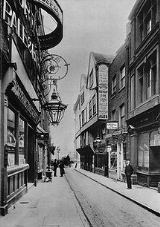
The Opera Comique was a 19th-century opera house constructed between Wych Street
Wych Street

Wych Street was a street in London, running roughly east-west to the south of Lincoln's Inn Fields, from the Strand, London to Drury Lane. It was in an area that was not affected by the Great Fire of London, and contained decrepit Elizabethan houses, with projecting wooden Jettying, until the street was demolished in around 1901 as part of...
 and Holywell Street with entrances on the East Strand
Strand, London

The Strand is a street in the City of Westminster, London, England. It currently starts at Trafalgar Square and runs east to join Fleet Street at Temple Bar London, which marks the boundary of the City of London at this point, though its #History has been longer than this....
. The theatre opened in 1870 and was demolished in 1902, for the construction of the Aldwych
Aldwych

Aldwych is a place and road in the City of Westminster in London, England. The road is a crescent, connecting to Strand, London at both ends....
 and Kingsway
Kingsway

Kingsway may refer to:*Kingsway , a major road in central London, England*Kingsway , a major road in Vancouver, Canada*A34 road, an A-road starting in Manchester...
. It is perhaps best remembered for hosting several of the early Gilbert and Sullivan
Gilbert and Sullivan

'Gilbert and Sullivan' refers to the Victorian era partnership of librettist W. S. Gilbert and composer Arthur Sullivan . Together, they wrote fourteen comic operas between 1871 and 1896, of which H.M.S....
 operas.

Opera Comique opened in 1870, followed shortly by construction of the adjoining Globe Theatre
Globe Theatre (Newcastle Street)

The Globe was a Victorian era theatre built in 1868 and demolished in 1902. It was the third of five London theatres to bear the name. It was also known at various times as the Royal Globe Theatre or Globe Theatre Royal....
 in Newcastle Street.


Discussion
Ask a question about 'Opera Comique'
Start a new discussion about 'Opera Comique'
Answer questions from other users
Full Discussion Forum


Encyclopedia


The Opera Comique was a 19th-century opera house constructed between Wych Street
Wych Street

Wych Street was a street in London, running roughly east-west to the south of Lincoln's Inn Fields, from the Strand, London to Drury Lane. It was in an area that was not affected by the Great Fire of London, and contained decrepit Elizabethan houses, with projecting wooden Jettying, until the street was demolished in around 1901 as part of...
 and Holywell Street with entrances on the East Strand
Strand, London

The Strand is a street in the City of Westminster, London, England. It currently starts at Trafalgar Square and runs east to join Fleet Street at Temple Bar London, which marks the boundary of the City of London at this point, though its #History has been longer than this....
. The theatre opened in 1870 and was demolished in 1902, for the construction of the Aldwych
Aldwych

Aldwych is a place and road in the City of Westminster in London, England. The road is a crescent, connecting to Strand, London at both ends....
 and Kingsway
Kingsway

Kingsway may refer to:*Kingsway , a major road in central London, England*Kingsway , a major road in Vancouver, Canada*A34 road, an A-road starting in Manchester...
. It is perhaps best remembered for hosting several of the early Gilbert and Sullivan
Gilbert and Sullivan

'Gilbert and Sullivan' refers to the Victorian era partnership of librettist W. S. Gilbert and composer Arthur Sullivan . Together, they wrote fourteen comic operas between 1871 and 1896, of which H.M.S....
 operas.

History

The Opera Comique opened in 1870, followed shortly by construction of the adjoining Globe Theatre
Globe Theatre (Newcastle Street)

The Globe was a Victorian era theatre built in 1868 and demolished in 1902. It was the third of five London theatres to bear the name. It was also known at various times as the Royal Globe Theatre or Globe Theatre Royal....
 in Newcastle Street. The two theatres, both owned by Sefton Parry, were built back to back and called the "Rickety Twins", on the site of the former Lyon's Inn, an old Inn of Chancery, previously belonging to the Inner Temple
Inner Temple

The Honourable Society of the Inner Temple is one of the four Inns of Court around the Royal Courts of Justice in London which may call members to the Bar association and so entitle them to practise as barristers....
. The theatre, built partly underground, had three entrances through long narrow tunnels from three streets (including the Strand) and was therefore nicknamed the "Theatre Royal, Tunnels". It was reportedly hastily built and draughty, and its long flight of stairs leading down to the level of the stalls was a dangerous fire hazard. However, it was nicely decorated. Parry built the theatre cheaply, hoping "to make handsome profits in compensation when the area was demolished, which was even then in contemplation".

The theatre was opened in October 1870 with a French company led by the veteran actress Pauline Virginie Déjazet
Virginie Déjazet

Pauline Virginie Dejazet was a France actress.She was born in Paris, and made her first appearance on the stage at the age of five. It was not until 1820, when she began her seven years' connexion with the recently founded Gymnase, that she won her triumphs in soubrette and "breeches" parts, which came to be known as "Dejazets." From 182...
. This was followed by the Parisian company, Comédie-Française
Comédie-Française

The Com?die-Fran?aise or Th??tre-Fran?ais is one of the few state theaters in France. It is the only state theater to have its own troupe of actors....
, who made the theatre their base during the Franco-Prussian War
Franco-Prussian War

The Franco-Prussian War or Franco-German War, often referred to in France as the 1870 War was a conflict between Second French Empire and Kingdom of Prussia, while Prussia was backed by the North German Confederation, of which it was a member, and the South German states of Grand Duchy of Baden, History of W?rttemberg#The Kingdom...
.

The first home-grown production at the theatre was a musical play in 1871, based on a Molière
Molière

Jean-Baptiste Poquelin, also known by his stage name Moli?re, was a French playwright and actor who is considered one of the greatest masters of comedy in Western literature....
 work, called The Doctor in Spite of Himself, with music by Richard D'Oyly Carte
Richard D'Oyly Carte

Richard D'Oyly Carte was an English people talent agent, theatrical impresario and hotelier during the latter half of the Victorian era.Carte started his career in his father's music publishing and musical instrument manufacturing business....
, which was a failure. The theatre then turned to presenting French works in translation; however, the public did not approve of its French name and repertoire, and the theatre was not popular. In 1873, Italian tragedienne Adelaide Ristori
Adelaide Ristori

Adelaide Ristori was a distinguished Italy tragedienne, who was often referred to as the Marquise....
 appeared there.

In November 1877, however, Carte took on the lease and returned to produce the première of Gilbert and Sullivan
Gilbert and Sullivan

'Gilbert and Sullivan' refers to the Victorian era partnership of librettist W. S. Gilbert and composer Arthur Sullivan . Together, they wrote fourteen comic operas between 1871 and 1896, of which H.M.S....
's The Sorcerer
The Sorcerer

The Sorcerer is a two-act comic opera, with a libretto by W. S. Gilbert and music by Arthur Sullivan. It was Gilbert and Sullivan's third opera together....
, a proudly English comic opera
Comic opera

Comic opera, or light opera, denotes a sung dramatic work of a light or comic nature, usually with a happy ending.Comic opera first developed in 18th-century Italy as opera buffa, an alternative to opera seria....
, at the theatre This was followed in 1878 by the patriotic H.M.S. Pinafore (during the performance on 31 July 1879, Carte's former business partners tried to seize the set), which became a nearly unprecedented hit, running for 571 performances. Two more successes followed, The Pirates of Penzance
The Pirates of Penzance

The Pirates of Penzance, or The Slave of Duty, is a comic opera in two acts, with music by Arthur Sullivan and libretto by W. S. Gilbert. It is one of the Savoy Operas....
 (1880) and, finally, Patience
Patience (opera)

Patience, or Bunthorne's Bride, is a comic opera in two acts, with music by Arthur Sullivan and libretto by W. S. Gilbert. First performed at the Opera Comique, London, on April 23 1881, it moved to the 1,292-seat Savoy Theatre on October 10 1881, where it was the first theatrical production in the world to be lit entirely by electric li...
 (1881), which was later transferred to Carte's larger new theatre, the Savoy Theatre
Savoy Theatre

The Savoy Theatre is a West End theatre located in the Strand, London in the City of Westminster, London, England. The theatre opened on 10 October 1881 and was built by Richard D'Oyly Carte on the site of the old Savoy Palace as a showcase for the popular series of comic operas of Gilbert and Sullivan, which became known as the Savoy Operas...
. During this period, Carte also presented various companion pieces with the Gilbert and Sullivan operas, including the 1877 revival of Dora's Dream
Dora's Dream

Dora's Dream is a one-act operetta, with music composed by Alfred Cellier and a libretto by Arthur Cecil.The piece was first performed at the Royal Gallery of Illustration on 3 July 1873, with Fanny Holland and Arthur Cecil starring in the two roles....
 by Arthur Cecil
Arthur Cecil

Arthur Cecil Blunt, better known as Arthur Cecil was an English people actor, comedian, playwright and theatre manager. He is probably best remembered for playing the role of Box in the long-running production of Cox and Box, by Arthur Sullivan and F....
 and Alfred Cellier
Alfred Cellier

Alfred Cellier , was an English people composer, orchestrator and conductor.In addition to conducting and music directing the original productions of several of the most famous Gilbert and Sullivan works and writing the overtures to some of them, Cellier conducted at many theatres in London, New York and on tour in Britain, America and Au...
; The Spectre Knight
The Spectre Knight

The Spectre Knight is a one-act "fanciful operetta" with a libretto by James Albery and music by Alfred Cellier. It was first performed on 9 February 1878 at the Opera Comique by D'Oyly Carte Opera Company as a companion piece to The Sorcerer....
 (1878); revivals of Trial by Jury
Trial by Jury

Trial by Jury is a comic opera in one act, with music by Arthur Sullivan and libretto by W. S. Gilbert. It was first produced on 25 March 1875, at London's Royalty Theatre, where it initially ran for 131 performances and was considered a hit, receiving critical praise and outrunning its popular companion piece, Jacques Offenbach's...
; several pieces by George Grossmith
George Grossmith

George Grossmith was an English people comedian, writer, composer, actor, and singer. His performing career spanned more than four decades. As a writer and composer, he created 18 comic operas, nearly 100 musical sketches, some 600 songs and piano pieces, three books and both serious and comic pieces for newspapers and magazines....
 beginning in 1878: Beauties on the Beach, A Silver Wedding, Five Hamlets, and Cups and Saucers
Cups and Saucers

Cups and Saucers is a one-act "satirical musical sketch" written and composed by George Grossmith. It was first produced in 1876 on tour as a vehicle for Grossmith and Florence Marryat, as part of Entre Nous, their series of piano sketches....
; revivals of Gilbert's After All!
After All!

'After All!' is a one-act comic opera with a libretto by Frank Desprez and music by Alfred Cellier. It was first performed at the Savoy Theatre along with the H.M.S....
; a Children's Pinafore (1878); In the Sulks
In the Sulks

In the Sulks is a one-act comic opera with a libretto by Frank Desprez and music by Alfred Cellier. It was first performed at the Opera Comique on 21 February 1880; revived 3 April 1880 to 2 April 1881 as a curtain raiser to The Pirates of Penzance, and again from 23 or 25 April to 2 May 1881 and from 11 to 14 October 1881 as a curta...
 (1880); and Uncle Samuel
Uncle Samuel

Uncle Samuel is a one-act comic opera with a libretto by Arthur Law and music by George Grossmith. It was first produced at the Opera Comique on 3 May 1881 to 8 October 1881, as companion piece to Patience ....
 (1881).

Once the D'Oyly Carte Opera Company
D'Oyly Carte Opera Company

The D'Oyly Carte Opera Company was a professional light opera company that staged performances of Gilbert and Sullivan's Savoy Operas in the UK, Europe, North America, South Africa, Australia and elsewhere from the 1870s until it closed in 1982....
 left the theatre, its fortunes declined. Later productions includied farces and burlesque, such as Mother-In-Law (1885, by George R. Sims), which was paired with Vulcan, by Rose and Harris.

The Opera Comique was rebuilt in 1895 and closed in 1899, to be demolished in 1902 when the maze of slums in the area was redeveloped to create Aldwych
Aldwych

Aldwych is a place and road in the City of Westminster in London, England. The road is a crescent, connecting to Strand, London at both ends....
 (named after old Wych Street
Wych Street

Wych Street was a street in London, running roughly east-west to the south of Lincoln's Inn Fields, from the Strand, London to Drury Lane. It was in an area that was not affected by the Great Fire of London, and contained decrepit Elizabethan houses, with projecting wooden Jettying, until the street was demolished in around 1901 as part of...
) and Kingsway
Kingsway (London)

Kingsway is a major road in central London in the United Kingdom, designated as part of the A4200 road. It runs from High Holborn, at its north end in the London Borough of Camden, and meets Aldwych in the south in the City of Westminster at Bush House....
.

See also

  • Savoy Opera
    Savoy opera

    The Savoy Operas denote a style of comic opera that developed in Victorian England in the late 19th century, with W. S. Gilbert and Arthur Sullivan as the original and most successful practitioners....


External links