

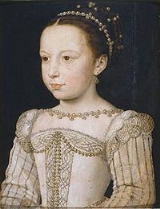
Marguerite de Valois

Encyclopedia
Margaret of Valois was Queen of France
and of Navarre during the late sixteenth century. A royal princess of France by birth, she ultimately became the only surviving member of the Valois Dynasty
.
She was the daughter of King Henry II of France
and Catherine de' Medici
and the sister of Kings Francis II
, Charles IX
and Henry III
and of Queen Elizabeth of Spain. She was queen twice for she had married King Henry III of Navarre who finally became King Henri IV of France.
Margaret, among other political manipulations, was subjected to an arranged marriage and being held prisoner (albeit at a castle) for many years. However, her life was anything but passive.
Aside from being twice a queen—first of Navarre
(1572), then of France
(1589), Margaret was famous for her beauty and sense of style (she was one of the most fashionable women of her time, influencing most of Europe's Royal Courts with her clothing). She was also a gifted poet and writer, notable for both her own scandalous behavior and for revealing that of others. Margaret took many lovers both during her marriage and after her annulment. The most well-known were Joseph Boniface de La Môle
, Jacques de Harlay, Seigneur de Champvallon and Louis de Bussy d'Amboise. When imprisoned by her brother Henry III
for eighteen years, she took advantage of the time to write her memoirs, which included a succession of stories relating to the disputes of her brothers Charles IX
and Henry III
with her husband Henry IV
. The memoirs were published posthumously in 1628 and scandalised the population.
Her life has inspired a variety of stories over the centuries, beginning with Shakespeare's
early comedy Love's Labour's Lost
written during her lifetime, to Alexandre Dumas, père
's 1845 novel La Reine Margot; to a 1994 movie La Reine Margot
.
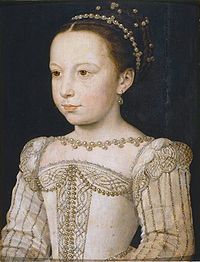 Margaret was born Marguerite de Valois on May 14, 1553, at the royal Château de Saint-Germain-en-Laye
, the sixth child and third daughter of Henry II
and Catherine de' Medici
. Three of her brothers would become kings of France: Francis II
, Charles IX
and Henry III
. Her sister, Elisabeth of Valois
, would become the third wife of King Philip II of Spain
.
any chance of controlling France. Instead, she offered to marry Margaret to Philip II's son Carlos, Prince of Asturias, but the marriage never occurred. Serious negotiations for Margaret's marriage to King Sebastian of Portugal
were also considered but abandoned.
Ultimately Margaret was forced to marry King Henry III of Navarre, who ultimately succeeded to her brothers as Henry IV of France
(from this marriage, she was also the Duchess of Vendôme
), the son of the Protestant queen Jeanne III of Navarre
and of the First Prince of the Blood Antoine de Bourbon, in a union that was designed to reunite family ties (the Bourbons were part of the French Royal family
and the closest relatives to the reigning Valois
branch) and create harmony between Catholics and the Protestant Huguenot
s. Henry's mother opposed the marriage, but many of her nobles supported it, so the match was made.
However, Jeanne died under suspicious circumstances before the marriage could take place; some suspected that a pair of gloves sent to Jeanne as a wedding gift from Margaret's mother, Catherine de' Medici had been poisoned. The marriage of the 19-year-old Margaret to Henry, who had become King of Navarre upon the death of his mother, took place on 18 August 1572 at Notre Dame
cathedral in Paris
. The groom, a Huguenot, had to remain outside the cathedral during the religious ceremony.
Just six days after the wedding, on Saint Bartholomew's Day
, Roman Catholic factions instigated a targeted group of assassinations, followed by a wave of mob violence, both directed against the Huguenot
s (French Calvinist Protestants). Traditionally believed to have been instigated by Catherine de' Medici
, the marriage was an occasion on which many of the most wealthy and prominent Huguenots had gathered in largely Catholic Paris
.
This event took place during the period 1562 to 1598, known as the French Wars of Religion
, which consisted of factional disputes between the aristocratic houses of France, such as the House of Bourbon and House of Guise (Lorraine).
After more than three years of confinement at court, Henry escaped Paris in 1576, leaving his wife behind. Finally granted permission to return to her husband in Navarre, for the next three and a half years Margaret and her husband lived in Pau. Both openly kept other lovers, and they quarrelled frequently.
and seized power over Agen
, one of her appanage
s. After several months of fortifying the city, the citizens of Agen revolted and Queen Margaret fled to the castle of Carlat
. In 1586, she was imprisoned by her brother Henry III in the castle of Usson
, in Auvergne
, where she spent eighteen years.
During this time, Margaret wrote her memoirs consisting of a succession of stories relating to the affairs of her brothers Charles IX and Henry III with her former husband Henry IV. The memoirs were published posthumously in 1628 and scandalised the population.
In 1589, Henry, her husband, succeeded to the throne of France as Henry IV. He was, however, not accepted by most of the Catholic population until he converted four years later. Henry continued to keep mistresses, most notably Gabrielle d'Estrées
from 1591 to 1599, who bore him four children. Negotiations to annul the marriage were entered in 1592 and concluded in 1599 with an agreement that allowed Margaret to maintain the title of queen.
, in the Hostel de la Reyne Margueritte that is illustrated in Mérian
's 1615 plan of Paris (illustration); the hostel was built for her to designs by Jean Bullant
in 1609. It was eventually demolished and partially replaced in 1640 by the Hôtel de La Rochefoucauld.
Reconciled to her former husband and his second wife, Marie de' Medici
, Queen Margaret returned to Paris and established herself as a mentor of the arts and benefactress of the poor. She often helped plan events at court and nurtured the children of Henry IV and Marie.
Margaret died in her Hostel de la Reyne Margueritte, on 27 March 1615, and was buried in the funerary chapel of the Valois in the Basilica of St. Denis. Her casket has disappeared and it is not known whether it was removed and transferred when work was done at the chapel, or destroyed during the French Revolution
.
's 1845 novel La Reine Margot is a fictionalised account of the events surrounding Margaret's marriage to Henry of Navarre. The novel was adapted into a 1994 French film
, La Reine Margot
, in which the role of Margaret was played by the popular French actress Isabelle Adjani
. The main action of Shakespeare's
early comedy Love's Labour's Lost
(1594–5) is based on an attempt at reconciliation, made in 1578, between Margaret and Henry.
Margaret is portrayed by Constance Talmadge
in D.W. Griffith's 1916 film Intolerance
.
La Reine Margot appears in Jean Plaidy's novel, Myself, My Enemy a fictional memoir of Queen Henrietta Maria
, consort of King Charles I of England
. A chance meeting between the young princesse Henriette and the elderly reine Margot at the celebration of marriage of Henriette's brother, Louis XIII of France
, and Anne of Austria
, hints to the reader about the fascinating character that Margaret of Valois was.
Margaret of Valois also has a major role in the Meyerbeer opera Les Huguenots
. This was one of Joan Sutherland
's signature roles and she performed it for her farewell performance for the Australian Opera in 1990.
Kingdom of France
The Kingdom of France was one of the most powerful states to exist in Europe during the second millennium.It originated from the Western portion of the Frankish empire, and consolidated significant power and influence over the next thousand years. Louis XIV, also known as the Sun King, developed a...
and of Navarre during the late sixteenth century. A royal princess of France by birth, she ultimately became the only surviving member of the Valois Dynasty
Valois Dynasty
The House of Valois was a cadet branch of the Capetian dynasty, succeeding the House of Capet as kings of France from 1328 to 1589...
.
She was the daughter of King Henry II of France
Henry II of France
Henry II was King of France from 31 March 1547 until his death in 1559.-Early years:Henry was born in the royal Château de Saint-Germain-en-Laye, near Paris, the son of Francis I and Claude, Duchess of Brittany .His father was captured at the Battle of Pavia in 1525 by his sworn enemy,...
and Catherine de' Medici
Catherine de' Medici
Catherine de' Medici was an Italian noblewoman who was Queen consort of France from 1547 until 1559, as the wife of King Henry II of France....
and the sister of Kings Francis II
Francis II of France
Francis II was aged 15 when he succeeded to the throne of France after the accidental death of his father, King Henry II, in 1559. He reigned for 18 months before he died in December 1560...
, Charles IX
Charles IX of France
Charles IX was King of France, ruling from 1560 until his death. His reign was dominated by the Wars of Religion. He is best known as king at the time of the St. Bartholomew's Day Massacre.-Childhood:...
and Henry III
Henry III of France
Henry III was King of France from 1574 to 1589. As Henry of Valois, he was the first elected monarch of the Polish-Lithuanian Commonwealth with the dual titles of King of Poland and Grand Duke of Lithuania from 1573 to 1575.-Childhood:Henry was born at the Royal Château de Fontainebleau,...
and of Queen Elizabeth of Spain. She was queen twice for she had married King Henry III of Navarre who finally became King Henri IV of France.
Margaret, among other political manipulations, was subjected to an arranged marriage and being held prisoner (albeit at a castle) for many years. However, her life was anything but passive.
Aside from being twice a queen—first of Navarre
Navarre
Navarre , officially the Chartered Community of Navarre is an autonomous community in northern Spain, bordering the Basque Country, La Rioja, and Aragon in Spain and Aquitaine in France...
(1572), then of France
France
The French Republic , The French Republic , The French Republic , (commonly known as France , is a unitary semi-presidential republic in Western Europe with several overseas territories and islands located on other continents and in the Indian, Pacific, and Atlantic oceans. Metropolitan France...
(1589), Margaret was famous for her beauty and sense of style (she was one of the most fashionable women of her time, influencing most of Europe's Royal Courts with her clothing). She was also a gifted poet and writer, notable for both her own scandalous behavior and for revealing that of others. Margaret took many lovers both during her marriage and after her annulment. The most well-known were Joseph Boniface de La Môle
Joseph Boniface de La Môle
Joseph Boniface de La Môle was a French nobleman. He was the son of Jacques Boniface, seigneur de la Môle et de Colobrières, of Marseille....
, Jacques de Harlay, Seigneur de Champvallon and Louis de Bussy d'Amboise. When imprisoned by her brother Henry III
Henry III of France
Henry III was King of France from 1574 to 1589. As Henry of Valois, he was the first elected monarch of the Polish-Lithuanian Commonwealth with the dual titles of King of Poland and Grand Duke of Lithuania from 1573 to 1575.-Childhood:Henry was born at the Royal Château de Fontainebleau,...
for eighteen years, she took advantage of the time to write her memoirs, which included a succession of stories relating to the disputes of her brothers Charles IX
Charles IX of France
Charles IX was King of France, ruling from 1560 until his death. His reign was dominated by the Wars of Religion. He is best known as king at the time of the St. Bartholomew's Day Massacre.-Childhood:...
and Henry III
Henry III of France
Henry III was King of France from 1574 to 1589. As Henry of Valois, he was the first elected monarch of the Polish-Lithuanian Commonwealth with the dual titles of King of Poland and Grand Duke of Lithuania from 1573 to 1575.-Childhood:Henry was born at the Royal Château de Fontainebleau,...
with her husband Henry IV
Henry IV of France
Henry IV , Henri-Quatre, was King of France from 1589 to 1610 and King of Navarre from 1572 to 1610. He was the first monarch of the Bourbon branch of the Capetian dynasty in France....
. The memoirs were published posthumously in 1628 and scandalised the population.
Her life has inspired a variety of stories over the centuries, beginning with Shakespeare's
William Shakespeare
William Shakespeare was an English poet and playwright, widely regarded as the greatest writer in the English language and the world's pre-eminent dramatist. He is often called England's national poet and the "Bard of Avon"...
early comedy Love's Labour's Lost
Love's Labour's Lost
Love's Labour's Lost is one of William Shakespeare's early comedies, believed to have been written in the mid-1590s, and first published in 1598.-Title:...
written during her lifetime, to Alexandre Dumas, père
Alexandre Dumas, père
Alexandre Dumas, , born Dumas Davy de la Pailleterie was a French writer, best known for his historical novels of high adventure which have made him one of the most widely read French authors in the world...
's 1845 novel La Reine Margot; to a 1994 movie La Reine Margot
La Reine Margot (1994 film)
La Reine Margot is a 1994 French period film directed by Patrice Chéreau, based on the 1845 historical novel of the same name by Alexandre Dumas, père. It stars Isabelle Adjani, Daniel Auteuil, Virna Lisi and Vincent Pérez...
.
Early life
Château de Saint-Germain-en-Laye
The Château de Saint-Germain-en-Laye is a royal palace in the commune of Saint-Germain-en-Laye, in the département of Yvelines, about 19 km west of Paris, France. Today, it houses the Musée d'Archéologie Nationale ....
, the sixth child and third daughter of Henry II
Henry II of France
Henry II was King of France from 31 March 1547 until his death in 1559.-Early years:Henry was born in the royal Château de Saint-Germain-en-Laye, near Paris, the son of Francis I and Claude, Duchess of Brittany .His father was captured at the Battle of Pavia in 1525 by his sworn enemy,...
and Catherine de' Medici
Catherine de' Medici
Catherine de' Medici was an Italian noblewoman who was Queen consort of France from 1547 until 1559, as the wife of King Henry II of France....
. Three of her brothers would become kings of France: Francis II
Francis II of France
Francis II was aged 15 when he succeeded to the throne of France after the accidental death of his father, King Henry II, in 1559. He reigned for 18 months before he died in December 1560...
, Charles IX
Charles IX of France
Charles IX was King of France, ruling from 1560 until his death. His reign was dominated by the Wars of Religion. He is best known as king at the time of the St. Bartholomew's Day Massacre.-Childhood:...
and Henry III
Henry III of France
Henry III was King of France from 1574 to 1589. As Henry of Valois, he was the first elected monarch of the Polish-Lithuanian Commonwealth with the dual titles of King of Poland and Grand Duke of Lithuania from 1573 to 1575.-Childhood:Henry was born at the Royal Château de Fontainebleau,...
. Her sister, Elisabeth of Valois
Elisabeth of Valois
Elisabeth of Valois was the eldest daughter of Henry II of France and Catherine de' Medici.-Early life:She was born in the Château de Fontainebleau...
, would become the third wife of King Philip II of Spain
Philip II of Spain
Philip II was King of Spain, Portugal, Naples, Sicily, and, while married to Mary I, King of England and Ireland. He was lord of the Seventeen Provinces from 1556 until 1581, holding various titles for the individual territories such as duke or count....
.
Arranged marriage
Although Margaret is said to have loved Henry of Guise, her mother would never allow the House of GuiseHouse of Guise
The House of Guise was a French ducal family, partly responsible for the French Wars of Religion.The Guises were Catholic, and Henry Guise wanted to end growing Calvinist influence...
any chance of controlling France. Instead, she offered to marry Margaret to Philip II's son Carlos, Prince of Asturias, but the marriage never occurred. Serious negotiations for Margaret's marriage to King Sebastian of Portugal
Sebastian of Portugal
Sebastian "the Desired" was the 16th king of Portugal and the Algarves. He was the son of Prince John of Portugal and his wife, Joan of Spain...
were also considered but abandoned.
Ultimately Margaret was forced to marry King Henry III of Navarre, who ultimately succeeded to her brothers as Henry IV of France
Henry IV of France
Henry IV , Henri-Quatre, was King of France from 1589 to 1610 and King of Navarre from 1572 to 1610. He was the first monarch of the Bourbon branch of the Capetian dynasty in France....
(from this marriage, she was also the Duchess of Vendôme
Duchess of Vendôme
-House of Bourbon:...
), the son of the Protestant queen Jeanne III of Navarre
Jeanne III of Navarre
Jeanne d'Albret , also known as Jeanne III or Joan III, was the queen regnant of Navarre from 1555 to 1572. She married Antoine de Bourbon, Duke of Vendôme, and was the mother of Henry of Bourbon, who became King of Navarre and of France as Henry IV, the first Bourbon king...
and of the First Prince of the Blood Antoine de Bourbon, in a union that was designed to reunite family ties (the Bourbons were part of the French Royal family
Capetian dynasty
The Capetian dynasty , also known as the House of France, is the largest and oldest European royal house, consisting of the descendants of King Hugh Capet of France in the male line. Hugh Capet himself was a cognatic descendant of the Carolingians and the Merovingians, earlier rulers of France...
and the closest relatives to the reigning Valois
Valois Dynasty
The House of Valois was a cadet branch of the Capetian dynasty, succeeding the House of Capet as kings of France from 1328 to 1589...
branch) and create harmony between Catholics and the Protestant Huguenot
Huguenot
The Huguenots were members of the Protestant Reformed Church of France during the 16th and 17th centuries. Since the 17th century, people who formerly would have been called Huguenots have instead simply been called French Protestants, a title suggested by their German co-religionists, the...
s. Henry's mother opposed the marriage, but many of her nobles supported it, so the match was made.
However, Jeanne died under suspicious circumstances before the marriage could take place; some suspected that a pair of gloves sent to Jeanne as a wedding gift from Margaret's mother, Catherine de' Medici had been poisoned. The marriage of the 19-year-old Margaret to Henry, who had become King of Navarre upon the death of his mother, took place on 18 August 1572 at Notre Dame
Notre Dame de Paris
Notre Dame de Paris , also known as Notre Dame Cathedral, is a Gothic, Roman Catholic cathedral on the eastern half of the Île de la Cité in the fourth arrondissement of Paris, France. It is the cathedral of the Catholic Archdiocese of Paris: that is, it is the church that contains the cathedra of...
cathedral in Paris
Paris
Paris is the capital and largest city in France, situated on the river Seine, in northern France, at the heart of the Île-de-France region...
. The groom, a Huguenot, had to remain outside the cathedral during the religious ceremony.
Just six days after the wedding, on Saint Bartholomew's Day
St. Bartholomew's Day massacre
The St. Bartholomew's Day massacre in 1572 was a targeted group of assassinations, followed by a wave of Roman Catholic mob violence, both directed against the Huguenots , during the French Wars of Religion...
, Roman Catholic factions instigated a targeted group of assassinations, followed by a wave of mob violence, both directed against the Huguenot
Huguenot
The Huguenots were members of the Protestant Reformed Church of France during the 16th and 17th centuries. Since the 17th century, people who formerly would have been called Huguenots have instead simply been called French Protestants, a title suggested by their German co-religionists, the...
s (French Calvinist Protestants). Traditionally believed to have been instigated by Catherine de' Medici
Catherine de' Medici
Catherine de' Medici was an Italian noblewoman who was Queen consort of France from 1547 until 1559, as the wife of King Henry II of France....
, the marriage was an occasion on which many of the most wealthy and prominent Huguenots had gathered in largely Catholic Paris
Paris
Paris is the capital and largest city in France, situated on the river Seine, in northern France, at the heart of the Île-de-France region...
.
This event took place during the period 1562 to 1598, known as the French Wars of Religion
French Wars of Religion
The French Wars of Religion is the name given to a period of civil infighting and military operations, primarily fought between French Catholics and Protestants . The conflict involved the factional disputes between the aristocratic houses of France, such as the House of Bourbon and House of Guise...
, which consisted of factional disputes between the aristocratic houses of France, such as the House of Bourbon and House of Guise (Lorraine).
After the Saint Bartholomew's Day massacre
Margaret has been credited with saving the lives of several prominent Protestants, including her husband's, during the massacre, by keeping them in her rooms and refusing to admit the assassins. Henry of Navarre had to feign conversion to Catholicism.After more than three years of confinement at court, Henry escaped Paris in 1576, leaving his wife behind. Finally granted permission to return to her husband in Navarre, for the next three and a half years Margaret and her husband lived in Pau. Both openly kept other lovers, and they quarrelled frequently.
Agen and Usson
After an illness in 1582, Queen Margaret returned to the court of her brother, Henry III, in Paris. But Henry III was soon scandalized by her reputation and forced her to leave the court. After long negotiations, she was allowed to return to her husband's court in Navarre, but she received an icy reception. Determined to overcome her difficulties, Queen Margaret masterminded a coup d'étatCoup d'état
A coup d'état state, literally: strike/blow of state)—also known as a coup, putsch, and overthrow—is the sudden, extrajudicial deposition of a government, usually by a small group of the existing state establishment—typically the military—to replace the deposed government with another body; either...
and seized power over Agen
Agen
Agen is a commune in the Lot-et-Garonne department in Aquitaine in south-western France. It lies on the river Garonne southeast of Bordeaux. It is the capital of the department.-Economy:The town has a higher level of unemployment than the national average...
, one of her appanage
Appanage
An apanage or appanage or is the grant of an estate, titles, offices, or other things of value to the younger male children of a sovereign, who would otherwise have no inheritance under the system of primogeniture...
s. After several months of fortifying the city, the citizens of Agen revolted and Queen Margaret fled to the castle of Carlat
Carlat
Carlat is a commune in the Cantal department in south-central France.The "Rocher de Carlat" or rock of Carlat situated above the picturesque commune was once the site of one of the most powerful and impenetrable chateaux in all of France. It was the seat of Jacques d'Armagnac, duke of Nemours, and...
. In 1586, she was imprisoned by her brother Henry III in the castle of Usson
Usson, Puy-de-Dôme
Usson is a commune in the Puy-de-Dôme department in Auvergne in central France.-References:*...
, in Auvergne
Auvergne (province)
Auvergne was a historic province in south central France. It was originally the feudal domain of the Counts of Auvergne. It is now the geographical and cultural area that corresponds to the former province....
, where she spent eighteen years.
During this time, Margaret wrote her memoirs consisting of a succession of stories relating to the affairs of her brothers Charles IX and Henry III with her former husband Henry IV. The memoirs were published posthumously in 1628 and scandalised the population.
In 1589, Henry, her husband, succeeded to the throne of France as Henry IV. He was, however, not accepted by most of the Catholic population until he converted four years later. Henry continued to keep mistresses, most notably Gabrielle d'Estrées
Gabrielle d'Estrées
Gabrielle d'Estrées, Duchess of Beaufort and Verneuil, Marchioness of Monceaux was a French mistress of King Henry IV of France, born at either the Château de la Bourdaisière in Montlouis-sur-Loire, in Touraine, or at the château de Cœuvres, in Picardy....
from 1591 to 1599, who bore him four children. Negotiations to annul the marriage were entered in 1592 and concluded in 1599 with an agreement that allowed Margaret to maintain the title of queen.
Last years
She settled her household on the Left Bank of the SeineSeine
The Seine is a -long river and an important commercial waterway within the Paris Basin in the north of France. It rises at Saint-Seine near Dijon in northeastern France in the Langres plateau, flowing through Paris and into the English Channel at Le Havre . It is navigable by ocean-going vessels...
, in the Hostel de la Reyne Margueritte that is illustrated in Mérian
Matthäus Merian
Matthäus Merian der Ältere was a Swiss-born engraver who worked in Frankfurt for most of his career, where he also ran a publishing house.-Early life and marriage:...
's 1615 plan of Paris (illustration); the hostel was built for her to designs by Jean Bullant
Jean Bullant
Jean Bullant was a French architect and sculptor who built the tombs of Anne de Montmorency, Grand Connétable of France, Henri II, and Catherine de' Medici. He also worked on the Tuileries, the Louvre, and the Château d'Écouen...
in 1609. It was eventually demolished and partially replaced in 1640 by the Hôtel de La Rochefoucauld.
Reconciled to her former husband and his second wife, Marie de' Medici
Marie de' Medici
Marie de Médicis , Italian Maria de' Medici, was queen consort of France, as the second wife of King Henry IV of France, of the House of Bourbon. She herself was a member of the wealthy and powerful House of Medici...
, Queen Margaret returned to Paris and established herself as a mentor of the arts and benefactress of the poor. She often helped plan events at court and nurtured the children of Henry IV and Marie.
Margaret died in her Hostel de la Reyne Margueritte, on 27 March 1615, and was buried in the funerary chapel of the Valois in the Basilica of St. Denis. Her casket has disappeared and it is not known whether it was removed and transferred when work was done at the chapel, or destroyed during the French Revolution
French Revolution
The French Revolution , sometimes distinguished as the 'Great French Revolution' , was a period of radical social and political upheaval in France and Europe. The absolute monarchy that had ruled France for centuries collapsed in three years...
.
Margaret of Valois in literature & fiction
Alexandre Dumas, pèreAlexandre Dumas, père
Alexandre Dumas, , born Dumas Davy de la Pailleterie was a French writer, best known for his historical novels of high adventure which have made him one of the most widely read French authors in the world...
's 1845 novel La Reine Margot is a fictionalised account of the events surrounding Margaret's marriage to Henry of Navarre. The novel was adapted into a 1994 French film
French Film
French Film is a 2008 British comedy film directed by Jackie Oudney and starring Anne-Marie Duff, Hugh Bonneville, Victoria Hamilton, Douglas Henshall and Eric Cantona. The film was shot in Spring 2007 at various locations around London including Waterloo station and the BFI Southbank.-Plot:Two...
, La Reine Margot
La Reine Margot (1994 film)
La Reine Margot is a 1994 French period film directed by Patrice Chéreau, based on the 1845 historical novel of the same name by Alexandre Dumas, père. It stars Isabelle Adjani, Daniel Auteuil, Virna Lisi and Vincent Pérez...
, in which the role of Margaret was played by the popular French actress Isabelle Adjani
Isabelle Adjani
Isabelle Yasmine Adjani is a French film actress and singer. Adjani has appeared in 30 films since 1970. She holds the record for most César Awards for Best Actress with five, for Possession , One Deadly Summer , Camille Claudel , Queen Margot and Skirt Day...
. The main action of Shakespeare's
William Shakespeare
William Shakespeare was an English poet and playwright, widely regarded as the greatest writer in the English language and the world's pre-eminent dramatist. He is often called England's national poet and the "Bard of Avon"...
early comedy Love's Labour's Lost
Love's Labour's Lost
Love's Labour's Lost is one of William Shakespeare's early comedies, believed to have been written in the mid-1590s, and first published in 1598.-Title:...
(1594–5) is based on an attempt at reconciliation, made in 1578, between Margaret and Henry.
Margaret is portrayed by Constance Talmadge
Constance Talmadge
Constance Talmadge was a silent movie star born in Brooklyn, New York, USA, and was the sister of fellow actresses Norma Talmadge and Natalie Talmadge.-Early life:...
in D.W. Griffith's 1916 film Intolerance
Intolerance (film)
Intolerance is a 1916 American silent film directed by D. W. Griffith and is considered one of the great masterpieces of the Silent Era. The three-and-a-half hour epic intercuts four parallel storylines each separated by several centuries: A contemporary melodrama of crime and redemption; a...
.
La Reine Margot appears in Jean Plaidy's novel, Myself, My Enemy a fictional memoir of Queen Henrietta Maria
Henrietta Maria of France
Henrietta Maria of France ; was the Queen consort of England, Scotland and Ireland as the wife of King Charles I...
, consort of King Charles I of England
Charles I of England
Charles I was King of England, King of Scotland, and King of Ireland from 27 March 1625 until his execution in 1649. Charles engaged in a struggle for power with the Parliament of England, attempting to obtain royal revenue whilst Parliament sought to curb his Royal prerogative which Charles...
. A chance meeting between the young princesse Henriette and the elderly reine Margot at the celebration of marriage of Henriette's brother, Louis XIII of France
Louis XIII of France
Louis XIII was a Bourbon monarch who ruled as King of France and of Navarre from 1610 to 1643.Louis was only eight years old when he succeeded his father. His mother, Marie de Medici, acted as regent during Louis' minority...
, and Anne of Austria
Anne of Austria
Anne of Austria was Queen consort of France and Navarre, regent for her son, Louis XIV of France, and a Spanish Infanta by birth...
, hints to the reader about the fascinating character that Margaret of Valois was.
Margaret of Valois also has a major role in the Meyerbeer opera Les Huguenots
Les Huguenots
Les Huguenots is a French opera by Giacomo Meyerbeer, one of the most popular and spectacular examples of the style of grand opera. The opera is in five acts and premiered in Paris in 1836. The libretto was written by Eugène Scribe and Émile Deschamps....
. This was one of Joan Sutherland
Joan Sutherland
Dame Joan Alston Sutherland, OM, AC, DBE was an Australian dramatic coloratura soprano noted for her contribution to the renaissance of the bel canto repertoire from the late 1950s through to the 1980s....
's signature roles and she performed it for her farewell performance for the Australian Opera in 1990.
Ancestry
External links
- Memoirs of Marguerite de Valois (in English):
- New York, Charles Scribners, 1892, translated by Violet Fane. View at Google Books http://books.google.com/books?id=gluBsPuBwBIC&pg=PP15#v=onepage&q&f=false.
- Boston, L. C. Page, 1899 . Vew at Project GutenbergProject GutenbergProject Gutenberg is a volunteer effort to digitize and archive cultural works, to "encourage the creation and distribution of eBooks". Founded in 1971 by Michael S. Hart, it is the oldest digital library. Most of the items in its collection are the full texts of public domain books...
http://www.gutenberg.net/etext/3841 or Google Books http://books.google.com/books?id=MEAcI-cTXfAC&pg=PR3#v=onepage&q&f=false.
- Image at cybersybils.net
- Image at pandemonium.tiscali.de

