
All Topics  
Notre Dame de Paris

 
Notre Dame De Paris

   Email Print
   Bookmark   Link


Notre Dame de Paris


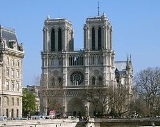
Notre Dame de Paris ('Our Lady of Paris' in French) is a Gothic
Gothic architecture

Gothic architecture is a style of architecture which flourished during the high and late Middle Ages. It evolved from Romanesque architecture and was succeeded by Renaissance architecture....
 cathedral
Cathedral

A cathedral is a Christian church that contains the seat of a bishop. It is a Religion building for worship, specifically of a denomination with an episcopal hierarchy, such as the Roman Catholic Church, Anglicanism, Orthodox Christian and some Lutheranism churches, which serves as a bishop's seat, and thus as the central church of a dioc...
 on the eastern half of the Île de la Cité
Île de la Cité

File:Image-Notre Dame de Paris on ?le de la Cit? Edit 1 - July 2006.jpgThe ?le de la Cit? is one of two natural islands in the Seine within the city of Paris ....
 in the fourth arrondissement of Paris
Paris

Paris is the Capital of France and the country's largest city. It is situated on the river Seine, in northern France, at the heart of the ?le-de-France Regions of France ....
, France
France

France , officially the French Republic , is a country whose Metropolitan France is located in Western Europe and that also comprises various Overseas departments and territories of France....
, with its main entrance to the west. It is the cathedral
Cathedral

A cathedral is a Christian church that contains the seat of a bishop. It is a Religion building for worship, specifically of a denomination with an episcopal hierarchy, such as the Roman Catholic Church, Anglicanism, Orthodox Christian and some Lutheranism churches, which serves as a bishop's seat, and thus as the central church of a dioc...
 of Paris and the seat of the Archbishop of Paris. Notre Dame de Paris is widely considered one of the finest examples of French Gothic architecture
Architecture

The term architecture can refer to a process, a profession or documentation.As a process, architecture is the activity of designing and construction buildings and other physical structures by a person or a computer, primarily to provide shelter....
. It was restored and saved from destruction by Viollet-le-Duc, one of France's most famous architects.


Discussion
Ask a question about 'Notre Dame de Paris'
Start a new discussion about 'Notre Dame de Paris'
Answer questions from other users
Full Discussion Forum


Encyclopedia


Notre Dame de Paris ('Our Lady of Paris' in French) is a Gothic
Gothic architecture

Gothic architecture is a style of architecture which flourished during the high and late Middle Ages. It evolved from Romanesque architecture and was succeeded by Renaissance architecture....
 cathedral
Cathedral

A cathedral is a Christian church that contains the seat of a bishop. It is a Religion building for worship, specifically of a denomination with an episcopal hierarchy, such as the Roman Catholic Church, Anglicanism, Orthodox Christian and some Lutheranism churches, which serves as a bishop's seat, and thus as the central church of a dioc...
 on the eastern half of the Île de la Cité
Île de la Cité

File:Image-Notre Dame de Paris on ?le de la Cit? Edit 1 - July 2006.jpgThe ?le de la Cit? is one of two natural islands in the Seine within the city of Paris ....
 in the fourth arrondissement of Paris
Paris

Paris is the Capital of France and the country's largest city. It is situated on the river Seine, in northern France, at the heart of the ?le-de-France Regions of France ....
, France
France

France , officially the French Republic , is a country whose Metropolitan France is located in Western Europe and that also comprises various Overseas departments and territories of France....
, with its main entrance to the west. It is the cathedral
Cathedral

A cathedral is a Christian church that contains the seat of a bishop. It is a Religion building for worship, specifically of a denomination with an episcopal hierarchy, such as the Roman Catholic Church, Anglicanism, Orthodox Christian and some Lutheranism churches, which serves as a bishop's seat, and thus as the central church of a dioc...
 of Paris and the seat of the Archbishop of Paris. Notre Dame de Paris is widely considered one of the finest examples of French Gothic architecture
Architecture

The term architecture can refer to a process, a profession or documentation.As a process, architecture is the activity of designing and construction buildings and other physical structures by a person or a computer, primarily to provide shelter....
. It was restored and saved from destruction by Viollet-le-Duc, one of France's most famous architects. The name Notre Dame means "Our Lady
Blessed Virgin Mary

The Blessed Virgin Mary, sometimes shortened to The Blessed Virgin or The Virgin Mary, is a traditional title used by most Christians and most specifically used by liturgical Christians such as Roman Catholics, Anglicanism, Eastern Orthodox and Eastern Catholics, and some others to describe Mary, mother of Jesus, the mother of...
" in French
French language

French is a Romance language spoken around the world by around 80 million people as first language, by 190 million as second language, and by about another 200 million people as an acquired tongue, with significant speakers in 54 countries....
. Notre Dame de Paris was one of the first Gothic cathedrals, and its construction spanned the Gothic period. Its sculptures and stained glass
Stained glass

For the Blackford Oakes novel, see Stained Glass The term stained glass can refer to the material of coloured glass or the craft of working with it....
 show the heavy influence of naturalism
Naturalism (art)

Naturalism in art refers to the depiction of realistic objects in a natural setting. The realism movement of the 19th century advocated naturalism in reaction to the stylized and idealized depictions of subjects in Romanticism, but many painters have adopted a similar approach over the centuries....
, unlike that of earlier Romanesque architecture
Romanesque architecture

Romanesque architecture is the term that is used to describe the architecture of Middle Ages Europe which evolved into the Gothic architecture style beginning in the 12th century....
.

Notre Dame de Paris was among the first buildings in the world to use the flying buttress
Flying buttress

A flying buttress, or arc-boutant, is a specific type of buttress usually found on a religious building such as a cathedral. They are used to transmit the horizontal thrust of a Vault across an intervening space , to a buttress outside the building....
 [arched exterior supports]. The building was not originally designed to include the flying buttresses around the choir and nave
Nave

In Romanesque architecture and Gothic architecture Christian abbey, cathedral basilica and Church architecture, the nave is the central approach to the high altar....
. After the construction began and the thinner walls (popularized in the Gothic style) grew ever higher, stress fractures began to occur as the walls pushed outward. In response, the cathedral's architects built supports around the outside walls, and later additions continued as such.

The cathedral suffered desecration
Desecration

Desecration is the act of depriving something of its sacred character -- or the disrespectful or contemptuous treatment of that which is held to be sacred by a group or individual....
 during the radical phase of the French Revolution
French Revolution

The French Revolution was a period of political and social upheaval and radical change in the history of France, during which the French governmental structure, previously an absolute monarchy with feudalism for the aristocracy and Roman Catholic Church clergy, underwent radical change to forms based on Age of Enlightenment principles of cit...
 in the 1790s, when much of its religious imagery was damaged or destroyed. During the 19th century, an extensive restoration project was completed, returning the cathedral to its previous state.

Construction


In 1160, because the church in Paris had become the "parish church of the kings of Europe", Bishop Maurice de Sully
Maurice de Sully

Maurice de Sully was Bishop of Paris from 1160 until his death.He was born of humble parents at Sully-sur-Loire , near Orl?ans, at the beginning of the twelfth century....
 deemed the previous Parisian cathedral, St Stephen's (which had been built in the 4th century) unworthy of its lofty role, and had it demolished shortly after he assumed the title of Bishop of Paris. According to legend, de Sully had a vision of a glorious new cathedral for Paris, and sketched it in the dirt outside of the original church. To begin the construction, the bishop had several houses demolished and had a new road built in order to transport materials for the rest of the cathedral. Construction began in 1163, during the reign of Louis VII
Louis VII of France

Louis VII, called the Younger or the Young, , was List of French monarchs, the son and successor of Louis VI of France . He ruled from 1137 until his death....
, and opinion differs as to whether Maurice de Sully or Pope Alexander III
Pope Alexander III

Pope Alexander III , born Rolando of Siena, was Pope from 1159 to 1181....
 laid the foundation stone of the cathedral. However, both were at the ceremony in question. Bishop de Sully went on to devote most of his life and wealth to the cathedral's construction.

Construction of the west front, with its distinctive two towers, began about the year 1200, before the nave
Nave

In Romanesque architecture and Gothic architecture Christian abbey, cathedral basilica and Church architecture, the nave is the central approach to the high altar....
 had been completed, contrary to normal construction practice. Over the construction period, numerous architect
Architect

An architect is trained and licenced in planning and designing buildings, and participates in supervising the construction of a building. Etymologically, architect derives from the Latin architectus, itself derived from the Greek arkhitekton , i.e....
s worked on the site, as is evidenced by the differing styles at different heights of the west front and towers. Between 1210 and 1220, the fourth architect oversaw the construction of the level with the rose window
Rose window

A Rose window is often used as a generic term applied to a circular window, but is especially used for those found in churches of the Gothic architecture and being divided into segments by stone mullions and tracery....
 and the great halls beneath the towers. The towers were completed around 1245, and the cathedral was completed around 1345.

Timeline of construction

  • 1160 Maurice de Sully
    Maurice de Sully

    Maurice de Sully was Bishop of Paris from 1160 until his death.He was born of humble parents at Sully-sur-Loire , near Orl?ans, at the beginning of the twelfth century....
     (named Bishop of Paris), orders the original cathedral to be demolished.
  • 1163 Cornerstone
    Cornerstone

    The cornerstone concept is derived from the first stone set in the construction of a masonry Foundation , important since all other stones will be set in reference to this stone, thus determining the position of the entire Construction....
     laid for Notre Dame de Paris — construction begins.
  • 1182 Apse
    Apse

    In architecture, the apse is a semicircular recess covered with a hemispherical Vault . In Romanesque architecture, Byzantine architecture and Gothic architecture Christian abbey, cathedral and church architecture, the term is applied to the semi-circular or polygonal section of the sanctuary at the liturgical east end beyond the altar....
     and choir completed.
  • 1196 Nave
    Nave

    In Romanesque architecture and Gothic architecture Christian abbey, cathedral basilica and Church architecture, the nave is the central approach to the high altar....
     completed. Bishop de Sully dies.
  • 1200 Work begins on western façade.
  • 1225 Western façade completed.
  • 1250 Western towers and north rose window completed.
  • 1260s Transepts changed to the Gothic style
    Gothic architecture

    Gothic architecture is a style of architecture which flourished during the high and late Middle Ages. It evolved from Romanesque architecture and was succeeded by Renaissance architecture....
     by Jean de Chelles
    Jean de Chelles

    Jean or Jehan de Chelles was a master mason and sculptor who was one of the architects at the Cathedral of N?tre Dame de Paris. On the exterior wall of the south transept a stone plaque is signed Johanne Magistro and dated February 1257, documenting the initiation of alterations to the transept and its portal....
     then Peter of Montereau
    Peter of Montereau

    Pierre de Montereau or Pierre de Montreuil was a French architect. He is widely recognized as one of the most important proponents of Gothic architecture, though little is known of his life and sources vary as to which buildings are by him....
  • 1250–1345 Remaining elements completed


The organ

Though several organs
Pipe organ

The pipe organ is a keyboard musical instrument that produces sound by venting mechanically compressed air through resonant Organ pipe. Each pipe produces sound at one fixed pitch, so they are provided in sets or "ranks" with one pipe or more per note, each rank having a common timbre and loudness throughout....
 were installed in the cathedral over time, the earliest ones were inadequate for the building. The first noteworthy organ was finished in the 1700s by the noted builder François-Henri Clicquot
François-Henri Clicquot

Fran?ois-Henri Clicquot was a France pipe organ builder and was the grandson of Robert Clicquot and son of Louis-Alexandre Cliquot, who were also noted organ builders....
. Some of Clicquot's original pipework in the pedal division continues to sound from the organ today. The organ was almost completely rebuilt and expanded in the 19th century by Aristide Cavaillé-Coll
Aristide Cavaillé-Coll

Aristide Cavaill?-Coll was a France organ builder. He is considered by many to be the greatest pipe organ builder of the 19th century because he combined both science and art to make his instruments....
.

The position of titular
Titular

Titular means existing in title only.*Titular ruler*Titular head *Titular - bishop or titular cardinal, holder of a titulus , titular see or titular bishopric....
 organist at Notre-Dame is considered as one of the most prestigious organist posts in France, along with the post of Saint Sulpice
Saint-Sulpice (Paris)

Saint-Sulpice is a famous Parisian church on the east side of the Place Saint-Sulpice, in the Luxembourg Quarter of the VIe arrondissement. At 113 meters long, 58 meters in width and 34 meters tall, it is only slightly smaller than Notre Dame de Paris and thus the second largest church in Paris....
 in Paris, Cavaillé-Coll's largest instrument.

The organ has 7,800 pipes, with 900 classified as historical. The organ has 109 stops
Organ stop

An organ stop is a component of a pipe organ which admits pressurized air to a set of organ pipes. Its name comes from the fact that stops can be used selectively by the organist; some can be "on" , while other can be "off" ....
, five 56-key manuals
Manual (music)

A manual is a musical keyboard designed to be played with the hands on a pipe organ, harpsichord, clavichord, electronic organ, or synthesizer. The term "manual" is used with regard to any hand keyboard on these instruments to distinguish it from the Pedal clavier, which is a keyboard that the organist plays with his or her feet....
 and a 32-key pedalboard. In December 1992, work was completed on the organ that fully computerized the organ under 3 LANs
Local area network

A local area network is a computer network covering a small physical area, like a home, office, or small group of buildings, such as a school, or an airport....
 (Local Area Networks).

Among the best-known organists at Notre Dame was Louis Vierne
Louis Vierne

Louis Victor Jules Vierne was a renowned French organ ist and composer. He was born October 8, 1870 in Poitiers and died June 2, 1937 in Paris....
, who held this position from 1900 to 1937. Under his tenure, the Cavaillé-Coll organ was modified in its tonal character, notably in 1902 and 1932. Pierre Cochereau
Pierre Cochereau

Pierre Eug?ne Charles Cochereau , was a French organist, improviser, composer, and pedagogue....
 initiated further alterations (many of which were already planned by Louis Vierne), including the electrification of the action
Action (piano)

The action of a piano is the mechanical assembly which translates the depression of the piano keys into a felt hammer striking the strings. The illustration to the right is of a circa 1907 Wessell, Nickel and Gross Upright action; the parts are listed below....
 between 1959 and 1963 (the original Cavaillé-Coll console, which is now located in the south tower entrance to the tribune), was replaced by a new console in Anglo-American style) and the addition of further stops between 1965 and 1972, notably in the pedal division, the recomposition of the mixture stops, and finally the adding of three horizontal reed stops "en chamade
En chamade

En Chamade refers to powerfully voiced reed stops in a pipe organ that are mounted horizontally rather than vertically in the front of the organ case, projecting out into the church....
". After Cochereau's sudden death in 1984, four new titular organists were appointed at Notre Dame in 1985: Jean-Pierre Leguay, Olivier Latry, Yves Devernay (who died in 1990), and Philippe Lefebvre. This was reminiscent of the 18th-century practice of the cathedral having four titular organists, each one playing for three months of the year. Beginning in 1989, another restoration to the instrument was undertaken, which was completed in 1992.

Alterations, vandalism and restorations


In 1548, rioting Huguenots damaged features of the cathedral, considering them idolatrous
Idolatry

Idolatry is usually defined as worship of any cult image, idea, or Object , as opposed to the worship of a monotheistic God. It is considered a major sin in the Abrahamic religions whereas in religions where such activity is not considered as sin, the term "idolatry" itself is absent....
. During the reigns of Louis XIV
Louis XIV of France

Louis XIV ruled as List of French monarchs and of King of Navarre. He ascended the throne a few months before his fifth birthday, but did not assume actual personal control of the government until the death of his prime minister , the Italians Jules Cardinal Mazarin, in 1661....
 and Louis XV
Louis XV of France

Louis XV ruled as List of French monarchs and of List of Navarrese monarchs from 1 September 1715 until his death on 10 May 1774. Coming to the throne at the age of five, Louis reigned until 15 February 1723, the date of his thirteenth birthday, with the aid of the R?gence, Philippe II, Duke of Orl?ans, his Cousin, thereafter taking formal p...
, the cathedral underwent major alterations as part of an ongoing attempt to modernize cathedrals throughout Europe. Tombs and stained glass windows were destroyed. The north and south rose windows were spared this fate, however.

In 1793, during the French Revolution
French Revolution

The French Revolution was a period of political and social upheaval and radical change in the history of France, during which the French governmental structure, previously an absolute monarchy with feudalism for the aristocracy and Roman Catholic Church clergy, underwent radical change to forms based on Age of Enlightenment principles of cit...
, the cathedral was rededicated to the Cult of Reason
Cult of Reason

The Cult of Reason was a creed based on secularism and atheism devised during the French Revolution by Jacques H?bert, Pierre Gaspard Chaumette and their supporters....
, and then to the Cult of the Supreme Being
Cult of the Supreme Being

The Cult of the Supreme Being was a religion based on deism devised by Maximilien Robespierre, intended to become the state religion after the French Revolution....
. During this time, many of the treasures of the cathedral were either destroyed or plundered. The statues of biblical kings of Judah
Kingdom of Judah

The Kingdom of Judah existed at two periods in Jewish history. According to the Hebrew Bible, a kingdom emerged in Judah after the death of Saul, when the tribe of Judah elevated David to rule over it....
 (erroneously thought to be kings of France) were beheaded. Many of the heads were found during a 1977 excavation nearby and are on display at the Musée de Cluny
Musée de Cluny

The Mus?e de Cluny, officially known as Mus?e National du Moyen ?ge , is a museum in Paris, France. It is located in the Ve arrondissement at 6 Place Paul Painlev?, south of the Boulevard Saint-Germain, between the Boulevard Saint-Michel and the Rue Saint-Jacques ....
. For a time, Lady Liberty replaced the Virgin Mary on several altars. The cathedral's great bells managed to avoid being melted down. The cathedral also came to be used as a warehouse for the storage of food.

A restoration program was initiated in 1845, overseen by architects Jean-Baptiste-Antoine Lassus and Eugène Viollet-le-Duc. The restoration lasted 25 years and included the construction of a flèche
Flèche

A fl?che is used in French architecture to refer to a spire and in English to refer to a lead-covered timber spire. These are placed on the ridges of Church or cathedral roofs and are usually relatively small....
 (a type of spire
Spire

A spire is a tapering conical or pyramidal structure on the top of a building, particularly a church tower. Etymologically, the word is derived from Anglo-Saxon language, so it is related to "spear," rather than the Romance languages and "spirit."...
) as well as the addition of the chimera
Gargoyle

In architecture, a gargoyle is a carved stone grotesque with a spout designed to convey water from a roof and away from the side of a building....
s on the Galerie des Chimères. Viollet le Duc always signed his work with a bat, the wing structure of which most resembles the Gothic vault (see Roquetaillade castle).

In 1871, during the period of the Paris Commune
Paris Commune

The Paris Commune was a government that briefly ruled Paris from March 28 to May 28, 1871. It existed before the split between Anarchism and Socialism, and is hailed by both as the first seizure of power by the working class....
, the cathedral was nearly set alight: some records suggest that the rebels even went so far as to set fire to a mound of chairs within the building. Whether that was so or not, the cathedral survived the Commune period essentially unscathed.

In 1939, during World War II
World War II

World War II, or the Second World War , was a global military conflict which involved a Participants in World War II, including all of the great powers, organised into two opposing military alliances: the Allies of World War II and the Axis powers....
, it was feared that German
Nazi Germany

Nazi Germany and the Third Reich are the colloquial English names for Germany under the regime of Adolf Hitler and the Nazi Party , which established a Totalitarianism dictatorship that existed from 1933 to 1945....
 bombers could destroy the windows; as a result, on September 11 1939, they were removed. They were restored at the end of the war.

In 1991, a major program of maintenance and restoration was initiated, which was intended to last 10 years but is still in progress as of 2008, the cleaning and restoration of old sculptures being an exceedingly delicate matter.

The bells

There are five bells
Church bell

A church bell is a bell which is rung in a church either to signify the hour or the time for worshippers to go to church, perhaps to attend a wedding, funeral, or other Service of worship....
 at Notre Dame. The great bourdon bell
Bourdon (bell)

The bourdon is the heaviest of the bell s that belong to a musical instrument, especially a chime or a carillon, and produces its lowest tone....
, Emmanuel, is located in the South Tower, weighs just over 13 tons, and is tolled to mark the hours of the day and for various occasions and services. There are four additional bells on wheels in the North Tower, which are swing chimed. These bells are rung for various services and festivals. The bells were once rung manually, but are currently rung by electric motors. The bells also have external hammers for tune playing from a small clavier.

Significant events

  • 1185 — Heraclius of Caesarea calls for the Third Crusade
    Third Crusade

    The Third Crusade , also known as the Kings' Crusade, was an attempt by European leaders to reconquer the Holy Land from Saladin .After the failure of the Second Crusade, the Zengid dynasty controlled a unified Syria and engaged in a conflict with the Fatimid dynasty rulers of Egypt, which ultimately resulted in the unification of Egy...
     from the still-incomplete cathedral.
  • 1239 — The Crown of Thorns
    Crown of Thorns

    In Christianity, the Crown of Thorns, one of the instruments of the Passion , was woven of thorn branches and placed on Jesus before Crucifixion of Jesus....
     is placed in the cathedral by St. Louis
    Louis IX of France

    Louis IX , commonly Saint Louis, was List of French monarchs from 1226 to his death. He was also Counts of Artois from 1226 to 1237. Born at Poissy, near Paris, he was a member of the House of Capet and the son of Louis VIII of France and Blanche of Castile....
     during the construction of Sainte-Chapelle
    Sainte-Chapelle

    La Sainte-Chapelle is a Gothic architecture chapel on the ?le de la Cit? in the heart of Paris, France. It is perhaps the high point of the full tide of the Rayonnant period of Gothic architecture....
    .
  • 1302 — Philip the Fair opens the first States-General
    French States-General

    In France under the Ancient Regime, the States-General or Estates-General , was a legislative assembly of the different classes of French nationalitys....
    .
  • December 16 1431Henry VI of England
    Henry VI of England

    Henry VI was Kingdom of England 1422?1461 and then 1470?1471, and King of France as the de jure monarch from 1422 to 1429....
     is crowned King of France.
  • 1450Wolves of Paris
    Wolves of Paris

    The Wolves of Paris were a Man-eater wolf pack that entered Paris during the winter of 1450 through breaches in the city walls, killing forty people....
     trapped and are killed on the steps of the Cathedral.
  • November 7 1455Isabelle Romée
    Isabelle Romée

    Isabelle Rom?e, also known as Isabelle de Vouthon and Isabelle d'Arc and Ysabeau Romee, was the mother of Joan of Arc. She was a native of Vouthon, a village near Domr?my-la-Pucelle where she and her husband Jacques d'Arc settled....
    , the mother of Joan of Arc
    Joan of Arc

    Saint Joan of Arc also known as the Maid of Orleans, is a national heroine of France and a Roman Catholic saint. A peasant girl born in eastern France, she led the French army to several important victories during the Hundred Years' War, claiming divine guidance, and was indirectly responsible for the coronation of Charles VII of Franc...
    , petitions a papal delegation to overturn her daughter's conviction for heresy
    Heresy

    Heresy is an introduced change to some system of belief, especially a religion, that conflicts with the previously established canon of that belief....
    .
  • April 24 1558Mary I of Scotland
    Mary I of Scotland

    Mary I was Queen of Scots from 14 December 1542 to 24 July 1567.She was the only surviving legitimate child of James V of Scotland. She was only six days old when her father died and left her Queen of Scots....
     is married to the Dauphin François (later François II of France), son of Henry II of France
    Henry II of France

    Henry II , of the House of Valois and the son and successor of Francis I of France, was King of France from 31 March 1547, until his death....
    .
  • August 18 1572Henry of Navarre
    Henry IV of France

    Henry de Bourbon, , ruled as Henry III, List of Navarrese monarchs, from 1572 to 1610, and as Henry IV, List of French monarchs, from 1589 to 1610....
     (later Henry IV of France) marries Marguerite de Valois
    Marguerite de Valois

    Marguerite de Valois , "La Reine Margot" was List of Queens and Empresses of France of Kingdom of France and of Kingdom of Navarre during the late sixteenth century....
    .
  • September 10 1573Henri de Valois
    Henry III of France

    Henry III of France , born Alexandre-?douard de Valois-Angoul?me, was King of France from 1574 to 1589, and as Henry of Valois, first elected List of Polish rulers#Polish-Lithuanian Commonwealth and List of Lithuanian rulers#Polish-Lithuanian Commonwealth from 1573 to 1574....
     took an oath in Notre Dame Cathedral to respect traditional liberties and the law on religious freedom that had been passed during the interregnum
    Interregnum

    An interregnum is a period of discontinuity of a government, organization, or social order. Archetypally, it was the period of time between the reign of one monarch and the next , and the concepts of interregnum and Regent therefore overlap....
     in the Polish-Lithuanian Commonwealth
    Polish-Lithuanian Commonwealth

    The Polish?Lithuanian Commonwealth was one of the largest and most populous countries in 16th and 17th-century Europe, formed by a Union of Lublin of Kingdom of Poland and Grand Duchy of Lithuania in 1569....
    . He agreed to two documents, the Henrician articles
    Henrician Articles

    The Henrician Articles, or Henrycian Articles , or more often stated in English literature as King Henry's Articles, were a permanent contract that stated the fundamental principles of governance and constitutional law in the Polish-Lithuanian Commonwealth in the form of 21 Articles written and adopted by the szlachta in 1573 at t...
     and the pacta conventa
    Pacta conventa (Poland)

    Pacta conventa was a contractual agreement, from 1573 to 1764 entered into between the "Polish nation" and a newly-elected monarch upon his "free election."...
     (sworn articles). In them, the king recognized the principle of free election
    Free election

    Free election was the election of individual monarchs, rather than of dynasties, to the Poland throne between 1572 and 1791, when "free election" was abolished by the Constitution of May 3, 1791....
     and abandoned all succession claims.
  • December 2 1804 — the coronation ceremony of Napoléon I
    Napoleon I of France

    Napoleon Bonaparte later known as Emperor Napoleon I, was a military and political leader of France whose actions shaped European politics in the early 19th century....
     and his wife Joséphine
    Joséphine de Beauharnais

    Jos?phine de Beauharnais was the first wife of Napoleon I of France, and thus the first First French Empire. Through her daughter, Hortense de Beauharnais, she was the maternal grandmother of Napol?on III....
    , with Pope Pius VII
    Pope Pius VII

    Pope Pius VII, Order of Saint Benedict , born Count Barnaba Niccol? Maria Luigi Chiaramonti, was Pope from March 14, 1800 to August 20, 1823....
     officiating.
  • 1909 — Joan of Arc is beatified
    Beatification

    Beatification is a recognition accorded by the Catholic church of a dead person's accession to Heaven and capacity to intercede on behalf of individuals who pray in his or her name ....
    .
  • May 16 1920Joan of Arc
    Joan of Arc

    Saint Joan of Arc also known as the Maid of Orleans, is a national heroine of France and a Roman Catholic saint. A peasant girl born in eastern France, she led the French army to several important victories during the Hundred Years' War, claiming divine guidance, and was indirectly responsible for the coronation of Charles VII of Franc...
     is canonized
    Canonization

    Canonization is the act by which a particular Christian church declares a deceased person to be a saint and is included in the canon, or list, of recognized saints....
    .
  • 1900Louis Vierne
    Louis Vierne

    Louis Victor Jules Vierne was a renowned French organ ist and composer. He was born October 8, 1870 in Poitiers and died June 2, 1937 in Paris....
     is appointed Organist of Notre-Dame de Paris after a heavy competition (with judges including Charles-Marie Widor
    Charles-Marie Widor

    Charles-Marie Jean Albert Widor was a French organists, composer and teacher....
    ) against the 500 most talented organ players of the era. On June 2 1937 he dies at the cathedral organ (as was his life-long wish) as he is nearing the end of his final concert held at Notre Dame.
  • August 26 1944 — The Te Deum
    Te Deum

    The Te Deum is an Early Christian hymn of praise. The hymn remains in regular use in the Roman Catholic Church in the Office of Readings found in the Liturgy of the Hours, and in thanksgiving to God for a special blessing either after Mass or Divine Office or as a separate religious ceremony....
     Mass
    Mass (liturgy)

    The Mass is the Eucharistic celebration in the Latin liturgical rites of the Roman Catholic Church. The term is used also of similar celebrations in Old Catholic Churches, in the Anglo-Catholic tradition of Anglicanism, and in some largely High Church Lutheranism Lutheranism regions, including the Scandinavian and Baltic states countries....
     takes place in the cathedral to celebrate the liberation of Paris
    Liberation of Paris

    The Liberation of Paris took place during World War II from 19 August 1944 until the surrender of the occupying German garrison on the 25th and is accounted as the last battle in the Operation Overlord and the transitional conclusion of the Allied invasion breakout in Operation Overlord into a broad-fronted general offensive....
    . (According to some accounts the Mass was interrupted by sniper fire from both the internal and external galleries.)
  • November 12 1970 — The Requiem
    Requiem

    The Requiem or Requiem Mass , also known formally in Latin as the Missa pro defunctis or Missa defunctorum , is a liturgy of the Roman Catholic Church, Anglo-Catholic Anglicans, and certain Lutheran Church Churches in the United States....
     Mass of General Charles de Gaulle
    Charles de Gaulle

    Charles Andr? Joseph Marie de Gaulle , , was a French people general and statesman who led the Free French Forces during World War II. He later founded the French Fifth Republic in 1958 and served as its first President of France from 1959 to 1969....
     is held.
  • May 31 1980 — After the Magnificat
    Magnificat

    The Magnificat is a canticle frequently sung liturgy in Christian church services. The text of the canticle is taken directly from the Gospel of Luke where it is spoken by the Virgin Mary upon the occasion of her Visitation to her cousin Elizabeth....
     of this day, Pope John Paul II
    Pope John Paul II

    Pope John Paul II John Paul II is widely acclaimed as one of the most influential leaders of the twentieth century. He has been Pope_John_Paul_II#Role_in_the_fall_of_Communism in bringing down communism in Eastern Europe, as well as significantly improving the Roman Catholic Church's relations with Judaism, the Eastern Orthodox Church, and A...
     celebrates Mass on the parvis in front of the cathedral.
  • January 1996—The Requiem Mass of François Mitterrand
    François Mitterrand

    Fran?ois Maurice Adrien Marie Mitterrand served as President of France from 1981 to 1995, elected as representative of the French Socialist Party ....
     is held.
  • August 10 2007 — The Requiem Mass of Jean-Marie Cardinal Lustiger
    Jean-Marie Cardinal Lustiger

    Aaron Jean-Marie Cardinal Lustiger was a France prelate of the Roman Catholic Church. He was Archbishop of Paris from 1981 until his resignation in 2005....
    , archbishop
    Archbishop

    In Christianity, an archbishop is an elevated bishop. In the Roman Catholic Church, the Anglican Communion and others, this means that they lead a diocese of particular importance called an archdiocese, or in the Anglican Communion an Ecclesiastical Province, but this is not always the case....
     emeritus
    Emeritus

    Emeritus is an adjective that is used in the title of a retired professor, bishop or other professional. Emerita was used for women, but is rarely used today....
     of Paris, is held.


The cathedral is renowned for its Lent
Lent

Lent, in Christianity, is the period of the liturgical year leading up to Easter. Conventionally it is described as being forty days long, though different Christian denominations calculate the forty days differently....
 sermons founded by the famous Dominican
Dominican Order

The Order of Preachers , after the 15th century more commonly known as the Dominican Order or Dominicans, is a Roman Catholic religious order founded by Saint Dominic in the early 13th century in France....
 Jean-Baptiste Henri Lacordaire
Jean-Baptiste Henri Lacordaire

Jean-Baptiste Henri Lacordaire, Father Henri-Dominique Lacordaire, born on the 12 May, 1802 at Recey-sur-Ource , died on the 21 November, 1861 at Sor?ze , a France ecclesiastic, preacher, journalist and political activist....
 in the 1840s. In recent years, however, an increasing number have been given by leading public figures and state-employed academics. Many of their audience, however, are foreigners, and as such obliged to a devoir de réserve.

Other


  • Under the 1905 French law on the separation of Church and State
    1905 French law on the separation of Church and State

    The 1905 French law on the Separation of the Churches and State was passed by the Chamber of Deputies on 9 December 1905. Enacted during the French Third Republic, it established state secularism in France....
    , Notre Dame remains state property, like all cathedrals built by the Kingdom of France, but its use is granted to the Roman Catholic Church.
  • France's "Point zéro
    Kilometre Zero

    In many countries, Kilometre Zero or similar terms in other languages, is a particular location , from which distances are traditionally measured....
    ", the reference point for distances along the highways starting in Paris, is situated in the square in front of the cathedral.
  • During the early 19th century, the cathedral was in a state of disrepair, and city planners began to contemplate tearing it down. French novelist Victor Hugo
    Victor Hugo

    Victor-Marie Hugo was a France poet, playwright, novelist, essayist, visual artist, statesman, human rights activist and exponent of the Romanticism movement in France....
    , an admirer of the cathedral, wrote his novel The Hunchback of Notre Dame
    The Hunchback of Notre Dame

    The Hunchback of Notre Dame is an 1831 French novel written by Victor Hugo. It is set in 1482 in Paris, in and around the cathedral of Notre Dame de Paris....
     (originally titled Notre Dame de Paris) in part to raise awareness of the cathedral's heritage, which sparked renewed interest in the cathedral's fate. A campaign to collect funds to save the cathedral followed, culminating in the 1845 restorations.
  • Atop the main cathedral sit 13 tarnished statues. Twelve of them face outwards and are of the Twelve Apostles
    Twelve Apostles

    In Christianity, apostles were missionaries among the leaders in the Early Christianity and, in the Epistle to the Hebrews, Jesus Christ himself....
    , while the remaining statue is of the architect himself, and is facing inwards, his arms extended.


See also


  • Maîtrise Notre Dame de Paris
    Maîtrise Notre Dame de Paris

    Ma?trise Notre Dame de Paris is a noted pre-college music school situated in Paris, France. Its origins can be dated to the 12th century, and are associated with the rise of the cathedral of Notre Dame de Paris....
  • Musée de Notre Dame de Paris
    Musée de Notre Dame de Paris

    The Mus?e de Notre Dame de Paris is a small museum dedicated to Notre Dame de Paris and its archaeology. It is located at 10, rue du Clo?tre Notre Dame, Paris, France, and open several afternoons per week; an admission fee is charged....
  • List of tallest structures in Paris


External links