
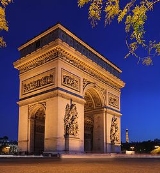
The design
The
astylarAstylar is an architectural term given to a class of design in which neither columns nor pilasters are used for decorative purposes; thus the Riccardi and Strozzi palaces in Florence are astylar in their design, in contradistinction to Palladio's palaces at Vicenza, which are columnar....
design is by
Jean ChalgrinJean-François-Thérèse Chalgrin was a French architect, best known for his design for the Arc de Triomphe, Paris.-Biography:...
(1739–1811), in the
NeoclassicalNeoclassicism is the name given to Western movements in the decorative and visual arts, literature, theatre, music, and architecture that draw inspiration from the "classical" art and culture of Ancient Greece or Ancient Rome...
version of ancient
Roman architectureAncient Roman architecture adopted certain aspects of Ancient Greek architecture, creating a new architectural style. The Romans were indebted to their Etruscan neighbors and forefathers who supplied them with a wealth of knowledge essential for future architectural solutions, such as hydraulics...
(see, for example, the triumphal
Arch of TitusThe Arch of Titus is a 1st-century honorific arch located on the Via Sacra, Rome, just to the south-east of the Roman Forum. It was constructed in c.82 AD by the Roman Emperor Domitian shortly after the death of his older brother Titus to commemorate Titus' victories, including the Siege of...
). Major
academicAn academy is an institution of higher learning, research, or honorary membership.The name traces back to Plato's school of philosophy, founded approximately 385 BC at Akademia, a sanctuary of Athena, the goddess of wisdom and skill, north of Athens, Greece. In the western world academia is the...
sculptors of France are represented in the sculpture of the Arc de Triomphe:
Jean-Pierre CortotJean-Pierre Cortot was a French sculptor.- Life :Cortot was born and died in Paris. He was educated at the Ecole des Beaux Arts in Paris, and took the Prix de Rome in 1809, residing in the Villa Medici in Rome from 1810 to 1813.Cortot worked in an austere, correct, academic neo-classical style,...
;
François RudeFrançois Rude was a French sculptor. He was the stepfather of Paul Cabet, a sculptor.Born in Dijon, he worked at his father's trade as a stovemaker till the age of sixteen, but received training in drawing from François Devosges, where he learned that a strong, simple contour was an invaluable...
;
Antoine ÉtexAntoine Étex was a French sculptor, painter and architect. He was born in Paris.He first exhibited in the Paris Salon of 1833, his work including a reproduction in marble of his "Death of Hyacinthus", and the plaster cast of his "Cain and his race cursed by God"...
;
James PradierJames Pradier, also known as Jean-Jacques Pradier was a Swiss-born French sculptor best known for his work in the neoclassical style.-Life and work:...
and
Philippe Joseph Henri Lemaire[Philippe Joseph] Henri Lemaire was a French sculptor, working in a neoclassical academic style. He was a pupil of Pierre Cartellier, and won the Prix de Rome for sculpture in 1821....
. The main sculptures are not integral
friezethumb|267px|Frieze of the [[Tower of the Winds]], AthensIn architecture the frieze is the wide central section part of an entablature and may be plain in the Ionic or Doric order, or decorated with bas-reliefs. Even when neither columns nor pilasters are expressed, on an astylar wall it lies upon...
s but are treated as independent trophies applied to the vast
ashlarAshlar is prepared stone work of any type of stone. Masonry using such stones laid in parallel courses is known as ashlar masonry, whereas masonry using irregularly shaped stones is known as rubble masonry. Ashlar blocks are rectangular cuboid blocks that are masonry sculpted to have square edges...
masonry masses, not unlike the gilt-bronze
appliquéIn its broadest sense, an appliqué is a smaller ornament or device applied to another surface. In the context of ceramics, for example, an appliqué is a separate piece of clay added to the primary work, generally for the purpose of decoration...
s on
Empire furnitureThe Empire style, , sometimes considered the second phase of Neoclassicism, is an early-19th-century design movement in architecture, furniture, other decorative arts, and the visual arts followed in Europe and America until around 1830, although in the U. S. it continued in popularity in...
. The four sculptural groups at the base of the Arc are The Triumph of 1810 (Cortot), Resistance and Peace (both by Antoine Étex) and the most renowned of them all, Departure of the Volunteers of 1792 commonly called
La Marseillaise"La Marseillaise" is the national anthem of France. The song, originally titled "Chant de guerre pour l'Armée du Rhin" was written and composed by Claude Joseph Rouget de Lisle in 1792. The French National Convention adopted it as the Republic's anthem in 1795...
(François Rude). The face of the allegorical representation of France calling forth her people on this last was used as the belt buckle for the honorary rank of
Marshal of FranceThe Marshal of France is a military distinction in contemporary France, not a military rank. It is granted to generals for exceptional achievements...
. Since the fall of Napoleon (1815), the sculpture representing Peace is interpreted as commemorating the
Peace of 1815Treaty of Paris of 1815, was signed on 20 November 1815 following the defeat and second abdication of Napoleon Bonaparte. In February, Napoleon had escaped from his exile on Elba; he entered Paris on 20 March, beginning the Hundred Days of his restored rule. Four days after France's defeat in the...
.
In the attic above the richly sculptured frieze of soldiers are 30 shields engraved with the names of major Revolutionary and
Napoleonic military victoriesThe Napoleonic Wars were a series of wars declared against Napoleon's French Empire by opposing coalitions that ran from 1803 to 1815. As a continuation of the wars sparked by the French Revolution of 1789, they revolutionised European armies and played out on an unprecedented scale, mainly due to...
. The inside walls of
the monument list the names of 660 peopleThe following is the list of the names of the 660 persons inscribed on the Arc de Triomphe, in Paris. Most of them are generals who served during the First French Empire with additional figures from the French Revolution ....
, among which are 558 French generals of the
First French EmpireThe First French Empire , also known as the Greater French Empire or Napoleonic Empire, was the empire of Napoleon I of France...
; the names of those who died in battle are underlined. Also inscribed, on the shorter sides of the four supporting columns, are the names of the major victorious battles of the Napoleonic Wars. The battles that took place in the period between the
departure of Napoleon from Elba to his final defeat at WaterlooThe Hundred Days, sometimes known as the Hundred Days of Napoleon or Napoleon's Hundred Days for specificity, marked the period between Emperor Napoleon I of France's return from exile on Elba to Paris on 20 March 1815 and the second restoration of King Louis XVIII on 8 July 1815...
are not included.
There was at the top of the Arc from 1882 to 1886, a monumental sculpture of
Alexandre FalguièreJean Alexandre Joseph Falguière was a French sculptor and painter.He was born in Toulouse...
, "Le triomphe de la Révolution" (the Triumph of the Revolution), a chariot drawn by horses preparing "to crush Anarchy and Despotism", that remained only four years up there before falling in ruins.
Inside the monument, a new permanent exhibition conceived by the artist
Maurice BenayounMaurice Benayoun is a French pioneer new-media artist and theorist based in Paris. His work employs various media, including video, immersive virtual reality, the Web, wireless technology, performance, large-scale urban art installations and interactive exhibitions.-Biography:Born in Mascara,...
and the architect Christophe Girault opened in February 2007. The steel and new media installation interrogates the symbolism of the national monument, questioning the balance of its symbolic message during the last two centuries, oscillating between war and peace.
The Unknown Soldier
Beneath the Arc is the
Tomb of the Unknown SoldierTomb of the Unknown Soldier refers to a grave in which the unidentifiable remains of a soldier are interred. Such tombs can be found in many nations and are usually high-profile national monuments. Throughout history, many soldiers have died in wars without their remains being identified...
from
World War IWorld War I , which was predominantly called the World War or the Great War from its occurrence until 1939, and the First World War or World War I thereafter, was a major war centred in Europe that began on 28 July 1914 and lasted until 11 November 1918...
. Interred here on
Armistice DayArmistice Day is on 11 November and commemorates the armistice signed between the Allies of World War I and Germany at Compiègne, France, for the cessation of hostilities on the Western Front of World War I, which took effect at eleven o'clock in the morning—the "eleventh hour of the eleventh day...
1920, it has the first
eternal flameAn eternal flame is a flame or torch that burns day and night for an indefinite period. The flame that burned constantly at Delphi was an archaic feature, "alien to the ordinary Greek temple"....
lit in Western and Eastern Europe since the
Vestal VirginIn ancient Roman religion, the Vestals or Vestal Virgins , were priestesses of Vesta, goddess of the hearth. The College of the Vestals and its well-being was regarded as fundamental to the continuance and security of Rome, as embodied by their cultivation of the sacred fire that could not be...
s' fire was extinguished in the fourth century. It burns in memory of the dead who were never identified (now in both world wars). According to a 2008 television programme, presented by
Griff Rhys JonesGriffith "Griff" Rhys Jones is a Welsh comedian, writer, actor, television presenter and personality. Jones came to national attention in the early 1980s for his work in the BBC television comedy sketch shows Not the Nine O'Clock News and Alas Smith and Jones along with his comedy partner Mel Smith...
, “the flame has only been extinguished once, by a drunken
MexicanThe United Mexican States , commonly known as Mexico , is a federal constitutional republic in North America. It is bordered on the north by the United States; on the south and west by the Pacific Ocean; on the southeast by Guatemala, Belize, and the Caribbean Sea; and on the east by the Gulf of...
football supporter on the night that
FranceThe France national football team represents the nation of France in international football. It is fielded by the French Football Federation , the governing body of football in France, and competes as a member of UEFA, which encompasses the countries of Europe...
beat
BrazilThe Brazil national football team represents Brazil in international men's football and is controlled by the Brazilian Football Confederation , the governing body for football in Brazil. They are a member of the International Federation of Association Football since 1923 and also a member of the...
here in Paris,” most likely referring to the
1998 FIFA World Cup FinalThe 1998 FIFA World Cup Final was a football match that was played on 12 July 1998 at the Stade de France in St-Denis to determine the winner of the 1998 FIFA World Cup a global football tournament held every four years...
.
A ceremony is held Tomb of the Unknown Soldier every 11 November on the anniversary of the
armisticeThe armistice between the Allies and Germany was an agreement that ended the fighting in the First World War. It was signed in a railway carriage in Compiègne Forest on 11 November 1918 and marked a victory for the Allies and a complete defeat for Germany, although not technically a surrender...
signed between France and Germany in 1918. It was originally decided on 12 November 1919 to bury the unknown soldier's remains in the
PanthéonThe Panthéon is a building in the Latin Quarter in Paris. It was originally built as a church dedicated to St. Genevieve and to house the reliquary châsse containing her relics but, after many changes, now functions as a secular mausoleum containing the remains of distinguished French citizens...
, but a public letter-writing campaign led to the decision to bury him beneath the Arc de Triomphe. The coffin was put in the chapel on the first floor of the Arc on 10 November 1920, and put in its final resting place on 28 January 1921. The slab on top carries the inscription
ICI REPOSE UN SOLDAT FRANÇAIS MORT POUR LA PATRIE 1914–1918 ("Here lies a French soldier who died for the fatherland 1914–1918").
In 1961, President
John F. KennedyJohn Fitzgerald "Jack" Kennedy , often referred to by his initials JFK, was the 35th President of the United States, serving from 1961 until his assassination in 1963....
and First Lady Jacqueline Kennedy of the United States paid their respects at the Tomb of the Unknown Soldier, accompanied by French President
Charles de GaulleCharles André Joseph Marie de Gaulle was a French general and statesman who led the Free French Forces during World War II. He later founded the French Fifth Republic in 1958 and served as its first President from 1959 to 1969....
. After the 1963
assassination of President KennedyJohn Fitzgerald Kennedy, the thirty-fifth President of the United States, was assassinated at 12:30 p.m. Central Standard Time on Friday, November 22, 1963, in Dealey Plaza, Dallas, Texas...
, Mrs Kennedy remembered the eternal flame at the Arc de Triomphe and requested that an eternal flame be placed next to her husband's grave at
Arlington National CemeteryArlington National Cemetery in Arlington County, Virginia, is a military cemetery in the United States of America, established during the American Civil War on the grounds of Arlington House, formerly the estate of the family of Confederate general Robert E. Lee's wife Mary Anna Lee, a great...
in Virginia. President Charles de Gaulle went to Washington to attend the state funeral, and witnessed Jacqueline Kennedy lighting the eternal flame that had been inspired by her visit to France.
Details
- The four main sculptures of the monument are:
- Le Départ de 1792' (or La Marseillaise
"La Marseillaise" is the national anthem of France. The song, originally titled "Chant de guerre pour l'Armée du Rhin" was written and composed by Claude Joseph Rouget de Lisle in 1792. The French National Convention adopted it as the Republic's anthem in 1795...
), by François RudeFrançois Rude was a French sculptor. He was the stepfather of Paul Cabet, a sculptor.Born in Dijon, he worked at his father's trade as a stovemaker till the age of sixteen, but received training in drawing from François Devosges, where he learned that a strong, simple contour was an invaluable...
- Le Triomphe de 1810, by Jean-Pierre Cortot
Jean-Pierre Cortot was a French sculptor.- Life :Cortot was born and died in Paris. He was educated at the Ecole des Beaux Arts in Paris, and took the Prix de Rome in 1809, residing in the Villa Medici in Rome from 1810 to 1813.Cortot worked in an austere, correct, academic neo-classical style,...
- La Résistance de 1814, by Antoine Étex
Antoine Étex was a French sculptor, painter and architect. He was born in Paris.He first exhibited in the Paris Salon of 1833, his work including a reproduction in marble of his "Death of Hyacinthus", and the plaster cast of his "Cain and his race cursed by God"...
- La Paix de 1815, by Antoine Étex
Antoine Étex was a French sculptor, painter and architect. He was born in Paris.He first exhibited in the Paris Salon of 1833, his work including a reproduction in marble of his "Death of Hyacinthus", and the plaster cast of his "Cain and his race cursed by God"...
- Six relief
Relief is a sculptural technique. The term relief is from the Latin verb levo, to raise. To create a sculpture in relief is thus to give the impression that the sculpted material has been raised above the background plane...
s sculpted on the façades of the Arch, representing important moments of the French RevolutionThe French Revolution , sometimes distinguished as the 'Great French Revolution' , was a period of radical social and political upheaval in France and Europe. The absolute monarchy that had ruled France for centuries collapsed in three years...
and of the Napoleonic eraThe First French Empire , also known as the Greater French Empire or Napoleonic Empire, was the empire of Napoleon I of France...
include:
- Les funérailles du général Marceau (General Marceau's burial), by P. H. Lamaire (SOUTH façade, right),
- La bataille d'Aboukir (The Battle of Aboukir
The Battle of Abukir was Napoleon Bonaparte's decisive victory over Seid Mustafa Pasha's Ottoman army on 25 July 1799 during the French invasion of Egypt...
), by Bernard SeurreBernard Gabriel Seurre or Seurre the Elder was a French sculptor. His younger brother Charles Émile Seurre was also a sculptor.- Life :...
(SOUTH façade, left),
- La bataille de Jemappes (The Battle of Jemappes
The Battle of Jemappes took place near the town of Jemappes in Hainaut, Belgium, near Mons. General Charles François Dumouriez, in command of the French Revolutionary Army, defeated the greatly outnumbered Austrian army of Field Marshal Duke Albert of Saxe-Teschen and his second-in-command...
), by Carlo MarochettiBaron Carlo Marochetti was a sculptor, born in Turin but raised in Paris as a French citizen.-Life:Carlo Marochetti was born on 4 January 1805. His first teachers were François Joseph Bosio and Antoine-Jean Gros in Paris. Here his statue of A Young Girl playing with a Dog won a medal in 1829, and...
(EAST façade),
- Le passage du pont d'Arcole (The Battle of Arcole), by J. J. Feuchère
Jean-Jacques Feuchère was a French sculptor.He was a student of Jean-Pierre Cortot, and among his students was Jacques-Léonard Maillet.-Selected works:* Relief panel Le Pont d'Arcole, Arc de Triomphe, Paris, 1833-1834...
(NORTH façade, right),
- La prise d'Alexandrie, (The Fall of Alexandria
The Battle of the Pyramids, also known as the Battle of Embabeh, was fought on July 21, 1798 between the French army in Egypt under Napoleon Bonaparte, and local Mamluk forces. It occurred during France's Egyptian Campaign and was the battle where Napoleon put into use one of his significant...
), by J. E. Chaponnière (NORTH façade, left),
- La bataille d'Austerlitz (The Battle of Austerlitz
The Battle of Austerlitz, also known as the Battle of the Three Emperors, was one of Napoleon's greatest victories, where the French Empire effectively crushed the Third Coalition...
), by J. F. T. GechterJean-François-Théodore Gechter was a French sculptor. A student of François Joseph Bosio and baron Gros, he is now most noted for his bronzes. He first exhibited in 1824, in a show of classical and mythological subjects. From 1830 he shifted to smaller sculptures and animal subjects, like...
(WEST façade),
- Some great battles of the French Revolutionary and Napoleonic Wars are engraved on the attic, including
- A list of French victories is engraved under the great arches on the inside façades of the monument.
- On the inner façades of the small arches are engraved the names of the military leaders of the French Revolution and Empire
The following is the list of the names of the 660 persons inscribed on the Arc de Triomphe, in Paris. Most of them are generals who served during the First French Empire with additional figures from the French Revolution ....
. The names of those who died on the battlefield are underlined.
- The great arcades
An arcade is a succession of arches, each counterthrusting the next, supported by columns or piers or a covered walk enclosed by a line of such arches on one or both sides. In warmer or wet climates, exterior arcades provide shelter for pedestrians....
are decorated with allegorical figures representing characters in Roman mythology (by J. PradierJames Pradier, also known as Jean-Jacques Pradier was a Swiss-born French sculptor best known for his work in the neoclassical style.-Life and work:...
).
Access
The Arc de Triomphe is accessible by the
RERThe RER is a rapid transit system in France serving Paris and its suburbs. The RER is an integration of a modern city-centre underground rail and a pre-existing set of commuter rail lines. It has several connections with the Paris Métro within the city of Paris. Within the city, the RER...
and
MétroThe Paris Métro or Métropolitain is the rapid transit metro system in Paris, France. It has become a symbol of the city, noted for its density within the city limits and its uniform architecture influenced by Art Nouveau. The network's sixteen lines are mostly underground and run to 214 km ...
, with exit at the
Charles de Gaulle—Étoile stationCharles de Gaulle – Étoile is a station on Paris Métro Line 1 and of the RER urban rail network. It lies on the boundary of the VIIIe and XVIIe arrondissements of Paris...
.
Because of heavy traffic on the roundabout of which the Arc is the centre, it is recommended that pedestrians use one of two underpasses located at the Champs Élysées and the Avenue de la Grande Armée.
A lift will take visitors almost to the top – to the attic, where there is a small museum which contains large models of the Arc and tells its story from the time of its construction. 46 steps remain to climb in order to reach the top, the terrasse, from where one can enjoy a panoramic view of Paris.
See also
- Names inscribed under the Arc de Triomphe
The following is the list of the names of the 660 persons inscribed on the Arc de Triomphe, in Paris. Most of them are generals who served during the First French Empire with additional figures from the French Revolution ....
- Bastille Day Military Parade
The Bastille Day Military Parade is a French military parade that has been held on the morning of 14 July each year in Paris since 1880, almost without exception....
- Galerie des Batailles
The Galerie des Batailles is a 120 metre long and 13 metre wide gallery occupying the first floor of the aile du midi of the Palace of Versailles, joining onto the grand and petit 'appartements de la reine'...
External links