


French Wars of Religion

Encyclopedia
The French Wars of Religion (1562–98) is the name given to a period of civil infighting
and military operation
s, primarily fought between French Catholics
and Protestants
(Huguenot
s). The conflict involved the factional disputes between the aristocratic houses of France, such as the House of Bourbon
and House of Guise
(Lorraine
), and both sides received assistance from foreign sources.
The exact number of wars and their respective dates are the subject of continued debate by historians; some assert that the Edict of Nantes
in 1598 concludes the wars, although a resurgence of rebellious activity following this leads some to believe the Peace of Alais
in 1629 is the actual conclusion. However, the Massacre of Vassy in 1562 is agreed to begin the Wars of Religion and the Edict of Nantes at least ended this series of conflicts. During this time, complex diplomatic negotiations and agreements of peace were followed by renewed conflict and power struggles.
At the conclusion of the conflict in 1598, Huguenots were granted substantial rights and freedoms by the Edict of Nantes, though it did not end hostility towards them. The wars weakened the authority of the monarchy
, already fragile under the rule of Francis II
and then Charles IX
, though it later reaffirmed its role under Henry IV
.
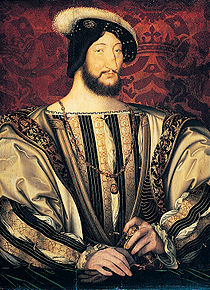 Protestant ideas
were first introduced to France during the reign of Francis I
(1515–47) in the form of Lutheranism
, the teachings of Martin Luther
, and circulated unimpeded for more than a year around Paris. Although Francis firmly opposed heresy
, the difficulty was initially in recognising what constituted it; Catholic doctrine and definition of orthodox belief was unclear. Despite this, it was observed in January 1535 that all "Lutherans" in France were actually Zwinglians
, followers of Huldrych Zwingli
.
in 1534, in which anti-Catholic posters appeared in public, turned Protestantism into "a religion of rebels", helping define heresy, and the attitude of the French monarchy hardened in the wake of the incident. Francis I
was severely criticized for his initial tolerance towards Protestants, and had to pursue them. Coincidentally, Francis I was pursuing a policy of alliance with the Ottoman Empire
, and the Ottoman ambassadors in the 1534 Ottoman embassy to France
accompanied Francis I to Paris, and attended the burning of those responsible for the Affair of the Placards, on 21 January 1535 in front of the Cathedral of Notre-Dame de Paris.
John Calvin
, a Frenchman, escaped from the persecution to Basle, where he published the Institutes of the Christian Religion
in 1536. In the same year, he visited Geneva
, but was forced out for trying to reform the church. When he returned on invitation in 1541, he wrote the Ecclesiastical ordinances
, the constitution for a Genevan church, which was passed by the council of Geneva.
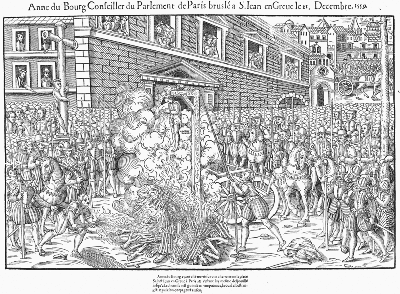 The Massacre of Mérindol
took place in 1545, when Francis I of France
ordered the Waldensians
of the city of Mérindol
, who were affiliated to Protestantism, to be punished for dissident religious activities.
In the 1550s, Geneva played an important role in influencing the disorganised French Calvinist (Huguenot) church. The 1540s had seen an intensification in the fight against heresy, which meant Protestants gathered in secret to worship. However, by the middle of the century, the Huguenot population expanded greatly, as the nobility in particular were converted to Calvinism; it is estimated that over half of the nobility were Calvinist in the 1560s, and that there were between 1,200–1,250 Calvinist churches and 2 million Calvinists at the outbreak of war in 1562. Calvinism had proved attractive to people from across the social hierarchy and occupational divides, and was highly regionalized with no coherent pattern of geographical spread.
in 1559 created a political vacuum that encouraged the rise of factions, eager to grasp power for themselves. Francis II of France
, at this point only 15 years old, was weak and lacked the qualities that allowed his predecessors to impose their will onto the leading noblemen at court. The House of Guise
, having an advantage in the King's wife, Mary, Queen of Scots, who was their niece, moved quickly to exploit the situation at the expense of their rivals, the House of Montmorency. Within days of the King's accession, the English ambassador reported that "the house of Guise ruleth and doth all about the French King".
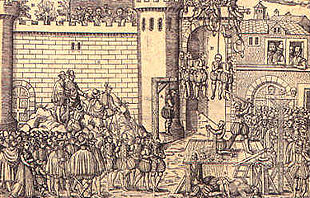 In March 1560 a group of disaffected nobles (led by Jean du Barry, seigneur de la Renaudie) attempted to abduct the young Francis II and eliminate the Guise faction. Their plans were discovered before they could succeed, and hundreds of plotters were executed. The Guise brothers suspected Louis I de Bourbon, prince de Condé
of leading the plot. He was arrested but eventually freed for lack of evidence, adding to the tensions of the period. (In the polemics that followed, the label "Huguenot
" for France's Protestants came into widespread usage.)
in Catholic churches occurred in Rouen
and La Rochelle
in 1560. The following year, these disturbances extended to over twenty cities and towns, and would, in turn, incite Catholic urban groups to bloody reprisals in Sens
, Cahors
, Carcassonne
, Tours
and other cities.
became regent for her second son, Charles IX
. Inexperienced and faced with the legacy of debt from the Habsburg-Valois conflict, Catherine felt that she had to steer the throne carefully between the powerful and conflicting interests that surrounded it, embodied by the powerful aristocrats who led essentially private armies. Although she was a sincere Roman Catholic, she was prepared to deal favourably with the Huguenot
House of Bourbon
in order to have a counterweight against the overmighty Guise
. She nominated a moderate chancellor, Michel de l'Hôpital
, who urged a number of measures providing for civic peace so that a religious resolution could be sought by a sacred council.
, when the national council of prelates accepted the crown's request for Huguenots to be given a hearing. The Protestants were represented by 12 ministers and 20 laymen, led by Théodore de Bèze. Neither party aimed at toleration, but at reaching some form of concord on which a new unity could be based. A meeting between Bèze and the Cardinal of Lorraine
, of the House of Guise, seemed promising; both appeared ready to compromise on form. However, by the end of the Colloquy in October 1561 it was clear that the divide between Catholic and Protestant ideas was already too wide.
In early 1562, the regency government attempted to quell escalating disorder in the provinces, which had been only encouraged by factional feuds at court, by instituting the Edict of Saint-Germain
, also known as the Edict of January. The legislation sought to give concessions to the Huguenots in order to avoid their rebellion, and allowed them to worship publicly outside of towns and privately inside of them. On March 1, however, a faction of the Guise family's retainers attacked a Calvinist service in Wassy-sur-Blaise in Champagne
and massacred the worshippers. The Huguenot Jean de la Fontaine put it this way:
, and proclaiming that they were liberating the king and regent from "evil" councillors, organised a kind of protectorate over the Protestant churches and began to seize and garrison strategic towns along the Loire
. Although the Huguenots had begun to mobilise for war before Vassy, Condé
used the massacre as evidence that the Edict had been broken, lending further weight to his campaign, and as hostilities broke out, the Edict was in fact revoked under pressure from the Guise faction.
The major engagements of the war occurred at Rouen
, Dreux
and Orléans. At the Siege of Rouen (May–October 1562), the crown regained the city at the cost of Antoine de Navarre, who died of his wounds. The Battle of Dreux (December 1562), saw the capture of Condé
by the Guises and Montmorency
, the governor general, by the Bourbons. In February 1563, at the Siege of Orléans, Francis, Duke of Guise
was shot and killed by the Huguenot Poltrot de Méré; the Guise considered this an assassination
on the orders of the duke's enemy, Admiral Coligny
, as it was outside of direct combat. The popular unrest caused by the 'assassination', coupled with the fact that Orléans
was holding out in the siege, led Catherine
to mediate a truce and the Edict of Amboise
(1563).
which had been occupied by the English as part of the Treaty of Hampton Court
between the Huguenot leaders and Elizabeth I
. The English were successfully expelled that July and the next month Charles IX
declared his legal majority, ending Catherine de' Medici
's regency. His mother continued to play a principal role in politics, however, and she joined her son on a Grand Tour
of the kingdom between 1564 and 1566, designed to reinstate crown authority.
Reports of iconoclasm in Flanders
led Charles IX to lend support to the Catholics there, leading to fears among the French Huguenots of a Catholic re-mobilisation against them. Philip II of Spain
's reinforcement of the strategic corridor from Italy north along the Rhine added to these fears and political discontent grew. Protestant troops then made an unsuccessful attempt to capture and take control of King Charles IX in the Surprise of Meaux
, a number of cities, such as La Rochelle
, declared themselves for the Huguenot cause and Catholics, both laymen and clergy, were massacred the following day in Nîmes
in what became known as the Michelade
.
This provoked the Second War, the main military engagement of which was the Battle of Saint-Denis
where the crown's commander-in-chief and lieutenant general, the seventy-four year old Anne de Montmorency
died. The war was brief, ending in another truce, the Peace of Longjumeau
(March 1568), which granted significant religious freedoms and privileges to Protestants.
led an army into France in order to support his fellow Protestants, but the army being poorly paid, he accepted the crown's offer of money and free passage to leave the country.
Nevertheless the Huguenots gathered together a formidable army under the command of Condé, aided by forces from south-east France, led by Paul de Mouvans, and a contingent of fellow Protestant militias from Germany — including 14,000 mercenary reiter
s led by the Calvinist Duke of Zweibrücken
. After the Duke was killed in action, his troops remained under the employ of the Huguenots who had raised a loan from England against the security of the queen of Navarre
's crown jewels. Much of the Huguenots' financing came from Queen Elizabeth of England, who was likely influenced in the matter by Sir Francis Walsingham. The Catholics were commanded by the Duke d'Anjou
(later King Henry III) and assisted by troops from Spain, the Papal States
and the Grand Duchy of Tuscany
.
The Protestant army laid siege to several cities in the Poitou
and Saintonge
regions (to protect La Rochelle
), and then Angoulême
and Cognac
. At the Battle of Jarnac
(16 March 1569), the prince of Condé was killed, forcing Admiral de Coligny
to take command of the Protestant forces, nominally on behalf of Condé's 15 year old son, Henry
, and the sixteen-year old Henry of Navarre
, who were presented by Jeanne d'Albret
as the legitimate leaders of the Huguenot cause against royal authority. The Battle of La Roche-l'Abeille
was a nominal victory for the Huguenots, but they were unable to seize control of Poitiers
and were soundly defeated at the Battle of Moncontour
(October 30, 1569). Coligny and his troops retreated to the south-west and regrouped with Gabriel, comte de Montgomery
, and in spring of 1570 they pillaged Toulouse
, cut a path through the south of France and went up the Rhone
valley up to La Charité-sur-Loire
. The staggering royal debt and Charles IX's desire to seek a peaceful solution led to the Peace of Saint-Germain-en-Laye
(8 August 1570), which once more allowed some concessions to the Huguenots.
massacres of Huguenots at the hands of Catholic mobs continued, in cities such as Rouen
, Orange and Paris. Matters at Court were further complicated as King Charles IX openly allied himself with the Huguenot leaders — especially Admiral
Gaspard de Coligny
. Meanwhile, the Queen Mother became increasingly fearful of the unchecked power wielded by Coligny and his supporters, especially once it became clear that Coligny was pursuing an alliance with England and the Dutch rebels
.
Coligny, along with many other Calvinist nobles, arrived in Paris for the wedding of the Catholic Princess Marguerite de Valois
to the Protestant Henry of Navarre
on August 18. On August 22, an assassin
made a failed attempt on Coligny's life, shooting him in the street from a window. While historians have suggested a likely identity for the assassin (Charles de Louvier, sieur de Maurevert), the source of the order to assassinate Coligny has never been determined (it is improbable that the order came from Catherine
).
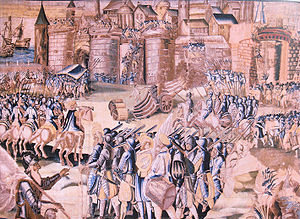 Amidst fears of a Huguenot coup, the Duke of Guise
and his supporters acted and, in the early morning of August 24, killed Coligny in his lodgings with several of his men. Coligny's body was thrown from the window into the street, and was subsequently mutilated, castrated, dragged through the mud, thrown in the river, suspended on a gallows and burned by the Parisian crowd. For the next five days the city erupted into a full-scale massacre of Calvinist men, women and children, and the looting of their houses, which was neither approved of nor predicted by the king. Over the next few weeks the disorder spread to more than a dozen cities across France. Perhaps 2,000 Huguenots were slaughtered in Paris and, in the days that followed, thousands more in the provinces; in all, perhaps 10,000 people were killed. Henry of Navarre and his cousin, the young Prince of Condé
, managed to avoid death by agreeing to convert to Catholicism; both would repudiate their conversions once they managed to escape Paris.
The massacre provoked horror and outrage among Protestants throughout Europe, but both Philip II of Spain
and Pope Gregory XIII
, following the official version that a Huguenot coup had been barely thwarted, celebrated the outcome. In France, Huguenot opposition to the crown was left seriously weakened by the death of many of the leadership, and emigration and reconversion among the mass of Huguenots, who now concentrated in a small number of cities where they formed a majority.
s of the cities of Sommières
(by troops led by Henri I de Montmorency), Sancerre
and La Rochelle
(by troops led by the duke of Anjou
). The end of hostilities was brought on by the election (11–15 May 1573) of the Duke of Anjou to the throne of Poland and by the Edict of Boulogne
(signed in July 1573) which severely curtailed many of the rights previously granted to French Protestants. Based on the terms of the treaty, all Huguenots were granted amnesty for their past actions and the freedom of belief. However, they were permitted the freedom to worship only within the three towns of La Rochelle
, Montauban
, and Nîmes
, and even then only within their own residences; Protestant aristocrats with the right of high-justice were permitted to celebrate marriages and baptisms, but only before an assembly limited to ten persons outside of their family.
disputes between Charles
and his youngest brother, the duke of Alençon
, led to many Huguenots congregating around Alençon for patronage and support. A failed coup at Saint-Germain
(February 1574), allegedly aiming to release Condé
and Navarre
who had been held at court since St Bartholemew
's, coincided with rather successful Huguenot uprisings in other parts of France such as Lower Normandy, Poitou
and the Rhône
valley, which reinitiated hostilities.
Three months after Henry of Anjou's coronation as King of Poland, his brother Charles IX died (May 1574) and his mother declared herself regent until his return. Henry secretly left Poland and returned via Venice
to France, where he faced the defection of Montmorency-Damville, ex-commander in the Midi
(November 1574). Despite having failed to have established his authority over the Midi, he was crowned King Henry III, at Rheims February 1575, marrying Louise Vaudémont
, a kinswoman of the Guise, the following day. By April the crown was already seeking to negotiate, and the escape of Alençon from court in September prompted the possibility of an overwhelming coalition of forces against the crown, as John Casimir of the Palatinate
invaded Champagne
. The crown hastily negotiated a truce of seven months with Alençon and promised Casimir's forces 500,000 livres to stay east of the Rhine but neither action secured a peace. By May 1576 the crown was forced to accept the terms of Alençon, and the Huguenots who supported him, in the Edict of Beaulieu
, known as the Peace of Monsieur.
granted many concessions to the Calvinists, but they were short-lived in the face of the Catholic League
which the ultra-Catholic, Henry I, Duke of Guise
, had formed in opposition to it. The House of Guise
had long been identified with the defense of the Roman Catholic Church
and the Duke of Guise and his relations — the Duke of Mayenne
, Duke of Aumale
, Duke of Elboeuf, Duke of Mercœur and the Duke of Lorraine
— controlled extensive territories that were loyal to the League. The League also had a large following among the urban middle class. The Estates-General
of Blois
(1576) failed to resolve matters, and by December the Huguenots had already taken up arms in Poitou
and Guyenne
. While the Guise faction had the unwavering support of the Spanish Crown, the Huguenots had the advantage of a strong power base in the southwest; they were also discreetly supported by foreign Protestant governments, but in practice, England or the German states
could provide few troops in the ensuing conflict. After much posturing and negotiations, Henry III rescinded most of the concessions that had been made to the Protestants in the Edict of Beaulieu with the Treaty of Bergerac
(September 1577), confirmed in the Edict of Poitiers passed six days later.
. Meanwhile the regional situation disintegrated into disorder as both Catholics and Protestants armed themselves in 'self defence'. In November 1579 Condé
seized the town of La Fère
leading to another round of military action which was brought to an end by the Treaty of Fleix
(November 1580), negotiated by Anjou
.
The fragile compromise came to an end in 1584, when the Duke of Anjou
, the King's youngest brother and heir presumptive, died. As Henry III had no son, under Salic Law
, the next heir to the throne was the Calvinist Prince Henri of Navarre
, a descendant of Louis IX
whom Pope Sixtus V
had excommunicated along with his cousin, Henri Prince de Condé
. When it became clear that Henri of Navarre would not rennounce his Protestantism the Duke of Guise signed the Treaty of Joinville
(December 31, 1584), on behalf of the League, with Philip II of Spain
, who supplied a considerable annual grant to the League over the following decade to maintain the civil war in France, with the hope of destroying the French Calvinists. Under pressure from the Guise, Henri III reluctantly issued the Treaty of Nemours
(July) and an Edict, suppressing Protestantism and annulling Henri of Navarre's right to the throne.
again sought foreign aid from the German princes and Elizabeth I of England
. Meanwhile, the solidly Catholic people of Paris, under the influence of the Committee of Sixteen were becoming dissatisfied with Henry III
and his failure to defeat the Calvinists. On 12 May 1588, the Day of the Barricades
, a popular uprising raised barricades on the streets of Paris to defend the Duke of Guise against the alleged hostility of the king, and Henry III fled the city. The Committee of Sixteen took complete control of the government, while the Guise protected the surrounding supply lines. The mediation of Catherine de'Medici led to the Edict of Union, in which the crown accepted almost all the League's demands; reaffirming the Treaty of Nemours
, recognizing Cardinal de Bourbon
as heir, and making the duke of Guise Lieutenant-General.
at Blois
in September of that year. During the Estates-General Henry suspected that the members of the third estate were being manipulated by the League
and became convinced that Guise had encouraged the duke of Savoy
's invasion of Saluzzo
in October. Viewing the House of Guise as a dangerous threat to the power of the Crown, King Henri decided to strike first. On December 23, 1588, at the Château de Blois, Henry of Guise
and his brother, the Cardinal de Guise
, were lured into a trap by the King's guards. The Duke arrived in the council chamber where his brother the Cardinal waited. The Duke was told that the King wished to see him in the private room adjoining the royal chambers. There guardsmen seized the duke and stabbed him in the heart, while others arrested the Cardinal who later died on the pikes of his escort. To make sure that no contender for the French throne was free to act against him, the King had the Duke's son imprisoned. The Duke of Guise had been highly popular in France, and the Catholic League declared open war against King Henry. The Parlement of Paris instituted criminal charges against the King, who now joined forces with his cousin, the Huguenot, Henry of Navarre
, to war against the League.
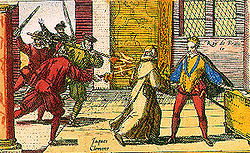 It thus fell upon the younger brother of the Guise, the Duke of Mayenne
, to become the leader of the Catholic League. The League presses began printing anti-royalist tracts under a variety of pseudonyms, while the Sorbonne
proclaimed that it was just and necessary to depose Henri III, and that any private citizen was morally free to commit regicide
. In July 1589, in the royal camp at Saint-Cloud
, a Dominican monk named Jacques Clément
gained an audience with the King and drove a long knife into his spleen. Clément was killed on the spot, taking with him the information of who, if anyone, had hired him. On his deathbed, Henri III called for Henry of Navarre, and begged him, in the name of Statecraft
, to become a Catholic, citing the brutal warfare that would ensue if he refused. In keeping with Salic Law
, he named Henri as his heir.
in 1589 was that the new Henry IV of France, as Navarre had become, held the south and west, and the Catholic League the north and east. The leadership of the Catholic League had devolved to the Duke de Mayenne, who was appointed Lieutenant-General of the kingdom. He and his troops controlled most of rural Normandy. However, in September 1589, Henry inflicted a severe defeat on the Duke at the Battle of Arques
. Henry's army swept through Normandy, taking town after town throughout the winter.
The King knew that he had to take Paris if he stood any chance of ruling all of France. This, however, was no easy task. The Catholic League's presses and supporters continued to spread stories about atrocities committed against Catholic priests and the laity in Protestant England (see Forty Martyrs of England and Wales
). The city prepared to fight to the death rather than accept a Calvinist king.
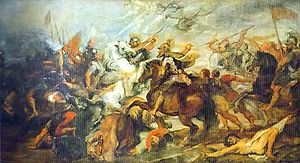 The Battle of Ivry
, fought on March 14, 1590, was another decisive victory for Henry against forces led by the Duke of Mayenne
. Henry's forces then went on to lay siege
to Paris, but the siege was broken by Spanish support (under the command of the Duke of Parma
), by the end of August; a situation which was repeated at the Siege of Rouen (November 1591-March 1592).
in 1582, was endeavouring to make himself independent in that province. A leader of the Catholic League
, he invoked the hereditary rights of his wife, Marie de Luxembourg
, who was a descendant of the dukes of Brittany and heiress of the Blois-Brosse claim to the duchy as well as Duchess of Penthièvre in Brittany, and organized a government at Nantes
. Proclaiming his son "prince and duke of Brittany", he allied with Philip II of Spain
, who sought to place his own daughter, infanta Isabella Clara Eugenia, on the throne of Brittany. With the aid of the Spanish, Mercœur defeated Henry IV's forces under the Duke of Montpensier, at Craon
in 1592, but the royal troops, reinforced by English contingents, soon recovered the advantage.
"). He was formally received into the Catholic Church in 1593, and was crowned at Chartres
in 1594 as League members maintained control of the Cathedral of Rheims, and, sceptical of Henry's sincerity, continued to oppose him. He was finally received into Paris in March 1594, and 120 League members in the city who refused to submit were banished from the capital. Paris' capitulation encouraged the same of many other towns, while others returned to support the crown after Pope Clement VIII
absolved Henry, revoking his excommunication
in return for the publishing of the Tridentine Decrees
, the restoration of Catholicism in Béarn
, and appointing only Catholics to high office. Evidently Henry's conversion worried Protestant nobles, many of whom had, until then, hoped to win not just concessions but a complete reformation of the French Church, and their acceptance of Henry was by no means a foregone conclusion.
 By the end of 1594 certain League members were still working against Henry across the country, but all relied on the support of Spain. In January 1595, therefore, the king declared war on Spain, in order to show Catholics, that Spain was using religion as a cover for an attack on the French state, and Protestants, that he had not become a puppet of Spain through his conversion, while hoping to take the war to Spain and make territorial gain. The conflict mostly consisted of military action aimed at League members, such as the Battle of Fontaine-Française
, though the Spanish launched a concerted offensive in the spring of 1596 capturing Calais
and Ardes
by April. Following the capture of Amiens
in March 1597 the crown laid siege until its surrender in September. After the Siege of Amiens Henry's concerns turned to the situation in Brittany
, the king sent Bellièvre
and Brulart de Sillery to negotiate a peace with Spain. The war was only drawn to an official close, however, after the Edict of Nantes
, with the Peace of Vervins
in May 1598.
on March 20, 1598. Mercœur subsequently went to exile in Hungary. Mercœur's daughter and heiress was married to the Duke of Vendôme
, an illegitimate son of Henry IV.
Henry IV was faced with the task of rebuilding a shattered and impoverished Kingdom and uniting it under a single authority. Henry
and his advisor, the Duke of Sully
saw the essential first step in this to be the negotiation of the Edict of Nantes
, which, rather than being a sign of genuine toleration
, was in fact a kind of grudging truce between the religions, with guarantees for both sides. The Edict can be said to mark the end of the Wars of Religion, though its apparent success was not assured at the time of its publication. Indeed, in January 1599, Henry had to visit the Parlement in person to have the Edict passed. Religious tensions continued to affect politics for many years to come, though never to the same degree, and Henry IV faced many attempts on his life; the last — a Catholic who believed the king had failed in his Christian duty — succeeding in May 1610.
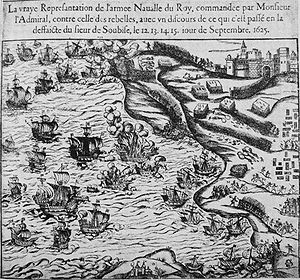 Although the Edict of Nantes brought the conflicts to a close, the political freedoms it granted to the Huguenots (seen by detractors as "a state within the state") became an increasing source of trouble during the 17th century. The decision of King Louis XIII
to reintroduce Catholicism in a portion of southwestern France prompted a Huguenot revolt. By the Peace of Montpellier in 1622, the fortified Protestant towns were reduced to two: La Rochelle
and Montauban
. Another war followed, which concluded with the Siege of La Rochelle
, in which royal forces led by Cardinal Richelieu blockaded the city for fourteen months. Under the 1629 Peace of La Rochelle, the brevets of the Edict (sections of the treaty which dealt with the military and pastoral clauses and which were renewable by letters patent
) were entirely withdrawn, though Protestants retained their prewar religious freedoms.
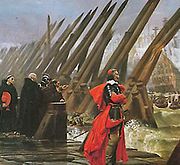 Over the remainder of Louis XIII's reign, and especially during the minority of Louis XIV
, the implementation of the Edict varied year by year. In 1661 Louis XIV, who was particularly hostile to the Huguenots, assumed control of the French government and began to disregard some of the provisions of the Edict. In 1681 he instituted the policy of dragonnade
s, to intimidate Huguenot families to reconvert to Roman Catholicism or emigrate. Finally, in October 1685, Louis issued the Edict of Fontainebleau
, which formally revoked the Edict and made the practice of Protestantism illegal in France. The revocation of the Edict had very damaging results for France. While it did not prompt renewed religious warfare, many Protestants chose to leave France rather than convert, with most moving to Great Britain, Prussia
, the Dutch Republic
and Switzerland.
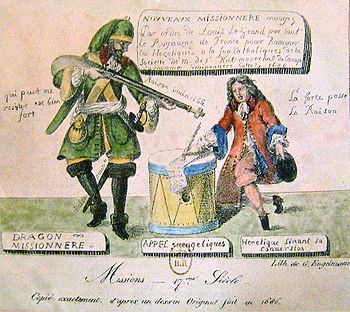 At the dawn of the 18th century, Protestants remained in significant numbers in the remote Cévennes
region of the Massif Central
. This population, known as the Camisard
s, revolted against the government in 1702, leading to fighting that continued intermittently until 1715, after which time the Camisards were largely left in peace.
Civil war
A civil war is a war between organized groups within the same nation state or republic, or, less commonly, between two countries created from a formerly-united nation state....
and military operation
Military operation
Military operation is the coordinated military actions of a state in response to a developing situation. These actions are designed as a military plan to resolve the situation in the state's favor. Operations may be of combat or non-combat types, and are referred to by a code name for the purpose...
s, primarily fought between French Catholics
Roman Catholic Church
The Catholic Church, also known as the Roman Catholic Church, is the world's largest Christian church, with over a billion members. Led by the Pope, it defines its mission as spreading the gospel of Jesus Christ, administering the sacraments and exercising charity...
and Protestants
Protestantism
Protestantism is one of the three major groupings within Christianity. It is a movement that began in Germany in the early 16th century as a reaction against medieval Roman Catholic doctrines and practices, especially in regards to salvation, justification, and ecclesiology.The doctrines of the...
(Huguenot
Huguenot
The Huguenots were members of the Protestant Reformed Church of France during the 16th and 17th centuries. Since the 17th century, people who formerly would have been called Huguenots have instead simply been called French Protestants, a title suggested by their German co-religionists, the...
s). The conflict involved the factional disputes between the aristocratic houses of France, such as the House of Bourbon
House of Bourbon
The House of Bourbon is a European royal house, a branch of the Capetian dynasty . Bourbon kings first ruled Navarre and France in the 16th century. By the 18th century, members of the Bourbon dynasty also held thrones in Spain, Naples, Sicily, and Parma...
and House of Guise
House of Guise
The House of Guise was a French ducal family, partly responsible for the French Wars of Religion.The Guises were Catholic, and Henry Guise wanted to end growing Calvinist influence...
(Lorraine
Lorraine (province)
The Duchy of Upper Lorraine was an historical duchy roughly corresponding with the present-day northeastern Lorraine region of France, including parts of modern Luxembourg and Germany. The main cities were Metz, Verdun, and the historic capital Nancy....
), and both sides received assistance from foreign sources.
The exact number of wars and their respective dates are the subject of continued debate by historians; some assert that the Edict of Nantes
Edict of Nantes
The Edict of Nantes, issued on 13 April 1598, by Henry IV of France, granted the Calvinist Protestants of France substantial rights in a nation still considered essentially Catholic. In the Edict, Henry aimed primarily to promote civil unity...
in 1598 concludes the wars, although a resurgence of rebellious activity following this leads some to believe the Peace of Alais
Peace of Alais
The Peace of Alais, also known as the Edict of Alès or the Edict of Grace, was a treaty negotiated by Cardinal Richelieu with Huguenot leaders and signed by King Louis XIII of France on 27 September 1629...
in 1629 is the actual conclusion. However, the Massacre of Vassy in 1562 is agreed to begin the Wars of Religion and the Edict of Nantes at least ended this series of conflicts. During this time, complex diplomatic negotiations and agreements of peace were followed by renewed conflict and power struggles.
At the conclusion of the conflict in 1598, Huguenots were granted substantial rights and freedoms by the Edict of Nantes, though it did not end hostility towards them. The wars weakened the authority of the monarchy
Monarchy
A monarchy is a form of government in which the office of head of state is usually held until death or abdication and is often hereditary and includes a royal house. In some cases, the monarch is elected...
, already fragile under the rule of Francis II
Francis II of France
Francis II was aged 15 when he succeeded to the throne of France after the accidental death of his father, King Henry II, in 1559. He reigned for 18 months before he died in December 1560...
and then Charles IX
Charles IX of France
Charles IX was King of France, ruling from 1560 until his death. His reign was dominated by the Wars of Religion. He is best known as king at the time of the St. Bartholomew's Day Massacre.-Childhood:...
, though it later reaffirmed its role under Henry IV
Henry IV of France
Henry IV , Henri-Quatre, was King of France from 1589 to 1610 and King of Navarre from 1572 to 1610. He was the first monarch of the Bourbon branch of the Capetian dynasty in France....
.
Growth of Calvinism
Protestantism
Protestantism is one of the three major groupings within Christianity. It is a movement that began in Germany in the early 16th century as a reaction against medieval Roman Catholic doctrines and practices, especially in regards to salvation, justification, and ecclesiology.The doctrines of the...
were first introduced to France during the reign of Francis I
Francis I of France
Francis I was King of France from 1515 until his death. During his reign, huge cultural changes took place in France and he has been called France's original Renaissance monarch...
(1515–47) in the form of Lutheranism
Lutheranism
Lutheranism is a major branch of Western Christianity that identifies with the theology of Martin Luther, a German reformer. Luther's efforts to reform the theology and practice of the church launched the Protestant Reformation...
, the teachings of Martin Luther
Martin Luther
Martin Luther was a German priest, professor of theology and iconic figure of the Protestant Reformation. He strongly disputed the claim that freedom from God's punishment for sin could be purchased with money. He confronted indulgence salesman Johann Tetzel with his Ninety-Five Theses in 1517...
, and circulated unimpeded for more than a year around Paris. Although Francis firmly opposed heresy
Heresy
Heresy is a controversial or novel change to a system of beliefs, especially a religion, that conflicts with established dogma. It is distinct from apostasy, which is the formal denunciation of one's religion, principles or cause, and blasphemy, which is irreverence toward religion...
, the difficulty was initially in recognising what constituted it; Catholic doctrine and definition of orthodox belief was unclear. Despite this, it was observed in January 1535 that all "Lutherans" in France were actually Zwinglians
Theology of Huldrych Zwingli
The basis of the theology of Huldrych Zwingli was the Bible. He took scripture as the inspired word of God and placed its authority higher than human sources such as the Ecumenical councils and the church fathers...
, followers of Huldrych Zwingli
Huldrych Zwingli
Ulrich Zwingli was a leader of the Reformation in Switzerland. Born during a time of emerging Swiss patriotism and increasing criticism of the Swiss mercenary system, he attended the University of Vienna and the University of Basel, a scholarly centre of humanism...
.
Affair of the Placards
The Affair of the PlacardsAffair of the placards
The Affair of the Placards was an incident in which anti-Catholic posters appeared in public places in Paris and in four major provincial cities: Blois, Rouen, Tours and Orléans, overnight during 17 October 1534. One was actually posted on the bedchamber door of King Francis I at Amboise, an...
in 1534, in which anti-Catholic posters appeared in public, turned Protestantism into "a religion of rebels", helping define heresy, and the attitude of the French monarchy hardened in the wake of the incident. Francis I
Francis I of France
Francis I was King of France from 1515 until his death. During his reign, huge cultural changes took place in France and he has been called France's original Renaissance monarch...
was severely criticized for his initial tolerance towards Protestants, and had to pursue them. Coincidentally, Francis I was pursuing a policy of alliance with the Ottoman Empire
Franco-Ottoman alliance
The Franco-Ottoman alliance, also Franco-Turkish alliance, was an alliance established in 1536 between the king of France Francis I and the Turkish ruler of the Ottoman Empire Suleiman the Magnificent. The alliance has been called "the first non-ideological diplomatic alliance of its kind between a...
, and the Ottoman ambassadors in the 1534 Ottoman embassy to France
Ottoman embassy to France (1534)
An Ottoman embassy to France occurred in 1534, with the objective to prepare and coordinate Franco-Ottoman offensives for the next year, 1535. The embassy closely followed a first Ottoman embassy to France in 1533, as well as the Conquest of Tunis by Hayreddin Barbarossa on 16 August 1534, which...
accompanied Francis I to Paris, and attended the burning of those responsible for the Affair of the Placards, on 21 January 1535 in front of the Cathedral of Notre-Dame de Paris.
John Calvin
John Calvin
John Calvin was an influential French theologian and pastor during the Protestant Reformation. He was a principal figure in the development of the system of Christian theology later called Calvinism. Originally trained as a humanist lawyer, he broke from the Roman Catholic Church around 1530...
, a Frenchman, escaped from the persecution to Basle, where he published the Institutes of the Christian Religion
Institutes of the Christian Religion
The Institutes of the Christian Religion is John Calvin's seminal work on Protestant systematic theology...
in 1536. In the same year, he visited Geneva
Geneva
Geneva In the national languages of Switzerland the city is known as Genf , Ginevra and Genevra is the second-most-populous city in Switzerland and is the most populous city of Romandie, the French-speaking part of Switzerland...
, but was forced out for trying to reform the church. When he returned on invitation in 1541, he wrote the Ecclesiastical ordinances
Ecclesiastical ordinances
Ecclesiastical ordinances are the bylaws of a Christian religious organization, especially that of a diocese or province of a church. They are used in the Anglican Communion, particularly the American Episcopal Church and Roman Catholic Church....
, the constitution for a Genevan church, which was passed by the council of Geneva.
Massacre of Mérindol
Massacre of Mérindol
The Massacre of Mérindol took place in 1545, when Francis I of France ordered the Waldensians of the city of Mérindol to be punished for dissident religious activities.-Arrêt de Mérindol:...
took place in 1545, when Francis I of France
Francis I of France
Francis I was King of France from 1515 until his death. During his reign, huge cultural changes took place in France and he has been called France's original Renaissance monarch...
ordered the Waldensians
Waldensians
Waldensians, Waldenses or Vaudois are names for a Christian movement of the later Middle Ages, descendants of which still exist in various regions, primarily in North-Western Italy. There is considerable uncertainty about the earlier history of the Waldenses because of a lack of extant source...
of the city of Mérindol
Mérindol
Mérindol is a commune in the Vaucluse department in the Provence-Alpes-Côte d'Azur region in southeastern France.-References:*...
, who were affiliated to Protestantism, to be punished for dissident religious activities.
In the 1550s, Geneva played an important role in influencing the disorganised French Calvinist (Huguenot) church. The 1540s had seen an intensification in the fight against heresy, which meant Protestants gathered in secret to worship. However, by the middle of the century, the Huguenot population expanded greatly, as the nobility in particular were converted to Calvinism; it is estimated that over half of the nobility were Calvinist in the 1560s, and that there were between 1,200–1,250 Calvinist churches and 2 million Calvinists at the outbreak of war in 1562. Calvinism had proved attractive to people from across the social hierarchy and occupational divides, and was highly regionalized with no coherent pattern of geographical spread.
Rise of factionism
The accidental death of Henry IIHenry II of France
Henry II was King of France from 31 March 1547 until his death in 1559.-Early years:Henry was born in the royal Château de Saint-Germain-en-Laye, near Paris, the son of Francis I and Claude, Duchess of Brittany .His father was captured at the Battle of Pavia in 1525 by his sworn enemy,...
in 1559 created a political vacuum that encouraged the rise of factions, eager to grasp power for themselves. Francis II of France
Francis II of France
Francis II was aged 15 when he succeeded to the throne of France after the accidental death of his father, King Henry II, in 1559. He reigned for 18 months before he died in December 1560...
, at this point only 15 years old, was weak and lacked the qualities that allowed his predecessors to impose their will onto the leading noblemen at court. The House of Guise
House of Guise
The House of Guise was a French ducal family, partly responsible for the French Wars of Religion.The Guises were Catholic, and Henry Guise wanted to end growing Calvinist influence...
, having an advantage in the King's wife, Mary, Queen of Scots, who was their niece, moved quickly to exploit the situation at the expense of their rivals, the House of Montmorency. Within days of the King's accession, the English ambassador reported that "the house of Guise ruleth and doth all about the French King".
The "Amboise conspiracy", or "Tumult of Amboise"
Louis I de Bourbon, prince de Condé
Louis de Bourbon was a prominent Huguenot leader and general, the founder of the House of Condé, a cadet branch of the House of Bourbon.-Life:...
of leading the plot. He was arrested but eventually freed for lack of evidence, adding to the tensions of the period. (In the polemics that followed, the label "Huguenot
Huguenot
The Huguenots were members of the Protestant Reformed Church of France during the 16th and 17th centuries. Since the 17th century, people who formerly would have been called Huguenots have instead simply been called French Protestants, a title suggested by their German co-religionists, the...
" for France's Protestants came into widespread usage.)
Iconoclasm and civic disturbances
The first instances of Protestant destruction of images and statuesIconoclasm
Iconoclasm is the deliberate destruction of religious icons and other symbols or monuments, usually with religious or political motives. It is a frequent component of major political or religious changes...
in Catholic churches occurred in Rouen
Rouen
Rouen , in northern France on the River Seine, is the capital of the Haute-Normandie region and the historic capital city of Normandy. Once one of the largest and most prosperous cities of medieval Europe , it was the seat of the Exchequer of Normandy in the Middle Ages...
and La Rochelle
La Rochelle
La Rochelle is a city in western France and a seaport on the Bay of Biscay, a part of the Atlantic Ocean. It is the capital of the Charente-Maritime department.The city is connected to the Île de Ré by a bridge completed on 19 May 1988...
in 1560. The following year, these disturbances extended to over twenty cities and towns, and would, in turn, incite Catholic urban groups to bloody reprisals in Sens
Sens
Sens is a commune in the Yonne department in Burgundy in north-central France.Sens is a sub-prefecture of the department. It is crossed by the Yonne and the Vanne, which empties into the Yonne here.-History:...
, Cahors
Cahors
Cahors is the capital of the Lot department in south-western France.Its site is dramatic being contained on three sides within an udder shaped twist in the river Lot known as a 'presqu'île' or peninsula...
, Carcassonne
Carcassonne
Carcassonne is a fortified French town in the Aude department, of which it is the prefecture, in the former province of Languedoc.It is divided into the fortified Cité de Carcassonne and the more expansive lower city, the ville basse. Carcassone was founded by the Visigoths in the fifth century,...
, Tours
Tours
Tours is a city in central France, the capital of the Indre-et-Loire department.It is located on the lower reaches of the river Loire, between Orléans and the Atlantic coast. Touraine, the region around Tours, is known for its wines, the alleged perfection of its local spoken French, and for the...
and other cities.
Death of Francis II
In December 1560 Francis II died, and his mother Catherine de' MediciCatherine de' Medici
Catherine de' Medici was an Italian noblewoman who was Queen consort of France from 1547 until 1559, as the wife of King Henry II of France....
became regent for her second son, Charles IX
Charles IX of France
Charles IX was King of France, ruling from 1560 until his death. His reign was dominated by the Wars of Religion. He is best known as king at the time of the St. Bartholomew's Day Massacre.-Childhood:...
. Inexperienced and faced with the legacy of debt from the Habsburg-Valois conflict, Catherine felt that she had to steer the throne carefully between the powerful and conflicting interests that surrounded it, embodied by the powerful aristocrats who led essentially private armies. Although she was a sincere Roman Catholic, she was prepared to deal favourably with the Huguenot
Huguenot
The Huguenots were members of the Protestant Reformed Church of France during the 16th and 17th centuries. Since the 17th century, people who formerly would have been called Huguenots have instead simply been called French Protestants, a title suggested by their German co-religionists, the...
House of Bourbon
House of Bourbon
The House of Bourbon is a European royal house, a branch of the Capetian dynasty . Bourbon kings first ruled Navarre and France in the 16th century. By the 18th century, members of the Bourbon dynasty also held thrones in Spain, Naples, Sicily, and Parma...
in order to have a counterweight against the overmighty Guise
House of Guise
The House of Guise was a French ducal family, partly responsible for the French Wars of Religion.The Guises were Catholic, and Henry Guise wanted to end growing Calvinist influence...
. She nominated a moderate chancellor, Michel de l'Hôpital
Michel de l'Hôpital
Michel de l'Hôpital was a French statesman.-Biography:De l'Hôpital was born near Aigueperse in Auvergne ....
, who urged a number of measures providing for civic peace so that a religious resolution could be sought by a sacred council.
The Colloquy of Poissy and the Edict of Saint-Germain
This council of clergy was formed in 1561, during the Estates-General of Saint-Germain-en-LayeSaint-Germain-en-Laye
Saint-Germain-en-Laye is a commune in the Yvelines department in the Île-de-France in north-central France. It is located in the western suburbs of Paris from the centre.Inhabitants are called Saint-Germanois...
, when the national council of prelates accepted the crown's request for Huguenots to be given a hearing. The Protestants were represented by 12 ministers and 20 laymen, led by Théodore de Bèze. Neither party aimed at toleration, but at reaching some form of concord on which a new unity could be based. A meeting between Bèze and the Cardinal of Lorraine
Charles, Cardinal of Lorraine
Charles de Lorraine , Duke of Chevreuse, was a French Cardinal, a member of the powerful House of Guise. He was known at first as the Cardinal of Guise, and then as the second Cardinal of Lorraine, after the death of his uncle, John, Cardinal of Lorraine . He was the protector of Rabelais and...
, of the House of Guise, seemed promising; both appeared ready to compromise on form. However, by the end of the Colloquy in October 1561 it was clear that the divide between Catholic and Protestant ideas was already too wide.
In early 1562, the regency government attempted to quell escalating disorder in the provinces, which had been only encouraged by factional feuds at court, by instituting the Edict of Saint-Germain
Edict of Saint-Germain
The Edict of Saint-Germain, also known as the Edict of January, was a decree of tolerance promulgated by the regent, Catherine de' Medici, in January 1562. It provided limited tolerance of Protestantism in her Roman Catholic realms, especially in relation to the French Huguenots.It was among...
, also known as the Edict of January. The legislation sought to give concessions to the Huguenots in order to avoid their rebellion, and allowed them to worship publicly outside of towns and privately inside of them. On March 1, however, a faction of the Guise family's retainers attacked a Calvinist service in Wassy-sur-Blaise in Champagne
Champagne (province)
The Champagne wine region is a historic province within the Champagne administrative province in the northeast of France. The area is best known for the production of the sparkling white wine that bears the region's name...
and massacred the worshippers. The Huguenot Jean de la Fontaine put it this way:
"The Protestants were engaged in prayer outside the walls, in conformity with the king's edict, when the Duke of Guise approached. Some of his suite insulted the worshippers, and from insults they proceeded to blows, and the Duke himself was accidentally wounded in the cheek. The sight of his blood enraged his followers, and a general massacre of the inhabitants of Vassy ensued."
The "first" war (1562–63)
The Massacre of Vassy, as this became known, provoked open hostilities between the two religions. The Bourbons, led by the prince of CondéLouis I de Bourbon, prince de Condé
Louis de Bourbon was a prominent Huguenot leader and general, the founder of the House of Condé, a cadet branch of the House of Bourbon.-Life:...
, and proclaiming that they were liberating the king and regent from "evil" councillors, organised a kind of protectorate over the Protestant churches and began to seize and garrison strategic towns along the Loire
Loire
Loire is an administrative department in the east-central part of France occupying the River Loire's upper reaches.-History:Loire was created in 1793 when after just 3½ years the young Rhône-et-Loire department was split into two. This was a response to counter-Revolutionary activities in Lyon...
. Although the Huguenots had begun to mobilise for war before Vassy, Condé
Louis I de Bourbon, prince de Condé
Louis de Bourbon was a prominent Huguenot leader and general, the founder of the House of Condé, a cadet branch of the House of Bourbon.-Life:...
used the massacre as evidence that the Edict had been broken, lending further weight to his campaign, and as hostilities broke out, the Edict was in fact revoked under pressure from the Guise faction.
The major engagements of the war occurred at Rouen
Rouen
Rouen , in northern France on the River Seine, is the capital of the Haute-Normandie region and the historic capital city of Normandy. Once one of the largest and most prosperous cities of medieval Europe , it was the seat of the Exchequer of Normandy in the Middle Ages...
, Dreux
Battle of Dreux
The Battle of Dreux was fought on 19 December 1562 between Catholics and Huguenots. The Catholics were led by Anne de Montmorency while Louis I, Prince of Condé led the Huguenots....
and Orléans. At the Siege of Rouen (May–October 1562), the crown regained the city at the cost of Antoine de Navarre, who died of his wounds. The Battle of Dreux (December 1562), saw the capture of Condé
Louis I de Bourbon, prince de Condé
Louis de Bourbon was a prominent Huguenot leader and general, the founder of the House of Condé, a cadet branch of the House of Bourbon.-Life:...
by the Guises and Montmorency
Anne de Montmorency
Anne de Montmorency, duc de Montmorency, Honorary Knight of the Garter was a French soldier, statesman and diplomat. He became Marshal of France and Constable of France.-Early life:...
, the governor general, by the Bourbons. In February 1563, at the Siege of Orléans, Francis, Duke of Guise
Francis, Duke of Guise
Francis de Lorraine II, Prince of Joinville, Duke of Guise, Duke of Aumale , called Balafré , was a French soldier and politician.-Early life:...
was shot and killed by the Huguenot Poltrot de Méré; the Guise considered this an assassination
Assassination
To carry out an assassination is "to murder by a sudden and/or secret attack, often for political reasons." Alternatively, assassination may be defined as "the act of deliberately killing someone, especially a public figure, usually for hire or for political reasons."An assassination may be...
on the orders of the duke's enemy, Admiral Coligny
Gaspard de Coligny
Gaspard de Coligny , Seigneur de Châtillon, was a French nobleman and admiral, best remembered as a disciplined Huguenot leader in the French Wars of Religion.-Ancestry:...
, as it was outside of direct combat. The popular unrest caused by the 'assassination', coupled with the fact that Orléans
Orléans
-Prehistory and Roman:Cenabum was a Gallic stronghold, one of the principal towns of the Carnutes tribe where the Druids held their annual assembly. It was conquered and destroyed by Julius Caesar in 52 BC, then rebuilt under the Roman Empire...
was holding out in the siege, led Catherine
Catherine de' Medici
Catherine de' Medici was an Italian noblewoman who was Queen consort of France from 1547 until 1559, as the wife of King Henry II of France....
to mediate a truce and the Edict of Amboise
Edict of Amboise
The Edict of Amboise was signed at the Château of Amboise on March 19, 1563 by Catherine de' Medici, acting as regent for her son Charles IX of France. The treaty officially ended the first phase of the French Wars of Religion...
(1563).
The "Armed Peace" (1563–67) and the "second" war (1567–68)
The Edict of Amboise was generally regarded as unsatisfactory by all concerned, the Guise faction being particularly opposed to what they saw as dangerous concessions to heretics. Nonetheless the crown looked to re-unite the two factions in its efforts to re-capture Le HavreLe Havre
Le Havre is a city in the Seine-Maritime department of the Haute-Normandie region in France. It is situated in north-western France, on the right bank of the mouth of the river Seine on the English Channel. Le Havre is the most populous commune in the Haute-Normandie region, although the total...
which had been occupied by the English as part of the Treaty of Hampton Court
Treaty of Hampton Court (1562)
The Treaty of Hampton Court was signed on 22 September 1562 between Queen Elizabeth and Huguenot leader Louis I de Bourbon, prince de Condé. The treaty was concluded by François de Beauvais, Seigneur de Briquemault. Based on the terms of the accord, 3000 English troops were summoned to occupy Le...
between the Huguenot leaders and Elizabeth I
Elizabeth I of England
Elizabeth I was queen regnant of England and Ireland from 17 November 1558 until her death. Sometimes called The Virgin Queen, Gloriana, or Good Queen Bess, Elizabeth was the fifth and last monarch of the Tudor dynasty...
. The English were successfully expelled that July and the next month Charles IX
Charles IX of France
Charles IX was King of France, ruling from 1560 until his death. His reign was dominated by the Wars of Religion. He is best known as king at the time of the St. Bartholomew's Day Massacre.-Childhood:...
declared his legal majority, ending Catherine de' Medici
Catherine de' Medici
Catherine de' Medici was an Italian noblewoman who was Queen consort of France from 1547 until 1559, as the wife of King Henry II of France....
's regency. His mother continued to play a principal role in politics, however, and she joined her son on a Grand Tour
Royal Entry
The Royal Entry, also known by various other names, including Triumphal Entry and Joyous Entry, embraced the ceremonial and festivities accompanying a formal entry by a ruler or his representative into a city in the Middle Ages and Early Modern Period in Europe...
of the kingdom between 1564 and 1566, designed to reinstate crown authority.
Reports of iconoclasm in Flanders
Flanders
Flanders is the community of the Flemings but also one of the institutions in Belgium, and a geographical region located in parts of present-day Belgium, France and the Netherlands. "Flanders" can also refer to the northern part of Belgium that contains Brussels, Bruges, Ghent and Antwerp...
led Charles IX to lend support to the Catholics there, leading to fears among the French Huguenots of a Catholic re-mobilisation against them. Philip II of Spain
Philip II of Spain
Philip II was King of Spain, Portugal, Naples, Sicily, and, while married to Mary I, King of England and Ireland. He was lord of the Seventeen Provinces from 1556 until 1581, holding various titles for the individual territories such as duke or count....
's reinforcement of the strategic corridor from Italy north along the Rhine added to these fears and political discontent grew. Protestant troops then made an unsuccessful attempt to capture and take control of King Charles IX in the Surprise of Meaux
Surprise of Meaux
The surprise of Meaux was a conspiracy organised in 1567 by Louis I de Bourbon, prince de Condé to capture Charles IX and the rest of the French royal family...
, a number of cities, such as La Rochelle
La Rochelle
La Rochelle is a city in western France and a seaport on the Bay of Biscay, a part of the Atlantic Ocean. It is the capital of the Charente-Maritime department.The city is connected to the Île de Ré by a bridge completed on 19 May 1988...
, declared themselves for the Huguenot cause and Catholics, both laymen and clergy, were massacred the following day in Nîmes
Nîmes
Nîmes is the capital of the Gard department in the Languedoc-Roussillon region in southern France. Nîmes has a rich history, dating back to the Roman Empire, and is a popular tourist destination.-History:...
in what became known as the Michelade
Michelade
The Michelade is the name given to the massacre of Catholics, including 24 Catholic priests and monks, by Protestant rioters in Nîmes on Michaelmas 1567, following their failure to abduct the king and queen mother in the so-called, Surprise of Meaux the previous day and in retaliation for the...
.
This provoked the Second War, the main military engagement of which was the Battle of Saint-Denis
Battle of Saint-Denis (1567)
The Battle of Saint-Denis was fought on November 10, 1567 between Catholics and Protestants during the French Wars of Religion in Saint-Denis near Paris, France.Anne de Montmorency with 16,000 Royalists fell on Condé's 3,500 Huguenots...
where the crown's commander-in-chief and lieutenant general, the seventy-four year old Anne de Montmorency
Anne de Montmorency
Anne de Montmorency, duc de Montmorency, Honorary Knight of the Garter was a French soldier, statesman and diplomat. He became Marshal of France and Constable of France.-Early life:...
died. The war was brief, ending in another truce, the Peace of Longjumeau
Peace of Longjumeau
The Peace of Longjumeau was signed on March 23, 1568 by Charles IX of France and Catherine de' Medici. This accord officially ended the second phase of the French Wars of Religion. Overall, the treaty confirmed the Edict of Amboise, which granted significant religious privileges and freedoms to...
(March 1568), which granted significant religious freedoms and privileges to Protestants.
The "third" war (1568–70)
In reaction to the Peace, Catholic confraternities and leagues sprang up across the country in defiance of the law throughout the summer of 1568. Huguenot leaders such as Condé and Coligny fled court in fear of their lives, many of their followers were murdered, and in September the Edict of Saint-Maur revoked the Huguenots' freedom to worship. In November William of OrangeWilliam the Silent
William I, Prince of Orange , also widely known as William the Silent , or simply William of Orange , was the main leader of the Dutch revolt against the Spanish that set off the Eighty Years' War and resulted in the formal independence of the United Provinces in 1648. He was born in the House of...
led an army into France in order to support his fellow Protestants, but the army being poorly paid, he accepted the crown's offer of money and free passage to leave the country.
Nevertheless the Huguenots gathered together a formidable army under the command of Condé, aided by forces from south-east France, led by Paul de Mouvans, and a contingent of fellow Protestant militias from Germany — including 14,000 mercenary reiter
Reiter
Reiters were a type of cavalry, which appeared in the armies of Western Europe in the 16th century in place of the outmoded lance-armed knights, at the same time that cuirassiers and dragoons began to attain typological distinction from other kinds of cavalry...
s led by the Calvinist Duke of Zweibrücken
Wolfgang, Count Palatine of Zweibrücken
Count Palatine Wolfgang of Zweibrücken was member of the Wittelsbach family of the Counts Palatine and Duke of Zweibrücken 1532–1559.-Biography:...
. After the Duke was killed in action, his troops remained under the employ of the Huguenots who had raised a loan from England against the security of the queen of Navarre
Jeanne III of Navarre
Jeanne d'Albret , also known as Jeanne III or Joan III, was the queen regnant of Navarre from 1555 to 1572. She married Antoine de Bourbon, Duke of Vendôme, and was the mother of Henry of Bourbon, who became King of Navarre and of France as Henry IV, the first Bourbon king...
's crown jewels. Much of the Huguenots' financing came from Queen Elizabeth of England, who was likely influenced in the matter by Sir Francis Walsingham. The Catholics were commanded by the Duke d'Anjou
Henry III of France
Henry III was King of France from 1574 to 1589. As Henry of Valois, he was the first elected monarch of the Polish-Lithuanian Commonwealth with the dual titles of King of Poland and Grand Duke of Lithuania from 1573 to 1575.-Childhood:Henry was born at the Royal Château de Fontainebleau,...
(later King Henry III) and assisted by troops from Spain, the Papal States
Papal States
The Papal State, State of the Church, or Pontifical States were among the major historical states of Italy from roughly the 6th century until the Italian peninsula was unified in 1861 by the Kingdom of Piedmont-Sardinia .The Papal States comprised territories under...
and the Grand Duchy of Tuscany
Grand Duchy of Tuscany
The Grand Duchy of Tuscany was a central Italian monarchy that existed, with interruptions, from 1569 to 1859, replacing the Duchy of Florence. The grand duchy's capital was Florence...
.
The Protestant army laid siege to several cities in the Poitou
Poitou
Poitou was a province of west-central France whose capital city was Poitiers.The region of Poitou was called Thifalia in the sixth century....
and Saintonge
Saintonge
Saintonge is a small region on the Atlantic coast of France within the département Charente-Maritime, west and south of Charente in the administrative region of Poitou-Charentes....
regions (to protect La Rochelle
La Rochelle
La Rochelle is a city in western France and a seaport on the Bay of Biscay, a part of the Atlantic Ocean. It is the capital of the Charente-Maritime department.The city is connected to the Île de Ré by a bridge completed on 19 May 1988...
), and then Angoulême
Angoulême
-Main sights:In place of its ancient fortifications, Angoulême is encircled by boulevards above the old city walls, known as the Remparts, from which fine views may be obtained in all directions. Within the town the streets are often narrow. Apart from the cathedral and the hôtel de ville, the...
and Cognac
Cognac
Cognac is a commune in the Charente department in southwestern France. It is a sub-prefecture of the department.-Geography:Cognac is situated on the river Charente between the towns of Angoulême and Saintes. The majority of the town has been built on the river's left bank, with the smaller right...
. At the Battle of Jarnac
Battle of Jarnac
The Battle of Jarnac on 13 March 1569 was an encounter during the French Wars of Religion between the Catholic forces of Marshal Gaspard de Saulx, sieur de Tavannes, and the Huguenots, near the nadir of their fortunes, financed by Reinhold von Krockow and led by Louis I de Bourbon, prince de...
(16 March 1569), the prince of Condé was killed, forcing Admiral de Coligny
Gaspard de Coligny
Gaspard de Coligny , Seigneur de Châtillon, was a French nobleman and admiral, best remembered as a disciplined Huguenot leader in the French Wars of Religion.-Ancestry:...
to take command of the Protestant forces, nominally on behalf of Condé's 15 year old son, Henry
Henri I de Bourbon, prince de Condé
Henri de Bourbon-Condé was a French Prince du Sang and Huguenot general like his more prominent father, Louis I, Prince of Condé....
, and the sixteen-year old Henry of Navarre
Henry IV of France
Henry IV , Henri-Quatre, was King of France from 1589 to 1610 and King of Navarre from 1572 to 1610. He was the first monarch of the Bourbon branch of the Capetian dynasty in France....
, who were presented by Jeanne d'Albret
Jeanne III of Navarre
Jeanne d'Albret , also known as Jeanne III or Joan III, was the queen regnant of Navarre from 1555 to 1572. She married Antoine de Bourbon, Duke of Vendôme, and was the mother of Henry of Bourbon, who became King of Navarre and of France as Henry IV, the first Bourbon king...
as the legitimate leaders of the Huguenot cause against royal authority. The Battle of La Roche-l'Abeille
Battle of La Roche-l'Abeille
The Battle of La Roche-l'Abeille occurred on 25 June 1569 between the Catholic forces of King Charles IX of France commanded by the Duke d’Anjou and the Huguenots commanded by the Admiral de Coligny during the "Third War" of the French Wars of Religion.-Background:The Third War of Religion saw an...
was a nominal victory for the Huguenots, but they were unable to seize control of Poitiers
Poitiers
Poitiers is a city on the Clain river in west central France. It is a commune and the capital of the Vienne department and of the Poitou-Charentes region. The centre is picturesque and its streets are interesting for predominant remains of historical architecture, especially from the Romanesque...
and were soundly defeated at the Battle of Moncontour
Battle of Moncontour
The Battle of Moncontour occurred on 3 October 1569 between the Catholic forces of King Charles IX of France and the Huguenots during the "Third War" of the French Wars of Religion.-The battle:...
(October 30, 1569). Coligny and his troops retreated to the south-west and regrouped with Gabriel, comte de Montgomery
Gabriel, comte de Montgomery
Gabriel, comte de Montgomery, seigneur de Lorges , a French nobleman, was a captain in Henry II's Scots Guards...
, and in spring of 1570 they pillaged Toulouse
Toulouse
Toulouse is a city in the Haute-Garonne department in southwestern FranceIt lies on the banks of the River Garonne, 590 km away from Paris and half-way between the Atlantic Ocean and the Mediterranean Sea...
, cut a path through the south of France and went up the Rhone
Rhône
Rhone can refer to:* Rhone, one of the major rivers of Europe, running through Switzerland and France* Rhône Glacier, the source of the Rhone River and one of the primary contributors to Lake Geneva in the far eastern end of the canton of Valais in Switzerland...
valley up to La Charité-sur-Loire
La Charité-sur-Loire
La Charité-sur-Loire is a commune in the Nièvre department in central France.-History:The town began as the first of the Cluniac priories on an island site in the Loire....
. The staggering royal debt and Charles IX's desire to seek a peaceful solution led to the Peace of Saint-Germain-en-Laye
Peace of Saint-Germain-en-Laye
The Peace of Saint-Germain-en-Laye was a treaty signed August 5, 1570 at the royal Château of Saint-Germain-en-Laye, ending the third of the French Wars of Religion....
(8 August 1570), which once more allowed some concessions to the Huguenots.
St. Bartholomew's Day Massacre and after (1572–73)
Despite this shaky truce, anti-ProtestantAnti-Protestantism
Anti-Protestantism is an institutional, ideological or emotional bias, hatred or distrust and against some or all forms and divisions of Protestantism and its followers.- History :...
massacres of Huguenots at the hands of Catholic mobs continued, in cities such as Rouen
Rouen
Rouen , in northern France on the River Seine, is the capital of the Haute-Normandie region and the historic capital city of Normandy. Once one of the largest and most prosperous cities of medieval Europe , it was the seat of the Exchequer of Normandy in the Middle Ages...
, Orange and Paris. Matters at Court were further complicated as King Charles IX openly allied himself with the Huguenot leaders — especially Admiral
Admiral of France
The title Admiral of France is one of the Great Officers of the Crown of France, the naval equivalent of Marshal of France.The title was created in 1270 by Louis IX of France, during the Eighth Crusade. At the time it was equivalent to the office of Constable of France. The Admiral was responsible...
Gaspard de Coligny
Gaspard de Coligny
Gaspard de Coligny , Seigneur de Châtillon, was a French nobleman and admiral, best remembered as a disciplined Huguenot leader in the French Wars of Religion.-Ancestry:...
. Meanwhile, the Queen Mother became increasingly fearful of the unchecked power wielded by Coligny and his supporters, especially once it became clear that Coligny was pursuing an alliance with England and the Dutch rebels
Dutch Revolt
The Dutch Revolt or the Revolt of the Netherlands This article adopts 1568 as the starting date of the war, as this was the year of the first battles between armies. However, since there is a long period of Protestant vs...
.
Coligny, along with many other Calvinist nobles, arrived in Paris for the wedding of the Catholic Princess Marguerite de Valois
Marguerite de Valois
Margaret of Valois was Queen of France and of Navarre during the late sixteenth century...
to the Protestant Henry of Navarre
Henry IV of France
Henry IV , Henri-Quatre, was King of France from 1589 to 1610 and King of Navarre from 1572 to 1610. He was the first monarch of the Bourbon branch of the Capetian dynasty in France....
on August 18. On August 22, an assassin
Assassination
To carry out an assassination is "to murder by a sudden and/or secret attack, often for political reasons." Alternatively, assassination may be defined as "the act of deliberately killing someone, especially a public figure, usually for hire or for political reasons."An assassination may be...
made a failed attempt on Coligny's life, shooting him in the street from a window. While historians have suggested a likely identity for the assassin (Charles de Louvier, sieur de Maurevert), the source of the order to assassinate Coligny has never been determined (it is improbable that the order came from Catherine
Catherine de' Medici
Catherine de' Medici was an Italian noblewoman who was Queen consort of France from 1547 until 1559, as the wife of King Henry II of France....
).
Henry I, Duke of Guise
Henry I, Prince of Joinville, Duke of Guise, Count of Eu , sometimes called Le Balafré, "the scarred", was the eldest son of Francis, Duke of Guise, and Anna d'Este...
and his supporters acted and, in the early morning of August 24, killed Coligny in his lodgings with several of his men. Coligny's body was thrown from the window into the street, and was subsequently mutilated, castrated, dragged through the mud, thrown in the river, suspended on a gallows and burned by the Parisian crowd. For the next five days the city erupted into a full-scale massacre of Calvinist men, women and children, and the looting of their houses, which was neither approved of nor predicted by the king. Over the next few weeks the disorder spread to more than a dozen cities across France. Perhaps 2,000 Huguenots were slaughtered in Paris and, in the days that followed, thousands more in the provinces; in all, perhaps 10,000 people were killed. Henry of Navarre and his cousin, the young Prince of Condé
Henri I de Bourbon, prince de Condé
Henri de Bourbon-Condé was a French Prince du Sang and Huguenot general like his more prominent father, Louis I, Prince of Condé....
, managed to avoid death by agreeing to convert to Catholicism; both would repudiate their conversions once they managed to escape Paris.
The massacre provoked horror and outrage among Protestants throughout Europe, but both Philip II of Spain
Philip II of Spain
Philip II was King of Spain, Portugal, Naples, Sicily, and, while married to Mary I, King of England and Ireland. He was lord of the Seventeen Provinces from 1556 until 1581, holding various titles for the individual territories such as duke or count....
and Pope Gregory XIII
Pope Gregory XIII
Pope Gregory XIII , born Ugo Boncompagni, was Pope from 1572 to 1585. He is best known for commissioning and being the namesake for the Gregorian calendar, which remains the internationally-accepted civil calendar to this date.-Youth:He was born the son of Cristoforo Boncompagni and wife Angela...
, following the official version that a Huguenot coup had been barely thwarted, celebrated the outcome. In France, Huguenot opposition to the crown was left seriously weakened by the death of many of the leadership, and emigration and reconversion among the mass of Huguenots, who now concentrated in a small number of cities where they formed a majority.
The 'fourth' war (1572–73)
The massacres set off further military action, which included Catholic siegeSiege
A siege is a military blockade of a city or fortress with the intent of conquering by attrition or assault. The term derives from sedere, Latin for "to sit". Generally speaking, siege warfare is a form of constant, low intensity conflict characterized by one party holding a strong, static...
s of the cities of Sommières
Sommières
Sommières is a commune in the Gard department in southern France.It lies from Nîmes, from Montpellier.-Geography:Sommières is to the south of the garrigues and on the edge of the Vaunage, a wine growing region. It straddles the River Vidourle.-History:...
(by troops led by Henri I de Montmorency), Sancerre
Siege of Sancerre
The Siege of Sancerre was a siege of the fortified hilltop city of Sancerre in central France during the Wars of Religion where the Huguenot population held out for nearly eight months against the Catholic forces of the king.-Background:...
and La Rochelle
Siege of La Rochelle (1572-1573)
The Siege of La Rochelle of 1572–1573 was a massive military assault on the Huguenot-held city of La Rochelle by Catholic troops during the fourth phase of the French Wars of Religion, following the August 1572 St. Bartholomew's Day massacre. The conflict began in November 1572 when inhabitants of...
(by troops led by the duke of Anjou
Henry III of France
Henry III was King of France from 1574 to 1589. As Henry of Valois, he was the first elected monarch of the Polish-Lithuanian Commonwealth with the dual titles of King of Poland and Grand Duke of Lithuania from 1573 to 1575.-Childhood:Henry was born at the Royal Château de Fontainebleau,...
). The end of hostilities was brought on by the election (11–15 May 1573) of the Duke of Anjou to the throne of Poland and by the Edict of Boulogne
Edict of Boulogne
The Edict of Boulogne, also called the Edict of Pacification of Boulogne and the Peace of La Rochelle, was signed in July, 1573 by King Charles IX of France in the Château de Madrid in the Bois de Boulogne. It was officially registered by the Parlement of Paris on 11 August 1573. The treaty...
(signed in July 1573) which severely curtailed many of the rights previously granted to French Protestants. Based on the terms of the treaty, all Huguenots were granted amnesty for their past actions and the freedom of belief. However, they were permitted the freedom to worship only within the three towns of La Rochelle
La Rochelle
La Rochelle is a city in western France and a seaport on the Bay of Biscay, a part of the Atlantic Ocean. It is the capital of the Charente-Maritime department.The city is connected to the Île de Ré by a bridge completed on 19 May 1988...
, Montauban
Montauban
Montauban is a commune in the Tarn-et-Garonne department in the Midi-Pyrénées region in southern France. It is the capital of the department and lies north of Toulouse....
, and Nîmes
Nîmes
Nîmes is the capital of the Gard department in the Languedoc-Roussillon region in southern France. Nîmes has a rich history, dating back to the Roman Empire, and is a popular tourist destination.-History:...
, and even then only within their own residences; Protestant aristocrats with the right of high-justice were permitted to celebrate marriages and baptisms, but only before an assembly limited to ten persons outside of their family.
Death of Charles IX and the 'fifth' war (1574–76)
In the absence of the duke of AnjouHenry III of France
Henry III was King of France from 1574 to 1589. As Henry of Valois, he was the first elected monarch of the Polish-Lithuanian Commonwealth with the dual titles of King of Poland and Grand Duke of Lithuania from 1573 to 1575.-Childhood:Henry was born at the Royal Château de Fontainebleau,...
disputes between Charles
Charles IX of France
Charles IX was King of France, ruling from 1560 until his death. His reign was dominated by the Wars of Religion. He is best known as king at the time of the St. Bartholomew's Day Massacre.-Childhood:...
and his youngest brother, the duke of Alençon
François, Duke of Anjou
Francis, Duke of Anjou and Alençon was the youngest son of Henry II of France and Catherine de' Medici.-Early years:...
, led to many Huguenots congregating around Alençon for patronage and support. A failed coup at Saint-Germain
Château de Saint-Germain-en-Laye
The Château de Saint-Germain-en-Laye is a royal palace in the commune of Saint-Germain-en-Laye, in the département of Yvelines, about 19 km west of Paris, France. Today, it houses the Musée d'Archéologie Nationale ....
(February 1574), allegedly aiming to release Condé
Henri I de Bourbon, prince de Condé
Henri de Bourbon-Condé was a French Prince du Sang and Huguenot general like his more prominent father, Louis I, Prince of Condé....
and Navarre
Henry IV of France
Henry IV , Henri-Quatre, was King of France from 1589 to 1610 and King of Navarre from 1572 to 1610. He was the first monarch of the Bourbon branch of the Capetian dynasty in France....
who had been held at court since St Bartholemew
St. Bartholomew's Day massacre
The St. Bartholomew's Day massacre in 1572 was a targeted group of assassinations, followed by a wave of Roman Catholic mob violence, both directed against the Huguenots , during the French Wars of Religion...
's, coincided with rather successful Huguenot uprisings in other parts of France such as Lower Normandy, Poitou
Poitou
Poitou was a province of west-central France whose capital city was Poitiers.The region of Poitou was called Thifalia in the sixth century....
and the Rhône
Rhône
Rhone can refer to:* Rhone, one of the major rivers of Europe, running through Switzerland and France* Rhône Glacier, the source of the Rhone River and one of the primary contributors to Lake Geneva in the far eastern end of the canton of Valais in Switzerland...
valley, which reinitiated hostilities.
Three months after Henry of Anjou's coronation as King of Poland, his brother Charles IX died (May 1574) and his mother declared herself regent until his return. Henry secretly left Poland and returned via Venice
Venice
Venice is a city in northern Italy which is renowned for the beauty of its setting, its architecture and its artworks. It is the capital of the Veneto region...
to France, where he faced the defection of Montmorency-Damville, ex-commander in the Midi
Southern France
Southern France , colloquially known as le Midi is defined geographical area consisting of the regions of France that border the Atlantic Ocean south of the Gironde, Spain, the Mediterranean, and Italy...
(November 1574). Despite having failed to have established his authority over the Midi, he was crowned King Henry III, at Rheims February 1575, marrying Louise Vaudémont
Louise de Lorraine-Vaudémont
Louise of Lorraine was a member of the House of Lorraine who became Queen consort of France from 1575 until 1589...
, a kinswoman of the Guise, the following day. By April the crown was already seeking to negotiate, and the escape of Alençon from court in September prompted the possibility of an overwhelming coalition of forces against the crown, as John Casimir of the Palatinate
John I, Count Palatine of Zweibrücken
John I of Zweibrücken was Count Palatine and Duke of Zweibrücken during 1569-1604.He was born in Meisenheim as the second son of Wolfgang, Count Palatine of Zweibrücken and his wife Anna of Hesse. In 1588 he changed the state religion from Lutheranism to Calvinism...
invaded Champagne
Champagne, France
Champagne is a historic province in the northeast of France, now best known for the sparkling white wine that bears its name.Formerly ruled by the counts of Champagne, its western edge is about 100 miles east of Paris. The cities of Troyes, Reims, and Épernay are the commercial centers of the area...
. The crown hastily negotiated a truce of seven months with Alençon and promised Casimir's forces 500,000 livres to stay east of the Rhine but neither action secured a peace. By May 1576 the crown was forced to accept the terms of Alençon, and the Huguenots who supported him, in the Edict of Beaulieu
Edict of Beaulieu
The Edict of Beaulieu was promulgated from Beaulieu-lès-Loches on 6 May 1576 by Henry III of France, who was pressured by Alençon's support of the Protestant army besieging Paris that spring....
, known as the Peace of Monsieur.
The Catholic League and the 'sixth' war (1576–77)
The Edict of BeaulieuEdict of Beaulieu
The Edict of Beaulieu was promulgated from Beaulieu-lès-Loches on 6 May 1576 by Henry III of France, who was pressured by Alençon's support of the Protestant army besieging Paris that spring....
granted many concessions to the Calvinists, but they were short-lived in the face of the Catholic League
Catholic League (French)
The Catholic League of France, sometimes referred to by contemporary Roman Catholics as the Holy League, a major player in the French Wars of Religion, was formed by Duke Henry of Guise in 1576...
which the ultra-Catholic, Henry I, Duke of Guise
Henry I, Duke of Guise
Henry I, Prince of Joinville, Duke of Guise, Count of Eu , sometimes called Le Balafré, "the scarred", was the eldest son of Francis, Duke of Guise, and Anna d'Este...
, had formed in opposition to it. The House of Guise
House of Guise
The House of Guise was a French ducal family, partly responsible for the French Wars of Religion.The Guises were Catholic, and Henry Guise wanted to end growing Calvinist influence...
had long been identified with the defense of the Roman Catholic Church
Roman Catholic Church
The Catholic Church, also known as the Roman Catholic Church, is the world's largest Christian church, with over a billion members. Led by the Pope, it defines its mission as spreading the gospel of Jesus Christ, administering the sacraments and exercising charity...
and the Duke of Guise and his relations — the Duke of Mayenne
Charles of Lorraine, Duke of Mayenne
Charles of Lorraine, Duke of Mayenne , or Charles de Guise, was a French nobleman of the house of Guise and a military leader of the Catholic League, which he headed during the French Wars of Religion, following the assassination of his brothers at Blois in 1588...
, Duke of Aumale
Charles, Duke of Aumale
Charles of Guise, duc d'Aumale was the son of Claude, Duke of Aumale and Louise de Brézé.-Biography:...
, Duke of Elboeuf, Duke of Mercœur and the Duke of Lorraine
Charles III, Duke of Lorraine
Charles III , known as the Great, was Duke of Lorraine from 1545 until his death.-History:He was the eldest surviving son of Francis I, Duke of Lorraine, and Christina of Denmark...
— controlled extensive territories that were loyal to the League. The League also had a large following among the urban middle class. The Estates-General
French States-General
In France under the Old Regime, the States-General or Estates-General , was a legislative assembly of the different classes of French subjects. It had a separate assembly for each of the three estates, which were called and dismissed by the king...
of Blois
Blois
Blois is the capital of Loir-et-Cher department in central France, situated on the banks of the lower river Loire between Orléans and Tours.-History:...
(1576) failed to resolve matters, and by December the Huguenots had already taken up arms in Poitou
Poitou
Poitou was a province of west-central France whose capital city was Poitiers.The region of Poitou was called Thifalia in the sixth century....
and Guyenne
Guyenne
Guyenne or Guienne , , ; Occitan Guiana ) is a vaguely defined historic region of south-western France. The Province of Guyenne, sometimes called the Province of Guyenne and Gascony, was a large province of pre-revolutionary France....
. While the Guise faction had the unwavering support of the Spanish Crown, the Huguenots had the advantage of a strong power base in the southwest; they were also discreetly supported by foreign Protestant governments, but in practice, England or the German states
Holy Roman Empire
The Holy Roman Empire was a realm that existed from 962 to 1806 in Central Europe.It was ruled by the Holy Roman Emperor. Its character changed during the Middle Ages and the Early Modern period, when the power of the emperor gradually weakened in favour of the princes...
could provide few troops in the ensuing conflict. After much posturing and negotiations, Henry III rescinded most of the concessions that had been made to the Protestants in the Edict of Beaulieu with the Treaty of Bergerac
Treaty of Bergerac
The Treaty of Bergerac was signed at Bergerac on 14 September 1577 between Henry III of France and Huguenot princes, and later ratified by the Edict of Poitiers on 17 September. This accord was developed after the sixth phase of the French Wars of Religion. The treaty replaced the Edict of...
(September 1577), confirmed in the Edict of Poitiers passed six days later.
The 'seventh' war (1579–80) and the Death of Anjou (1584)
Despite according his brother the title of Duke of Anjou, the prince and his followers continued to create disorder at court through their involvement in the Dutch RevoltDutch Revolt
The Dutch Revolt or the Revolt of the Netherlands This article adopts 1568 as the starting date of the war, as this was the year of the first battles between armies. However, since there is a long period of Protestant vs...
. Meanwhile the regional situation disintegrated into disorder as both Catholics and Protestants armed themselves in 'self defence'. In November 1579 Condé
Henri I de Bourbon, prince de Condé
Henri de Bourbon-Condé was a French Prince du Sang and Huguenot general like his more prominent father, Louis I, Prince of Condé....
seized the town of La Fère
La Fère
La Fère is a commune in the Aisne department in Picardy in France.-Population:-References:*...
leading to another round of military action which was brought to an end by the Treaty of Fleix
Treaty of Fleix
The Treaty of Fleix was signed on 26 November 1580 by Henry III of France in Le Fleix. Negotiated by François, Duke of Anjou, who wished to focus military efforts on the Netherlands, the accord officially ended the seventh phase of the French Wars of Religion...
(November 1580), negotiated by Anjou
François, Duke of Anjou
Francis, Duke of Anjou and Alençon was the youngest son of Henry II of France and Catherine de' Medici.-Early years:...
.
The fragile compromise came to an end in 1584, when the Duke of Anjou
François, Duke of Anjou
Francis, Duke of Anjou and Alençon was the youngest son of Henry II of France and Catherine de' Medici.-Early years:...
, the King's youngest brother and heir presumptive, died. As Henry III had no son, under Salic Law
Salic law
Salic law was a body of traditional law codified for governing the Salian Franks in the early Middle Ages during the reign of King Clovis I in the 6th century...
, the next heir to the throne was the Calvinist Prince Henri of Navarre
Henry IV of France
Henry IV , Henri-Quatre, was King of France from 1589 to 1610 and King of Navarre from 1572 to 1610. He was the first monarch of the Bourbon branch of the Capetian dynasty in France....
, a descendant of Louis IX
Louis IX of France
Louis IX , commonly Saint Louis, was King of France from 1226 until his death. He was also styled Louis II, Count of Artois from 1226 to 1237. Born at Poissy, near Paris, he was an eighth-generation descendant of Hugh Capet, and thus a member of the House of Capet, and the son of Louis VIII and...
whom Pope Sixtus V
Pope Sixtus V
Pope Sixtus V , born Felice Peretti di Montalto, was Pope from 1585 to 1590.-Early life:The chronicler Andrija Zmajević states that Felice's family originated from modern-day Montenegro...
had excommunicated along with his cousin, Henri Prince de Condé
Henri I de Bourbon, prince de Condé
Henri de Bourbon-Condé was a French Prince du Sang and Huguenot general like his more prominent father, Louis I, Prince of Condé....
. When it became clear that Henri of Navarre would not rennounce his Protestantism the Duke of Guise signed the Treaty of Joinville
Treaty of Joinville
The Treaty of Joinville was signed in secret in December 31, 1584 by the French Catholic League, led by France's first family of Catholic nobles, the Guises, and Habsburg Spain. In this treaty, Philip II, King of Spain, agreed to finance the Catholic League...
(December 31, 1584), on behalf of the League, with Philip II of Spain
Philip II of Spain
Philip II was King of Spain, Portugal, Naples, Sicily, and, while married to Mary I, King of England and Ireland. He was lord of the Seventeen Provinces from 1556 until 1581, holding various titles for the individual territories such as duke or count....
, who supplied a considerable annual grant to the League over the following decade to maintain the civil war in France, with the hope of destroying the French Calvinists. Under pressure from the Guise, Henri III reluctantly issued the Treaty of Nemours
Treaty of Nemours
Articles of the Treaty of Nemours were agreed upon in writing and signed in Nemours on July 7, 1585 between the Queen Mother, Catherine de' Medici, acting for the King, and representatives of the House of Guise, including the Duke of Lorraine...
(July) and an Edict, suppressing Protestantism and annulling Henri of Navarre's right to the throne.
The "War of the Three Henrys"
The King at first tried to co-opt the head of the Catholic League and steer it towards a negotiated settlement. This was anathema to the Guise leaders, who wanted to bankrupt the Huguenots and divide their considerable assets with the King. The situation degenerated into open warfare. Henry of NavarreHenry IV of France
Henry IV , Henri-Quatre, was King of France from 1589 to 1610 and King of Navarre from 1572 to 1610. He was the first monarch of the Bourbon branch of the Capetian dynasty in France....
again sought foreign aid from the German princes and Elizabeth I of England
Elizabeth I of England
Elizabeth I was queen regnant of England and Ireland from 17 November 1558 until her death. Sometimes called The Virgin Queen, Gloriana, or Good Queen Bess, Elizabeth was the fifth and last monarch of the Tudor dynasty...
. Meanwhile, the solidly Catholic people of Paris, under the influence of the Committee of Sixteen were becoming dissatisfied with Henry III
Henry III of France
Henry III was King of France from 1574 to 1589. As Henry of Valois, he was the first elected monarch of the Polish-Lithuanian Commonwealth with the dual titles of King of Poland and Grand Duke of Lithuania from 1573 to 1575.-Childhood:Henry was born at the Royal Château de Fontainebleau,...
and his failure to defeat the Calvinists. On 12 May 1588, the Day of the Barricades
Day of the Barricades
In the French Wars of Religion, the Day of the Barricades , 12 May 1588, was an apparently spontaneous public uprising in staunchly Catholic Paris against the moderate, hesitant, temporalizing policies of Henry III...
, a popular uprising raised barricades on the streets of Paris to defend the Duke of Guise against the alleged hostility of the king, and Henry III fled the city. The Committee of Sixteen took complete control of the government, while the Guise protected the surrounding supply lines. The mediation of Catherine de'Medici led to the Edict of Union, in which the crown accepted almost all the League's demands; reaffirming the Treaty of Nemours
Treaty of Nemours
Articles of the Treaty of Nemours were agreed upon in writing and signed in Nemours on July 7, 1585 between the Queen Mother, Catherine de' Medici, acting for the King, and representatives of the House of Guise, including the Duke of Lorraine...
, recognizing Cardinal de Bourbon
Charles, Cardinal de Bourbon
Charles de Bourbon was a French cardinal. The Catholic League considered him the rightful King of France after the death of Henry III of France in 1589.-Biography:...
as heir, and making the duke of Guise Lieutenant-General.
The Estates-General of Blois and Assassination of the Guise (1588)
Refusing to return to Paris, Henry III called for an Estates-GeneralFrench States-General
In France under the Old Regime, the States-General or Estates-General , was a legislative assembly of the different classes of French subjects. It had a separate assembly for each of the three estates, which were called and dismissed by the king...
at Blois
Blois
Blois is the capital of Loir-et-Cher department in central France, situated on the banks of the lower river Loire between Orléans and Tours.-History:...
in September of that year. During the Estates-General Henry suspected that the members of the third estate were being manipulated by the League
Catholic League (French)
The Catholic League of France, sometimes referred to by contemporary Roman Catholics as the Holy League, a major player in the French Wars of Religion, was formed by Duke Henry of Guise in 1576...
and became convinced that Guise had encouraged the duke of Savoy
Charles Emmanuel I, Duke of Savoy
Charles Emmanuel I , known as the Great, was the Duke of Savoy from 1580 to 1630...
's invasion of Saluzzo
Saluzzo
Saluzzo is a town and former principality in the province of Cuneo, Piedmont region, Italy.The city of Saluzzo is built on a hill overlooking a vast, well-cultivated plain. Iron, lead, silver, marble, slate etc...
in October. Viewing the House of Guise as a dangerous threat to the power of the Crown, King Henri decided to strike first. On December 23, 1588, at the Château de Blois, Henry of Guise
Henry I, Duke of Guise
Henry I, Prince of Joinville, Duke of Guise, Count of Eu , sometimes called Le Balafré, "the scarred", was the eldest son of Francis, Duke of Guise, and Anna d'Este...
and his brother, the Cardinal de Guise
Louis II, Cardinal of Guise
Louis II, Cardinal of Guise was the third son of Francis, Duke of Guise and Anna d'Este. His maternal grandparents were Ercole d'Este II, Duke of Ferrara and Renée of France....
, were lured into a trap by the King's guards. The Duke arrived in the council chamber where his brother the Cardinal waited. The Duke was told that the King wished to see him in the private room adjoining the royal chambers. There guardsmen seized the duke and stabbed him in the heart, while others arrested the Cardinal who later died on the pikes of his escort. To make sure that no contender for the French throne was free to act against him, the King had the Duke's son imprisoned. The Duke of Guise had been highly popular in France, and the Catholic League declared open war against King Henry. The Parlement of Paris instituted criminal charges against the King, who now joined forces with his cousin, the Huguenot, Henry of Navarre
Henry IV of France
Henry IV , Henri-Quatre, was King of France from 1589 to 1610 and King of Navarre from 1572 to 1610. He was the first monarch of the Bourbon branch of the Capetian dynasty in France....
, to war against the League.
The assassination of Henry III (1589)
Charles of Lorraine, Duke of Mayenne
Charles of Lorraine, Duke of Mayenne , or Charles de Guise, was a French nobleman of the house of Guise and a military leader of the Catholic League, which he headed during the French Wars of Religion, following the assassination of his brothers at Blois in 1588...
, to become the leader of the Catholic League. The League presses began printing anti-royalist tracts under a variety of pseudonyms, while the Sorbonne
Collège de Sorbonne
The Collège de Sorbonne was a theological college of the University of Paris, founded in 1257 by Robert de Sorbon, after whom it is named. With the rest of the Paris colleges, it was suppressed during the French Revolution. It was restored in 1808 but finally closed in 1882. The name Sorbonne...
proclaimed that it was just and necessary to depose Henri III, and that any private citizen was morally free to commit regicide
Regicide
The broad definition of regicide is the deliberate killing of a monarch, or the person responsible for the killing of a monarch. In a narrower sense, in the British tradition, it refers to the judicial execution of a king after a trial...
. In July 1589, in the royal camp at Saint-Cloud
Saint-Cloud
Saint-Cloud is a commune in the western suburbs of Paris, France. It is located from the centre of Paris.Like other communes of the Hauts-de-Seine such as Marnes-la-Coquette, Neuilly-sur-Seine or Vaucresson, Saint-Cloud is one of the wealthiest cities in France, ranked 22nd out of the 36500 in...
, a Dominican monk named Jacques Clément
Jacques Clément
Jacques Clément was the assassin of the French king Henry III.He was born at Serbonnes, in today's Yonne département, in Burgundy, and became a Dominican lay brother....
gained an audience with the King and drove a long knife into his spleen. Clément was killed on the spot, taking with him the information of who, if anyone, had hired him. On his deathbed, Henri III called for Henry of Navarre, and begged him, in the name of Statecraft
Public administration
Public Administration houses the implementation of government policy and an academic discipline that studies this implementation and that prepares civil servants for this work. As a "field of inquiry with a diverse scope" its "fundamental goal.....
, to become a Catholic, citing the brutal warfare that would ensue if he refused. In keeping with Salic Law
Salic law
Salic law was a body of traditional law codified for governing the Salian Franks in the early Middle Ages during the reign of King Clovis I in the 6th century...
, he named Henri as his heir.
Henry IV's 'Conquest of the Kingdom' (1589-1593)
The situation on the groundFacts on the ground
Facts on the ground is a diplomatic term that means the situation in reality as opposed to in the abstract. It originated in discussions of the Israeli–Palestinian conflict, where it was used to refer to Israeli settlements built in the occupied West Bank, which were intended to establish permanent...
in 1589 was that the new Henry IV of France, as Navarre had become, held the south and west, and the Catholic League the north and east. The leadership of the Catholic League had devolved to the Duke de Mayenne, who was appointed Lieutenant-General of the kingdom. He and his troops controlled most of rural Normandy. However, in September 1589, Henry inflicted a severe defeat on the Duke at the Battle of Arques
Battle of Arques
This article is about the 1589 battle. For the Battle of 1303 see Battle of Arques .The Battle of Arques occurred on 15–18 September 1589 between the French royal forces of King Henry IV of France and troops of the Catholic League commanded by Charles of Lorraine, Duke of Mayenne during the eighth...
. Henry's army swept through Normandy, taking town after town throughout the winter.
The King knew that he had to take Paris if he stood any chance of ruling all of France. This, however, was no easy task. The Catholic League's presses and supporters continued to spread stories about atrocities committed against Catholic priests and the laity in Protestant England (see Forty Martyrs of England and Wales
Forty Martyrs of England and Wales
The Forty Martyrs of England and Wales are a group of men and women who were executed for treason and related offences in the Kingdom of England between 1535 and 1679...
). The city prepared to fight to the death rather than accept a Calvinist king.
Battle of Ivry
The Battle of Ivry was fought on 14 March 1590, during the French Wars of Religion. The battle was a decisive victory for Henry of Navarre, the future Henry IV of France, leading Huguenot forces against the Catholic League forces led by the Duc de Mayenne...
, fought on March 14, 1590, was another decisive victory for Henry against forces led by the Duke of Mayenne
Charles of Lorraine, Duke of Mayenne
Charles of Lorraine, Duke of Mayenne , or Charles de Guise, was a French nobleman of the house of Guise and a military leader of the Catholic League, which he headed during the French Wars of Religion, following the assassination of his brothers at Blois in 1588...
. Henry's forces then went on to lay siege
Siege of Paris (1590)
The Siege of Paris took place in 1590 during the French Wars of Religion when the French Royal Army under Henry of Navarre, and supported by the French Huguenots, failed to capture the city of Paris defended by the Catholic League, and finally successfully relieved by the Spanish-Catholic army...
to Paris, but the siege was broken by Spanish support (under the command of the Duke of Parma
Alexander Farnese, Duke of Parma
Alexander Farnese was Duke of Parma and Piacenza from 1586 to 1592, and Governor of the Spanish Netherlands from 1578 to 1592.-Biography:...
), by the end of August; a situation which was repeated at the Siege of Rouen (November 1591-March 1592).
War in Brittany
Meanwhile Philippe Emmanuel, Duke of Mercœur, whom Henry III had made governor of BrittanyGovernor of Brittany
This page is a list of royal governors of Brittany during the Ancien Regime.*Nominoe, 9th century*Enguerrand VII, Lord of Coucy from 1380*Jean de Laval, husband of Françoise de Foix, 16th century*Louis III de Bourbon, Duke of Montpensier 1569-1582...
in 1582, was endeavouring to make himself independent in that province. A leader of the Catholic League
Catholic League (French)
The Catholic League of France, sometimes referred to by contemporary Roman Catholics as the Holy League, a major player in the French Wars of Religion, was formed by Duke Henry of Guise in 1576...
, he invoked the hereditary rights of his wife, Marie de Luxembourg
Marie de Luxembourg
Marie of Luxembourg was a French noblewoman, the elder daughter and principal heiress of Pierre II de Luxembourg, Count of Saint-Pol, by Margaret, a daughter of Louis, Duke of Savoy...
, who was a descendant of the dukes of Brittany and heiress of the Blois-Brosse claim to the duchy as well as Duchess of Penthièvre in Brittany, and organized a government at Nantes
Nantes
Nantes is a city in western France, located on the Loire River, from the Atlantic coast. The city is the 6th largest in France, while its metropolitan area ranks 8th with over 800,000 inhabitants....
. Proclaiming his son "prince and duke of Brittany", he allied with Philip II of Spain
Philip II of Spain
Philip II was King of Spain, Portugal, Naples, Sicily, and, while married to Mary I, King of England and Ireland. He was lord of the Seventeen Provinces from 1556 until 1581, holding various titles for the individual territories such as duke or count....
, who sought to place his own daughter, infanta Isabella Clara Eugenia, on the throne of Brittany. With the aid of the Spanish, Mercœur defeated Henry IV's forces under the Duke of Montpensier, at Craon
Battle of Craon
The Battle of Craon took place between 21–24 May 1592, between the French Royal army under the Duke of Montpensier and François de Bourbon, Prince of Conti, reinforced by English contingents, against the Catholic League of France during the War of the Three Henrys, in the context of the French Wars...
in 1592, but the royal troops, reinforced by English contingents, soon recovered the advantage.
Conversion
Despite the campaigns between 1590 and 1592, Henry IV was "no closer to capturing Paris". Realising that Henry III had been right and that there was no prospect of a Protestant king succeeding in resolutely Catholic Paris, Henry agreed to convert, reputedly stating "Paris vaut bien une messe" ("Paris is well worth a MassMass (liturgy)
"Mass" is one of the names by which the sacrament of the Eucharist is called in the Roman Catholic Church: others are "Eucharist", the "Lord's Supper", the "Breaking of Bread", the "Eucharistic assembly ", the "memorial of the Lord's Passion and Resurrection", the "Holy Sacrifice", the "Holy and...
"). He was formally received into the Catholic Church in 1593, and was crowned at Chartres
Chartres
Chartres is a commune and capital of the Eure-et-Loir department in northern France. It is located southwest of Paris.-Geography:Chartres is built on the left bank of the Eure River, on a hill crowned by its famous cathedral, the spires of which are a landmark in the surrounding country...
in 1594 as League members maintained control of the Cathedral of Rheims, and, sceptical of Henry's sincerity, continued to oppose him. He was finally received into Paris in March 1594, and 120 League members in the city who refused to submit were banished from the capital. Paris' capitulation encouraged the same of many other towns, while others returned to support the crown after Pope Clement VIII
Pope Clement VIII
Pope Clement VIII , born Ippolito Aldobrandini, was Pope from 30 January 1592 to 3 March 1605.-Cardinal:...
absolved Henry, revoking his excommunication
Excommunication
Excommunication is a religious censure used to deprive, suspend or limit membership in a religious community. The word means putting [someone] out of communion. In some religions, excommunication includes spiritual condemnation of the member or group...
in return for the publishing of the Tridentine Decrees
Council of Trent
The Council of Trent was the 16th-century Ecumenical Council of the Roman Catholic Church. It is considered to be one of the Church's most important councils. It convened in Trent between December 13, 1545, and December 4, 1563 in twenty-five sessions for three periods...
, the restoration of Catholicism in Béarn
Béarn
Béarn is one of the traditional provinces of France, located in the Pyrenees mountains and in the plain at their feet, in southwest France. Along with the three Basque provinces of Soule, Lower Navarre, and Labourd, the principality of Bidache, as well as small parts of Gascony, it forms in the...
, and appointing only Catholics to high office. Evidently Henry's conversion worried Protestant nobles, many of whom had, until then, hoped to win not just concessions but a complete reformation of the French Church, and their acceptance of Henry was by no means a foregone conclusion.
War with Spain (1595–98)
Battle of Fontaine-Française
The Battle of Fontaine-Française occurred on 5 June 1595 between the French royal forces of King Henry IV of France and troops of Spain and the Catholic League commanded by Juan Fernández de Velasco and Charles of Lorraine, Duke of Mayenne during the eighth and final war of the French Wars of...
, though the Spanish launched a concerted offensive in the spring of 1596 capturing Calais
Calais
Calais is a town in Northern France in the department of Pas-de-Calais, of which it is a sub-prefecture. Although Calais is by far the largest city in Pas-de-Calais, the department's capital is its third-largest city of Arras....
and Ardes
Ardes
Ardes is a commune in the Puy-de-Dôme department in Auvergne in central France.-References:*...
by April. Following the capture of Amiens
Amiens
Amiens is a city and commune in northern France, north of Paris and south-west of Lille. It is the capital of the Somme department in Picardy...
in March 1597 the crown laid siege until its surrender in September. After the Siege of Amiens Henry's concerns turned to the situation in Brittany
Brittany
Brittany is a cultural and administrative region in the north-west of France. Previously a kingdom and then a duchy, Brittany was united to the Kingdom of France in 1532 as a province. Brittany has also been referred to as Less, Lesser or Little Britain...
, the king sent Bellièvre
Pomponne de Bellièvre
Pomponne de Bellièvre was a French statesman, chancellor of France .-Life:Bellièvre was born in Lyon in 1529....
and Brulart de Sillery to negotiate a peace with Spain. The war was only drawn to an official close, however, after the Edict of Nantes
Edict of Nantes
The Edict of Nantes, issued on 13 April 1598, by Henry IV of France, granted the Calvinist Protestants of France substantial rights in a nation still considered essentially Catholic. In the Edict, Henry aimed primarily to promote civil unity...
, with the Peace of Vervins
Peace of Vervins
The Peace of Vervins was signed between the representatives of Henry IV of France and Philip II of Spain, on 2 May 1598, at the small town of Vervins in Picardy, northern France, close to the territory of the Habsburg Netherlands...
in May 1598.
Resolution of the War in Brittany (1598–99)
In early 1598 the king marched against Mercœur in person, and received his submission at AngersAngers
Angers is the main city in the Maine-et-Loire department in western France about south-west of Paris. Angers is located in the French region known by its pre-revolutionary, provincial name, Anjou, and its inhabitants are called Angevins....
on March 20, 1598. Mercœur subsequently went to exile in Hungary. Mercœur's daughter and heiress was married to the Duke of Vendôme
César de Bourbon, duc de Vendôme
César de Bourbon, Légitimé de France , Duke of Vendôme, was the son of Henry IV of France and his mistress Gabrielle d'Estrées. Sometimes simply known as César de Vendôme. Through his daughter, Élisabeth de Bourbon, César was a great-great-great-grandfather of Louis XV of France, merging thereafter...
, an illegitimate son of Henry IV.
The Edict of Nantes (1598)
Henry IV was faced with the task of rebuilding a shattered and impoverished Kingdom and uniting it under a single authority. Henry
Henry IV of France
Henry IV , Henri-Quatre, was King of France from 1589 to 1610 and King of Navarre from 1572 to 1610. He was the first monarch of the Bourbon branch of the Capetian dynasty in France....
and his advisor, the Duke of Sully
Maximilien de Béthune, duc de Sully
Maximilien de Béthune, first Duke of Sully was the doughty soldier, French minister, staunch Huguenot and faithful right-hand man who assisted Henry IV of France in the rule of France.-Early years:...
saw the essential first step in this to be the negotiation of the Edict of Nantes
Edict of Nantes
The Edict of Nantes, issued on 13 April 1598, by Henry IV of France, granted the Calvinist Protestants of France substantial rights in a nation still considered essentially Catholic. In the Edict, Henry aimed primarily to promote civil unity...
, which, rather than being a sign of genuine toleration
Religious toleration
Toleration is "the practice of deliberately allowing or permitting a thing of which one disapproves. One can meaningfully speak of tolerating, ie of allowing or permitting, only if one is in a position to disallow”. It has also been defined as "to bear or endure" or "to nourish, sustain or preserve"...
, was in fact a kind of grudging truce between the religions, with guarantees for both sides. The Edict can be said to mark the end of the Wars of Religion, though its apparent success was not assured at the time of its publication. Indeed, in January 1599, Henry had to visit the Parlement in person to have the Edict passed. Religious tensions continued to affect politics for many years to come, though never to the same degree, and Henry IV faced many attempts on his life; the last — a Catholic who believed the king had failed in his Christian duty — succeeding in May 1610.
17th and 18th centuries
Louis XIII of France
Louis XIII was a Bourbon monarch who ruled as King of France and of Navarre from 1610 to 1643.Louis was only eight years old when he succeeded his father. His mother, Marie de Medici, acted as regent during Louis' minority...
to reintroduce Catholicism in a portion of southwestern France prompted a Huguenot revolt. By the Peace of Montpellier in 1622, the fortified Protestant towns were reduced to two: La Rochelle
La Rochelle
La Rochelle is a city in western France and a seaport on the Bay of Biscay, a part of the Atlantic Ocean. It is the capital of the Charente-Maritime department.The city is connected to the Île de Ré by a bridge completed on 19 May 1988...
and Montauban
Montauban
Montauban is a commune in the Tarn-et-Garonne department in the Midi-Pyrénées region in southern France. It is the capital of the department and lies north of Toulouse....
. Another war followed, which concluded with the Siege of La Rochelle
Siege of La Rochelle
The Siege of La Rochelle was a result of a war between the French royal forces of Louis XIII of France and the Huguenots of La Rochelle in 1627-1628...
, in which royal forces led by Cardinal Richelieu blockaded the city for fourteen months. Under the 1629 Peace of La Rochelle, the brevets of the Edict (sections of the treaty which dealt with the military and pastoral clauses and which were renewable by letters patent
Letters patent
Letters patent are a type of legal instrument in the form of a published written order issued by a monarch or president, generally granting an office, right, monopoly, title, or status to a person or corporation...
) were entirely withdrawn, though Protestants retained their prewar religious freedoms.
Louis XIV of France
Louis XIV , known as Louis the Great or the Sun King , was a Bourbon monarch who ruled as King of France and Navarre. His reign, from 1643 to his death in 1715, began at the age of four and lasted seventy-two years, three months, and eighteen days...
, the implementation of the Edict varied year by year. In 1661 Louis XIV, who was particularly hostile to the Huguenots, assumed control of the French government and began to disregard some of the provisions of the Edict. In 1681 he instituted the policy of dragonnade
Dragonnade
"Dragonnades" was a French policy instituted by Louis XIV in 1681 to intimidate Huguenot families into either leaving France or re-converting to Catholicism.- History :This policy involved billeting ill-disciplined dragoons in Protestant households...
s, to intimidate Huguenot families to reconvert to Roman Catholicism or emigrate. Finally, in October 1685, Louis issued the Edict of Fontainebleau
Edict of Fontainebleau
The Edict of Fontainebleau was an edict issued by Louis XIV of France, also known as the Revocation of the Edict of Nantes. The Edict of Nantes of 1598, had granted the Huguenots the right to practice their religion without persecution from the state...
, which formally revoked the Edict and made the practice of Protestantism illegal in France. The revocation of the Edict had very damaging results for France. While it did not prompt renewed religious warfare, many Protestants chose to leave France rather than convert, with most moving to Great Britain, Prussia
Prussia
Prussia was a German kingdom and historic state originating out of the Duchy of Prussia and the Margraviate of Brandenburg. For centuries, the House of Hohenzollern ruled Prussia, successfully expanding its size by way of an unusually well-organized and effective army. Prussia shaped the history...
, the Dutch Republic
Dutch Republic
The Dutch Republic — officially known as the Republic of the Seven United Netherlands , the Republic of the United Netherlands, or the Republic of the Seven United Provinces — was a republic in Europe existing from 1581 to 1795, preceding the Batavian Republic and ultimately...
and Switzerland.
Cévennes
The Cévennes are a range of mountains in south-central France, covering parts of the départements of Gard, Lozère, Ardèche, and Haute-Loire.The word Cévennes comes from the Gaulish Cebenna, which was Latinized by Julius Caesar to Cevenna...
region of the Massif Central
Massif Central
The Massif Central is an elevated region in south-central France, consisting of mountains and plateaux....
. This population, known as the Camisard
Camisard
Camisards were French Protestants of the rugged and isolated Cevennes region of south-central France, who raised an insurrection against the persecutions which followed the revocation of the Edict of Nantes in 1685...
s, revolted against the government in 1702, leading to fighting that continued intermittently until 1715, after which time the Camisards were largely left in peace.
Chronology
- January 17, 1562 - Edict of Saint-GermainEdict of Saint-GermainThe Edict of Saint-Germain, also known as the Edict of January, was a decree of tolerance promulgated by the regent, Catherine de' Medici, in January 1562. It provided limited tolerance of Protestantism in her Roman Catholic realms, especially in relation to the French Huguenots.It was among...
, often called the "Edict of January" - March 1, 1562 - Massacre of Vassy (Wassy)
- March 1562 - March 1563 First War, ended by the Edict of AmboiseEdict of AmboiseThe Edict of Amboise was signed at the Château of Amboise on March 19, 1563 by Catherine de' Medici, acting as regent for her son Charles IX of France. The treaty officially ended the first phase of the French Wars of Religion...
- December 19, 1562 - Battle of DreuxBattle of DreuxThe Battle of Dreux was fought on 19 December 1562 between Catholics and Huguenots. The Catholics were led by Anne de Montmorency while Louis I, Prince of Condé led the Huguenots....
- December 19, 1562 - Battle of Dreux
- September 1567 - March 1568 Second War, ended by the Peace of LongjumeauPeace of LongjumeauThe Peace of Longjumeau was signed on March 23, 1568 by Charles IX of France and Catherine de' Medici. This accord officially ended the second phase of the French Wars of Religion. Overall, the treaty confirmed the Edict of Amboise, which granted significant religious privileges and freedoms to...
- November 10, 1567 - Battle of Saint DenisBattle of Saint-Denis (1567)The Battle of Saint-Denis was fought on November 10, 1567 between Catholics and Protestants during the French Wars of Religion in Saint-Denis near Paris, France.Anne de Montmorency with 16,000 Royalists fell on Condé's 3,500 Huguenots...
- November 10, 1567 - Battle of Saint Denis
- 1568–70 Third War, ended by the Peace of Saint-Germain-en-LayePeace of Saint-Germain-en-LayeThe Peace of Saint-Germain-en-Laye was a treaty signed August 5, 1570 at the royal Château of Saint-Germain-en-Laye, ending the third of the French Wars of Religion....
- March 1569 - Battle of JarnacBattle of JarnacThe Battle of Jarnac on 13 March 1569 was an encounter during the French Wars of Religion between the Catholic forces of Marshal Gaspard de Saulx, sieur de Tavannes, and the Huguenots, near the nadir of their fortunes, financed by Reinhold von Krockow and led by Louis I de Bourbon, prince de...
- June 1569 - Battle of La Roche-l'AbeilleBattle of La Roche-l'AbeilleThe Battle of La Roche-l'Abeille occurred on 25 June 1569 between the Catholic forces of King Charles IX of France commanded by the Duke d’Anjou and the Huguenots commanded by the Admiral de Coligny during the "Third War" of the French Wars of Religion.-Background:The Third War of Religion saw an...
- October 1569 - Battle of MoncontourBattle of MoncontourThe Battle of Moncontour occurred on 3 October 1569 between the Catholic forces of King Charles IX of France and the Huguenots during the "Third War" of the French Wars of Religion.-The battle:...
- March 1569 - Battle of Jarnac
- 1572 - St. Bartholomew's Day MassacreSt. Bartholomew's Day massacreThe St. Bartholomew's Day massacre in 1572 was a targeted group of assassinations, followed by a wave of Roman Catholic mob violence, both directed against the Huguenots , during the French Wars of Religion...
- 1572–73 Fourth War, ended by the Edict of BoulogneEdict of BoulogneThe Edict of Boulogne, also called the Edict of Pacification of Boulogne and the Peace of La Rochelle, was signed in July, 1573 by King Charles IX of France in the Château de Madrid in the Bois de Boulogne. It was officially registered by the Parlement of Paris on 11 August 1573. The treaty...
- November 1572 - July 1573 - Siege of La RochelleSiege of La Rochelle (1572-1573)The Siege of La Rochelle of 1572–1573 was a massive military assault on the Huguenot-held city of La Rochelle by Catholic troops during the fourth phase of the French Wars of Religion, following the August 1572 St. Bartholomew's Day massacre. The conflict began in November 1572 when inhabitants of...
- May 1573 - Henry d'Anjou elected King of Poland
- November 1572 - July 1573 - Siege of La Rochelle
- 1574 - Death of Charles IX
- 1574–76 Fifth War, ended by the Edict of BeaulieuEdict of BeaulieuThe Edict of Beaulieu was promulgated from Beaulieu-lès-Loches on 6 May 1576 by Henry III of France, who was pressured by Alençon's support of the Protestant army besieging Paris that spring....
- 1576 - Formation of the first Catholic LeagueCatholic League (French)The Catholic League of France, sometimes referred to by contemporary Roman Catholics as the Holy League, a major player in the French Wars of Religion, was formed by Duke Henry of Guise in 1576...
in France - 1576–77 Sixth War, ended by the Treaty of BergeracTreaty of BergeracThe Treaty of Bergerac was signed at Bergerac on 14 September 1577 between Henry III of France and Huguenot princes, and later ratified by the Edict of Poitiers on 17 September. This accord was developed after the sixth phase of the French Wars of Religion. The treaty replaced the Edict of...
(also known as the "Edict of Poitiers") - 1579–80 Seventh War, ended by the Treaty of FleixTreaty of FleixThe Treaty of Fleix was signed on 26 November 1580 by Henry III of France in Le Fleix. Negotiated by François, Duke of Anjou, who wished to focus military efforts on the Netherlands, the accord officially ended the seventh phase of the French Wars of Religion...
- June 1584 - death of François, Duke of AnjouFrançois, Duke of AnjouFrancis, Duke of Anjou and Alençon was the youngest son of Henry II of France and Catherine de' Medici.-Early years:...
, heir presumptive - December 1584 - Treaty of JoinvilleTreaty of JoinvilleThe Treaty of Joinville was signed in secret in December 31, 1584 by the French Catholic League, led by France's first family of Catholic nobles, the Guises, and Habsburg Spain. In this treaty, Philip II, King of Spain, agreed to finance the Catholic League...
- 1585–98 Eighth War, ended by the Peace of VervinsPeace of VervinsThe Peace of Vervins was signed between the representatives of Henry IV of France and Philip II of Spain, on 2 May 1598, at the small town of Vervins in Picardy, northern France, close to the territory of the Habsburg Netherlands...
and the Edict of NantesEdict of NantesThe Edict of Nantes, issued on 13 April 1598, by Henry IV of France, granted the Calvinist Protestants of France substantial rights in a nation still considered essentially Catholic. In the Edict, Henry aimed primarily to promote civil unity...
- October 1587 - Battle of CoutrasBattle of CoutrasThe Battle of Coutras, fought on 20 October 1587, was a major engagement in the eighth and final war of the French Religious Wars between an army under Henry of Navarre and a royal army led by Anne, Duke of Joyeuse...
, Battle of VimoryBattle of VimoryThe Battle of Vimory occurred on 26 October 1587 between the French royal forces of King Henry III of France commanded by Henry of Guise and German and Swiss mercenaires commanded by Fabien I, Burgrave of Dohna and William-Robert de la Marck, Duke of Bouillon who were hired to assist Henry of... - December 1588 - Assassination of the Duke of Guise and his brother
- August 1589 - Assassination of Henry III
- September 1589 - Battle of ArquesBattle of ArquesThis article is about the 1589 battle. For the Battle of 1303 see Battle of Arques .The Battle of Arques occurred on 15–18 September 1589 between the French royal forces of King Henry IV of France and troops of the Catholic League commanded by Charles of Lorraine, Duke of Mayenne during the eighth...
- March 1590 - Battle of IvryBattle of IvryThe Battle of Ivry was fought on 14 March 1590, during the French Wars of Religion. The battle was a decisive victory for Henry of Navarre, the future Henry IV of France, leading Huguenot forces against the Catholic League forces led by the Duc de Mayenne...
, Siege of Paris - 1593 - Henry IV abjures Protestantism
- 1594 - Henry IV crowned in Chartres.
- June 1595 - Battle of Fontaine-FrançaiseBattle of Fontaine-FrançaiseThe Battle of Fontaine-Française occurred on 5 June 1595 between the French royal forces of King Henry IV of France and troops of Spain and the Catholic League commanded by Juan Fernández de Velasco and Charles of Lorraine, Duke of Mayenne during the eighth and final war of the French Wars of...
- April – September 1597 - Siege of Amiens
- April 1598 - Edict of NantesEdict of NantesThe Edict of Nantes, issued on 13 April 1598, by Henry IV of France, granted the Calvinist Protestants of France substantial rights in a nation still considered essentially Catholic. In the Edict, Henry aimed primarily to promote civil unity...
issued by Henry IV
- October 1587 - Battle of Coutras
See also
- Edict of tolerationEdict of TolerationAn edict of toleration is a declaration made by a government or ruler and states that members of a given religion will not be persecuted for engaging in their religious practices and traditions...
- MonarchomachsMonarchomachsThe Monarchomachs were originally French Huguenot theorists who opposed absolute monarchy at the end of the 16th century, known in particular for having theoretically justified tyrannicide...
- European wars of religionEuropean wars of religionThe European wars of religion were a series of wars waged in Europe from ca. 1524 to 1648, following the onset of the Protestant Reformation in Western and Northern Europe...
- Religion in FranceReligion in FranceFrance is a country where freedom of religion and freedom of thought are guaranteed by virtue of the 1789 Declaration of the Rights of Man and of the Citizen. The Republic is based on the principle of laïcité enforced by the 1880s Jules Ferry laws and the 1905 French law on the Separation of the...
- List of wars and disasters by death toll
External links
- The Wars of Religion, Part I
- The Wars of Religion, Part II
- The Wars of Religion at The Virtual Museum of French Protestantism
- French Religious Wars
- The Wars of Religion