
All Topics  
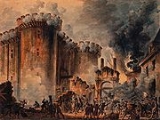
Storming of the Bastille

 
Storming of the Bastille

   Email Print
   Bookmark   Link


Storming of the Bastille


The Storming of the Bastille in Paris
Paris

Paris is the Capital of France and the country's largest city. It is situated on the river Seine, in northern France, at the heart of the ?le-de-France Regions of France ....
 occurred on 14 July 1789. While the medieval fortress and prison
Prison

A prison, penitentiary, or correctional facility is a place in which individuals are physically confined or internment and usually deprived of a range of personal Freedom ....
 in Paris known as the Bastille
Bastille

The bastille was a fortress-prison in Paris, known formally as Bastille Saint-Antoine?Number 232, Rue Saint-Antoine?best known today because of the storming of the Bastille on 14 July 1789, which along with the Tennis Court Oath is considered the beginning of the French Revolution....
 contained only seven prisoners, its fall was the flashpoint of the French Revolution
French Revolution

The French Revolution was a period of political and social upheaval and radical change in the history of France, during which the French governmental structure, previously an absolute monarchy with feudalism for the aristocracy and Roman Catholic Church clergy, underwent radical change to forms based on Age of Enlightenment principles of cit...
, and it subsequently became an icon of the French Republic. In France, Le quatorze juillet (14 July) is a public holiday, formally known as the Fête de la Fédération
Fête de la Fédération

The F?te de la F?d?ration of the 14 July 1790 was a huge feast and official event to celebrate the establishment of the short-lived constitutional monarchy in France and what people of the time considered to be the happy conclusion of the French Revolution, the outcome hoped for by the monarchiens....
 (Federation Holiday). It is usually called Bastille Day
Bastille Day

Bastille Day is the France National Day, celebrated on 14 July each year . In France, it is called F?te Nationale in official parlance, or more commonly le quatorze juillet ....
 in English.

During the reign of Louis XVI
Louis XVI of France

Louis XVI or Louis-Auguste de France ruled as List of French monarchs of France and of List of Navarrese monarchs from 1774 until 1791, and then as Popular monarchy from 1791 to 1792....
, France faced a major financial crisis, triggered by the cost of intervening in the American War of Independence
American Revolutionary War

The American Revolutionary War , also known as the American War of Independence, began as a war between the Kingdom of Great Britain and Thirteen Colonies on the North America, and ended in a global war between several European great powers....
, and exacerbated by an unequal system of taxation.


Discussion
Ask a question about 'Storming of the Bastille'
Start a new discussion about 'Storming of the Bastille'
Answer questions from other users
Full Discussion Forum


Encyclopedia


The Storming of the Bastille in Paris
Paris

Paris is the Capital of France and the country's largest city. It is situated on the river Seine, in northern France, at the heart of the ?le-de-France Regions of France ....
 occurred on 14 July 1789. While the medieval fortress and prison
Prison

A prison, penitentiary, or correctional facility is a place in which individuals are physically confined or internment and usually deprived of a range of personal Freedom ....
 in Paris known as the Bastille
Bastille

The bastille was a fortress-prison in Paris, known formally as Bastille Saint-Antoine?Number 232, Rue Saint-Antoine?best known today because of the storming of the Bastille on 14 July 1789, which along with the Tennis Court Oath is considered the beginning of the French Revolution....
 contained only seven prisoners, its fall was the flashpoint of the French Revolution
French Revolution

The French Revolution was a period of political and social upheaval and radical change in the history of France, during which the French governmental structure, previously an absolute monarchy with feudalism for the aristocracy and Roman Catholic Church clergy, underwent radical change to forms based on Age of Enlightenment principles of cit...
, and it subsequently became an icon of the French Republic. In France, Le quatorze juillet (14 July) is a public holiday, formally known as the Fête de la Fédération
Fête de la Fédération

The F?te de la F?d?ration of the 14 July 1790 was a huge feast and official event to celebrate the establishment of the short-lived constitutional monarchy in France and what people of the time considered to be the happy conclusion of the French Revolution, the outcome hoped for by the monarchiens....
 (Federation Holiday). It is usually called Bastille Day
Bastille Day

Bastille Day is the France National Day, celebrated on 14 July each year . In France, it is called F?te Nationale in official parlance, or more commonly le quatorze juillet ....
 in English.

During the reign of Louis XVI
Louis XVI of France

Louis XVI or Louis-Auguste de France ruled as List of French monarchs of France and of List of Navarrese monarchs from 1774 until 1791, and then as Popular monarchy from 1791 to 1792....
, France faced a major financial crisis, triggered by the cost of intervening in the American War of Independence
American Revolutionary War

The American Revolutionary War , also known as the American War of Independence, began as a war between the Kingdom of Great Britain and Thirteen Colonies on the North America, and ended in a global war between several European great powers....
, and exacerbated by an unequal system of taxation. On 5 May 1789, the Estates-General of 1789
Estates-General of 1789

The Estates-General of 1789 was the first meeting since 1614 of the France French States-General, a general assembly consisting of representatives from all but the poorest segment of the French citizenry....
 convened to deal with this issue, but was held back by archaic protocols and the conservatism of the Second Estate
Estates of the realm

The Estates of the realm were the broad divisions of society, usually distinguishing nobility, clergy, and commoners recognized in the Middle Ages and later in some parts of Europe....
, consisting of the nobility and comprising 2% of France's population at the time. On 17 June 1789, the Third Estate
Estates of the realm

The Estates of the realm were the broad divisions of society, usually distinguishing nobility, clergy, and commoners recognized in the Middle Ages and later in some parts of Europe....
, with its representatives drawn from the middle class, or bourgeoisie
Bourgeoisie

Bourgeoisie is a classification used in analyzing human societies to describe a social class of people. Historically, the bourgeoisie comes from the middle or merchant classes of the Middle Ages, whose status or power came from employment, education, and wealth, as distinguished from those whose power came from being born into an aristocrati...
, reconstituted themselves as the National Assembly
National Assembly (French Revolution)

During the French Revolution, the National Assembly , which existed from June 17 to July 9 of 1789, was a transitional body between the Estates-General of 1789 and the National Constituent Assembly....
, a body whose purpose was the creation of a French constitution
Constitution

A constitution is a system for government — often codified as a written document — that establishes the rules and principles of an autonomous political entity....
. The king initially opposed this development, but was forced to acknowledge the authority of the assembly, which subsequently renamed itself the National Constituent Assembly
National Constituent Assembly

The National Constituent Assembly was formed from the National Assembly on 9 July 1789, during the first stages of the French Revolution. It dissolved on 30 September 1791 and was succeeded by the French Legislative Assembly....
 on 9 July.

The storming of the Bastille and the subsequent Declaration of the Rights of Man and of the Citizen
Declaration of the Rights of Man and of the Citizen

The Declaration of the Rights of Man and of the Citizen is a fundamental document of the French Revolution, defining the individual and collective rights of all the estates of the realm as universal....
 was the third event of this opening stage of the revolution. The first had been the revolt of the nobility, refusing to aid King Louis XVI through the payment of taxes. The second had been the formation of the National Assembly and the Tennis Court Oath
Tennis Court Oath

The Tennis Court Oath was a pivotal event during the French Revolution. The Oath was a pledge signed by 576 out of the 577 members from the Third Estate and a few members of the First Estate during a meeting of the Estates General of 1789 of 20 June 1789 in a tennis court near the Palace of Versailles....
.

The middle class had formed the National Guard, sporting tricolor rosettes of blue, white and red; soon to become the symbol of the revolution.

Paris
Paris

Paris is the Capital of France and the country's largest city. It is situated on the river Seine, in northern France, at the heart of the ?le-de-France Regions of France ....
, close to insurrection, and, in François Mignet
François Mignet

Fran?ois Auguste Marie Mignet was a France journalist and historian....
's words, "intoxicated with liberty and enthusiasm," showed wide support for the Assembly. The press published the Assembly's debates; political debate spread beyond the Assembly itself into the public squares and halls of the capital. The Palais-Royal and its grounds became the site of an endless meeting. The crowd, on the authority of the meeting at the Palais-Royal, broke open the prisons of the Abbaye
Prison de l'Abbaye

The prison de l?Abbaye was a Paris prison in use from 1522 to 1854. The final building was built by Gamard in 1631 and made up of three floors, flanked by two turrets and an ?chauguette....
 to release some grenadiers of the French guards, reportedly imprisoned for refusing to fire on the people. The Assembly recommended the imprisoned guardsmen to the clemency of the king; they returned to prison, and received pardon. The rank and file of the regiment, previously considered reliable, now leaned toward the popular cause.

Necker's dismissal

commemorating the storming of the Bastille, depicting Camille Desmoulins supported by sans-culottes
Sans-culottes

Sans-culottes was a term created 1790 - 1792 by the French aristocracy to describe the poorer members of the Third Estate, according to the dominant theory because they usually wore pantaloons instead of the chic knee-length culotte....
]]On 11 July 1789, with troops at Versailles
Versailles

Versailles , formerly de facto capital of the kingdom of France, is now a wealthy suburb of Paris and is still an important administrative and judicial centre....
, Sèvres
Sèvres

S?vres is a Communes of France in the southwestern suburbs of Paris, France. It is located 9.9 km from the Kilometre Zero.The town is known for its porcelain manufacture, the Manufacture nationale de S?vres, making the famous S?vres porcelain, as well as being the location of the International Bureau of Weights and Measures,...
, the Champ de Mars
Champ de Mars

The Champ de Mars is a large public green-space in Paris, France, located in the 7?me arrondissement, Paris, between the Eiffel Tower to the northwest and the ?cole Militaire to the southeast....
, and Saint-Denis, Louis XVI, acting under the influence of the conservative nobles of his privy council
Privy council

A privy council is a body that advises the head of state of a nation on how to exercise their Executive , typically, but not always, in the context of a monarchy....
, dismissed and banished his finance minister, Jacques Necker
Jacques Necker

Jacques Necker was a France statesman of Switzerland birth and List of Finance Ministers of France of Louis XVI of France, a post he held in the lead-up to the French Revolution in 1789....
, who had been sympathetic to the Third Estate, and completely reconstructed the ministry. The marshal Victor-François, duc de Broglie o [[la Galissonnière]], the [[Paul François de Quelen, duc de la Vauguyon|duc de la Vauguyon]], the Baron [[Louis Auguste Le Tonnelier de Breteuil|Louis de Breteuil]], and the intendant [[Foulon]], took over the posts of [[Puységur]], [[Armand Marc, comte de Montmorin]], [[César Guillaume de La Luzerne|La Luzerne]], [[Saint-Priest]], and Necker.

News of Necker's dismissal reached Paris in the afternoon of Sunday, 12 July. The Parisians generally presumed that the dismissal marked the start of a coup by conservative elements. Liberal Parisians were further enraged by the fear that a concentration of Royal troops brought to Versailles from frontier garrisons would attempt to shut down the [[National Constituent Assembly]], which was meeting in Versailles. Crowds gathered throughout Paris, including more than ten thousand at the Palais-Royal. [[Camille Desmoulins]], a known [[freemasonry|freemason]] from the [[Neuf Soeurs|lodge of the Nine Sisters]], according to Mignet, successfully rallied the crowd by "mounting a table, pistol in hand, exclaiming: 'Citizens, there is no time to lose; the dismissal of Necker is the knell of a [[St. Bartholomew's Day Massacre|Saint Bartholomew]] for patriots! This very night all the Swiss and German battalions will leave the Champ de Mars to massacre us all; one resource is left; to take arms!'"

The Swiss and German regiments referred to were among the foreign [[mercenary]] troops who made up a significant portion of the pre-revolutionary [[Military history of France#Ancien Régime|Royal Army]], and were seen as being less likely to be sympathetic to the popular cause than ordinary French soldiers. By early July, approximately half of the 25,000 regular troops concentrated around Paris and Versailles were drawn from these foreign regiments.

During the public demonstrations that started on 12 July the multitude displayed busts of Necker and of [[Louis Philippe II, Duke of Orléans]]. The crowd clashed with the Royal German Cavalry Regiment ("Royal-Allemande") between the [[Place Vendôme]] and the [[Tuileries Palace]]. The Royal commander, Baron de Besenval, fearing the results a blood bath amongst the poorly armed crowds or defections amongst his own men, withdrew the cavalry towards Sèvres. Meanwhile, unrest was growing among the people of Paris who due to their hostility against the Fiscal Legislation of State's Farmers started attacking customs posts blamed for causing increased food and wine prices. The people of Paris started to plunder any place where food, guns and supplies could be hoarded. The next day, on 13 July, rumours spread that supplies were being hoarded at Saint-Lazare, a huge property of the clergy, which functioned as convent, hospital, school and even as a jail. An angry mob broke in and plundered the propety, seizing 52 wagons of wheat which were taken to the public market. That same day multitudes of people plundered many other places including weapon arsenals. The Royal troops did nothing to stop the spreading of social chaos in Paris during those days.

Armed conflict

The regiment of [[Gardes Françaises]] (French Guards) formed the permanent garrison of Paris and with many local ties was favourably disposed towards the popular cause. This regiment had remained confined to its barracks during the initial stages of the mid-July disturbances. With Paris becoming the scene of a general riot, Lambesc, not trusting the regiment to obey his order, posted sixty dragoons to station themselves before its dépôt in the [[Rue de la Chaussée-d'Antin|Chaussée d'Antin]]. Once again, a measure intended to restrain only served to provoke. The French Guards regiment routed the cavalry, killing two, wounding three, and putting the rest to flight. The officers of the French Guards made ineffectual attempts to rally their men. The rebellious citizenry had now acquired a trained military contingent; as word of this spread, the commanders of the royal forces encamped on the Champ de Mars became doubtful of the dependability of even the foreign regiments. The future "Citizen King", [[Louis-Philippe of France|Louis-Phillipe, duc d'Orléans]], witnessed these events as a young officer and was of the opinion that the soldiers would have obeyed orders if put to the test. He also commented in retrospect that the officers of the French Guards had neglected their responsibilities in the period before the rising, leaving the regiment too much to the control of its [[non-commissioned officer]]s. However the uncertain leadership of M. de Besenval led to a virtual abdication of royal authority in central Paris.

The demonstrators gathered in and around the [[Hôtel de Ville, Paris|Hôtel de Ville]] and sounded the [[tocsin]]. Distrust between the leading citizens gathered within the building and the masses outside was exacerbated by the failure or inability of the former to provide the latter with arms. Between political insurrection and opportunistic looting, Paris slid into chaos. In Versailles, the Assembly went into continuous session so that it could not, once again, be deprived of its meeting space.

Storming the Bastille

The demonstrators had earlier stormed the [[Les Invalides|Hôtel des Invalides]] to gather arms (29,000 to 32,000 muskets, but without powder or shot), and were mainly seeking to acquire the large quantities of arms and ammunition stored at the Bastille - on the 14th there were over 13,600 kg (30,000 lb) of [[gunpowder]] stored there.

At this point, the Bastille was nearly empty of prisoners, housing only seven inmates: four [[forgery|forgers]], two "lunatics" and one "deviant" aristocrat, the comte de Solages (the [[Marquis de Sade]] had been transferred out ten days earlier). The cost of maintaining a medieval fortress and garrison for so limited a purpose had led to a decision being taken to close it, shortly before the disturbances began. It was, however, a symbol of royal tyranny.

The regular garrison consisted of 82 invalides (veteran soldiers no longer suitable for service in the field). It had however been reinforced on [[7 July]] by 32 grenadiers of the Swiss Salis-Samade Regiment from the troops on the Champ de Mars. The walls mounted eighteen eight-pound guns and twelve smaller pieces. The governor was [[Bernard-René de Launay]], son of the previous governor and actually born within the Bastille.

The list of vainqueurs de la Bastille has around 600 names, and the total of the crowd was probably less than one thousand. The crowd gathered outside around mid-morning, calling for the surrender of the prison, the removal of the guns and the release of the arms and gunpowder. Two representatives of the crowd outside were invited into the fortress and negotiations began, and another was admitted around noon with definite demands. The negotiations dragged on while the crowd grew and became impatient.

Around 13:30 the crowd surged into the undefended outer courtyard, and the chains on the [[drawbridge]] to the inner courtyard were cut - crushing one unfortunate vainqueur. About this time gunfire began, though which side actually fired first will never be conclusively decided. The crowd seemed to have felt it had been drawn into a trap and the fighting became more violent and intense, while attempts by deputies to organize a cease-fire were ignored by the attackers.

The firing continued, and at 15:00 the attackers were reinforced by mutinous gardes françaises and other deserters from among the regular troops, along with two cannons. A substantial force of Royal Army troops encamped on the nearby Champs de Mars did not intervene. With the possibility of a mutual massacre suddenly apparent Governor de Launay ordered a cease fire at 17:00. A letter offering his terms was handed out to the besiegers through a gap in the inner gate. His demands were refused, but de Launay nonetheless capitulated, as he realized that his troops could not hold out much longer; he opened the gates to the inner courtyard, and the vainqueurs swept in to liberate the fortress at 17:30.

Ninety-eight attackers and one defender had died in the actual fighting. De Launay was seized and dragged towards the [[Hôtel de Ville]] in a storm of abuse. Outside the Hôtel a discussion as to his fate began. The badly beaten de Launay shouted "Enough! Let me die!" and kicked a pastry cook named Dulait in the groin. De Launay was then stabbed repeatedly and fell, and his head was sawed off and fixed on a [[Pike (weapon)|pike]] to be carried through the streets. The three officers of the permanent Bastille garrison were also killed by the crowd; surviving police reports detail their wounds and clothing. Two of the invalides of the garrison were lynched, but all but two of the Swiss regulars of the Salis-Samade Regiment were protected by the French Guards and eventually released to return to their regiment. Their officer, Lieutenant Louis de Flue, wrote a detailed report on the defense of the Bastille which was incorporated in the logbook of the Salis-Samade and has survived. It is (perhaps unfairly) critical of the dead Marquis de Launay, whom de Flue accuses of weak and indecisive leadership. The blame for the fall of the Bastille would rather appear to lie with the inertia of the commanders of the substantial force of Royal Army troops encamped on the Champs de Mars, who made no effort to intervene when the nearby Hôtel des Invalides or the Bastille were attacked.

Returning to the Hôtel de Ville, the mob accused the prévôt ès marchands (roughly, mayor) [[Jacques de Flesselles]] of treachery, and he was assassinated en route to an ostensible trial at the [[Palais-Royal]].

Aftermath

, wearing iconic [[Phrygian cap]]s and tricolor rosettes

The citizenry of Paris, expecting a counterattack, entrenched the streets, built barricades of paving stones, and armed themselves as well as they could, especially with improvised pikes. Meanwhile, at Versailles, the Assembly remained ignorant of most of the Paris events, but eminently aware that Marshal de Broglie stood on the brink of unleashing a pro-Royalist coup to force the Assembly to adopt the order of 23 June and then to dissolve. The viscomte de Noailles
Louis-Marie, vicomte de Noailles

Louis-Marie, vicomte de Noailles was the second son of Philippe, duc de Mouchy, and a member of duc de Mouchy branch of the famous duc de Noailles family of the France aristocracy....
 apparently first brought reasonably accurate news of the Paris events to Versailles. M. Ganilh and Bancal-des-Issarts, dispatched to the Hôtel de Ville, confirmed his report.

By the morning of 15 July the outcome appeared clear to the king as well, and he and his military commanders backed down. The Royal troops concentrated around Paris were dispersed to their frontier garrisons. The Marquis de la Fayette took up command of the National Guard at Paris; Jean-Sylvain Bailly — leader of the Third Estate and instigator of the Tennis Court Oath
Tennis Court Oath

The Tennis Court Oath was a pivotal event during the French Revolution. The Oath was a pledge signed by 576 out of the 577 members from the Third Estate and a few members of the First Estate during a meeting of the Estates General of 1789 of 20 June 1789 in a tennis court near the Palace of Versailles....
 — became the city's mayor under a new governmental structure known as the
Commune de Paris
Paris Commune (French Revolution)

The Paris Commune during the French Revolution was the government of Paris from 1789 until 1795, and especially from 1792 until 1795. Established in the H?tel de Ville, Paris just after the storming of the Bastille, the Commune became insurrectionary in the summer of 1792, essentially refusing to take orders from the central French govern...
. The king announced that he would recall Necker and return from Versailles to Paris; on 27 July, in Paris, he accepted a tricolor
Flag of France

The national flag of France is a tricolour featuring three vertical bands coloured blue , white, and red. It is known to English language speakers as the French tricolour or simply, the tricolour....
 cockade
Cockade

A cockade is a knot of ribbons, or other circular- or oval-shaped symbol of distinctive colors which is usually worn on a hat....
 from Bailly and entered the Hôtel de Ville, as cries of "Long live the King" were changed to "Long live the Nation".

Nonetheless, after this violence, nobles — little assured by the apparent and, as it was to prove, temporary reconciliation of king and people — started to flee the country as
émigré
Émigré

?migr? is a French language term that literally refers to a person who has "migrated out," but often carries a connotation of politico-social self-exile....
s. Early émigrés included the comte d'Artois (the future Charles X of France
Charles X of France

Charles X ruled as List of French monarchs and List of Navarrese monarchs from 20 May 1824 until the July Revolution, when he Abdication. He was the last king of the senior House of Bourbon line to reign over France....
) and his two sons, the prince de Condé, the prince de Conti, the Polignac
Polignac

Polignac is the name of several communes in France:* Polignac, Charente-Maritime* Polignac, Haute-Loire, in the Haute-Loire d?partement, dominated by the fortress Ch?teau de Polignac with its square donjon tower, 32 m tall...
 family, and (slightly later) Charles Alexandre de Calonne
Charles Alexandre de Calonne

Charles Alexandre, Viscount de Calonne was a France statesman, best known for his involvement in the French Revolution....
, the former finance minister. They settled at Turin
Turín

Tur?n is a municipality in the Ahuachap?n Department Departments of El Salvador of El Salvador....
, where Calonne, as agent for the count d'Artois and the prince de Condé, began plotting civil war within the kingdom and agitating for a European coalition against France.

Necker returned from Basel
Basel

Basel is Switzerland's third most populous city . With 731,000 inhabitants in the tri-national metropolitan area , Basel is Switzerland's third-largest urban area....
 to Paris in triumph (which proved short-lived). He discovered upon his arrival that the mob had cruelly murdered Foulon
Joseph Foullon de Doué

Joseph-Fran?ois Foullon de Dou? or Foulon de Dou? was a France politician and a Controller-General of Finances under Louis XVI of France....
 and Foulon's nephew, Berthier, and that the baron de Besenval
Pierre Victor Besenval de Bronstatt

Pierre Victor Besenval de Bronstatt , was the last commander of the Swiss Guards in France.Born at Solothurn, he was the son of Jean Victor Besenval, colonel of the regiment of Swiss Guards in the pay of France, who was charged in 1707 by Louis XIV of France with a mission to Sweden to reconcile Charles XII of Sweden with the tsar Peter I...
 (commander under Broglie) was held prisoner. Wishing to avoid further bloodshed, he overplayed his hand by demanding and obtaining a general amnesty, voted by the assembly of electors of Paris. In demanding amnesty rather than merely a just tribunal, Necker misjudged the weight of the political forces. He overestimated the power of the
ad hoc assembly, which almost immediately revoked the amnesty to save their own role, and perhaps their own skins, instituting a trial court at the Châtelet
Châtelet

In antiquity, a ch?telet was a little castle or fortress, wherein the chatelain, or governor lodged.Now, the term may refer to:* Ch?telet, Belgium, city...
. Mignet counts this as the moment when the Revolution left Necker behind.

The successful insurrection at Paris spread throughout France. In accord with principles of popular sovereignty
Popular sovereignty

Popular sovereignty or the sovereignty of the people is the belief that the legitimacy of the state is created by the will or Consent of the governed, who are the source of all political power....
 and with complete disregard for claims of royal authority, the people created a parallel structure of municipalities for civic government and militia for civic protection. In rural areas, many went beyond this: some burned title-deeds and no small number of châteaux, as the "Great Fear
Great Fear

The "Great Fear" occurred from July 20 to August 5, 1789 in France at the start of the French Revolution. Rural unrest had been present in France since the worsening grain shortage of the spring, and the grain supplies were now guarded by local militias as bands of vagrants roamed the countryside....
" spread across the countryside during the weeks of 20 July to 5 August, with attacks on wealthy landlords impelled by the belief that the aristocracy was trying to put down the revolution.

Further reading


External links