

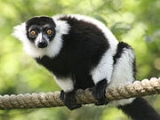
Lemur

Encyclopedia
Lemurs are a clade
of strepsirrhine
primate
s endemic to the island of Madagascar
. They are named after the lemures (ghosts or spirits) of Roman mythology
due to the ghostly vocalizations, reflective eyes, and the nocturnal habits of some species. Although lemurs often are confused with ancestral primates, the anthropoid
primates (monkey
s, ape
s, and human
s) did not evolve from them; instead, lemurs merely share morphological and behavioral traits with basal
primates. Lemurs arrived in Madagascar around 62 to 65 mya by rafting on mats of vegetation at a time when ocean currents favored oceanic dispersal to the island. Since that time, lemurs have evolved
to cope with an extremely seasonal environment and their adaptation
s give them a level of diversity that rivals that of all other primate groups. Until shortly after humans arrived on the island around 2,000 years ago, there were lemurs as large as a male gorilla
. Today, there are nearly 100 species of lemurs, and most of those species have been discovered or promoted to full species status since the 1990s; however, lemur taxonomic classification
is controversial and depends on which species concept
is used. Even the higher-level taxonomy is disputed, with some experts preferring to place most lemurs within the infraorder
Lemuriformes, while others prefer Lemuriformes to contain all living strepsirrhines, placing all lemurs in superfamily
Lemuroidea and all loris
es and galago
s in superfamily Lorisoidea.
Ranging in size from 30 g (1.1 oz) to 9 kg (20 lb), lemurs share many common, basal primate traits, such as divergent digits
on their hands and feet and nails
instead of claw
s (in most species). However, their brain-to-body size ratio is smaller than that of anthropoid primates, and among many other traits they share with other strepsirrhine primates, they have a "wet nose" (rhinarium
). Lemurs are generally the most social of the strepsirrhine primates and communicate more with scents and vocalizations than with visual signals. Many lemur adaptations are in response to Madagascar's highly seasonal environment. Lemurs have relatively low basal metabolic rate
s and may exhibit seasonal breeding
, dormancy
(such as hibernation
or torpor
), or female social dominance. Most eat a wide variety of fruits and leaves, while some are specialists. Although many share similar diets, different species of lemur share the same forests by differentiating niches
.
Lemur research focused on taxonomy and specimen collection during the 18th and 19th centuries. Although field observations trickled in from early explorers, modern studies of lemur ecology and behavior did not begin in earnest until the 1950s and 1960s. Initially hindered by political instability and turmoil on Madagascar during the mid-1970s, field studies resumed in the 1980s and have greatly increased our understanding of these primates. Research facilities like the Duke Lemur Center
have provided research opportunities under more controlled settings. Lemurs are important for research because their mix of primitive characteristics and traits shared with anthropoid primates can yield insights on primate and human evolution
. However, many lemur species are threatened with extinction due to habitat loss and hunting. Although local traditions generally help protect lemurs and their forests, illegal logging
, widespread poverty, and political instability hinder and undermine conservation efforts.
, gave lemurs their name as early as 1758, when he used it in 10th edition of Systema Naturae
. He included three species under the genus Lemur: Lemur tardigradus (the red slender loris
, now known as Loris tardigradus), Lemur catta (the ring-tailed lemur
), and Lemur volans (the Philippine colugo
, now known as Cynocephalus volans). Although the term "lemur" was apparently at first intended for loris
es, it was soon limited to the endemic Malagasy primates, which have been known as "lemurs" ever since. The name derives from the Latin
term lemures, which refers to specters or ghosts that were exorcised
during the Lemuria festival. Linnaeus was familiar with the nocturnal habits and ghost-like appearance of lemurs and lorises, as well as their noiseless movements at night, reflective eyes
, and ghostly cries. He may also have known that the some Malagasy people have held legends that lemurs are the souls of their ancestors. Being familiar with the works of Virgil
and Ovid
and seeing an analogy that fit with his naming scheme, Linnaeus adapted the term "lemur" for these nocturnal primates.
primates belonging to the suborder Strepsirrhini
. Like other strepsirrhine primate
s, such as loris
es, potto
s, and galago
s, they share ancestral (or plesiomorphic) traits with early primates. In this regard, lemurs are popularly confused with ancestral primates; however, lemurs did not give rise to monkeys and apes (simian
s). Instead, they evolved independently in isolation on Madagascar
. All modern strepsirrhines including lemurs are traditionally thought to have evolved from primitive primates known as adapiforms
during the Eocene
(56 to 34 mya) or Paleocene
(65 to 56 mya). Adapiforms, however, lack a specialized arrangement of teeth, known as a toothcomb
, which nearly all living strepsirrhines possess. A more recent hypothesis
is that lemurs descended from lorisiform (loris-like) primates. This is supported by comparative studies of the cytochrome b gene and the presence of the strepsirrhine toothcomb in both groups. Instead of being the direct ancestors of lemurs, the adapiforms may have given rise to both the lemurs and lorisiforms, a split that would be supported by molecular phylogenetic studies. The later split between lemurs and lorises is thought to have occurred approximately 62 to 65 mya according to molecular studies, although other genetic tests and the fossil record in Africa suggest more conservative estimates of 50 to 55 mya for this divergence.
Once part of the supercontinent Gondwana
, the island of Madagascar has been isolated since it broke away from eastern Africa
(~160 mya), Antarctica (~80–130 mya), and India (~80–90 mya). Since ancestral lemurs are thought to have originated in Africa around 62 to 65 mya, they would have had to have crossed the Mozambique Channel
, a deep channel between Africa and Madagascar with a minimum width of about 560 km (350 mi). In 1915, paleontologist William Diller Matthew
noted that the mammalian biodiversity on Madagascar (including lemurs) can only be accounted for by random rafting event
s, where very small populations rafted from nearby Africa on tangled mats of vegetation, which get flushed out to sea from major rivers. This form of biological dispersal
can occur randomly over millions of years. In the 1940s, American paleontologist George Gaylord Simpson
coined the term "sweepstakes hypothesis" for such random events. Rafting has since been the most accepted explanation for the lemur colonization of Madagascar, but until recently this trip was thought to be very unlikely because strong ocean current
s flow away from the island. In , a report demonstrated that around 60 mya both Madagascar and Africa were 1,650 km (1,030 mi) south of their present-day positions, placing them in a different ocean gyre, producing currents that ran counter to what they are today. The ocean currents were shown to be even stronger than today, which would have pushed a raft along faster, shortening the trip to 30 days or less—short enough for a small mammal to survive easily. As the continental plate
s drifted northward, the currents gradually changed, and by 20 mya the window for oceanic dispersal had closed, effectively isolating the lemurs and the rest of the terrestrial Malagasy fauna from mainland Africa. Isolated on Madagascar with only a limited number of mammalian competitors, the lemurs did not have to compete with other evolving arboreal
mammalian groups, such as squirrel
s. They were also spared from having to compete with monkey
s, which evolved later. The intelligence, aggression, and deceptiveness of monkeys gave them an advantage over other primates in exploiting the environment.
to fill many open ecological niche
s since making their way to Madagascar. Their diversity in both behavior and morphology (outward appearance) rivals that of the monkeys and apes found elsewhere in the world. Ranging in size from the 30 g (1.1 oz) Madame Berthe's mouse lemur
, the world's smallest primate, to the recently extinct 160–200 kg (350–440 lb) Archaeoindris fontoynonti, lemurs evolved diverse forms of locomotion, varying levels of social complexity, and unique adaptations to the local climate.
Lemurs lack any shared traits that make them stand out from all other primates. Different types of lemurs have evolved unique combinations of unusual traits to cope with Madagascar's harsh, seasonal climate. These traits can include seasonal fat storage, hypometabolism (including torpor
and hibernation
), small group sizes, low encephalization
(relative brain size), cathemeral
ity (activity both day and night), and strict breeding seasons
. Extreme resource limitations and seasonal breeding are also thought to have given rise to three other relatively common lemur traits: female social dominance, sexual monomorphism, and male–male competition for mates involving low levels of agonism
, such as sperm competition
.
Before the arrival of humans roughly 1500 to 2000 years ago, lemurs were found all across the island. However, early settlers quickly converted the forests to rice paddies
and grassland
through slash-and-burn agriculture
(known locally as tavy), restricting lemurs to approximately 10% of the island's area, ~60,000 km2 (23,000 sq mi). Today, the diversity and complexity of lemur communities increases with flora
l diversity and precipitation
and is highest in the rainforest
s of the east coast, where precipitation and floral diversity are also at their highest. Despite their adaptations for weathering extreme adversity, habitat destruction and hunting have resulted in lemur populations declining sharply, and their diversity has diminished, with the recent extinction of at least 17 species in eight genera, known collectively as the subfossil lemur
s. Most of the approximately 100 species and subspecies of lemur are either threatened or endangered. Unless trends change, extinctions are likely to continue.
Until recently, giant lemurs existed on Madagascar. Now represented only by recent or subfossil
remains, they were modern forms that were once part of the rich lemur diversity that has evolved in isolation. Some of their adaptations were unlike those seen in their living relatives.All 17 extinct lemurs were larger than the extant (living) forms, some weighing as much as 200 kg (440 lb), and are thought to have been active during the day. Not only were they unlike the living lemurs in both size and appearance, they also filled ecological niches that either no longer exist or are now left unoccupied. Large parts of Madagascar, which are now devoid of forests and lemurs, once hosted diverse primate communities that included more than 20 lemur species covering the full range of lemur sizes.
. The term is now used in the colloquial
sense in reference to all Malagasy primates.
Lemur taxonomy is controversial, and not all experts agree, particularly with the recent increase in the number of recognized species. According to Russell Mittermeier
, the president of Conservation International
(CI), taxonomist Colin Groves
, and others, there are nearly 100 recognized species or subspecies of extant (or living) lemur, divided into five families and 15 genera. Because genetic data indicates that the recently extinct subfossil lemurs were closely related to living lemurs, an additional three families, eight genera, and 17 species can be included in the total. In contrast, other experts have labeled this as taxonomic inflation
, instead preferring a total closer to 50 species.
The classification of lemurs within the suborder Strepsirrhini is equally controversial, although the most experts agree on the same phylogenetic tree
. In one taxonomy published by Colin Groves, the aye-aye was placed in its own infraorder, Chiromyiformes, while the rest of the lemurs were placed in Lemuriformes. In another taxonomy, Lemuriformes contains all living strepsirrhines in two superfamilies, Lemuroidea for all lemurs and Lorisoidea for lorises and galagos.
Lemur taxonomy has changed significantly since the first taxonomic classification of lemurs by Carl Linnaeus in 1758. One of the greatest challenges has been the classification of the aye-aye, which has been a topic of debate up until very recently. Until Richard Owen
published a definitive anatomical study in 1866, early naturalists were uncertain whether the aye-aye (genus Daubentonia) was a primate
, rodent
, or marsupial
. However, the placement of the aye-aye within the order Primates remained problematic until very recently. Based on its anatomy, researchers have found support for classifying the genus Daubentonia as a specialized indriid
, a sister group
to all strepsirrhines, and as an indeterminate taxon within the order Primates. Molecular tests have now shown Daubentoniidae is basal to all Lemuriformes, and in 2008, Russell Mittermeier, Colin Groves, and others ignored addressing higher-level taxonomy by defining lemurs as monophyletic and containing five living families, including Daubentoniidae.
Relationships among lemur families have also proven to be problematic and have yet to be definitively resolved. To further complicate the issue, several Paleogene
fossil primates from outside Madagascar, such as Bugtilemur
, have been classified as lemurs. However, scientific consensus does not accept these assignments based on genetic evidence, and therefore it is generally accepted that the Malagasy primates are monophyletic. Another area of contention is the relationship between the sportive lemurs and the extinct koala lemurs (Megaladapidae). Formerly grouped in the same family due to similarities in dentition, they are no longer considered to be closely related due to genetic studies.
More taxonomic changes have occurred at the genus level, although these revisions have proven more conclusive, often supported by genetic and molecular analysis. The most noticeable revisions included the gradual split of a broadly defined genus Lemur into separate genera for the ring-tailed lemur
, ruffed lemur
s, and brown lemurs due to a host of morphological differences.
Due to several taxonomic revisions by Russell Mittermeier, Colin Groves, and others, the number of recognized lemur species has grown from 33 species and subspecies in 1994 to approximately 100 in 2008. With continuing cytogenetic
and molecular genetic
research, as well as ongoing field studies, particularly with cryptic species such as mouse lemurs, the number of recognized lemur species is likely to keep growing. However, the rapid increase in the number of recognized species has had its critics among taxonomists and lemur researchers. Since classifications ultimately depend on the species concept used, conservationist
s often favor definitions that result in the splitting of genetically distinct populations into separate species to gain added environmental protection. Others favor a more thorough analysis.
(Microcebus berthae) up to 7–9 kg (15–20 lb) for the indri
(Indri indri) and diademed sifaka
(Propithecus diadema). When recently extinct species are considered, the size range extended up to that of a gorilla
at 160–200 kg (350–440 lb) for Archaeoindris fontoynonti.
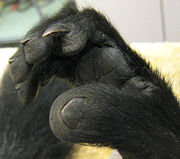 Like all primates, lemurs have five divergent digit
s with nail
s (in most cases) on their hands and feet. Most lemurs possess a laterally compressed, elongated nail, called a toilet-claw
, on the second toe and use it for scratching and grooming. In addition to the toilet-claw, lemurs share a variety of other traits with other strepsirrhine primates, which include a rhinarium (or "wet nose"); a fully functional vomeronasal organ
, which detects pheromone
s; a postorbital bar
and the lack of postorbital closure (a wall of thin bone behind the eye); orbit
s (bony sockets that enclose the eye) that are not fully facing forward; left and right mandible
(lower jaw) bones that are not fully fused; and a small brain-to-body mass ratio.
Additional traits shared with other prosimian primates (strepsirrhine primates and tarsier
s) include a bicornuate (two-horned) uterus
and epitheliochorial placentation
. Because their thumbs are only pseudo-opposable, making their movement less independent of the other fingers, their hands are less than perfect at grasping and manipulating objects. On their feet, they have a widely abducted hallux
(first toe) which facilitates the grasping of tree limbs. A common misconception is that lemurs have a prehensile tail
, a trait found only in New World monkey
s, particularly atelids
, among primates. Lemurs also rely heavily on their sense of smell, a trait shared with most other mammals and primitive primates, but not with the visually oriented higher primates. This sense of smell is important in terms of marking territory as well as provide an indication of whether or not another lemur is a viable breeding partner.
Lemurs are a diverse group of primates in terms of morphology and physiology. Some lemurs, such as the sportive lemur
s and indriid
s, have longer hind limb
s than forelimb
s, making them excellent leaper
s. Indriids also have a specialized digestive system for folivory
, exhibiting enlarged salivary gland
s, a spacious stomach
, and an elongated caecum (lower gut) that facilitates fermentation
. The hairy-eared dwarf lemur
(Allocebus trichotis) reportedly has a very long tongue
, allowing it to feed on nectar. Likewise, the red-bellied lemur
(Eulemur rubriventer) has a feathery brush-shaped tongue, also uniquely adapted to feed on nectar and pollen. The aye-aye has evolved some traits that are unique among primates, making it stand out among the lemurs. Such traits include continuously growing, rodent-like front teeth for gnawing through wood and hard seeds; a highly mobile, filiform (filament-shaped) middle finger for extracting food from tiny holes; large, bat
-like ears for detecting hollow spaces within trees; and use of self-generated acoustical cues to forage.
Lemurs are unusual since they have great variability in their social structure, yet generally lack sexual dimorphism
in size and canine tooth morphology. However, some species tend towards having larger females, and two species of true lemur (genus Eulemur), the gray-headed lemur
(E. albocollaris) and the Red Lemur
(E. rufus), exhibit size differences in canine teeth. True lemurs show sexual dichromatism (sexual differences in fur coloration), but the difference between the genders varies from strikingly obvious, as in the blue- eyed black lemur (E. macaco), to nearly imperceptible in the case of the common brown lemur
(E. fulvus).
Crypsis
, or the inability of humans to visually distinguish between two or more distinct species, has recently been discovered among lemurs, particularly within the sportive lemur
s (Lepilemur) and mouse lemur
s (Microcebus). With sportive lemurs, subspecies
were traditionally defined based on slight morphological differences, but new genetic evidence has supported giving full species status to these regional populations. In the case of mouse lemurs, the gray mouse lemur
(M. murinus), golden-brown mouse lemur (M. ravelobensis), and Goodman's mouse lemur
(M. lehilahytsara) were considered the same species until recently, when genetic tests identified them as cryptic species.
The lemur dentition
is heterodont
(having multiple tooth morphologies) and derives from an ancestral primate permanent dentition
of . Indriids, sportive lemurs, the aye-aye, and the extinct sloth lemurs, monkey lemur
s, and koala lemurs have reduced dentitions, having lost incisors, canines, or premolars. The ancestral deciduous dentition
is , but young indriids, aye-ayes, koala lemurs, sloth lemurs, and probably monkey lemurs have fewer deciduous teeth.
There are also noticeable differences in dental morphology and tooth topography between lemurs. Indri
, for instance, have teeth that are perfectly adapted for shearing leaves and crushing seeds. In the toothcomb
of most lemurs, the bottom incisor
s and canine teeth
are procumbent (face forward rather than up) and finely spaced, thus providing a tool for either grooming
or feeding. For instance, indri use their toothcomb not only for grooming, but also to pry out the large seeds from the tough exocarp of Beilschmiedia
fruits, while fork-marked lemurs use their relatively long toothcomb to cut through tree bark
to induce the flow of tree sap
. Only the aye-aye, the extinct giant aye-aye
, and the largest of the extinct giant sloth lemurs lack a functional strepsirrhine toothcomb. In the case of the aye-aye, the morphology of the deciduous incisors, which are lost shortly after birth, indicate that its ancestors had a toothcomb. These milk teeth are lost shortly after birth and are replaced by open-rooted, continually growing (hypselodont) incisors.
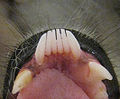 The toothcomb in lemurs normally consists of six teeth (four incisors and two canines), although indriids, monkey lemurs, and some sloth lemurs only have a four-tooth toothcomb due to the loss of either a canine or an incisor. Because the lower canine is either included in the toothcomb or lost, the lower dentition can be difficult to read, especially since the first premolar (P2) is often shaped like a canine (caniniform) to fill the canine's role. In folivorous
(leaf-eating) lemurs, except for indriids, the upper incisors are greatly reduced or absent. Used together with the toothcomb on the mandible
(lower jaw), this complex is reminiscent of an ungulate
browsing pad
.
Lemurs are unusual among primates for their rapid dental development, particularly among the largest species. For example, indriids have relatively slow body growth but extremely fast tooth formation and eruption
. By contrast, anthropoid
primates exhibit slower dental development with increased size and slower morphological development. Lemurs are also dentally precocious
at birth, and have their full permanent dentition at weaning
.
Lemurs generally have thin tooth enamel
compared to anthropoid primates. This may result in extra wear and breakage to the anterior (front) teeth due to heavy use in grooming, feeding, and fighting. Little other dental health information is available for lemurs, except that wild Ring-tailed Lemurs at Berenty Private Reserve occasionally exhibit abscess
ed maxilla
ry canines (seen as open wounds on the muzzle) and tooth decay
, possibly due to the consumption of non-native foods.
, is highly important to lemurs and is frequently used in communication. Lemurs have long snouts (compared to the short snouts of haplorrhines) that are traditionally thought to position the nose for better sifting of smells, although long snouts do not necessarily translate into high olfactory acuity since its not the relative size of the nasal cavity
that correlates with smell, but the density of olfactory receptor
s. Instead, the long snouts may facilitate better chewing.
The wet nose, or rhinarium
, is a trait shared with other strepsirrhines and many other mammals, but not with haplorrhine primates. Although it is claimed to enhance the sense of smell, it is actually a touch-based sense organ that connects with a well-developed vomeronasal organ
(VNO). Since pheromones are usually large, non-volatile molecules, the rhinarium is used to touch a scent-marked object and transfer the pheromone molecules down the philtrum
(the nasal mid-line cleft) to the VNO via the nasopalatine ducts that travel through the incisive foramen
of the hard palate
.
To communicate with smell, which is useful at night, lemurs will scent mark with urine
as well as scent gland
s located on the wrists, inside elbow, genital regions, or the neck. The scrotal skin
of most male lemurs has scent glands. Ruffed lemur
s (genus Varecia) and male sifakas have a gland at the base of their neck, while the greater bamboo lemur
(Prolemur simus) and the Ring-tailed Lemur have glands inside the upper arms near the axilla. Male ring-tailed lemurs also have scent glands on the inside of their forearms, adjacent to a thorn-like spur, which they use to gouge, and simultaneously, scent-mark tree branches. They will also wipe their tails between their forearms and then engage in "stink fights" by waving their tail as their opponents.
Lemurs (and strepsirrhines in general) are considered to be less visually oriented than the higher primates, since they rely so heavily on their sense of smell and pheromone detection. The fovea on the retina
; which yields higher visual acuity
, is not well-developed. The postorbital septum (or bony closure behind the eye) in haplorrhine primates is thought to stabilize the eye slightly, allowing for the evolution of the fovea. With only a postorbital bar, lemurs have been unable to develop a fovea. Therefore, regardless of their activity pattern (nocturnal, cathemeral, or diurnal), lemurs exhibit low visual acuity and high retinal summation
. Lemurs can see a wider visual field, however, than anthropoid primates due to a slight difference in the angle between the eyes, as shown in the following table:
Although they lack a fovea, some diurnal lemurs have a cone
-rich, although less clustered, area centralis. This area centralis has a high rod
-to-cone cell ratio in many diurnal species studied thus far, whereas diurnal anthropoids have no rod cells in their fovea. Once again, this suggests lower visual acuity in lemurs than in anthropoids. Furthermore, the rod-to-cone cell ratio can be variable even among diurnal species. For instance, Verreaux's sifaka
(Propithecus verreauxi) and the indri
(Indri indri) have only a few large cones scattered along their predominantly rod-dominated retina. The eyes of the Ring-tailed Lemur contain one cone to five rods. Nocturnal lemurs such as mouse lemurs and dwarf lemur
s, on the other hand, have retinas made up entirely of rod cells.
Since cone cells make color vision
possible, the high prevalence of rod cells in lemur eyes suggest they have not evolved color vision
. The most studied lemur, the Ring-tailed Lemur, has been shown to have blue-yellow vision, but lacks the ability to distinguish red and green hues. Due to polymorphism
in opsin
genes, which code for color receptivity, trichromatic vision may rarely occur in females of a few lemur species, such as Coquerel's sifaka
(Propithecus coquereli) and the red ruffed lemur
(Varecia rubra). Most lemurs, therefore, are either monochromats or dichromats.
_4.jpg) Most lemurs have retained the tapetum lucidum
Most lemurs have retained the tapetum lucidum
, a reflective layer of tissue in the eye, which is found in many vertebrates. This trait is absent in haplorrhine primates, and its presence further limits the visual acuity in lemurs. The strepsirrhine choroidal tapetum is unique among mammals because it is made up of crystalline riboflavin
, and the resulting optical scattering is what limits visual acuity. Although the tapetum is considered to be ubiquitous in lemurs, there appear to be exceptions among true lemurs, such as the Black Lemur and the common brown lemur, as well as the ruffed lemurs. Since the riboflavins in the tapetum have a tendency to dissolve and vanish when processed for histological investigation, however, the exceptions are still debatable.
s (BMR), which helps them to conserve energy during the dry season, when water and food are scarce. They can optimize their energy use by lowering their metabolic rate to 20% below the values predicted for mammals of similar body mass. The red-tailed sportive lemur
(Lepilemur ruficaudatus), for instance, reportedly has one of the lowest metabolic rates among mammals. Its low metabolic rate may be linked to its generally folivorous diet and relatively small body mass. Lemurs exhibit behavioral adaptations to complement this trait, including sunning behaviors, hunched sitting, group huddling, and nest sharing, in order to reduce heat loss and conserve energy. Dwarf lemurs and mouse lemurs exhibit seasonal cycles of dormancy
to conserve energy. Before dry season, they will accumulate fat in white adipose tissue
located at the base of the tail and hind legs, doubling their weight. At the end of the dry season, their body mass may fall to half of what it was prior to the dry season. Lemurs that do not experience states of dormancy are also able to shut down aspects of their metabolism for energy conservation.
), while the larger species are more herbivorous
, consuming mostly plant material. As with all primates, hungry lemurs might eat anything that is edible, whether or not the item is one of their preferred foods. For instance, the Ring-tailed Lemur eats insects and small vertebrate
s when necessary and as a result it is commonly viewed as an opportunistic omnivore. Coquerel's giant mouse lemur (Mirza coquereli) is mostly frugivorous
, but will consume insect secretions during the dry season.
A common assumption in mammalogy
is that small mammals cannot subsist entirely on plant material and must have a high-calorie diet in order to survive. As a result, it was thought that the diet of tiny primates must be high in protein-containing insects (insectivory
). Research has shown, however, that mouse lemurs, the smallest living primates, consume more fruit than insects, contradicting the popular hypothesis.
Plant material makes up the majority of most lemur diets. Members of at least 109 of all known plant families in Madagascar (55%) are exploited by lemurs. Since lemurs are primarily arboreal, most of these exploited species are woody plant
s, including tree
s, shrub
s, or liana
s. Only the ring-tailed lemur, the bamboo lemur
s (genus Hapalemur), and the black-and-white ruffed lemur
(Varecia variegata) are known to consume herb
s. While Madagascar is rich in fern
diversity, these plants are rarely eaten by lemurs. One possible reason for this is that ferns lack flowers, fruits, and seeds—common food items in lemur diets. They also occur close to the ground, while lemurs spend most of their time in the trees. Lastly, ferns have an unpleasant taste due to the high content of tannin
s in their frond
s. Likewise, mangrove
s appear to be rarely exploited by lemurs due to their high tannin content. Some lemurs appear to have evolved responses against common plant defenses, however, such as tannins and alkaloids. The golden bamboo lemur
(Hapalemur aureus), for instance, eats giant bamboo (Cathariostachys madagascariensis
), which contains high levels of cyanide
. This lemur can consume twelve times the typically lethal dose for most mammals on a daily basis; the physiological mechanisms that protect it from cyanide poisoning are unknown. At the Duke Lemur Center
(DLC) in the United States, lemurs that roam the outdoor enclosures have been observed eating poison ivy
(Taxicodendron radicans), yet have shown no ill effects.
Many of the larger lemur species consume leaves (folivory
), particularly the indriids. However, some smaller lemurs such as sportive lemur
s (genus Lepilemur) and woolly lemur
s (genus Avahi) also primarily eat leaves, making them the smallest primates that do so. The smallest of the lemurs generally do not eat much leaf matter. Collectively, lemurs have been documented consuming leaves from at least 82 native plant families and 15 alien plant families. Lemurs tend to be selective in their consumption of the part of the leaf or shoot as well as its age. Often, young leaves are preferred over mature leaves.
Many lemurs that eat leaves tend to do so during times of fruit scarcity, sometimes suffering weight loss as a result. Most lemur species, including most of the smallest lemurs and excluding some of the indriids, predominantly eat fruit (frugivory
) when available. Collectively, lemurs have been documented consuming fruit from at least 86 native plant families and 15 alien plant families. As with most tropical fruit eaters, the lemur diet is dominated by fruit from Ficus
(fig) species. In many anthropoid primates, fruit is a primary source of vitamin C
, but unlike anthropoid primates, lemurs (and all strepsirrhines) can synthesize their own vitamin C. Historically, captive lemur diets high in vitamin C-rich fruits have been thought to cause hemosiderosis
, a type of iron overload disorder, since vitamin C increases iron absorption. Although lemurs in captivity have been shown to be prone to hemosiderosis, the frequency of the disease varies across institutions and may depend on the diet, husbandry protocols, and genetic stock. Assumptions about the problem need to be tested separately for each species. The ring-tailed lemur, for instance, seems to be less prone to the disorder than other lemur species.
Only eight species of lemur are known to be seed predators
(granivores), but this may be under-reported since most observations only report fruit consumption and do not investigate whether the seeds are consumed as well. These lemurs include some indriids, such as the diademed sifaka
(Propithecus diadema), the golden-crowned sifaka
(Propithecus tattersalli), the indri, and the aye-aye. The aye-aye, which specializes in structurally defended resources, can chew through Canarium
seeds, which are harder than the seeds that New World monkey
s are known to break open. At least 36 genera from 23 families of plants are targeted by lemur seed predators.
Inflorescence
s (clusters of flowers) of at least 60 plant families are eaten by lemurs ranging in size from the tiny mouse lemurs to the relatively large ruffed lemurs. If the flowers are not exploited, sometimes the nectar is consumed (nectarivory
) along with the pollen (palynivory
). At least 24 native species from 17 plant families are targeted for nectar or pollen consumption.
Bark and plant exudates such as tree sap are consumed by a few lemur species. The exploitation of exudates has been reported in 18 plant species and only in the dry regions in the south and west of Madagascar. Only the Masoala fork-marked lemur (Phaner furcifer) and Coquerel's giant mouse lemur regularly consume tree sap. Bark has never been reported as an important food item in lemur diets, but at least four species eat it: the aye-aye, the red-tailed sportive lemur
(Lepilemur ruficaudatus), the common brown lemur
(Eulemur fulvus), and Verreaux's sifaka
(Propithecus verreauxi). Most bark feeding is directly linked to exudate feeding, except for the aye-aye's bark feeding on Afzelia bijuga (genus Afzelia
) at Nosy Mangabe
in the northeast.
Soil consumption (geophagy
) has also been reported and likely helps with digestion
, provides minerals and salts, and helps absorb toxins. Sifakas have been observed eating soil from termite
mounds, possibly adding beneficial intestinal flora
to aid the digestion of cellulose
from their folivorous diet.
", "fission-fusion
", "pair bond
s", and "multi-male group
". Nocturnal lemurs are mostly solitary but social, foraging alone at night but often nesting in groups during the day. The degree of socialization varies by species, gender, location, and season. In many nocturnal species, for instance, the females, along with their young, will share nests with other females and possibly one male, whose larger home range
happens to overlap one or more female nesting groups. In sportive lemur
s and fork-marked lemurs, one or two females may share a home range, possibly with a male. In addition to sharing nests, they will also interact vocally or physically with their range-mate while they forage at night. Diurnal lemurs exhibit many of the social systems seen in monkeys and apes, living in relatively permanent and cohesive social groups. Multi-male groups are the most common, just as they are in most anthropoid primates. True lemurs utilize this social system, often living in groups of ten or less. Ruffed lemurs have been shown to live in fission-fusion societies, and Indri forms pair bonds.
Some lemurs exhibit female philopatry
, where females stay within their natal range and the males migrate upon reaching maturity, and in other species both sexes will migrate. In some cases, female philopatry may help explain the evolution of female-bonded multi-male groups, such as those of the ring-tailed lemur, Milne-Edwards' sifaka
(Propithecus edwardsi), and the Verreaux's sifaka. Their ancestors may have been more solitary, with females that lived in mother-daughter pairs (or dyads). Over time, these dyads may have allied themselves with other neighboring mother-daughter dyads in order to defend more distributed resources in a wide home range. If this is true, then multi-male groups in lemurs may differ fundamentally in their internal structure from those in catarrhine
primates (Old World monkeys and apes).
The presence of female social dominance sets lemurs apart from most other primates and mammals; in most primate societies, males are dominant unless females band together to form coalitions that displace them. However, many Eulemur species are exceptions and the greater bamboo lemur
(Prolemur simus) does not exhibit female dominance. When females are dominant within a group, the way they maintain dominance varies. Ring-tailed lemur males act submissively with or without signs of female aggression. Male crowned lemur
s (Eulemur coronatus), on the other hand, will only act submissively when females act aggressively towards them. Female aggression is often associated with, but not limited to, feeding.
There have been many hypotheses that have attempted to explain why lemurs exhibit female social dominance while other primates with similar social structures do not, but no consensus has been reached after decades of research. The dominant view in the literature states that female dominance is an advantageous trait given the high costs of reproduction and the scarcity of resources available. Indeed, female dominance has been shown to be linked to increased maternal investment. However, when reproductive costs and extreme seasonality of resources were compared across primates, other primates demonstrated male dominance under conditions that were similar to or more challenging than those faced by lemurs. In 2008, a new hypothesis revised this model using simple game theory
. It was argued that when two individuals were equally matched in fighting capacity, the one with the most need would win the conflict since it would have the most to lose. Consequently, the female, with higher resource needs for pregnancy, lactation, and maternal care, was more likely to win in resource conflicts with equally sized males. This, however, assumed monomorphism between sexes. The following year, a new hypothesis was proposed to explain monomorphism, stating that because most female lemurs are only sexually receptive for a day or two each year, males can utilize a more passive form of mate guarding: copulatory plugs
, which block the female reproductive tract, preventing other males from successfully mating with her, and thus reducing the need for aggression and the evolutionary drive for sexual dimorphism.
In general, levels of agonism
(or aggression) tend to correlate with relative canine height. The ring-tailed lemur has long, sharp upper canine teeth in both sexes, and it also exhibits high levels of agonism. The Indri, on the other hand, has smaller canines and exhibits lower levels of aggression. When neighboring groups of the same species defend their territories, the conflict can take the form of ritualized defense. In sifakas, these ritualized combats involve staring, growling, scent-marking, and leaping to occupy certain sections of the tree. The indri defends its home range with ritualized "singing" battles.
Like other primates, lemurs groom socially (allogroom
) to ease tensions and solidify relationships. They groom in greeting, when waking up, when settling in for sleep, between mother and infant, in juvenile relations, and for sexual advances. Unlike anthropoid primates, who part the fur with the hands and pick out particles with the fingers or mouth, lemurs groom with their tongue and scraping with their toothcomb. Despite the differences in technique, lemurs groom with the same frequency and for the same reasons as anthropoids.
can vary from nocturnal in smaller lemurs to diurnal in most larger lemurs. Diurnality is not seen in any other prosimian. Cathemeral
ity, where an animal is active sporadically both day and night, occurs among some of the larger lemurs. Few if any other primates exhibit this sort of activity cycle, either regularly or irregularly under changing environmental conditions. The most heavily studied cathemeral lemurs are the true lemurs. Although the mongoose lemur
(E. mongoz) is the best-documented example, every species in the genus studied has shown some degree of cathemeral behavior, although night activity is often restricted by light availability and moon periodicity. This type of behavior was first documented in the 1960s in true lemur species as well as other Lemuridae
species, such as ruffed lemur
s and bamboo lemur
s. Initially described as "crepuscular
" (active at dawn and dusk), anthropologist Ian Tattersall
stimulated additional research and coined the new term "cathemeral", although many non-anthropologists prefer the terms "circadian" or "diel".
In order to conserve energy and water in their highly seasonal environment, mouse lemurs and dwarf lemurs exhibit seasonal behavioral cycles of dormancy
where the metabolic rate and body temperature are lowered. They are the only primates known to do so. They accumulate fat reserves in their hind legs and the base of their tail before the dry winter season, when food and water are scarce, and can exhibit daily and prolonged torpor
during the dry season. Daily torpor constitutes less than 24 hours of dormancy, whereas prolonged torpor averages two weeks in duration and signals hibernation
. Mouse lemurs have been observed experiencing torpor that lasts for several consecutive days, but dwarf lemurs are known to hibernate for six to eight months every year, particularly on the west coast of Madagascar.
Dwarf lemurs are the only primates known to hibernate for extended periods. Unlike other hibernating mammals from temperate regions, which have to awaken regularly for a few days, dwarf lemurs experience five months of continuous deep hibernation (May through September). Before and after this deep hibernation, there are two months (April and October) of transition, where they will forage on a limited basis to reduce demands on their fat reserves. Unlike any other hibernating mammal, the body temperature of hibernating dwarf lemurs will fluctuate with the ambient temperature rather than remaining low and stable.
Other lemurs that do not exhibit dormancy conserve energy by selecting thermoregulated microhabitats (such as tree holes), sharing nests, and reducing exposed body surfaces, such as by hunched sitting and group huddling. Also, the ring-tailed lemur, ruffed lemurs, and sifakas are commonly seen sunning, thus using solar radiation to warm their bodies instead of metabolic heat
.
in lemurs, both living and extinct, is highly varied and its diversity exceeds that of anthropoids. Locomotor postures and behaviors have included vertical clinging and leaping
(including saltatory
behavior), seen in indriids and bamboo lemurs; slow (loris
-like) arboreal quadrupedal locomotion, once exhibited by Mesopropithecus
; fast arboreal quadrupedal locomotion, seen in true lemurs and ruffed lemurs; partially terrestrial quadrupedal locomotion, seen in the ring-tailed lemur; highly terrestrial quadrupedal locomotion, once exhibited by monkey lemur
s such as Hadropithecus
; and sloth
-like suspensory locomotion, once exhibited by many of the sloth lemurs, such as Palaeopropithecus. The Lac Alaotra gentle lemur
(Hapalemur alaotrensis) has even been reported to be a good swimmer
. Sometimes these locomotor types are lumped together into two main groups of lemurs, the vertical clingers and leapers and the arboreal (and occasionally terrestrial) quadrupeds.
The jumping prowess of the indriids have been well documented and are popular among ecotourist
s visiting Madagascar. Using their long, powerful back legs, they catapult themselves into the air and land in an upright posture on a nearby tree, with both hands and feet tightly gripping the trunk. Indriids can leap up to 10 m (33 ft) rapidly from tree trunk to tree trunk, an ability referred to as "ricochetal leaping". Verreaux's sifaka
(Propithecus verreauxi) manages to do this in the spiny forests
of southern Madagascar. It is unknown how it avoids impaling its palms on the thorn-covered trunks of large plants such as Alluaudia
. When distances between trees are too great, sifakas will descend to the ground and cross distances more than 100 m (330 ft) by standing upright and hopping sideways with the arms held to the side and waving up and down from chest to head height, presumably for balance. This is sometimes described as a "dance-hop".
). The ring-tailed lemur, for instance, uses complex though highly stereotyped behaviors such as scent-marking
and vocalizations. Visual signals are probably the least used by lemurs, since they lack many of the muscles used in common primate facial expression
s. Given their poor vision, whole-body postures are probably more noticeable. However, the Ring-tailed Lemur has demonstrated distinct facial expressions including a threat stare, pulled back lips for submission, and pulled back ears along with flared nostrils during scent-marking. This species has also been observed using yawns as threats. Their ringed tails also communicate distance, warn off neighboring troops, and help locate troop members. Sifakas are known to exhibit an open-mouth play face as well as a submissive teeth-baring grimace used in agonistic interactions.
Olfaction is particularly important to lemurs, except for the indri, which lacks most common lemur scent glands and has a greatly reduced olfactory region in the brain. Olfaction can communicate information about age, sex, reproductive status, as well as demarcate the boundaries of a territory. It is most useful for communication between animals that rarely encounter each other. Small, nocturnal lemurs mark their territories with urine
, while the larger, diurnal species use scent glands located on various parts of their anatomy. The ring-tailed lemur engages in "stink fights" by rubbing its tail across scent glands on its wrists, and then flicking its tail at other male opponents. Some lemurs defecate
in specific areas, otherwise known as latrine behavior. Although many animals exhibit this behavior, it is a rare trait among primates. Latrine behavior can represent territorial marking and aid in interspecies signaling.
Compared to other mammals, primates in general are very vocal, and lemurs are no exception. Some lemur species have extensive vocal repertoires, including the Ring-tailed Lemur and ruffed lemurs. Some of the most common calls among lemurs are predator alarm calls. Lemurs not only respond to alarm calls of their own species, but also alarm calls of other species and those of non-predatory birds. The Ring-tailed Lemur and a few other species have different calls and reactions to specific types of predators. With mating calls, it has been shown that mouse lemurs that cannot be discerned visually respond more strongly to the calls of their own species, particularly when exposed to the calls of other mouse lemurs that they would encounter normally within their home range. Lemur calls can also be very loud and carry long distances. Ruffed lemurs use several loud calls that can be heard up to 1 km (0.62 mi) away on a clear, calm day. The loudest lemur is the indri, whose calls can be heard up to 2 km (1.2 mi) or more and thus communicate more effectively the territorial boundaries over its 34 to 40 hectares (0.13 to 0.15 sq mi) home range. Both ruffed lemurs and the indri exhibit contagious calling, where one individual or group starts a loud call and others within the area join in. The song of the indri can last 45 seconds to more than 3 minutes and tends to coordinate to form a stable duet comparable to that of gibbon
s.
Tactile
communication (touch) is mostly used by lemurs in the form of grooming, although the ring-tailed lemur also clumps together to sleep (in an order determined by rank), reaches out and touches adjacent members, and cuffs other members. Reaching out and touching another individual in this species has been shown to be a submissive behavior, done by younger or submissive animals towards older and more dominant members of the troop. Allogrooming, however, appears to occur more frequently between higher ranking individuals, a shared trait with other primate species. Unlike anthropoid primates, lemur grooming seems to be more intimate and mutual, often directly reciprocated. Anthropoids, on the other hand, use allogrooming to manage agonistic interactions. The Ring-tailed Lemur is known to be very tactile, spending between 5 and 11% of its time grooming.
s and predator mobbing
, mostly among diurnal lemurs. The leaping abilities of lemurs may have evolved for predator avoidance rather than for travel, according to a study in kinematics
. Nocturnal lemurs are difficult to see and track at night and decrease their visibility by foraging alone. They also try to avoid predators by using concealing sleeping locations, such as nests, tree holes, or dense vegetation, and alternating between multiple sleeping locations. Even torpor and hibernation states among cheirogaleids
may be partly due to high levels of predation. Infants are protected while foraging by either leaving them in the nest or by stashing them in a hidden location, where the infant remains immobile in the absence of the parent.
Diurnal lemurs are visible during the day, so many live in groups, where the increased number of eyes and ears helps aid in predator detection. Diurnal lemurs use and respond to alarm calls, even those of other lemur species and non-predatory birds. The ring-tailed lemur has different calls and reactions to different classes of predators, such as predatory birds, mammals, or snakes. Some lemurs, such as the indri, use crypsis
to camouflage themselves. They are often heard but difficult to see in the trees due to the dappled light, earning them the reputation of being "ghosts of the forest".
opening up only during a few hours or days of her most receptive time of estrus. These narrow windows for reproduction and resource availability appear to relate to their short gestation
periods, rapid maturation, and low basal metabolic rates, as well as the high energy costs of reproduction for females. This may also relate to the relatively high mortality rate among adult females and the higher proportion of adult males in some lemur populations—both unusual traits among primates. In both the aye-aye and Lac Alaotra gentle lemur, birth (parturition) occurs over a six-month period.
Lemurs time their mating and birth seasons so that all weaning
periods are synchronized to match the time of highest food availability. Weaning occurs either before or shortly after the eruption of the first permanent molars in lemurs. Mouse lemurs are able to fit their entire breeding cycle into the wet season, whereas larger lemurs, such as sifakas, must lactate
for two months during the dry season. Infant survival in some species, such as Milne-Edwards' Sifaka, has been shown to be directly impacted by both environmental conditions and the rank, age, and health of the mother. The breeding season is also affected by geographical location. For example, mouse lemurs give birth between September and October in their native habitat in the southern hemisphere
, but from May through June in the captive settings in the northern hemisphere
.
Scent factors heavily into lemur reproduction. Scent-marking activity escalates during the mating season
. Pheromones may coordinate reproductive timing for females coming into estrus. Mating
can be either monogamous
or promiscuous
for both males and females, and mating can include individuals from outside the group. Monogamous lemurs include the red-bellied lemur
(Eulemur rubriventer) and the mongoose lemur
(Eulemur mongoz), although the Mongoose Lemur has been observed mating outside of its pair bond. Monogamy is most common among nocturnal species, although some exhibit scramble competition, sexual suppression of subordinates, or competitions between males that avoid direct fighting. In mouse lemurs, males utilize sperm plugs
, developed enlarged testes
during the mating season, and develop size dimorphism (likely due to the enlarged testes). These indicate a mating system known as scramble competition polygyny, where males cannot defend females or the resources that might attract them.
The gestation period
varies within lemurs, ranging from 9 weeks in mouse lemurs and 9–10 weeks in dwarf lemurs to 18–24 weeks in other lemurs. The smaller, nocturnal lemurs, such as mouse lemurs, giant mouse lemur
s, and dwarf lemurs, usually give birth to more than one infant, whereas the larger, nocturnal lemurs, such as fork-marked lemurs, sportive lemurs, and the aye-aye usually have one offspring. Dwarf and mouse lemurs have up to four offspring, but both average only two. Ruffed lemurs are the only large, diurnal lemurs to consistently give birth to two or three offspring. All other lemurs have single births. Multiple births in lemurs are normally fraternal, and are known to occur in every five to six births in species such as the ring-tailed lemur and some Eulemur.
After the offspring are born, lemurs either carry them around or stash them while foraging. When transported, the infants either cling to the mother's fur or are carried in the mouth by the scruff. In some species, such as bamboo lemurs, infants are carried by mouth until they are able to cling to their mother's fur. Species that park their offspring include nocturnal species (e.g. mouse lemurs, sportive lemurs, and dwarf lemurs), bamboo lemurs, and ruffed lemurs. In the case of the ruffed lemurs, the young are altricial
and the mothers build nests for them, much like the smaller, nocturnal lemur species. Woolly lemurs are unusual for nocturnal lemurs because they live in cohesive family groups and carry their single offspring with them rather than parking them. Alloparenting
(multiple or group parenting) has been reported in all lemur families except the sportive lemurs and aye-aye. Allonursing is also known to occur in several lemur groups. Even males have been observed caring for infants in species such as the red-bellied lemur, mongoose lemur, eastern lesser bamboo lemur, silky sifaka, fat-tailed dwarf lemur, and ruffed lemurs.
Yet another trait that sets most lemurs apart from anthropoid primates is their long lifespan together with their high infant mortality. Many lemurs, including the Ring-tailed Lemur, have adapted to a highly seasonal environment, which has affected their birthrate, maturation, and twinning rate (r-selection
). This helps them to recover rapidly from a population crash. In captivity, lemurs can live twice as long as they do in the wild, benefiting from consistent nutrition that meets their dietary requirements, medical advancements, and improved understanding of their housing requirements. In 1960, it was thought that lemurs could live between 23 and 25 years. We now know that the larger species can live for more than 30 years without showing signs of aging (senescence
) and still be capable of reproduction.
s and apes often described as having more cunning, guile, and deceptiveness. Many lemur species, such as sifakas and the ring-tailed lemur, have scored lower on tests designed for monkeys while performing as well as monkeys on other tests. These comparisons may not be fair since lemurs prefer to manipulate objects with their mouths (rather than their hands) and only take interest in objects when in captivity. Tool use
has not been witnessed by lemurs in the wild, although in captivity the common brown lemur and the ring-tailed lemur have been demonstrated to be able to understand and use tools.
A few lemurs have been noted to have relatively large brains. The extinct Hadropithecus was as large as a large male baboon
and had a comparably sized brain, giving it the largest brain size relative to body size among all prosimians. The aye-aye also has a large brain-to-body ratio, which may indicate a higher level of intelligence. However, despite having a built-in tool in the form of its thin, elongated middle finger, which it uses to fish for insect grubs, the aye-aye has tested poorly in the use of extraneous tools.
Madagascar not only contains two radically different climatic zone
s, the rainforests of the east and the dry regions of the west, but also swings from extended drought to cyclone
-generated floods. These climatic and geographical challenges, along with poor soils, low plant productivity, wide ranges of ecosystem
complexity, and a lack of regularly fruiting trees (such as fig trees
) have driven the evolution of lemurs' immense morphological and behavioral diversity. Their survival has required the ability to endure the persistent extremes, not yearly averages.
Lemurs have either presently or formerly filled the ecological niche
s normally occupied by monkeys, squirrels, woodpecker
s, and grazing ungulate
s. With the diversity of adaptations for specific ecological niches, habitat selections among lemur families and some genera are often very distinct, thus minimizing competition
. In nocturnal lemurs from the more seasonal forests in the west, up to five species can coexist during the wet season due to high food abundance. However, to endure the extreme dry season, three of the five species utilize different dietary patterns and their underlying physiological traits to allow them to coexist: fork-marked lemurs feed on tree gum, sportive lemurs feed on leaves, and giant mouse lemurs sometimes feed on insect secretions. The other two species, the Gray Mouse Lemur and the fat-tailed dwarf lemur
(Cheirogaleus medius), avoid competition through reduced activity. The gray mouse lemur uses bouts of torpor, while the fat-tailed dwarf lemur hibernates completely. Similarly, on the east coast entire genera focus on specific food to avoid too much niche overlap. True lemurs and ruffed lemurs are frugivorous, indriids are folivorous, and bamboo lemurs specialize in bamboo and other grasses. Once again, seasonal dietary differences as well as subtle differences in substrate
preferences, forest strata used, activity cycle, and social organization enable lemur species to coexist, although this time the species are more closely related and have similar niches. A classic example involves resource partitioning
between three species of bamboo lemur that live in close proximity in small forested areas: the golden bamboo lemur, the greater bamboo lemur, and the eastern lesser bamboo lemur (Hapalemur griseus). Each utilizes either different species of bamboo, different parts of the plant, or different layers in the forest. Nutrient and toxin content (such as cyanide) help regulate food selection, though seasonal food preferences are also known to play a role.
Dietary regimes of lemurs include folivory
, frugivory
, and omnivory
, with some being highly adaptable while others specialize on foods such as plant exudates (tree gum) and bamboo. In some cases, lemur feeding patterns directly benefit the native plant life. When lemurs exploit nectar, they may act as pollinators as long as the functional parts of the flower are not damaged. In fact, several unrelated Malagasy flowering plants demonstrate lemur-specific pollination traits, and studies indicate that some diurnal species, such as the red-bellied lemur and the ruffed lemurs, act as major pollinators. Two examples of plant species that rely on lemurs for pollination include Traveller's Palm (Ravenala madagascariensis) and a species of legume-like liana, Strongylodon cravieniae
. Seed dispersal
is another service lemurs provide. After passing through the lemur gut, tree and vine seeds exhibit lower mortality and germinate
faster. Latrine behavior exhibited by some lemurs may help improve soil quality and facilitate seed dispersal. Because of their importance in maintaining a healthy forest, frugivorous lemurs may qualify as keystone mutualists
.
All lemurs, particularly the smaller species, are affected by predation and they are important prey items for predators. Humans are the most significant predator of diurnal lemurs, despite taboo
s that occasionally forbid the hunting and eating of certain lemur species. Other predators include native euplerids
, such as the fossa
, feral cat
s, domestic dogs
, snake
s, diurnal birds of prey
, owl
s, and crocodile
s. Extinct giant eagles, including one or two species from the genus Aquila
and the giant Malagasy Crowned Eagle
(Stephanoaetus mahery), as well as the giant fossa (Cryptoprocta spelea
), previously also preyed on lemurs, perhaps including the giant subfossil lemurs or their subadult offspring. The existence of these extinct giants suggests that predator-prey interactions involving lemurs were more complex than they are today. Today, predator size only restricts owls to the smaller lemurs, usually 100 g (3.5 oz) or less, while the larger lemurs fall victim to the larger diurnal birds of prey, such as the Madagascar Harrier-hawk
(Polyboroides radiatus) and the Madagascar Buzzard
(Buteo brachypterus).
Lemurs have been the focus of monographic series
, action plans, field guides, and classic works in ethology. However, few species have been thoroughly studied to date, and most research has been preliminary and restricted to a single locality. Only recently have numerous scientific papers been published to explain the basic aspects of behavior and ecology of poorly known species. Field studies have given insights on population dynamics
and evolutionary ecology
of most genera and many species. Long-term research focused on identified individuals is in its infancy and has only been started for a few populations. However, learning opportunities are dwindling as habitat destruction and other factors threaten the existence of lemur populations across the island.
Lemurs are mentioned in sailors' voyage logs as far back as 1608 and in 1658 that at least seven lemur species were described in detail by the French merchant, Étienne de Flacourt
, who may also have been the only westerner to see and chronicle the existence of a giant (now extinct) lemur, which he called the tretretretre. Around 1703 merchants and sailors began bringing lemurs back to Europe, at which time James Petiver
, an apothecary in London, described and illustrated the mongoose lemur. Starting in 1751, the London illustrator George Edwards began describing and illustrating some lemur species, of which a few were included in various editions of Systema Naturae
by Carl Linnaeus. In the 1760s and 1770s, French naturalists Georges-Louis Leclerc, Comte de Buffon
and Louis-Jean-Marie Daubenton
began describing the anatomy of several lemur species. The first traveling naturalist to comment on lemurs was Philibert Commerçon
in 1771, although it was Pierre Sonnerat
who recorded a greater variety of lemur species during his travels.
During the 19th century, there was an explosion of new lemur descriptions and names, which later took decades to sort out. During this time, professional collectors gathered specimens for museum
s, menagerie
s, and cabinets
. Some of the major collectors were Johannes Hildebrandt
and Charles Immanuel Forsyth Major
. From these collections, as well as increasing observations of lemurs in their natural habitats, museum systematists
including Albert Günther and John Edward Gray
continued to contribute new names for new lemur species. However, the most notable contributions from this century includes the work of Alfred Grandidier
, a naturalist and explorer who devoted himself to the study of Madagascar's natural history and local people. With the help of Alphonse Milne-Edwards
, most of the diurnal lemurs were illustrated at this time. However, lemur taxonomic nomenclature took its modern form in the 1920s and 1930s, being standardized by Ernst Schwarz
in 1931.
Although lemur taxonomy had developed, it was not until the 1950s and 1960s that the in-situ (or on-site) study of lemur behavior and ecology began to blossom. Jean-Jacques Petter and Arlette Petter-Rousseaux toured Madagascar in 1956 and 1957, surveying many of its lemur species and making important observations about their social groupings and reproduction. In 1960, the year of Madagascar's independence, David Attenborough
introduced lemurs to the West with a commercial film. Under the guidance of John Buettner-Janusch
, who founded the Duke Lemur Center
in 1966, Alison Jolly
traveled to Madagascar in 1962 to study the diet and social behavior of the ring-tailed lemur and Verreaux's sifaka at Berenty Private Reserve. The Petters and Jolly spawned a new era of interest in lemur ecology and behavior and were shortly followed by anthropologists such as Alison Richard
, Robert Sussman, Ian Tattersall
, and many others. Following the political turmoil of the mid-1970s and Madagascar's revolution, field studies resumed in the 1980s, thanks in part to the renewed involvement of the Duke Lemur Center under the direction of Elwyn Simons and the conservation efforts of Patricia Wright
. In the decades that followed, huge strides have been made in lemur studies and many new species have been discovered.
Ex situ research (or off-site research) is also popular among researchers looking to answer questions that are difficult to test in the field. For example, efforts to sequence the genome
of the gray mouse lemur will help researchers understand which genetic traits set primates apart from other mammals and will ultimately help understand what genomic traits set humans apart from other primates. One of the foremost lemur research facilities is the Duke Lemur Center (DLC) in Durham, North Carolina
. It maintains the largest captive lemur population outside of Madagascar, which it maintains for non-invasive research and captive breeding
. Many important research projects have been carried out there, including studies of lemur vocalizations, basic locomotor research, the kinematics
of bipedalism, the effects of social complexity transitive reasoning, and cognition studies involving a lemur's ability to organize and retrieve sequences from memory. Other facilities, such as the Lemur Conservation Foundation
, located near Myakka City, Florida
, have also hosted research projects, such as one that looked at lemurs' ability to preferentially select tools based on functional qualities.
, hunting for bushmeat
, live capture for the exotic pet trade, and climate change. All species are listed by CITES on Appendix I, which prohibits trade of specimens or parts, except for scientific purposes. As of 2005, the International Union for Conservation of Nature (IUCN) listed 16% of all lemur species as Critically Endangered
, 23% as Endangered
, 25% as Vulnerable
, 28% as "Data Deficient", and only 8% as Least Concern
. Over the next five years, at least 28 species were newly identified, none of which have had their conservation status assessed. Many are likely to be considered threatened
since the new lemur species that have been described recently are typically confined to small regions. Given the rate of continued habitat destruction
, undiscovered species could go extinct before being identified. Since the arrival of humans on the island approximately 2000 years ago, all endemic Malagasy vertebrates over 10 kg (22 lb) have disappeared, including 17 species, 8 genera, and 3 families of lemurs. The IUCN Species Survival Commission
(IUCN/SSC), the International Primatological Society
(IPS), and Conservation International
(CI) have included as many as five lemurs in their biennial "Top 25 Most Endangered Primates
". The 2008–2010 list includes the greater bamboo lemur, gray-headed lemur
(Eulemur cinereiceps), blue-eyed black lemur (Eulemur flavifrons), northern sportive lemur
(Lepilemur septentrionalis), and silky sifaka.
Madagascar is one of the poorest countries in the world, with a high population growth
rate of 2.5% per year and nearly 70% of the population living in poverty. The country is also burdened with high levels of debt and limited resources. These socioeconomic issues have complicated conservation efforts, even though the island of Madagascar has been recognized by IUCN/SSC as a critical primate region for over 20 years. Due to its relatively small land area—587,045 km2 (226,659 sq mi)—compared to other high-priority biodiversity
regions and its high levels of endemism, the country is considered one of the world's most important biodiversity hotspot
s, with lemur conservation being a high priority. Despite the added emphasis for conservation, there is no indication that the extinctions that began with the arrival of humans have come to an end.
agriculture (referred to as tavy in Malagasy), the creation of pasture
for cattle through burning, and legal and illegal gathering of wood for firewood
or charcoal
production; commercial mining
; and the illegal logging
of precious hardwood
s for foreign markets. After centuries of unsustainable use, as well as rapidly escalating forest destruction since 1950, less than 60,000 km2 (23,000 sq mi) or 10% of Madagascar's land area remains forested. Only 17,000 km2 (6,600 sq mi) or 3% of the island's land area is protected and due to dire economic conditions and political instability, most of the protected areas are ineffectively managed and defended. Some protected areas were set aside because they were naturally protected by their remote, isolated location, often on steep cliffs. Other areas, such as the dry forests
and spiny forests
of the west and south, receive little protection and are in serious danger of being destroyed.
Some species may be in risk of extinction even without complete deforestation, such as ruffed lemurs, which are very sensitive to habitat disturbance. If large fruit trees are removed, the forest may sustain fewer individuals of a species and their reproductive success may be affected for years. Small populations may be able to persist in isolated forest fragments for 20 to 40 years due to long generation times, but in the long term, such populations may not be viable. Small, isolated populations also risk extirpation
by natural disasters and disease outbreaks (epizootic
s). Two diseases that are lethal to lemurs and could severely impact isolated lemur populations are toxoplasmosis
, which is spread by feral cats, and the herpes simplex virus
carried by humans.
Climate change and weather-related natural disasters also threaten lemur survival. For the last 1000 years, western and highland regions have been growing significantly drier, but in the past few decades, severe drought has become much more frequent. There are indications that deforestation and forest fragmentation are accelerating this gradual desiccation. The effects of drought are even felt in the rainforests. As annual rainfall decreases, the larger trees that make up the high canopy suffer increased mortality, failure to fruit, and decreased production of new leaves, which folivorous lemurs prefer. Cyclones can defoliate an area, knock down canopy trees, and create landslides and flooding. This can leave lemur populations without fruit or leaves until the following spring, requiring them to subsist on crisis foods, such as epiphyte
s.
Lemurs are hunted for food by the local Malagasy, either for local subsistence or to supply a luxury meat market in the larger cities. Most rural Malagasy do not understand what "endangered" means, nor do they know that hunting lemurs is illegal or that lemurs are found only in Madagascar. Many Malagasy have taboo, or fady, about hunting and eating lemurs, but this does not prevent hunting in many regions. Even though hunting has been a threat to lemur populations in the past, it has recently become a more serious threat as socioeconomic conditions deteriorate. Economic hardships have caused people to move around the country in search of employment, leading local traditions to break down. Drought and famine can also relax the fady that protect lemurs. Larger species, such as sifakas and ruffed lemurs, are common targets, but smaller species are also hunted or accidentally caught in snares intended for larger prey. Experienced, organized hunting parties using firearms, slings and blowguns can kill as many as eight to twenty lemurs in one trip. Organized hunting parties and lemur traps can be found in both non-protected areas and remote corners of protected areas. National parks and other protected areas are not adequately protected by law enforcement agencies. Often, there are too few park rangers to cover a large area, and sometimes terrain within the park is too rugged to check regularly.
Although not as significant as deforestation and hunting, some lemurs, such as crowned lemurs and other species that have successfully been kept in captivity, are occasionally kept as exotic pet
s by Malagasy people. Bamboo lemurs are also kept as pets, although they only survive for up to two months. Live capture for the exotic pet trade in wealthier countries is not normally considered a threat due to strict regulations controlling their export.
, the most notable of which is the Ring-tailed Lemur, which is considered an icon of the country. The presence of lemurs in national parks helps drive ecotourism
, which especially helps local communities living in the vicinity of the national parks, since it offers employment opportunities and the community receives half of the park entrance fees. In the case of Ranomafana National Park
, job opportunities and other revenue from long-term research can rival that of ecotourism.
Starting in 1927, the Malagasy government
has declared all lemurs as "protected" by establishing protected areas that are now classified under three categories: National Parks (Parcs Nationaux), Strict Nature Reserves (Réserves Naturelles Intégrales), and Special Reserves (Réserves Spéciales). There are currently 18 national parks, 5 strict nature reserves, and 22 special reserves, as well as several other small private reserves, such as Berenty Reserve and Sainte Luce Private Reserve, both near Fort Dauphin
. All protected areas, excluding the private reserves, comprise approximately 3% of the land surface of Madagascar and are managed by Madagascar National Parks
, formerly known as l'Association Nationale pour la Gestion des Aires Protégées (ANGAP), as well as other non-governmental organization
s (NGOs), including Conservation International
(CI), the Wildlife Conservation Society
(WCS), and the World Wide Fund for Nature
(WWF). Most lemur species are covered by this network of protected areas, and a few species can be found in multiple parks or reserves.
Conservation is also facilitated by the Madagascar Fauna Group
(MFG), an association of nearly 40 zoos and related organizations, including the Duke Lemur Center, the Durrell Wildlife Conservation Trust
, and the Saint Louis Zoological Park
. This international NGO supports Madagascar's Parc Ivoloina
, helps protect Betampona Reserve
and other protected areas, and promotes field research, breeding programs, conservation planning, and education in zoos. One of their major projects involved the release of captive black-and-white ruffed lemurs, designed to help restock the dwindling population within Betampona Reserve.
Habitat corridor
s are needed for linking these protected areas so that small populations are not isolated. In in Durban
, South Africa, Madagascar's former president Marc Ravalomanana
promised to triple the size of the island's protected areas in five years. This became known as the "Durban Vision". In June 2007, the World Heritage Committee
included a sizable portion of Madagascar's eastern rainforests as a new UNESCO
World Heritage Site
.
Debt relief may help Madagascar protect its biodiversity. With the political crisis in 2009, illegal logging
has proliferated and now threatens rainforests in the northeast, including its lemur inhabitants and the ecotourism that the local communities rely upon.
Captive lemur populations are maintained outside of Madagascar in many zoos, although the diversity of species is limited. Sikafas, for instance, do not survive well in captivity, so few facilities have them. The largest captive lemur population can be found at the Duke Lemur Center (DLC), whose mission includes non-invasive research, conservation (e.g. captive breeding
), and public education.
s (ambiroa) which can get revenge if mocked while alive or if killed in a cruel fashion. Because of this, lemurs, like many other elements of daily life, have been a source of taboo
s, known locally as fady, which can be based around stories with four basic principles. A village or region may believe that a certain type of lemur may be the ancestor
of the clan. They may also believe that a lemur's spirit may get revenge. Alternatively, the animal may appear as a benefactor. Lemurs are also thought to impart their qualities, good or bad, onto human babies. In general, fady extend beyond a sense of the forbidden, but can include events that bring bad luck.
One example of lemur fady told around 1970 comes from Ambatofinandrahana
in the Fianarantsoa Province
. According to the account, a man brought a lemur home in a trap, but alive. His children wanted to keep the lemur as a pet, but when the father told them it was not a domestic animal, the children asked to kill it. After the children tortured the lemur, it eventually died and was eaten. A short time later, all the children died of illness. As a result, the father declared that anyone who tortures lemurs for fun shall "be destroyed and have no descendants."
Fady can not only help protect lemurs and their forests under stable socioeconomic situations
, but they can also lead to discrimination and persecution if a lemur is known to bring bad fortune, for instance, if it walks through town. In other ways, fady does not protect all lemurs equally. For example, although the hunting and eating of certain species may be taboo, other species may not share that same protection and are therefore targeted instead. Fady can vary from village to village within the same region. If people move to a new village or region, their fady may not apply to the lemur species that are locally present, making them available for consumption. Fady restrictions on lemur meat can be relaxed in times of famine and drought.
The aye-aye is almost universally viewed unfavorably across Madagascar, though the tales vary from village to village and region to region. If people see an aye-aye, they may kill it and hang the corpse on a pole near a road outside of town (so others can carry the bad fortunes away) or burn their village and move. The superstitions behind aye-aye fady include beliefs that they kill and eat chickens or people, that they kill people in their sleep by cutting their aortic vein, that they embody ancestral spirits, or that they warn of illness, death, or bad luck in the family. As of 1970, the people of the Marolambo District in the Toamasina Province
feared the aye-aye because they believed it had supernatural powers. Because of this, no one was allowed to mock, kill, or eat one.
There are also widespread fady about Indri and sifakas. They are often protected from hunting and consumption because of their resemblance to humans and their ancestors, mostly due to their large size and upright or orthograde posture
. The resemblance is even stronger for Indri, which lack the long tail of most living lemurs. Known locally as babakoto ("Ancestor of Man"), the indri is sometimes seen as the progenitor of the family or clan. There are also stories of an indri that helped a human down from a tree, so they are seen as benefactors. Other lemur fady include the belief that a wife will have ugly children if her husband kills a woolly lemur
, or that if a pregnant woman eats a dwarf lemur, her baby will get its beautiful, round eyes.
Lemurs have also become popular in Western culture
in recent years. The original 2005 animated film Madagascar
was seen by an estimated 100 million people in theaters and 200–300 million people on DVD worldwide. Prior to this movie, Zoboomafoo
, a Public Broadcasting Service
(PBS) children's television series from 1999 to 2001, helped to popularize sifakas by featuring a Coquerel's sifaka from the Duke Lemur Center. A twenty-episode series called Lemur Kingdom (in the United States) or Lemur Street
(in the United Kingdom and Canada) aired in 2008 on Animal Planet
. It combined the typical animal documentary
with dramatic narration
to tell the story of two groups of ring-tailed lemurs at Berenty Private Reserve.
|ref = harv}}
Clade
A clade is a group consisting of a species and all its descendants. In the terms of biological systematics, a clade is a single "branch" on the "tree of life". The idea that such a "natural group" of organisms should be grouped together and given a taxonomic name is central to biological...
of strepsirrhine
Strepsirrhini
The clade Strepsirrhini is one of the two suborders of primates. Madagascar's only non-human primates are strepsirrhines, and others can be found in southeast Asia and Africa...
primate
Primate
A primate is a mammal of the order Primates , which contains prosimians and simians. Primates arose from ancestors that lived in the trees of tropical forests; many primate characteristics represent adaptations to life in this challenging three-dimensional environment...
s endemic to the island of Madagascar
Madagascar
The Republic of Madagascar is an island country located in the Indian Ocean off the southeastern coast of Africa...
. They are named after the lemures (ghosts or spirits) of Roman mythology
Roman mythology
Roman mythology is the body of traditional stories pertaining to ancient Rome's legendary origins and religious system, as represented in the literature and visual arts of the Romans...
due to the ghostly vocalizations, reflective eyes, and the nocturnal habits of some species. Although lemurs often are confused with ancestral primates, the anthropoid
Simian
The simians are the "higher primates" familiar to most people: the Old World monkeys and apes, including humans, , and the New World monkeys or platyrrhines. Simians tend to be larger than the "lower primates" or prosimians.- Classification and evolution :The simians are split into three groups...
primates (monkey
Monkey
A monkey is a primate, either an Old World monkey or a New World monkey. There are about 260 known living species of monkey. Many are arboreal, although there are species that live primarily on the ground, such as baboons. Monkeys are generally considered to be intelligent. Unlike apes, monkeys...
s, ape
Ape
Apes are Old World anthropoid mammals, more specifically a clade of tailless catarrhine primates, belonging to the biological superfamily Hominoidea. The apes are native to Africa and South-east Asia, although in relatively recent times humans have spread all over the world...
s, and human
Human
Humans are the only living species in the Homo genus...
s) did not evolve from them; instead, lemurs merely share morphological and behavioral traits with basal
Basal (phylogenetics)
In phylogenetics, a basal clade is the earliest clade to branch in a larger clade; it appears at the base of a cladogram.A basal group forms an outgroup to the rest of the clade, such as in the following example:...
primates. Lemurs arrived in Madagascar around 62 to 65 mya by rafting on mats of vegetation at a time when ocean currents favored oceanic dispersal to the island. Since that time, lemurs have evolved
Evolution
Evolution is any change across successive generations in the heritable characteristics of biological populations. Evolutionary processes give rise to diversity at every level of biological organisation, including species, individual organisms and molecules such as DNA and proteins.Life on Earth...
to cope with an extremely seasonal environment and their adaptation
Adaptation
An adaptation in biology is a trait with a current functional role in the life history of an organism that is maintained and evolved by means of natural selection. An adaptation refers to both the current state of being adapted and to the dynamic evolutionary process that leads to the adaptation....
s give them a level of diversity that rivals that of all other primate groups. Until shortly after humans arrived on the island around 2,000 years ago, there were lemurs as large as a male gorilla
Gorilla
Gorillas are the largest extant species of primates. They are ground-dwelling, predominantly herbivorous apes that inhabit the forests of central Africa. Gorillas are divided into two species and either four or five subspecies...
. Today, there are nearly 100 species of lemurs, and most of those species have been discovered or promoted to full species status since the 1990s; however, lemur taxonomic classification
Taxonomy
Taxonomy is the science of identifying and naming species, and arranging them into a classification. The field of taxonomy, sometimes referred to as "biological taxonomy", revolves around the description and use of taxonomic units, known as taxa...
is controversial and depends on which species concept
Species problem
The species problem or species concept is a mixture of difficult, related questions that often come up when biologists identify species and when they define the word "species"....
is used. Even the higher-level taxonomy is disputed, with some experts preferring to place most lemurs within the infraorder
Taxonomic rank
In biological classification, rank is the level in a taxonomic hierarchy. Examples of taxonomic ranks are species, genus, family, and class. Each rank subsumes under it a number of less general categories...
Lemuriformes, while others prefer Lemuriformes to contain all living strepsirrhines, placing all lemurs in superfamily
Taxonomic rank
In biological classification, rank is the level in a taxonomic hierarchy. Examples of taxonomic ranks are species, genus, family, and class. Each rank subsumes under it a number of less general categories...
Lemuroidea and all loris
Loris
Loris is the common name for the strepsirrhine primates of the subfamily Lorisinae in family Lorisidae. Loris is one genus in this subfamily and includes the slender lorises, while Nycticebus is the genus for the slow lorises....
es and galago
Galago
Galagos , also known as bushbabies, bush babies or nagapies , are small, nocturnal primates native to continental Africa, and make up the family Galagidae...
s in superfamily Lorisoidea.
Ranging in size from 30 g (1.1 oz) to 9 kg (20 lb), lemurs share many common, basal primate traits, such as divergent digits
Digit (anatomy)
A digit is one of several most distal parts of a limb, such as fingers or toes, present in many vertebrates.- Names:Some languages have different names for hand and foot digits ....
on their hands and feet and nails
Nail (anatomy)
A nail is a horn-like envelope covering the dorsal aspect of the terminal phalanges of fingers and toes in humans, most non-human primates, and a few other mammals. Nails are similar to claws, which are found on numerous other animals....
instead of claw
Claw
A claw is a curved, pointed appendage, found at the end of a toe or finger in most mammals, birds, and some reptiles. However, the word "claw" is also often used in reference to an invertebrate. Somewhat similar fine hooked structures are found in arthropods such as beetles and spiders, at the end...
s (in most species). However, their brain-to-body size ratio is smaller than that of anthropoid primates, and among many other traits they share with other strepsirrhine primates, they have a "wet nose" (rhinarium
Rhinarium
The rhinarium is the moist, naked surface around the nostrils of the nose in most mammals. In actual scientific usage it is typically called a "wet snout" or "wet nose" from its moist and shiny appearance...
). Lemurs are generally the most social of the strepsirrhine primates and communicate more with scents and vocalizations than with visual signals. Many lemur adaptations are in response to Madagascar's highly seasonal environment. Lemurs have relatively low basal metabolic rate
Basal metabolic rate
Basal Metabolic Rate , and the closely related resting metabolic rate , is the amount of daily energy expended by humans and other animals at rest. Rest is defined as existing in a neutrally temperate environment while in the post-absorptive state...
s and may exhibit seasonal breeding
Seasonal breeder
Seasonal breeders are animal species that successfully mate only during certain times of the year. These times of year allow for the births at a time optimal for the survival of the young in terms of factors such as temperature, food and water. Related sexual interest and behaviors are expressed...
, dormancy
Dormancy
Dormancy is a period in an organism's life cycle when growth, development, and physical activity are temporarily stopped. This minimizes metabolic activity and therefore helps an organism to conserve energy. Dormancy tends to be closely associated with environmental conditions...
(such as hibernation
Hibernation
Hibernation is a state of inactivity and metabolic depression in animals, characterized by lower body temperature, slower breathing, and lower metabolic rate. Hibernating animals conserve food, especially during winter when food supplies are limited, tapping energy reserves, body fat, at a slow rate...
or torpor
Torpor
Torpor, sometimes called temporary hibernation is a state of decreased physiological activity in an animal, usually characterized by a reduced body temperature and rate of metabolism. Animals that go through torpor include birds and some mammals such as mice and bats...
), or female social dominance. Most eat a wide variety of fruits and leaves, while some are specialists. Although many share similar diets, different species of lemur share the same forests by differentiating niches
Niche differentiation
The term niche differentiation , as it applies to the field of ecology, refers to the process by which natural selection drives competing species into different patterns of resource use or different niches...
.
Lemur research focused on taxonomy and specimen collection during the 18th and 19th centuries. Although field observations trickled in from early explorers, modern studies of lemur ecology and behavior did not begin in earnest until the 1950s and 1960s. Initially hindered by political instability and turmoil on Madagascar during the mid-1970s, field studies resumed in the 1980s and have greatly increased our understanding of these primates. Research facilities like the Duke Lemur Center
Duke Lemur Center
The Duke Lemur Center is an sanctuary for rare and endangered prosimian primates, located at Duke University in Durham, North Carolina. It is the largest sanctuary for prosimian primates in the world....
have provided research opportunities under more controlled settings. Lemurs are important for research because their mix of primitive characteristics and traits shared with anthropoid primates can yield insights on primate and human evolution
Human evolution
Human evolution refers to the evolutionary history of the genus Homo, including the emergence of Homo sapiens as a distinct species and as a unique category of hominids and mammals...
. However, many lemur species are threatened with extinction due to habitat loss and hunting. Although local traditions generally help protect lemurs and their forests, illegal logging
Illegal logging in Madagascar
Illegal logging has been a problem in Madagascar for decades and is perpetuated by extreme poverty and government corruption. Often taking the form of selective logging, the trade has been driven by high international demand for expensive, fine-grained lumber such as rosewood and ebony...
, widespread poverty, and political instability hinder and undermine conservation efforts.
Etymology
Carl Linnaeus, the founder of modern binomial nomenclatureBinomial nomenclature
Binomial nomenclature is a formal system of naming species of living things by giving each a name composed of two parts, both of which use Latin grammatical forms, although they can be based on words from other languages...
, gave lemurs their name as early as 1758, when he used it in 10th edition of Systema Naturae
10th edition of Systema Naturae
The 10th edition of Systema Naturae was a book written by Carl Linnaeus and published in two volumes in 1758 and 1759, which marks the starting point of zoological nomenclature...
. He included three species under the genus Lemur: Lemur tardigradus (the red slender loris
Red Slender Loris
The red slender loris is a small, nocturnal prosimian native to the rainforests of Sri Lanka. This is #6 of the 10 focal species and #22 of the 100 EDGE mammal species worldwide considered the most Evolutionarily Distinct and Globally Endangered. Two subspecies have been identified, L. t....
, now known as Loris tardigradus), Lemur catta (the ring-tailed lemur
Ring-tailed Lemur
The ring-tailed lemur is a large strepsirrhine primate and the most recognized lemur due to its long, black and white ringed tail. It belongs to Lemuridae, one of five lemur families. It is the only member of the Lemur genus. Like all lemurs it is endemic to the island of Madagascar...
), and Lemur volans (the Philippine colugo
Philippine Flying Lemur
The Philippine Flying Lemur is one of two species of flying lemurs, the only two living species in the order Dermoptera. Additionally, it is the only member of the genus Cynocephalus.-Distribution:...
, now known as Cynocephalus volans). Although the term "lemur" was apparently at first intended for loris
Loris
Loris is the common name for the strepsirrhine primates of the subfamily Lorisinae in family Lorisidae. Loris is one genus in this subfamily and includes the slender lorises, while Nycticebus is the genus for the slow lorises....
es, it was soon limited to the endemic Malagasy primates, which have been known as "lemurs" ever since. The name derives from the Latin
Latin
Latin is an Italic language originally spoken in Latium and Ancient Rome. It, along with most European languages, is a descendant of the ancient Proto-Indo-European language. Although it is considered a dead language, a number of scholars and members of the Christian clergy speak it fluently, and...
term lemures, which refers to specters or ghosts that were exorcised
Exorcism
Exorcism is the religious practice of evicting demons or other spiritual entities from a person or place which they are believed to have possessed...
during the Lemuria festival. Linnaeus was familiar with the nocturnal habits and ghost-like appearance of lemurs and lorises, as well as their noiseless movements at night, reflective eyes
Tapetum lucidum
The tapetum lucidum is a layer of tissue in the eye of many vertebrate animals....
, and ghostly cries. He may also have known that the some Malagasy people have held legends that lemurs are the souls of their ancestors. Being familiar with the works of Virgil
Virgil
Publius Vergilius Maro, usually called Virgil or Vergil in English , was an ancient Roman poet of the Augustan period. He is known for three major works of Latin literature, the Eclogues , the Georgics, and the epic Aeneid...
and Ovid
Ovid
Publius Ovidius Naso , known as Ovid in the English-speaking world, was a Roman poet who is best known as the author of the three major collections of erotic poetry: Heroides, Amores, and Ars Amatoria...
and seeing an analogy that fit with his naming scheme, Linnaeus adapted the term "lemur" for these nocturnal primates.
Evolutionary history
Lemurs are prosimianProsimian
Prosimians are a grouping of mammals defined as being primates, but not monkeys or apes. They include, among others, lemurs, bushbabies, and tarsiers. They are considered to have characteristics that are more primitive than those of monkeys and apes. Prosimians are the only primates native to...
primates belonging to the suborder Strepsirrhini
Strepsirrhini
The clade Strepsirrhini is one of the two suborders of primates. Madagascar's only non-human primates are strepsirrhines, and others can be found in southeast Asia and Africa...
. Like other strepsirrhine primate
Primate
A primate is a mammal of the order Primates , which contains prosimians and simians. Primates arose from ancestors that lived in the trees of tropical forests; many primate characteristics represent adaptations to life in this challenging three-dimensional environment...
s, such as loris
Loris
Loris is the common name for the strepsirrhine primates of the subfamily Lorisinae in family Lorisidae. Loris is one genus in this subfamily and includes the slender lorises, while Nycticebus is the genus for the slow lorises....
es, potto
Potto
The potto is a strepsirrhine primate from the Lorisidae family. It is the only species in genus Perodicticus...
s, and galago
Galago
Galagos , also known as bushbabies, bush babies or nagapies , are small, nocturnal primates native to continental Africa, and make up the family Galagidae...
s, they share ancestral (or plesiomorphic) traits with early primates. In this regard, lemurs are popularly confused with ancestral primates; however, lemurs did not give rise to monkeys and apes (simian
Simian
The simians are the "higher primates" familiar to most people: the Old World monkeys and apes, including humans, , and the New World monkeys or platyrrhines. Simians tend to be larger than the "lower primates" or prosimians.- Classification and evolution :The simians are split into three groups...
s). Instead, they evolved independently in isolation on Madagascar
Madagascar
The Republic of Madagascar is an island country located in the Indian Ocean off the southeastern coast of Africa...
. All modern strepsirrhines including lemurs are traditionally thought to have evolved from primitive primates known as adapiforms
Adapiformes
Adapiformes are an extinct group of primitive primates.The adapiformes radiated throughout much of the northern continental mass, reaching as far south as northern Africa and tropical Asia. The adapiformes existed from the Eocene to the Miocene epoch...
during the Eocene
Eocene
The Eocene Epoch, lasting from about 56 to 34 million years ago , is a major division of the geologic timescale and the second epoch of the Paleogene Period in the Cenozoic Era. The Eocene spans the time from the end of the Palaeocene Epoch to the beginning of the Oligocene Epoch. The start of the...
(56 to 34 mya) or Paleocene
Paleocene
The Paleocene or Palaeocene, the "early recent", is a geologic epoch that lasted from about . It is the first epoch of the Palaeogene Period in the modern Cenozoic Era...
(65 to 56 mya). Adapiforms, however, lack a specialized arrangement of teeth, known as a toothcomb
Toothcomb
A toothcomb is an anatomical structure found in strepsirrhine primates, which includes lemurs, lorises and galagos. A toothcomb consists of long, flat forward-angled teeth, and includes the lower incisors and the canine teeth...
, which nearly all living strepsirrhines possess. A more recent hypothesis
Hypothesis
A hypothesis is a proposed explanation for a phenomenon. The term derives from the Greek, ὑποτιθέναι – hypotithenai meaning "to put under" or "to suppose". For a hypothesis to be put forward as a scientific hypothesis, the scientific method requires that one can test it...
is that lemurs descended from lorisiform (loris-like) primates. This is supported by comparative studies of the cytochrome b gene and the presence of the strepsirrhine toothcomb in both groups. Instead of being the direct ancestors of lemurs, the adapiforms may have given rise to both the lemurs and lorisiforms, a split that would be supported by molecular phylogenetic studies. The later split between lemurs and lorises is thought to have occurred approximately 62 to 65 mya according to molecular studies, although other genetic tests and the fossil record in Africa suggest more conservative estimates of 50 to 55 mya for this divergence.
Once part of the supercontinent Gondwana
Gondwana
In paleogeography, Gondwana , originally Gondwanaland, was the southernmost of two supercontinents that later became parts of the Pangaea supercontinent. It existed from approximately 510 to 180 million years ago . Gondwana is believed to have sutured between ca. 570 and 510 Mya,...
, the island of Madagascar has been isolated since it broke away from eastern Africa
Africa
Africa is the world's second largest and second most populous continent, after Asia. At about 30.2 million km² including adjacent islands, it covers 6% of the Earth's total surface area and 20.4% of the total land area...
(~160 mya), Antarctica (~80–130 mya), and India (~80–90 mya). Since ancestral lemurs are thought to have originated in Africa around 62 to 65 mya, they would have had to have crossed the Mozambique Channel
Mozambique Channel
The Mozambique Channel is a portion of the Indian Ocean located between the island nation of Madagascar and southeast Africa, primarily the country of Mozambique. It was a World War II clashpoint during the Battle of Madagascar...
, a deep channel between Africa and Madagascar with a minimum width of about 560 km (350 mi). In 1915, paleontologist William Diller Matthew
William Diller Matthew
William Diller Matthew FRS was a vertebrate paleontologist who worked primarily on mammal fossils....
noted that the mammalian biodiversity on Madagascar (including lemurs) can only be accounted for by random rafting event
Rafting event
Oceanic dispersal is a type of biological dispersal that occurs when organisms transfer from one land mass to another by way of a sea crossing on large clumps of floating vegetation. Such matted clumps of vegetation are often seen floating down major rivers in the tropics and washing out to sea,...
s, where very small populations rafted from nearby Africa on tangled mats of vegetation, which get flushed out to sea from major rivers. This form of biological dispersal
Biological dispersal
Biological dispersal refers to species movement away from an existing population or away from the parent organism. Through simply moving from one habitat patch to another, the dispersal of an individual has consequences not only for individual fitness, but also for population dynamics, population...
can occur randomly over millions of years. In the 1940s, American paleontologist George Gaylord Simpson
George Gaylord Simpson
George Gaylord Simpson was an American paleontologist. Simpson was perhaps the most influential paleontologist of the twentieth century, and a major participant in the modern evolutionary synthesis, contributing Tempo and mode in evolution , The meaning of evolution and The major features of...
coined the term "sweepstakes hypothesis" for such random events. Rafting has since been the most accepted explanation for the lemur colonization of Madagascar, but until recently this trip was thought to be very unlikely because strong ocean current
Ocean current
An ocean current is a continuous, directed movement of ocean water generated by the forces acting upon this mean flow, such as breaking waves, wind, Coriolis effect, cabbeling, temperature and salinity differences and tides caused by the gravitational pull of the Moon and the Sun...
s flow away from the island. In , a report demonstrated that around 60 mya both Madagascar and Africa were 1,650 km (1,030 mi) south of their present-day positions, placing them in a different ocean gyre, producing currents that ran counter to what they are today. The ocean currents were shown to be even stronger than today, which would have pushed a raft along faster, shortening the trip to 30 days or less—short enough for a small mammal to survive easily. As the continental plate
Plate tectonics
Plate tectonics is a scientific theory that describes the large scale motions of Earth's lithosphere...
s drifted northward, the currents gradually changed, and by 20 mya the window for oceanic dispersal had closed, effectively isolating the lemurs and the rest of the terrestrial Malagasy fauna from mainland Africa. Isolated on Madagascar with only a limited number of mammalian competitors, the lemurs did not have to compete with other evolving arboreal
Arboreal locomotion
Arboreal locomotion is the locomotion of animals in trees. In every habitat in which trees are present, animals have evolved to move in them. Some animals may only scale trees occasionally, while others are exclusively arboreal. These habitats pose numerous mechanical challenges to animals...
mammalian groups, such as squirrel
Squirrel
Squirrels belong to a large family of small or medium-sized rodents called the Sciuridae. The family includes tree squirrels, ground squirrels, chipmunks, marmots , flying squirrels, and prairie dogs. Squirrels are indigenous to the Americas, Eurasia, and Africa and have been introduced to Australia...
s. They were also spared from having to compete with monkey
Monkey
A monkey is a primate, either an Old World monkey or a New World monkey. There are about 260 known living species of monkey. Many are arboreal, although there are species that live primarily on the ground, such as baboons. Monkeys are generally considered to be intelligent. Unlike apes, monkeys...
s, which evolved later. The intelligence, aggression, and deceptiveness of monkeys gave them an advantage over other primates in exploiting the environment.
Distribution and diversity
Lemurs have adaptedAdaptation
An adaptation in biology is a trait with a current functional role in the life history of an organism that is maintained and evolved by means of natural selection. An adaptation refers to both the current state of being adapted and to the dynamic evolutionary process that leads to the adaptation....
to fill many open ecological niche
Ecological niche
In ecology, a niche is a term describing the relational position of a species or population in its ecosystem to each other; e.g. a dolphin could potentially be in another ecological niche from one that travels in a different pod if the members of these pods utilize significantly different food...
s since making their way to Madagascar. Their diversity in both behavior and morphology (outward appearance) rivals that of the monkeys and apes found elsewhere in the world. Ranging in size from the 30 g (1.1 oz) Madame Berthe's mouse lemur
Madame Berthe's Mouse Lemur
Madame Berthe's mouse lemur or Berthe's mouse lemur is the smallest of the mouse lemurs and the smallest primate in the world; the average body length is and seasonal weight is around...
, the world's smallest primate, to the recently extinct 160–200 kg (350–440 lb) Archaeoindris fontoynonti, lemurs evolved diverse forms of locomotion, varying levels of social complexity, and unique adaptations to the local climate.
Lemurs lack any shared traits that make them stand out from all other primates. Different types of lemurs have evolved unique combinations of unusual traits to cope with Madagascar's harsh, seasonal climate. These traits can include seasonal fat storage, hypometabolism (including torpor
Torpor
Torpor, sometimes called temporary hibernation is a state of decreased physiological activity in an animal, usually characterized by a reduced body temperature and rate of metabolism. Animals that go through torpor include birds and some mammals such as mice and bats...
and hibernation
Hibernation
Hibernation is a state of inactivity and metabolic depression in animals, characterized by lower body temperature, slower breathing, and lower metabolic rate. Hibernating animals conserve food, especially during winter when food supplies are limited, tapping energy reserves, body fat, at a slow rate...
), small group sizes, low encephalization
Encephalization
Encephalization is defined as the amount of brain mass exceeding that related to an animal's total body mass. Quantifying an animal's encephalization has been argued to be directly related to that animal's level of intelligence. Aristotle wrote in 335 B.C...
(relative brain size), cathemeral
Cathemeral
A cathemeral organism is one that has sporadic and random intervals of activity during the day or night in which food is acquired, socializing with other organisms occurs, and any other activities necessary for livelihood are performed...
ity (activity both day and night), and strict breeding seasons
Seasonal breeder
Seasonal breeders are animal species that successfully mate only during certain times of the year. These times of year allow for the births at a time optimal for the survival of the young in terms of factors such as temperature, food and water. Related sexual interest and behaviors are expressed...
. Extreme resource limitations and seasonal breeding are also thought to have given rise to three other relatively common lemur traits: female social dominance, sexual monomorphism, and male–male competition for mates involving low levels of agonism
Agonistic behaviour
In ethology, agonistic behaviour is any social behaviour related to fighting. Thus it is broader than aggressive behaviour because it includes not only actual aggression but also threats, displays, retreats, placating aggressors, and conciliation. The term was coined by Scott and Fredericson in 1951...
, such as sperm competition
Sperm competition
Sperm competition is a term used to refer to the competitive process between spermatozoa of two different males to fertilize an egg of a lone female. Competition occurs whenever females engage in promiscuous mating to increase their chances in producing more viable offspring...
.
Before the arrival of humans roughly 1500 to 2000 years ago, lemurs were found all across the island. However, early settlers quickly converted the forests to rice paddies
Paddy field
A paddy field is a flooded parcel of arable land used for growing rice and other semiaquatic crops. Paddy fields are a typical feature of rice farming in east, south and southeast Asia. Paddies can be built into steep hillsides as terraces and adjacent to depressed or steeply sloped features such...
and grassland
Grassland
Grasslands are areas where the vegetation is dominated by grasses and other herbaceous plants . However, sedge and rush families can also be found. Grasslands occur naturally on all continents except Antarctica...
through slash-and-burn agriculture
Slash and burn
Slash-and-burn is an agricultural technique which involves cutting and burning of forests or woodlands to create fields. It is subsistence agriculture that typically uses little technology or other tools. It is typically part of shifting cultivation agriculture, and of transhumance livestock...
(known locally as tavy), restricting lemurs to approximately 10% of the island's area, ~60,000 km2 (23,000 sq mi). Today, the diversity and complexity of lemur communities increases with flora
Flora
Flora is the plant life occurring in a particular region or time, generally the naturally occurring or indigenous—native plant life. The corresponding term for animals is fauna.-Etymology:...
l diversity and precipitation
Precipitation (meteorology)
In meteorology, precipitation In meteorology, precipitation In meteorology, precipitation (also known as one of the classes of hydrometeors, which are atmospheric water phenomena is any product of the condensation of atmospheric water vapor that falls under gravity. The main forms of precipitation...
and is highest in the rainforest
Rainforest
Rainforests are forests characterized by high rainfall, with definitions based on a minimum normal annual rainfall of 1750-2000 mm...
s of the east coast, where precipitation and floral diversity are also at their highest. Despite their adaptations for weathering extreme adversity, habitat destruction and hunting have resulted in lemur populations declining sharply, and their diversity has diminished, with the recent extinction of at least 17 species in eight genera, known collectively as the subfossil lemur
Subfossil lemur
Subfossil lemurs are lemurs from Madagascar that are represented by recent remains dating from nearly 26,000 years ago to approximately 560 years ago. They include both living and extinct species, although the term more frequently refers to the extinct giant lemurs...
s. Most of the approximately 100 species and subspecies of lemur are either threatened or endangered. Unless trends change, extinctions are likely to continue.
Until recently, giant lemurs existed on Madagascar. Now represented only by recent or subfossil
Subfossil
Subfossil refers to remains whose fossilization process is not complete, either for lack of time or because the conditions in which they were buried were not optimal for fossilization....
remains, they were modern forms that were once part of the rich lemur diversity that has evolved in isolation. Some of their adaptations were unlike those seen in their living relatives.All 17 extinct lemurs were larger than the extant (living) forms, some weighing as much as 200 kg (440 lb), and are thought to have been active during the day. Not only were they unlike the living lemurs in both size and appearance, they also filled ecological niches that either no longer exist or are now left unoccupied. Large parts of Madagascar, which are now devoid of forests and lemurs, once hosted diverse primate communities that included more than 20 lemur species covering the full range of lemur sizes.
Taxonomic classification and phylogeny
From a taxonomic standpoint, the term "lemur" originally referred to the genus Lemur, which currently contains only the ring-tailed lemurRing-tailed Lemur
The ring-tailed lemur is a large strepsirrhine primate and the most recognized lemur due to its long, black and white ringed tail. It belongs to Lemuridae, one of five lemur families. It is the only member of the Lemur genus. Like all lemurs it is endemic to the island of Madagascar...
. The term is now used in the colloquial
Colloquialism
A colloquialism is a word or phrase that is common in everyday, unconstrained conversation rather than in formal speech, academic writing, or paralinguistics. Dictionaries often display colloquial words and phrases with the abbreviation colloq. as an identifier...
sense in reference to all Malagasy primates.
Lemur taxonomy is controversial, and not all experts agree, particularly with the recent increase in the number of recognized species. According to Russell Mittermeier
Russell Mittermeier
Russell Alan Mittermeier is a primatologist, herpetologist and biological anthropologist. He has written several books for both popular and scientist audiences, and has authored some 300 scientific papers.-Biography:...
, the president of Conservation International
Conservation International
Conservation International is a nonprofit organization headquartered in Arlington, Virginia, which seeks to ensure the health of humanity by protecting Earth's ecosystems and biodiversity. CI’s work focuses on six key initiatives that affect human well-being: climate, food security, freshwater...
(CI), taxonomist Colin Groves
Colin Groves
Colin Peter Groves is Professor of Biological Anthropology at the Australian National University in Canberra, Australia.Born in England on 24 June 1942, Colin Groves completed a Bachelor of Science at University College London in 1963, and a Doctor of Philosophy at the Royal Free Hospital School of...
, and others, there are nearly 100 recognized species or subspecies of extant (or living) lemur, divided into five families and 15 genera. Because genetic data indicates that the recently extinct subfossil lemurs were closely related to living lemurs, an additional three families, eight genera, and 17 species can be included in the total. In contrast, other experts have labeled this as taxonomic inflation
Taxonomic inflation
Taxonomic inflation is a pejorative term for what is perceived to be an excessive increase in the number of recognised taxa in a given context, due not to the discovery of new taxa but rather to putatively arbitrary changes to how taxa are delineated....
, instead preferring a total closer to 50 species.
The classification of lemurs within the suborder Strepsirrhini is equally controversial, although the most experts agree on the same phylogenetic tree
Phylogenetic tree
A phylogenetic tree or evolutionary tree is a branching diagram or "tree" showing the inferred evolutionary relationships among various biological species or other entities based upon similarities and differences in their physical and/or genetic characteristics...
. In one taxonomy published by Colin Groves, the aye-aye was placed in its own infraorder, Chiromyiformes, while the rest of the lemurs were placed in Lemuriformes. In another taxonomy, Lemuriformes contains all living strepsirrhines in two superfamilies, Lemuroidea for all lemurs and Lorisoidea for lorises and galagos.
|
Primate A primate is a mammal of the order Primates , which contains prosimians and simians. Primates arose from ancestors that lived in the trees of tropical forests; many primate characteristics represent adaptations to life in this challenging three-dimensional environment... s
|
Lemur taxonomy has changed significantly since the first taxonomic classification of lemurs by Carl Linnaeus in 1758. One of the greatest challenges has been the classification of the aye-aye, which has been a topic of debate up until very recently. Until Richard Owen
Richard Owen
Sir Richard Owen, FRS KCB was an English biologist, comparative anatomist and palaeontologist.Owen is probably best remembered today for coining the word Dinosauria and for his outspoken opposition to Charles Darwin's theory of evolution by natural selection...
published a definitive anatomical study in 1866, early naturalists were uncertain whether the aye-aye (genus Daubentonia) was a primate
Primate
A primate is a mammal of the order Primates , which contains prosimians and simians. Primates arose from ancestors that lived in the trees of tropical forests; many primate characteristics represent adaptations to life in this challenging three-dimensional environment...
, rodent
Rodent
Rodentia is an order of mammals also known as rodents, characterised by two continuously growing incisors in the upper and lower jaws which must be kept short by gnawing....
, or marsupial
Marsupial
Marsupials are an infraclass of mammals, characterized by giving birth to relatively undeveloped young. Close to 70% of the 334 extant species occur in Australia, New Guinea, and nearby islands, with the remaining 100 found in the Americas, primarily in South America, but with thirteen in Central...
. However, the placement of the aye-aye within the order Primates remained problematic until very recently. Based on its anatomy, researchers have found support for classifying the genus Daubentonia as a specialized indriid
Indriidae
The Indriidae are a family of strepsirrhine primates. They are medium to large sized lemurs with only four teeth in the toothcomb instead of the usual six...
, a sister group
Cladistics
Cladistics is a method of classifying species of organisms into groups called clades, which consist of an ancestor organism and all its descendants . For example, birds, dinosaurs, crocodiles, and all descendants of their most recent common ancestor form a clade...
to all strepsirrhines, and as an indeterminate taxon within the order Primates. Molecular tests have now shown Daubentoniidae is basal to all Lemuriformes, and in 2008, Russell Mittermeier, Colin Groves, and others ignored addressing higher-level taxonomy by defining lemurs as monophyletic and containing five living families, including Daubentoniidae.
Relationships among lemur families have also proven to be problematic and have yet to be definitively resolved. To further complicate the issue, several Paleogene
Paleogene
The Paleogene is a geologic period and system that began 65.5 ± 0.3 and ended 23.03 ± 0.05 million years ago and comprises the first part of the Cenozoic Era...
fossil primates from outside Madagascar, such as Bugtilemur
Bugtilemur
Bugtilemur is an extinct genus of Strepsirhine primate tentatively placed within family Cheirogaleidae, which includes the dwarf and mouse lemurs of Madagascar. It is represented by only one species, B. mathesoni, which was found in the Chitarwata Formation of Pakistan...
, have been classified as lemurs. However, scientific consensus does not accept these assignments based on genetic evidence, and therefore it is generally accepted that the Malagasy primates are monophyletic. Another area of contention is the relationship between the sportive lemurs and the extinct koala lemurs (Megaladapidae). Formerly grouped in the same family due to similarities in dentition, they are no longer considered to be closely related due to genetic studies.
More taxonomic changes have occurred at the genus level, although these revisions have proven more conclusive, often supported by genetic and molecular analysis. The most noticeable revisions included the gradual split of a broadly defined genus Lemur into separate genera for the ring-tailed lemur
Ring-tailed Lemur
The ring-tailed lemur is a large strepsirrhine primate and the most recognized lemur due to its long, black and white ringed tail. It belongs to Lemuridae, one of five lemur families. It is the only member of the Lemur genus. Like all lemurs it is endemic to the island of Madagascar...
, ruffed lemur
Ruffed lemur
The ruffed lemurs of the genus Varecia are strepsirrhine primates and the largest extant lemurs within the family Lemuridae. Like all living lemurs, they are found only on the island of Madagascar...
s, and brown lemurs due to a host of morphological differences.
Due to several taxonomic revisions by Russell Mittermeier, Colin Groves, and others, the number of recognized lemur species has grown from 33 species and subspecies in 1994 to approximately 100 in 2008. With continuing cytogenetic
Cytogenetics
Cytogenetics is a branch of genetics that is concerned with the study of the structure and function of the cell, especially the chromosomes. It includes routine analysis of G-Banded chromosomes, other cytogenetic banding techniques, as well as molecular cytogenetics such as fluorescent in situ...
and molecular genetic
Molecular genetics
Molecular genetics is the field of biology and genetics that studies the structure and function of genes at a molecular level. The field studies how the genes are transferred from generation to generation. Molecular genetics employs the methods of genetics and molecular biology...
research, as well as ongoing field studies, particularly with cryptic species such as mouse lemurs, the number of recognized lemur species is likely to keep growing. However, the rapid increase in the number of recognized species has had its critics among taxonomists and lemur researchers. Since classifications ultimately depend on the species concept used, conservationist
Conservation movement
The conservation movement, also known as nature conservation, is a political, environmental and a social movement that seeks to protect natural resources including animal, fungus and plant species as well as their habitat for the future....
s often favor definitions that result in the splitting of genetically distinct populations into separate species to gain added environmental protection. Others favor a more thorough analysis.
Anatomy and physiology
Lemurs vary greatly in size. They include the smallest primates in the world and, until recently, also included some of the largest. They currently range in size from about 30 g (1.1 oz) for Madame Berthe's mouse lemurMadame Berthe's Mouse Lemur
Madame Berthe's mouse lemur or Berthe's mouse lemur is the smallest of the mouse lemurs and the smallest primate in the world; the average body length is and seasonal weight is around...
(Microcebus berthae) up to 7–9 kg (15–20 lb) for the indri
Indri
The indri , also called the babakoto, is one of the largest living lemurs. It is a diurnal tree-dweller related to the sifakas and, like all lemuroids, it is native to Madagascar.- Etymology :...
(Indri indri) and diademed sifaka
Diademed Sifaka
The diademed sifaka , or diademed simpona, is an endangered species of sifaka, one of the lemurs endemic to certain rainforests in eastern Madagascar. This species is one of the world's largest living lemurs, with a total adult length of approximately 105 centimetres , half of which is tail...
(Propithecus diadema). When recently extinct species are considered, the size range extended up to that of a gorilla
Gorilla
Gorillas are the largest extant species of primates. They are ground-dwelling, predominantly herbivorous apes that inhabit the forests of central Africa. Gorillas are divided into two species and either four or five subspecies...
at 160–200 kg (350–440 lb) for Archaeoindris fontoynonti.
Digit (anatomy)
A digit is one of several most distal parts of a limb, such as fingers or toes, present in many vertebrates.- Names:Some languages have different names for hand and foot digits ....
s with nail
Nail (anatomy)
A nail is a horn-like envelope covering the dorsal aspect of the terminal phalanges of fingers and toes in humans, most non-human primates, and a few other mammals. Nails are similar to claws, which are found on numerous other animals....
s (in most cases) on their hands and feet. Most lemurs possess a laterally compressed, elongated nail, called a toilet-claw
Toilet-claw
A toilet-claw is the specialized claw or nail on the foot of certain primates, used for personal grooming. All prosimians have a toilet claw, but the digit that is specialized in this manner varies. Tarsiers have a toilet claw on toe two and toe three...
, on the second toe and use it for scratching and grooming. In addition to the toilet-claw, lemurs share a variety of other traits with other strepsirrhine primates, which include a rhinarium (or "wet nose"); a fully functional vomeronasal organ
Vomeronasal organ
The vomeronasal organ , or Jacobson's organ, is an auxiliary olfactory sense organ that is found in many animals. It was discovered by Frederik Ruysch and later by Ludwig Jacobson in 1813....
, which detects pheromone
Pheromone
A pheromone is a secreted or excreted chemical factor that triggers a social response in members of the same species. Pheromones are chemicals capable of acting outside the body of the secreting individual to impact the behavior of the receiving individual...
s; a postorbital bar
Postorbital bar
The postorbital bar is a bone which runs around the eyesocket of strepsirrhine primates. This is in contrast to the higher primates, haplorrhine, which have evolved fully enclosed sockets to protect their eyes....
and the lack of postorbital closure (a wall of thin bone behind the eye); orbit
Orbit (anatomy)
In anatomy, the orbit is the cavity or socket of the skull in which the eye and its appendages are situated. "Orbit" can refer to the bony socket, or it can also be used to imply the contents...
s (bony sockets that enclose the eye) that are not fully facing forward; left and right mandible
Mandible
The mandible pronunciation or inferior maxillary bone forms the lower jaw and holds the lower teeth in place...
(lower jaw) bones that are not fully fused; and a small brain-to-body mass ratio.
Additional traits shared with other prosimian primates (strepsirrhine primates and tarsier
Tarsier
Tarsiers are haplorrhine primates of the genus Tarsius, a genus in the family Tarsiidae, which is itself the lone extant family within the infraorder Tarsiiformes...
s) include a bicornuate (two-horned) uterus
Uterus
The uterus or womb is a major female hormone-responsive reproductive sex organ of most mammals including humans. One end, the cervix, opens into the vagina, while the other is connected to one or both fallopian tubes, depending on the species...
and epitheliochorial placentation
Placentation
In biology, placentation refers to the formation, type and structure, or arrangement of placentas. The function of placentation is to transfer nutrients from maternal tissue to a growing embryo...
. Because their thumbs are only pseudo-opposable, making their movement less independent of the other fingers, their hands are less than perfect at grasping and manipulating objects. On their feet, they have a widely abducted hallux
Hallux
In tetrapods, the hallux is the innermost toe of the foot. Despite its name it may not be the longest toe on the foot of some individuals...
(first toe) which facilitates the grasping of tree limbs. A common misconception is that lemurs have a prehensile tail
Prehensile tail
A prehensile tail is the tail of an animal that has adapted to be able to grasp and/or hold objects. Fully prehensile tails can be used to hold and manipulate objects, and in particular to aid arboreal creatures in finding and eating food in the trees...
, a trait found only in New World monkey
New World monkey
New World monkeys are the five families of primates that are found in Central and South America: Callitrichidae, Cebidae, Aotidae, Pitheciidae, and Atelidae. The five families are ranked together as the Platyrrhini parvorder and the Ceboidea superfamily, which are essentially synonymous since...
s, particularly atelids
Atelidae
Atelidae is one of the five families of New World monkeys now recognised. It was formerly included in the family Cebidae. Atelids are generally larger monkeys; the family includes the howler, spider, woolly and woolly spider monkeys...
, among primates. Lemurs also rely heavily on their sense of smell, a trait shared with most other mammals and primitive primates, but not with the visually oriented higher primates. This sense of smell is important in terms of marking territory as well as provide an indication of whether or not another lemur is a viable breeding partner.
Lemurs are a diverse group of primates in terms of morphology and physiology. Some lemurs, such as the sportive lemur
Sportive lemur
The sportive lemurs are the medium sized primates that make up the Lepilemuridae family. The family consists of only one extant genus, Lepilemur, as well as the extinct genus Megaladapis. They are closely related to the other lemurs and exclusively live on the island of Madagascar...
s and indriid
Indriidae
The Indriidae are a family of strepsirrhine primates. They are medium to large sized lemurs with only four teeth in the toothcomb instead of the usual six...
s, have longer hind limb
Hind limb
A hind limb is a posterior limb on an animal. When referring to quadrupeds, the term hind leg is often instead used....
s than forelimb
Forelimb
A forelimb is an anterior limb on an animal's body. When referring to quadrupeds , the term foreleg is often instead used....
s, making them excellent leaper
Jumping
Jumping or leaping is a form of locomotion or movement in which an organism or non-living mechanical system propels itself through the air along a ballistic trajectory...
s. Indriids also have a specialized digestive system for folivory
Folivore
In zoology, a folivore is a herbivore that specializes in eating leaves. Mature leaves contain a high proportion of hard-to-digest cellulose, less energy than other types of foods, and often toxic compounds. For this reason folivorous animals tend to have long digestive tracts and slow metabolisms....
, exhibiting enlarged salivary gland
Salivary gland
The salivary glands in mammals are exocrine glands, glands with ducts, that produce saliva. They also secrete amylase, an enzyme that breaks down starch into maltose...
s, a spacious stomach
Stomach
The stomach is a muscular, hollow, dilated part of the alimentary canal which functions as an important organ of the digestive tract in some animals, including vertebrates, echinoderms, insects , and molluscs. It is involved in the second phase of digestion, following mastication .The stomach is...
, and an elongated caecum (lower gut) that facilitates fermentation
Fermentation (biochemistry)
Fermentation is the process of extracting energy from the oxidation of organic compounds, such as carbohydrates, using an endogenous electron acceptor, which is usually an organic compound. In contrast, respiration is where electrons are donated to an exogenous electron acceptor, such as oxygen,...
. The hairy-eared dwarf lemur
Hairy-eared Dwarf Lemur
The hairy-eared dwarf lemur , or hairy-eared mouse lemur, is a nocturnal lemur endemic to Madagascar. It is the only member of the genus Allocebus. This species is critically endangered and the population is estimated at 100-1000 individuals. They all live a single location in the northeastern part...
(Allocebus trichotis) reportedly has a very long tongue
Tongue
The tongue is a muscular hydrostat on the floors of the mouths of most vertebrates which manipulates food for mastication. It is the primary organ of taste , as much of the upper surface of the tongue is covered in papillae and taste buds. It is sensitive and kept moist by saliva, and is richly...
, allowing it to feed on nectar. Likewise, the red-bellied lemur
Red-bellied Lemur
The Red-bellied Lemur is a medium sized prosimian with a luxuriant chestnut brown coat. This lemur is endemic to eastern Madagascan rainforests and is distinguished by patches of white skin below the eyes, giving rise to a "teardrop" effect, particularly conspicuous in the male.The species, first...
(Eulemur rubriventer) has a feathery brush-shaped tongue, also uniquely adapted to feed on nectar and pollen. The aye-aye has evolved some traits that are unique among primates, making it stand out among the lemurs. Such traits include continuously growing, rodent-like front teeth for gnawing through wood and hard seeds; a highly mobile, filiform (filament-shaped) middle finger for extracting food from tiny holes; large, bat
Bat
Bats are mammals of the order Chiroptera "hand" and pteron "wing") whose forelimbs form webbed wings, making them the only mammals naturally capable of true and sustained flight. By contrast, other mammals said to fly, such as flying squirrels, gliding possums, and colugos, glide rather than fly,...
-like ears for detecting hollow spaces within trees; and use of self-generated acoustical cues to forage.
Lemurs are unusual since they have great variability in their social structure, yet generally lack sexual dimorphism
Sexual dimorphism
Sexual dimorphism is a phenotypic difference between males and females of the same species. Examples of such differences include differences in morphology, ornamentation, and behavior.-Examples:-Ornamentation / coloration:...
in size and canine tooth morphology. However, some species tend towards having larger females, and two species of true lemur (genus Eulemur), the gray-headed lemur
Gray-headed Lemur
The gray-headed lemur , or gray-headed brown lemur, is a medium-sized primate, a cathemeral species of lemur in the Lemuridae family. Until a taxonomic revision in 2008, it was known as the white-collared brown lemur or white-collared lemur . It lives in south-eastern Madagascar...
(E. albocollaris) and the Red Lemur
Red Lemur
The red lemur , also known as the rufous brown lemur or northern red-fronted lemur, is a species of lemur from Madagascar. Until 2001, the species E. rufus was considered a subspecies of the common brown lemur, E. fulvus, after which it was classified as its own species...
(E. rufus), exhibit size differences in canine teeth. True lemurs show sexual dichromatism (sexual differences in fur coloration), but the difference between the genders varies from strikingly obvious, as in the blue- eyed black lemur (E. macaco), to nearly imperceptible in the case of the common brown lemur
Common Brown Lemur
The common brown lemur , or brown lemur, is a species of lemur in the Lemuridae family. It is found in Madagascar and Mayotte.-Range:...
(E. fulvus).
Crypsis
Cryptic species complex
In biology, a cryptic species complex is a group of species which satisfy the biological definition of species—that is, they are reproductively isolated from each other—but whose morphology is very similar ....
, or the inability of humans to visually distinguish between two or more distinct species, has recently been discovered among lemurs, particularly within the sportive lemur
Sportive lemur
The sportive lemurs are the medium sized primates that make up the Lepilemuridae family. The family consists of only one extant genus, Lepilemur, as well as the extinct genus Megaladapis. They are closely related to the other lemurs and exclusively live on the island of Madagascar...
s (Lepilemur) and mouse lemur
Mouse lemur
The mouse lemurs are nocturnal lemurs of the genus Microcebus. Like all lemurs, mouse lemurs are native to Madagascar.Mouse lemurs have a combined head, body and tail length of less than , making them the smallest primates ; however, their weight fluctuates in response to daylight duration.Mouse...
s (Microcebus). With sportive lemurs, subspecies
Subspecies
Subspecies in biological classification, is either a taxonomic rank subordinate to species, ora taxonomic unit in that rank . A subspecies cannot be recognized in isolation: a species will either be recognized as having no subspecies at all or two or more, never just one...
were traditionally defined based on slight morphological differences, but new genetic evidence has supported giving full species status to these regional populations. In the case of mouse lemurs, the gray mouse lemur
Gray Mouse Lemur
The gray mouse lemur , or lesser mouse lemur, is a small lemur, a type of strepsirrhine primate, found only on the island of Madagascar. Weighing , it is the largest of the mouse lemurs , a group which include the smallest primates in the world...
(M. murinus), golden-brown mouse lemur (M. ravelobensis), and Goodman's mouse lemur
Goodman's Mouse Lemur
Goodman's mouse lemur is a species of mouse lemur from Andasibe in eastern Madagascar. It is thought to have diverged from other mouse lemurs in the region about 2 million years ago....
(M. lehilahytsara) were considered the same species until recently, when genetic tests identified them as cryptic species.
Dentition
| Family | ||
|---|---|---|
| Cheirogaleidae Cheirogaleidae Cheirogaleidae is the family of strepsirrhine primates that contains the various dwarf and mouse lemurs. Like all other lemurs, cheirogaleids live exclusively on the island of Madagascar.-Characteristics:... , Lemuridae Lemuridae Lemuridae is a family of prosimian primates native to Madagascar, and one of five families commonly known as lemurs. These animals were thought to be the evolutionary predecessors of monkeys and apes, but this is no longer considered correct... |
||
| Lepilemuridae | ||
| †Archaeolemuridae | ||
| †Megaladapidae | ||
| Indriidae Indriidae The Indriidae are a family of strepsirrhine primates. They are medium to large sized lemurs with only four teeth in the toothcomb instead of the usual six... , †Palaeopropithecidae |
||
| Daubentoniidae |
The lemur dentition
Dentition
Dentition pertains to the development of teeth and their arrangement in the mouth. In particular, the characteristic arrangement, kind, and number of teeth in a given species at a given age...
is heterodont
Heterodont
The anatomical term heterodont refers to animals which possess more than a single tooth morphology. For example, members of the Synapsida generally possess incisors, canines , premolars, and molars. The presence of heterodont dentition is evidence of some degree of feeding/hunting specialization...
(having multiple tooth morphologies) and derives from an ancestral primate permanent dentition
Permanent teeth
Permanent teeth are the second set of teeth formed in humans. There are thirty-two permanent teeth, consisting of six maxillary and six mandibular molars, four maxillary and four mandibular premolars, two maxillary and two mandibular canines, four maxillary and four mandibular incisors.The first...
of . Indriids, sportive lemurs, the aye-aye, and the extinct sloth lemurs, monkey lemur
Monkey lemur
The Monkey lemurs or Baboon lemurs are an extinct type of lemurs that includes one family, Archaeolemuridae, two genera and three species. Despite their common names, members of Archaeolemuridae were not as closely related to monkeys as they were to other lemurs....
s, and koala lemurs have reduced dentitions, having lost incisors, canines, or premolars. The ancestral deciduous dentition
Deciduous teeth
Deciduous teeth, otherwise known as reborner teeth, baby teeth, temporary teeth and primary teeth, are the first set of teeth in the growth development of humans and many other mammals. In some Asian countries they are referred to as fall teeth as they will eventually fall out, while in almost all...
is , but young indriids, aye-ayes, koala lemurs, sloth lemurs, and probably monkey lemurs have fewer deciduous teeth.
There are also noticeable differences in dental morphology and tooth topography between lemurs. Indri
Indri
The indri , also called the babakoto, is one of the largest living lemurs. It is a diurnal tree-dweller related to the sifakas and, like all lemuroids, it is native to Madagascar.- Etymology :...
, for instance, have teeth that are perfectly adapted for shearing leaves and crushing seeds. In the toothcomb
Toothcomb
A toothcomb is an anatomical structure found in strepsirrhine primates, which includes lemurs, lorises and galagos. A toothcomb consists of long, flat forward-angled teeth, and includes the lower incisors and the canine teeth...
of most lemurs, the bottom incisor
Incisor
Incisors are the first kind of tooth in heterodont mammals. They are located in the premaxilla above and mandible below.-Function:...
s and canine teeth
Canine tooth
In mammalian oral anatomy, the canine teeth, also called cuspids, dogteeth, fangs, or eye teeth, are relatively long, pointed teeth...
are procumbent (face forward rather than up) and finely spaced, thus providing a tool for either grooming
Personal grooming
Personal grooming is the art of cleaning, grooming, and maintaining parts of the body. It is a species-typical behavior that is controlled by neural circuits in the brain.- In humans :...
or feeding. For instance, indri use their toothcomb not only for grooming, but also to pry out the large seeds from the tough exocarp of Beilschmiedia
Beilschmiedia
Beilschmiedia is a genus of trees and shrubs in family Lauraceae. Most of its species grow in tropical climates, but a few of them are native to temperate regions, and they are widespread in tropical Asia, Africa, Madagascar, Australia, New Zealand, North America, Central America, the Caribbean,...
fruits, while fork-marked lemurs use their relatively long toothcomb to cut through tree bark
Bark
Bark is the outermost layers of stems and roots of woody plants. Plants with bark include trees, woody vines and shrubs. Bark refers to all the tissues outside of the vascular cambium and is a nontechnical term. It overlays the wood and consists of the inner bark and the outer bark. The inner...
to induce the flow of tree sap
Plant sap
Sap is a fluid transported in xylem cells or phloem sieve tube elements of a plant. It transports water and nutrients throughout the plant....
. Only the aye-aye, the extinct giant aye-aye
Giant Aye-aye
The giant aye-aye is an extinct relative of the aye-aye, the only other species in the genus Daubentonia. It lived in Madagascar, appears to have disappeared less than 1,000 years ago, is entirely unknown in life, and is only known from subfossil remains.As of 2004, giant aye-aye remains consisted...
, and the largest of the extinct giant sloth lemurs lack a functional strepsirrhine toothcomb. In the case of the aye-aye, the morphology of the deciduous incisors, which are lost shortly after birth, indicate that its ancestors had a toothcomb. These milk teeth are lost shortly after birth and are replaced by open-rooted, continually growing (hypselodont) incisors.
Folivore
In zoology, a folivore is a herbivore that specializes in eating leaves. Mature leaves contain a high proportion of hard-to-digest cellulose, less energy than other types of foods, and often toxic compounds. For this reason folivorous animals tend to have long digestive tracts and slow metabolisms....
(leaf-eating) lemurs, except for indriids, the upper incisors are greatly reduced or absent. Used together with the toothcomb on the mandible
Mandible
The mandible pronunciation or inferior maxillary bone forms the lower jaw and holds the lower teeth in place...
(lower jaw), this complex is reminiscent of an ungulate
Ungulate
Ungulates are several groups of mammals, most of which use the tips of their toes, usually hoofed, to sustain their whole body weight while moving. They make up several orders of mammals, of which six to eight survive...
browsing pad
Dental pad
The dental pad or browsing pad is a feature of ruminant dental anatomy that results from a lack of upper incisors and helps them gather large quantities of grass and other plant matter. In cattle, the tongue is used to grasp food and pinch it off between the dental pad and the lower incisors...
.
Lemurs are unusual among primates for their rapid dental development, particularly among the largest species. For example, indriids have relatively slow body growth but extremely fast tooth formation and eruption
Tooth eruption
Tooth eruption is a process in tooth development in which the teeth enter the mouth and become visible. It is currently believed that the periodontal ligaments play an important role in tooth eruption...
. By contrast, anthropoid
Simian
The simians are the "higher primates" familiar to most people: the Old World monkeys and apes, including humans, , and the New World monkeys or platyrrhines. Simians tend to be larger than the "lower primates" or prosimians.- Classification and evolution :The simians are split into three groups...
primates exhibit slower dental development with increased size and slower morphological development. Lemurs are also dentally precocious
Precocial
In biology, the term precocial refers to species in which the young are relatively mature and mobile from the moment of birth or hatching. The opposite developmental strategy is called "altricial," where the young are born or hatched helpless. Extremely precocial species may be called...
at birth, and have their full permanent dentition at weaning
Weaning
Weaning is the process of gradually introducing a mammal infant, either human or animal, to what will be its adult diet and withdrawing the supply of its mother's milk.The process takes place only in mammals, as only mammals produce milk...
.
Lemurs generally have thin tooth enamel
Tooth enamel
Tooth enamel, along with dentin, cementum, and dental pulp is one of the four major tissues that make up the tooth in vertebrates. It is the hardest and most highly mineralized substance in the human body. Tooth enamel is also found in the dermal denticles of sharks...
compared to anthropoid primates. This may result in extra wear and breakage to the anterior (front) teeth due to heavy use in grooming, feeding, and fighting. Little other dental health information is available for lemurs, except that wild Ring-tailed Lemurs at Berenty Private Reserve occasionally exhibit abscess
Abscess
An abscess is a collection of pus that has accumulated in a cavity formed by the tissue in which the pus resides due to an infectious process or other foreign materials...
ed maxilla
Maxilla
The maxilla is a fusion of two bones along the palatal fissure that form the upper jaw. This is similar to the mandible , which is also a fusion of two halves at the mental symphysis. Sometimes The maxilla (plural: maxillae) is a fusion of two bones along the palatal fissure that form the upper...
ry canines (seen as open wounds on the muzzle) and tooth decay
Dental caries
Dental caries, also known as tooth decay or a cavity, is an irreversible infection usually bacterial in origin that causes demineralization of the hard tissues and destruction of the organic matter of the tooth, usually by production of acid by hydrolysis of the food debris accumulated on the...
, possibly due to the consumption of non-native foods.
Senses
The sense of smell, or olfactionOlfaction
Olfaction is the sense of smell. This sense is mediated by specialized sensory cells of the nasal cavity of vertebrates, and, by analogy, sensory cells of the antennae of invertebrates...
, is highly important to lemurs and is frequently used in communication. Lemurs have long snouts (compared to the short snouts of haplorrhines) that are traditionally thought to position the nose for better sifting of smells, although long snouts do not necessarily translate into high olfactory acuity since its not the relative size of the nasal cavity
Nasal cavity
The nasal cavity is a large air filled space above and behind the nose in the middle of the face.- Function :The nasal cavity conditions the air to be received by the other areas of the respiratory tract...
that correlates with smell, but the density of olfactory receptor
Olfactory receptor
Olfactory receptors expressed in the cell membranes of olfactory receptor neurons are responsible for the detection of odor molecules. Activated olfactory receptors are the initial player in a signal transduction cascade which ultimately produces a nerve impulse which is transmitted to the brain...
s. Instead, the long snouts may facilitate better chewing.
The wet nose, or rhinarium
Rhinarium
The rhinarium is the moist, naked surface around the nostrils of the nose in most mammals. In actual scientific usage it is typically called a "wet snout" or "wet nose" from its moist and shiny appearance...
, is a trait shared with other strepsirrhines and many other mammals, but not with haplorrhine primates. Although it is claimed to enhance the sense of smell, it is actually a touch-based sense organ that connects with a well-developed vomeronasal organ
Vomeronasal organ
The vomeronasal organ , or Jacobson's organ, is an auxiliary olfactory sense organ that is found in many animals. It was discovered by Frederik Ruysch and later by Ludwig Jacobson in 1813....
(VNO). Since pheromones are usually large, non-volatile molecules, the rhinarium is used to touch a scent-marked object and transfer the pheromone molecules down the philtrum
Philtrum
The philtrum , is a medial cleft common to many mammals, extending from the nose to the upper lip, and, together with a glandular rhinarium and slit-like nostrils, is believed to constitute the primitive condition for mammals in general...
(the nasal mid-line cleft) to the VNO via the nasopalatine ducts that travel through the incisive foramen
Incisive foramen
The fossa incisiva is an opening in the bone of the oral hard palate where blood vessels and nerves may pass. There are four of these openings in the incisive fossa.-Formation:...
of the hard palate
Hard palate
The hard palate is a thin horizontal bony plate of the skull, located in the roof of the mouth. It spans the arch formed by the upper teeth.It is formed by the palatine process of the maxilla and horizontal plate of palatine bone....
.
To communicate with smell, which is useful at night, lemurs will scent mark with urine
Urine
Urine is a typically sterile liquid by-product of the body that is secreted by the kidneys through a process called urination and excreted through the urethra. Cellular metabolism generates numerous by-products, many rich in nitrogen, that require elimination from the bloodstream...
as well as scent gland
Scent gland
Scent glands are found in the genital area of most mammals and in various other parts of the body, such as the underarms of humans and the preorbital glands of deer and muskox. They produce a semi-viscous fluid which contains pheromones. These odor-messengers indicate information such as status,...
s located on the wrists, inside elbow, genital regions, or the neck. The scrotal skin
Scrotum
In some male mammals the scrotum is a dual-chambered protuberance of skin and muscle containing the testicles and divided by a septum. It is an extension of the perineum, and is located between the penis and anus. In humans and some other mammals, the base of the scrotum becomes covered with curly...
of most male lemurs has scent glands. Ruffed lemur
Ruffed lemur
The ruffed lemurs of the genus Varecia are strepsirrhine primates and the largest extant lemurs within the family Lemuridae. Like all living lemurs, they are found only on the island of Madagascar...
s (genus Varecia) and male sifakas have a gland at the base of their neck, while the greater bamboo lemur
Greater Bamboo Lemur
The Greater Bamboo Lemur , also known as the Broad-nosed Bamboo Lemur and the Broad-nosed Gentle Lemur, is the largest bamboo lemur, at over five pounds or nearly 2.5 kilograms. It has greyish brown fur and white ear tufts, and has a head-body length of around one and a half feet, or forty to...
(Prolemur simus) and the Ring-tailed Lemur have glands inside the upper arms near the axilla. Male ring-tailed lemurs also have scent glands on the inside of their forearms, adjacent to a thorn-like spur, which they use to gouge, and simultaneously, scent-mark tree branches. They will also wipe their tails between their forearms and then engage in "stink fights" by waving their tail as their opponents.
Lemurs (and strepsirrhines in general) are considered to be less visually oriented than the higher primates, since they rely so heavily on their sense of smell and pheromone detection. The fovea on the retina
Retina
The vertebrate retina is a light-sensitive tissue lining the inner surface of the eye. The optics of the eye create an image of the visual world on the retina, which serves much the same function as the film in a camera. Light striking the retina initiates a cascade of chemical and electrical...
; which yields higher visual acuity
Visual acuity
Visual acuity is acuteness or clearness of vision, which is dependent on the sharpness of the retinal focus within the eye and the sensitivity of the interpretative faculty of the brain....
, is not well-developed. The postorbital septum (or bony closure behind the eye) in haplorrhine primates is thought to stabilize the eye slightly, allowing for the evolution of the fovea. With only a postorbital bar, lemurs have been unable to develop a fovea. Therefore, regardless of their activity pattern (nocturnal, cathemeral, or diurnal), lemurs exhibit low visual acuity and high retinal summation
Retinal summation
Retinal summation describes the relationship between different types of cells in the retina: cone photoreceptor cells, bipolar cells, and ganglion cells. With high retinal summation, a large number of photoreceptor cells converge on a smaller number of bipolar cells in transferring their signals...
. Lemurs can see a wider visual field, however, than anthropoid primates due to a slight difference in the angle between the eyes, as shown in the following table:
| Angle between eyes | Binocular field | Combined field(binocular + periphery) | |
|---|---|---|---|
| Lemurs | 10–15° | 114–130° | 250–280° |
| Anthropoid primates | 0° | 140–160° | 180–190° |
Although they lack a fovea, some diurnal lemurs have a cone
Cone cell
Cone cells, or cones, are photoreceptor cells in the retina of the eye that are responsible for color vision; they function best in relatively bright light, as opposed to rod cells that work better in dim light. If the retina is exposed to an intense visual stimulus, a negative afterimage will be...
-rich, although less clustered, area centralis. This area centralis has a high rod
Rod cell
Rod cells, or rods, are photoreceptor cells in the retina of the eye that can function in less intense light than can the other type of visual photoreceptor, cone cells. Named for their cylindrical shape, rods are concentrated at the outer edges of the retina and are used in peripheral vision. On...
-to-cone cell ratio in many diurnal species studied thus far, whereas diurnal anthropoids have no rod cells in their fovea. Once again, this suggests lower visual acuity in lemurs than in anthropoids. Furthermore, the rod-to-cone cell ratio can be variable even among diurnal species. For instance, Verreaux's sifaka
Verreaux's Sifaka
Verreaux's sifaka , or white sifaka, is a medium sized primate in one of the lemur families, Indriidae. It lives in Madagascar and can be found in a variety of habitats from rainforest to western Madagascar dry deciduous forests and dry and spiny forests...
(Propithecus verreauxi) and the indri
Indri
The indri , also called the babakoto, is one of the largest living lemurs. It is a diurnal tree-dweller related to the sifakas and, like all lemuroids, it is native to Madagascar.- Etymology :...
(Indri indri) have only a few large cones scattered along their predominantly rod-dominated retina. The eyes of the Ring-tailed Lemur contain one cone to five rods. Nocturnal lemurs such as mouse lemurs and dwarf lemur
Dwarf lemur
The dwarf lemurs are the lemurs of the genus Cheirogaleus. All of the species in this genus, like all other lemurs, are native to Madagascar.- Description :...
s, on the other hand, have retinas made up entirely of rod cells.
Since cone cells make color vision
Color vision
Color vision is the capacity of an organism or machine to distinguish objects based on the wavelengths of the light they reflect, emit, or transmit...
possible, the high prevalence of rod cells in lemur eyes suggest they have not evolved color vision
Evolution of color vision in primates
The evolution of color vision in primates is unique compared to most eutherian mammals. A remote vertebrate ancestor of primates possessed tetrachromacy, but nocturnal, warm-blooded, mammalian ancestors lost two of four cones in the retina at the time of dinosaurs...
. The most studied lemur, the Ring-tailed Lemur, has been shown to have blue-yellow vision, but lacks the ability to distinguish red and green hues. Due to polymorphism
Polymorphism (biology)
Polymorphism in biology occurs when two or more clearly different phenotypes exist in the same population of a species — in other words, the occurrence of more than one form or morph...
in opsin
Opsin
Opsins are a group of light-sensitive 35–55 kDa membrane-bound G protein-coupled receptors of the retinylidene protein family found in photoreceptor cells of the retina. Five classical groups of opsins are involved in vision, mediating the conversion of a photon of light into an electrochemical...
genes, which code for color receptivity, trichromatic vision may rarely occur in females of a few lemur species, such as Coquerel's sifaka
Coquerel's Sifaka
Coquerel's sifaka is a medium-sized lemur of the sifaka genus Propithecus. Like all lemurs, it is endemic to Madagascar.-Description:...
(Propithecus coquereli) and the red ruffed lemur
Red Ruffed Lemur
The red ruffed lemur is one of two species in the genus Varecia, the ruffed lemurs; the other is the black-and-white ruffed lemur . Like all lemurs, it is native to Madagascar and occurs only in the rainforests of Masoala, in the northeast of the island...
(Varecia rubra). Most lemurs, therefore, are either monochromats or dichromats.
Tapetum lucidum
The tapetum lucidum is a layer of tissue in the eye of many vertebrate animals....
, a reflective layer of tissue in the eye, which is found in many vertebrates. This trait is absent in haplorrhine primates, and its presence further limits the visual acuity in lemurs. The strepsirrhine choroidal tapetum is unique among mammals because it is made up of crystalline riboflavin
Riboflavin
Riboflavin, also known as vitamin B2 or additive E101, is an easily absorbed micronutrient with a key role in maintaining health in humans and animals. It is the central component of the cofactors FAD and FMN, and is therefore required by all flavoproteins. As such, vitamin B2 is required for a...
, and the resulting optical scattering is what limits visual acuity. Although the tapetum is considered to be ubiquitous in lemurs, there appear to be exceptions among true lemurs, such as the Black Lemur and the common brown lemur, as well as the ruffed lemurs. Since the riboflavins in the tapetum have a tendency to dissolve and vanish when processed for histological investigation, however, the exceptions are still debatable.
Metabolism
Lemurs have low basal metabolic rateBasal metabolic rate
Basal Metabolic Rate , and the closely related resting metabolic rate , is the amount of daily energy expended by humans and other animals at rest. Rest is defined as existing in a neutrally temperate environment while in the post-absorptive state...
s (BMR), which helps them to conserve energy during the dry season, when water and food are scarce. They can optimize their energy use by lowering their metabolic rate to 20% below the values predicted for mammals of similar body mass. The red-tailed sportive lemur
Red-tailed Sportive Lemur
The red-tailed sportive lemur , or red-tailed weasel lemur, is native to Madagascar like all lemurs. It is a nocturnal species feeding largely on leaves, though they also eat some fruit. Individuals weigh around 800 grams, and there is little sexual dimorphism...
(Lepilemur ruficaudatus), for instance, reportedly has one of the lowest metabolic rates among mammals. Its low metabolic rate may be linked to its generally folivorous diet and relatively small body mass. Lemurs exhibit behavioral adaptations to complement this trait, including sunning behaviors, hunched sitting, group huddling, and nest sharing, in order to reduce heat loss and conserve energy. Dwarf lemurs and mouse lemurs exhibit seasonal cycles of dormancy
Dormancy
Dormancy is a period in an organism's life cycle when growth, development, and physical activity are temporarily stopped. This minimizes metabolic activity and therefore helps an organism to conserve energy. Dormancy tends to be closely associated with environmental conditions...
to conserve energy. Before dry season, they will accumulate fat in white adipose tissue
White adipose tissue
White adipose tissue or white fat is one of the two types of adipose tissue found in mammals. The other kind of adipose tissue is brown adipose tissue....
located at the base of the tail and hind legs, doubling their weight. At the end of the dry season, their body mass may fall to half of what it was prior to the dry season. Lemurs that do not experience states of dormancy are also able to shut down aspects of their metabolism for energy conservation.
Behavior
Lemur behavior is as variable as lemur morphology. Differences in diet, social systems, activity patterns, locomotion, communication, predator avoidance tactics, breeding systems, and intelligence levels help define lemur taxa and set individual species apart from the rest. Although trends frequently distinguish the smaller, nocturnal lemurs from the larger, diurnal lemurs, there are often exceptions that help exemplify the unique and diverse nature of these Malagasy primates.Diet
Lemur diets are highly variable and demonstrate a high degree of plasticity, although general trends suggest that the smallest species primarily consume fruit and insects (omnivoryOmnivore
Omnivores are species that eat both plants and animals as their primary food source...
), while the larger species are more herbivorous
Herbivore
Herbivores are organisms that are anatomically and physiologically adapted to eat plant-based foods. Herbivory is a form of consumption in which an organism principally eats autotrophs such as plants, algae and photosynthesizing bacteria. More generally, organisms that feed on autotrophs in...
, consuming mostly plant material. As with all primates, hungry lemurs might eat anything that is edible, whether or not the item is one of their preferred foods. For instance, the Ring-tailed Lemur eats insects and small vertebrate
Vertebrate
Vertebrates are animals that are members of the subphylum Vertebrata . Vertebrates are the largest group of chordates, with currently about 58,000 species described. Vertebrates include the jawless fishes, bony fishes, sharks and rays, amphibians, reptiles, mammals, and birds...
s when necessary and as a result it is commonly viewed as an opportunistic omnivore. Coquerel's giant mouse lemur (Mirza coquereli) is mostly frugivorous
Frugivore
A frugivore is a fruit eater. It can be any type of herbivore or omnivore where fruit is a preferred food type. Because approximately 20% of all mammalian herbivores also eat fruit, frugivory is considered to be common among mammals. Since frugivores eat a lot of fruit they are highly dependent...
, but will consume insect secretions during the dry season.
A common assumption in mammalogy
Mammalogy
In zoology, mammalogy is the study of mammals – a class of vertebrates with characteristics such as homeothermic metabolism, fur, four-chambered hearts, and complex nervous systems...
is that small mammals cannot subsist entirely on plant material and must have a high-calorie diet in order to survive. As a result, it was thought that the diet of tiny primates must be high in protein-containing insects (insectivory
Insectivore
An insectivore is a type of carnivore with a diet that consists chiefly of insects and similar small creatures. An alternate term is entomophage, which also refers to the human practice of eating insects....
). Research has shown, however, that mouse lemurs, the smallest living primates, consume more fruit than insects, contradicting the popular hypothesis.
Plant material makes up the majority of most lemur diets. Members of at least 109 of all known plant families in Madagascar (55%) are exploited by lemurs. Since lemurs are primarily arboreal, most of these exploited species are woody plant
Woody plant
A woody plant is a plant that uses wood as its structural tissue. These are typically perennial plants whose stems and larger roots are reinforced with wood produced adjacent to the vascular tissues. The main stem, larger branches, and roots of these plants are usually covered by a layer of...
s, including tree
Tree
A tree is a perennial woody plant. It is most often defined as a woody plant that has many secondary branches supported clear of the ground on a single main stem or trunk with clear apical dominance. A minimum height specification at maturity is cited by some authors, varying from 3 m to...
s, shrub
Shrub
A shrub or bush is distinguished from a tree by its multiple stems and shorter height, usually under 5–6 m tall. A large number of plants may become either shrubs or trees, depending on the growing conditions they experience...
s, or liana
Liana
A liana is any of various long-stemmed, woody vines that are rooted in the soil at ground level and use trees, as well as other means of vertical support, to climb up to the canopy to get access to well-lit areas of the forest. Lianas are especially characteristic of tropical moist deciduous...
s. Only the ring-tailed lemur, the bamboo lemur
Bamboo lemur
The bamboo or gentle lemurs are the lemurs in genus Hapalemur. They are medium sized primates that live exclusively on Madagascar...
s (genus Hapalemur), and the black-and-white ruffed lemur
Black-and-white ruffed lemur
The black-and-white ruffed lemur is the more endangered of the two species of ruffed lemurs, both of which are endemic to the island of Madagascar. Despite having a larger range than the red ruffed lemur, it has a much smaller population that is spread out, living in lower population densities...
(Varecia variegata) are known to consume herb
Herb
Except in botanical usage, an herb is "any plant with leaves, seeds, or flowers used for flavoring, food, medicine, or perfume" or "a part of such a plant as used in cooking"...
s. While Madagascar is rich in fern
Fern
A fern is any one of a group of about 12,000 species of plants belonging to the botanical group known as Pteridophyta. Unlike mosses, they have xylem and phloem . They have stems, leaves, and roots like other vascular plants...
diversity, these plants are rarely eaten by lemurs. One possible reason for this is that ferns lack flowers, fruits, and seeds—common food items in lemur diets. They also occur close to the ground, while lemurs spend most of their time in the trees. Lastly, ferns have an unpleasant taste due to the high content of tannin
Tannin
A tannin is an astringent, bitter plant polyphenolic compound that binds to and precipitates proteins and various other organic compounds including amino acids and alkaloids.The term tannin refers to the use of...
s in their frond
Frond
The term frond refers to a large, divided leaf. In both common usage and botanical nomenclature, the leaves of ferns are referred to as fronds and some botanists restrict the term to this group...
s. Likewise, mangrove
Mangrove
Mangroves are various kinds of trees up to medium height and shrubs that grow in saline coastal sediment habitats in the tropics and subtropics – mainly between latitudes N and S...
s appear to be rarely exploited by lemurs due to their high tannin content. Some lemurs appear to have evolved responses against common plant defenses, however, such as tannins and alkaloids. The golden bamboo lemur
Golden Bamboo Lemur
The Golden Bamboo Lemur or Golden Lemur is a medium sized bamboo lemur endemic to southeastern Madagascar. It is listed as an endangered species due to habitat loss. The population is declining with only about 1000 individuals...
(Hapalemur aureus), for instance, eats giant bamboo (Cathariostachys madagascariensis
Cathariostachys madagascariensis
Cathariostachys madagascariensis, the Madagascar giant bamboo or Volohosy in Malagasy language, is a bamboo species in the genus Cathariostachys found in Madagascar....
), which contains high levels of cyanide
Cyanide
A cyanide is a chemical compound that contains the cyano group, -C≡N, which consists of a carbon atom triple-bonded to a nitrogen atom. Cyanides most commonly refer to salts of the anion CN−. Most cyanides are highly toxic....
. This lemur can consume twelve times the typically lethal dose for most mammals on a daily basis; the physiological mechanisms that protect it from cyanide poisoning are unknown. At the Duke Lemur Center
Duke Lemur Center
The Duke Lemur Center is an sanctuary for rare and endangered prosimian primates, located at Duke University in Durham, North Carolina. It is the largest sanctuary for prosimian primates in the world....
(DLC) in the United States, lemurs that roam the outdoor enclosures have been observed eating poison ivy
Poison ivy
Toxicodendron radicans, better known as poison ivy , is a poisonous North American plant that is well known for its production of urushiol, a clear liquid compound found within the sap of the plant that causes an itching rash in most people who touch it...
(Taxicodendron radicans), yet have shown no ill effects.
Many of the larger lemur species consume leaves (folivory
Folivore
In zoology, a folivore is a herbivore that specializes in eating leaves. Mature leaves contain a high proportion of hard-to-digest cellulose, less energy than other types of foods, and often toxic compounds. For this reason folivorous animals tend to have long digestive tracts and slow metabolisms....
), particularly the indriids. However, some smaller lemurs such as sportive lemur
Sportive lemur
The sportive lemurs are the medium sized primates that make up the Lepilemuridae family. The family consists of only one extant genus, Lepilemur, as well as the extinct genus Megaladapis. They are closely related to the other lemurs and exclusively live on the island of Madagascar...
s (genus Lepilemur) and woolly lemur
Woolly lemur
The woolly lemurs, also known as avahis or woolly indris, are nine species of strepsirrhine primates. Like all other lemurs, they live only on the island of Madagascar....
s (genus Avahi) also primarily eat leaves, making them the smallest primates that do so. The smallest of the lemurs generally do not eat much leaf matter. Collectively, lemurs have been documented consuming leaves from at least 82 native plant families and 15 alien plant families. Lemurs tend to be selective in their consumption of the part of the leaf or shoot as well as its age. Often, young leaves are preferred over mature leaves.
Many lemurs that eat leaves tend to do so during times of fruit scarcity, sometimes suffering weight loss as a result. Most lemur species, including most of the smallest lemurs and excluding some of the indriids, predominantly eat fruit (frugivory
Frugivore
A frugivore is a fruit eater. It can be any type of herbivore or omnivore where fruit is a preferred food type. Because approximately 20% of all mammalian herbivores also eat fruit, frugivory is considered to be common among mammals. Since frugivores eat a lot of fruit they are highly dependent...
) when available. Collectively, lemurs have been documented consuming fruit from at least 86 native plant families and 15 alien plant families. As with most tropical fruit eaters, the lemur diet is dominated by fruit from Ficus
Ficus
Ficus is a genus of about 850 species of woody trees, shrubs, vines, epiphytes, and hemiepiphyte in the family Moraceae. Collectively known as fig trees or figs, they are native throughout the tropics with a few species extending into the semi-warm temperate zone. The Common Fig Ficus is a genus of...
(fig) species. In many anthropoid primates, fruit is a primary source of vitamin C
Vitamin C
Vitamin C or L-ascorbic acid or L-ascorbate is an essential nutrient for humans and certain other animal species. In living organisms ascorbate acts as an antioxidant by protecting the body against oxidative stress...
, but unlike anthropoid primates, lemurs (and all strepsirrhines) can synthesize their own vitamin C. Historically, captive lemur diets high in vitamin C-rich fruits have been thought to cause hemosiderosis
Hemosiderosis
Idiopathic pulmonary haemosiderosis is a lung disease of unknown cause that is characterized by alveolar capillary bleeding and accumulation of haemosiderin in the lungs...
, a type of iron overload disorder, since vitamin C increases iron absorption. Although lemurs in captivity have been shown to be prone to hemosiderosis, the frequency of the disease varies across institutions and may depend on the diet, husbandry protocols, and genetic stock. Assumptions about the problem need to be tested separately for each species. The ring-tailed lemur, for instance, seems to be less prone to the disorder than other lemur species.
Only eight species of lemur are known to be seed predators
Seed predation
Seed predation, often referred to as granivory, is a type of plant-animal interaction in which granivores feed on the seeds of plants as a main or exclusive food source, in many cases leaving the seeds damaged and not viable...
(granivores), but this may be under-reported since most observations only report fruit consumption and do not investigate whether the seeds are consumed as well. These lemurs include some indriids, such as the diademed sifaka
Diademed Sifaka
The diademed sifaka , or diademed simpona, is an endangered species of sifaka, one of the lemurs endemic to certain rainforests in eastern Madagascar. This species is one of the world's largest living lemurs, with a total adult length of approximately 105 centimetres , half of which is tail...
(Propithecus diadema), the golden-crowned sifaka
Golden-crowned Sifaka
The golden-crowned sifaka or Tattersall's sifaka is a medium-sized lemur characterized by mostly white fur, prominent furry ears and a golden-orange crown. It is one of the smallest sifakas , weighing around and measuring approximately from head to tail...
(Propithecus tattersalli), the indri, and the aye-aye. The aye-aye, which specializes in structurally defended resources, can chew through Canarium
Canarium
Canarium is a genus of about 75 species of tropical and subtropical trees in the family Burseraceae, native to tropical Africa, southern Asia, and Australia, from southern Nigeria east to Madagascar, Mauritius, India, southern China, Indonesia and the Philippines...
seeds, which are harder than the seeds that New World monkey
New World monkey
New World monkeys are the five families of primates that are found in Central and South America: Callitrichidae, Cebidae, Aotidae, Pitheciidae, and Atelidae. The five families are ranked together as the Platyrrhini parvorder and the Ceboidea superfamily, which are essentially synonymous since...
s are known to break open. At least 36 genera from 23 families of plants are targeted by lemur seed predators.
Inflorescence
Inflorescence
An inflorescence is a group or cluster of flowers arranged on a stem that is composed of a main branch or a complicated arrangement of branches. Strictly, it is the part of the shoot of seed plants where flowers are formed and which is accordingly modified...
s (clusters of flowers) of at least 60 plant families are eaten by lemurs ranging in size from the tiny mouse lemurs to the relatively large ruffed lemurs. If the flowers are not exploited, sometimes the nectar is consumed (nectarivory
Nectarivore
In zoology, nectarivore is an animal which eats the sugar-rich nectar produced by flowering plants. Most nectarivores are insects or birds, but there are also nectarivorous mammals, notably several species of bats in the Southwestern United States and Mexico, as well as the Australian Honey Possum...
) along with the pollen (palynivory
Palynivore
In zoology, a palynivore is an herbivorous animal which selectively eats the nutrient-rich pollen produced by angiosperms and gymnosperms. Most true palynivores are insects or mites...
). At least 24 native species from 17 plant families are targeted for nectar or pollen consumption.
Bark and plant exudates such as tree sap are consumed by a few lemur species. The exploitation of exudates has been reported in 18 plant species and only in the dry regions in the south and west of Madagascar. Only the Masoala fork-marked lemur (Phaner furcifer) and Coquerel's giant mouse lemur regularly consume tree sap. Bark has never been reported as an important food item in lemur diets, but at least four species eat it: the aye-aye, the red-tailed sportive lemur
Red-tailed Sportive Lemur
The red-tailed sportive lemur , or red-tailed weasel lemur, is native to Madagascar like all lemurs. It is a nocturnal species feeding largely on leaves, though they also eat some fruit. Individuals weigh around 800 grams, and there is little sexual dimorphism...
(Lepilemur ruficaudatus), the common brown lemur
Common Brown Lemur
The common brown lemur , or brown lemur, is a species of lemur in the Lemuridae family. It is found in Madagascar and Mayotte.-Range:...
(Eulemur fulvus), and Verreaux's sifaka
Verreaux's Sifaka
Verreaux's sifaka , or white sifaka, is a medium sized primate in one of the lemur families, Indriidae. It lives in Madagascar and can be found in a variety of habitats from rainforest to western Madagascar dry deciduous forests and dry and spiny forests...
(Propithecus verreauxi). Most bark feeding is directly linked to exudate feeding, except for the aye-aye's bark feeding on Afzelia bijuga (genus Afzelia
Afzelia
Afzelia is a genus in the subfamily Caesalpinioideae of the family Fabaceae . The thirteen species all are trees, native to tropical Africa or Asia.- Uses :...
) at Nosy Mangabe
Nosy Mangabe
Nosy Mangabe is a small island reserve located in Antongil Bay about 2 km offshore from the town of Maroantsetra in eastern Madagascar. 520ha in size, it is accessible by small boat and is part of the larger Masoala National Park complex. It is a tropical rainforest preserve and sanctuary for...
in the northeast.
Soil consumption (geophagy
Geophagy
Geophagy is the practice of eating earthy or soil-like substances such as clay, and chalk. It exists in animals in the wild and also in humans, most often in rural or preindustrial societies among children and pregnant women...
) has also been reported and likely helps with digestion
Digestion
Digestion is the mechanical and chemical breakdown of food into smaller components that are more easily absorbed into a blood stream, for instance. Digestion is a form of catabolism: a breakdown of large food molecules to smaller ones....
, provides minerals and salts, and helps absorb toxins. Sifakas have been observed eating soil from termite
Termite
Termites are a group of eusocial insects that, until recently, were classified at the taxonomic rank of order Isoptera , but are now accepted as the epifamily Termitoidae, of the cockroach order Blattodea...
mounds, possibly adding beneficial intestinal flora
Gut flora
Gut flora consists of microorganisms that live in the digestive tracts of animals and is the largest reservoir of human flora. In this context, gut is synonymous with intestinal, and flora with microbiota and microflora....
to aid the digestion of cellulose
Cellulose
Cellulose is an organic compound with the formula , a polysaccharide consisting of a linear chain of several hundred to over ten thousand β linked D-glucose units....
from their folivorous diet.
Social systems
Lemurs are social and live in groups that usually include less than 15 individuals. Observed social organization patterns include "solitary but socialSolitary but social
"Solitary but social" is a type of social organization where individuals forage separately, yet some individuals sleep in the same location or share nests. Female home ranges usually overlap while those of males do not. Males usually do not associate with other males, and male offspring are usually...
", "fission-fusion
Fission-fusion society
In primatology, a fission-fusion society is one in which the social group, e.g. bonobo collectives of 100-strong, sleep in one locality together, but forage in small groups going off in different directions during the day. This form of social organization occurs in several other species of...
", "pair bond
Pair bond
In biology, a pair bond is the strong affinity that develops in some species between the males and females in a pair, potentially leading to breeding. Pair-bonding is a term coined in the 1940s that is frequently used in sociobiology and evolutionary psychology circles...
s", and "multi-male group
Multi-male group
Multi-male groups, also known as multi-male/multi-female, are a type of social organization where the group contains more than one adult male, more than one adult female, and offspring of all ages. Within Order Primates, it is the most common social group type, with group sizes ranging from 10 to...
". Nocturnal lemurs are mostly solitary but social, foraging alone at night but often nesting in groups during the day. The degree of socialization varies by species, gender, location, and season. In many nocturnal species, for instance, the females, along with their young, will share nests with other females and possibly one male, whose larger home range
Home range
Home range is the area where an animal lives and travels in. It is closely related to, but not identical with, the concept of "territory".The concept that can be traced back to a publication in 1943 by W. H. Burt, who constructed maps delineating the spatial extent or outside boundary of an...
happens to overlap one or more female nesting groups. In sportive lemur
Sportive lemur
The sportive lemurs are the medium sized primates that make up the Lepilemuridae family. The family consists of only one extant genus, Lepilemur, as well as the extinct genus Megaladapis. They are closely related to the other lemurs and exclusively live on the island of Madagascar...
s and fork-marked lemurs, one or two females may share a home range, possibly with a male. In addition to sharing nests, they will also interact vocally or physically with their range-mate while they forage at night. Diurnal lemurs exhibit many of the social systems seen in monkeys and apes, living in relatively permanent and cohesive social groups. Multi-male groups are the most common, just as they are in most anthropoid primates. True lemurs utilize this social system, often living in groups of ten or less. Ruffed lemurs have been shown to live in fission-fusion societies, and Indri forms pair bonds.
Some lemurs exhibit female philopatry
Philopatry
Broadly, philopatry is the behaviour of remaining in, or returning to, an individual's birthplace. More specifically, in ecology philopatry is the behaviour of elder offspring sharing the parental burden in the upbringing of their siblings, a classic example of kin selection...
, where females stay within their natal range and the males migrate upon reaching maturity, and in other species both sexes will migrate. In some cases, female philopatry may help explain the evolution of female-bonded multi-male groups, such as those of the ring-tailed lemur, Milne-Edwards' sifaka
Milne-Edwards' sifaka
Milne-Edwards' sifaka , or Milne-Edwards' simpona, is a large arboreal, diurnal lemur endemic to the eastern coastal rainforest of Madagascar. Milne-Edwards' sifaka is characterized by a black body with a light-colored "saddle" on the lower part of its back. It is closely related to the diademed...
(Propithecus edwardsi), and the Verreaux's sifaka. Their ancestors may have been more solitary, with females that lived in mother-daughter pairs (or dyads). Over time, these dyads may have allied themselves with other neighboring mother-daughter dyads in order to defend more distributed resources in a wide home range. If this is true, then multi-male groups in lemurs may differ fundamentally in their internal structure from those in catarrhine
Catarrhini
Catarrhini is one of the two subdivisions of the higher primates . It contains the Old World monkeys and the apes, which in turn are further divided into the lesser apes or gibbons and the great apes, consisting of the orangutans, gorillas, chimpanzees, bonobos, and humans...
primates (Old World monkeys and apes).
The presence of female social dominance sets lemurs apart from most other primates and mammals; in most primate societies, males are dominant unless females band together to form coalitions that displace them. However, many Eulemur species are exceptions and the greater bamboo lemur
Greater Bamboo Lemur
The Greater Bamboo Lemur , also known as the Broad-nosed Bamboo Lemur and the Broad-nosed Gentle Lemur, is the largest bamboo lemur, at over five pounds or nearly 2.5 kilograms. It has greyish brown fur and white ear tufts, and has a head-body length of around one and a half feet, or forty to...
(Prolemur simus) does not exhibit female dominance. When females are dominant within a group, the way they maintain dominance varies. Ring-tailed lemur males act submissively with or without signs of female aggression. Male crowned lemur
Crowned Lemur
The crowned lemur is a lemur that is 31–36 cm long and weighs 2 kg. Its tail is about 42–51 cm long). The crowned lemur is endemic to the dry deciduous forests of the northern tip of Madagascar. It eats a diet of mostly flowers, fruits, and leaves...
s (Eulemur coronatus), on the other hand, will only act submissively when females act aggressively towards them. Female aggression is often associated with, but not limited to, feeding.
There have been many hypotheses that have attempted to explain why lemurs exhibit female social dominance while other primates with similar social structures do not, but no consensus has been reached after decades of research. The dominant view in the literature states that female dominance is an advantageous trait given the high costs of reproduction and the scarcity of resources available. Indeed, female dominance has been shown to be linked to increased maternal investment. However, when reproductive costs and extreme seasonality of resources were compared across primates, other primates demonstrated male dominance under conditions that were similar to or more challenging than those faced by lemurs. In 2008, a new hypothesis revised this model using simple game theory
Game theory
Game theory is a mathematical method for analyzing calculated circumstances, such as in games, where a person’s success is based upon the choices of others...
. It was argued that when two individuals were equally matched in fighting capacity, the one with the most need would win the conflict since it would have the most to lose. Consequently, the female, with higher resource needs for pregnancy, lactation, and maternal care, was more likely to win in resource conflicts with equally sized males. This, however, assumed monomorphism between sexes. The following year, a new hypothesis was proposed to explain monomorphism, stating that because most female lemurs are only sexually receptive for a day or two each year, males can utilize a more passive form of mate guarding: copulatory plugs
Mating plug
right|thumbnail|A mating plug in a female [[Richardson's ground squirrel]] A mating plug, also known as a copulation plug, sperm plug, vaginal plug, or sphragis, is gelatinous secretion used in the mating of some species. It is deposited by a male into a female genital tract and later hardens into...
, which block the female reproductive tract, preventing other males from successfully mating with her, and thus reducing the need for aggression and the evolutionary drive for sexual dimorphism.
In general, levels of agonism
Agonistic behaviour
In ethology, agonistic behaviour is any social behaviour related to fighting. Thus it is broader than aggressive behaviour because it includes not only actual aggression but also threats, displays, retreats, placating aggressors, and conciliation. The term was coined by Scott and Fredericson in 1951...
(or aggression) tend to correlate with relative canine height. The ring-tailed lemur has long, sharp upper canine teeth in both sexes, and it also exhibits high levels of agonism. The Indri, on the other hand, has smaller canines and exhibits lower levels of aggression. When neighboring groups of the same species defend their territories, the conflict can take the form of ritualized defense. In sifakas, these ritualized combats involve staring, growling, scent-marking, and leaping to occupy certain sections of the tree. The indri defends its home range with ritualized "singing" battles.
Like other primates, lemurs groom socially (allogroom
Social grooming
In social animals, including humans, social grooming or allogrooming is an activity in which individuals in a group clean or maintain one another's body or appearance. It is a major social activity, and a means by which animals who live in proximity can bond and reinforce social structures, family...
) to ease tensions and solidify relationships. They groom in greeting, when waking up, when settling in for sleep, between mother and infant, in juvenile relations, and for sexual advances. Unlike anthropoid primates, who part the fur with the hands and pick out particles with the fingers or mouth, lemurs groom with their tongue and scraping with their toothcomb. Despite the differences in technique, lemurs groom with the same frequency and for the same reasons as anthropoids.
Activity patterns
The biological rhythmChronobiology
Chronobiology is a field of biology that examines periodic phenomena in living organisms and their adaptation to solar- and lunar-related rhythms. These cycles are known as biological rhythms. Chronobiology comes from the ancient Greek χρόνος , and biology, which pertains to the study, or science,...
can vary from nocturnal in smaller lemurs to diurnal in most larger lemurs. Diurnality is not seen in any other prosimian. Cathemeral
Cathemeral
A cathemeral organism is one that has sporadic and random intervals of activity during the day or night in which food is acquired, socializing with other organisms occurs, and any other activities necessary for livelihood are performed...
ity, where an animal is active sporadically both day and night, occurs among some of the larger lemurs. Few if any other primates exhibit this sort of activity cycle, either regularly or irregularly under changing environmental conditions. The most heavily studied cathemeral lemurs are the true lemurs. Although the mongoose lemur
Mongoose Lemur
The mongoose lemur is a lemur ranging from 12 to 18 inches long plus a tail of 16 to 25 inches. The mongoose lemur lives in dry deciduous forests on the island of Madagascar as well as in the humid forests on the islands of the Comoros...
(E. mongoz) is the best-documented example, every species in the genus studied has shown some degree of cathemeral behavior, although night activity is often restricted by light availability and moon periodicity. This type of behavior was first documented in the 1960s in true lemur species as well as other Lemuridae
Lemuridae
Lemuridae is a family of prosimian primates native to Madagascar, and one of five families commonly known as lemurs. These animals were thought to be the evolutionary predecessors of monkeys and apes, but this is no longer considered correct...
species, such as ruffed lemur
Ruffed lemur
The ruffed lemurs of the genus Varecia are strepsirrhine primates and the largest extant lemurs within the family Lemuridae. Like all living lemurs, they are found only on the island of Madagascar...
s and bamboo lemur
Bamboo lemur
The bamboo or gentle lemurs are the lemurs in genus Hapalemur. They are medium sized primates that live exclusively on Madagascar...
s. Initially described as "crepuscular
Crepuscular
Crepuscular animals are those that are active primarily during twilight, that is during dawn and dusk. The word is derived from the Latin word crepusculum, meaning "twilight." Crepuscular is, thus, in contrast with diurnal and nocturnal behavior. Crepuscular animals may also be active on a bright...
" (active at dawn and dusk), anthropologist Ian Tattersall
Ian Tattersall
Ian Tattersall is a paleoanthropologist and a curator at the American Museum of Natural History. Tattersall received his PhD from Yale University in 1971. In addition to human evolution, he has worked extensively with lemurs. He is working with The Templeton Foundation.-Selected publications:* The...
stimulated additional research and coined the new term "cathemeral", although many non-anthropologists prefer the terms "circadian" or "diel".
In order to conserve energy and water in their highly seasonal environment, mouse lemurs and dwarf lemurs exhibit seasonal behavioral cycles of dormancy
Dormancy
Dormancy is a period in an organism's life cycle when growth, development, and physical activity are temporarily stopped. This minimizes metabolic activity and therefore helps an organism to conserve energy. Dormancy tends to be closely associated with environmental conditions...
where the metabolic rate and body temperature are lowered. They are the only primates known to do so. They accumulate fat reserves in their hind legs and the base of their tail before the dry winter season, when food and water are scarce, and can exhibit daily and prolonged torpor
Torpor
Torpor, sometimes called temporary hibernation is a state of decreased physiological activity in an animal, usually characterized by a reduced body temperature and rate of metabolism. Animals that go through torpor include birds and some mammals such as mice and bats...
during the dry season. Daily torpor constitutes less than 24 hours of dormancy, whereas prolonged torpor averages two weeks in duration and signals hibernation
Hibernation
Hibernation is a state of inactivity and metabolic depression in animals, characterized by lower body temperature, slower breathing, and lower metabolic rate. Hibernating animals conserve food, especially during winter when food supplies are limited, tapping energy reserves, body fat, at a slow rate...
. Mouse lemurs have been observed experiencing torpor that lasts for several consecutive days, but dwarf lemurs are known to hibernate for six to eight months every year, particularly on the west coast of Madagascar.
Dwarf lemurs are the only primates known to hibernate for extended periods. Unlike other hibernating mammals from temperate regions, which have to awaken regularly for a few days, dwarf lemurs experience five months of continuous deep hibernation (May through September). Before and after this deep hibernation, there are two months (April and October) of transition, where they will forage on a limited basis to reduce demands on their fat reserves. Unlike any other hibernating mammal, the body temperature of hibernating dwarf lemurs will fluctuate with the ambient temperature rather than remaining low and stable.
Other lemurs that do not exhibit dormancy conserve energy by selecting thermoregulated microhabitats (such as tree holes), sharing nests, and reducing exposed body surfaces, such as by hunched sitting and group huddling. Also, the ring-tailed lemur, ruffed lemurs, and sifakas are commonly seen sunning, thus using solar radiation to warm their bodies instead of metabolic heat
Metabolism
Metabolism is the set of chemical reactions that happen in the cells of living organisms to sustain life. These processes allow organisms to grow and reproduce, maintain their structures, and respond to their environments. Metabolism is usually divided into two categories...
.
Locomotion
Locomotor behaviorAnimal locomotion
Animal locomotion, which is the act of self-propulsion by an animal, has many manifestations, including running, swimming, jumping and flying. Animals move for a variety of reasons, such as to find food, a mate, or a suitable microhabitat, and to escape predators...
in lemurs, both living and extinct, is highly varied and its diversity exceeds that of anthropoids. Locomotor postures and behaviors have included vertical clinging and leaping
Vertical clinging and leaping
"Vertical clinging and leaping" is a type of arboreal locomotion seen most commonly among the strepsirrhine primates, and particularly the members of the family Indriidae. At rest, the animal clings to a vertical support, such as the side of a tree or bamboo stalk...
(including saltatory
Jumping
Jumping or leaping is a form of locomotion or movement in which an organism or non-living mechanical system propels itself through the air along a ballistic trajectory...
behavior), seen in indriids and bamboo lemurs; slow (loris
Loris
Loris is the common name for the strepsirrhine primates of the subfamily Lorisinae in family Lorisidae. Loris is one genus in this subfamily and includes the slender lorises, while Nycticebus is the genus for the slow lorises....
-like) arboreal quadrupedal locomotion, once exhibited by Mesopropithecus
Mesopropithecus
Mesopropithecus is an extinct genus of small to medium-sized lemur, or strepsirrhine primate, from Madagascar that includes three species, M. dolichobrachion, M. globiceps, and M. pithecoides. Together with Palaeopropithecus, Archaeoindris, and Babakotia, it is part of the sloth...
; fast arboreal quadrupedal locomotion, seen in true lemurs and ruffed lemurs; partially terrestrial quadrupedal locomotion, seen in the ring-tailed lemur; highly terrestrial quadrupedal locomotion, once exhibited by monkey lemur
Monkey lemur
The Monkey lemurs or Baboon lemurs are an extinct type of lemurs that includes one family, Archaeolemuridae, two genera and three species. Despite their common names, members of Archaeolemuridae were not as closely related to monkeys as they were to other lemurs....
s such as Hadropithecus
Hadropithecus
Hadropithecus is a medium-sized, extinct genus of lemur, or strepsirrhine primate, from Madagascar that includes a single species, Hadropithecus stenognathus. Due to its rarity and lack of sufficient skeletal remains, it is one of the least understood of the extinct lemurs...
; and sloth
Sloth
Sloths are the six species of medium-sized mammals belonging to the families Megalonychidae and Bradypodidae , part of the order Pilosa and therefore related to armadillos and anteaters, which sport a similar set of specialized claws.They are arboreal residents of the jungles of Central and South...
-like suspensory locomotion, once exhibited by many of the sloth lemurs, such as Palaeopropithecus. The Lac Alaotra gentle lemur
Lac Alaotra Gentle Lemur
The Lac Alaotra bamboo lemur , also known as the Lac Alaotra gentle lemur, Alaotran bamboo lemur, Alaotran gentle lemur, or locally as the , is a bamboo lemur. It is endemic to the reed beds in and around Lac Alaotra, in northeast Madagascar. The Alaotran lemur is the only primate specifically...
(Hapalemur alaotrensis) has even been reported to be a good swimmer
Aquatic locomotion
Swimming is biologically propelled motion through a liquid medium. Swimming has evolved a number of times in a range of organisms ranging from arthropods to fish to molluscs.-Evolution of swimming:...
. Sometimes these locomotor types are lumped together into two main groups of lemurs, the vertical clingers and leapers and the arboreal (and occasionally terrestrial) quadrupeds.
The jumping prowess of the indriids have been well documented and are popular among ecotourist
Ecotourism
Ecotourism is a form of tourism visiting fragile, pristine, and usually protected areas, intended as a low impact and often small scale alternative to standard commercial tourism...
s visiting Madagascar. Using their long, powerful back legs, they catapult themselves into the air and land in an upright posture on a nearby tree, with both hands and feet tightly gripping the trunk. Indriids can leap up to 10 m (33 ft) rapidly from tree trunk to tree trunk, an ability referred to as "ricochetal leaping". Verreaux's sifaka
Verreaux's Sifaka
Verreaux's sifaka , or white sifaka, is a medium sized primate in one of the lemur families, Indriidae. It lives in Madagascar and can be found in a variety of habitats from rainforest to western Madagascar dry deciduous forests and dry and spiny forests...
(Propithecus verreauxi) manages to do this in the spiny forests
Madagascar spiny thickets
The Madagascar spiny thickets is an ecoregion in Madagascar. The vegetation type is found on poor substrates with low, erratic winter rainfall. An estimated 14,000 to is covered with this habitat, all in the southwest of the country...
of southern Madagascar. It is unknown how it avoids impaling its palms on the thorn-covered trunks of large plants such as Alluaudia
Alluaudia
Alluaudia is a genus of six species of flowering plants endemic to Madagascar, where they form an important component of the Madagascar spiny forests. They are spiny succulent shrubs and trees from 2–20 m tall, with leaves that are deciduous in the long dry season...
. When distances between trees are too great, sifakas will descend to the ground and cross distances more than 100 m (330 ft) by standing upright and hopping sideways with the arms held to the side and waving up and down from chest to head height, presumably for balance. This is sometimes described as a "dance-hop".
Communication
Lemur communication can be transmitted through sound, sight, and smell (olfactionOlfaction
Olfaction is the sense of smell. This sense is mediated by specialized sensory cells of the nasal cavity of vertebrates, and, by analogy, sensory cells of the antennae of invertebrates...
). The ring-tailed lemur, for instance, uses complex though highly stereotyped behaviors such as scent-marking
Territory (animal)
In ethology the term territory refers to any sociographical area that an animal of a particular species consistently defends against conspecifics...
and vocalizations. Visual signals are probably the least used by lemurs, since they lack many of the muscles used in common primate facial expression
Facial expression
A facial expression one or more motions or positions of the muscles in the skin. These movements convey the emotional state of the individual to observers. Facial expressions are a form of nonverbal communication. They are a primary means of conveying social information among humans, but also occur...
s. Given their poor vision, whole-body postures are probably more noticeable. However, the Ring-tailed Lemur has demonstrated distinct facial expressions including a threat stare, pulled back lips for submission, and pulled back ears along with flared nostrils during scent-marking. This species has also been observed using yawns as threats. Their ringed tails also communicate distance, warn off neighboring troops, and help locate troop members. Sifakas are known to exhibit an open-mouth play face as well as a submissive teeth-baring grimace used in agonistic interactions.
Olfaction is particularly important to lemurs, except for the indri, which lacks most common lemur scent glands and has a greatly reduced olfactory region in the brain. Olfaction can communicate information about age, sex, reproductive status, as well as demarcate the boundaries of a territory. It is most useful for communication between animals that rarely encounter each other. Small, nocturnal lemurs mark their territories with urine
Urine
Urine is a typically sterile liquid by-product of the body that is secreted by the kidneys through a process called urination and excreted through the urethra. Cellular metabolism generates numerous by-products, many rich in nitrogen, that require elimination from the bloodstream...
, while the larger, diurnal species use scent glands located on various parts of their anatomy. The ring-tailed lemur engages in "stink fights" by rubbing its tail across scent glands on its wrists, and then flicking its tail at other male opponents. Some lemurs defecate
Defecation
Defecation is the final act of digestion by which organisms eliminate solid, semisolid or liquid waste material from the digestive tract via the anus. Waves of muscular contraction known as peristalsis in the walls of the colon move fecal matter through the digestive tract towards the rectum...
in specific areas, otherwise known as latrine behavior. Although many animals exhibit this behavior, it is a rare trait among primates. Latrine behavior can represent territorial marking and aid in interspecies signaling.
Compared to other mammals, primates in general are very vocal, and lemurs are no exception. Some lemur species have extensive vocal repertoires, including the Ring-tailed Lemur and ruffed lemurs. Some of the most common calls among lemurs are predator alarm calls. Lemurs not only respond to alarm calls of their own species, but also alarm calls of other species and those of non-predatory birds. The Ring-tailed Lemur and a few other species have different calls and reactions to specific types of predators. With mating calls, it has been shown that mouse lemurs that cannot be discerned visually respond more strongly to the calls of their own species, particularly when exposed to the calls of other mouse lemurs that they would encounter normally within their home range. Lemur calls can also be very loud and carry long distances. Ruffed lemurs use several loud calls that can be heard up to 1 km (0.62 mi) away on a clear, calm day. The loudest lemur is the indri, whose calls can be heard up to 2 km (1.2 mi) or more and thus communicate more effectively the territorial boundaries over its 34 to 40 hectares (0.13 to 0.15 sq mi) home range. Both ruffed lemurs and the indri exhibit contagious calling, where one individual or group starts a loud call and others within the area join in. The song of the indri can last 45 seconds to more than 3 minutes and tends to coordinate to form a stable duet comparable to that of gibbon
Gibbon
Gibbons are apes in the family Hylobatidae . The family is divided into four genera based on their diploid chromosome number: Hylobates , Hoolock , Nomascus , and Symphalangus . The extinct Bunopithecus sericus is a gibbon or gibbon-like ape which, until recently, was thought to be closely related...
s.
Tactile
Somatosensory system
The somatosensory system is a diverse sensory system composed of the receptors and processing centres to produce the sensory modalities such as touch, temperature, proprioception , and nociception . The sensory receptors cover the skin and epithelia, skeletal muscles, bones and joints, internal...
communication (touch) is mostly used by lemurs in the form of grooming, although the ring-tailed lemur also clumps together to sleep (in an order determined by rank), reaches out and touches adjacent members, and cuffs other members. Reaching out and touching another individual in this species has been shown to be a submissive behavior, done by younger or submissive animals towards older and more dominant members of the troop. Allogrooming, however, appears to occur more frequently between higher ranking individuals, a shared trait with other primate species. Unlike anthropoid primates, lemur grooming seems to be more intimate and mutual, often directly reciprocated. Anthropoids, on the other hand, use allogrooming to manage agonistic interactions. The Ring-tailed Lemur is known to be very tactile, spending between 5 and 11% of its time grooming.
Predator avoidance
All lemurs experience some predation pressure. Common defenses against predation include the use of alarm callAlarm call
In the field of animal communication, an alarm signal is an antipredator adaptation referring to various signals emitted by social animals in response to danger. Many primates and birds have elaborate alarm calls for warning conspecifics of approaching predators. For example, the characteristic...
s and predator mobbing
Mobbing behavior
Mobbing in animals is an antipredator behavior which occurs when individuals of a certain species mob a predator by cooperatively attacking or harassing it, usually to protect their offspring. A simple definition of mobbing is an assemblage of individuals around a potentially dangerous predator...
, mostly among diurnal lemurs. The leaping abilities of lemurs may have evolved for predator avoidance rather than for travel, according to a study in kinematics
Kinematics
Kinematics is the branch of classical mechanics that describes the motion of bodies and systems without consideration of the forces that cause the motion....
. Nocturnal lemurs are difficult to see and track at night and decrease their visibility by foraging alone. They also try to avoid predators by using concealing sleeping locations, such as nests, tree holes, or dense vegetation, and alternating between multiple sleeping locations. Even torpor and hibernation states among cheirogaleids
Cheirogaleidae
Cheirogaleidae is the family of strepsirrhine primates that contains the various dwarf and mouse lemurs. Like all other lemurs, cheirogaleids live exclusively on the island of Madagascar.-Characteristics:...
may be partly due to high levels of predation. Infants are protected while foraging by either leaving them in the nest or by stashing them in a hidden location, where the infant remains immobile in the absence of the parent.
Diurnal lemurs are visible during the day, so many live in groups, where the increased number of eyes and ears helps aid in predator detection. Diurnal lemurs use and respond to alarm calls, even those of other lemur species and non-predatory birds. The ring-tailed lemur has different calls and reactions to different classes of predators, such as predatory birds, mammals, or snakes. Some lemurs, such as the indri, use crypsis
Crypsis
In ecology, crypsis is the ability of an organism to avoid observation or detection by other organisms. It may be either a predation strategy or an antipredator adaptation, and methods include camouflage, nocturnality, subterranean lifestyle, transparency, and mimicry...
to camouflage themselves. They are often heard but difficult to see in the trees due to the dappled light, earning them the reputation of being "ghosts of the forest".
Reproduction
Except for the aye-aye and the Lac Alaotra gentle lemur, lemurs are seasonal breeders with very short mating and birth seasons influenced by the highly seasonal availability of resources in their environment. Mating seasons usually last less than three weeks each year, with the female vaginaVagina
The vagina is a fibromuscular tubular tract leading from the uterus to the exterior of the body in female placental mammals and marsupials, or to the cloaca in female birds, monotremes, and some reptiles. Female insects and other invertebrates also have a vagina, which is the terminal part of the...
opening up only during a few hours or days of her most receptive time of estrus. These narrow windows for reproduction and resource availability appear to relate to their short gestation
Gestation
Gestation is the carrying of an embryo or fetus inside a female viviparous animal. Mammals during pregnancy can have one or more gestations at the same time ....
periods, rapid maturation, and low basal metabolic rates, as well as the high energy costs of reproduction for females. This may also relate to the relatively high mortality rate among adult females and the higher proportion of adult males in some lemur populations—both unusual traits among primates. In both the aye-aye and Lac Alaotra gentle lemur, birth (parturition) occurs over a six-month period.
Lemurs time their mating and birth seasons so that all weaning
Weaning
Weaning is the process of gradually introducing a mammal infant, either human or animal, to what will be its adult diet and withdrawing the supply of its mother's milk.The process takes place only in mammals, as only mammals produce milk...
periods are synchronized to match the time of highest food availability. Weaning occurs either before or shortly after the eruption of the first permanent molars in lemurs. Mouse lemurs are able to fit their entire breeding cycle into the wet season, whereas larger lemurs, such as sifakas, must lactate
Lactation
Lactation describes the secretion of milk from the mammary glands and the period of time that a mother lactates to feed her young. The process occurs in all female mammals, however it predates mammals. In humans the process of feeding milk is called breastfeeding or nursing...
for two months during the dry season. Infant survival in some species, such as Milne-Edwards' Sifaka, has been shown to be directly impacted by both environmental conditions and the rank, age, and health of the mother. The breeding season is also affected by geographical location. For example, mouse lemurs give birth between September and October in their native habitat in the southern hemisphere
Southern Hemisphere
The Southern Hemisphere is the part of Earth that lies south of the equator. The word hemisphere literally means 'half ball' or "half sphere"...
, but from May through June in the captive settings in the northern hemisphere
Northern Hemisphere
The Northern Hemisphere is the half of a planet that is north of its equator—the word hemisphere literally means “half sphere”. It is also that half of the celestial sphere north of the celestial equator...
.
Scent factors heavily into lemur reproduction. Scent-marking activity escalates during the mating season
Estrous cycle
The estrous cycle comprises the recurring physiologic changes that are induced by reproductive hormones in most mammalian placental females. Estrous cycles start after puberty in sexually mature females and are interrupted by anestrous phases or pregnancies...
. Pheromones may coordinate reproductive timing for females coming into estrus. Mating
Mating
In biology, mating is the pairing of opposite-sex or hermaphroditic organisms for copulation. In social animals, it also includes the raising of their offspring. Copulation is the union of the sex organs of two sexually reproducing animals for insemination and subsequent internal fertilization...
can be either monogamous
Monogamy
Monogamy /Gr. μονός+γάμος - one+marriage/ a form of marriage in which an individual has only one spouse at any one time. In current usage monogamy often refers to having one sexual partner irrespective of marriage or reproduction...
or promiscuous
Promiscuity
In humans, promiscuity refers to less discriminating casual sex with many sexual partners. The term carries a moral or religious judgement and is viewed in the context of the mainstream social ideal for sexual activity to take place within exclusive committed relationships...
for both males and females, and mating can include individuals from outside the group. Monogamous lemurs include the red-bellied lemur
Red-bellied Lemur
The Red-bellied Lemur is a medium sized prosimian with a luxuriant chestnut brown coat. This lemur is endemic to eastern Madagascan rainforests and is distinguished by patches of white skin below the eyes, giving rise to a "teardrop" effect, particularly conspicuous in the male.The species, first...
(Eulemur rubriventer) and the mongoose lemur
Mongoose Lemur
The mongoose lemur is a lemur ranging from 12 to 18 inches long plus a tail of 16 to 25 inches. The mongoose lemur lives in dry deciduous forests on the island of Madagascar as well as in the humid forests on the islands of the Comoros...
(Eulemur mongoz), although the Mongoose Lemur has been observed mating outside of its pair bond. Monogamy is most common among nocturnal species, although some exhibit scramble competition, sexual suppression of subordinates, or competitions between males that avoid direct fighting. In mouse lemurs, males utilize sperm plugs
Mating plug
right|thumbnail|A mating plug in a female [[Richardson's ground squirrel]] A mating plug, also known as a copulation plug, sperm plug, vaginal plug, or sphragis, is gelatinous secretion used in the mating of some species. It is deposited by a male into a female genital tract and later hardens into...
, developed enlarged testes
Testicle
The testicle is the male gonad in animals. Like the ovaries to which they are homologous, testes are components of both the reproductive system and the endocrine system...
during the mating season, and develop size dimorphism (likely due to the enlarged testes). These indicate a mating system known as scramble competition polygyny, where males cannot defend females or the resources that might attract them.
The gestation period
Gestation period
For mammals the gestation period is the time in which a fetus develops, beginning with fertilization and ending at birth. The duration of this period varies between species.-Duration:...
varies within lemurs, ranging from 9 weeks in mouse lemurs and 9–10 weeks in dwarf lemurs to 18–24 weeks in other lemurs. The smaller, nocturnal lemurs, such as mouse lemurs, giant mouse lemur
Giant mouse lemur
The giant mouse lemurs are small lemur species in the genus Mirza. They are native to the western deciduous forests of Madagascar, usually located near the coast or other sources of water...
s, and dwarf lemurs, usually give birth to more than one infant, whereas the larger, nocturnal lemurs, such as fork-marked lemurs, sportive lemurs, and the aye-aye usually have one offspring. Dwarf and mouse lemurs have up to four offspring, but both average only two. Ruffed lemurs are the only large, diurnal lemurs to consistently give birth to two or three offspring. All other lemurs have single births. Multiple births in lemurs are normally fraternal, and are known to occur in every five to six births in species such as the ring-tailed lemur and some Eulemur.
After the offspring are born, lemurs either carry them around or stash them while foraging. When transported, the infants either cling to the mother's fur or are carried in the mouth by the scruff. In some species, such as bamboo lemurs, infants are carried by mouth until they are able to cling to their mother's fur. Species that park their offspring include nocturnal species (e.g. mouse lemurs, sportive lemurs, and dwarf lemurs), bamboo lemurs, and ruffed lemurs. In the case of the ruffed lemurs, the young are altricial
Altricial
Altricial, meaning "requiring nourishment", refers to a pattern of growth and development in organisms which are incapable of moving around on their own soon after hatching or being born...
and the mothers build nests for them, much like the smaller, nocturnal lemur species. Woolly lemurs are unusual for nocturnal lemurs because they live in cohesive family groups and carry their single offspring with them rather than parking them. Alloparenting
Alloparenting
In biology and sociology, alloparenting is where individuals other than the actual parents act in a parental role.One common form of alloparenting is where grandparents adopt a parental role. This is sometimes named a "skipped generation household"...
(multiple or group parenting) has been reported in all lemur families except the sportive lemurs and aye-aye. Allonursing is also known to occur in several lemur groups. Even males have been observed caring for infants in species such as the red-bellied lemur, mongoose lemur, eastern lesser bamboo lemur, silky sifaka, fat-tailed dwarf lemur, and ruffed lemurs.
Yet another trait that sets most lemurs apart from anthropoid primates is their long lifespan together with their high infant mortality. Many lemurs, including the Ring-tailed Lemur, have adapted to a highly seasonal environment, which has affected their birthrate, maturation, and twinning rate (r-selection
R/K selection theory
In ecology, r/K selection theory relates to the selection of combinations of traits in an organism that trade off between quantity or quality of offspring...
). This helps them to recover rapidly from a population crash. In captivity, lemurs can live twice as long as they do in the wild, benefiting from consistent nutrition that meets their dietary requirements, medical advancements, and improved understanding of their housing requirements. In 1960, it was thought that lemurs could live between 23 and 25 years. We now know that the larger species can live for more than 30 years without showing signs of aging (senescence
Senescence
Senescence or biological aging is the change in the biology of an organism as it ages after its maturity. Such changes range from those affecting its cells and their function to those affecting the whole organism...
) and still be capable of reproduction.
Cognitive abilities and tool use
Lemurs have traditionally been regarded as being less intelligent than anthropoid primates, with monkeyMonkey
A monkey is a primate, either an Old World monkey or a New World monkey. There are about 260 known living species of monkey. Many are arboreal, although there are species that live primarily on the ground, such as baboons. Monkeys are generally considered to be intelligent. Unlike apes, monkeys...
s and apes often described as having more cunning, guile, and deceptiveness. Many lemur species, such as sifakas and the ring-tailed lemur, have scored lower on tests designed for monkeys while performing as well as monkeys on other tests. These comparisons may not be fair since lemurs prefer to manipulate objects with their mouths (rather than their hands) and only take interest in objects when in captivity. Tool use
Tool use by animals
Tools are used by some animals, particularly primates, to perform simple tasks such as the acquisition of food, or grooming. Originally thought to be a skill only possessed by humans, tool use requires some level of intelligence. Primates have been observed exploiting sticks and stones to...
has not been witnessed by lemurs in the wild, although in captivity the common brown lemur and the ring-tailed lemur have been demonstrated to be able to understand and use tools.
A few lemurs have been noted to have relatively large brains. The extinct Hadropithecus was as large as a large male baboon
Baboon
Baboons are African and Arabian Old World monkeys belonging to the genus Papio, part of the subfamily Cercopithecinae. There are five species, which are some of the largest non-hominoid members of the primate order; only the mandrill and the drill are larger...
and had a comparably sized brain, giving it the largest brain size relative to body size among all prosimians. The aye-aye also has a large brain-to-body ratio, which may indicate a higher level of intelligence. However, despite having a built-in tool in the form of its thin, elongated middle finger, which it uses to fish for insect grubs, the aye-aye has tested poorly in the use of extraneous tools.
Ecology
- See above: Diet, Metabolism, Activity patterns, and Locomotion
Madagascar not only contains two radically different climatic zone
Climate
Climate encompasses the statistics of temperature, humidity, atmospheric pressure, wind, rainfall, atmospheric particle count and other meteorological elemental measurements in a given region over long periods...
s, the rainforests of the east and the dry regions of the west, but also swings from extended drought to cyclone
Cyclone
In meteorology, a cyclone is an area of closed, circular fluid motion rotating in the same direction as the Earth. This is usually characterized by inward spiraling winds that rotate anticlockwise in the Northern Hemisphere and clockwise in the Southern Hemisphere of the Earth. Most large-scale...
-generated floods. These climatic and geographical challenges, along with poor soils, low plant productivity, wide ranges of ecosystem
Ecosystem
An ecosystem is a biological environment consisting of all the organisms living in a particular area, as well as all the nonliving , physical components of the environment with which the organisms interact, such as air, soil, water and sunlight....
complexity, and a lack of regularly fruiting trees (such as fig trees
Ficus
Ficus is a genus of about 850 species of woody trees, shrubs, vines, epiphytes, and hemiepiphyte in the family Moraceae. Collectively known as fig trees or figs, they are native throughout the tropics with a few species extending into the semi-warm temperate zone. The Common Fig Ficus is a genus of...
) have driven the evolution of lemurs' immense morphological and behavioral diversity. Their survival has required the ability to endure the persistent extremes, not yearly averages.
Lemurs have either presently or formerly filled the ecological niche
Ecological niche
In ecology, a niche is a term describing the relational position of a species or population in its ecosystem to each other; e.g. a dolphin could potentially be in another ecological niche from one that travels in a different pod if the members of these pods utilize significantly different food...
s normally occupied by monkeys, squirrels, woodpecker
Woodpecker
Woodpeckers are near passerine birds of the order Piciformes. They are one subfamily in the family Picidae, which also includes the piculets and wrynecks. They are found worldwide and include about 180 species....
s, and grazing ungulate
Ungulate
Ungulates are several groups of mammals, most of which use the tips of their toes, usually hoofed, to sustain their whole body weight while moving. They make up several orders of mammals, of which six to eight survive...
s. With the diversity of adaptations for specific ecological niches, habitat selections among lemur families and some genera are often very distinct, thus minimizing competition
Competition (biology)
Competition is an interaction between organisms or species, in which the fitness of one is lowered by the presence of another. Limited supply of at least one resource used by both is required. Competition both within and between species is an important topic in ecology, especially community ecology...
. In nocturnal lemurs from the more seasonal forests in the west, up to five species can coexist during the wet season due to high food abundance. However, to endure the extreme dry season, three of the five species utilize different dietary patterns and their underlying physiological traits to allow them to coexist: fork-marked lemurs feed on tree gum, sportive lemurs feed on leaves, and giant mouse lemurs sometimes feed on insect secretions. The other two species, the Gray Mouse Lemur and the fat-tailed dwarf lemur
Fat-tailed dwarf lemur
The fat-tailed dwarf lemur , also known as the lesser dwarf lemur, western fat-tailed dwarf lemur, or spiny forest dwarf lemur, is one of the smallest primates. It is endemic to Madagascar....
(Cheirogaleus medius), avoid competition through reduced activity. The gray mouse lemur uses bouts of torpor, while the fat-tailed dwarf lemur hibernates completely. Similarly, on the east coast entire genera focus on specific food to avoid too much niche overlap. True lemurs and ruffed lemurs are frugivorous, indriids are folivorous, and bamboo lemurs specialize in bamboo and other grasses. Once again, seasonal dietary differences as well as subtle differences in substrate
Substrate (biology)
In biology a substrate is the surface a plant or animal lives upon and grows on. A substrate can include biotic or abiotic materials and animals. For example, encrusting algae that lives on a rock can be substrate for another animal that lives on top of the algae. See also substrate .-External...
preferences, forest strata used, activity cycle, and social organization enable lemur species to coexist, although this time the species are more closely related and have similar niches. A classic example involves resource partitioning
Niche differentiation
The term niche differentiation , as it applies to the field of ecology, refers to the process by which natural selection drives competing species into different patterns of resource use or different niches...
between three species of bamboo lemur that live in close proximity in small forested areas: the golden bamboo lemur, the greater bamboo lemur, and the eastern lesser bamboo lemur (Hapalemur griseus). Each utilizes either different species of bamboo, different parts of the plant, or different layers in the forest. Nutrient and toxin content (such as cyanide) help regulate food selection, though seasonal food preferences are also known to play a role.
Dietary regimes of lemurs include folivory
Folivore
In zoology, a folivore is a herbivore that specializes in eating leaves. Mature leaves contain a high proportion of hard-to-digest cellulose, less energy than other types of foods, and often toxic compounds. For this reason folivorous animals tend to have long digestive tracts and slow metabolisms....
, frugivory
Frugivore
A frugivore is a fruit eater. It can be any type of herbivore or omnivore where fruit is a preferred food type. Because approximately 20% of all mammalian herbivores also eat fruit, frugivory is considered to be common among mammals. Since frugivores eat a lot of fruit they are highly dependent...
, and omnivory
Omnivore
Omnivores are species that eat both plants and animals as their primary food source...
, with some being highly adaptable while others specialize on foods such as plant exudates (tree gum) and bamboo. In some cases, lemur feeding patterns directly benefit the native plant life. When lemurs exploit nectar, they may act as pollinators as long as the functional parts of the flower are not damaged. In fact, several unrelated Malagasy flowering plants demonstrate lemur-specific pollination traits, and studies indicate that some diurnal species, such as the red-bellied lemur and the ruffed lemurs, act as major pollinators. Two examples of plant species that rely on lemurs for pollination include Traveller's Palm (Ravenala madagascariensis) and a species of legume-like liana, Strongylodon cravieniae
Strongylodon
Strongylodon is a genus of flowering plants in the legume family, Fabaceae. It belongs to the sub family Faboideae....
. Seed dispersal
Seed dispersal
Seed dispersal is the movement or transport of seeds away from the parent plant. Plants have limited mobility and consequently rely upon a variety of dispersal vectors to transport their propagules, including both abiotic and biotic vectors. Seeds can be dispersed away from the parent plant...
is another service lemurs provide. After passing through the lemur gut, tree and vine seeds exhibit lower mortality and germinate
Germination
Germination is the process in which a plant or fungus emerges from a seed or spore, respectively, and begins growth. The most common example of germination is the sprouting of a seedling from a seed of an angiosperm or gymnosperm. However the growth of a sporeling from a spore, for example the...
faster. Latrine behavior exhibited by some lemurs may help improve soil quality and facilitate seed dispersal. Because of their importance in maintaining a healthy forest, frugivorous lemurs may qualify as keystone mutualists
Keystone species
A keystone species is a species that has a disproportionately large effect on its environment relative to its abundance. Such species play a critical role in maintaining the structure of an ecological community, affecting many other organisms in an ecosystem and helping to determine the types and...
.
All lemurs, particularly the smaller species, are affected by predation and they are important prey items for predators. Humans are the most significant predator of diurnal lemurs, despite taboo
Taboo
A taboo is a strong social prohibition relating to any area of human activity or social custom that is sacred and or forbidden based on moral judgment, religious beliefs and or scientific consensus. Breaking the taboo is usually considered objectionable or abhorrent by society...
s that occasionally forbid the hunting and eating of certain lemur species. Other predators include native euplerids
Eupleridae
The family Eupleridae is a group of carnivorans endemic to Madagascar and comprising 10 known species in seven genera. Probably the best known species is the Fossa , in the subfamily Euplerinae...
, such as the fossa
Fossa (animal)
The fossa is a cat-like, carnivorous mammal that is endemic to Madagascar. It is a member of the Eupleridae, a family of carnivorans closely related to the mongoose family . Its classification has been controversial because its physical traits resemble those of cats, yet other traits suggest a...
, feral cat
Feral cat
A feral cat is a descendant of a domesticated cat that has returned to the wild. It is distinguished from a stray cat, which is a pet cat that has been lost or abandoned, while feral cats are born in the wild; the offspring of a stray cat can be considered feral if born in the wild.In many parts of...
s, domestic dogs
Dog
The domestic dog is a domesticated form of the gray wolf, a member of the Canidae family of the order Carnivora. The term is used for both feral and pet varieties. The dog may have been the first animal to be domesticated, and has been the most widely kept working, hunting, and companion animal in...
, snake
Snake
Snakes are elongate, legless, carnivorous reptiles of the suborder Serpentes that can be distinguished from legless lizards by their lack of eyelids and external ears. Like all squamates, snakes are ectothermic, amniote vertebrates covered in overlapping scales...
s, diurnal birds of prey
Bird of prey
Birds of prey are birds that hunt for food primarily on the wing, using their keen senses, especially vision. They are defined as birds that primarily hunt vertebrates, including other birds. Their talons and beaks tend to be relatively large, powerful and adapted for tearing and/or piercing flesh....
, owl
Owl
Owls are a group of birds that belong to the order Strigiformes, constituting 200 bird of prey species. Most are solitary and nocturnal, with some exceptions . Owls hunt mostly small mammals, insects, and other birds, although a few species specialize in hunting fish...
s, and crocodile
Crocodile
A crocodile is any species belonging to the family Crocodylidae . The term can also be used more loosely to include all extant members of the order Crocodilia: i.e...
s. Extinct giant eagles, including one or two species from the genus Aquila
Aquila (genus)
Aquila is the genus of true eagles. It is often united with the buteos, sea eagles and other more heavyset Accipitridae, but more recently it appears as if they are less distinct from the more slender accipitrine hawks than believed...
and the giant Malagasy Crowned Eagle
Malagasy Crowned Eagle
The Malagasy Crowned Eagle , also known as the Madagascar Crowned Hawk-eagle, was a large bird of prey, comparable in size to the African Crowned Eagle, that inhabited Madagascar until 1500 AD. It probably fed on lemurs...
(Stephanoaetus mahery), as well as the giant fossa (Cryptoprocta spelea
Cryptoprocta spelea
Cryptoprocta spelea, also known as the giant fossa, is an extinct species of carnivore from Madagascar in the family Eupleridae, which is most closely related to the mongooses and includes all Malagasy carnivorans. It was first described in 1902, and in 1935 was recognized as a separate species...
), previously also preyed on lemurs, perhaps including the giant subfossil lemurs or their subadult offspring. The existence of these extinct giants suggests that predator-prey interactions involving lemurs were more complex than they are today. Today, predator size only restricts owls to the smaller lemurs, usually 100 g (3.5 oz) or less, while the larger lemurs fall victim to the larger diurnal birds of prey, such as the Madagascar Harrier-hawk
Madagascar Harrier-hawk
The Madagascar Harrier-Hawk is a species of bird of prey in the Accipitridae family.It is endemic to Madagascar. Its natural habitats are subtropical or tropical moist lowland forests and subtropical or tropical moist montane forests.-References:* BirdLife International 2004. . Downloaded on...
(Polyboroides radiatus) and the Madagascar Buzzard
Madagascar Buzzard
The Madagascar Buzzard is a species of bird of prey in the Accipitridae family.It is endemic to Madagascar.Its natural habitats are subtropical or tropical moist lowland forests and subtropical or tropical moist montane forests....
(Buteo brachypterus).
Research
Similarities that lemurs share with anthropoid primates, such as diet and social organization, along with their own unique traits, have made lemurs the most heavily studied of all mammal groups on Madagascar. Research often focuses on the link between ecology and social organization, but also on their behavior and morphophysiology (the study of anatomy in relation to function). Studies of their life-history traits, behavior and ecology help understanding of primate evolution, since they are thought to share similarities with ancestral primates.Lemurs have been the focus of monographic series
Monographic series
Monographic series are scholarly and scientific books released in successive volumes, each of which is structured like a separate book or scholarly monograph.-Semantics:...
, action plans, field guides, and classic works in ethology. However, few species have been thoroughly studied to date, and most research has been preliminary and restricted to a single locality. Only recently have numerous scientific papers been published to explain the basic aspects of behavior and ecology of poorly known species. Field studies have given insights on population dynamics
Population dynamics
Population dynamics is the branch of life sciences that studies short-term and long-term changes in the size and age composition of populations, and the biological and environmental processes influencing those changes...
and evolutionary ecology
Evolutionary ecology
Evolutionary ecology lies at the intersection of ecology and evolutionary biology. It approaches the study of ecology in a way that explicitly considers the evolutionary histories of species and the interactions between them. Conversely, it can be seen as an approach to the study of evolution that...
of most genera and many species. Long-term research focused on identified individuals is in its infancy and has only been started for a few populations. However, learning opportunities are dwindling as habitat destruction and other factors threaten the existence of lemur populations across the island.
Lemurs are mentioned in sailors' voyage logs as far back as 1608 and in 1658 that at least seven lemur species were described in detail by the French merchant, Étienne de Flacourt
Étienne de Flacourt
Étienne de Flacourt was a French governor of Madagascar, born at Orléans in 1607. He was named governor of Madagascar by the French East India Company in 1648....
, who may also have been the only westerner to see and chronicle the existence of a giant (now extinct) lemur, which he called the tretretretre. Around 1703 merchants and sailors began bringing lemurs back to Europe, at which time James Petiver
James Petiver
James Petiver was a London apothecary, a Fellow of the Royal Society as well as London's informal Temple Coffee House Botany Club, famous for his study of botany and entomology.-Life:...
, an apothecary in London, described and illustrated the mongoose lemur. Starting in 1751, the London illustrator George Edwards began describing and illustrating some lemur species, of which a few were included in various editions of Systema Naturae
Systema Naturae
The book was one of the major works of the Swedish botanist, zoologist and physician Carolus Linnaeus. The first edition was published in 1735...
by Carl Linnaeus. In the 1760s and 1770s, French naturalists Georges-Louis Leclerc, Comte de Buffon
Georges-Louis Leclerc, Comte de Buffon
Georges-Louis Leclerc, Comte de Buffon was a French naturalist, mathematician, cosmologist, and encyclopedic author.His works influenced the next two generations of naturalists, including Jean-Baptiste Lamarck and Georges Cuvier...
and Louis-Jean-Marie Daubenton
Louis-Jean-Marie Daubenton
Louis-Jean-Marie Daubenton was a French naturalist.Daubenton was born at Montbard . His father, Jean Daubenton, a notary, intended him for the church, and sent him to Paris to study theology, but Louis-Jean-Marie was more interested in medicine...
began describing the anatomy of several lemur species. The first traveling naturalist to comment on lemurs was Philibert Commerçon
Philibert Commerçon
Dr. Philibert Commerçon was a French naturalist, best known for accompanying Louis Antoine de Bougainville on his voyage of circumnavigation in 1766–1769.- Background :...
in 1771, although it was Pierre Sonnerat
Pierre Sonnerat
Pierre Sonnerat was a French naturalist and explorer.Sonnerat was the nephew of the botanist Pierre Poivre. He made several voyages to southeast Asia, visiting the Philippines and Moluccas between 1769 and 1772, and India and China from 1774 to 1781. He was the first person to give a scientific...
who recorded a greater variety of lemur species during his travels.
During the 19th century, there was an explosion of new lemur descriptions and names, which later took decades to sort out. During this time, professional collectors gathered specimens for museum
Museum
A museum is an institution that cares for a collection of artifacts and other objects of scientific, artistic, cultural, or historical importance and makes them available for public viewing through exhibits that may be permanent or temporary. Most large museums are located in major cities...
s, menagerie
Menagerie
A menagerie is/was a form of keeping common and exotic animals in captivity that preceded the modern zoological garden. The term was first used in seventeenth century France in reference to the management of household or domestic stock. Later, it came to be used primarily in reference to...
s, and cabinets
Cabinet of curiosities
A cabinet of curiosities was an encyclopedic collection in Renaissance Europe of types of objects whose categorical boundaries were yet to be defined. They were also known by various names such as Cabinet of Wonder, and in German Kunstkammer or Wunderkammer...
. Some of the major collectors were Johannes Hildebrandt
Johannes Hildebrandt
Johannes Maria Hildebrandt, born 13 or 19 March 1847, died 29 May 1881, was a German explorer and collector. He was born in Düsseldorf to a family of painters. Originally a machine maker, he lost an eye after an accident and became a gardener, eventually starting work in 1869 for the Berlin...
and Charles Immanuel Forsyth Major
Charles Immanuel Forsyth Major
Charles Immanuel Forsyth Major was a Swiss zoologist and vertebrate palaeontologist.Major was born in Glasgow and studied at Basel and Zurich Universities in Switzerland and later Göttingen in Germany...
. From these collections, as well as increasing observations of lemurs in their natural habitats, museum systematists
Systematics
Biological systematics is the study of the diversification of terrestrial life, both past and present, and the relationships among living things through time. Relationships are visualized as evolutionary trees...
including Albert Günther and John Edward Gray
John Edward Gray
John Edward Gray, FRS was a British zoologist. He was the elder brother of George Robert Gray and son of the pharmacologist and botanist Samuel Frederick Gray ....
continued to contribute new names for new lemur species. However, the most notable contributions from this century includes the work of Alfred Grandidier
Alfred Grandidier
Alfred Grandidier was a French naturalist and explorer.From a very wealthy family, he and his brother, Ernest Grandidier , undertook a voyage around the world...
, a naturalist and explorer who devoted himself to the study of Madagascar's natural history and local people. With the help of Alphonse Milne-Edwards
Alphonse Milne-Edwards
Alphonse Milne-Edwards was a French mammalologist, ornithologist and carcinologist. He was English in origin, the son of Henri Milne-Edwards and grandson of Bryan Edwards, a Jamaican planter who settled at Bruges .Milne-Edwards obtained a medical degree in 1859 and became assistant to his father...
, most of the diurnal lemurs were illustrated at this time. However, lemur taxonomic nomenclature took its modern form in the 1920s and 1930s, being standardized by Ernst Schwarz
Ernst Schwarz
Ernst Schwarz was a German zoologist.Schwarz was born in Frankfurt and studied zoology in Munich. He worked at the Museum of Natural History in Frankfurt and the Zoological Museum in Berlin. In 1929 he became professor of Zoology at the University of Greifswald. He worked at the Natural History...
in 1931.
Although lemur taxonomy had developed, it was not until the 1950s and 1960s that the in-situ (or on-site) study of lemur behavior and ecology began to blossom. Jean-Jacques Petter and Arlette Petter-Rousseaux toured Madagascar in 1956 and 1957, surveying many of its lemur species and making important observations about their social groupings and reproduction. In 1960, the year of Madagascar's independence, David Attenborough
David Attenborough
Sir David Frederick Attenborough OM, CH, CVO, CBE, FRS, FZS, FSA is a British broadcaster and naturalist. His career as the face and voice of natural history programmes has endured for more than 50 years...
introduced lemurs to the West with a commercial film. Under the guidance of John Buettner-Janusch
John Buettner-Janusch
John Buettner-Janusch , often called "B-J", was an American physical anthropologist who pioneered the application of molecular evolution methods, such as protein sequence comparison, to the field of primate evolution...
, who founded the Duke Lemur Center
Duke Lemur Center
The Duke Lemur Center is an sanctuary for rare and endangered prosimian primates, located at Duke University in Durham, North Carolina. It is the largest sanctuary for prosimian primates in the world....
in 1966, Alison Jolly
Alison Jolly
Alison Jolly is a primatologist, known for her studies of lemur biology. She has written several books for both popular and scientific audiences and conducted extensive fieldwork on Lemurs in Madagascar, primarily at the Berenty Reserve, a small private reserve of gallery forest set in the...
traveled to Madagascar in 1962 to study the diet and social behavior of the ring-tailed lemur and Verreaux's sifaka at Berenty Private Reserve. The Petters and Jolly spawned a new era of interest in lemur ecology and behavior and were shortly followed by anthropologists such as Alison Richard
Alison Richard
Dame Alison Fettes Richard, DBE, DL was the 344th Vice-Chancellor of the University of Cambridge. She was the first female Vice-Chancellor of Cambridge since the post became full-time...
, Robert Sussman, Ian Tattersall
Ian Tattersall
Ian Tattersall is a paleoanthropologist and a curator at the American Museum of Natural History. Tattersall received his PhD from Yale University in 1971. In addition to human evolution, he has worked extensively with lemurs. He is working with The Templeton Foundation.-Selected publications:* The...
, and many others. Following the political turmoil of the mid-1970s and Madagascar's revolution, field studies resumed in the 1980s, thanks in part to the renewed involvement of the Duke Lemur Center under the direction of Elwyn Simons and the conservation efforts of Patricia Wright
Patricia Wright
Patricia C. Wright is the Executive Director of the Institute for the Conservation of Tropical Environments and Professor at Stony Brook University in New York. Dr. Wright, a MacArthur Fellow, has been active in research and conservation in Madagascar since 1985. In 1986, Dr...
. In the decades that followed, huge strides have been made in lemur studies and many new species have been discovered.
Ex situ research (or off-site research) is also popular among researchers looking to answer questions that are difficult to test in the field. For example, efforts to sequence the genome
Full genome sequencing
Full genome sequencing , also known as whole genome sequencing , complete genome sequencing, or entire genome sequencing, is a laboratory process that determines the complete DNA sequence of an organism's genome at a single time...
of the gray mouse lemur will help researchers understand which genetic traits set primates apart from other mammals and will ultimately help understand what genomic traits set humans apart from other primates. One of the foremost lemur research facilities is the Duke Lemur Center (DLC) in Durham, North Carolina
Durham, North Carolina
Durham is a city in the U.S. state of North Carolina. It is the county seat of Durham County and also extends into Wake County. It is the fifth-largest city in the state, and the 85th-largest in the United States by population, with 228,330 residents as of the 2010 United States census...
. It maintains the largest captive lemur population outside of Madagascar, which it maintains for non-invasive research and captive breeding
Captive breeding
Captive breedingis the process of breeding animals in human controlled environments with restricted settings, such as wildlife reserves, zoos and other conservation facilities; sometimes the process is construed to include release of individual organisms to the wild, when there is sufficient...
. Many important research projects have been carried out there, including studies of lemur vocalizations, basic locomotor research, the kinematics
Kinematics
Kinematics is the branch of classical mechanics that describes the motion of bodies and systems without consideration of the forces that cause the motion....
of bipedalism, the effects of social complexity transitive reasoning, and cognition studies involving a lemur's ability to organize and retrieve sequences from memory. Other facilities, such as the Lemur Conservation Foundation
Lemur Conservation Foundation
The Lemur Conservation Foundation is a small American non-profit organization that works closely with the Duke Lemur Center, LCF Scientific Advisory Council , the Association of Zoos and Aquariums Prosimian Taxon Advisory Group , and the Species Survival Plan coordinators...
, located near Myakka City, Florida
Myakka City, Florida
Myakka City is an unincorporated community in southeastern Manatee County, Florida, United States. It lies along State Road 70 southeast of the city of Bradenton, the county seat of Manatee County. Its elevation is , and it is located at...
, have also hosted research projects, such as one that looked at lemurs' ability to preferentially select tools based on functional qualities.
Conservation
Lemurs are threatened by a host of environmental problems, including deforestationDeforestation
Deforestation is the removal of a forest or stand of trees where the land is thereafter converted to a nonforest use. Examples of deforestation include conversion of forestland to farms, ranches, or urban use....
, hunting for bushmeat
Bushmeat
Bushmeat initially referred to the hunting of wild animals in West and Central Africa and is a calque from the French viande de brousse. Today the term is commonly used for meat of terrestrial wild animals, killed for subsistence or commercial purposes throughout the humid tropics of the Americas,...
, live capture for the exotic pet trade, and climate change. All species are listed by CITES on Appendix I, which prohibits trade of specimens or parts, except for scientific purposes. As of 2005, the International Union for Conservation of Nature (IUCN) listed 16% of all lemur species as Critically Endangered
Critically Endangered
Critically Endangered is the highest risk category assigned by the IUCN Red List for wild species. Critically Endangered means that a species' numbers have decreased, or will decrease, by 80% within three generations....
, 23% as Endangered
Endangered species
An endangered species is a population of organisms which is at risk of becoming extinct because it is either few in numbers, or threatened by changing environmental or predation parameters...
, 25% as Vulnerable
Vulnerable species
On 30 January 2010, the IUCN Red List of Threatened Species identified 9694 Vulnerable species, subspecies and varieties, stocks and sub-populations.-References:...
, 28% as "Data Deficient", and only 8% as Least Concern
Least Concern
Least Concern is an IUCN category assigned to extant taxon or lower taxa which have been evaluated but do not qualify for any other category. As such they do not qualify as threatened, Near Threatened, or Conservation Dependent...
. Over the next five years, at least 28 species were newly identified, none of which have had their conservation status assessed. Many are likely to be considered threatened
Threatened species
Threatened species are any speciesg animals, plants, fungi, etc.) which are vulnerable to endangerment in the near future.The World Conservation Union is the foremost authority on threatened species, and treats threatened species not as a single category, but as a group of three categories,...
since the new lemur species that have been described recently are typically confined to small regions. Given the rate of continued habitat destruction
Habitat destruction
Habitat destruction is the process in which natural habitat is rendered functionally unable to support the species present. In this process, the organisms that previously used the site are displaced or destroyed, reducing biodiversity. Habitat destruction by human activity mainly for the purpose of...
, undiscovered species could go extinct before being identified. Since the arrival of humans on the island approximately 2000 years ago, all endemic Malagasy vertebrates over 10 kg (22 lb) have disappeared, including 17 species, 8 genera, and 3 families of lemurs. The IUCN Species Survival Commission
IUCN Species Survival Commission
The IUCN Species Survival Commission is a special commission operated by the International Union for Conservation of Nature. The commission's "major role is to provide information to IUCN on biodiversity conservation, the inherent value of species, their role in ecosystem health and functioning,...
(IUCN/SSC), the International Primatological Society
International Primatological Society
International Primatological Society is a scientific, educational, and charitable organization focused on non-human primates. It encourages scientific research in all areas of study, facilitates international cooperation among researchers, and promote primate conservation.Together with the IUCN...
(IPS), and Conservation International
Conservation International
Conservation International is a nonprofit organization headquartered in Arlington, Virginia, which seeks to ensure the health of humanity by protecting Earth's ecosystems and biodiversity. CI’s work focuses on six key initiatives that affect human well-being: climate, food security, freshwater...
(CI) have included as many as five lemurs in their biennial "Top 25 Most Endangered Primates
The World's 25 Most Endangered Primates
The World's 25 Most Endangered Primates is a list of highly endangered primate species selected and published by the International Union for Conservation of Nature Species Survival Commission Primate Specialist Group , the International Primatological Society , and Conservation International...
". The 2008–2010 list includes the greater bamboo lemur, gray-headed lemur
Gray-headed Lemur
The gray-headed lemur , or gray-headed brown lemur, is a medium-sized primate, a cathemeral species of lemur in the Lemuridae family. Until a taxonomic revision in 2008, it was known as the white-collared brown lemur or white-collared lemur . It lives in south-eastern Madagascar...
(Eulemur cinereiceps), blue-eyed black lemur (Eulemur flavifrons), northern sportive lemur
Northern Sportive Lemur
The northern sportive lemur , also known as the Sahafary sportive lemur or northern weasel lemur, is a species of lemur in the Lepilemuridae family. It is endemic to Madagascar. It is threatened by habitat loss and has been named one of "The World's 25 Most Endangered Primates."-References:...
(Lepilemur septentrionalis), and silky sifaka.
Madagascar is one of the poorest countries in the world, with a high population growth
Population growth
Population growth is the change in a population over time, and can be quantified as the change in the number of individuals of any species in a population using "per unit time" for measurement....
rate of 2.5% per year and nearly 70% of the population living in poverty. The country is also burdened with high levels of debt and limited resources. These socioeconomic issues have complicated conservation efforts, even though the island of Madagascar has been recognized by IUCN/SSC as a critical primate region for over 20 years. Due to its relatively small land area—587,045 km2 (226,659 sq mi)—compared to other high-priority biodiversity
Biodiversity
Biodiversity is the degree of variation of life forms within a given ecosystem, biome, or an entire planet. Biodiversity is a measure of the health of ecosystems. Biodiversity is in part a function of climate. In terrestrial habitats, tropical regions are typically rich whereas polar regions...
regions and its high levels of endemism, the country is considered one of the world's most important biodiversity hotspot
Biodiversity hotspot
A biodiversity hotspot is a biogeographic region with a significant reservoir of biodiversity that is under threat from humans.The concept of biodiversity hotspots was originated by Norman Myers in two articles in “The Environmentalist” , revised after thorough analysis by Myers and others in...
s, with lemur conservation being a high priority. Despite the added emphasis for conservation, there is no indication that the extinctions that began with the arrival of humans have come to an end.
Threats in the wild
The greatest concern facing lemur populations is habitat destruction and degradation. Deforestation takes the form of local subsistence use, such as slash and burnSlash and burn
Slash-and-burn is an agricultural technique which involves cutting and burning of forests or woodlands to create fields. It is subsistence agriculture that typically uses little technology or other tools. It is typically part of shifting cultivation agriculture, and of transhumance livestock...
agriculture (referred to as tavy in Malagasy), the creation of pasture
Pasture
Pasture is land used for grazing. Pasture lands in the narrow sense are enclosed tracts of farmland, grazed by domesticated livestock, such as horses, cattle, sheep or swine. The vegetation of tended pasture, forage, consists mainly of grasses, with an interspersion of legumes and other forbs...
for cattle through burning, and legal and illegal gathering of wood for firewood
Firewood
Firewood is any wood-like material that is gathered and used for fuel. Generally, firewood is not highly processed and is in some sort of recognizable log or branch form....
or charcoal
Charcoal
Charcoal is the dark grey residue consisting of carbon, and any remaining ash, obtained by removing water and other volatile constituents from animal and vegetation substances. Charcoal is usually produced by slow pyrolysis, the heating of wood or other substances in the absence of oxygen...
production; commercial mining
Mining
Mining is the extraction of valuable minerals or other geological materials from the earth, from an ore body, vein or seam. The term also includes the removal of soil. Materials recovered by mining include base metals, precious metals, iron, uranium, coal, diamonds, limestone, oil shale, rock...
; and the illegal logging
Illegal logging in Madagascar
Illegal logging has been a problem in Madagascar for decades and is perpetuated by extreme poverty and government corruption. Often taking the form of selective logging, the trade has been driven by high international demand for expensive, fine-grained lumber such as rosewood and ebony...
of precious hardwood
Hardwood
Hardwood is wood from angiosperm trees . It may also be used for those trees themselves: these are usually broad-leaved; in temperate and boreal latitudes they are mostly deciduous, but in tropics and subtropics mostly evergreen.Hardwood contrasts with softwood...
s for foreign markets. After centuries of unsustainable use, as well as rapidly escalating forest destruction since 1950, less than 60,000 km2 (23,000 sq mi) or 10% of Madagascar's land area remains forested. Only 17,000 km2 (6,600 sq mi) or 3% of the island's land area is protected and due to dire economic conditions and political instability, most of the protected areas are ineffectively managed and defended. Some protected areas were set aside because they were naturally protected by their remote, isolated location, often on steep cliffs. Other areas, such as the dry forests
Madagascar dry deciduous forests
The Madagascar dry deciduous forests represent a tropical dry forest ecoregion generally situated in the western part of Madagascar. The area has high numbers of endemic plant and animal species but has suffered large-scale clearance for agriculture...
and spiny forests
Madagascar spiny thickets
The Madagascar spiny thickets is an ecoregion in Madagascar. The vegetation type is found on poor substrates with low, erratic winter rainfall. An estimated 14,000 to is covered with this habitat, all in the southwest of the country...
of the west and south, receive little protection and are in serious danger of being destroyed.
Some species may be in risk of extinction even without complete deforestation, such as ruffed lemurs, which are very sensitive to habitat disturbance. If large fruit trees are removed, the forest may sustain fewer individuals of a species and their reproductive success may be affected for years. Small populations may be able to persist in isolated forest fragments for 20 to 40 years due to long generation times, but in the long term, such populations may not be viable. Small, isolated populations also risk extirpation
Local extinction
Local extinction, also known as extirpation, is the condition of a species which ceases to exist in the chosen geographic area of study, though it still exists elsewhere...
by natural disasters and disease outbreaks (epizootic
Epizootic
In epizoology, an epizootic is a disease that appears as new cases in a given animal population, during a given period, at a rate that substantially exceeds what is "expected" based on recent experience . Epidemic is the analogous term applied to human populations...
s). Two diseases that are lethal to lemurs and could severely impact isolated lemur populations are toxoplasmosis
Toxoplasmosis
Toxoplasmosis is a parasitic disease caused by the protozoan Toxoplasma gondii. The parasite infects most genera of warm-blooded animals, including humans, but the primary host is the felid family. Animals are infected by eating infected meat, by ingestion of feces of a cat that has itself...
, which is spread by feral cats, and the herpes simplex virus
Herpes simplex virus
Herpes simplex virus 1 and 2 , also known as Human herpes virus 1 and 2 , are two members of the herpes virus family, Herpesviridae, that infect humans. Both HSV-1 and HSV-2 are ubiquitous and contagious...
carried by humans.
Climate change and weather-related natural disasters also threaten lemur survival. For the last 1000 years, western and highland regions have been growing significantly drier, but in the past few decades, severe drought has become much more frequent. There are indications that deforestation and forest fragmentation are accelerating this gradual desiccation. The effects of drought are even felt in the rainforests. As annual rainfall decreases, the larger trees that make up the high canopy suffer increased mortality, failure to fruit, and decreased production of new leaves, which folivorous lemurs prefer. Cyclones can defoliate an area, knock down canopy trees, and create landslides and flooding. This can leave lemur populations without fruit or leaves until the following spring, requiring them to subsist on crisis foods, such as epiphyte
Epiphyte
An epiphyte is a plant that grows upon another plant non-parasitically or sometimes upon some other object , derives its moisture and nutrients from the air and rain and sometimes from debris accumulating around it, and is found in the temperate zone and in the...
s.
Lemurs are hunted for food by the local Malagasy, either for local subsistence or to supply a luxury meat market in the larger cities. Most rural Malagasy do not understand what "endangered" means, nor do they know that hunting lemurs is illegal or that lemurs are found only in Madagascar. Many Malagasy have taboo, or fady, about hunting and eating lemurs, but this does not prevent hunting in many regions. Even though hunting has been a threat to lemur populations in the past, it has recently become a more serious threat as socioeconomic conditions deteriorate. Economic hardships have caused people to move around the country in search of employment, leading local traditions to break down. Drought and famine can also relax the fady that protect lemurs. Larger species, such as sifakas and ruffed lemurs, are common targets, but smaller species are also hunted or accidentally caught in snares intended for larger prey. Experienced, organized hunting parties using firearms, slings and blowguns can kill as many as eight to twenty lemurs in one trip. Organized hunting parties and lemur traps can be found in both non-protected areas and remote corners of protected areas. National parks and other protected areas are not adequately protected by law enforcement agencies. Often, there are too few park rangers to cover a large area, and sometimes terrain within the park is too rugged to check regularly.
Although not as significant as deforestation and hunting, some lemurs, such as crowned lemurs and other species that have successfully been kept in captivity, are occasionally kept as exotic pet
Exotic pet
An exotic pet is a rare or unusual animal pet, or an animal kept as a pet which is not commonly thought of as a pet.The definition is an evolving one; some rodents, reptiles, and amphibians have become firmly enough established in the world of animal fancy to no longer be considered exotic...
s by Malagasy people. Bamboo lemurs are also kept as pets, although they only survive for up to two months. Live capture for the exotic pet trade in wealthier countries is not normally considered a threat due to strict regulations controlling their export.
Conservation efforts
Lemurs have drawn much attention to Madagascar and its endangered species. In this capacity, they act as flagship speciesFlagship species
The concept of flagship species is a surrogate species concept with its genesis in the field of conservation biology. The flagship species concept holds that by raising the profile of a particular species, it can successfully leverage more support for biodiversity conservation at large in a...
, the most notable of which is the Ring-tailed Lemur, which is considered an icon of the country. The presence of lemurs in national parks helps drive ecotourism
Ecotourism
Ecotourism is a form of tourism visiting fragile, pristine, and usually protected areas, intended as a low impact and often small scale alternative to standard commercial tourism...
, which especially helps local communities living in the vicinity of the national parks, since it offers employment opportunities and the community receives half of the park entrance fees. In the case of Ranomafana National Park
Ranomafana National Park
Ranomafana National Park is located in the southeastern part of Madagascar in Haute Matsiatra and Vatovavy-Fitovinany. With more than 41,600 hectares of moist forest climate, the park is home to several rare species of flora and fauna such as the lemur...
, job opportunities and other revenue from long-term research can rival that of ecotourism.
Starting in 1927, the Malagasy government
Politics of Madagascar
Politics of Madagascar takes place in a framework of a semi-presidential representative democratic republic, whereby the President of Madagascar is head of state and the Prime Minister of Madagascar is head of government, and of a pluriform multi-party system. Executive power is exercised by the...
has declared all lemurs as "protected" by establishing protected areas that are now classified under three categories: National Parks (Parcs Nationaux), Strict Nature Reserves (Réserves Naturelles Intégrales), and Special Reserves (Réserves Spéciales). There are currently 18 national parks, 5 strict nature reserves, and 22 special reserves, as well as several other small private reserves, such as Berenty Reserve and Sainte Luce Private Reserve, both near Fort Dauphin
Tôlanaro
Tôlanaro or Tolagnaro is a city in Madagascar. It is the capital of Anosy Region and of Tôlanaro District. It has a port of local importance, and a new port has been built at Ehoala...
. All protected areas, excluding the private reserves, comprise approximately 3% of the land surface of Madagascar and are managed by Madagascar National Parks
Madagascar National Parks
Madagascar National Parks, formerly known as l'Association Nationale pour la Gestion des Aires Protégées , is charged with managing a network of protected areas in Madagascar...
, formerly known as l'Association Nationale pour la Gestion des Aires Protégées (ANGAP), as well as other non-governmental organization
Non-governmental organization
A non-governmental organization is a legally constituted organization created by natural or legal persons that operates independently from any government. The term originated from the United Nations , and is normally used to refer to organizations that do not form part of the government and are...
s (NGOs), including Conservation International
Conservation International
Conservation International is a nonprofit organization headquartered in Arlington, Virginia, which seeks to ensure the health of humanity by protecting Earth's ecosystems and biodiversity. CI’s work focuses on six key initiatives that affect human well-being: climate, food security, freshwater...
(CI), the Wildlife Conservation Society
Wildlife Conservation Society
The Wildlife Conservation Society based at the Bronx Zoo was founded in 1895 as the New York Zoological Society and currently manages some of wild places around the world, with over 500 field conservation projects in 60 countries, and 200 scientists on staff...
(WCS), and the World Wide Fund for Nature
World Wide Fund for Nature
The World Wide Fund for Nature is an international non-governmental organization working on issues regarding the conservation, research and restoration of the environment, formerly named the World Wildlife Fund, which remains its official name in Canada and the United States...
(WWF). Most lemur species are covered by this network of protected areas, and a few species can be found in multiple parks or reserves.
Conservation is also facilitated by the Madagascar Fauna Group
Madagascar Fauna Group
The Madagascar Fauna Group or MFG is an international consortium of zoos and other conservation agencies which pool together resources to help conserve animal species in Madagascar, through captive breeding programs, field research programs, training programs for rangers and wardens, and...
(MFG), an association of nearly 40 zoos and related organizations, including the Duke Lemur Center, the Durrell Wildlife Conservation Trust
Durrell Wildlife Conservation Trust
Durrell Wildlife Conservation Trust is a conservation organisation with a mission to save species from extinction.Gerald Durrell founded the Jersey Wildlife Preservation Trust as a charitable institution in 1963 with the Dodo as its symbol...
, and the Saint Louis Zoological Park
Saint Louis Zoological Park
The Saint Louis Zoological Park, commonly known as the St. Louis Zoo, is a zoo in Forest Park in St. Louis, Missouri. It is recognized as a leading zoo in animal management, research, conservation, and education...
. This international NGO supports Madagascar's Parc Ivoloina
Parc Ivoloina
Parc Ivoloina is a recreational, zoological and educational park, with zoological exhibits, free-ranging lemurs, botanical trails, dugout canoe tours, and environmental education programs in Madagascar. Located near the city of Toamasina, it is run by the Madagascar Fauna Group - a...
, helps protect Betampona Reserve
Betampona Reserve
Betampona Reserve is a nature reserve in Toamasina Province of Madagascar. It is located 40 km northwest of Toamasina and was established in 1927. The area of the reserve is 29.2 km².-References:**...
and other protected areas, and promotes field research, breeding programs, conservation planning, and education in zoos. One of their major projects involved the release of captive black-and-white ruffed lemurs, designed to help restock the dwindling population within Betampona Reserve.
Habitat corridor
Habitat corridor
A habitat corridor is a strip of land that aids in the movement of species between disconnected areas of their natural habitat. An animal’s natural habitat would typically include a number of areas necessary to thrive, such as wetlands, burrowing sites, food, and breeding grounds...
s are needed for linking these protected areas so that small populations are not isolated. In in Durban
Durban
Durban is the largest city in the South African province of KwaZulu-Natal and the third largest city in South Africa. It forms part of the eThekwini metropolitan municipality. Durban is famous for being the busiest port in South Africa. It is also seen as one of the major centres of tourism...
, South Africa, Madagascar's former president Marc Ravalomanana
Marc Ravalomanana
Marc Ravalomanana is a Malagasy politician who was the President of Madagascar from 2002 to 2009. A member of the Merina ethnic group, Ravalomanana served as Mayor of Antananarivo before becoming President in 2002...
promised to triple the size of the island's protected areas in five years. This became known as the "Durban Vision". In June 2007, the World Heritage Committee
World Heritage Committee
The World Heritage Committee establishes the sites to be listed as UNESCO World Heritage Sites. It is responsible for the implementation of the World Heritage Convention, defines the use of the World Heritage Fund and allocates financial assistance upon requests from States Parties...
included a sizable portion of Madagascar's eastern rainforests as a new UNESCO
UNESCO
The United Nations Educational, Scientific and Cultural Organization is a specialized agency of the United Nations...
World Heritage Site
World Heritage Site
A UNESCO World Heritage Site is a place that is listed by the UNESCO as of special cultural or physical significance...
.
Debt relief may help Madagascar protect its biodiversity. With the political crisis in 2009, illegal logging
Illegal logging in Madagascar
Illegal logging has been a problem in Madagascar for decades and is perpetuated by extreme poverty and government corruption. Often taking the form of selective logging, the trade has been driven by high international demand for expensive, fine-grained lumber such as rosewood and ebony...
has proliferated and now threatens rainforests in the northeast, including its lemur inhabitants and the ecotourism that the local communities rely upon.
Captive lemur populations are maintained outside of Madagascar in many zoos, although the diversity of species is limited. Sikafas, for instance, do not survive well in captivity, so few facilities have them. The largest captive lemur population can be found at the Duke Lemur Center (DLC), whose mission includes non-invasive research, conservation (e.g. captive breeding
Captive breeding
Captive breedingis the process of breeding animals in human controlled environments with restricted settings, such as wildlife reserves, zoos and other conservation facilities; sometimes the process is construed to include release of individual organisms to the wild, when there is sufficient...
), and public education.
Cultural references
In Malagasy culture lemurs, and animals in general, have soulSoul
A soul in certain spiritual, philosophical, and psychological traditions is the incorporeal essence of a person or living thing or object. Many philosophical and spiritual systems teach that humans have souls, and others teach that all living things and even inanimate objects have souls. The...
s (ambiroa) which can get revenge if mocked while alive or if killed in a cruel fashion. Because of this, lemurs, like many other elements of daily life, have been a source of taboo
Taboo
A taboo is a strong social prohibition relating to any area of human activity or social custom that is sacred and or forbidden based on moral judgment, religious beliefs and or scientific consensus. Breaking the taboo is usually considered objectionable or abhorrent by society...
s, known locally as fady, which can be based around stories with four basic principles. A village or region may believe that a certain type of lemur may be the ancestor
Ancestor
An ancestor is a parent or the parent of an ancestor ....
of the clan. They may also believe that a lemur's spirit may get revenge. Alternatively, the animal may appear as a benefactor. Lemurs are also thought to impart their qualities, good or bad, onto human babies. In general, fady extend beyond a sense of the forbidden, but can include events that bring bad luck.
One example of lemur fady told around 1970 comes from Ambatofinandrahana
Ambatofinandrahana
Ambatofinandrahana is a town in Ambatofinandraha District in central MadagascarIt is a part of Amoron'i Mania Region....
in the Fianarantsoa Province
Fianarantsoa Province
Fianarantsoa is a former province of Madagascar.*Area: 103,272 km2.*Population of 3,366,291 .*Capital: Fianarantsoa.*President: Fidy Mpanjato Rakotonarivo .One of its towns was Andohapatsakana...
. According to the account, a man brought a lemur home in a trap, but alive. His children wanted to keep the lemur as a pet, but when the father told them it was not a domestic animal, the children asked to kill it. After the children tortured the lemur, it eventually died and was eaten. A short time later, all the children died of illness. As a result, the father declared that anyone who tortures lemurs for fun shall "be destroyed and have no descendants."
Fady can not only help protect lemurs and their forests under stable socioeconomic situations
Socioeconomics
Socioeconomics or socio-economics or social economics is an umbrella term with different usages. 'Social economics' may refer broadly to the "use of economics in the study of society." More narrowly, contemporary practice considers behavioral interactions of individuals and groups through social...
, but they can also lead to discrimination and persecution if a lemur is known to bring bad fortune, for instance, if it walks through town. In other ways, fady does not protect all lemurs equally. For example, although the hunting and eating of certain species may be taboo, other species may not share that same protection and are therefore targeted instead. Fady can vary from village to village within the same region. If people move to a new village or region, their fady may not apply to the lemur species that are locally present, making them available for consumption. Fady restrictions on lemur meat can be relaxed in times of famine and drought.
The aye-aye is almost universally viewed unfavorably across Madagascar, though the tales vary from village to village and region to region. If people see an aye-aye, they may kill it and hang the corpse on a pole near a road outside of town (so others can carry the bad fortunes away) or burn their village and move. The superstitions behind aye-aye fady include beliefs that they kill and eat chickens or people, that they kill people in their sleep by cutting their aortic vein, that they embody ancestral spirits, or that they warn of illness, death, or bad luck in the family. As of 1970, the people of the Marolambo District in the Toamasina Province
Toamasina Province
Toamasina is a former province of Madagascar with an area of 71,911 km². It had a population of 2,855,600 . Its capital was Toamasina, the most important seaport of the country....
feared the aye-aye because they believed it had supernatural powers. Because of this, no one was allowed to mock, kill, or eat one.
There are also widespread fady about Indri and sifakas. They are often protected from hunting and consumption because of their resemblance to humans and their ancestors, mostly due to their large size and upright or orthograde posture
Orthograde posture
Orthograde is a term derived from Latin [ortho + gradi] that describes a manner of walking which is upright, with the independent motion of limbs....
. The resemblance is even stronger for Indri, which lack the long tail of most living lemurs. Known locally as babakoto ("Ancestor of Man"), the indri is sometimes seen as the progenitor of the family or clan. There are also stories of an indri that helped a human down from a tree, so they are seen as benefactors. Other lemur fady include the belief that a wife will have ugly children if her husband kills a woolly lemur
Woolly lemur
The woolly lemurs, also known as avahis or woolly indris, are nine species of strepsirrhine primates. Like all other lemurs, they live only on the island of Madagascar....
, or that if a pregnant woman eats a dwarf lemur, her baby will get its beautiful, round eyes.
Lemurs have also become popular in Western culture
Western culture
Western culture, sometimes equated with Western civilization or European civilization, refers to cultures of European origin and is used very broadly to refer to a heritage of social norms, ethical values, traditional customs, religious beliefs, political systems, and specific artifacts and...
in recent years. The original 2005 animated film Madagascar
Madagascar (2005 film)
Madagascar is a 2005 computer-animated film produced by DreamWorks Animation, and released in movie theaters on May 27, 2005. The film tells the story of four Central Park Zoo animals who have spent their lives in blissful captivity and are unexpectedly shipped back to Africa, getting shipwrecked...
was seen by an estimated 100 million people in theaters and 200–300 million people on DVD worldwide. Prior to this movie, Zoboomafoo
Zoboomafoo
Zoboomafoo is an American children's television series that aired from January 25, 1998, to April 21, 2001, and is still shown today in syndication depending on the area, and it is regularly shown on PBS Kids Sprout. A total of 65 episodes were aired...
, a Public Broadcasting Service
Public Broadcasting Service
The Public Broadcasting Service is an American non-profit public broadcasting television network with 354 member TV stations in the United States which hold collective ownership. Its headquarters is in Arlington, Virginia....
(PBS) children's television series from 1999 to 2001, helped to popularize sifakas by featuring a Coquerel's sifaka from the Duke Lemur Center. A twenty-episode series called Lemur Kingdom (in the United States) or Lemur Street
Lemur Street
Lemur Street is a British television show produced by Oxford Scientific Films for Animal Planet International that is based on the successful format of Meerkat Manor. The series premiered in the United Kingdom on 20 November 2007 on the UK Animal Planet network with Martin Shaw narrating.On 8...
(in the United Kingdom and Canada) aired in 2008 on Animal Planet
Animal Planet
Animal Planet is an American cable tv specialty channel that launched on October 1, 1996. It is distributed by Discovery Communications. A high-definition simulcast of the channel launched on September 1, 2007.-History:...
. It combined the typical animal documentary
Documentary film
Documentary films constitute a broad category of nonfictional motion pictures intended to document some aspect of reality, primarily for the purposes of instruction or maintaining a historical record...
with dramatic narration
Dramatic programming
Dramatic programming in the UK, or television drama and television drama series in the US, is television program content that is scripted and fictional along the lines of √a traditional drama. This excludes, for example, sports television, television news, reality show and game shows, stand-up...
to tell the story of two groups of ring-tailed lemurs at Berenty Private Reserve.
Books cited
|ref = harv}}
External links
- Duke Lemur Center A research, conservation, and education facility
- Lemur Conservation Foundation A research, conservation, and education facility
- Lemurs of Madagascar Info about lemurs and the national parks they can be found in
- Bronx Zoo Presents Lemur Life A site created by the Wildlife Conservation Society that provides lemur videos, photos and educational tools for teachers and parents
- BBC Nature Lemurs: from the planet's smallest primate, the mouse lemur, to ring-tailed lemurs and indris. News, sounds and video.