

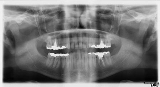
Mandible

Encyclopedia
The mandible pronunciation
(from Latin mandibula, "jawbone") or inferior maxillary bone forms the lower jaw
and holds the lower teeth
in place. The term "mandible" also refers to both the upper and lower sections of the beak
s of bird
s; in this case the "lower mandible" corresponds to the mandible of humans, while the "upper mandible" is functionally equivalent to the human maxilla
but mainly consists of the premaxilla
ry bones. Conversely, in bony fish for example, the lower jaw may be termed "lower maxilla".
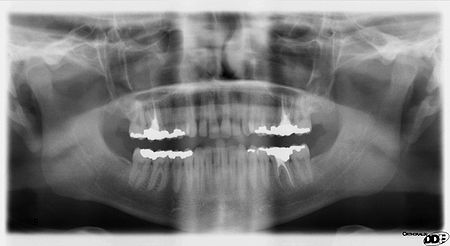 Inferior alveolar nerve
, branch of the mandibular division of Trigeminal (V) nerve, enters the mandibular foramen and runs forward in the mandibular canal, supplying sensation to the teeth. At the mental foramen the nerve divides into two terminal branches: incisive and mental nerves. The incisive nerve runs forward in the mandible and supplies the anterior teeth. The mental nerve exits the mental foramen and supplies sensation to the lower lip.
s at the temporomandibular joint
s.
injuries
involve mandibular fracture
. Mandibular fractures are often accompanied by a 'twin fracture' on the contralateral (opposite) side.
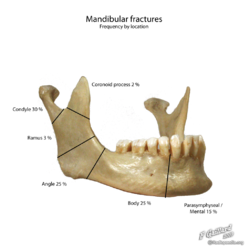
The mandible may be dislocated anteriorly (to the front) and inferiorly (downwards) but very rarely posteriorly (backwards).
Pronunciation
Pronunciation refers to the way a word or a language is spoken, or the manner in which someone utters a word. If one is said to have "correct pronunciation", then it refers to both within a particular dialect....
(from Latin mandibula, "jawbone") or inferior maxillary bone forms the lower jaw
Jaw
The jaw is any opposable articulated structure at the entrance of the mouth, typically used for grasping and manipulating food. The term jaws is also broadly applied to the whole of the structures constituting the vault of the mouth and serving to open and close it and is part of the body plan of...
and holds the lower teeth
Tooth
Teeth are small, calcified, whitish structures found in the jaws of many vertebrates that are used to break down food. Some animals, particularly carnivores, also use teeth for hunting or for defensive purposes. The roots of teeth are embedded in the Mandible bone or the Maxillary bone and are...
in place. The term "mandible" also refers to both the upper and lower sections of the beak
Beak
The beak, bill or rostrum is an external anatomical structure of birds which is used for eating and for grooming, manipulating objects, killing prey, fighting, probing for food, courtship and feeding young...
s of bird
Bird
Birds are feathered, winged, bipedal, endothermic , egg-laying, vertebrate animals. Around 10,000 living species and 188 families makes them the most speciose class of tetrapod vertebrates. They inhabit ecosystems across the globe, from the Arctic to the Antarctic. Extant birds range in size from...
s; in this case the "lower mandible" corresponds to the mandible of humans, while the "upper mandible" is functionally equivalent to the human maxilla
Maxilla
The maxilla is a fusion of two bones along the palatal fissure that form the upper jaw. This is similar to the mandible , which is also a fusion of two halves at the mental symphysis. Sometimes The maxilla (plural: maxillae) is a fusion of two bones along the palatal fissure that form the upper...
but mainly consists of the premaxilla
Premaxilla
The incisive bone is the portion of the maxilla adjacent to the incisors. It is a pair of small cranial bones at the very tip of the jaws of many animals, usually bearing teeth, but not always. They are connected to the maxilla and the nasals....
ry bones. Conversely, in bony fish for example, the lower jaw may be termed "lower maxilla".
Components
The mandible consists of:- a curved, horizontal portion, the body. (See body of mandibleBody of mandibleThe body of the mandible is curved somewhat like a horseshoe and has two surfaces and two borders.- External surface :The external surface is marked in the median line by a faint ridge, indicating the symphysis or line of junction of the two pieces of which the bone is composed at an early period...
). - two perpendicular portions, the rami, which unite with the ends of the body nearly at right angles. (See ramus mandibulaeRamus mandibulaeThe ramus of the mandible is quadrilateral in shape, and has two surfaces, four borders, and two processes.- Surfaces :...
) - Alveolar process, the tooth bearing area of the mandible (upper part of the body of the mandible)
- CondyleCondyloid processThe condyloid process is part of the mandible and is thicker than the coronoid, and consists of two portions: the condyle, and the constricted portion which supports it, the neck.-Condyle :...
, superior (upper) and posterior projection from the ramus, which makes the temporomandibular jointTemporomandibular jointThe temporomandibular joint is the joint of the jaw and is frequently referred to as TMJ. There are two TMJs, one on either side, working in unison. The name is derived from the two bones which form the joint: the upper temporal bone which is part of the cranium , and the lower jaw bone called the...
with the temporal boneTemporal boneThe temporal bones are situated at the sides and base of the skull, and lateral to the temporal lobes of the cerebrum.The temporal bone supports that part of the face known as the temple.-Parts:The temporal bone consists of four parts:* Squama temporalis... - Coronoid processCoronoid process of the mandibleThe mandible's coronoid process is a thin, triangular eminence, which is flattened from side to side and varies in shape and size....
, superior and anterior projection from the ramus. This provides attachment to the temporalis muscleTemporalis muscleThe temporal muscle is one of the muscles of mastication.-Structure:It arises from the temporal fossa and the deep part of temporal fascia...
Foramina (singular = foramen)
- Mandibular foramenMandibular foramenThe Mandibular foramen is an opening on the internal surface of the ramus for divisions of the mandibular vessels and nerve to pass.-Contents:...
, paired, in the inner (medial) aspect of the mandible, superior to the mandibular angle in the middle of the ramus. - Mental foramen, paired, lateral to the mental protuberance on the body of mandible.
Nerves
Inferior alveolar nerve
The inferior alveolar nerve is a branch of the mandibular nerve, which is itself the third branch of the trigeminal nerve .-Path:...
, branch of the mandibular division of Trigeminal (V) nerve, enters the mandibular foramen and runs forward in the mandibular canal, supplying sensation to the teeth. At the mental foramen the nerve divides into two terminal branches: incisive and mental nerves. The incisive nerve runs forward in the mandible and supplies the anterior teeth. The mental nerve exits the mental foramen and supplies sensation to the lower lip.
Articulations
The mandible articulates with the two temporal boneTemporal bone
The temporal bones are situated at the sides and base of the skull, and lateral to the temporal lobes of the cerebrum.The temporal bone supports that part of the face known as the temple.-Parts:The temporal bone consists of four parts:* Squama temporalis...
s at the temporomandibular joint
Temporomandibular joint
The temporomandibular joint is the joint of the jaw and is frequently referred to as TMJ. There are two TMJs, one on either side, working in unison. The name is derived from the two bones which form the joint: the upper temporal bone which is part of the cranium , and the lower jaw bone called the...
s.
Pathologies
One fifth of facialFace
The face is a central sense organ complex, for those animals that have one, normally on the ventral surface of the head, and can, depending on the definition in the human case, include the hair, forehead, eyebrow, eyelashes, eyes, nose, ears, cheeks, mouth, lips, philtrum, temple, teeth, skin, and...
injuries
Injury
-By cause:*Traumatic injury, a body wound or shock produced by sudden physical injury, as from violence or accident*Other injuries from external physical causes, such as radiation injury, burn injury or frostbite*Injury from infection...
involve mandibular fracture
Fracture
A fracture is the separation of an object or material into two, or more, pieces under the action of stress.The word fracture is often applied to bones of living creatures , or to crystals or crystalline materials, such as gemstones or metal...
. Mandibular fractures are often accompanied by a 'twin fracture' on the contralateral (opposite) side.
Etiology
- Motor vehicle accident (MVA) – 40%
- Assault – 40%
- Fall – 10%
- Sport – 5%
- Other – 5%
Location
- Condyle – 30%
- Angle – 25%
- Body – 25%
- Symphesis – 15%
- Ramus – 3%
- Coronoid process – 2%
The mandible may be dislocated anteriorly (to the front) and inferiorly (downwards) but very rarely posteriorly (backwards).
See also
- Bone terminology
- Terms for anatomical location
- Changes produced in the mandible by ageChanges produced in the mandible by agethumb|Fig. 1: At birth.thumb|Fig. 2: In childhood.thumb|Fig. 3: In the adult.thumb|Fig. 4: In old age. Side view of the mandible at different periods of life....
- Ossification of the mandibleOssification of the mandiblethumb|Figure 3: Mandible of human embryo 24 mm. long. Outer aspect.thumb|Figure 4: Mandible of human embryo 24 mm. long. Inner aspect.thumb|Figure 5: Mandible of human embryo 95 mm. long. Outer aspect. Nuclei of cartilage stippled....
- Oral and maxillofacial surgeryOral and maxillofacial surgeryOral and maxillofacial surgery is surgery to correct a wide spectrum of diseases, injuries and defects in the head, neck, face, jaws and the hard and soft tissues of the oral and maxillofacial region. It is an internationally recognized surgical specialty...
- Simian shelfSimian shelfThe simian shelf is a bony thickening on the front of the ape mandible. Its function is to reinforce the jaw, though it also has the effect of considerably reducing the movement of the tongue by restricting the area available for muscles....