

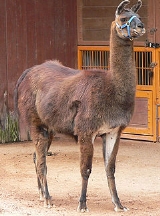
Ungulate

Encyclopedia
Ungulates are several groups of mammal
s, most of which use the tips of their toes, usually hoofed, to sustain their whole body weight while moving. They make up several orders
of mammals, of which six to eight survive. There is some dispute as to whether Ungulata is a cladistic (evolution-based) group, or merely a phenetic
group or folk taxon (similar, but not necessarily related), because not all ungulates appear as closely related as once believed. Ungulata was formerly considered an order which has since been split into:
As a descriptive term, "ungulate" normally excludes cetacea
ns, which are now known to share a common ancestor with Artiodactyla and form the clade
Cetartiodactyla
with them. Members of the orders Perissodactyla and Artiodactyla are called the 'true ungulates' to distinguish them from 'subungulates' (Paenungulata
) which include members from the afrotheria
n orders Proboscidea, Sirenia and Hyracoidea.
Commonly known examples of ungulates living today are the horse
, zebra
, donkey
, cattle
/bison
, rhinoceros
, camel
, hippopotamus
, tapir
, goat
, pig
, sheep, giraffe
, okapi
, moose
, elk
, deer
, antelope
, and gazelle
.
and early Eocene
(about 54 million years ago), rapidly spreading to a wide variety of species on numerous continents, and have developed in parallel since that time.
Although whales and dolphins (Cetacea
) do not possess most of the typical morphological characteristics of ungulates, recent discoveries indicate that they are descended from early artiodactyls, and thus are directly related to other even-toed ungulates such as cattle, with hippopotamus
es being their closest living relatives. As a result of these discoveries, the new order Cetartiodactyla
has been proposed to include the members of Artiodactyla and Cetacea
, to reflect their common ancestry; however, strictly speaking, this is merely a matter of nomenclature, since it is possible simply to recognize Cetacea as a subgroup of Artiodactyla.
Hyracoidea, Sirenia and Proboscidea comprise Paenungulata
. Aardvarks are also thought to be ungulates. Some recent studies link Tubulidentata with Paenungulata in Pseudoungulata
. Macroscelideans have been interpreted as pseudoungulates as well, based on dental as well as genetic evidence. Genetic studies indicate that these animals are not closely related to artiodactyls and perissodactyls; their closest relatives are afrosoricida
ns. Pseudungulata, Macroscelidea and Afrosoricida together make up Afrotheria
.
Ungulate groups represented in the fossil record include afrotherian embrithopods
and demostylians
, artiodactyl-related mesonychids, "condylarths" and various South American and Paleogene lineages.
 In addition to hooves, most ungulates have developed reduced canine teeth, bunodont molars
(molars with low, rounded cusps), and an astragalus
(one of the ankle bones at the end of the lower leg) with a short, robust head. Some completely lack upper incisors and instead have a dental pad
to assist in browsing.
In most modern ungulates, the radius
and ulna
are fused along the length of the forelimb; early ungulates, such as the arctocyonids did not share this unique skeletal structure. The fusion of the radius and ulna prevents an ungulate from rotating its forelimb. Since this skeletal structure has no specific function in ungulates, it is considered to be a homologous characteristic that ungulates share with other mammals. This trait would have been passed down from a common ancestor.
Ungulates diversified rapidly in the Eocene
, but are thought to date back as far as the late Cretaceous
. Most ungulates are herbivore
s, but a few are omnivore
s or even predators (mesonychids and whales).
and Pholidota rather than to Pseudungulata.
Pseudungulata is united with Afrosoricida
in the cohort or super-order Afrotheria
based on molecular and DNA analysis. This means they are not related to other ungulates.
The orders of the extinct South American ungulates, which arose when the continent was in isolation some time during the mid to late Paleocene
, are united in the super-order Meridiungulata
. They are thought by some to be unrelated to other ungulates. Instead, they may be united with Afrotheria and Xenarthra
in the supercohort Atlantogenata
.
Embrithopods, desmostylians and other related groups are seen as relatives of paenungulates, thus members of Afrotheria. Condylarths are, as a result, no longer seen as the ancestors of all ungulates. Instead, it is now believed condylarths are members of the cohort Laurasiatheria
. So it seems that, of all the ungulates, only Perissodactyla and Artiodactyla descended from condylarths—assuming that the animals lumped by scientists into Condylarthra over the years are even related to one another.
As a result of all this, the typical ungulate morphology appears to have originated independently three times: in Meridiungulata, Afrotheria and the "true" ungulates in Laurasiatheria. This is a great example of convergent evolution
. This idea has met with skepticism by some scientists, because of the lack of an obvious morphological basis for splitting the ungulates into so many unrelated clades.
Mammal
Mammals are members of a class of air-breathing vertebrate animals characterised by the possession of endothermy, hair, three middle ear bones, and mammary glands functional in mothers with young...
s, most of which use the tips of their toes, usually hoofed, to sustain their whole body weight while moving. They make up several orders
Order (biology)
In scientific classification used in biology, the order is# a taxonomic rank used in the classification of organisms. Other well-known ranks are life, domain, kingdom, phylum, class, family, genus, and species, with order fitting in between class and family...
of mammals, of which six to eight survive. There is some dispute as to whether Ungulata is a cladistic (evolution-based) group, or merely a phenetic
Phenetics
In biology, phenetics, also known as taximetrics, is an attempt to classify organisms based on overall similarity, usually in morphology or other observable traits, regardless of their phylogeny or evolutionary relation. It is closely related to numerical taxonomy which is concerned with the use of...
group or folk taxon (similar, but not necessarily related), because not all ungulates appear as closely related as once believed. Ungulata was formerly considered an order which has since been split into:
- Perissodactyla (odd-toed ungulates),
- Artiodactyla (even-toed ungulates),
- Tubulidentata (aardvarks),
- Hyracoidea (hyraxes),
- Sirenia (dugongs and manatees)SireniaSirenia is an order of fully aquatic, herbivorous mammals that inhabit swamps, rivers, estuaries, marine wetlands, and coastal marine waters. Four species are living, in two families and genera. These are the dugong and manatees...
, and - Proboscidea (elephants)ProboscideaProboscidea is a taxonomic order containing one living family, Elephantidae, and several extinct families. This order was first described by J. Illiger in 1881 and encompasses the trunked mammals...
.
As a descriptive term, "ungulate" normally excludes cetacea
Cetacea
The order Cetacea includes the marine mammals commonly known as whales, dolphins, and porpoises. Cetus is Latin and is used in biological names to mean "whale"; its original meaning, "large sea animal", was more general. It comes from Ancient Greek , meaning "whale" or "any huge fish or sea...
ns, which are now known to share a common ancestor with Artiodactyla and form the clade
Clade
A clade is a group consisting of a species and all its descendants. In the terms of biological systematics, a clade is a single "branch" on the "tree of life". The idea that such a "natural group" of organisms should be grouped together and given a taxonomic name is central to biological...
Cetartiodactyla
Cetartiodactyla
Cetartiodactyla is the clade in which whales and even-toed ungulates have currently been placed. The term was coined by merging the name for the two orders, Cetacea and Artiodactyla, into a single word. The term Cetartiodactyla reflects the idea that whales evolved within the artiodactyls...
with them. Members of the orders Perissodactyla and Artiodactyla are called the 'true ungulates' to distinguish them from 'subungulates' (Paenungulata
Paenungulata
Paenungulata is a taxon that groups some remarkable mammals, including three orders that are extant: Proboscidea , Sirenia , and Hyracoidea . At least two more orders are known only as fossils, namely Embrithopoda and Desmostylia...
) which include members from the afrotheria
Afrotheria
Afrotheria is a clade of mammals, the living members of which belong to groups from Africa or of African origin: golden moles, sengis , tenrecs, aardvarks, hyraxes, elephants and sea cows. The common ancestry of these animals was not recognized until the late 1990s...
n orders Proboscidea, Sirenia and Hyracoidea.
Commonly known examples of ungulates living today are the horse
Horse
The horse is one of two extant subspecies of Equus ferus, or the wild horse. It is a single-hooved mammal belonging to the taxonomic family Equidae. The horse has evolved over the past 45 to 55 million years from a small multi-toed creature into the large, single-toed animal of today...
, zebra
Zebra
Zebras are several species of African equids united by their distinctive black and white stripes. Their stripes come in different patterns unique to each individual. They are generally social animals that live in small harems to large herds...
, donkey
Donkey
The donkey or ass, Equus africanus asinus, is a domesticated member of the Equidae or horse family. The wild ancestor of the donkey is the African Wild Ass, E...
, cattle
Cattle
Cattle are the most common type of large domesticated ungulates. They are a prominent modern member of the subfamily Bovinae, are the most widespread species of the genus Bos, and are most commonly classified collectively as Bos primigenius...
/bison
Bison
Members of the genus Bison are large, even-toed ungulates within the subfamily Bovinae. Two extant and four extinct species are recognized...
, rhinoceros
Rhinoceros
Rhinoceros , also known as rhino, is a group of five extant species of odd-toed ungulates in the family Rhinocerotidae. Two of these species are native to Africa and three to southern Asia....
, camel
Camel
A camel is an even-toed ungulate within the genus Camelus, bearing distinctive fatty deposits known as humps on its back. There are two species of camels: the dromedary or Arabian camel has a single hump, and the bactrian has two humps. Dromedaries are native to the dry desert areas of West Asia,...
, hippopotamus
Hippopotamus
The hippopotamus , or hippo, from the ancient Greek for "river horse" , is a large, mostly herbivorous mammal in sub-Saharan Africa, and one of only two extant species in the family Hippopotamidae After the elephant and rhinoceros, the hippopotamus is the third largest land mammal and the heaviest...
, tapir
Tapir
A Tapir is a large browsing mammal, similar in shape to a pig, with a short, prehensile snout. Tapirs inhabit jungle and forest regions of South America, Central America, and Southeast Asia. There are four species of Tapirs: the Brazilian Tapir, the Malayan Tapir, Baird's Tapir and the Mountain...
, goat
Goat
The domestic goat is a subspecies of goat domesticated from the wild goat of southwest Asia and Eastern Europe. The goat is a member of the Bovidae family and is closely related to the sheep as both are in the goat-antelope subfamily Caprinae. There are over three hundred distinct breeds of...
, pig
Pig
A pig is any of the animals in the genus Sus, within the Suidae family of even-toed ungulates. Pigs include the domestic pig, its ancestor the wild boar, and several other wild relatives...
, sheep, giraffe
Giraffe
The giraffe is an African even-toed ungulate mammal, the tallest of all extant land-living animal species, and the largest ruminant...
, okapi
Okapi
The okapi , Okapia johnstoni, is a giraffid artiodactyl mammal native to the Ituri Rainforest, located in the northeast of the Democratic Republic of the Congo, in Central Africa...
, moose
Moose
The moose or Eurasian elk is the largest extant species in the deer family. Moose are distinguished by the palmate antlers of the males; other members of the family have antlers with a dendritic configuration...
, elk
Elk
The Elk is the large deer, also called Cervus canadensis or wapiti, of North America and eastern Asia.Elk may also refer to:Other antlered mammals:...
, deer
Deer
Deer are the ruminant mammals forming the family Cervidae. Species in the Cervidae family include white-tailed deer, elk, moose, red deer, reindeer, fallow deer, roe deer and chital. Male deer of all species and female reindeer grow and shed new antlers each year...
, antelope
Antelope
Antelope is a term referring to many even-toed ungulate species indigenous to various regions in Africa and Eurasia. Antelopes comprise a miscellaneous group within the family Bovidae, encompassing those old-world species that are neither cattle, sheep, buffalo, bison, nor goats...
, and gazelle
Gazelle
A gazelle is any of many antelope species in the genus Gazella, or formerly considered to belong to it. Six species are included in two genera, Eudorcas and Nanger, which were formerly considered subgenera...
.
Relationships
Perissodactyla and Artiodactyla comprise the largest portion of ungulates, and also include the majority of large land mammals. These two groups first appeared during the late PaleocenePaleocene
The Paleocene or Palaeocene, the "early recent", is a geologic epoch that lasted from about . It is the first epoch of the Palaeogene Period in the modern Cenozoic Era...
and early Eocene
Eocene
The Eocene Epoch, lasting from about 56 to 34 million years ago , is a major division of the geologic timescale and the second epoch of the Paleogene Period in the Cenozoic Era. The Eocene spans the time from the end of the Palaeocene Epoch to the beginning of the Oligocene Epoch. The start of the...
(about 54 million years ago), rapidly spreading to a wide variety of species on numerous continents, and have developed in parallel since that time.
Although whales and dolphins (Cetacea
Cetacea
The order Cetacea includes the marine mammals commonly known as whales, dolphins, and porpoises. Cetus is Latin and is used in biological names to mean "whale"; its original meaning, "large sea animal", was more general. It comes from Ancient Greek , meaning "whale" or "any huge fish or sea...
) do not possess most of the typical morphological characteristics of ungulates, recent discoveries indicate that they are descended from early artiodactyls, and thus are directly related to other even-toed ungulates such as cattle, with hippopotamus
Hippopotamus
The hippopotamus , or hippo, from the ancient Greek for "river horse" , is a large, mostly herbivorous mammal in sub-Saharan Africa, and one of only two extant species in the family Hippopotamidae After the elephant and rhinoceros, the hippopotamus is the third largest land mammal and the heaviest...
es being their closest living relatives. As a result of these discoveries, the new order Cetartiodactyla
Cetartiodactyla
Cetartiodactyla is the clade in which whales and even-toed ungulates have currently been placed. The term was coined by merging the name for the two orders, Cetacea and Artiodactyla, into a single word. The term Cetartiodactyla reflects the idea that whales evolved within the artiodactyls...
has been proposed to include the members of Artiodactyla and Cetacea
Cetacea
The order Cetacea includes the marine mammals commonly known as whales, dolphins, and porpoises. Cetus is Latin and is used in biological names to mean "whale"; its original meaning, "large sea animal", was more general. It comes from Ancient Greek , meaning "whale" or "any huge fish or sea...
, to reflect their common ancestry; however, strictly speaking, this is merely a matter of nomenclature, since it is possible simply to recognize Cetacea as a subgroup of Artiodactyla.
Hyracoidea, Sirenia and Proboscidea comprise Paenungulata
Paenungulata
Paenungulata is a taxon that groups some remarkable mammals, including three orders that are extant: Proboscidea , Sirenia , and Hyracoidea . At least two more orders are known only as fossils, namely Embrithopoda and Desmostylia...
. Aardvarks are also thought to be ungulates. Some recent studies link Tubulidentata with Paenungulata in Pseudoungulata
Pseudoungulata
Pseudoungulata, or "false hoofed mammals", is a possible clade made up of two subgroups, aardvarks and paenungulates . Before this group was proposed, it was thought that aardvarks were more closely related to xenarthrans...
. Macroscelideans have been interpreted as pseudoungulates as well, based on dental as well as genetic evidence. Genetic studies indicate that these animals are not closely related to artiodactyls and perissodactyls; their closest relatives are afrosoricida
Afrosoricida
The order Afrosoricida contains the golden moles of southern Africa and the tenrecs of Madagascar and Africa, two families of small mammals that have traditionally been considered to be a part of the order Insectivora.Some biologists use Tenrecomorpha as the name for the tenrec-golden mole clade,...
ns. Pseudungulata, Macroscelidea and Afrosoricida together make up Afrotheria
Afrotheria
Afrotheria is a clade of mammals, the living members of which belong to groups from Africa or of African origin: golden moles, sengis , tenrecs, aardvarks, hyraxes, elephants and sea cows. The common ancestry of these animals was not recognized until the late 1990s...
.
Ungulate groups represented in the fossil record include afrotherian embrithopods
Embrithopoda
Embrithopoda is an extinct order of mammals which first appeared in the fossil record during the late Eocene and then died out during the Oligocene....
and demostylians
Desmostylia
Desmostylia is an extinct order of marine mammals which existed from the Arikareean age of the late Oligocene epoch to the Tortonian age of the late Miocene epoch . Their dental and skeletal form suggests desmostylians were amphibious herbivores dependent on littoral habitats...
, artiodactyl-related mesonychids, "condylarths" and various South American and Paleogene lineages.
Molar (tooth)
Molars are the rearmost and most complicated kind of tooth in most mammals. In many mammals they grind food; hence the Latin name mola, "millstone"....
(molars with low, rounded cusps), and an astragalus
Talus bone
-External links:* *...
(one of the ankle bones at the end of the lower leg) with a short, robust head. Some completely lack upper incisors and instead have a dental pad
Dental pad
The dental pad or browsing pad is a feature of ruminant dental anatomy that results from a lack of upper incisors and helps them gather large quantities of grass and other plant matter. In cattle, the tongue is used to grasp food and pinch it off between the dental pad and the lower incisors...
to assist in browsing.
In most modern ungulates, the radius
Radius (bone)
The radius is one of the two large bones of the forearm, the other being the ulna. It extends from the lateral side of the elbow to the thumb side of the wrist and runs parallel to the ulna, which exceeds it in length and size. It is a long bone, prism-shaped and slightly curved longitudinally...
and ulna
Ulna
The ulna is one of the two long bones in the forearm, the other being the radius. It is prismatic in form and runs parallel to the radius, which is shorter and smaller. In anatomical position The ulna is one of the two long bones in the forearm, the other being the radius. It is prismatic in form...
are fused along the length of the forelimb; early ungulates, such as the arctocyonids did not share this unique skeletal structure. The fusion of the radius and ulna prevents an ungulate from rotating its forelimb. Since this skeletal structure has no specific function in ungulates, it is considered to be a homologous characteristic that ungulates share with other mammals. This trait would have been passed down from a common ancestor.
Ungulates diversified rapidly in the Eocene
Eocene
The Eocene Epoch, lasting from about 56 to 34 million years ago , is a major division of the geologic timescale and the second epoch of the Paleogene Period in the Cenozoic Era. The Eocene spans the time from the end of the Palaeocene Epoch to the beginning of the Oligocene Epoch. The start of the...
, but are thought to date back as far as the late Cretaceous
Cretaceous
The Cretaceous , derived from the Latin "creta" , usually abbreviated K for its German translation Kreide , is a geologic period and system from circa to million years ago. In the geologic timescale, the Cretaceous follows the Jurassic period and is followed by the Paleogene period of the...
. Most ungulates are herbivore
Herbivore
Herbivores are organisms that are anatomically and physiologically adapted to eat plant-based foods. Herbivory is a form of consumption in which an organism principally eats autotrophs such as plants, algae and photosynthesizing bacteria. More generally, organisms that feed on autotrophs in...
s, but a few are omnivore
Omnivore
Omnivores are species that eat both plants and animals as their primary food source...
s or even predators (mesonychids and whales).
Recent developments
That these groups of mammals are most closely related to each other has been questioned on anatomical and genetic grounds. Molecular phylogenetic studies have suggested that Perissodactyla and Cetartiodactyla are closest to CarnivoraCarnivora
The diverse order Carnivora |Latin]] carō "flesh", + vorāre "to devour") includes over 260 species of placental mammals. Its members are formally referred to as carnivorans, while the word "carnivore" can refer to any meat-eating animal...
and Pholidota rather than to Pseudungulata.
Pseudungulata is united with Afrosoricida
Afrosoricida
The order Afrosoricida contains the golden moles of southern Africa and the tenrecs of Madagascar and Africa, two families of small mammals that have traditionally been considered to be a part of the order Insectivora.Some biologists use Tenrecomorpha as the name for the tenrec-golden mole clade,...
in the cohort or super-order Afrotheria
Afrotheria
Afrotheria is a clade of mammals, the living members of which belong to groups from Africa or of African origin: golden moles, sengis , tenrecs, aardvarks, hyraxes, elephants and sea cows. The common ancestry of these animals was not recognized until the late 1990s...
based on molecular and DNA analysis. This means they are not related to other ungulates.
The orders of the extinct South American ungulates, which arose when the continent was in isolation some time during the mid to late Paleocene
Paleocene
The Paleocene or Palaeocene, the "early recent", is a geologic epoch that lasted from about . It is the first epoch of the Palaeogene Period in the modern Cenozoic Era...
, are united in the super-order Meridiungulata
Meridiungulata
Meridiungulata is an extinct clade with the rank of cohort or super-order, containing the South-American ungulates: Pyrotheria , Astrapotheria, Notoungulata and Litopterna...
. They are thought by some to be unrelated to other ungulates. Instead, they may be united with Afrotheria and Xenarthra
Xenarthra
The superorder Xenarthra is a group of placental mammals , existent today only in the Americas and represented by anteaters, tree sloths, and armadillos. The origins of the order can be traced back as far as the Paleogene in South America...
in the supercohort Atlantogenata
Atlantogenata
Atlantogenata is a proposed clade of mammals containing the cohorts or super-orders Afrotheria, Xenarthra and Meridiungulata. These groups originated and radiated in the South American and African continents, presumably in the Cretaceous. Together with Boreoeutheria it makes up Eutheria...
.
Embrithopods, desmostylians and other related groups are seen as relatives of paenungulates, thus members of Afrotheria. Condylarths are, as a result, no longer seen as the ancestors of all ungulates. Instead, it is now believed condylarths are members of the cohort Laurasiatheria
Laurasiatheria
Laurasiatheria is a large group of placental mammals believed to have originated on the northern supercontinent of Laurasia. It includes shrews, hedgehogs, pangolins, bats, whales, most hoofed mammals, and carnivorans, among others....
. So it seems that, of all the ungulates, only Perissodactyla and Artiodactyla descended from condylarths—assuming that the animals lumped by scientists into Condylarthra over the years are even related to one another.
As a result of all this, the typical ungulate morphology appears to have originated independently three times: in Meridiungulata, Afrotheria and the "true" ungulates in Laurasiatheria. This is a great example of convergent evolution
Convergent evolution
Convergent evolution describes the acquisition of the same biological trait in unrelated lineages.The wing is a classic example of convergent evolution in action. Although their last common ancestor did not have wings, both birds and bats do, and are capable of powered flight. The wings are...
. This idea has met with skepticism by some scientists, because of the lack of an obvious morphological basis for splitting the ungulates into so many unrelated clades.
External links
- Your Guide to the World's Hoofed Mammals - The Ultimate Ungulate Page