


Systema Naturae

Encyclopedia
The book was one of the major works of the Swedish
botanist, zoologist and physician Carolus Linnaeus
. The first edition was published in 1735. The full title of the 10th edition, which was certainly the most important one, was or translated: "System of nature through the three kingdoms of nature, according to classes, orders, genera and species, with characters, differences, synonyms, places".
The tenth edition of this book
is considered the starting point of zoological nomenclature. In 1766–1768 Linnaeus published the much enhanced 12th edition
, the last under his authorship. Another again enhanced work in the same style and entitled "" was published by Johann Friedrich Gmelin
between 1788 and 1793. Since at least the early 1900s zoologists commonly recognized this as the last edition belonging to this series. It was also officially regarded by the International Commission on Zoological Nomenclature
in Opinion 296 (26 Oct 1954) as the 13th edition of Systema Naturae.
. As customary for the scientific literature
of its day, the book was published in Latin
. In it, he outlines his ideas for the hierarchical classification of the natural world, dividing it into the animal kingdom
(), the plant kingdom () and the "mineral kingdom
" ().
At the time of Linnaeus only about 10,000 species of organisms were recognised by science, about 6,000 species of plants and 4,236 species of animals. Even in 1753 he believed that the number of species of plants in the whole world would hardly reach 10,000; in his whole career he named about 7,700 species of flowering plants.
The classification of the plant kingdom in the book was not one meant to reflect the actual order of nature but to organize it in a fashion convenient for humans: it followed Linnaeus' new sexual system where species with the same number of stamen
s were treated in the same group. Linnaeus believed that he was classifying God
's creation and was not trying to express any deeper relationships. He is frequently quoted to have said God created, Linnaeus organized. The classification of animals was more natural. For instance, human
s were for the first time placed together with other primate
s, as Anthropomorpha
.
In view of the popularity of the work, Linnaeus kept publishing new and ever-expanding editions, growing from eleven very large pages in the first edition (1735) to 2,400 pages in the twelfth edition
(1766–1768). Also, as the work progressed he made changes: in the first edition whale
s were classified as fish
es, following the work of Linnaeus' friend and "father of ichthyology
" Peter Artedi
; in the 10th edition, published in 1758, whale
s were moved into the mammal
class. In this same edition he introduced two part names (see binomen
) for animal species, something he had done for plant species (see binary name) in the 1753 publication of . The system eventually developed into modern Linnaean taxonomy
, a hierarchically organized biological classification
.
, class
, order
, genus
and species
. While species and genus was seen as God-given (or "natural"), the three higher levels were seen by Linnaeus as constructs. The concept behind the set ranks being applied to all groups was to make a system that was easy to remember and navigate in, a task in which he must be said to have succeeded.
The work of Linnaeus had a huge impact on science; it was indispensable as a foundation for biological nomenclature, now regulated by the Nomenclature Codes
. Two of his works, the first edition of the (1753) for plants and the tenth edition of the Systema Naturæ
(1758) are accepted among the starting points of nomenclature; most of his names for species and genera were published at very early dates and thus take priority over those of others (in zoology there is one exception, which is a monograph on Swedish spiders , published by Carl Clerck
in 1757, the names established therein take priority over the Linnean names). However, the impact he had on science was not because of the value of his taxonomy. His taxonomy was not particularly notable, but Linnaeus' talent for attracting skillful young students and sending them abroad to collect made his works far more influential than that of his contemporaries. At the close of the 18th century, his system had effectively become the standard system for biological classification.
.png) Only in the Animal Kingdom is the higher taxonomy of Linnaeus still more or less recognizable and some of these names are still in use, but usually not quite for the same groups as used by Linnaeus. He divided the Animal Kingdom into six classes; in the tenth edition (1758), these were:
Only in the Animal Kingdom is the higher taxonomy of Linnaeus still more or less recognizable and some of these names are still in use, but usually not quite for the same groups as used by Linnaeus. He divided the Animal Kingdom into six classes; in the tenth edition (1758), these were:
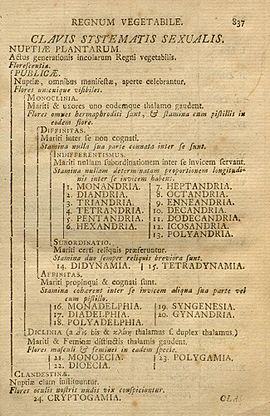 The Linnaean classes for plants, in the Sexual System, were:
The dates of publication for Gmelin's edition were the following:
Sweden
Sweden , officially the Kingdom of Sweden , is a Nordic country on the Scandinavian Peninsula in Northern Europe. Sweden borders with Norway and Finland and is connected to Denmark by a bridge-tunnel across the Öresund....
botanist, zoologist and physician Carolus Linnaeus
Carolus Linnaeus
Carl Linnaeus , also known after his ennoblement as , was a Swedish botanist, physician, and zoologist, who laid the foundations for the modern scheme of binomial nomenclature. He is known as the father of modern taxonomy, and is also considered one of the fathers of modern ecology...
. The first edition was published in 1735. The full title of the 10th edition, which was certainly the most important one, was or translated: "System of nature through the three kingdoms of nature, according to classes, orders, genera and species, with characters, differences, synonyms, places".
The tenth edition of this book
10th edition of Systema Naturae
The 10th edition of Systema Naturae was a book written by Carl Linnaeus and published in two volumes in 1758 and 1759, which marks the starting point of zoological nomenclature...
is considered the starting point of zoological nomenclature. In 1766–1768 Linnaeus published the much enhanced 12th edition
12th edition of Systema Naturae
The 12th edition of was the last edition of to be overseen by its author, Carl Linnaeus. It was published in three volumes, with parts appearing from 1766 to 1768...
, the last under his authorship. Another again enhanced work in the same style and entitled "" was published by Johann Friedrich Gmelin
Johann Friedrich Gmelin
Johann Friedrich Gmelin was a German naturalist, botanist, entomologist, herpetologist and malacologist.- Education :Johann Friedrich Gmelin was born as the eldest son of Philipp Friedrich Gmelin in 1748 in Tübingen...
between 1788 and 1793. Since at least the early 1900s zoologists commonly recognized this as the last edition belonging to this series. It was also officially regarded by the International Commission on Zoological Nomenclature
International Commission on Zoological Nomenclature
The International Commission on Zoological Nomenclature is an organization dedicated to "achieving stability and sense in the scientific naming of animals". Founded in 1895, it currently comprises 28 members from 20 countries, mainly practicing zoological taxonomists...
in Opinion 296 (26 Oct 1954) as the 13th edition of Systema Naturae.
Overview
Linnaeus (later known as "Carl von Linné", after his ennoblement in 1761) published the first edition of in the year 1735, during his stay in the NetherlandsNetherlands
The Netherlands is a constituent country of the Kingdom of the Netherlands, located mainly in North-West Europe and with several islands in the Caribbean. Mainland Netherlands borders the North Sea to the north and west, Belgium to the south, and Germany to the east, and shares maritime borders...
. As customary for the scientific literature
Scientific literature
Scientific literature comprises scientific publications that report original empirical and theoretical work in the natural and social sciences, and within a scientific field is often abbreviated as the literature. Academic publishing is the process of placing the results of one's research into the...
of its day, the book was published in Latin
Latin
Latin is an Italic language originally spoken in Latium and Ancient Rome. It, along with most European languages, is a descendant of the ancient Proto-Indo-European language. Although it is considered a dead language, a number of scholars and members of the Christian clergy speak it fluently, and...
. In it, he outlines his ideas for the hierarchical classification of the natural world, dividing it into the animal kingdom
Animal
Animals are a major group of multicellular, eukaryotic organisms of the kingdom Animalia or Metazoa. Their body plan eventually becomes fixed as they develop, although some undergo a process of metamorphosis later on in their life. Most animals are motile, meaning they can move spontaneously and...
(), the plant kingdom () and the "mineral kingdom
Mineral
A mineral is a naturally occurring solid chemical substance formed through biogeochemical processes, having characteristic chemical composition, highly ordered atomic structure, and specific physical properties. By comparison, a rock is an aggregate of minerals and/or mineraloids and does not...
" ().
At the time of Linnaeus only about 10,000 species of organisms were recognised by science, about 6,000 species of plants and 4,236 species of animals. Even in 1753 he believed that the number of species of plants in the whole world would hardly reach 10,000; in his whole career he named about 7,700 species of flowering plants.
The classification of the plant kingdom in the book was not one meant to reflect the actual order of nature but to organize it in a fashion convenient for humans: it followed Linnaeus' new sexual system where species with the same number of stamen
Stamen
The stamen is the pollen producing reproductive organ of a flower...
s were treated in the same group. Linnaeus believed that he was classifying God
God
God is the English name given to a singular being in theistic and deistic religions who is either the sole deity in monotheism, or a single deity in polytheism....
's creation and was not trying to express any deeper relationships. He is frequently quoted to have said God created, Linnaeus organized. The classification of animals was more natural. For instance, human
Human
Humans are the only living species in the Homo genus...
s were for the first time placed together with other primate
Primate
A primate is a mammal of the order Primates , which contains prosimians and simians. Primates arose from ancestors that lived in the trees of tropical forests; many primate characteristics represent adaptations to life in this challenging three-dimensional environment...
s, as Anthropomorpha
Anthropomorpha
Anthropomorpha is a defunct taxon which contained the manlike, or anthropoid, apes.The order was established by Carl Linnaeus in the first edition of his book Systema Naturae for genera Homo , Simia and Bradypus...
.
In view of the popularity of the work, Linnaeus kept publishing new and ever-expanding editions, growing from eleven very large pages in the first edition (1735) to 2,400 pages in the twelfth edition
12th edition of Systema Naturae
The 12th edition of was the last edition of to be overseen by its author, Carl Linnaeus. It was published in three volumes, with parts appearing from 1766 to 1768...
(1766–1768). Also, as the work progressed he made changes: in the first edition whale
Whale
Whale is the common name for various marine mammals of the order Cetacea. The term whale sometimes refers to all cetaceans, but more often it excludes dolphins and porpoises, which belong to suborder Odontoceti . This suborder also includes the sperm whale, killer whale, pilot whale, and beluga...
s were classified as fish
Fish
Fish are a paraphyletic group of organisms that consist of all gill-bearing aquatic vertebrate animals that lack limbs with digits. Included in this definition are the living hagfish, lampreys, and cartilaginous and bony fish, as well as various extinct related groups...
es, following the work of Linnaeus' friend and "father of ichthyology
Ichthyology
Ichthyology is the branch of zoology devoted to the study of fish. This includes skeletal fish , cartilaginous fish , and jawless fish...
" Peter Artedi
Peter Artedi
Peter Artedi or Petrus Arctaedius was a Swedish naturalist and is known as the "father of Ichthyology."...
; in the 10th edition, published in 1758, whale
Whale
Whale is the common name for various marine mammals of the order Cetacea. The term whale sometimes refers to all cetaceans, but more often it excludes dolphins and porpoises, which belong to suborder Odontoceti . This suborder also includes the sperm whale, killer whale, pilot whale, and beluga...
s were moved into the mammal
Mammal
Mammals are members of a class of air-breathing vertebrate animals characterised by the possession of endothermy, hair, three middle ear bones, and mammary glands functional in mothers with young...
class. In this same edition he introduced two part names (see binomen
Binomen
In zoological nomenclature, a binomen , is the two-part name of a species. The term was introduced in 1953, abolishing the previously used "binomial name" . A binomen consists of a generic name and a specific epithet...
) for animal species, something he had done for plant species (see binary name) in the 1753 publication of . The system eventually developed into modern Linnaean taxonomy
Linnaean taxonomy
Linnaean taxonomy can mean either of two related concepts:# the particular form of biological classification set up by Carl Linnaeus, as set forth in his Systema Naturæ and subsequent works...
, a hierarchically organized biological classification
Biological classification
Biological classification, or scientific classification in biology, is a method to group and categorize organisms by biological type, such as genus or species. Biological classification is part of scientific taxonomy....
.
Taxonomy
In his , Linnaeus established three kingdoms, namely , and . This approach, the Animal, Vegetable and Mineral Kingdoms, survives until today in the popular mind, notably in the form of parlour games: "Is it animal, vegetable or mineral?". The classification was based on 5 levels: KingdomKingdom (biology)
In biology, kingdom is a taxonomic rank, which is either the highest rank or in the more recent three-domain system, the rank below domain. Kingdoms are divided into smaller groups called phyla or divisions in botany...
, class
Class (biology)
In biological classification, class is* a taxonomic rank. Other well-known ranks are life, domain, kingdom, phylum, order, family, genus, and species, with class fitting between phylum and order...
, order
Order (biology)
In scientific classification used in biology, the order is# a taxonomic rank used in the classification of organisms. Other well-known ranks are life, domain, kingdom, phylum, class, family, genus, and species, with order fitting in between class and family...
, genus
Genus
In biology, a genus is a low-level taxonomic rank used in the biological classification of living and fossil organisms, which is an example of definition by genus and differentia...
and species
Species
In biology, a species is one of the basic units of biological classification and a taxonomic rank. A species is often defined as a group of organisms capable of interbreeding and producing fertile offspring. While in many cases this definition is adequate, more precise or differing measures are...
. While species and genus was seen as God-given (or "natural"), the three higher levels were seen by Linnaeus as constructs. The concept behind the set ranks being applied to all groups was to make a system that was easy to remember and navigate in, a task in which he must be said to have succeeded.
The work of Linnaeus had a huge impact on science; it was indispensable as a foundation for biological nomenclature, now regulated by the Nomenclature Codes
Nomenclature Codes
Nomenclature codes or codes of nomenclature are the various rulebooks that govern biological taxonomic nomenclature, each in their own broad field of organisms...
. Two of his works, the first edition of the (1753) for plants and the tenth edition of the Systema Naturæ
10th edition of Systema Naturae
The 10th edition of Systema Naturae was a book written by Carl Linnaeus and published in two volumes in 1758 and 1759, which marks the starting point of zoological nomenclature...
(1758) are accepted among the starting points of nomenclature; most of his names for species and genera were published at very early dates and thus take priority over those of others (in zoology there is one exception, which is a monograph on Swedish spiders , published by Carl Clerck
Carl Alexander Clerck
Carl Alexander Clerck was a Swedish entomologist and arachnologist.Clerck came from a family in the petty nobility and entered the University of Uppsala in 1726. Little is known of his studies; although a contemporary of Linnaeus, it is unknown whether he had any contact with him during his time...
in 1757, the names established therein take priority over the Linnean names). However, the impact he had on science was not because of the value of his taxonomy. His taxonomy was not particularly notable, but Linnaeus' talent for attracting skillful young students and sending them abroad to collect made his works far more influential than that of his contemporaries. At the close of the 18th century, his system had effectively become the standard system for biological classification.
The Animal Kingdom
- MammaliaMammalia in the 10th edition of Systema NaturaeIn the 10th edition of Systema Naturae, Carl Linnaeus described the Mammalia as:Animals that suckle their young by means of lactiferous teats. In external and internal structure they resemble man: most of them are quadrupeds; and with man, their natural enemy, inhabit the surface of the Earth...
comprised the mammalMammalMammals are members of a class of air-breathing vertebrate animals characterised by the possession of endothermy, hair, three middle ear bones, and mammary glands functional in mothers with young...
s. In the first edition, whalesCetaceaThe order Cetacea includes the marine mammals commonly known as whales, dolphins, and porpoises. Cetus is Latin and is used in biological names to mean "whale"; its original meaning, "large sea animal", was more general. It comes from Ancient Greek , meaning "whale" or "any huge fish or sea...
and the West Indian ManateeWest Indian ManateeThe West Indian Manatee is a manatee, and the largest surviving member of the aquatic mammal order Sirenia . The West Indian Manatee, Trichechus manatus, is a species distinct from the Amazonian Manatee, T. inunguis, and the West African Manatee, T. senegalensis...
were classified among the fishes. - AvesAves in the 10th edition of Systema NaturaeIn the 10th edition of Systema Naturae, Carl Linnaeus listed the 564 species of bird from around the world which were known to him at the time. There are now believed to be around 10,000 extant species...
comprised the birdBirdBirds are feathered, winged, bipedal, endothermic , egg-laying, vertebrate animals. Around 10,000 living species and 188 families makes them the most speciose class of tetrapod vertebrates. They inhabit ecosystems across the globe, from the Arctic to the Antarctic. Extant birds range in size from...
s. Linnaeus was the first to remove batBatBats are mammals of the order Chiroptera "hand" and pteron "wing") whose forelimbs form webbed wings, making them the only mammals naturally capable of true and sustained flight. By contrast, other mammals said to fly, such as flying squirrels, gliding possums, and colugos, glide rather than fly,...
s from the birds and classify them under mammals. - AmphibiaAmphibia in the 10th edition of Systema NaturaeIn the 10th edition of Systema Naturae, Carl Linnaeus described the Amphibia as:Animals that are distinguished by a body cold and generally naked; stern and expressive countenance; harsh voice; mostly lurid color; filthy odor; a few are furnished with a horrid poison; all have cartilaginous bones,...
comprised amphibianAmphibianAmphibians , are a class of vertebrate animals including animals such as toads, frogs, caecilians, and salamanders. They are characterized as non-amniote ectothermic tetrapods...
s, reptileReptileReptiles are members of a class of air-breathing, ectothermic vertebrates which are characterized by laying shelled eggs , and having skin covered in scales and/or scutes. They are tetrapods, either having four limbs or being descended from four-limbed ancestors...
s, and assorted fishes that are not of OsteichthyesOsteichthyesOsteichthyes , also called bony fish, are a taxonomic group of fish that have bony, as opposed to cartilaginous, skeletons. The vast majority of fish are osteichthyes, which is an extremely diverse and abundant group consisting of over 29,000 species...
. - PiscesPisces in the 10th edition of Systema NaturaeIn the 10th edition of Systema Naturae, Carl Linnaeus described the Pisces as:Always inhabiting the waters; are swift in their motion and voracious in their appetites. They breathe by means of gills, which are generally united by a bony arch; swim by means of radiate fins, and are mostly covered...
comprised the bony fishesOsteichthyesOsteichthyes , also called bony fish, are a taxonomic group of fish that have bony, as opposed to cartilaginous, skeletons. The vast majority of fish are osteichthyes, which is an extremely diverse and abundant group consisting of over 29,000 species...
. These included the spiny-finned fishes (PerciformesPerciformesThe Perciformes, also called the Percomorphi or Acanthopteri, is one of the largest orders of vertebrates, containing about 40% of all bony fish. Perciformes means perch-like. They belong to the class of ray-finned fish and comprise over 7,000 species found in almost all aquatic environments...
) as a separate order. - InsectaInsecta in the 10th edition of Systema NaturaeIn the 10th edition of Systema Naturae, Carl Linnaeus classified the arthropods, including insects, arachnids and crustaceans, among his class "Insecta"...
comprised all arthropodArthropodAn arthropod is an invertebrate animal having an exoskeleton , a segmented body, and jointed appendages. Arthropods are members of the phylum Arthropoda , and include the insects, arachnids, crustaceans, and others...
s. CrustaceanCrustaceanCrustaceans form a very large group of arthropods, usually treated as a subphylum, which includes such familiar animals as crabs, lobsters, crayfish, shrimp, krill and barnacles. The 50,000 described species range in size from Stygotantulus stocki at , to the Japanese spider crab with a leg span...
s, arachnidArachnidArachnids are a class of joint-legged invertebrate animals in the subphylum Chelicerata. All arachnids have eight legs, although in some species the front pair may convert to a sensory function. The term is derived from the Greek words , meaning "spider".Almost all extant arachnids are terrestrial...
s & myriapods were included as the order "Aptera". - VermesVermes in the 10th edition of Systema NaturaeIn 1758, in the 10th edition of Systema Naturae, the Swedish scientist and taxonomist Carl Linnaeus described the class "Vermes" as:Animals of slow motion, soft substance, able to increase their bulk and restore parts which have been destroyed, extremely tenatious of life, and the inhabitants of...
comprised the remaining invertebrateInvertebrateAn invertebrate is an animal without a backbone. The group includes 97% of all animal species – all animals except those in the chordate subphylum Vertebrata .Invertebrates form a paraphyletic group...
s, roughly divided into "worms", molluscsMolluscaThe Mollusca , common name molluscs or mollusksSpelled mollusks in the USA, see reasons given in Rosenberg's ; for the spelling mollusc see the reasons given by , is a large phylum of invertebrate animals. There are around 85,000 recognized extant species of molluscs. Mollusca is the largest...
and hard-shelled organisms like echinodermEchinodermEchinoderms are a phylum of marine animals. Echinoderms are found at every ocean depth, from the intertidal zone to the abyssal zone....
s.
The Plant Kingdom
His orders and classes of plants, according to his , were never intended to represent natural groups (as opposed to his in his ) but only for use in identification. They were used in that sense well into the nineteenth century.- Classis 1. Monandria
- Classis 2. Diandria
- Classis 3. Triandria
- Classis 4. Tetrandria
- Classis 5. Pentandria
- Classis 6. Hexandria
- Classis 7. Heptandria
- Classis 8. Octandria
- Classis 9. Enneandria
- Classis 10. Decandria
- Classis 11. Dodecandria
- Classis 12. Icosandria
- Classis 13. Polyandra
- Classis 14. Didynamia
- Classis 15. Tetradynamia
- Classis 16. Monadelphia
- Classis 17. Diadelphia
- Classis 18. Polyadelphia
- Classis 19. Syngenesia
- Classis 20. Gynandria
- Classis 21. Monoecia
- Classis 22. Dioecia
- Classis 23. Polygamia
- Classis 24. Cryptogamia
The Mineral Kingdoms
His taxonomy of minerals has dropped long since from use. In the tenth edition, 1758, of the , the Linnaean classes were:- Classis 1. Petræ (rocksRock (geology)In geology, rock or stone is a naturally occurring solid aggregate of minerals and/or mineraloids.The Earth's outer solid layer, the lithosphere, is made of rock. In general rocks are of three types, namely, igneous, sedimentary, and metamorphic...
) - Classis 2. Mineræ (mineralMineralA mineral is a naturally occurring solid chemical substance formed through biogeochemical processes, having characteristic chemical composition, highly ordered atomic structure, and specific physical properties. By comparison, a rock is an aggregate of minerals and/or mineraloids and does not...
s and oreOreAn ore is a type of rock that contains minerals with important elements including metals. The ores are extracted through mining; these are then refined to extract the valuable element....
s) - Classis 3. Fossilia (fossilFossilFossils are the preserved remains or traces of animals , plants, and other organisms from the remote past...
s and aggregates)
Editions
| Edition, volumes/parts | Location | Year | Complete bibliographical citation | links to online versions |
|---|---|---|---|---|
| 1 | Leiden | 1735 | Linnæus, C. 1735. Systema naturæ, sive regna tria naturæ systematice proposita per classes, ordines, genera, & species. – pp. [1–12]. Lugduni Batavorum. (Haak) | Missouri Botanical Garden |
| 2 | Stockholm | 1740 | Linnæus, C. 1740. Systema naturæ in quo naturæ regna tria, secundum classes, ordines, genera, species, systematice proponuntur. Editio secunda, auctior. – pp. [1–2], 1–80. Stockholmiæ. (Kiesewetter) | Google Books |
| 3 | Halle | 1740 | Lange, J. J. 1740. Caroli Linnaei systema natvrae, sive Regna tria natvrae systematice proposita per classes, ordines, genera et species. Caroli Linnaei Natur-Systema, oder die in ordentlichem Zusammenhange vorgetragene drey Reiche der Natur nach ihren Classen, Ordnungen, Geschlechtern und Arten, in die deutsche Sprache übersetzet und mit einer Vorrede herausgegeben von Johann Joachim Langen. – pp. [1–8], 1–70, [1]. Halle. (Gebauer) | Bayerische Staatsbibliothek München |
| 4 | Paris | 1744 | Linnæus, C. 1744. Systema naturæ in quo proponuntur naturæ regna tria secundum classes, ordines, genera & species. Editio quarta ab auctore emendata & aucta. Accesserunt nomina Gallica. – pp. i–xxvi, [1], 1–108. Parisiis. (David.) | Google Books – CSIC Madrid (not accessible in Aug/Sep 2010) |
| 5 | Halle | 1747 | Agnethler, M. G. 1847. Caroli Linnæi systema natvræ in qvo natvræ regna tria, secvndvm classes, ordines, genera, species, systematice proponvntvr. Recvsvm et societatis, qvæ impensas contvlit, vsvi accomodatvm. Editio altera avctior et emendatior. – pp. 1–88. Halæ Magdebvrgicæ. | Bayerische Staatsbibliothek München |
| 6 | Stockholm | 1748 | Linnæus, C. 1748. Systema naturæ sistens regna tria naturæ, in classes et ordines, genera et species redacta tabulisque æneis illustrata. Editio sexta, emendata et aucta. – pp. [1–3], 1–224, [1–18], Tab. I–VIII. Stockholmiæ. (Kiesewetter) | SUB Göttingen |
| 7 | Leipzig | 1748 | Linnæus, C. 1748. Systema naturæ sistens regna tria naturæ, in classes et ordines, genera et species redacta tabulisque æneis illustrata. Secundum sextam Stockholmiensem emendatam & auctam editionem. – pp. [A], [1–5], 1–224, [1–22], Tab. I–VIII. Lipsiae. (Kiesewetter) | Bayerische Staatsbibliothek München |
| 8 | Stockholm | 1753 | Haartman, J. J. 1753. Caroli Linnæi Indelning i Ö̈rt-Riket, efter Systema Naturae, på Swenska öfwersatt af Johan J. Haartman. – pp. [1–12], 1–136, [1–8]. Stockholm. (Salvius) | Umeå UB |
| 9 | Leiden | 1756 | Linnæus, C. 1756. Systema naturæ sistens regna tria naturæ in classes et ordines, genera et species redacta, tabulisque æneis illustrata. Accedunt vocabula gallica. Editio multo auctior & emendatior. – pp. [1–7], 1–227, [1–19], Tab. I–VIII. Lugduni Batavorum. (Haak) | New York Botanical Garden, Bayerische Staatsbibliothek München |
| 10, Vol. 1 | Stockholm | 1758 | Linnæus, C. 1758. Systema naturæ per regna tria naturæ, secundum classes, ordines, genera, species, cum characteribus, differentiis, synonymis, locis. Tomus I. Editio decima, reformata. – pp. [1–4], 1–824. Holmiæ. (Salvius) | Bayerische Staatsbibliothek München, SUB Göttingen, Missouri Botanical Garden |
| 10, Vol. 2 | Stockholm | 1759 | Linnæus, C. 1759. Systema naturæ per regna tria naturæ, secundum classes, ordines, genera, species, cum characteribus, differentiis, synonymis, locis. Tomus II. Editio decima, reformata. – pp. [1–4], 825–1384. Holmiæ. (Salvius) | Missouri Botanical Garden |
| 11, Vol. 1 | Halle | 1760 | Linnaeus, C. 1760. Systema natvrae per regna tria natvrae, secvndvm classes, ordines, genera, species, cvm characteribvs, differentiis, synonymis, locis. Tomvs I. Praefactvs est Ioannes Ioachimvs Langivs. Ad editionem decimam reformatam Holmiensem. – pp. [1–8], 1–824. Halae Magdebvrgicae. (Curt). (Linnæus 1758: p. 5 recorded probably this edition as from Leipzig 1762, "nil additum" = nothing added) | New York Botanical Garden (pp. [1–8], 1–338), New York Botanical Garden (pp. 339–824) |
| 12, Vol. 1, part 1 | Stockholm | 1766 | Linné, C. a 1766. Systema naturæ per regna tria naturæ, secundum classes, ordines, genera, species, cum characteribus, differentiis, synonymis, locis. Tomus I. Editio duodecima, reformata. – pp. 1–532. Holmiæ. (Salvius) | SUB Göttingen, Bayerische Staatsbibliothek München |
| 12, Vol. 1, part 2 | Stockholm | 1767 | Linné, C. a 1767. Systema naturæ, Tom. I. Pars II. Editio duodecima reformata. – pp. 533–1327, [1–37]. Holmiæ. (Salvius) | SUB Göttingen, Bayerische Staatsbibliothek München |
| 12, Vol. 2 | Stockholm | 1767 | Linné, C. a 1767. Systema naturæ per regna tria naturæ, secundum classes, ordines, genera, species, cum characteribus & differentiis. Tomus II. – pp. 1–735, [1–16], 1–142, [1–2]. Holmiæ. (Salvius) | |
| 12, Vol. 3 | Stockholm | 1768 | Linné, C. a 1768. Systema naturæ per regna tria naturæ, secundum classes, ordines, genera, species, cum characteribus & differentiis. Tomus III. – pp. 1–236, [1–20], Tab. I–III. Holmiæ. (Salvius) | SUB Göttingen |
| 12a ("13"), Vol. 1, part. 1 | Vienna | 1767 | Linné, C. a 1767. Systema naturæ per regna tria naturae, secundum classes, ordines, genera, species cum characteribus, differentiis, synonymis, locis. Tomus I. Editio decima tertia, ad editionem duodecimam reformatam Holmiensem. – pp. 1–532. Vindobonae. (Trattnern) | NCSU Libraries – Missouri Botanical Garden, Google Books |
| 12a ("13"), Vol. 1, part 2 | Vienna | 1767 | Linné, C. a [1767]. Systema naturæ. Tom. I. Pars II. – pp. [1–2], 1–1327, [1–37]. Vindobonae. (Trattnern) | NCSU Libraries, Missouri Botanical Garden, Google Books |
| 12a ("13"), Vol. 2 | Vienna | 1770 | Linné, C. a 1770. Systema natvrae per regna tria natvrae, secvndvm classes, ordines, genera, species cvm characteribvs, et differentiis. Tomvs II. Editio decima tertia, ad editionem duodecimam reformatam Holmiensem. – 1–736, [1–6]. Vindobonae. (Trattnern) | NCSU Libraries, Missouri Botanical Garden, New York Botanical Garden, Google Books |
| 12a ("13"), Vol. 3 | Vienna | 1770 | Linnaeus, C. 1770. Systema natvrae per regna tria natvrae, secvndvm classes, ordines, genera, species cvm characteribvs, et differentiis. Tomvs III. – 1–236, [1–19]. Vindobonae. (Trattnern) | NCSU Libraries, Missouri Botanical Garden, Google Books |
| 12b, Vol. 1 | Göttingen | 1772 | Beckmann, J. 1772. Caroli a Linné systema naturae ex editione duodecima in epitomen redactum et praelectionibus academicis accommodatum a Iohanne Beckmanno. Tomus I. Regnum Animale. – pp. [1–5], 1–240, [1–10]. Gottingae. (Vandenhoeck) | NCSU Libraries |
| 12b, Vol. 2 | Göttingen | 1772 | Beckmann, J. 1772. Caroli a Linné systema naturae ex editione duodecima in epitomen redactum et praelectionibus academicis accommodatum a Iohanne Beckmanno. Tomus II. Regnum Vegetabile. – pp. 1–356, [1–32]. Gottingae. (Vandenhoeck) | NCSU Libraries |
| 13, Vol. 1 ,part 1 | Leipzig | 1788 | Gmelin, J. F. 1788. Caroli a Linné systema naturae per regna tria naturae, secundum classes, ordines, genera, species, cum characteribus, differentiis, synonymis, locis. Tomus I. Editio decima tertia, aucta, reformata. – pp. [1–12], 1–500. Lipsiae. (Beer) | Missouri Botanical Garden, NCSU Libraries |
| 13, Vol. 1, part 2 | Leipzig | [1789] | Gmelin, J. F. [1789]. Caroli a Linné, systema naturae. Tom. I. Pars II. – pp. 501–1032. Lipsiae. (Beer) | Missouri Botanical Garden, NCSU Libraries |
| 13, Vol. 1, part 3 | Leipzig | [1789] | Gmelin, J. F. [1789]. Caroli a Linné, systema naturae. Tom. I. Pars III. – pp. 1033–1516. Lipsiae. (Beer) | Missouri Botanical Garden, NCSU Libraries |
| 13, Vol. 1, part 4 | Leipzig | [1790] | Gmelin, J. F. [1790]. Caroli a Linné, systema naturae. Tom. I. Pars IV. – pp. 1517–2224. Lipsiae. (Beer) | Missouri Botanical Garden, NCSU Libraries |
| 13, Vol. 1, part 5 | Leipzig | [1790] | Gmelin, J. F. [1790]. Caroli a Linné, systema naturae. Tom. I. Pars V. – pp. 2225–3020. Lipsiae. (Beer) | Missouri Botanical Garden, NCSU Libraries |
| 13, Vol. 1, part 6 | Leipzig | [1791] | Gmelin, J. F. [1791]. Caroli a Linné, systema naturae. Tom. I. Pars VI. – pp. 3021–3910. Lipsiae. (Beer) | Missouri Botanical Garden, NCSU Libraries |
| 13, Vol. 1, part 7 | Leipzig | [1792] | Gmelin, J. F. [1792]. Caroli a Linné, systema naturae. Tom. I. Pars VII. – pp. [1], 3911–4120. Lipsiae. (Beer) | Missouri Botanical Garden |
| 13, Vol. 2, part 1 | Leipzig | 1791 | Gmelin, J. F. 1791. Caroli a Linné systema naturae per regna tria naturae, secundum classes, ordines, genera, species, cum characteribus et differentiis. Tomus II. Editio decima tertia, aucta, reformata. – pp. [1], I–XL, 1–884. Lipsiae. (Beer) | Missouri Botanical Garden, NCSU Libraries, Bayerische Staatsbibliothek München |
| 13, Vol. 2, part 2 | Leipzig | [1791]? | Caroli a Linné, systema naturae. Tom. II. Pars II. – pp. [1], 885–1661, [1]. Lipsiae. (Beer) | Missouri Botanical Garden, Bayerische Staatsbibliothek München |
| 13, Vol. 3 | Leipzig | 1793 | Gmelin, J. F. 1793. Caroli a Linné (...) systema naturae per regna tria naturae, secundum classes, ordines, genera, species, cum characteribus et differentiis. Tomus III. Editio decima tertia, aucta, reformata. – pp. 1–476. Lipsiae. (Beer) | Missouri Botanical Garden, NCSU Libraries, Bayerische Staatsbibliothek München |
The dates of publication for Gmelin's edition were the following:
- Part 1: pp. [1–12], 1–500 (25 July 1788)
- Part 2: pp. 501–1032 (20 April 1789)
- Part 3: pp. 1033–1516 (20 November 1789)
- Part 4: pp. 1517–2224 (21 May 1790)
- Part 5: pp. 2225–3020 (6 December 1790)
- Part 6: pp. 3021–3910 (14 May 1791)
- Part 7: pp. 3911–4120 (2 July 1792)
See also
- 10th edition of Systema Naturae10th edition of Systema NaturaeThe 10th edition of Systema Naturae was a book written by Carl Linnaeus and published in two volumes in 1758 and 1759, which marks the starting point of zoological nomenclature...
- 12th edition of Systema Naturae12th edition of Systema NaturaeThe 12th edition of was the last edition of to be overseen by its author, Carl Linnaeus. It was published in three volumes, with parts appearing from 1766 to 1768...
- Animalia ParadoxaAnimalia Paradoxaare the mythical, magical or otherwise suspect animals included in early editions of Carl Linnaeus' seminal work under the cryptid wastebasket taxon of "Paradoxa". It includes fantastic creatures found in medieval bestiaries as well as those reported by explorers from abroad...