

Prosimian

Encyclopedia
Primate
A primate is a mammal of the order Primates , which contains prosimians and simians. Primates arose from ancestors that lived in the trees of tropical forests; many primate characteristics represent adaptations to life in this challenging three-dimensional environment...
s, but not monkey
Monkey
A monkey is a primate, either an Old World monkey or a New World monkey. There are about 260 known living species of monkey. Many are arboreal, although there are species that live primarily on the ground, such as baboons. Monkeys are generally considered to be intelligent. Unlike apes, monkeys...
s or apes. They include, among others, lemur
Lemur
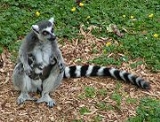
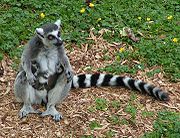
Lemurs are a clade of strepsirrhine primates endemic to the island of Madagascar. They are named after the lemures of Roman mythology due to the ghostly vocalizations, reflective eyes, and the nocturnal habits of some species...
s, bushbabies, and tarsier
Tarsier
Tarsiers are haplorrhine primates of the genus Tarsius, a genus in the family Tarsiidae, which is itself the lone extant family within the infraorder Tarsiiformes...
s. They are considered to have characteristics that are more primitive
Primitive (biology)
Primitive in the sense most relevant to phylogenetics means resembling the first living things and in particular resembling them in the simple nature of their anatomy and behaviour...
than those of monkeys and apes. Prosimians are the only primates native to Madagascar
Madagascar
The Republic of Madagascar is an island country located in the Indian Ocean off the southeastern coast of Africa...
, and are also found in Africa
Africa
Africa is the world's second largest and second most populous continent, after Asia. At about 30.2 million km² including adjacent islands, it covers 6% of the Earth's total surface area and 20.4% of the total land area...
and Asia
Asia
Asia is the world's largest and most populous continent, located primarily in the eastern and northern hemispheres. It covers 8.7% of the Earth's total surface area and with approximately 3.879 billion people, it hosts 60% of the world's current human population...
. With the exception of the tarsiers, all extant prosimians are in the suborder Strepsirrhini
Strepsirrhini
The clade Strepsirrhini is one of the two suborders of primates. Madagascar's only non-human primates are strepsirrhines, and others can be found in southeast Asia and Africa...
. Because tarsiers, as well as some extinct prosimians, share a more recent common ancestor
Common descent
In evolutionary biology, a group of organisms share common descent if they have a common ancestor. There is strong quantitative support for the theory that all living organisms on Earth are descended from a common ancestor....
with monkeys and apes than with other prosimians, they belong to a paraphyletic group and not a clade
Clade
A clade is a group consisting of a species and all its descendants. In the terms of biological systematics, a clade is a single "branch" on the "tree of life". The idea that such a "natural group" of organisms should be grouped together and given a taxonomic name is central to biological...
.
The adapid
Adapid
Adapids are a diverse group of extinct primates that primarily radiated during the Eocene epoch between about 55 and 34 million years ago. However, one specialized endemic Asian group survived into the Miocene. Fossils of adapids are known from North America, Europe, Asia, and Africa...
s are an extinct grouping that were most certainly prosimians and closely related to the strepsirrhines. The omomyid
Omomyid
Omomyids are a diverse group of early primates that radiated during the Eocene epoch between about 55 and 34 million years ago . Fossils of omomyids are found in North America, Europe, Asia, and possibly Africa...
s are another extinct group of prosimians, but they are believed to be haplorrhines, closely related to the tarsiers, but an outgroup to the rest of the haplorrhines.
Classification
The prosimians were once a group considered a suborder of the primate orderOrder (biology)
In scientific classification used in biology, the order is# a taxonomic rank used in the classification of organisms. Other well-known ranks are life, domain, kingdom, phylum, class, family, genus, and species, with order fitting in between class and family...
(suborder Prosimii - Gr. pro, before, + simia, ape). They have been shown, however, to be paraphyletic - that is, their most recent common ancestor was a prosimian but it has some nonprosimian descendents (i.e. monkeys and apes). This relationship is shown by the ranks (prosimians in bold) in the list below of the current primate classification between the order and family
Family (biology)
In biological classification, family is* a taxonomic rank. Other well-known ranks are life, domain, kingdom, phylum, class, order, genus, and species, with family fitting between order and genus. As for the other well-known ranks, there is the option of an immediately lower rank, indicated by the...
level. The classification is used on a more behavioural term nowadays, due to the lack of a unique last common ancestor.
- Order PrimatePrimateA primate is a mammal of the order Primates , which contains prosimians and simians. Primates arose from ancestors that lived in the trees of tropical forests; many primate characteristics represent adaptations to life in this challenging three-dimensional environment...
s- Suborder StrepsirrhiniStrepsirrhiniThe clade Strepsirrhini is one of the two suborders of primates. Madagascar's only non-human primates are strepsirrhines, and others can be found in southeast Asia and Africa...
: nontarsier prosimians- Infraorder Lemuriformes
- Family CheirogaleidaeCheirogaleidaeCheirogaleidae is the family of strepsirrhine primates that contains the various dwarf and mouse lemurs. Like all other lemurs, cheirogaleids live exclusively on the island of Madagascar.-Characteristics:...
: dwarf lemurs and mouse-lemurs - Family DaubentoniidaeAye-ayeThe aye-aye is a lemur, a strepsirrhine primate native to Madagascar that combines rodent-like teeth and a special thin middle finger to fill the same ecological niche as a woodpecker...
: aye-ayes - Family LemuridaeLemuridaeLemuridae is a family of prosimian primates native to Madagascar, and one of five families commonly known as lemurs. These animals were thought to be the evolutionary predecessors of monkeys and apes, but this is no longer considered correct...
: lemurs - Family Lepilemuridae: sportive lemurs
- Family IndriidaeIndriidaeThe Indriidae are a family of strepsirrhine primates. They are medium to large sized lemurs with only four teeth in the toothcomb instead of the usual six...
: woolly lemurs and allies
- Family Cheirogaleidae
- Infraorder LorisiformesLorisiformesLorisiformes are a group of primates found throughout Africa and Asia. Members of this infraorder include the galagos and the lorises. As strepsirrhines, they are related to the lemurs.* Order Primates** Suborder Strepsirrhini: non-tarsier prosimians...
- Family LorisidaeLorisidaeLorisidae is a family of strepsirrhine primates. The lorisids are all slim arboreal animals and include the lorises, pottos and angwantibos. Lorisids live in tropical, central Africa as well as in south and southeast Asia....
: lorises, pottos and allies - Family Galagidae: galagos
- Family Lorisidae
- Infraorder Lemuriformes
- Suborder HaplorrhiniHaplorrhiniThe haplorhines, the "dry-nosed" primates , are members of the Haplorhini clade: the prosimian tarsiers and the anthropoids...
: tarsiers, monkeys and apes- Infraorder TarsiiformesTarsierTarsiers are haplorrhine primates of the genus Tarsius, a genus in the family Tarsiidae, which is itself the lone extant family within the infraorder Tarsiiformes...
- Family TarsiidaeTarsierTarsiers are haplorrhine primates of the genus Tarsius, a genus in the family Tarsiidae, which is itself the lone extant family within the infraorder Tarsiiformes...
: tarsiers
- Family Tarsiidae
- Infraorder Simiiformes
- Parvorder Platyrrhini: New World monkeys (5 families)
- Parvorder CatarrhiniCatarrhiniCatarrhini is one of the two subdivisions of the higher primates . It contains the Old World monkeys and the apes, which in turn are further divided into the lesser apes or gibbons and the great apes, consisting of the orangutans, gorillas, chimpanzees, bonobos, and humans...
: humans and other Old World primates (3 families)
- Infraorder Tarsiiformes
- Suborder Strepsirrhini
See also
- Evolution of mammalsEvolution of mammals__FORCETOC__The evolution of mammals within the synapsid lineage was a gradual process that took approximately 70 million years, beginning in the mid-Permian. By the mid-Triassic, there were many species that looked like mammals, and the first true mammals appeared in the early Jurassic...
- List of primates