
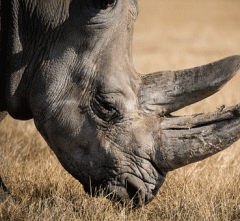
Endangered species
An endangered species is a population of organisms , which because it is either few in number or threatened by changing environmental or predation parameters, it is at risk of becoming
extinct. Many countries have
laws offering special protection to these species or their habitats: for example, forbidding
hunting, restricting land development or creating preserves. Only a few of the many endangered species actually make it to the lists and obtain
legal protection. Many more species become extinct, or potentially will become extinct, without gaining public notice.
Encyclopedia
An
endangered species is a population of organisms , which because it is either few in number or threatened by changing environmental or predation parameters, it is at risk of becoming
extinct. Many countries have
laws offering special protection to these species or their habitats: for example, forbidding
hunting, restricting land development or creating preserves. Only a few of the many endangered species actually make it to the lists and obtain
legal protection. Many more species become extinct, or potentially will become extinct, without gaining public notice.
The greatest factor of concern is the rate at which species are becoming extinct within the last 150 years. While species have evolved and become
extinct on a regular basis for the last several hundred million years, the number of species becoming extinct since the
Industrial Revolution has no precedent in biological history. If this rate of extinction continues, or accelerates as now seems to be the case, the number of species becoming extinct in the next decade could number in the millions. While most people readily relate to endangerment of large mammals or
birdlife, some of the greatest
ecological issues are the threats to stability of whole ecosystems if key species vanish at any level of the
food chain.
Issues of extinction
Species extinction is the ultimate concern, but there are four different reasons to have for concern with this outcome:
- Loss of a species as a biological entity
- Destabilization of an ecosystem
- Endangerment of other species
- Loss of irreplaceable genetic material and associated biochemicals
The loss of a species in and of itself is an important factor, both as diminution of the enjoyment of nature and as a moral issue for those who believe humans are stewards of the natural environment. Destabilization is a well understood outcome, when an element of food or predation is removed from an ecosystem. Examples abound that other species are in turn affected, such that population increases or declines are forthcoming in these secondary species. Drastic change or an unstable spiral can ensue, until other species are lost and the ecosystem structure is changed markedly and irreversibly.
The fourth outcome is more subtle, but perhaps the most important point for mankind to grasp. Each species carries unique genetic material in its
DNA and in its chemical factory responding to these genetic instructions. For example, in the valleys of central China, a
fernlike weed called sweet wormwood grows, that is the only source of
artemisinin, a drug that is nearly 100 percent effective against
malaria . If this plant were lost to extinction, then the ability to control malaria, even today a potent killer, would diminish. There are countless other examples of chemicals unique to a certain species, whose only source is the species, whose genetic factory makes that given substance. How many further chemicals have not yet been discovered and could vanish from the planet when further species become extinct cannot be determined, but it is a highly debated and influential point.
Though extinction can be a natural effect of the process of
natural selection, the current extinction crisis is not related to that process. At the present, the Earth is at a peak of biodiversity and scientists contend that the Earth is undergoing the sixth
mass extinction period. These periods have occurred before without human intervention; however the current extinction period is unique. Previous periods were triggered by physical causes, such as meteorite collision and volcanic eruption, all leading to climate change. The current extinction period is being caused by humans and began approximately 100,000 years ago with the diaspora of humans to different parts the world. By entering new ecosystems which had never before experienced the human presence, humans disrupted the ecological balance by hunting and also possibly bringing disease. From this time up to approximately 10,000 years ago is known as "phase one" of the sixth extinction period.
Phase two of the period began approximately 10,000 years ago with the birth of agriculture. With the birth of agriculture, humans did not have to rely on interaction with other species for survival and so could begin to domesticate them, and they also did not have to adhere to the limitations of the ecosystem's carrying capacity. Thus, humans became the first species able to live outside local ecosystems. As Niles Eldridge says "Indeed, to develop agriculture is essentially to declare war on ecosystems - converting land to produce one or two food crops, with all other native plant species all now classified as unwanted "weeds" -- and all but a few domesticated species of animals now considered as pests." With the ability to live outside of a local ecosystem, humans have been free to breech the "carrying-capacity" of areas and overpopulate, putting ever more stress on the environment with destructive activities necessary for more population growth. Today, those activities include
tropical deforestation, coral loss, other habitat destruction, overexploitation of species, introduction of alien species into ecosystems and
pollution .
Conservation status
The
conservation status of a species is an indicator of the likelihood of that endangered species continuing to survive. Many factors are taken into account when assessing the conservation status of a species; not simply the number remaining, but the overall increase or decrease in the population over time, breeding success rates, known threats, and so on. In many areas this is referred to as a red-listed species. Internationally, 189 countries have signed an accord agreeing to create
Biodiversity Action Plans to protect endangered and other threatened species. In the
USA this plan is usually called a species Recovery Plan.
The best-known worldwide conservation status listing is the IUCN Red List, but many more specialized lists exist. The following conservation status categories are used in articles in this encyclopedia. They are loosely based on the IUCN categories.
- Extinct: the last remaining member of the species had died, or is presumed beyond reasonable doubt to have died. Examples: Thylacine, Dodo, Passenger Pigeon.
- Extinct in the wild: captive individuals survive, but there is no free-living, natural population. Examples: Dromedary.
- Critical or critically endangered: faces an extremely high risk of extinction in the immediate future. Examples: Ivory-billed Woodpecker, Arakan Forest Turtle
- Endangered: faces a very high risk of extinction in the near future. Examples: Blue whale, Snow Leopard, Kings holly
- Vulnerable: faces a high risk of extinction in the medium-term. Examples: Cheetah, Bactrian Camel
- Secure or lower risk: no immediate threat to the survival of the species. Examples: Norway Rats, Nootka Cypress, Llama
The following lists are examples of endangered species. It is important to stress that the following lists are a miniscule fraction of the total endangered species. It is also worth noting that the number of species becoming extinct each year is many times as large as the number of species classified as endangered; this fact arises from the extensive and slow review process for listing new species as endangered. It also arises from the loluminous number of yearly extinctions, often for species about which little docementation exists. Note that because of varying standards for regarding a species as endangered, and the very large number of endangered species,
these lists should not be regarded as comprehensive.
Endangered mammals
The following list is a very small fraction of known endangered mammals:
Endangered birds
...
...
...
Endangered fish
Endangered plants
About 6% of the 300,000 identified species are endangered due to overcollection or destruction of habitat, among other causes. Pollinator decline is also a factor for some species. The following is a very small fraction of the endangered plants:
- African violet , due to forest clearance
- Baishanzu fir of southeast China, three trees known on an isolated mountain summit
- Baker's larkspur of California, due to very limited habitat
- Chilean wine palm , due to land clearance
- Dawn Redwood , thought to be extinct until 1941, when a small stand was discovered in China
- Hickman's potentilla , thought to be extinct until rediscovery in early 1990s.
- Kaka Beak of New Zealand, due to introduced grazers and competing plants
- King of the Paphs Orchid of Asia, due to overcollection
- Louisiana Quillwort, of Louisiana
...
, due to very limited habitat
- Madonna lily of Europe, due to overcollection
- muiri tree of Kenya and neighboring countries, because of harvesting excessively and by improper methods
- Pinus squamata of southwest China, about 20 trees known
- Saguaro cactus of North America, due to overcollection, slow maturing, and slow breeding
- Saharan Cypress of North Africa, due to small population and desertification
- Santa Cruz Tarweed , of California, due to limited range of habitat and encroachment by man
- Tennessee coneflower and Pyne's ground plum of the Nashville Basin of Tennessee, due to limited cedar glade habitat and its destruction by urbanization.
- Venus Flytrap of North America, due to land clearance and overcollection.
- Wollemi pine of Australia, also known as the 'Dinosaur Tree'. Wollemia fossils have been found in Australia, Antarctica and New Zealand. The plant was thought to be extinct until two trees were discovered in 1994. Research into the horticultural development of the Wollemi pine is being conducted at Mount Annan Botanic Garden. The plants are now available and commercially propagated.
Controversy
Some endangered species laws are controversial. Typical areas of controversy include: criteria for placing a species on the endangered species list, and criteria for removing a species from the list once its population has recovered; whether restrictions on land development constitute a "taking" of land by the government; the related question of whether private landowners should be compensated for the loss of use of their land; and obtaining reasonable exceptions to protection laws.
Being listed as an endangered species can backfire, since it could make a species more desirable for collectors and poachers . However, this is usually a spurious argument by those favoring loose protection laws.
Another argument against listing species is the use of the "shoot, shovel, and shut up" method of clearing endangered species from an area of land. Due to the fact that landowners currently may perceive a diminution in value for their land after finding an endangered animal on it, some owners have opted to silently kill and bury the animals, thus removing the problem from their land, but at the same time further reducing the population of an endangered species. It has also been noted that the effectivenes of the Endangered Species Act , which coined the term "endangered species", has been questioned. Only 15 species have been de-listed to date, and many of those species recovered from the stoppage of practices not related to the ESA, such as the use of DDT.
See also
A large number of historical orders are extinct, for example dinosaur [i]s, pterosaur [i] ...
References
External links
- U.S. Fish & Wildlife Service. .
- Research and Conservation of of tigers in the largest remaining mangrove forest in the world.
- — Provided by New Scientist is a weekly international [i] science magazine [i] covering recent developments in sci ...
. - . . BBC News.
- , from Awake!
[i]
[i]
...
magazine