

Colloquialism

Encyclopedia
A colloquialism is a word
or phrase
that is common in everyday, unconstrained conversation rather than in formal speech, academic writing, or paralinguistics. Dictionaries often display colloquial words and phrases with the abbreviation colloq. as an identifier. Colloquialisms are sometimes referred to collectively as "youknowhatitis language".
" or "gonna" or "wanna
"), phrases (such as "old as the hills" and "raining cats and dogs" "graveyard dead"), or sometimes even an entire aphorism
("There's more than one way to skin a cat").
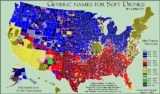
Colloquialisms are often used primarily within a limited geographical area, known by linguists to spread through normal conversational interaction of a language, although more often now through informal online interaction. A common example given is the regional term used by people when describing a carbonated soft drink
. In the Upper Midwestern United States
, in common with Canada
, it is commonly called "pop," while in other areas, notably the Northeastern and extreme Western United States, it is referred to as "soda" or "mix". In New England
it is occasionally called "tonic." In some areas of Scotland
it is referred to as "ginger", and confusion over whether this term referred to all carbonated soft drinks or just ginger beer was apparent in the case of Donoghue v Stevenson. (See: Names for soft drinks for more regional examples of colloquial names given to soft drinks.)
Another example of colloquialism is the two different terms for rectangular maple doughnuts. They are called Long Johns in most of the United States, but in the Pacific Northwest (such as Oregon and Washington), they are referred to as Maple bar
s.
Words that have a formal meaning might also have a colloquial meaning. "Kid" can mean "young goat" in formal usage and "child" in colloquial usage.
Auxiliary languages are sometimes assumed to be lacking in colloquialisms, but this varies from one language to another. In Interlingua
, the same standards of eligibility
apply to colloquialisms as to other terms. Thus, any widely international colloquialism may be used in Interlingua. Expressions such as en las manos de... 'in the hands of...', Que pasa? 'What's going on?', are common.
make a distinction between colloquialisms and slangisms (slang
words). According to linguist Ghil'ad Zuckermann, "slang refers to informal (and often transient) lexical items used by a specific social group, for instance teenagers, soldiers, prisoners, or surfers. Slang is not considered the same as colloquial (speech), which is informal, relaxed speech used on occasion by any speaker; this might include contractions such as you’re, as well as colloquialisms. A colloquialism is a lexical item used in informal speech; whilst the broadest sense of the term ‘colloquialism’ might include slangism, its narrow sense does not. Slangisms are often used in colloquial speech but not all colloquialisms are slangisms. One method of distinguishing between a slangism and a colloquialism is to ask whether most native speakers know the word (and use it); if they do, it is a colloquialism. However, the problem is that this is not a discrete, quantized system but a continuum. Although the majority of slangisms are ephemeral and often supplanted by new ones, some gain non-slang colloquial status (e.g. English
silly – cf. German
selig ‘blessed’, Middle High German
sælde ‘bliss, luck’ and Zelda
, a Middle Eastern female first name) and even formal status (e.g. English mob)."
is terminology which is especially defined in relationship to a specific activity, profession, or group. The term covers the language used by people who work in a particular area or who have a common interest. Much like slang, it can develop as a kind of short-hand, to express ideas that are frequently discussed between members of a group, though it can also be developed deliberately using chosen terms. A standard term may be given a more precise or unique usage among practitioners of a field. In many cases this causes a barrier to communication with those not familiar with the language of the field.
is used in two distinct ways, even by linguists. One usage refers to a variety of a language that is characteristic of a particular group of the language's speakers. The term is applied most often to regional speech patterns, but a dialect may also be defined by other factors, such as social class. A dialect that is associated with a particular social class can be termed a sociolect; a regional dialect may be termed a regiolect or topolect. The other usage refers to a language socially subordinate to a regional or national standard language, often historically cognate to the standard, but not a variety of it or in any other sense derived from it. A dialect is distinguished by its vocabulary, grammar, and pronunciation (phonology
, including prosody
).
Word
In language, a word is the smallest free form that may be uttered in isolation with semantic or pragmatic content . This contrasts with a morpheme, which is the smallest unit of meaning but will not necessarily stand on its own...
or phrase
Phrase
In everyday speech, a phrase may refer to any group of words. In linguistics, a phrase is a group of words which form a constituent and so function as a single unit in the syntax of a sentence. A phrase is lower on the grammatical hierarchy than a clause....
that is common in everyday, unconstrained conversation rather than in formal speech, academic writing, or paralinguistics. Dictionaries often display colloquial words and phrases with the abbreviation colloq. as an identifier. Colloquialisms are sometimes referred to collectively as "youknowhatitis language".
Examples
Some examples of informal colloquialisms can include words (such as "y'allY'all
Y'all is a contraction of the words "you" and "all". It is used as a plural second-person pronoun. Commonly believed to have originated in the Southern United States, it is primarily associated with Southern American English, African-American Vernacular English, and some dialects of the Western...
" or "gonna" or "wanna
Wanna
Wanna may refer to:Places*Wanna, Germany*Wanna, Pakistan, a town in PakistanOther*Wanna , a minor character from Frank Herbert's novel Dune*"Wanna" , a single by Korean girl group Kara.*Relaxed pronunciation of "want to" or "want a"...
"), phrases (such as "old as the hills" and "raining cats and dogs" "graveyard dead"), or sometimes even an entire aphorism
Aphorism
An aphorism is an original thought, spoken or written in a laconic and memorable form.The term was first used in the Aphorisms of Hippocrates...
("There's more than one way to skin a cat").
Colloquialisms are often used primarily within a limited geographical area, known by linguists to spread through normal conversational interaction of a language, although more often now through informal online interaction. A common example given is the regional term used by people when describing a carbonated soft drink
Soft drink
A soft drink is a non-alcoholic beverage that typically contains water , a sweetener, and a flavoring agent...
. In the Upper Midwestern United States
Upper Midwest
The Upper Midwest is a region in the northern portion of the U.S. Census Bureau's Midwestern United States. It is largely a sub-region of the midwest. Although there are no uniformly agreed-upon boundaries, the region is most commonly used to refer to the states of Minnesota, Wisconsin, and...
, in common with Canada
Canada
Canada is a North American country consisting of ten provinces and three territories. Located in the northern part of the continent, it extends from the Atlantic Ocean in the east to the Pacific Ocean in the west, and northward into the Arctic Ocean...
, it is commonly called "pop," while in other areas, notably the Northeastern and extreme Western United States, it is referred to as "soda" or "mix". In New England
New England
New England is a region in the northeastern corner of the United States consisting of the six states of Maine, New Hampshire, Vermont, Massachusetts, Rhode Island, and Connecticut...
it is occasionally called "tonic." In some areas of Scotland
Scotland
Scotland is a country that is part of the United Kingdom. Occupying the northern third of the island of Great Britain, it shares a border with England to the south and is bounded by the North Sea to the east, the Atlantic Ocean to the north and west, and the North Channel and Irish Sea to the...
it is referred to as "ginger", and confusion over whether this term referred to all carbonated soft drinks or just ginger beer was apparent in the case of Donoghue v Stevenson. (See: Names for soft drinks for more regional examples of colloquial names given to soft drinks.)
Another example of colloquialism is the two different terms for rectangular maple doughnuts. They are called Long Johns in most of the United States, but in the Pacific Northwest (such as Oregon and Washington), they are referred to as Maple bar
Maple bar
A maple bar is a rectangular pastry topped with a maple glaze. They can be filled with custard, or cream, or left unfilled.Maple bars are also known as a maple-glazed Long John....
s.
Words that have a formal meaning might also have a colloquial meaning. "Kid" can mean "young goat" in formal usage and "child" in colloquial usage.
Auxiliary languages are sometimes assumed to be lacking in colloquialisms, but this varies from one language to another. In Interlingua
Interlingua
Interlingua is an international auxiliary language , developed between 1937 and 1951 by the International Auxiliary Language Association...
, the same standards of eligibility
Interlingua and eligibility of international words
Words can be included in Interlingua in either of two ways: through regular derivation using roots and affixes or by establishing their eligibility as international words...
apply to colloquialisms as to other terms. Thus, any widely international colloquialism may be used in Interlingua. Expressions such as en las manos de... 'in the hands of...', Que pasa? 'What's going on?', are common.
Distinction between colloquialism and slang
Some linguistsLinguistics
Linguistics is the scientific study of human language. Linguistics can be broadly broken into three categories or subfields of study: language form, language meaning, and language in context....
make a distinction between colloquialisms and slangisms (slang
Slang
Slang is the use of informal words and expressions that are not considered standard in the speaker's language or dialect but are considered more acceptable when used socially. Slang is often to be found in areas of the lexicon that refer to things considered taboo...
words). According to linguist Ghil'ad Zuckermann, "slang refers to informal (and often transient) lexical items used by a specific social group, for instance teenagers, soldiers, prisoners, or surfers. Slang is not considered the same as colloquial (speech), which is informal, relaxed speech used on occasion by any speaker; this might include contractions such as you’re, as well as colloquialisms. A colloquialism is a lexical item used in informal speech; whilst the broadest sense of the term ‘colloquialism’ might include slangism, its narrow sense does not. Slangisms are often used in colloquial speech but not all colloquialisms are slangisms. One method of distinguishing between a slangism and a colloquialism is to ask whether most native speakers know the word (and use it); if they do, it is a colloquialism. However, the problem is that this is not a discrete, quantized system but a continuum. Although the majority of slangisms are ephemeral and often supplanted by new ones, some gain non-slang colloquial status (e.g. English
English language
English is a West Germanic language that arose in the Anglo-Saxon kingdoms of England and spread into what was to become south-east Scotland under the influence of the Anglian medieval kingdom of Northumbria...
silly – cf. German
German language
German is a West Germanic language, related to and classified alongside English and Dutch. With an estimated 90 – 98 million native speakers, German is one of the world's major languages and is the most widely-spoken first language in the European Union....
selig ‘blessed’, Middle High German
German language
German is a West Germanic language, related to and classified alongside English and Dutch. With an estimated 90 – 98 million native speakers, German is one of the world's major languages and is the most widely-spoken first language in the European Union....
sælde ‘bliss, luck’ and Zelda
Zelda (given name)
Zelda is a nickname for the feminine name Griselda, which means "dark battle", and also the feminine form of the yiddish name Selig, meaning "blessed", "happy".-People:* Zelda Fichandler , American director and educator...
, a Middle Eastern female first name) and even formal status (e.g. English mob)."
Distinction between colloquialism and jargon
JargonJargon
Jargon is terminology which is especially defined in relationship to a specific activity, profession, group, or event. The philosophe Condillac observed in 1782 that "Every science requires a special language because every science has its own ideas." As a rationalist member of the Enlightenment he...
is terminology which is especially defined in relationship to a specific activity, profession, or group. The term covers the language used by people who work in a particular area or who have a common interest. Much like slang, it can develop as a kind of short-hand, to express ideas that are frequently discussed between members of a group, though it can also be developed deliberately using chosen terms. A standard term may be given a more precise or unique usage among practitioners of a field. In many cases this causes a barrier to communication with those not familiar with the language of the field.
Distinction between colloquialism and dialect
The term dialectDialect
The term dialect is used in two distinct ways, even by linguists. One usage refers to a variety of a language that is a characteristic of a particular group of the language's speakers. The term is applied most often to regional speech patterns, but a dialect may also be defined by other factors,...
is used in two distinct ways, even by linguists. One usage refers to a variety of a language that is characteristic of a particular group of the language's speakers. The term is applied most often to regional speech patterns, but a dialect may also be defined by other factors, such as social class. A dialect that is associated with a particular social class can be termed a sociolect; a regional dialect may be termed a regiolect or topolect. The other usage refers to a language socially subordinate to a regional or national standard language, often historically cognate to the standard, but not a variety of it or in any other sense derived from it. A dialect is distinguished by its vocabulary, grammar, and pronunciation (phonology
Phonology
Phonology is, broadly speaking, the subdiscipline of linguistics concerned with the sounds of language. That is, it is the systematic use of sound to encode meaning in any spoken human language, or the field of linguistics studying this use...
, including prosody
Prosody (linguistics)
In linguistics, prosody is the rhythm, stress, and intonation of speech. Prosody may reflect various features of the speaker or the utterance: the emotional state of the speaker; the form of the utterance ; the presence of irony or sarcasm; emphasis, contrast, and focus; or other elements of...
).
External links
- Slangasaurus A Slang Dictionary
- Colloquial Spanish Dictionary of Colloquial Spanish.
- Urban Thesaurus An Urban Thesaurus