
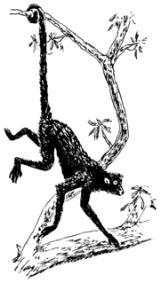
A
prehensile tail is the
tailThe tail is the section at the rear end of an animal's body; in general, the term refers to a distinct, flexible appendage to the torso. It is the part of the body that corresponds roughly to the sacrum and coccyx in mammals and birds...
of an
animalAnimals are a major group of mostly multicellular, eukaryotic organisms of the kingdom Animalia or Metazoa. Their body plan eventually becomes fixed as they develop, although some undergo a process of metamorphosis later on in their life. Most animals are motile, meaning they can move spontaneously...
that has adapted to be able to grasp and/or hold objects. Fully prehensile tails can be used to hold and manipulate objects, and in particular to aid arboreal creatures in finding and eating food in the trees. If the tail cannot be used for this it is considered only partially prehensile - such tails are often used to anchor an animal's body to or dangle from a branch, or as an aid to climbing. The term
prehensile means "able to grasp" (from the Latin
prehendere, the root of "comprehend" and "apprehend").
Evolution of the prehensile tail
One point of interest is the distribution of animals with prehensile tails. The prehensile tail is predominantly a
New WorldThe New World is one of the names used for the non-Afro-Eurasian parts of the Earth, specifically the Americas and possibly Australia. When the term originated in the late 15th century, the Americas were new to the Europeans, who previously thought of the world as consisting only of Europe, Asia,...
adaptation, especially among mammals. Many more animals in South America have prehensile tails than in Africa and Southeast Asia. It has been argued that animals with prehensile tails predominate in
South AmericaSouth America is the southern continent of the Americas, situated entirely in the Western Hemisphere and mostly in the Southern Hemisphere, with a relatively small portion in the Northern Hemisphere...
as the forest is very dense compared to that of
AfricaAfrica is the world's second-largest and second most-populous continent, after Asia. At about 30.2 million km² including adjacent islands, it covers 6% of the Earth's total surface area and 20.4% of the total land area. With a billion people in 61 territories, it accounts for about 14.8% of the...
or
Southeast AsiaManila
Bangkok
Ho Chi Minh City
Kuala Lumpur
Singapore
Yangon
Bandung
Hanoi
Surabaya
Taichung
Kaohsiung
Medan|-|}...
. In contrast, in less dense forest such as in Southeast Asia it is observed that
gliding animalsA number of animals have evolved aerial locomotion, either by powered flight or by gliding. Flying and gliding animals have evolved separately many times, without any single ancestor. Flight has evolved at least four times, in the insects, pterosaurs, birds, and bats. Gliding has evolved on many...
such as
colugoColugos are arboreal gliding mammals found in South-east Asia. There are just two extant species, which make up the entire family Cynocephalidae and order Dermoptera. They are the most capable of all gliding mammals, using flaps of extra skin between their legs to glide from higher to lower...
s or flying snakes tend to be more common instead, whereas there are few gliding vertebrates in South America. Also South American rainforests tend to have more
lianaA liana is any of various long-stemmed, usually woody vines that are rooted in the soil at ground level and use trees, as well as other means of vertical support, to climb up to the canopy in order to get access to well-lit areas of the forest. Lianas are especially characteristic of tropical moist...
s as there are fewer large animals to eat them compared to Africa and Asia; the presence of lianas perhaps aiding climbers but obstructing gliders. Curiously, Australia-New Guinea contains many mammals with prehensile tails and also many mammals which can glide; in fact, all Australian mammalian gliders have tails that are prehensile to an extent.
Anatomy and physiology of the prehensile tail
Tails are mostly a feature of
vertebrateVertebrates are members of the subphylum Vertebrata, chordates with backbones or spinal columns. About 58,000 species of vertebrates have been described. Vertebrata is the largest subphylum of chordates, and contains many familiar groups of large land animals. Vertebrates comprise cyclostomes, bony...
s, however some
invertebrateAn invertebrate is an animal without a vertebral column. The group includes 95% of all animal species — all animals except those in the Chordate subphylum Vertebrata ....
s such as
scorpionScorpions are predatory arthropod animals of the order Scorpiones within the class Arachnida. There are about 2,000 species of scorpions, found widely distributed south of about 49° N, except New Zealand and Antarctica...
s also have
appendageAn appendage in the broadest sense is an additional or subsidiary part existing on, or added to, something which can generally still function if the appendage has never existed or is later provided or grown, or will still perform a primary function if the appendage is removed.- Biological context...
s that can be considered tails. However, only vertebrates are known to have developed prehensile tails. Many mammals with prehensile tails will have a bare patch to aid gripping. This bare patch is known as a "friction pad."
Mammals
- New World Monkeys. Many New World monkeys in the family Atelidae
The Atelidae are one of the four families of New World monkeys now recognised. Formerly they were included in the family Cebidae. Atelids are general larger monkeys, and the family includes the howler, spider and woolly monkeys...
, which includes howler monkeyHowler monkeys are among the largest of the New World monkeys. Nine species are currently recognised. Previously classified in the family Cebidae, they are now placed in the family Atelidae. These monkeys are native to South and Central American forests. They live in groups of usually about 18...
s, spider monkeySpider monkeys of the genus Ateles are New World monkeys in the subfamily Atelinae, family Atelidae. Like other atelines, they are found in tropical forests of Central and South America, from southern Mexico to Brazil...
s and woolly monkeyThe woolly monkeys are the genus Lagothrix of New World monkeys, usually placed in the family Atelidae.There are four species of woolly monkey. All originate from the rainforests of South America...
s, have grasping tails often with a bare tactile padA tactile pad is an area of skin that is particularly sensitive to pressure, temperature, or pain. Tactile pads are characterized by high concentrations of free nerve endings. In primates, the last phalanges in the fingers and toes have tactile pads, allowing very accurate manipulation of objects....
. This is in contrast with their distant Old World monkeyThe Old World monkeys or Cercopithecidae are a group of primates, falling in the superfamily Cercopithecoidea in the clade Catarrhini. The Old World monkeys are native to Africa and Asia today, inhabiting a range of environments from tropical rain forest to savanna, scrubland, and mountainous...
cousins who do not have prehensile tails.
- Opossum. A marsupial
Marsupials are an infraclass of mammals, characterized by a distinctive pouch , in which females carry their young through early infancy.- History :...
group from the AmericasThe Americas, or America, are lands in the Western hemisphere or New World, comprising the continents of North America and South America with their associated islands and regions. America may be ambiguous in English, as it is more commonly used to refer to the United States of America...
. There is anecdotal evidence that opossums may use their prehensile tails to carry nesting material.
- Binturong
The Binturong , also known as the Asian Bearcat, the Palawan Bearcat, or simply the Bearcat, is a species of the family Viverridae, which includes the civets and genets. It is neither a bear nor a cat, and the real meaning of the original name has been lost, as the local language that gave it that...
. The only Old WorldThe Old World consists of those parts of Earth known to Europeans, Asians, and Africans in the 15th century.-Regions:The Old World includes Europe, Asia, and Africa , plus surrounding islands...
animals with fully prehensile tails are the binturongThe Binturong , also known as the Asian Bearcat, the Palawan Bearcat, or simply the Bearcat, is a species of the family Viverridae, which includes the civets and genets. It is neither a bear nor a cat, and the real meaning of the original name has been lost, as the local language that gave it that...
s of BorneoBorneo is the third largest island in the world and is located at the centre of Maritime Southeast Asia. Administratively, this island is divided among Indonesia , Malaysia and Brunei . Indonesians refer to the island as Kalimantan...
, though even they use only the tip of the tail.
- Kinkajou
The kinkajou , also known as the honey bear , is a rainforest mammal of the family Procyonidae related to the olingo, ringtail, cacomistle, raccoon, and coati. It is the only member of the genus Potos. Kinkajous may be mistaken for ferrets or monkeys, but are not related...
. The kinkajouThe kinkajou , also known as the honey bear , is a rainforest mammal of the family Procyonidae related to the olingo, ringtail, cacomistle, raccoon, and coati. It is the only member of the genus Potos. Kinkajous may be mistaken for ferrets or monkeys, but are not related...
of South and Central America is the only other animal of the order CarnivoraThe diverse order Carnivora includes over 260 species of placental mammals. Its members are formally referred to as carnivorans, while the word "carnivore" can refer to any meat-eating animal...
, besides the binturongThe Binturong , also known as the Asian Bearcat, the Palawan Bearcat, or simply the Bearcat, is a species of the family Viverridae, which includes the civets and genets. It is neither a bear nor a cat, and the real meaning of the original name has been lost, as the local language that gave it that...
, to sport the adaptation.
- Harvest Mouse
The Harvest Mouse, Micromys minutus is a small rodent native to Europe and Asia. They are typically found in fields of cereal crops such as wheat and oats as well as long grass and hedgerows. They have reddish-brown fur with white underparts and a naked, highly prehensile tail...
. The Harvest MouseThe Harvest Mouse, Micromys minutus is a small rodent native to Europe and Asia. They are typically found in fields of cereal crops such as wheat and oats as well as long grass and hedgerows. They have reddish-brown fur with white underparts and a naked, highly prehensile tail...
(Micromys minutus) also has a prehensile tail. Commonly found amongst areas of tall grasses such as cereal crops (particularly wheat and oats), roadside verges, hedgerows, reedbeds, dykes and salt-marshes.
- Bicolored-spined Porcupine
The Bicolored-spined Porcupine is a species of rodent in the Erethizontidae family.It is found in Bolivia, Colombia, Ecuador, and Peru....
This porcupine, unlike others, has a fully prehensile tail.
Mammals
- New World Monkeys. The capuchin monkey
The capuchins are the group of New World monkeys classified as genus Cebus. The range of the capuchin monkeys includes Central America and South America as far south as northern Argentina...
. It is interesting to note that the capuchin is more than intelligent enough to make full use of its prehensile tail, but since the tail lacks an area of bare skin for a good grip it is only used in climbing and dangling. Other reasons for partial prehensility might include the lack of strength or flexibility in the tail, or simply having no need to manipulate objects with it.
- Tree porcupines
The New World porcupines, or Erethizontidae, are large arboreal rodents, distinguished by the spiny covering from which they take their name. They inhabit forests and wooded regions across North America, and into northern South America...
. The 15 species of tree porcupine divided between 3 genera (Coendou, SphiggurusSphiggurus is a genus of New World porcupine. It contains the following species:*Sphiggurus ichillus - Streaked Dwarf Porcupine*Sphiggurus insidiosus - Bahia Porcupine*Sphiggurus melanurus - Black-tailed Hairy Dwarf Porcupine...
, and Echinoprocta). They are found in South America, with one species extending to Mexico. All have prehensile tails.
- Anteaters. Anteaters are found in Central and South America. Three of the four species of anteater, the Silky Anteater
Silky Anteater or Pygmy Anteater is a species of anteater from Central and South America, ranging from extreme southern Mexico south to Brazil and possibly Paraguay...
and the two species of tamandua, have prehensile tails
- Rats
RATS may refer to:* RATS , Regression Analysis of Time Series, a statistical package* Rough Auditing Tool for Security, a computer program...
have been known to be able to wrap the tail around an object after running around it, therefore giving the creature a small bit of balance. They have also been seen to be able to briefly hang off an object, though not for long.
- Tree Pangolin
The tree pangolin is one of eight extant species of pangolin and is native to equatorial Africa. Also known as the white-bellied pangolin or three-cusped pangolin, it is the most common of the African forest pangolins.-Taxonomy:The tree pangolin belongs to the Subgenus Phataginus and some...
. One of the few Old World mammals with a prehensile tail.
- Possums. This large, diverse group of 63 species forms the marsupial suborder Phalangeriformes, found in Australia, New Guinea
New Guinea, located north of Australia, is the world's second largest island. It became separated from the Australian mainland when the area now known as the Torres Strait flooded after the last glacial period. The name Papua has long been associated with the island...
, and some nearby islands. All members of the suborder have prehensile tails, however the tails of some members such as the AcrobatidaeAcrobatidae is a small family of gliding marsupials containing two genera, each with a single species, the Feathertail Glider from Australia and Feather-tailed Possum from New Guinea....
have only limited prehensile capacity. Notably, all three marsupial glider groups belong to this suborder.
- Potoroidae
The marsupial family Potoroidae includes the bettongs, potoroos, and two of the rat-kangaroos. All are rabbit-sized, brown, jumping marsupials and resemble a large rodent or a very small wallaby.-Characteristics:...
. A marsupial group found in Australia that includes the bettongs and the potoroos. They have weakly prehensile tails.
- Monito del Monte
The Monito del Monte , Dromiciops gliroides, is a diminutive marsupial native only to southwestern South America . It is notable for having been thought to have become extinct 11 million years ago until being rediscovered in the modern age...
. A small South American marsupial with a prehensile tail.
Reptiles
- Prehensile tailed skink. Several kinds of skink
Skinks are the most diverse group of lizards. They make up the family Scincidae which shares the superfamily or infraorder Scincomorpha with several other lizard families, including Lacertidae...
(e.g. Corucia zebrata) have partially prehensile tails.
- Chameleon
The family Chamaeleonidae are a distinctive and highly specialized clade of lizards. They are distinguished by their parrot-like zygodactylous feet, their separately mobile and stereoscopic eyes, their very long, highly modified, and rapidly extrudable tongues, their swaying gait, and the...
lizards.
- Snakes. Many snake
Snakes are elongate legless carnivorous reptiles of the suborder Serpentes that can be distinguished from legless lizards by their lack of eyelids and external ears. Like all squamates, snakes are ectothermic amniote vertebrates covered in overlapping scales...
s have prehensile tails. (or a Prehensile body)
- Crested geckos have fully prehensile tails
- Alligator lizard
Alligator Lizard may refer to one of the following:Species of the genus Elgaria:*Northern Alligator Lizard*Southern Alligator LizardSpecies of the genus Gerrhonotus.Species of the genus Abronia ...
. Some alligator lizards such as the southern alligator lizardThe Southern alligator lizard is a lizard native to the Pacific coast of North America. It is common throughout Southern California and can be found in grasslands, chaparral, and forests as well as urban areas. In dry climates, it is likely to be found in moist areas or near streams. Three...
, the Texas alligator lizard, and the arboreal alligator lizards (genus AbroniaAbronia may refer to:*Abronia , a genus of animals commonly known as arboreal alligator lizards*Abronia , a genus of plants commonly known as sand-verbenas...
) have prehensile tails.
Amphibians
- Salamander
Salamander is a common name of approximately 500 species of amphibians. They are typically characterized by their slender bodies, short noses, and long tails. All known fossils and extinct species fall under the order Caudata, while sometimes the extant species are grouped together as the Urodela...
s. A number of North American forest-dwelling climbing salamanderClimbing salamanders is the common name for plethodontid salamanders of the genus Aneides. As this name suggests, most of these species have prehensile tails and are as mobile up a tree as in a stream...
s have prehensile tails that help them climb. Some are from of the genus Aneides such as the Clouded Salamander (Aneides ferreusThe Clouded Salamander is a species of salamander in the Plethodontidae family.It is endemic to the United States.Its natural habitat is temperate forests and it is probable that many nest in trees....
), the Wandering SalamanderThe Wandering Salamander is a species of salamander in the Plethodontidae family.It is found in Canada and the United States.Its natural habitat is temperate forests.It is threatened by habitat loss.-Source:...
(Aneides vagrans), and the Arboreal Salamander (Aneides lugubrisAneides lugubris, the Arboreal salamander, is a species of climbing salamander. It is native to California and Baja California, where it is primarily associated with oak and sycamore woodlands, and thick chaparral.-Description:...
). Others are the large Red Hills SalamanderThe Red Hills Salamander is a fairly large, terrestrial salamander growing to about 255 millimeters. Its body color is gray to brownish without markings, and its limbs are relatively short...
(Phaeognathus hubrichti) and the Cave SalamanderThe Spotted-tail Salamander is a thin, enadangered species of cave salamander.-Identification:Dark spots cover the body and tail. Adults reach lengths of ....
(Eurycea lucifuga). There are also the Central American Bolitoglossa sombra and Mexican and Central American Bolitoglossa mexicana salamanders.
FishA fish is any aquatic vertebrate animal that is typically ectothermic , covered with scales, and equipped with two sets of paired fins and several unpaired fins...
- Syngnathidae
Syngnathidae is a family of fish which includes the seahorses, the pipefishes, and the weedy and leafy sea dragons. The name is derived from Greek, meaning "fused jaw" - syn meaning fused or together, and gnathus meaning jaws. This fused jaw trait is something the entire family has in common...
. Many species from this group, which includes SeahorseSeahorses are any species of fish belonging to the genus Hippocampus, which, in turn, belongs to the family Syngnathidae, which also includes pipefish and leafy sea dragons. There are over 47 species of seahorse, mainly found in shallow tropical and temperate waters throughout the world. They...
s and PipefishPipefishes or pipe-fishes are a subfamily of small fishes, with which the seahorses form a distinct family.-Anatomy:Pipefish look like straight-bodied seahorses with tiny mouths. The name is derived from the peculiar form of their snout, which is like a long tube, ending in narrow and small mouth...
, have prehensile tails.
External links