

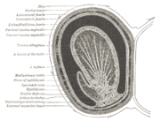
Testicle

Encyclopedia
The testicle is the male gonad
in animal
s. Like the ovaries
to which they are homologous
, testes are components of both the reproductive system
and the endocrine system
. The primary functions of the testes are to produce sperm
(spermatogenesis
) and to produce androgens, primarily testosterone
.
Both functions of the testicle are influenced by gonadotropic hormones produced by the anterior pituitary. Luteinizing hormone
(LH) results in testosterone release. The presence of both testosterone and follicle-stimulating hormone
(FSH) is needed to support spermatogenesis.
s have two testes. They are typically of similar size, although in shark
s, that on the right side is usually larger, and in many bird and mammal species, the left may be the larger. The primitive jawless fish have only a single testis, located in the midline of the body, although even this forms from the fusion of paired structures in the embryo.
In mammal
s, the testes are often contained within an extension of the abdomen
called the scrotum
. In mammals with external testes it is most common for one testicle to hang lower than the other. While the size of the testicle varies, it is estimated that 21.9% of men have their higher testicle being their left, while 27.3% of men have reported to have equally positioned testicles. This is due to differences in the vascular anatomical structure on the right and left sides.
In healthy European adult human males, average testicular volume is 18 cm³ per testis, with normal size ranging from 12 cm³ to 30 cm³. The average testicle size after puberty measures up to around 2 inches long, 0.8 inches in breadth, and 1.2 inches in height (5 x 2 x 3 cm).
Measurement in the living adult is done in two basic ways:
The volume is then calculated using the formula for the volume of an ellipsoid: 4/3 π × (length/2) × (width/2) × (depth/2).
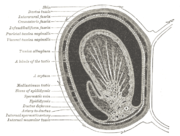
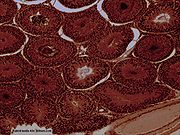
, the testis of amniote
s and some teleost fish, contains very fine coiled tubes called seminiferous tubules
. The tubules are lined with a layer of cells (germ cells) that from puberty
into old age, develop into sperm
cells
(also known as spermatozoa or male gametes).
The developing sperm travel through the seminiferous tubules to the rete testis
located in the mediastinum testis
, to the efferent ducts
, and then to the epididymis
where newly-created sperm cells mature (see spermatogenesis
). The sperm move into the vas deferens
, and are eventually expelled through the urethra
and out of the urethral orifice
through muscular contractions.
Amphibian
s and most fish do not possess seminiferous tubules. Instead, the sperm are produced in spherical structures called sperm ampullae. These are seasonal structures, releasing their contents during the breeding season, and then being reabsorbed by the body. Before the next breeding season, new sperm ampullae begin to form and ripen. The ampullae are otherwise essentially identical to the seminiferous tubules in higher vertebrates, including the same range of cell types.
:
Between tubules (interstitial cells)
. The layers of tissue enclosing each testicle are derived from the layers of the anterior abdominal wall. Notably, the cremasteric muscle arises from the internal oblique muscle.
The function of the blood–testis barrier (red highlight in diagram above) may be to prevent an auto-immune reaction. Mature sperm (and their antigen
s) arise long after immune tolerance is established in infancy. Therefore, since sperm are antigenically different from self tissue, a male animal can react immunologically to his own sperm. In fact, he is capable of making antibodies against them.
Injection of sperm antigens causes inflammation of the testis (auto-immune orchitis) and reduced fertility. Thus, the blood–testis barrier may reduce the likelihood that sperm proteins will induce an immune response, reducing fertility and so progeny.
is less efficient at lower and higher temperatures. This is presumably why the testes are located outside the body. There are a number of mechanisms to maintain the testes at the optimum temperature.
. When this muscle contracts, the cord is shortened and the testicle is moved closer up toward the body, which provides slightly more warmth to maintain optimal testicular temperature. When cooling is required, the cremasteric muscle relaxes and the testicle is lowered away from the warm body and is able to cool. This phenomenon is known as the cremasteric reflex
. It also occurs in response to stress (the testicles rise up toward the body in an effort to protect them in a fight). There are persistent reports that relaxation indicates approach of orgasm. There is a noticeable tendency to also retract during orgasm.
The testicles can also be lifted voluntarily using the pubococcygeus muscle, which partially activates related muscles. This can sometimes be triggered by tightening or sucking in the stomach or abdomen.
This movement will also happen spontaneously in some men when they unintentionally contract their abdominal or PC muscles.
or testes. In humans, starting at about week 4 the gonadal rudiments are present within the intermediate mesoderm
adjacent to the developing kidneys. At about week 6, sex cords develop within the forming testes. These are made up of early Sertoli cells that surround and nurture the germ cell
s that migrate into the gonads shortly before sex determination begins. In males, the sex-specific gene SRY
that is found on the Y-chromosome initiates sex determination by downstream regulation of sex-determining factors, (such as GATA4, SOX9 and AMH), which leads to development of the male phenotype, including directing development of the early bipotential gonad down the male path of development.
Testes follow the "path of descent" from high in the posterior fetal abdomen to the inguinal ring and beyond to the inguinal canal
and into the scrotum
. In most cases (97% full-term, 70% preterm), both testes have descended by birth. In most other cases, only one testis fails to descend (cryptorchidism
) and that will probabaly express itself within a year.
. Size depends on lytic function, sperm production (amount of spermatogenisis present in testis), interstitial fluid
, and Sertoli cell
fluid production. After puberty, the volume of the testes can be increased by over 500% as compared to the pre-pubertal size. Testicles are fully descended before one reaches puberty.
n land mammals, the large group of mammals that includes humans, have externalized testes. Their testes function best at temperatures lower than their core body temperature. Their testes are located outside of the body, suspended by the spermatic cord within the scrotum. The testes of the non-boreotherian mammals such as the monotremes, armadillo
s, sloth
s, elephant
s remain within the abdomen. There are also some Boreoeutherian mammals with internal testes, such as the rhinoceros.
Marine boreotherian mammals, such as whales and dolphins, also have internal testes, but it has recently been shown (e.g., for dolphins) that they use elaborate vascular networks to provide the necessary temperature lowering for optimum function. As external testes would increase drag, many boreotherian aquatic mammals have internal testes which are kept cool by special circulatory systems that cool the arterial blood going to the testes by placing the arteries near veins bringing cooled venous blood from the skin.
There are several hypotheses why most boreotherian mammals have external testes which operate best at a temperature that is slightly less than the core body temperature, e.g. that it is stuck with enzymes evolved in a colder temperature due to external testes evolving for different reasons, that the lower temperature of the testes simply is more efficient for sperm production.
1) More efficient. The classic hypothesis is that cooler temperature of the testes allows for more efficient fertile spermatogenesis
. In other words, there are no possible enzymes operating at normal core body temperature that are as efficient as the ones evolved, at least none appearing in our evolution so far.
The early mammals had lower body temperatures and thus their testes worked efficiently within their body. However it is argued that boreotherian mammals have higher body temperatures than the other mammals and had to develop external testes to keep them cool. It is argued that those mammals with internal testes, such as the monotremes, armadillos, sloths, elephants, and rhinoceroses, have a lower core body temperatures than those mammals with external testes.
However, the question remains why birds despite having very high core body temperatures have internal testes and did not evolve external testes. It was once theorized that birds used their air sacs to cool the testes internally, but later studies revealed that birds' testes are able to function at core body temperature.
Some mammals which have seasonal breeding cycles keep their testes internal until the breeding season at which point their testes descend and increase in size and become external.
2) Irreversible adaptation to sperm competition. It has been suggested that the ancestor of the boreoeutherian mammals was a small mammal that required very large testes (perhaps rather like those of a hamster
) for sperm competition
and thus had to place its testes outside the body. This led to enzymes involved in spermatogenesis, spermatogenic DNA polymerase beta and recombinase activities evolving a unique temperature optimum, slightly less than core body temperature. When the boreoeutherian mammals then diversified into forms that were larger and/or did not require intense sperm competition they still produced enzymes that operated best at cooler temperatures and had to keep their testes outside the body. This position is made less parsimonious by the fact that the kangaroo
, a non-boreoeutherian mammal, has external testicles. The ancestors of kangaroos might, separately from boreotherian mammals, have also been subject to heavy sperm competition and thus developed external testes, however, kangaroo external testes are suggestive of a possible adaptive function for external testes in large animals.
3) Protection from abdominal cavity pressure changes. One argument for the evolution of external testes is that it protects the testes from abdominal cavity pressure changes caused by jumping and galloping.
for survival. The testes of the right whale
are likely to be the largest of any animal, each weighing around 500 kg (1,100 lb).
Testis weight also varies in seasonal breeders like deer
and horses. The change is related to changes in testosterone production.
than they are normally accustomed to, they can be shrunk by competing against their intrinsic hormonal function through the use of externally administered steroidal hormones. Steroids taken for muscle enhancement (especially anabolic steroids) often have the undesired side effect of testicular shrinkage.
Similarly, stimulation of testicular functions via gonadotropic-like hormones
may enlarge their size. Testes may shrink or atrophy during hormone replacement therapy
or through chemical castration
.
In all cases, the loss in testes volume corresponds with a loss of spermatogenesis.
prescribed the ligation (tying off) of the left testicle in men wishing to have boys.
. The Latin
word "testis", witness, was used in the firmly established legal principle "Testis unus, testis nullus" (one witness [equals] no witness), meaning that testimony by any one person in court was to be disregarded unless corroborated by the testimony of at least another. This led to the common practice of producing two witnesses, bribed to testify the same way in cases of lawsuits with ulterior motives. Since such "witnesses" always came in pairs, the meaning was accordingly extended, often in the diminutive (testiculus, testiculi).
Another theory says that testis is influenced by a loan translation, from Greek parastatēs "defender (in law), supporter" that is "two glands side by side".
.
Gonad
The gonad is the organ that makes gametes. The gonads in males are the testes and the gonads in females are the ovaries. The product, gametes, are haploid germ cells. For example, spermatozoon and egg cells are gametes...
in animal
Animal
Animals are a major group of multicellular, eukaryotic organisms of the kingdom Animalia or Metazoa. Their body plan eventually becomes fixed as they develop, although some undergo a process of metamorphosis later on in their life. Most animals are motile, meaning they can move spontaneously and...
s. Like the ovaries
Ovary
The ovary is an ovum-producing reproductive organ, often found in pairs as part of the vertebrate female reproductive system. Ovaries in anatomically female individuals are analogous to testes in anatomically male individuals, in that they are both gonads and endocrine glands.-Human anatomy:Ovaries...
to which they are homologous
Homology (biology)
Homology forms the basis of organization for comparative biology. In 1843, Richard Owen defined homology as "the same organ in different animals under every variety of form and function". Organs as different as a bat's wing, a seal's flipper, a cat's paw and a human hand have a common underlying...
, testes are components of both the reproductive system
Reproductive system
The reproductive system or genital system is a system of organs within an organism which work together for the purpose of reproduction. Many non-living substances such as fluids, hormones, and pheromones are also important accessories to the reproductive system. Unlike most organ systems, the sexes...
and the endocrine system
Endocrine system
In physiology, the endocrine system is a system of glands, each of which secretes a type of hormone directly into the bloodstream to regulate the body. The endocrine system is in contrast to the exocrine system, which secretes its chemicals using ducts. It derives from the Greek words "endo"...
. The primary functions of the testes are to produce sperm
Spermatozoon
A spermatozoon is a motile sperm cell, or moving form of the haploid cell that is the male gamete. A spermatozoon joins an ovum to form a zygote...
(spermatogenesis
Spermatogenesis
Spermatogenesis is the process by which male primary germ cells undergo division, and produce a number of cells termed spermatogonia, from which the primary spermatocytes are derived. Each primary spermatocyte divides into two secondary spermatocytes, and each secondary spermatocyte into two...
) and to produce androgens, primarily testosterone
Testosterone
Testosterone is a steroid hormone from the androgen group and is found in mammals, reptiles, birds, and other vertebrates. In mammals, testosterone is primarily secreted in the testes of males and the ovaries of females, although small amounts are also secreted by the adrenal glands...
.
Both functions of the testicle are influenced by gonadotropic hormones produced by the anterior pituitary. Luteinizing hormone
Luteinizing hormone
Luteinizing hormone is a hormone produced by the anterior pituitary gland. In females, an acute rise of LH called the LH surge triggers ovulation and development of the corpus luteum. In males, where LH had also been called interstitial cell-stimulating hormone , it stimulates Leydig cell...
(LH) results in testosterone release. The presence of both testosterone and follicle-stimulating hormone
Follicle-stimulating hormone
Follicle-stimulating hormone is a hormone found in humans and other animals. It is synthesized and secreted by gonadotrophs of the anterior pituitary gland. FSH regulates the development, growth, pubertal maturation, and reproductive processes of the body. FSH and Luteinizing hormone act...
(FSH) is needed to support spermatogenesis.
External appearance
Almost all healthy male vertebrateVertebrate
Vertebrates are animals that are members of the subphylum Vertebrata . Vertebrates are the largest group of chordates, with currently about 58,000 species described. Vertebrates include the jawless fishes, bony fishes, sharks and rays, amphibians, reptiles, mammals, and birds...
s have two testes. They are typically of similar size, although in shark
Shark
Sharks are a type of fish with a full cartilaginous skeleton and a highly streamlined body. The earliest known sharks date from more than 420 million years ago....
s, that on the right side is usually larger, and in many bird and mammal species, the left may be the larger. The primitive jawless fish have only a single testis, located in the midline of the body, although even this forms from the fusion of paired structures in the embryo.
In mammal
Mammal
Mammals are members of a class of air-breathing vertebrate animals characterised by the possession of endothermy, hair, three middle ear bones, and mammary glands functional in mothers with young...
s, the testes are often contained within an extension of the abdomen
Abdomen
In vertebrates such as mammals the abdomen constitutes the part of the body between the thorax and pelvis. The region enclosed by the abdomen is termed the abdominal cavity...
called the scrotum
Scrotum
In some male mammals the scrotum is a dual-chambered protuberance of skin and muscle containing the testicles and divided by a septum. It is an extension of the perineum, and is located between the penis and anus. In humans and some other mammals, the base of the scrotum becomes covered with curly...
. In mammals with external testes it is most common for one testicle to hang lower than the other. While the size of the testicle varies, it is estimated that 21.9% of men have their higher testicle being their left, while 27.3% of men have reported to have equally positioned testicles. This is due to differences in the vascular anatomical structure on the right and left sides.
In healthy European adult human males, average testicular volume is 18 cm³ per testis, with normal size ranging from 12 cm³ to 30 cm³. The average testicle size after puberty measures up to around 2 inches long, 0.8 inches in breadth, and 1.2 inches in height (5 x 2 x 3 cm).
Measurement in the living adult is done in two basic ways:
- comparing the testicle with ellipsoids of known sizes (orchidometerOrchidometerAn orchidometer is a medical instrument used to measure the volume of the testicles.The orchidometer was introduced in 1966 by pediatric endocrinologist Prof. Dr. Dr. hc. Andrea Prader of the University of Zurich. It consists of a string of twelve numbered wooden or plastic beads of increasing...
). - measuring the length, depth and width with a ruler, a pair of calipers or ultrasoundUltrasoundUltrasound is cyclic sound pressure with a frequency greater than the upper limit of human hearing. Ultrasound is thus not separated from "normal" sound based on differences in physical properties, only the fact that humans cannot hear it. Although this limit varies from person to person, it is...
imaging.
The volume is then calculated using the formula for the volume of an ellipsoid: 4/3 π × (length/2) × (width/2) × (depth/2).
Internal structure
Duct system
Under a tough membranous shell, the tunica albugineaTunica albuginea (testicles)
The Tunica Albuginea is the fibrous covering of the testis.It is a dense blue-white membrane, composed of bundles of white fibrous tissue which interlace in every direction....
, the testis of amniote
Amniote
The amniotes are a group of tetrapods that have a terrestrially adapted egg. They include synapsids and sauropsids , as well as their fossil ancestors. Amniote embryos, whether laid as eggs or carried by the female, are protected and aided by several extensive membranes...
s and some teleost fish, contains very fine coiled tubes called seminiferous tubules
Seminiferous tubules
Seminiferous tubules are located in the testes, and are the specific location of meiosis, and the subsequent creation of gametes, namely spermatozoa....
. The tubules are lined with a layer of cells (germ cells) that from puberty
Puberty
Puberty is the process of physical changes by which a child's body matures into an adult body capable of reproduction, as initiated by hormonal signals from the brain to the gonads; the ovaries in a girl, the testes in a boy...
into old age, develop into sperm
Sperm
The term sperm is derived from the Greek word sperma and refers to the male reproductive cells. In the types of sexual reproduction known as anisogamy and oogamy, there is a marked difference in the size of the gametes with the smaller one being termed the "male" or sperm cell...
cells
Cell (biology)
The cell is the basic structural and functional unit of all known living organisms. It is the smallest unit of life that is classified as a living thing, and is often called the building block of life. The Alberts text discusses how the "cellular building blocks" move to shape developing embryos....
(also known as spermatozoa or male gametes).
The developing sperm travel through the seminiferous tubules to the rete testis
Rete testis
Rete testis is an anastomosing network of delicate tubules located in the hilum of the testicle that carries sperm from the seminiferous tubules to the vasa efferentia....
located in the mediastinum testis
Mediastinum testis
The mediastinum testis is a network of fibrous connective tissue that extends from the upper to near the lower extremity of the testis, and is wider above than below....
, to the efferent ducts
Efferent ducts
The efferent ducts connect the rete testis with the initial section of the epididymis.There are two basic designs for efferent ductule structure:...
, and then to the epididymis
Epididymis
The epididymis is part of the male reproductive system and is present in all male amniotes. It is a narrow, tightly-coiled tube connecting the efferent ducts from the rear of each testicle to its vas deferens. A similar, but probably non-homologous, structure is found in cartilaginous...
where newly-created sperm cells mature (see spermatogenesis
Spermatogenesis
Spermatogenesis is the process by which male primary germ cells undergo division, and produce a number of cells termed spermatogonia, from which the primary spermatocytes are derived. Each primary spermatocyte divides into two secondary spermatocytes, and each secondary spermatocyte into two...
). The sperm move into the vas deferens
Vas deferens
The vas deferens , also called ductus deferens, , is part of the male anatomy of many vertebrates; they transport sperm from the epididymis in anticipation of ejaculation....
, and are eventually expelled through the urethra
Urethra
In anatomy, the urethra is a tube that connects the urinary bladder to the genitals for the removal of fluids out of the body. In males, the urethra travels through the penis, and carries semen as well as urine...
and out of the urethral orifice
External urethral orifice (male)
The external urethral orifice is the external opening or meatus of the urethra, normally placed at the tip of glans penis; it presents as a vertical slit, possibly bounded on either side by two small labia-like projections, In some cases the slit may be more rounded. This occurs naturally in some...
through muscular contractions.
Amphibian
Amphibian
Amphibians , are a class of vertebrate animals including animals such as toads, frogs, caecilians, and salamanders. They are characterized as non-amniote ectothermic tetrapods...
s and most fish do not possess seminiferous tubules. Instead, the sperm are produced in spherical structures called sperm ampullae. These are seasonal structures, releasing their contents during the breeding season, and then being reabsorbed by the body. Before the next breeding season, new sperm ampullae begin to form and ripen. The ampullae are otherwise essentially identical to the seminiferous tubules in higher vertebrates, including the same range of cell types.
Primary Cell Types
Within the seminiferous tubulesSeminiferous tubules
Seminiferous tubules are located in the testes, and are the specific location of meiosis, and the subsequent creation of gametes, namely spermatozoa....
:
- Here, germ cells develop into spermatogonia, spermatocytes, spermatids and spermatozoonSpermatozoonA spermatozoon is a motile sperm cell, or moving form of the haploid cell that is the male gamete. A spermatozoon joins an ovum to form a zygote...
through the process of spermatogenesis. The gametes contain DNA for fertilization of an ovum
- Sertoli cells - the true epithelium of the seminiferous epithelium, critical for the support of germ cell development into spermatozoa. Sertoli cells secrete inhibin.
Between tubules (interstitial cells)
- Leydig cells - cells localized between seminiferous tubulesSeminiferous tubulesSeminiferous tubules are located in the testes, and are the specific location of meiosis, and the subsequent creation of gametes, namely spermatozoa....
that produce and secrete testosteroneTestosteroneTestosterone is a steroid hormone from the androgen group and is found in mammals, reptiles, birds, and other vertebrates. In mammals, testosterone is primarily secreted in the testes of males and the ovaries of females, although small amounts are also secreted by the adrenal glands...
and other androgenAndrogenAndrogen, also called androgenic hormone or testoid, is the generic term for any natural or synthetic compound, usually a steroid hormone, that stimulates or controls the development and maintenance of male characteristics in vertebrates by binding to androgen receptors...
s important for sexual development and pubertyPubertyPuberty is the process of physical changes by which a child's body matures into an adult body capable of reproduction, as initiated by hormonal signals from the brain to the gonads; the ovaries in a girl, the testes in a boy...
, secondary sexual characteristics like facial hair, sexual behavior and libidoLibidoLibido refers to a person's sex drive or desire for sexual activity. The desire for sex is an aspect of a person's sexuality, but varies enormously from one person to another, and it also varies depending on circumstances at a particular time. A person who has extremely frequent or a suddenly...
, supporting spermatogenesis and erectile functionErectionPenile erection is a physiological phenomenon where the penis becomes enlarged and firm. Penile erection is the result of a complex interaction of psychological, neural, vascular and endocrine factors, and is usually, though not exclusively, associated with sexual arousal...
. Testosterone also controls testicular volume.
- Also present are:
- Immature Leydig cells
- Interstitial macrophages and epithelial cells.
Blood supply and lymphatic drainage
Blood supply and lymphatic drainage of the testes and scrotum are distinct:- The paired testicular arteries arise directly from the abdominal aortaAbdominal aortaThe abdominal aorta is the largest artery in the abdominal cavity. As part of the aorta, it is a direct continuation of the descending aorta .-Path:...
and descend through the inguinal canalInguinal canalThe inguinal canal is a passage in the anterior abdominal wall which in men conveys the spermatic cord and in women the round ligament. The inguinal canal is larger and more prominent in men.-Site:...
, while the scrotum and the rest of the external genitalia is supplied by the internal pudendal arteryInternal pudendal arteryThe internal pudendal artery is an artery that branches off the internal iliac artery, providing blood to the external genitalia.The internal pudendal artery is the terminal branch of the anterior trunk of the internal iliac artery...
(itself a branch of the internal iliac arteryInternal iliac arteryThe internal iliac artery is the main artery of the pelvis.-Structure:The internal iliac artery supplies the walls and viscera of the pelvis, the buttock, the reproductive organs, and the medial compartment of the thigh...
). - The testis has collateral blood supply from 1. the cremasteric arteryCremasteric arteryThe cremasteric artery is a branch of the Inferior epigastric artery which accompanies the spermatic cord, and supplies the Cremaster and other coverings of the cord, anastomosing with the testicular artery ....
(a branch of the inferior epigastric arteryInferior epigastric arteryIn human anatomy, inferior epigastric artery refers to the artery that arises from the external iliac artery and anastomoses with the superior epigastric artery...
, which is a branch of the external iliac arteryExternal iliac arteryThe external iliac arteries are two major arteries which bifurcate off the common iliac arteries anterior to the sacroiliac joint of the pelvis. They proceed anterior and inferior along the medial border of the psoas major muscles...
), and 2. the artery to the ductus deferensArtery to the ductus deferensThe artery to the ductus deferens, as its name suggests, is an artery in males that provides blood to the vas deferens.-Course:The artery usually arises from the anterior trunk of the superior vesical artery. It accompanies the vas deferens into the testis, where it anastomoses with the testicular...
(a branch of the inferior vesical arteryInferior vesical arteryThe inferior vesical artery is an artery in the pelvis that supplies the lower part of the bladder.-Structure:The inferior vesical artery is a branch of the anterior division of the internal iliac artery. It frequently arises in common with the middle rectal artery, and is distributed to the...
, which is a branch of the internal iliac arteryInternal iliac arteryThe internal iliac artery is the main artery of the pelvis.-Structure:The internal iliac artery supplies the walls and viscera of the pelvis, the buttock, the reproductive organs, and the medial compartment of the thigh...
). Therefore, if the testicular artery is ligated, e.g., during a Fowler-Stevens orchiopexyOrchiopexyOrchiopexy is a surgery to move an undescended testicle into the scrotum and permanently fix it there. It is performed by a pediatric urologist or surgeon on boys with cryptorchidism, typically before they reach the age of two...
for a high undescended testis, the testis will usually survive on these other blood supplies. - Lymphatic drainage of the testes follows the testicular arteries back to the paraaortic lymph nodes, while lymph from the scrotum drains to the inguinal lymph nodes.
Layers
Many anatomical features of the adult testis reflect its developmental origin in the abdomenAbdomen
In vertebrates such as mammals the abdomen constitutes the part of the body between the thorax and pelvis. The region enclosed by the abdomen is termed the abdominal cavity...
. The layers of tissue enclosing each testicle are derived from the layers of the anterior abdominal wall. Notably, the cremasteric muscle arises from the internal oblique muscle.
The blood–testis barrier
Large molecules cannot pass from the blood into the lumen of a seminiferous tubule due to the presence of tight junctions between adjacent Sertoli cells. The spermatogonia are in the basal compartment (deep to the level of the tight junctions) and the more mature forms such as primary and secondary spermatocytes and spermatids are in the adluminal compartment.The function of the blood–testis barrier (red highlight in diagram above) may be to prevent an auto-immune reaction. Mature sperm (and their antigen
Antigen
An antigen is a foreign molecule that, when introduced into the body, triggers the production of an antibody by the immune system. The immune system will then kill or neutralize the antigen that is recognized as a foreign and potentially harmful invader. These invaders can be molecules such as...
s) arise long after immune tolerance is established in infancy. Therefore, since sperm are antigenically different from self tissue, a male animal can react immunologically to his own sperm. In fact, he is capable of making antibodies against them.
Injection of sperm antigens causes inflammation of the testis (auto-immune orchitis) and reduced fertility. Thus, the blood–testis barrier may reduce the likelihood that sperm proteins will induce an immune response, reducing fertility and so progeny.
Temperature regulation
The testes work best at temperatures slightly less than core body temperature. The spermatogenesisSpermatogenesis
Spermatogenesis is the process by which male primary germ cells undergo division, and produce a number of cells termed spermatogonia, from which the primary spermatocytes are derived. Each primary spermatocyte divides into two secondary spermatocytes, and each secondary spermatocyte into two...
is less efficient at lower and higher temperatures. This is presumably why the testes are located outside the body. There are a number of mechanisms to maintain the testes at the optimum temperature.
Cremasteric muscle
The cremasteric muscle is part of the spermatic cordSpermatic cord
The spermatic cord is the name given to the cord-like structure in males formed by the ductus deferens and surrounding tissue that run from the abdomen down to each testicle.-Contents of spermatic cord:...
. When this muscle contracts, the cord is shortened and the testicle is moved closer up toward the body, which provides slightly more warmth to maintain optimal testicular temperature. When cooling is required, the cremasteric muscle relaxes and the testicle is lowered away from the warm body and is able to cool. This phenomenon is known as the cremasteric reflex
Cremasteric reflex
The cremasteric reflex is a superficial reflex observed in human males.This reflex is elicited by lightly stroking the superior and medial part of the thigh...
. It also occurs in response to stress (the testicles rise up toward the body in an effort to protect them in a fight). There are persistent reports that relaxation indicates approach of orgasm. There is a noticeable tendency to also retract during orgasm.
The testicles can also be lifted voluntarily using the pubococcygeus muscle, which partially activates related muscles. This can sometimes be triggered by tightening or sucking in the stomach or abdomen.
This movement will also happen spontaneously in some men when they unintentionally contract their abdominal or PC muscles.
Development
There are two phases in which the testes grow substantially; namely in embryonic and pubertal age.Embryonic
During mammalian development, the gonads are at first capable of becoming either ovariesOvary
The ovary is an ovum-producing reproductive organ, often found in pairs as part of the vertebrate female reproductive system. Ovaries in anatomically female individuals are analogous to testes in anatomically male individuals, in that they are both gonads and endocrine glands.-Human anatomy:Ovaries...
or testes. In humans, starting at about week 4 the gonadal rudiments are present within the intermediate mesoderm
Intermediate mesoderm
Intermediate mesenchyme or intermediate mesoderm is a type of mesoderm that is located between the paraxial mesoderm and the lateral plate.It develops into the part of the urogenital system * forms of urogenital system...
adjacent to the developing kidneys. At about week 6, sex cords develop within the forming testes. These are made up of early Sertoli cells that surround and nurture the germ cell
Germ cell
A germ cell is any biological cell that gives rise to the gametes of an organism that reproduces sexually. In many animals, the germ cells originate near the gut of an embryo and migrate to the developing gonads. There, they undergo cell division of two types, mitosis and meiosis, followed by...
s that migrate into the gonads shortly before sex determination begins. In males, the sex-specific gene SRY
SRY
SRY is a sex-determining gene on the Y chromosome in the therians .This intronless gene encodes a transcription factor that is a member of the SOX gene family of DNA-binding proteins...
that is found on the Y-chromosome initiates sex determination by downstream regulation of sex-determining factors, (such as GATA4, SOX9 and AMH), which leads to development of the male phenotype, including directing development of the early bipotential gonad down the male path of development.
Testes follow the "path of descent" from high in the posterior fetal abdomen to the inguinal ring and beyond to the inguinal canal
Inguinal canal
The inguinal canal is a passage in the anterior abdominal wall which in men conveys the spermatic cord and in women the round ligament. The inguinal canal is larger and more prominent in men.-Site:...
and into the scrotum
Scrotum
In some male mammals the scrotum is a dual-chambered protuberance of skin and muscle containing the testicles and divided by a septum. It is an extension of the perineum, and is located between the penis and anus. In humans and some other mammals, the base of the scrotum becomes covered with curly...
. In most cases (97% full-term, 70% preterm), both testes have descended by birth. In most other cases, only one testis fails to descend (cryptorchidism
Cryptorchidism
Cryptorchidism is the absence of one or both testes from the scrotum. It is the most common birth defect regarding male genitalia. In unique cases, cryptorchidism can develop later in life, often as late as young adulthood. About 3% of full-term and 30% of premature infant boys are born with at...
) and that will probabaly express itself within a year.
Pubertal
The testes grow in response to the start of spermatogenesisSpermatogenesis
Spermatogenesis is the process by which male primary germ cells undergo division, and produce a number of cells termed spermatogonia, from which the primary spermatocytes are derived. Each primary spermatocyte divides into two secondary spermatocytes, and each secondary spermatocyte into two...
. Size depends on lytic function, sperm production (amount of spermatogenisis present in testis), interstitial fluid
Interstitial fluid
Interstitial fluid is a solution that bathes and surrounds the cells of multicellular animals. It is the main component of the extracellular fluid, which also includes plasma and transcellular fluid...
, and Sertoli cell
Sertoli cell
A Sertoli cell is a 'nurse' cell of the testes that is part of a seminiferous tubule.It is activated by follicle-stimulating hormone and has FSH-receptor on its membranes.-Functions:...
fluid production. After puberty, the volume of the testes can be increased by over 500% as compared to the pre-pubertal size. Testicles are fully descended before one reaches puberty.
External testes
The basal condition for mammals is to have internal testes. Only the BoreoeutheriaBoreoeutheria
Boreoeutheria is a clade of placental mammals that is composed of the sister taxa Laurasiatheria and Euarchontoglires...
n land mammals, the large group of mammals that includes humans, have externalized testes. Their testes function best at temperatures lower than their core body temperature. Their testes are located outside of the body, suspended by the spermatic cord within the scrotum. The testes of the non-boreotherian mammals such as the monotremes, armadillo
Armadillo
Armadillos are New World placental mammals, known for having a leathery armor shell. Dasypodidae is the only surviving family in the order Cingulata, part of the superorder Xenarthra along with the anteaters and sloths. The word armadillo is Spanish for "little armored one"...
s, sloth
Sloth
Sloths are the six species of medium-sized mammals belonging to the families Megalonychidae and Bradypodidae , part of the order Pilosa and therefore related to armadillos and anteaters, which sport a similar set of specialized claws.They are arboreal residents of the jungles of Central and South...
s, elephant
Elephant
Elephants are large land mammals in two extant genera of the family Elephantidae: Elephas and Loxodonta, with the third genus Mammuthus extinct...
s remain within the abdomen. There are also some Boreoeutherian mammals with internal testes, such as the rhinoceros.
Marine boreotherian mammals, such as whales and dolphins, also have internal testes, but it has recently been shown (e.g., for dolphins) that they use elaborate vascular networks to provide the necessary temperature lowering for optimum function. As external testes would increase drag, many boreotherian aquatic mammals have internal testes which are kept cool by special circulatory systems that cool the arterial blood going to the testes by placing the arteries near veins bringing cooled venous blood from the skin.
There are several hypotheses why most boreotherian mammals have external testes which operate best at a temperature that is slightly less than the core body temperature, e.g. that it is stuck with enzymes evolved in a colder temperature due to external testes evolving for different reasons, that the lower temperature of the testes simply is more efficient for sperm production.
1) More efficient. The classic hypothesis is that cooler temperature of the testes allows for more efficient fertile spermatogenesis
Spermatogenesis
Spermatogenesis is the process by which male primary germ cells undergo division, and produce a number of cells termed spermatogonia, from which the primary spermatocytes are derived. Each primary spermatocyte divides into two secondary spermatocytes, and each secondary spermatocyte into two...
. In other words, there are no possible enzymes operating at normal core body temperature that are as efficient as the ones evolved, at least none appearing in our evolution so far.
The early mammals had lower body temperatures and thus their testes worked efficiently within their body. However it is argued that boreotherian mammals have higher body temperatures than the other mammals and had to develop external testes to keep them cool. It is argued that those mammals with internal testes, such as the monotremes, armadillos, sloths, elephants, and rhinoceroses, have a lower core body temperatures than those mammals with external testes.
However, the question remains why birds despite having very high core body temperatures have internal testes and did not evolve external testes. It was once theorized that birds used their air sacs to cool the testes internally, but later studies revealed that birds' testes are able to function at core body temperature.
Some mammals which have seasonal breeding cycles keep their testes internal until the breeding season at which point their testes descend and increase in size and become external.
2) Irreversible adaptation to sperm competition. It has been suggested that the ancestor of the boreoeutherian mammals was a small mammal that required very large testes (perhaps rather like those of a hamster
Hamster
Hamsters are rodents belonging to the subfamily Cricetinae. The subfamily contains about 25 species, classified in six or seven genera....
) for sperm competition
Sperm competition
Sperm competition is a term used to refer to the competitive process between spermatozoa of two different males to fertilize an egg of a lone female. Competition occurs whenever females engage in promiscuous mating to increase their chances in producing more viable offspring...
and thus had to place its testes outside the body. This led to enzymes involved in spermatogenesis, spermatogenic DNA polymerase beta and recombinase activities evolving a unique temperature optimum, slightly less than core body temperature. When the boreoeutherian mammals then diversified into forms that were larger and/or did not require intense sperm competition they still produced enzymes that operated best at cooler temperatures and had to keep their testes outside the body. This position is made less parsimonious by the fact that the kangaroo
Kangaroo
A kangaroo is a marsupial from the family Macropodidae . In common use the term is used to describe the largest species from this family, especially those of the genus Macropus, Red Kangaroo, Antilopine Kangaroo, Eastern Grey Kangaroo and Western Grey Kangaroo. Kangaroos are endemic to the country...
, a non-boreoeutherian mammal, has external testicles. The ancestors of kangaroos might, separately from boreotherian mammals, have also been subject to heavy sperm competition and thus developed external testes, however, kangaroo external testes are suggestive of a possible adaptive function for external testes in large animals.
3) Protection from abdominal cavity pressure changes. One argument for the evolution of external testes is that it protects the testes from abdominal cavity pressure changes caused by jumping and galloping.
Testicular size
Testicular size as a proportion of body weight varies widely. In the mammalian kingdom, there is a tendency for testicular size to correspond with multiple mates (e.g., harems, polygamy). Production of testicular output sperm and spermatic fluid is also larger in polygamous animals, possibly a spermatogenic competitionSperm competition
Sperm competition is a term used to refer to the competitive process between spermatozoa of two different males to fertilize an egg of a lone female. Competition occurs whenever females engage in promiscuous mating to increase their chances in producing more viable offspring...
for survival. The testes of the right whale
Right whale
Right whales are three species of large baleen whales consisting of two genera in the family Balaenidae of order Cetacea. Their bodies are very dark gray or black and rotund....
are likely to be the largest of any animal, each weighing around 500 kg (1,100 lb).
Testis weight also varies in seasonal breeders like deer
Deer
Deer are the ruminant mammals forming the family Cervidae. Species in the Cervidae family include white-tailed deer, elk, moose, red deer, reindeer, fallow deer, roe deer and chital. Male deer of all species and female reindeer grow and shed new antlers each year...
and horses. The change is related to changes in testosterone production.
Physical injury
- The testicles are well-known to be very sensitive to impact and injury. The pain involved travels up from each testicle into the abdominal cavity, via the spermatic plexusSpermatic plexusThe spermatic plexus is derived from the renal plexus, receiving branches from the aortic plexus. It accompanies the internal spermatic artery to the testis....
, which is the primary nerve of each testicle. - Testicular torsionTesticular torsionTesticular torsion is when the spermatic cord to a testicle twists, cutting off the blood supply. The most common symptom is acute testicular pain and the most common underlying cause is a congenital malformation known as a "bell-clapper deformity". The diagnosis is often made clinically but if it...
is a medical emergency. Treatment within 4-6 hours of onset can prevent necrosis of the testis. - Testicular ruptureTesticular ruptureTesticular rupture is a rip or tear in the tunica albuginea resulting in extrusion of the testicular contents. It is a rare complication of testicular trauma. It may cause pain, scrotal swelling, nausea and vomiting. Treatment consists of surgical exploration with repair of the defect.-External...
is a medical emergency caused by blunt force impact, sharp edge, or piercing impact to one or both testicles, which can lead to necrosis of the testis in as little as 30 minutes. - Penetrating injuries to the scrotum may cause castrationCastrationCastration is any action, surgical, chemical, or otherwise, by which a male loses the functions of the testicles or a female loses the functions of the ovaries.-Humans:...
, or physical separation or destruction of the testes, possibly along with part or all of the penis, which results in total sterility if the testicles are not reattached quickly.
Diseases and conditions that affect the testes
Some prominent conditions and differential diagnoses include:- Testicular cancerTesticular cancerTesticular cancer is cancer that develops in the testicles, a part of the male reproductive system.In the United States, between 7,500 and 8,000 diagnoses of testicular cancer are made each year. In the UK, approximately 2,000 men are diagnosed each year. Over his lifetime, a man's risk of...
and other neoplasms To improve the chances of catching possible cases of testicular cancerTesticular cancerTesticular cancer is cancer that develops in the testicles, a part of the male reproductive system.In the United States, between 7,500 and 8,000 diagnoses of testicular cancer are made each year. In the UK, approximately 2,000 men are diagnosed each year. Over his lifetime, a man's risk of...
or other health issues early, regular testicular self-examinationTesticular self-examinationBecause testicular cancer is a significant killer of teenage boys and younger men , doctors recommend monthly self-examination.Men from puberty onwards should examine their testes after a hot shower or bath, when the scrotum is looser...
is recommended. - VaricoceleVaricoceleVaricocele , also known as varicoscele or varicose seal, is an abnormal enlargement of the vein that is in the scrotum draining the testicles. The testicular blood vessels originate in the abdomen and course down through the inguinal canal as part of the spermatic cord on their way to the testis...
, swollen vein(s) from the testes, usually affecting the left side, the testis usually being normal - Hydrocele testisHydrocele testisA hydrocele testis is an accumulation of clear fluid in the tunica vaginalis, the most internal of membranes containing a testicle. A primary hydrocele causes a painless enlargement in the scrotum on the affected side and is thought to be due to the defective absorption of fluid secreted between...
, swelling around testes caused by accumulation of clear liquid within a membranous sac, the testis usually being normal - Endocrine disorders can also affect the size and function of the testis.
- Certain inherited conditions involving mutations in key developmental genes also impair testicular descent, resulting in abdominal or inguinal testes which remain nonfunctional and may become cancerous. Other genetic conditions can result in the loss of the Wolffian ducts and allow for the persistence of Müllerian ducts.
- Bell Clapper Deformity is a deformity in which the testicle is not attached to the scrotal walls, and can rotate freely on the spermatic cord within the tunica vaginalis. This deformity has been linked to Testicular torsionTesticular torsionTesticular torsion is when the spermatic cord to a testicle twists, cutting off the blood supply. The most common symptom is acute testicular pain and the most common underlying cause is a congenital malformation known as a "bell-clapper deformity". The diagnosis is often made clinically but if it...
.
Effects of exogenous hormones
To some extent, it is possible to change testicular size. Short of direct injury or subjecting them to adverse conditions, e.g., higher temperatureTemperature
Temperature is a physical property of matter that quantitatively expresses the common notions of hot and cold. Objects of low temperature are cold, while various degrees of higher temperatures are referred to as warm or hot...
than they are normally accustomed to, they can be shrunk by competing against their intrinsic hormonal function through the use of externally administered steroidal hormones. Steroids taken for muscle enhancement (especially anabolic steroids) often have the undesired side effect of testicular shrinkage.
Similarly, stimulation of testicular functions via gonadotropic-like hormones
Gonadotropin
Gonadotropins are protein hormones secreted by gonadotrope cells of the pituitary gland of vertebrates. This is a family of proteins, which include the mammalian hormones follitropin , lutropin , placental chorionic gonadotropins hCG and eCG and chorionic gonadotropin , as well as at least two...
may enlarge their size. Testes may shrink or atrophy during hormone replacement therapy
Hormone therapy
Hormone therapy, or hormonal therapy is the use of hormones in medical treatment. Treatment with hormone antagonists may also referred to as hormonal therapy...
or through chemical castration
Chemical castration
Chemical castration is the administration of medication designed to reduce libido and sexual activity, usually in the hope of preventing rapists, child molesters and other sex offenders from repeating their crimes...
.
In all cases, the loss in testes volume corresponds with a loss of spermatogenesis.
Historical beliefs about testicles
In the Middle Ages, men who wanted a boy sometimes had their left testicle removed. This was because people believed that the right testicle made "boy" sperm and the left made "girl" sperm. As early as 330 BC, AristotleAristotle
Aristotle was a Greek philosopher and polymath, a student of Plato and teacher of Alexander the Great. His writings cover many subjects, including physics, metaphysics, poetry, theater, music, logic, rhetoric, linguistics, politics, government, ethics, biology, and zoology...
prescribed the ligation (tying off) of the left testicle in men wishing to have boys.
Etymology
The etymology of the word is based on Roman lawRoman law
Roman law is the legal system of ancient Rome, and the legal developments which occurred before the 7th century AD — when the Roman–Byzantine state adopted Greek as the language of government. The development of Roman law comprises more than a thousand years of jurisprudence — from the Twelve...
. The Latin
Latin
Latin is an Italic language originally spoken in Latium and Ancient Rome. It, along with most European languages, is a descendant of the ancient Proto-Indo-European language. Although it is considered a dead language, a number of scholars and members of the Christian clergy speak it fluently, and...
word "testis", witness, was used in the firmly established legal principle "Testis unus, testis nullus" (one witness [equals] no witness), meaning that testimony by any one person in court was to be disregarded unless corroborated by the testimony of at least another. This led to the common practice of producing two witnesses, bribed to testify the same way in cases of lawsuits with ulterior motives. Since such "witnesses" always came in pairs, the meaning was accordingly extended, often in the diminutive (testiculus, testiculi).
Another theory says that testis is influenced by a loan translation, from Greek parastatēs "defender (in law), supporter" that is "two glands side by side".
As a food
Testicles of a male calf or other livestock are used to comprise a dish, sometimes called Rocky Mountain oystersRocky Mountain oysters
Rocky Mountain oysters are bull calf testicles used as food.They are often deep-fried after being peeled, coated in flour, pepper and salt, and sometimes pounded flat...
.
See also
- AnorchiaAnorchiaAnorchia is a medical condition where both testes are absent at birth. Within a few weeks of fertilization, the embryo develops rudimentary sex organs, which are crucial to the development of the reproductive system...
- cryptorchidismCryptorchidismCryptorchidism is the absence of one or both testes from the scrotum. It is the most common birth defect regarding male genitalia. In unique cases, cryptorchidism can develop later in life, often as late as young adulthood. About 3% of full-term and 30% of premature infant boys are born with at...
(cryptorchismus) - PolyorchidismPolyorchidismPolyorchidism is the incidence of more than two testes. It is a very rare congenital disorder, with fewer than 100 cases reported in medical literature. The most common form is triorchidism, or tritestes, where three testes are present. The condition is usually asymptomatic...
- InfertilityInfertilityInfertility primarily refers to the biological inability of a person to contribute to conception. Infertility may also refer to the state of a woman who is unable to carry a pregnancy to full term...
- List of homologues of the human reproductive system
- OrchidometerOrchidometerAn orchidometer is a medical instrument used to measure the volume of the testicles.The orchidometer was introduced in 1966 by pediatric endocrinologist Prof. Dr. Dr. hc. Andrea Prader of the University of Zurich. It consists of a string of twelve numbered wooden or plastic beads of increasing...
- SpermatogenesisSpermatogenesisSpermatogenesis is the process by which male primary germ cells undergo division, and produce a number of cells termed spermatogonia, from which the primary spermatocytes are derived. Each primary spermatocyte divides into two secondary spermatocytes, and each secondary spermatocyte into two...
- Sterilization (surgical procedure)Sterilization (surgical procedure)Sterilization refers to any of a number of medical techniques that intentionally leave a person unable to reproduce. It is a method of birth control. For other causes of sterility, see infertility....
, vasectomyVasectomyVasectomy is a surgical procedure for male sterilization and/or permanent birth control. During the procedure, the vasa deferentia of a man are severed, and then tied/sealed in a manner such to prevent sperm from entering into the seminal stream... - EpididymisEpididymisThe epididymis is part of the male reproductive system and is present in all male amniotes. It is a narrow, tightly-coiled tube connecting the efferent ducts from the rear of each testicle to its vas deferens. A similar, but probably non-homologous, structure is found in cartilaginous...
- Spermatic cordSpermatic cordThe spermatic cord is the name given to the cord-like structure in males formed by the ductus deferens and surrounding tissue that run from the abdomen down to each testicle.-Contents of spermatic cord:...
- PenisPenisThe penis is a biological feature of male animals including both vertebrates and invertebrates...
- PerineumPerineumIn human anatomy, the perineum is a region of the body including the perineal body and surrounding structures...
- BollocksBollocks"Bollocks" is a word of Anglo-Saxon origin, meaning "testicles". The word is often used figuratively in British English and Hiberno-English, as a noun to mean "nonsense", an expletive following a minor accident or misfortune, or an adjective to mean "poor quality" or "useless"...
- WikiSaurus:testicles — the WikiSaurusWiktionaryWiktionary is a multilingual, web-based project to create a free content dictionary, available in 158 languages...
list of synonyms and slang words for testicles in many languages