
All Topics  
Gorilla

 
Gorilla

   Email Print
   Bookmark   Link


Gorilla


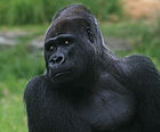
Gorillas are the largest of the living primate
Primate

A primate is a member of the biological order Primates , the group that contains lemurs, the Aye-aye, Lorisidaes, galagos, tarsiers, monkeys, and apes, with the last category including humans....
s. They are ground-dwelling herbivore
Herbivore

Herbivory is a form of predation in which an organism, known as an herbivore, heterotrophs principally autotrophs such as plants, algae and photosynthesizing bacteria....
s that inhabit the forest
Forest

File:Stara planina suma.jpgA forest is an area with a high density of trees. There are many definitions of a forest, based on various criteria....
s of Africa
Africa

Africa is the world's second-largest and second most-populous continent, after Asia. At about 30.2 million km? including adjacent islands, it covers 6% of the Earth's total surface area and 20.4% of the total land area....
. Gorillas are divided into two species and (still under debate as of 2008) either four or five subspecies. The DNA
DNA

Deoxyribonucleic acid is a nucleic acid that contains the genetics instructions used in the development and functioning of all known living organisms and some viruses....
 of gorillas is 98%–99% identical to that of a human
Human evolutionary genetics

Human evolutionary genetics studies how one human genome differs from the other, the evolutionary past that gave rise to it, and its current effects....
, and they are the next closest living relatives to human
Human

A human being, also human or man, is a member of a species of bipedalism primates in the family Hominidae . Mitochondrial DNA evidence indicates that modern humans originated in east Africa about 200,000 years ago....
s after the two chimpanzee
Chimpanzee

Chimpanzee, sometimes colloquially known as a chimp, is the common name for the two Extant taxon species of ape in the genus Pan where the Congo River forms the boundary between the native habitat of the two species:...
 species.

Gorillas live in tropical or subtropical forests. Although their range covers a small percentage of Africa, gorillas cover a wide range of elevations.


Discussion
Ask a question about 'Gorilla'
Start a new discussion about 'Gorilla'
Answer questions from other users
Full Discussion Forum


Recent Posts


Encyclopedia


Gorillas are the largest of the living primate
Primate

A primate is a member of the biological order Primates , the group that contains lemurs, the Aye-aye, Lorisidaes, galagos, tarsiers, monkeys, and apes, with the last category including humans....
s. They are ground-dwelling herbivore
Herbivore

Herbivory is a form of predation in which an organism, known as an herbivore, heterotrophs principally autotrophs such as plants, algae and photosynthesizing bacteria....
s that inhabit the forest
Forest

File:Stara planina suma.jpgA forest is an area with a high density of trees. There are many definitions of a forest, based on various criteria....
s of Africa
Africa

Africa is the world's second-largest and second most-populous continent, after Asia. At about 30.2 million km? including adjacent islands, it covers 6% of the Earth's total surface area and 20.4% of the total land area....
. Gorillas are divided into two species and (still under debate as of 2008) either four or five subspecies. The DNA
DNA

Deoxyribonucleic acid is a nucleic acid that contains the genetics instructions used in the development and functioning of all known living organisms and some viruses....
 of gorillas is 98%–99% identical to that of a human
Human evolutionary genetics

Human evolutionary genetics studies how one human genome differs from the other, the evolutionary past that gave rise to it, and its current effects....
, and they are the next closest living relatives to human
Human

A human being, also human or man, is a member of a species of bipedalism primates in the family Hominidae . Mitochondrial DNA evidence indicates that modern humans originated in east Africa about 200,000 years ago....
s after the two chimpanzee
Chimpanzee

Chimpanzee, sometimes colloquially known as a chimp, is the common name for the two Extant taxon species of ape in the genus Pan where the Congo River forms the boundary between the native habitat of the two species:...
 species.

Gorillas live in tropical or subtropical forests. Although their range covers a small percentage of Africa, gorillas cover a wide range of elevations. The Mountain Gorilla inhabits the Albertine Rift
Albertine Rift montane forests

The Albertine Rift montane forests are a tropical and subtropical moist broadleaf forests ecoregion of central Africa. The montane forests cover portions of Rwanda, Burundi, eastern Democratic Republic of the Congo, and western Uganda and Tanzania, occupy the parallel mountain ranges that enclose the Albertine Rift, the western branch of the...
 montane cloud forest
Cloud forest

A cloud forest, also called a fog forest, is a generally tropical or subtropical evergreen montane Tropical and subtropical moist broadleaf forests characterized by a high incidence of low-level cloud cover, usually at the canopy level....
s of the Virunga Volcanoes
Virunga Mountains

The Virunga Mountains are a chain of volcanoes in East Africa, along the northern border of Rwanda, the Democratic Republic of the Congo and Uganda....
, ranging in altitude from 2225 to 4267 m (7300-14000 ft). Lowland Gorillas live in dense forests and lowland swamps and marshes as low as sea level
Sea level

Mean sea level is the average height of the sea, with reference to a suitable reference surface. Defining the reference level , however, involves complex measurement, and accurately determining MSL can prove difficult....
.

Etymology

The American physician and missionary Thomas Staughton Savage
Thomas S. Savage

Thomas Staughton Savage was an United States Protestant clergyman, missionary, physician and natural history.Born June 7, 1804 in Cromwell, Connecticut, died December 27, 1880 in Rinebeck, New York....
 first described the Western Gorilla
Western Gorilla

The Western Gorilla is a great ape and the most populous species of the genus Gorilla....
 (he called it Troglodytes gorilla) in 1847 from specimens obtained in Liberia
Liberia

Liberia , officially the Republic of Liberia, is a country on the west coast of Africa, bordered by Sierra Leone, Guinea, C?te d'Ivoire, and the Atlantic Ocean....
. The name was derived from the Greek word Gorillai (a "tribe of hairy women") described by Hanno the Navigator
Hanno the Navigator

Hanno the Navigator was a Carthage explorer c. 500 BC, best known for his naval exploration of the African coast....
, a Carthaginian navigator and possible visitor (circa 480 BC) to the area that later became Sierra Leone
Sierra Leone

Sierra Leone, officially the Republic of Sierra Leone, is a country in West Africa. It is bordered by Guinea in the northeast, Liberia in the southeast, and the Atlantic Ocean in the southwest....
.

Evolution and classification

The closest relatives of gorillas are chimpanzees and humans, from which gorillas diverged about 7 million years ago. Human genes differ only 1.6% on average from their corresponding gorilla genes in their sequence, but there is further difference in how many copies
Gene copy number

A copy number variation is a segment of DNA in which copy-number differences have been found by comparison of two or more genomes. The segment may range from one kilobase to several megabases in size....
 each gene has.

Until recently there was considered to be a single gorilla species, with three subspecies: the Western Lowland Gorilla, the Eastern Lowland Gorilla and the Mountain Gorilla. There is now agreement that there are two species with two subspecies each. More recently it has been claimed that a third subspecies exists in one of the species.

Primatologists
Primatology

Primatology is the study of primates. It is a diverse discipline and primatologists can be found in departments of biology, anthropology, psychology and many others....
 continue to explore the relationships between various gorilla populations. The species and subspecies listed here are the ones upon which most scientists agree.

  • Genus Gorilla
    • Western Gorilla
      Western Gorilla

      The Western Gorilla is a great ape and the most populous species of the genus Gorilla....
       (Gorilla gorilla)
      • Western Lowland Gorilla
        Western Lowland Gorilla

        The Western Lowland Gorilla is a subspecies of the Western Gorilla that lives in montane forest, primary forest, and secondary forests and lowland swamps in Angola, Cameroon, Central African Republic, Republic of the Congo, Democratic Republic of the Congo, Equatorial Guinea and Gabon....
         (Gorilla gorilla gorilla)
      • Cross River Gorilla
        Cross River Gorilla

        The Cross River Gorilla is a subspecies of the Western Gorilla that can be found on the border between Nigeria and Cameroon, in both tropical and subtropical moist broadleaf forests....
         (Gorilla gorilla diehli)
    • Eastern Gorilla
      Eastern Gorilla

      The Eastern Gorilla is a species of the genus Gorilla and the largest living primate. At present, the species is subdivided into two subspecies....
       (Gorilla beringei)
      • Mountain Gorilla
        Mountain Gorilla

        The Mountain Gorilla is one of the two subspecies of the Eastern Gorilla. There are two groups. One is found in the Virunga Mountains of Central Africa, within 4 national parks: Mgahinga Gorilla National Park, in south-west Uganda; Volcanoes National Park, in north-west Rwanda; and Virunga National Park and Kahuzi-Bi?ga National Park, in t...
         (Gorilla beringei beringei)
      • Eastern Lowland Gorilla
        Eastern Lowland Gorilla

        The Eastern Lowland Gorilla is a subspecies of Eastern Gorilla that is now only found in the forests of eastern Democratic Republic of the Congo....
         (Gorilla beringei graueri)


The proposed third subspecies of Gorilla beringei, which has not yet received a trinomen
Trinomen

In ICZN, a trinomen, or trinominal name, refers to the name of a subspecies.A trinomen is a name consisting of three names: Genus#Generic name, specific name and subspecific name....
, is the Bwindi population
Bwindi gorilla

The Bwindi gorilla, a population of the Mountain Gorilla , is found in the rain forests of the Bwindi Impenetrable Forest, and comprises about half the world's endangered population of about 600 Mountain Gorillas....
 of the Mountain Gorilla, sometimes called the Bwindi Gorilla.

Behavior


Group life

A silverback is an adult male gorilla, typically more than 12 years of age and named for the distinctive patch of silver hair on his back. A silverback gorilla has large canine teeth that come with maturity. Black backs are sexually mature males of up to 11 years of age.

Silverbacks are the strong, dominant troop leaders. Each typically leads a troop (group size
Group size measures

Many animals, including humans, tend to live in groups, herds, flock , bands, Pack , parties, or Bird colony of conspecific individuals. The size of these groups, as expressed by the number of participant individuals, is an important aspect of their social environment....
 ranges from 5 to 30) and is in the center of the troop's attention, making all the decisions, mediating conflicts, determining the movements of the group, leading the others to feeding sites and taking responsibility for the safety and well-being of the troop. Younger males called blackbacks may serve as backup protection.

Males will slowly begin to leave their original troop when they are about 11 years old, traveling alone or with a group of other males for 2–5 years before being able to attract females to form a new group and start breeding. While infant gorillas normally stay with their mother for 3–4 years, silverbacks will care for weaned young orphans, though never to the extent of carrying the little gorillas. If challenged by a younger or even by an outsider male, a silverback will scream, beat his chest, break branches, bare his teeth, then charge forward. Sometimes a younger male in the group can take over leadership from an old male. If the leader is killed by disease, accident, fighting or poachers, the group will split up, as the animals disperse to look for a new protective male. Very occasionally, a group might be taken over in its entirety by another male. There is a strong risk that the new male may kill the infants of the dead silverback.

Food and foraging

Gorillas are herbivore
Herbivore

Herbivory is a form of predation in which an organism, known as an herbivore, heterotrophs principally autotrophs such as plants, algae and photosynthesizing bacteria....
s, eating fruits, leaves, and shoots. Further they are classified as foliovores. Much like other animals that feed on plants and shoots, they sometimes ingest small insects also. Gorilla spend most of the day eating. Their large sagittal crest
Sagittal crest

A sagittal crest is a ridge of bone running lengthwise along the midline of the top of the skull of many mammalian and reptilian skulls, among others....
 and long canines allow them to crush hard plants like bamboo
Bamboo

The bamboos are a group of woody perennial plant evergreen plants in the true grass family Poaceae, subfamily Bambusoideae, tribe Bambuseae....
. Lowland gorillas feed mainly on fruit while Mountain gorillas feed mostly on herbs, stems and roots.

Reproduction and lifespan

Gestation
Gestation

Gestation is the carrying of an embryo or fetus inside a female viviparous animal. Mammals during mammalian pregnancy can have one or more gestations at the same time ....
 is 8˝ months. There are typically 3 to 4 years between births. Infants stay with their mothers for 3–4 years. Females mature at 10–12 years (earlier in captivity); males at 11–13 years. Lifespan is between 30–50 years, although there have been exceptions. For example the Dallas Zoo's
Dallas Zoo

Dallas Zoo is a zoo located south of downtown Dallas in the Oak Cliff area of Dallas, Texas, Texas . The zoo was originally founded in 1888 and now covers , making it the largest zoological park in Texas ....
 Jenny
Jenny (gorilla)

Jenny was a Western lowland gorilla who resided at the Dallas Zoo in Dallas, Texas. Jenny was the world's oldest gorilla in captivity at the time of her death in 2008 at the age of 55....
 lived to the age of 55. Recently, gorillas have been observed engaging in face-to-face sex, a trait that was once considered unique to humans and the Bonobo
Bonobo

The Bonobo , which, until recently, usually was called the Pygmy Chimpanzee and less often, the Dwarf or Gracile Chimpanzee, is a great ape and one of the two species making up the genus, chimpanzee....
.

Physical characteristics

Gorillas move around by knuckle-walking
Knuckle-walking

Gorillas, and chimpanzees, use a style of locomotion called knuckle-walking, where they walk on all fours with the fingers of their forelimbs held in a partially flexed posture, putting pressure on their knuckles....
. Adult males range in height from 165-175 cm (5 ft 5 in – 5 ft 9 in), and in weight from 140–204.5 kg (310–450 lb). Adult females are often half the size of a silverback, averaging about 140 cm (4 ft 7 in) tall and 100 kg (220 lb). Occasionally, a silverback of over 183 cm (6 ft) and 225 kg (500 lb) has been recorded in the wild. However, obese gorillas in captivity have reached a weight of 270 kg (600 lb). Gorillas have a facial structure which is described as mandibular prognathism, that is, their mandible
Mandible

The mandible or inferior maxillary bone forms the lower jaw and holds the lower tooth in place. It also refers to both the upper and lower sections of the beaks of birds....
 protrudes farther out than the maxilla
Maxilla

The maxilla is a fusion of two bones along the palate fissure that form the upper jaw. This is similar to the mandible, which is also a fusion of two halves at the mental symphysis....
.

The Eastern Gorilla is more darkly colored than the Western Gorilla, with the Mountain Gorilla being the darkest of all. The Mountain Gorilla also has the thickest hair. The Western Lowland Gorilla can be brown or grayish with a reddish forehead. In addition, gorillas that live in lowland forests are more slender and agile than the more bulky Mountain Gorilla.

Almost all gorillas share the same blood type
Blood type

A blood type is a classification of blood based on the presence or absence of Inheritance antigenic substances on the surface of red blood cells ....
 (B) and, like humans, have individual finger prints.

Intelligence

Gorillas are closely related to humans and are considered highly intelligent. A few individuals in captivity, such as Koko
Koko (gorilla)

Koko is a lowland gorilla who, according to Francine Patterson, is able to understand more than 1,000 signs based on American Sign Language, and understand approximately 2,000 words of spoken English....
, have been taught a subset of sign language
Sign language

A sign language is a language which, instead of acoustically conveyed sound patterns, uses visually transmitted sign patterns to convey meaning—simultaneously combining hand shapes, orientation and movement of the hands, arms or body, and facial expressions to express fluidly a speaker's thoughts....
 (see animal language
Animal language

Animal language is the modeling of human language in non human animal systems. While the term is widely used, most researchers agree that animal languages are not as complex or expressive as human language....
 for a discussion).

Tool use

Gorrila Tool Use Efi
The following observations were made by a team led by Thomas Breuer of the Wildlife Conservation Society in September 2005. Gorillas are now known to use tool
Tool

A broad definition of a tool is an entity used to interface between two or more domains that facilitates more effective action of one domain upon the other....
s in the wild. A female gorilla in the Nouabalé-Ndoki National Park in the Republic of Congo was recorded using a stick as if to gauge the depth of water whilst crossing a swamp
Swamp

A swamp is a wetland featuring temporary or permanent inundation of large areas of land, by shallow bodies of water. A swamp generally has a substantial number of hammock , or dry-land protrusions, covered by aquatic vegetation, or vegetation that tolerates periodical inundation....
. A second female was seen using a tree stump as a bridge and also as a support whilst fishing in the swamp. This means that all of the great apes are now known to use tools.

In September 2005, a two and a half year old gorilla in the Republic of Congo was discovered using rocks to smash open palm nuts inside a game sanctuary. While this was the first such observation for a gorilla, over forty years previously chimpanzee
Chimpanzee

Chimpanzee, sometimes colloquially known as a chimp, is the common name for the two Extant taxon species of ape in the genus Pan where the Congo River forms the boundary between the native habitat of the two species:...
s had been seen using tools in the wild, famously 'fishing' for termites. It is a common tale among native peoples that gorillas have used rocks and sticks to thwart predators, even rebuking large mammals. Great ape
Ape

An ape is any member of the Hominoidea superfamily of primates. In less scientific language, it has various meanings, although it often excludes humans....
s are endowed with a semi-precision grip, and certainly have been able to use both simple tools and even weapons, by improvising a club from a convenient fallen branch.

Studies


The word "gorilla" comes from the history of Hanno the Navigator
Hanno the Navigator

Hanno the Navigator was a Carthage explorer c. 500 BC, best known for his naval exploration of the African coast....
, a Carthaginian explorer on an expedition on the west African coast. They encountered "a savage people, the greater part of whom were women, whose bodies were hairy, and whom our interpreters called Gorillae" . The word was then later used as the species name, though it is unknown whether what these ancient Carthaginians encountered were truly gorillas, another species of ape or monkeys, or humans.

American physician and missionary Thomas Staughton Savage obtained the first specimens (the skull and other bones) during his time in Liberia
Liberia

Liberia , officially the Republic of Liberia, is a country on the west coast of Africa, bordered by Sierra Leone, Guinea, C?te d'Ivoire, and the Atlantic Ocean....
 in Africa. The first scientific writings about describing gorillas date back to the publication of an article in 1847 in Proceedings of the Boston Society of Natural History, where Troglodytes gorilla is described, now known as the Western Gorilla
Western Gorilla

The Western Gorilla is a great ape and the most populous species of the genus Gorilla....
. Other species of gorilla are described in the next couple of years.

Explorer Paul du Chaillu
Paul du Chaillu

Paul Belloni du Chaillu was a French-American traveler and anthropologist. He became famous in the 1860s as the first modern outsider to confirm the existence of gorillas and the Pygmy people of central Africa....
 was the first westerner to see a live gorilla during his travel through western equatorial Africa from 1856 to 1859. He brought dead specimens to England in 1861.

The first systematic study was not conducted until the 1920s, when Carl Akeley
Carl Akeley

He was born in Clarendon, New York, and grew up on a farm, attending school for only three years. He learned taxidermy from David Bruce in Brockport, New York, and then entered an apprenticeship in taxidermy in Rochester, New York....
 of the American Museum of Natural History
American Museum of Natural History

The American Museum of Natural History , located on the Upper West Side, Manhattan, New York, USA, is one of the largest and most celebrated museums in the world....
 traveled to Africa to hunt for an animal to be shot and stuffed. On his first trip he was accompanied by his friends Mary Bradley, a famous mystery writer, and her husband. After their trip, Mary Bradley wrote On the Gorilla Trail. She later became an advocate for the conservation of gorillas and wrote several more books (mainly for children). In the late 1920s and early 1930s, Robert Yerkes
Robert Yerkes

Robert Mearns Yerkes was an United States psychologist, ethologist, and Primatology best known for his work in intelligence testing and in the field of comparative psychology....
 and his wife Ava helped further the study of gorillas when they sent Harold Bigham to Africa. Yerkes also wrote a book in 1929 about the great apes. After WWII, George Schaller
George Schaller

Dr. George Beals Schaller is a mammalogist, natural history, conservationist and author. Schaller is recognized by many as the world's preeminent field biologist, studying wildlife throughout Africa, Asia and South America....
 was one of the first researchers to go into the field and study primates. In 1959, he conducted a systematic study of the Mountain Gorilla in the wild and published his work. Years later, at the behest of Louis Leakey
Louis Leakey

Louis Seymour Bazett Leakey was a Kenyan Archaeology and naturalist whose work was important in establishing human evolutionary development in Africa....
 and the National Geographic, Dian Fossey
Dian Fossey

Dian Fossey was an American Ethology who completed an extended study of gorilla groups over a period of 18 years. She observed them daily for years in the mountain forests of Rwanda, initially encouraged to work there by famous paleontology Louis Leakey....
 conducted a much longer and more comprehensive study of the Mountain Gorilla. It was not until she published her work that many misconceptions and myths about gorillas were finally disproved, including the myth that gorillas are violent.

Endangerment

Both species of gorilla are endangered
Endangered species

An endangered species is a population of an organism which is at risk of becoming extinct because it is either few in numbers, or threatened by changing environmental or predation parameters....
, and have been subject to intense poaching
Poaching

Poaching is the illegal hunting, fishing or eating of wild plants or animals contrary to local and international Conservation and wildlife management laws....
 for a long time. Threats to gorilla survival include habitat destruction
Habitat destruction

Habitat destruction is the process in which natural habitat is rendered functionally unable to support the species originally present. In this process, plants and animals which previously used the site are displaced or destroyed, reducing biodiversity....
 and the bushmeat
Bushmeat

Bushmeat is the term commonly used for meat of terrestrial animal wild animals, killed for subsistence or commercial purposes throughout the humid tropics of the Americas, Asia, and Africa....
 trade. In 2004 a population of several hundred gorillas in the Odzala National Park
Odzala National Park

Odzala National Park is a national park in the Cuvette-Ouest Region of Republic of the Congo. Founded in 1935, the park now covers 13,600 Km2....
, Republic of Congo was essentially wiped out by the Ebola virus. A 2006 study published in Science concluded that more than 5,000 gorillas may have died in recent outbreaks of the Ebola virus in central Africa. The researchers indicated that in conjunction with commercial hunting of these apes, the virus creates "a recipe for rapid ecological extinction
Extinction

In biology and ecology, extinction is the death of every member of a species or group of taxon. The moment of extinction is generally considered to be the death of the last individual of that species ....
". Conservation efforts include the Great Ape Survival Project
Great Apes Survival Project

The Great Apes Survival Project , established in 2001, aims to conserve the great apes and their habitat ? primarily forested tropical ecosystems that provide important services to humanity, through pro-poor conservation and sustainable development strategies....
, a partnership between the United Nations Environment Programme
United Nations Environment Programme

The UN Environment Programme coordinates United Nations environmental activities, assisting developing countries in implementing environmentally sound policies and encourages sustainable development through sound environmental practices....
 and the United Nations Educational, Scientific and Cultural Organization
UNESCO

United Nations Educational, Scientific and Cultural Organization is a specialized agency of the United Nations established on 16 November 1945....
, and also an international treaty, the Agreement on the Conservation of Gorillas and Their Habitats
Gorilla agreement

The Agreement on the Conservation of Gorillas and Their Habitats, also known as the Gorilla Agreement, is an international treaty that binds the Parties to conserve gorillas in their territories....
, concluded under UNEP-administered Convention on Migratory Species
Bonn Convention

The Convention on the Conservation of Migratory Species of Wild Animals aims to conserve terrestrial, marine and avian migratory species throughout their range....
. The Gorilla Agreement
Gorilla agreement

The Agreement on the Conservation of Gorillas and Their Habitats, also known as the Gorilla Agreement, is an international treaty that binds the Parties to conserve gorillas in their territories....
 is the first legally binding instrument exclusively targeting Gorilla conservation and came into effect on 1 June 2008.

Cultural references

Since they came to the attention of western society in the 1860s, gorillas have been a recurring element of many aspects of popular culture and media. For example, gorillas have featured prominently in monstrous fantasy films such as King Kong
King Kong

King Kong is the name of a fictional giant gorilla from the fictional Skull Island, who has appeared in several works since 1933. These include the groundbreaking King Kong , the film remakes of King Kong and King Kong , and numerous sequels....
, and pulp fiction such as the stories of Tarzan
Tarzán

Tarz?n was a half-hour syndicated series that aired 1991 in television?1994 in television. In this version of the show, Tarzan was portrayed as a blond environmentalist, with Jane turned into a French ecologist....
 and Conan
Conan

Conan may refer to:*Irish, Conan, taken from the Celtic "cuno" meaning "High" "Exalted" or "Wisdom."*the English language version of the Gaels male name Con?n, which means "little wolf" or "little hound", derived from c?'' , meaning hound or wolf, and the diminutive suffix ?n''...
 have featured gorillas as physical opponents to the titular protagonists.

See also

  • List of apes
    List of apes

    This is a list of apes of encyclopedic interest. It includes individual apes who are in some way famous or notable....
     – notable individual apes
  • List of fictional apes
    List of fictional apes

    This is a list of fictional apes. Apes include bonobos, chimpanzees, gorillas, orangutans, gibbons, and other non-human higher primates.For monkeys, see list of fictional monkeys....


External links


  • International Gorilla Conservation Programme (Video)
  • - taxonomy, ecology, behavior and conservation
  • - features a video and photos
  • - conservation, facts and photos
  • - Gorilla conservation at Virunga National Park