

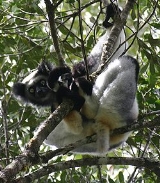
Indriidae

Encyclopedia
The Indriidae are a family of strepsirrhine primate
s. They are medium to large sized lemur
s with only four teeth in the toothcomb instead of the usual six. Indriids, like all lemurs, live exclusively on the island of Madagascar
.
The group was once much larger, and, in addition to the thirteen species living today, also contains eleven extinct species in six genera. Most if not all were larger animals
, called 'sloth lemurs'. These included the chimpanzee
-sized Palaeopropithecus and the gorilla
-sized Archaeoindris
. Most went extinct within the last 1500 to 2000 years, after humans colonized Madagascar.
are only 30 centimetres (11.8 in) in length, while the Indri
is the largest extant strepsirrhine. The tail of the Indri is only a stub, while avahi and the sifaka
tails are as long as their bodies. Their fur is long and mostly from whitish over reddish up to grey. Their black faces, however, are always bald. The hind legs are longer than their fore limbs, their hands are long and thin, and their thumb cannot be opposed to the other fingers correctly.
All species are arboreal, though they do come to the ground occasionally. When on the ground, they stand upright and move with short hops forward, with their arms held high. In the trees, though, they can make extraordinary leaps and are extremely agile, able to change direction from tree to tree. Like most leaf eaters they adjust for the low nutrient content of their food by long rests. Often they can be seen lying stretched on trees sunning themselves. Indrids live together in family federations from two to 15 animals, communicating with roars and also with facial expressions.
Indrids are strict vegetarian
s, eating mostly leaves, fruits and flowers. Like some other herbivores, they have a large cecum
, containing bacteria
that ferment cellulose, allowing for more efficient digestion
of plant matter. They have fewer premolar
teeth than other lemurs, with the dental formula
of:
Females and males usually mate monogamously for many years. Mostly at the end of the dry season, their four to five-month gestation ends with the birth of a single offspring, which lives in the family for a while after its weaning (at the age of five to six months).
.
Family Indriidae
Primate
A primate is a mammal of the order Primates , which contains prosimians and simians. Primates arose from ancestors that lived in the trees of tropical forests; many primate characteristics represent adaptations to life in this challenging three-dimensional environment...
s. They are medium to large sized lemur
Lemur
Lemurs are a clade of strepsirrhine primates endemic to the island of Madagascar. They are named after the lemures of Roman mythology due to the ghostly vocalizations, reflective eyes, and the nocturnal habits of some species...
s with only four teeth in the toothcomb instead of the usual six. Indriids, like all lemurs, live exclusively on the island of Madagascar
Madagascar
The Republic of Madagascar is an island country located in the Indian Ocean off the southeastern coast of Africa...
.
The group was once much larger, and, in addition to the thirteen species living today, also contains eleven extinct species in six genera. Most if not all were larger animals
Megafauna
In terrestrial zoology, megafauna are "giant", "very large" or "large" animals. The most common thresholds used are or...
, called 'sloth lemurs'. These included the chimpanzee
Chimpanzee
Chimpanzee, sometimes colloquially chimp, is the common name for the two extant species of ape in the genus Pan. The Congo River forms the boundary between the native habitat of the two species:...
-sized Palaeopropithecus and the gorilla
Gorilla
Gorillas are the largest extant species of primates. They are ground-dwelling, predominantly herbivorous apes that inhabit the forests of central Africa. Gorillas are divided into two species and either four or five subspecies...
-sized Archaeoindris
Archaeoindris
Archaeoindris fontoynonti is an extinct species of Malagasy lemur that was the largest primate to evolve on Madagascar. It weighed about and measured around 1.5m in height, more than a silverback gorilla. Archaeoindris is one of eight known members of the Palaeopropithecinae subfamily...
. Most went extinct within the last 1500 to 2000 years, after humans colonized Madagascar.
Characteristics
The ten extant indrid species vary considerably in size. Not counting the length of their tails, the avahisWoolly lemur
The woolly lemurs, also known as avahis or woolly indris, are nine species of strepsirrhine primates. Like all other lemurs, they live only on the island of Madagascar....
are only 30 centimetres (11.8 in) in length, while the Indri
Indri
The indri , also called the babakoto, is one of the largest living lemurs. It is a diurnal tree-dweller related to the sifakas and, like all lemuroids, it is native to Madagascar.- Etymology :...
is the largest extant strepsirrhine. The tail of the Indri is only a stub, while avahi and the sifaka
Sifaka
Sifakas are a genus of lemur from the family Indriidae within the order Primates. Their name of the family is an onomatopoeia of their characteristic "shi-fak" alarm call. Like all lemurs, they are found only on the island of Madagascar...
tails are as long as their bodies. Their fur is long and mostly from whitish over reddish up to grey. Their black faces, however, are always bald. The hind legs are longer than their fore limbs, their hands are long and thin, and their thumb cannot be opposed to the other fingers correctly.
All species are arboreal, though they do come to the ground occasionally. When on the ground, they stand upright and move with short hops forward, with their arms held high. In the trees, though, they can make extraordinary leaps and are extremely agile, able to change direction from tree to tree. Like most leaf eaters they adjust for the low nutrient content of their food by long rests. Often they can be seen lying stretched on trees sunning themselves. Indrids live together in family federations from two to 15 animals, communicating with roars and also with facial expressions.
Indrids are strict vegetarian
Herbivore
Herbivores are organisms that are anatomically and physiologically adapted to eat plant-based foods. Herbivory is a form of consumption in which an organism principally eats autotrophs such as plants, algae and photosynthesizing bacteria. More generally, organisms that feed on autotrophs in...
s, eating mostly leaves, fruits and flowers. Like some other herbivores, they have a large cecum
Cecum
The cecum or caecum is a pouch, connecting the ileum with the ascending colon of the large intestine. It is separated from the ileum by the ileocecal valve or Bauhin's valve, and is considered to be the beginning of the large intestine. It is also separated from the colon by the cecocolic...
, containing bacteria
Bacteria
Bacteria are a large domain of prokaryotic microorganisms. Typically a few micrometres in length, bacteria have a wide range of shapes, ranging from spheres to rods and spirals...
that ferment cellulose, allowing for more efficient digestion
Digestion
Digestion is the mechanical and chemical breakdown of food into smaller components that are more easily absorbed into a blood stream, for instance. Digestion is a form of catabolism: a breakdown of large food molecules to smaller ones....
of plant matter. They have fewer premolar
Premolar
The premolar teeth or bicuspids are transitional teeth located between the canine and molar teeth. In humans, there are two premolars per quadrant, making eight premolars total in the mouth. They have at least two cusps. Premolars can be considered as a 'transitional tooth' during chewing, or...
teeth than other lemurs, with the dental formula
Dentition
Dentition pertains to the development of teeth and their arrangement in the mouth. In particular, the characteristic arrangement, kind, and number of teeth in a given species at a given age...
of:
Females and males usually mate monogamously for many years. Mostly at the end of the dry season, their four to five-month gestation ends with the birth of a single offspring, which lives in the family for a while after its weaning (at the age of five to six months).
Classification
There are 19 living species in the family, divided into 3 generaGenus
In biology, a genus is a low-level taxonomic rank used in the biological classification of living and fossil organisms, which is an example of definition by genus and differentia...
.
Family Indriidae
- Genus IndriIndriThe indri , also called the babakoto, is one of the largest living lemurs. It is a diurnal tree-dweller related to the sifakas and, like all lemuroids, it is native to Madagascar.- Etymology :...
- IndriIndriThe indri , also called the babakoto, is one of the largest living lemurs. It is a diurnal tree-dweller related to the sifakas and, like all lemuroids, it is native to Madagascar.- Etymology :...
, Indri indri
- Indri
- Genus Avahi, woolly lemurs
- Bemaraha Woolly Lemur, Avahi cleesei
- Eastern Woolly LemurEastern Woolly LemurThe eastern woolly lemur , also known as the eastern avahi or Gmelin's woolly lemur, is a species of woolly lemur native to eastern Madagascar, where it lives in humid forests. This nocturnal animal weighs 1-1.3 kg and reaches a length of 27–29 cm with a tail of 33–37 cm...
, Avahi laniger - Moore's Woolly LemurMoore's Woolly LemurMoore's woolly lemur , or Masoala woolly lemur, is a woolly lemur endemic to Madagascar. It has brown-grey fur and a reddish tail. It is named in honor of the Gordon and Betty Moore Foundation of San Francisco....
, Avahi mooreorum - Western Woolly LemurWestern Woolly LemurThe western woolly lemur or western avahi is a species of woolly lemur native to western Madagascar, where they live in dry deciduous forests. These nocturnal animals weigh 0.7-0.9 kg. It is a folivorous species....
, Avahi occidentalis - Sambirano Woolly LemurSambirano Woolly LemurThe Sambirano woolly lemur , also known as the Sambirano avahi or Unicolor woolly lemur, is a species of woolly lemur native to western Madagascar....
, Avahi unicolor - Peyrieras' Woolly LemurPeyrieras' Woolly LemurThe Peyrieras' woolly lemur or Peyrieras' avahi is a species of woolly lemur native to southeastern Madagascar. It weighs about 1 kg....
, Avahi peyrierasi - Southern Woolly LemurSouthern Woolly LemurThe southern woolly lemur , or southern avahi, has been recently recognized as a separate species of woolly lemur in 2006 by Zaramody et al. It is a nocturnal and pair-living species...
, Avahi meridionalis - Ramanantsoavana's Woolly LemurRamanantsoavana's Woolly LemurThe Ramanantsoavana's woolly lemur , also known as Manombo woolly lemur or Ramanantsoavana's avahi, is a species of woolly lemur native to southeastern Madagascar. It weighs about 1 kg. It was originally considered a subspecies of Southern woolly lemur , A. m...
, Avahi ramanantsoavani - Betsileo Woolly LemurBetsileo Woolly LemurThe Betsileo woolly lemur or Betsileo avahi is a species of woolly lemur native to southeastern Madagascar, in the District of Fandriana. It weighs about 1 kg. The pelage differs significantly from other southeastern woolly lemurs in that it is primarily light reddish brown on most of the...
, Avahi betsileo
- Genus Propithecus, sifakas
- Propithecus diadema group
- Diademed SifakaDiademed SifakaThe diademed sifaka , or diademed simpona, is an endangered species of sifaka, one of the lemurs endemic to certain rainforests in eastern Madagascar. This species is one of the world's largest living lemurs, with a total adult length of approximately 105 centimetres , half of which is tail...
, Propithecus diadema - Silky SifakaSilky SifakaThe silky sifaka , or silky simpona, is a large lemur characterized by long, silky white fur. It has a very restricted range in northeastern Madagascar, where it is known locally as the simpona...
, Propithecus candidus - Milne-Edwards' SifakaMilne-Edwards' sifakaMilne-Edwards' sifaka , or Milne-Edwards' simpona, is a large arboreal, diurnal lemur endemic to the eastern coastal rainforest of Madagascar. Milne-Edwards' sifaka is characterized by a black body with a light-colored "saddle" on the lower part of its back. It is closely related to the diademed...
, Propithecus edwardsi - Perrier's SifakaPerrier's SifakaPerrier's sifaka is a sifaka endemic to Madagascar. It has a length of 85 to 92 centimeters, of which 42-46 centimeters are tail. Perrier's sifaka has a very limited range in northeastern Madagascar between the Irodo River to the north and the Lokia River to the south. It lives in dry deciduous...
, Propithecus perrieri - Golden-crowned SifakaGolden-crowned SifakaThe golden-crowned sifaka or Tattersall's sifaka is a medium-sized lemur characterized by mostly white fur, prominent furry ears and a golden-orange crown. It is one of the smallest sifakas , weighing around and measuring approximately from head to tail...
, Propithecus tattersalli
- Diademed Sifaka
- Propithecus verreauxi group
- Verreaux's SifakaVerreaux's SifakaVerreaux's sifaka , or white sifaka, is a medium sized primate in one of the lemur families, Indriidae. It lives in Madagascar and can be found in a variety of habitats from rainforest to western Madagascar dry deciduous forests and dry and spiny forests...
, Propithecus verreauxi - Coquerel's SifakaCoquerel's SifakaCoquerel's sifaka is a medium-sized lemur of the sifaka genus Propithecus. Like all lemurs, it is endemic to Madagascar.-Description:...
, Propithecus coquereli - Decken's Sifaka, Propithecus deckenii
- Crowned SifakaCrowned SifakaThe crowned sifaka is a sifaka endemic to Madagascar. It has a length of 87 to 102 centimeters, of which 47-57 centimeters are tail. The crowned sifaka lives in western Madagascar. It lives in dry deciduous forest....
, Propithecus coronatus
- Verreaux's Sifaka
- Propithecus diadema group