
All Topics  
Sloth

 
Sloth

   Email Print
   Bookmark   Link


Sloth


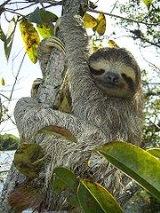
The living sloths comprise six species
Species

In biology, a species is one of the basic units of biological classification and a taxonomic rank. A species is often defined as a group of organisms capable of interbreeding and producing fertile offspring....
 of medium-sized mammal
Mammal

Mammals are a class of vertebrate animals whose name is derived from their distinctive feature, mammary glands, with which they feed their young....
s that live in Central
Central America

Central America is a central geography region of the Americas. It is the southernmost, isthmus portion of the North American continent, which connects with South America on the southeast....
 and South America
South America

South America is the southern continent of the Americas, situated entirely in the Western Hemisphere and mostly in the Southern Hemisphere, with a relatively small portion in the Northern Hemisphere....
 belonging to the families
Family (biology)

In biological classification, family is a taxonomic rank. Exact details of formal nomenclature depend on the Nomenclature Codes which applies....
 Megalonychidae
Two-toed sloth

The two extant species of two-toed sloths are Linnaeus's Two-toed Sloth and Hoffmann's Two-toed Sloth . They are the only members of the genus Choloepus, which name means "lame foot" and are the only living members of the family Megalonychidae....
 and Bradypodidae
Three-toed sloth

The three-toed sloths are the only members of the Bradypus genus and the Bradypodidae family. Although similar to the somewhat larger and generally faster moving two-toed sloths, the two genera are not particularly closely related....
, part of the order
Order (biology)

In Biological classification used in biology, the order is a taxonomic rank between class and family . The superorder is a rank between class and order....
 Pilosa
Pilosa

The order Pilosa is a group of placental mammals, extant today only in the Americas. It includes the anteaters and sloths, including the recently extinct ground sloths....
. The sloth's taxonomic suborder
Taxonomic rank

Taxonomic rank, taxonomic category, rank, or category is an abstract term used in the scientific classification, or taxonomy, of organisms....
 is Folivora, while some call it Phyllophaga. Both names mean "leaf-eaters"; the first is derived from Latin
Latin

Latin is an Italic language, historically spoken in Latium and Ancient Rome. Through the Military history of the Roman Empire, Latin spread throughout the Mediterranean and a large part of Europe....
, the second from ancient Greek
Ancient Greek

Ancient Greek is the historical stage in the development of the Greek language spanning across the Archaic Greece , Classical Greece , and Hellenistic civilization periods of ancient Greece and the classical antiquity....
. Tribal names include Ritto, Rit and Ridette, mostly forms of the word "sleep", "eat" and "dirty" from Tagaeri
Tagaeri

The Tagaeri are a clan of Huaorani people living in Yasuni National Park, at the Ecuadorian Amazon Basin, named for their association with the warrior Taga....
 tribe of Huaorani
Huaorani

The Huaorani, Waorani, or Waos are native amerindians from the Amazonian Region of Ecuador with some marked differences with the others ethnic groups from Ecuador....
.

l geologically recent times, large ground sloth
Ground sloth

Ground sloths are a diverse group of extinct sloths, mammals in the edentate superorder Xenarthra. They may have died out as recently as 1550 AD in Hispaniola and Cuba, but had long since been extinct on the mainland of North America and South America....
s such as Megatherium
Megatherium

Megatherium was a genus of elephant-sized ground sloths that lived from two million to 8,000 years ago. A related genus was Nothrotheriops, which were primarily bear-sized ground sloths....
 lived in South America
South America

South America is the southern continent of the Americas, situated entirely in the Western Hemisphere and mostly in the Southern Hemisphere, with a relatively small portion in the Northern Hemisphere....
 and parts of North America
North America

North America is the northern continent of the Americas, situated in the Earth's northern hemisphere and almost totally in the western hemisphere....
, but along with many other animals they disappeared immediately after the arrival of humans on the continent Much evidence suggests that human hunting contributed to the extinction of the American megafauna
Megafauna

The term megafauna has two distinct meanings in the biological sciences. The less commonly found meaning is of any animal which can be seen with the unaided eye, in contrast to microfauna....
, like that of far northern Asia
Asia

Asia is the world's largest and most populous continent. It covers 8.6% of the Earth's total surface area and, with over 4 billion people, it contains more than 60% of the world's current human population....
, Australia
Australia

Australia, officially the Commonwealth of Australia, is a country in the southern hemisphere comprising the Australia of the world's smallest continent, the major island of Tasmania, and numerous list of islands of Australia in the Indian Ocean and Pacific Oceans....
, New Zealand
New Zealand

New Zealand is an island country in the south-western Pacific Ocean comprising two main landmasses , and numerous Islands of New Zealand, most notably Stewart Island/Rakiura and the Chatham Islands....
, and Madagascar
Madagascar

Madagascar, or Republic of Madagascar , is an island nation in the Indian Ocean off the southeastern coast of Africa. The main island, also called Madagascar, is the List of islands by area, and is home to 5% of the world's plant and animal species, of which more than 80% are Endemism to Madagascar....
 .


Discussion
Ask a question about 'Sloth'
Start a new discussion about 'Sloth'
Answer questions from other users
Full Discussion Forum


Encyclopedia


The living sloths comprise six species
Species

In biology, a species is one of the basic units of biological classification and a taxonomic rank. A species is often defined as a group of organisms capable of interbreeding and producing fertile offspring....
 of medium-sized mammal
Mammal

Mammals are a class of vertebrate animals whose name is derived from their distinctive feature, mammary glands, with which they feed their young....
s that live in Central
Central America

Central America is a central geography region of the Americas. It is the southernmost, isthmus portion of the North American continent, which connects with South America on the southeast....
 and South America
South America

South America is the southern continent of the Americas, situated entirely in the Western Hemisphere and mostly in the Southern Hemisphere, with a relatively small portion in the Northern Hemisphere....
 belonging to the families
Family (biology)

In biological classification, family is a taxonomic rank. Exact details of formal nomenclature depend on the Nomenclature Codes which applies....
 Megalonychidae
Two-toed sloth

The two extant species of two-toed sloths are Linnaeus's Two-toed Sloth and Hoffmann's Two-toed Sloth . They are the only members of the genus Choloepus, which name means "lame foot" and are the only living members of the family Megalonychidae....
 and Bradypodidae
Three-toed sloth

The three-toed sloths are the only members of the Bradypus genus and the Bradypodidae family. Although similar to the somewhat larger and generally faster moving two-toed sloths, the two genera are not particularly closely related....
, part of the order
Order (biology)

In Biological classification used in biology, the order is a taxonomic rank between class and family . The superorder is a rank between class and order....
 Pilosa
Pilosa

The order Pilosa is a group of placental mammals, extant today only in the Americas. It includes the anteaters and sloths, including the recently extinct ground sloths....
. The sloth's taxonomic suborder
Taxonomic rank

Taxonomic rank, taxonomic category, rank, or category is an abstract term used in the scientific classification, or taxonomy, of organisms....
 is Folivora, while some call it Phyllophaga. Both names mean "leaf-eaters"; the first is derived from Latin
Latin

Latin is an Italic language, historically spoken in Latium and Ancient Rome. Through the Military history of the Roman Empire, Latin spread throughout the Mediterranean and a large part of Europe....
, the second from ancient Greek
Ancient Greek

Ancient Greek is the historical stage in the development of the Greek language spanning across the Archaic Greece , Classical Greece , and Hellenistic civilization periods of ancient Greece and the classical antiquity....
. Tribal names include Ritto, Rit and Ridette, mostly forms of the word "sleep", "eat" and "dirty" from Tagaeri
Tagaeri

The Tagaeri are a clan of Huaorani people living in Yasuni National Park, at the Ecuadorian Amazon Basin, named for their association with the warrior Taga....
 tribe of Huaorani
Huaorani

The Huaorani, Waorani, or Waos are native amerindians from the Amazonian Region of Ecuador with some marked differences with the others ethnic groups from Ecuador....
.

Extinction

Until geologically recent times, large ground sloth
Ground sloth

Ground sloths are a diverse group of extinct sloths, mammals in the edentate superorder Xenarthra. They may have died out as recently as 1550 AD in Hispaniola and Cuba, but had long since been extinct on the mainland of North America and South America....
s such as Megatherium
Megatherium

Megatherium was a genus of elephant-sized ground sloths that lived from two million to 8,000 years ago. A related genus was Nothrotheriops, which were primarily bear-sized ground sloths....
 lived in South America
South America

South America is the southern continent of the Americas, situated entirely in the Western Hemisphere and mostly in the Southern Hemisphere, with a relatively small portion in the Northern Hemisphere....
 and parts of North America
North America

North America is the northern continent of the Americas, situated in the Earth's northern hemisphere and almost totally in the western hemisphere....
, but along with many other animals they disappeared immediately after the arrival of humans on the continent Much evidence suggests that human hunting contributed to the extinction of the American megafauna
Megafauna

The term megafauna has two distinct meanings in the biological sciences. The less commonly found meaning is of any animal which can be seen with the unaided eye, in contrast to microfauna....
, like that of far northern Asia
Asia

Asia is the world's largest and most populous continent. It covers 8.6% of the Earth's total surface area and, with over 4 billion people, it contains more than 60% of the world's current human population....
, Australia
Australia

Australia, officially the Commonwealth of Australia, is a country in the southern hemisphere comprising the Australia of the world's smallest continent, the major island of Tasmania, and numerous list of islands of Australia in the Indian Ocean and Pacific Oceans....
, New Zealand
New Zealand

New Zealand is an island country in the south-western Pacific Ocean comprising two main landmasses , and numerous Islands of New Zealand, most notably Stewart Island/Rakiura and the Chatham Islands....
, and Madagascar
Madagascar

Madagascar, or Republic of Madagascar , is an island nation in the Indian Ocean off the southeastern coast of Africa. The main island, also called Madagascar, is the List of islands by area, and is home to 5% of the world's plant and animal species, of which more than 80% are Endemism to Madagascar....
 . Simultaneous climate change that came with the end of the last Ice age
Ice age

The general term "ice age" or, more precisely, "glacial age" denotes a geological period of long-term reduction in the temperature of the Earth's surface and atmosphere, resulting in an expansion of continental ice sheets, polar ice sheets and alpine glaciers....
 may have also played a role in some cases. However, the fact that ground sloths survived
Megalocnus

The ground sloths of the genus Megalocnus were among the largest of the Caribbean ground sloths, with individuals estimated to have weighed up to 90 kilos when alive....
 on the Antilles
Antilles

The Antilles Antillas in Spanish language; Antillen in Dutch language) refers to the islands forming the greater part of the Caribbean in the Caribbean Sea....
 long after they had died out on the mainland points towards human activities as the agency of extinction.

Ecology

The living sloths are omnivore
Omnivore

Omnivores are species that eating both plants and animals as their primary food source. They are opportunistic, general feeders not specifically adapted to eat and digest either meat or plant material exclusively....
s. They may eat insect
Insect

Insects are the biggest class of arthropods and the only ones with wings. They are the most diverse group of animals on the planet. They are most diverse at the equator and their diversity declines toward the poles....
s, small lizard
Lizard

Lizards are a large and widespread group of squamate reptiles, with nearly 5,000 species, ranging across all continents except Antarctica as well as most oceanic island chains....
s, and carrion
Carrion

Carrion refers to the carcass of a dead animal. Carrion is an important food source for large carnivores and omnivores in most ecosystems. Examples of carrion-eaters, or scavengers, include Hyenas, Vultures, Virginia Opossum, Tasmanian Devils, Black Bears, Komodo Dragons, Bald Eagles, Raccoons and Blue-tongued lizards....
, but their diet consists mostly of buds, tender shoots, and leaves, mainly of Cecropia
Cecropia

Cecropia is a genus of about 25 species of trees in the nettle family . They are native to the tropical Americas, where they form one of the most recognisable components of the rainforest....
 trees. They have made extraordinary adaptations to an arboreal
Arboreal

Arboreal is a word meaning "related to or resembling trees". Its meaning comes from the Latin arbor, meaning tree.In biology, an arboreal animal is one which inhabits or spends large amounts of time in trees or Shrubes....
 browsing lifestyle. Leaves, their main food source, provide very little energy or nutrition and do not digest easily. Sloths therefore have very large, specialized, slow-acting stomach
Stomach

In most mammals, the stomach is a hollow muscular organ of the gastrointestinal tract involved in the second phase of digestion, following mastication....
s with multiple compartments in which symbiotic
Symbiosis

The term symbiosis commonly describes close and often long-term interactions between different biological species. The term was first used in 1879 by the Germany mycology Heinrich Anton de Bary, who defined it as "the living together of unlike organisms"....
 bacteria
Bacteria

The Bacteria are a large group of unicellular microorganisms. Typically a few micrometres in length, bacteria have a wide range of shapes, ranging from spheres to rods and spirals....
 break down the tough leaves. As much as two-thirds of a well-fed sloth's body-weight consists of the contents of its stomach, and the digestive process can take a month or more to complete.

Even so, leaves provide little energy, and sloths deal with this by a range of economy measures: they have very low metabolic
Metabolism

Metabolism is the set of chemical reactions that occur in living organisms in order to maintain life. These processes allow organisms to grow and reproduce, maintain their structures, and respond to their environments....
 rates (less than half of that expected for a creature of their size), and maintain low body temperatures when active (30 to 34 °C or 86 to 93 °F), and still lower temperatures when resting.

Although unable to survive outside the tropical rainforests of South and Central America, within that environment sloths are outstandingly successful creatures: they can account for as much as half the total energy consumption and two-thirds of the total terrestrial mammalian biomass
Biomass

Biomass, as a renewable energy source, refers to living and recently dead biological material that can be used as fuel or for industrial production....
 in some areas. Of the six living species
Species

In biology, a species is one of the basic units of biological classification and a taxonomic rank. A species is often defined as a group of organisms capable of interbreeding and producing fertile offspring....
, only one, the Maned Three-toed Sloth
Maned Three-toed Sloth

The maned sloth, also known as the ai, Bradypus torquatus, is a species of Three-toed sloth South American sloth.The maned sloth has a small head, tiny eyes and ears, and a small tail hidden in its fur....
 (Bradypus torquatus), has a classification of "endangered" at present. The ongoing destruction of South America's forests, however, may soon prove a threat to other sloth species.

Physiology

Choloepus Hoffmanni
Sloth fur exhibits specialized functions: the outer hairs grow in a direction opposite from that of other mammals. In most mammals, hairs grow toward the extremities, but because sloths spend so much time with their legs above their bodies, their hairs grow away from the extremities in order to provide protection from the elements while the sloth hangs upside down. In moist conditions, the fur hosts two species of symbiotic
Symbiosis

The term symbiosis commonly describes close and often long-term interactions between different biological species. The term was first used in 1879 by the Germany mycology Heinrich Anton de Bary, who defined it as "the living together of unlike organisms"....
 cyanobacteria
Cyanobacteria

Cyanobacteria, also known as blue-green algae, blue-green bacteria or Cyanophyta, is a phylum of bacteria that obtain their energy through photosynthesis....
, which provide camouflage. Because of this algae, sloth fur is a small ecosystem of its own, hosting many species of non-parasitic insects.. Sloths have short, flat heads; big eyes; a short snout; long legs; and tiny ears. They also have stubby tails, usually 6-7cm long. Altogether, sloths' bodies usually are anywhere between 50 and 60 cm long.

Sloths' claws serve as their only natural defense. A cornered sloth may swipe at its attackers in an effort to scare them away or wound them. Despite sloths' apparent defenselessness, predators do not pose special problems: sloths blend in
Camouflage

Camouflage is a method of cryptic or concealing coloration that allows an otherwise visible organism or object to remain invisibility through deception....
 with the trees and, moving only slowly, do not attract attention. Only during their infrequent visits to ground level do they become vulnerable. The main predators of sloths are the jaguar
Jaguar

The jaguar, Panthera onca, is a New World Felidae and one of four "big cats" in the Panthera genus, along with the tiger, lion, and leopard of the Old World....
, the harpy eagle
American Harpy Eagle

The Harpy Eagle , sometimes known as the American Harpy Eagle, is a Neotropic ecozone species of eagle. This species was first described by Carl Linnaeus in his Systema naturae in 1758 as Vultur harpyja....
, and humans. The majority of sloth deaths in Costa Rica are due to contact with electrical lines
Electric power transmission

Electric power transmission is the bulk transfer of electrical power , a process in the delivery of electricity to consumers. A power transmission grid typically connects power plants to multiple Electrical substation near a populated area....
 and poachers
Poaching

Poaching is the illegal hunting, fishing or eating of wild plants or animals contrary to local and international Conservation and wildlife management laws....
. Despite their adaptation to living in trees, sloths make competent swimmers. Their claws also provide a further unexpected deterrent to human hunters - when hanging upside-down in a tree they are held in place by the claws themselves and often do not fall down even if shot from below.

Sloth47
Sloths move only when necessary and even then very slowly: they have about a quarter as much muscle tissue as other animals of similar weight. They can move at a marginally higher speed if they are in immediate danger from a predator (4.5 m or 15 feet per minute), but they burn large amounts of energy doing so. Their specialized hands and feet have long, curved claws to allow them to hang upside-down from branches without effort. While they sometimes sit on top of branches, they usually eat, sleep, and even give birth hanging from limbs. They sometimes remain hanging from branches after death. On the ground their maximum speed is 0.54 meters per second (1.2 mph).

It had been thought that sloths were among the most somnolent
Somnolence

Somnolence is a state of near-sleep, a strong desire for sleep, or sleeping for unusually long periods . It has two distinct meanings, referring both to the usual state preceding falling asleep, and the chronic condition referring to being in that state independent of a circadian rhythm....
 animals, sleeping from 15 to 18 hours each day. Recently, however, Dr. Neil Rattenborg and his colleagues from the Max Planck Institute for Ornithology in Starnberg, Germany, published a study testing sloth sleep-patterns in the wild; this is the first study of its kind. The study indicated that sloths sleep just under 10 hours a day. They go to the ground to urinate and defecate about once a week. They go to the same spot each time and are vulnerable while doing so. The reason for this risky behavior is unknown, although some believe that this is to avoid making noise while defecating from up high that would attract predators.

Infant sloths normally cling to their mother's fur, but occasionally fall off. Sloths are very sturdily built and rarely die from a fall. In some cases they die from a fall indirectly because the mothers prove unwilling to leave the safety of the trees to retrieve the young. Females normally bear one baby every year, but sometimes sloths' low level of movement actually keeps females from finding males for longer than one year.

Almost all mammal
Mammal

Mammals are a class of vertebrate animals whose name is derived from their distinctive feature, mammary glands, with which they feed their young....
s have seven cervical vertebrae
Cervical vertebrae

In vertebrates, cervical vertebrae are those vertebrae immediately behind the skull....
 or "neck bones" (including those with very short necks, such as elephant
Elephant

Elephants are large land mammals of the order Proboscidea and the family Elephantidae. There are three living species: the African Bush Elephant, the African Forest Elephant and the Asian Elephant ....
s or whale
Whale

Whales are marine mammals of order Cetacea which are neither dolphinsmembers, in other words, of the families Oceanic dolphin or River dolphinnor porpoises....
s, and those with very long necks, such as giraffe
Giraffe

The giraffe is an African even-toed ungulate mammal, the tallest of all land-living animal species, and the largest ruminant. It is covered in large, irregular patches of yellow to black fur separated by white, off-white, or dark yellowish brown background....
s). The few exceptions include manatee
Manatee

Manatees are large, fully aquatic marine mammals sometimes known as sea cows. The name manat? comes from the Ta?no, a pre-Columbian people of the Caribbean, meaning "breast"....
s and two-toed sloths, which each have only six cervical vertebrae, and three-toed sloths with nine cervical vertebrae.

Classification of the sloth

The living sloths belong to one of two families, known as the Megalonychidae ("two-toed" sloths) and the Bradypodidae (three-toed sloths). All living sloths have in fact three toe
Toe

Toes are the Digit s of the foot of an animal. Many animal species such as cats walk on their toes, and are described as being digitigrade....
s; the "two-toed" sloths, however, have only two finger
Finger

A finger is a type of digit , an organ of manipulation and sensation found in the hands of humans and other primates.Normally humans have five digits, termed phalanges, on each hand ....
s. Two-toed sloths are generally faster moving than three-toed sloths. Both types tend to occupy the same forests: in most areas, one species of three-toed sloth and one species of the larger two-toed type will jointly predominate.

However, their adaptation
Adaptation

Adaptation is the process, which takes place under natural selection, whereby an organism becomes better suited to its habitat. Also, the term may refer to some characteristic which stands out as being especially significant in the organism's survival....
s belie the actual relationships of the living sloth genera
Genus

A genus is a low-level taxonomic rank used in the classification of living and fossil organisms. The taxonomic ranks are domain , kingdom , phylum, class , order , family , genus, and species....
, which are more distant from each other than their outward similarity suggests. The common ancestor of the two genera apparently lived 35-40 million years ago, making the living forms stunning examples of convergent
Convergent evolution

Convergent evolution describes the acquisition of the same biological trait in unrelated lineages.The wing is a classic example of convergent evolution in action....
 or parallel evolution
Parallel evolution

Parallel evolution is the independent evolution of similar traits, starting from a similar ancestral condition due to similar environments or other evolutionary pressures....
. The two-toed sloths of today are far more closely related to one particular group of ground sloths than to the living three-toed sloths. Whether these ground-dwelling Megalonychidae were descended from tree-climbing ancestors or whether the two-toed sloths are really miniature ground sloths converted (or reverted) to arboreal life cannot presently be determined to satisfaction. The latter possibility seems slightly more likely, given the fact that the small ground sloths Acratocnus
Acratocnus

Acratocnus is an extinct genus of ground sloth found in Cuba, Hispaniola and Puerto Rico....
 and Neocnus which were also able to climb are among the closer relatives of the two-toed sloths, and that these together were related to the huge ground sloths Megalonyx and Megalocnus
Megalocnus

The ground sloths of the genus Megalocnus were among the largest of the Caribbean ground sloths, with individuals estimated to have weighed up to 90 kilos when alive....
.

The evolution
Evolution

In biology, evolution is change in the heritability trait of a population of organisms from one generation to the next. These changes are caused by a combination of three main processes: variation, reproduction, and selection....
ary history of the three-toed sloths is not at all well-known. No particularly close relatives, ground-dwelling or not, have yet been identified.

The ground sloths do not constitute a monophyletic
Clade

A clade is a term used in modern alpha taxonomy, the scientific classification of living and fossil organisms, to describe a monophyletic group, defined as a group consisting of a single common ancestor and all its descendants.The term "monophyletic group" is used in this article in the conventional sense of "an a...
 group. Rather, they make up a number of lineages, and as far as is known until the Holocene
Holocene

The Holocene is a geological Epoch which began approximately 11,700 years ago . According to traditional geological thinking, the Holocene continues to the present....
 most sloths were in fact ground-dwellers. The famous Megatherium
Megatherium

Megatherium was a genus of elephant-sized ground sloths that lived from two million to 8,000 years ago. A related genus was Nothrotheriops, which were primarily bear-sized ground sloths....
 for example belonged to a lineage of ground sloths that was not very close to the living sloths and their ground-living relatives like the small Neocnus or the massive Megalonyx. Meanwhile, Mylodon
Mylodon

Mylodon is an extinct genus of giant ground sloth that lived in the Patagonia area of South America until roughly 10,000 years ago.Mylodon weighed about and stood up to tall when raised up on its hind legs....
, among the last ground sloths to disappear, was only very distantly related to either of these.

  • ORDER PILOSA
    Pilosa

    The order Pilosa is a group of placental mammals, extant today only in the Americas. It includes the anteaters and sloths, including the recently extinct ground sloths....
    • Suborder Folivora
      • Family Bradypodidae
        • Genus Bradypus (Three-toed sloths)
          • Pygmy Three-toed Sloth
            Pygmy Three-toed Sloth

            The Pygmy Three-toed Sloth is a three-toed sloth. Its habitat is located on the tiny island of Isla Escudo de Veraguas off the coast of Panama....
            , Bradypus pygmaeus
          • Maned Three-toed Sloth
            Maned Three-toed Sloth

            The maned sloth, also known as the ai, Bradypus torquatus, is a species of Three-toed sloth South American sloth.The maned sloth has a small head, tiny eyes and ears, and a small tail hidden in its fur....
            , Bradypus torquatus
          • Pale-throated Three-toed Sloth
            Pale-throated Three-toed Sloth

            The Pale-throated Sloth is a three-toed sloth that inhabits tropical rainforests of Colombia, Venezuela, the Guyanas and Brazil. This sloth lives high in the canopy....
            , Bradypus tridactylus
          • Brown-throated Three-toed Sloth
            Brown-throated Three-toed Sloth

            The Brown-throated Sloth, Bradypus variegatus, is a species of three-toed sloth from Central America and South America.It is the most widespread and common species of the group, being found in many different kinds of environments, including evergreen and dry forests and in highly perturbed natural areas....
            , Bradypus variegatus
      • Family Megalonychidae (includes extinct megalonychid
        Ground sloth

        Ground sloths are a diverse group of extinct sloths, mammals in the edentate superorder Xenarthra. They may have died out as recently as 1550 AD in Hispaniola and Cuba, but had long since been extinct on the mainland of North America and South America....
         ground sloths)
        • Genus Choloepus (Two-toed sloths)
          • Linnaeus's Two-toed Sloth
            Linnaeus's Two-toed Sloth

            Linnaeus's Two-toed Sloth , also known as the Southern Two-toed Sloth or unau, is a species of sloth from South America, found in Venezuela, the Guyanas and Brazil north of the Amazon River....
            , Choloepus didactylus
          • Hoffmann's Two-toed Sloth
            Hoffmann's Two-toed Sloth

            The Hoffmann's Two-toed Sloth, Choloepus hoffmanni, is a species of sloth from Central America and South America. It is a solitary nocturnal and arboreal animal, found in mature and secondary rainforests and deciduous forests....
            , Choloepus hoffmanni
      • Family †Megatheriidae: megatheriid ground sloths
      • Family †Mylodontidae: mylodontid ground sloths
      • Family †Orophodontidae: orophodontid ground sloths
      • Family †Nothrotheriidae: nothrotheriid ground sloths
    • Suborder Vermilingua
      Anteater

      Anteaters are the four mammal species of the suborder Vermilingua commonly known for eating ants and termites. Together with the sloths, they compose the order Pilosa....
       (anteater
      Anteater

      Anteaters are the four mammal species of the suborder Vermilingua commonly known for eating ants and termites. Together with the sloths, they compose the order Pilosa....
      s and tamandua
      Tamandua

      Tamandua is a genus of anteaters. It has two members: the Southern Tamandua and the Northern Tamandua . They live in forests and grasslands, are semi-arboreal, and possess partially prehensile tails....
      s)


Gallery


External links

  • at National Geographic website
  • at National Geographic website
  • Sloth Sanctuary (open to tourists, and close to the cruise ship pier, in Costa Rica).