

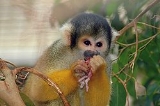
Haplorrhini

Encyclopedia
The haplorhines, the "dry-nosed" primates (the Greek name means "simple-nosed"), are members of the Haplorhini clade
: the prosimian
tarsier
s and the anthropoid
s. The anthropoids are the catarrhines (Old World monkeys and ape
s, including humans) and the platyrrhines (New World monkeys).
The omomyid
s are an extinct group of prosimians, believed to be more closely related to the tarsiers than to any strepsirrhines, and are considered the most primitive haplorhines.
Haplorhines share a number of derived features that distinguish them from the strepsirrhine "wet-nosed" primates (whose Greek name means "curved nose"), the other suborder of primates from which they parted in evolution some 63 million years ago. The haplorhines, including tarsiers, have all lost the function of the terminal enzyme which manufactures vitamin C, while the strepsirrhine prosimians, like most other orders of mammals, have retained this enzyme and the ability to manufacture vitamin C. The haplorhine upper lip, which has replaced the ancestral rhinarium
found in strepsirrhines, is not directly connected to their nose or gum, allowing a large range of facial expressions. Their brain to body ratio is significantly greater than the strepsirrhines, and their primary sense is vision. Haplorhines have a postorbital
plate, unlike the postorbital bar
found in strepsirhines. Most species are diurnal
(the exceptions being the tarsiers and the night monkey
s).
All anthropoids have a single-chambered uterus
; tarsiers have a bicornate uterus like the strepsirrhines. Most species typically have single births, although twins and triplets are common for marmoset
s and tamarin
s. Despite similar gestation periods, haplorhine newborns are relatively much larger than strepsirrhine newborns, but have a longer dependence period on their mother. This difference in size and dependence is credited to the increased complexity of their behavior and natural history.
, whose only remaining family is that of the tarsier (Tarsiidae), branched off from the other haplorhines. This could explain why the prosimian tarsiers show characteristics which once caused them to be grouped with the strepsirrhines.
The remaining clade ([Anthropoidea]) is divided into two parvorders: Platyrrhini (the New World monkeys) and Catarrhini
(the Old World monkeys and ape
s). The New World monkeys split from catarrhines about 40 mya, while the apes [Hominoidea] diverged from Old World monkeys [Cercopithecoidea] about 25 mya. The available fossil evidence indicates that both the hominoid and cercopithecoid clades originated in Africa.
The following is the listing of the living Haplorrhine families, and their placement in the Order Primates:
Cladistics
Cladistics is a method of classifying species of organisms into groups called clades, which consist of an ancestor organism and all its descendants . For example, birds, dinosaurs, crocodiles, and all descendants of their most recent common ancestor form a clade...
: the prosimian
Prosimian
Prosimians are a grouping of mammals defined as being primates, but not monkeys or apes. They include, among others, lemurs, bushbabies, and tarsiers. They are considered to have characteristics that are more primitive than those of monkeys and apes. Prosimians are the only primates native to...
tarsier
Tarsier
Tarsiers are haplorrhine primates of the genus Tarsius, a genus in the family Tarsiidae, which is itself the lone extant family within the infraorder Tarsiiformes...
s and the anthropoid
Anthropoid
Anthropoid may refer to:*Simian, monkeys and apes *Anthropoides, a genus of cranes*Operation Anthropoid, the codename for the assassination of SS-Obergruppenführer and Reichsprotektor of Bohemia and Moravia Reinhard Heydrich...
s. The anthropoids are the catarrhines (Old World monkeys and ape
Ape
Apes are Old World anthropoid mammals, more specifically a clade of tailless catarrhine primates, belonging to the biological superfamily Hominoidea. The apes are native to Africa and South-east Asia, although in relatively recent times humans have spread all over the world...
s, including humans) and the platyrrhines (New World monkeys).
The omomyid
Omomyid
Omomyids are a diverse group of early primates that radiated during the Eocene epoch between about 55 and 34 million years ago . Fossils of omomyids are found in North America, Europe, Asia, and possibly Africa...
s are an extinct group of prosimians, believed to be more closely related to the tarsiers than to any strepsirrhines, and are considered the most primitive haplorhines.
Haplorhines share a number of derived features that distinguish them from the strepsirrhine "wet-nosed" primates (whose Greek name means "curved nose"), the other suborder of primates from which they parted in evolution some 63 million years ago. The haplorhines, including tarsiers, have all lost the function of the terminal enzyme which manufactures vitamin C, while the strepsirrhine prosimians, like most other orders of mammals, have retained this enzyme and the ability to manufacture vitamin C. The haplorhine upper lip, which has replaced the ancestral rhinarium
Rhinarium
The rhinarium is the moist, naked surface around the nostrils of the nose in most mammals. In actual scientific usage it is typically called a "wet snout" or "wet nose" from its moist and shiny appearance...
found in strepsirrhines, is not directly connected to their nose or gum, allowing a large range of facial expressions. Their brain to body ratio is significantly greater than the strepsirrhines, and their primary sense is vision. Haplorhines have a postorbital
Postorbital
The postorbital is one of the bones in vertebrate skulls which forms a portion of the dermal skull roof and, sometimes, a ring about the orbit. Generally, it is located behind the postfrontal and posteriorly to the orbital fenestra. In some vertebrates, the postorbital is fused with the postfrontal...
plate, unlike the postorbital bar
Postorbital bar
The postorbital bar is a bone which runs around the eyesocket of strepsirrhine primates. This is in contrast to the higher primates, haplorrhine, which have evolved fully enclosed sockets to protect their eyes....
found in strepsirhines. Most species are diurnal
Diurnal animal
Diurnality is a plant or animal behavior characterized by activity during the day and sleeping at night.-In animals:Animals that are not diurnal might be nocturnal or crepuscular . Many animal species are diurnal, including many mammals, insects, reptiles and birds...
(the exceptions being the tarsiers and the night monkey
Night monkey
The night monkeys, also known as the owl monkeys or douroucoulis, are the members of the genus Aotus of New World monkeys . They are widely distributed in the forests of Central and South America, from Panama south to Paraguay and northern Argentina...
s).
All anthropoids have a single-chambered uterus
Uterus
The uterus or womb is a major female hormone-responsive reproductive sex organ of most mammals including humans. One end, the cervix, opens into the vagina, while the other is connected to one or both fallopian tubes, depending on the species...
; tarsiers have a bicornate uterus like the strepsirrhines. Most species typically have single births, although twins and triplets are common for marmoset
Marmoset
Marmosets are the 22 New World monkey species of the genera Callithrix, Cebuella, Callibella, and Mico. All four genera are part of the biological family Callitrichidae. The term marmoset is also used in reference to the Goeldi's Monkey, Callimico goeldii, which is closely related.Most marmosets...
s and tamarin
Tamarin
The tamarins are squirrel-sized New World monkeys from the family Callitrichidae in the genus Saguinus. They are closely related to the lion tamarins in the genus Leontopithecus.- Range :...
s. Despite similar gestation periods, haplorhine newborns are relatively much larger than strepsirrhine newborns, but have a longer dependence period on their mother. This difference in size and dependence is credited to the increased complexity of their behavior and natural history.
Classification and evolution
Haplorhini and its sister clade, Strepsirrhini ("wet-nosed" primates), parted ways about 63 million years ago (mya). Approximately 5 million years later (58 mya), only a short time afterward from an evolutionary perspective, the infraorder TarsiiformesTarsiiformes
Tarsiiformes are a group of primates that was once ranged across Europe, northern Africa, Asia, and North America, but today all living species are found in the islands of Southeast Asia. Tarsiers are the only living members of the infraorder, and also include the extinct Tarsius eocaenus from the...
, whose only remaining family is that of the tarsier (Tarsiidae), branched off from the other haplorhines. This could explain why the prosimian tarsiers show characteristics which once caused them to be grouped with the strepsirrhines.
The remaining clade ([Anthropoidea]) is divided into two parvorders: Platyrrhini (the New World monkeys) and Catarrhini
Catarrhini
Catarrhini is one of the two subdivisions of the higher primates . It contains the Old World monkeys and the apes, which in turn are further divided into the lesser apes or gibbons and the great apes, consisting of the orangutans, gorillas, chimpanzees, bonobos, and humans...
(the Old World monkeys and ape
Ape
Apes are Old World anthropoid mammals, more specifically a clade of tailless catarrhine primates, belonging to the biological superfamily Hominoidea. The apes are native to Africa and South-east Asia, although in relatively recent times humans have spread all over the world...
s). The New World monkeys split from catarrhines about 40 mya, while the apes [Hominoidea] diverged from Old World monkeys [Cercopithecoidea] about 25 mya. The available fossil evidence indicates that both the hominoid and cercopithecoid clades originated in Africa.
The following is the listing of the living Haplorrhine families, and their placement in the Order Primates:
- ORDER PRIMATESPrimateA primate is a mammal of the order Primates , which contains prosimians and simians. Primates arose from ancestors that lived in the trees of tropical forests; many primate characteristics represent adaptations to life in this challenging three-dimensional environment...
- Suborder StrepsirrhiniStrepsirrhiniThe clade Strepsirrhini is one of the two suborders of primates. Madagascar's only non-human primates are strepsirrhines, and others can be found in southeast Asia and Africa...
: lemurs, lorises, etc. - Suborder Haplorhini: tarsiers, monkeys, apes
- Infraorder TarsiiformesTarsiiformesTarsiiformes are a group of primates that was once ranged across Europe, northern Africa, Asia, and North America, but today all living species are found in the islands of Southeast Asia. Tarsiers are the only living members of the infraorder, and also include the extinct Tarsius eocaenus from the...
- Family TarsiidaeTarsierTarsiers are haplorrhine primates of the genus Tarsius, a genus in the family Tarsiidae, which is itself the lone extant family within the infraorder Tarsiiformes...
: tarsiers
- Family Tarsiidae
- Infraorder AnthropoideaAnthropoidAnthropoid may refer to:*Simian, monkeys and apes *Anthropoides, a genus of cranes*Operation Anthropoid, the codename for the assassination of SS-Obergruppenführer and Reichsprotektor of Bohemia and Moravia Reinhard Heydrich...
: monkeys, apes- Parvorder PlatyrrhiniNew World monkeyNew World monkeys are the five families of primates that are found in Central and South America: Callitrichidae, Cebidae, Aotidae, Pitheciidae, and Atelidae. The five families are ranked together as the Platyrrhini parvorder and the Ceboidea superfamily, which are essentially synonymous since...
: New World monkeys- Family Callitrichidae: marmosets, tamarins
- Family CebidaeCebidaeThe Cebidae is one of the five families of New World monkeys now recognised. It includes the capuchin monkeys and squirrel monkeys. These species are found throughout tropical and subtropical South and Central America.-Characteristics:...
: capuchins, squirrel monkeys - Family Aotidae: night or owl monkeys (douroucoulis)
- Family PitheciidaePitheciidaeThe Pitheciidae are one of the five families of New World monkeys now recognised. Formerly they were included in the family Atelidae. The family includes the titis, saki monkeys and uakaris...
: titis, sakis, uakaris - Family AtelidaeAtelidaeAtelidae is one of the five families of New World monkeys now recognised. It was formerly included in the family Cebidae. Atelids are generally larger monkeys; the family includes the howler, spider, woolly and woolly spider monkeys...
: howler, spider, and woolly monkeys
- Parvorder CatarrhiniCatarrhiniCatarrhini is one of the two subdivisions of the higher primates . It contains the Old World monkeys and the apes, which in turn are further divided into the lesser apes or gibbons and the great apes, consisting of the orangutans, gorillas, chimpanzees, bonobos, and humans...
Old World anthropoids- Superfamily CercopithecoideaOld World monkeyThe Old World monkeys or Cercopithecidae are a group of primates, falling in the superfamily Cercopithecoidea in the clade Catarrhini. The Old World monkeys are native to Africa and Asia today, inhabiting a range of environments from tropical rain forest to savanna, shrubland and mountainous...
: Old World monkeys- Family CercopithecidaeOld World monkeyThe Old World monkeys or Cercopithecidae are a group of primates, falling in the superfamily Cercopithecoidea in the clade Catarrhini. The Old World monkeys are native to Africa and Asia today, inhabiting a range of environments from tropical rain forest to savanna, shrubland and mountainous...
- Family Cercopithecidae
- Superfamily HominoideaApeApes are Old World anthropoid mammals, more specifically a clade of tailless catarrhine primates, belonging to the biological superfamily Hominoidea. The apes are native to Africa and South-east Asia, although in relatively recent times humans have spread all over the world...
: apes- Family HylobatidaeGibbonGibbons are apes in the family Hylobatidae . The family is divided into four genera based on their diploid chromosome number: Hylobates , Hoolock , Nomascus , and Symphalangus . The extinct Bunopithecus sericus is a gibbon or gibbon-like ape which, until recently, was thought to be closely related...
: lesser apes (gibbons) - Family Hominidae: great apes and humans
- Family Hylobatidae
- Superfamily Cercopithecoidea
- Parvorder Platyrrhini
- Infraorder Tarsiiformes
- Suborder Strepsirrhini