

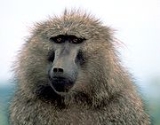
Primate

Encyclopedia
A primate is a mammal
of the order
Primates (p ; Latin
: "prime, first rank"), which contains prosimians and simian
s. Primates arose from ancestors that lived in the trees of tropical forests; many primate characteristics represent adaptations to life in this challenging three-dimensional environment. All but a few primate species remain at least partly arboreal.
With the exception of humans, who inhabit every continent, most primates live in tropical or subtropical regions of the Americas, Africa and Asia. Primates range in size from Madame Berthe's mouse lemur
, which weighs only 30 grams (1 oz), to the mountain gorilla
, weighing 200 kilograms (440.9 lb). According to fossil evidence, the primitive ancestors of primates may have existed in the late Cretaceous
period around 65 million years ago; the oldest known primate is the Late Paleocene
Plesiadapis
, c. 55–58 million years ago. Molecular clock
studies suggest that the primate branch may be even older, originating in the mid-Cretaceous period around 85 mya.
Order Primates has traditionally been divided into two main groupings: prosimian
s and anthropoid
s (simians). Prosimians have characteristics more like those of the earliest primates, and include the lemur
s of Madagascar
, lorisiforms
and tarsier
s. Simians include the monkeys, apes and human
s. More recently, taxonomists
have preferred to split primates into the suborder Strepsirrhini
, or curly-nosed primates, consisting of non-tarsier prosimians, and the suborder Haplorhini, or dry-nosed primates, consisting of tarsiers and the simians. Simians are divided into two groups: platyrrhine ("flat nosed") or New World monkey
s of South and Central America and catarrhine
(narrow nosed) monkeys and ape
s of Africa and southeastern Asia. New World monkeys include the capuchin
, howler
and squirrel monkey
s; catarrhines consist of Old World monkey
s (such as baboon
s and macaque
s), gibbon
s and great apes. Humans are the only extant catarrhines that have spread successfully outside of Africa, South Asia, and East Asia, although fossil evidence shows many other species were formerly present in Europe.
Considered generalist
mammals, primates exhibit a wide range of characteristics. Some primates (including some great apes and baboons) are primarily terrestrial rather than arboreal, but all species possess adaptations for climbing trees. Locomotion techniques used include leaping from tree to tree, walking on two or four limbs, knuckle-walking, and swinging between branches of trees (known as brachiation
). Primates are characterized by large brains relative to other mammals, as well as an increased reliance on stereoscopic
vision at the expense of smell, the dominant sensory system in most mammals. These features are more developed in monkeys and apes and noticeably less so in lorises and lemurs. Three-color vision has developed in some primates. Most also have opposable thumbs
and some have prehensile
tails. Many species are sexually dimorphic
, which means males and females have different physical traits, including body mass, canine tooth size, and coloration. Primates have slower rates of development than other similarly sized mammals and reach maturity later but have longer lifespans. Depending on the species, adults may live in solitude, in mated pairs, or in groups of up to hundreds of members.
Sir Wilfrid Le Gros Clark
was one of the primatologists who developed the idea that there were trends in primate evolution, and that the living members of the order could be arranged in an ascending series leading to humans. Commonly used names for groups of primates, for example "prosimian
s", "monkey
s", "lesser apes" and "great apes", reflect this arrangement. According to our current understanding of the evolutionary history of the primates, several of these groups are paraphyletic
, meaning that although all the species in the group descend from a common ancestor, the group does not include all the descendants of that ancestor.
By contrast with approaches such as those of Le Gros Clark, modern classifications typically use groups which are monophyletic
, since they include all the descendants of a common ancestor. The diagram below shows one currently accepted classification of the primates, with groups with commonly used names shown on the right.
All the groups which have scientific names are monophyletic (i.e. they are clade
s), so that the scientific classification reflects evolutionary history. Some of the traditional groups shown on the right, which form an "ascending series", are paraphyletic:
Thus the two sets of groups, and hence names, do not match, which causes problems in relating scientific names to common names. Consider the superfamily Hominoidea. In terms of the common names on the right, this group consists of apes and humans, and there is no single common name for all the members of the group. One possibility is to create a new common name, in this case "hominoids". Another possibility is to expand the use of one of the traditional terms. For example, in a 2005 book, the vertebrate
palaeontologist Benton wrote "The apes, Hominoidea, today include the gibbons and orang-utan ... the gorilla and chimpanzee ... and humans", thereby using "apes" to mean "hominoids". The group traditionally called "apes" must then be called the "nonhuman apes".
, there is no consensus as to which approach to follow, whether to accept traditional paraphyletic common names or whether to use monophyletic names, either new ones or adaptations of old ones. Both approaches will be found in biological sources, often in the same work. Thus although Benton defines "apes" to include humans, he also repeatedly uses "ape-like" to mean "like an ape rather than a human", and when discussing the reaction of others to a new fossil writes of "claims that Orrorin ... was an ape rather than a human".
Primates is part of the clade Euarchontoglires
, which is nested within the clade Eutheria
of Class Mammal
ia. Recent molecular genetic research on primates, colugo
s, and treeshrew
s has shown that the two species of colugos are more closely related to primates than treeshrews, even though treeshrews were at one time considered primates. These three orders make up the clade
Euarchonta
. The combination of this clade with the clade Glires
(composed of Rodent
ia and Lagomorpha
) forms the clade Euarchontoglires. Variously, both Euarchonta and Euarchontoglires are ranked as superorders. Some scientists consider Dermoptera a suborder of Primates and call the "true" primates the suborder Euprimates.
(c. 55–58 mya) from the Late Paleocene. Other studies, including molecular clock studies, have estimated the origin of the primate branch to have been in the mid-Cretaceous period, around 85 mya.
By modern cladistic
reckoning, Order Primates is monophyletic
. Suborder Strepsirrhini
, the curly-nosed or "wet-nosed
" primates, is generally thought to have split off from the primitive primate line about 63 mya, although earlier dates are also supported. The seven strepsirhine families are the five related lemur
families and the two remaining families that include the lorisids
and the galago
s. Older classification schemes wrap Lepilemuridae
into Lemuridae
and Galagidae
into Lorisidae
, yielding a four-one family distribution instead of five-two as presented here. During the Eocene
, most of the northern continents were dominated by two groups, the adapiforms and the omomyid
s. The former are considered members of Strepsirrhini, but did not have a toothcomb
like modern lemurs; recent analysis has suggested Darwinius masillae fits into this grouping. The latter was related closely to tarsiers, monkeys, and apes. It is unclear exactly how these two groups relate to extant primates. Omomyids perished about 30 mya, while adapids survived until about 10 mya.
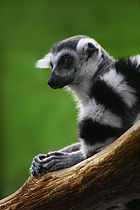 According to genetic studies, the lemurs of Madagascar diverged from the lorisiforms approximately 75 mya. These studies, as well as chromosomal and molecular evidence, also show that lemurs are more closely related to each other than to other strepsirrhine primates. However, Madagascar split from Africa 160 mya and from India 90 mya. To account for these facts, it is thought that a founding lemur population of a few individuals reached Madagascar from Africa via a single rafting event
between 50 and 80 million years ago. Other colonization options have been examined, such as multiple colonizations from Africa and India, but none are supported by the genetic and molecular evidence.
Until recently the aye-aye
has been difficult to place within Strepsirrhini. Theories had been proposed that its family, Daubentoniidae
, was either a lemuriform primate (meaning its ancestors split from the lemur line more recently than lemurs and lorises split) or a sister group to all the other strepsirrhines. In 2008, the aye-aye family was confirmed to be most closely related to the other Malagasy lemurs, likely having descended from the same ancestral population that colonized the island.
Suborder Haplorhini, the simple-nosed or "dry-nosed" primates, is composed of two sister clades. Prosimian
tarsiers in the family Tarsiidae
(monotypic in its own infraorder Tarsiiformes
), represent the most basal
division, originating about 58 mya. The infraorder Simiiformes
emerged about 40 mya, and contains two clades, both parvorders: Platyrrhini, which developed in South America, consisting of New World monkey
s, and Catarrhini
, which developed in Africa, consisting of Old World monkey
s, human
s and the other ape
s. A third clade, which included the eosimiids, developed in Asia but went extinct millions of years ago.
As in the case of lemurs, the origin of New World monkeys is unclear. Molecular studies of concatenated nuclear sequences have yielded a widely varying estimated date of divergence between platyrrhines and catarrhines, ranging from 33 to 70 mya, while studies based on mitochondrial sequences produce a narrower range of 35 to 43 mya. It is possible that anthropoid primates traversed the Atlantic ocean from Africa to South America during the Eocene
by island hopping
, facilitated by Atlantic Ocean ridges
and a lowered sea level. Alternatively, a single rafting event may explain this transoceanic colonization. Due to continental drift
, the Atlantic Ocean was not nearly as wide at the time as it is today. Research suggests that a small 1 kg (2.2 lb) primate could have survived 13 days on a raft of vegetation. Given estimated current and wind speeds, this would have provided enough time to make the voyage between the continents.
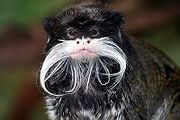 Apes and monkeys spread from Africa into Europe and Asia starting in the Miocene
. Soon after, the lorises and tarsiers made the same journey. The first hominid fossils were discovered in Northern Africa and date back 5–8 mya. Old World monkeys disappeared from Europe about 1.8 mya. Molecular and fossil studies generally show that modern humans originated in Africa 100,000–200,000 years ago.
Although primates are well studied in comparison to other animal groups, several new species have been recently discovered
, and genetic tests have revealed previously unrecognised species in known populations. Primate Taxonomy listed about 350 species of primates in 2001; the author, Colin Groves
, increased that number to 376 for his contribution to the third edition of Mammal Species of the World
(MSW3). However, publications since the taxonomy in MSW3 was compiled in 2003 have pushed the number to 424 species, or 658 including subspecies.
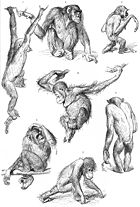 The following is the listing of the various families of primates:
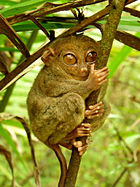 Order Primates was established by Carl Linnaeus in 1758, in the tenth edition
of his book Systema Naturae
, for the genera Homo
(humans), Simia
(other apes and monkeys), Lemur (prosimians) and Vespertilio
(bats). In the first edition of the same book (1735), he had used the name Anthropomorpha
for Homo, Simia and Bradypus (sloths). In 1839, Henri Marie Ducrotay de Blainville
, following Linnaeus and imitating his nomenclature, established the orders Secundates
(including the suborders Chiroptera
, Insectivora
and Carnivora
), Tertiates
(or Glires
) and Quaternates
(including Gravigrada
, Pachydermata
and Ruminantia
), but these new taxa were not accepted.
Before Anderson and Jones introduced the classification of Strepsirhini and Haplorhini in 1984, (followed by McKenna and Bell's 1997 work Classification of Mammals: Above the species level), the Primates were divided into two superfamilies: Prosimii and Anthropoidea. Prosimii included all of the prosimian
s: Strepsirrhini plus the tarsier
s. Anthropoidea contained all of the simian
s.
s; hybrids may be created by humans when animals are placed in zoos or due to environmental pressures such as predation. Intergeneric hybridizations, hybrids of different genera, have also been found in the wild. Although they belong to genera that have been distinct for several million years, interbreeding still occurs between the gelada
and the Hamadryas baboon
.
Not all primates exhibit these anatomical traits, nor is every trait unique to primates. For example, other mammals have collar bones, three kinds of teeth and a pendulous penis, while spider monkey
s have greatly reduced thumbs, ruffed lemur
s have six mammary glands and strepsirrhines generally have longer snouts and a strong sense of smell.
In regard to behavior, primates are frequently highly social
, with flexible dominance hierarchies. New World species form monogamous
pair bond
s, and show substantial paternal care
of their young, unlike most Old World monkeys.
allows accurate distance perception, useful for the brachiating
ancestors of all great apes. There is a bony ridge
above the eye sockets; this ridge reinforces weaker bones in the face which are put under strain during chewing. Strepsirrhines
have a postorbital bar
, a bone which runs around the eye socket, to protect their eyes; in contrast, the higher primates, haplorrhines
, have evolved fully enclosed sockets.
The primate skull has a large domed cranium
which is particularly prominent in anthropoids
. The cranium protects the large brain, a distinguishing characteristic of this group. The endocranial volume (the volume within the skull) is three times greater in humans than in the greatest non-human primate, reflecting a larger brain size. The mean endocranial volume is 1201 cubic centimeters in humans, 469 cm3 in gorillas, 400 cm3 in chimpanzees and 397 cm3 in orangutans. The primary evolutionary trend of primates has been the elaboration of the brain, in particular the neocortex
(a part of the cerebral cortex
), which is involved with sensory perception
, generation of motor commands
, spatial reasoning, conscious thought
and, in humans, language
. While other mammals rely heavily on their sense of smell
, the arboreal life of primates has led to a tactile
, visually
dominant sensory system, a reduction in the olfactory region of the brain and increasingly complex social behavior.
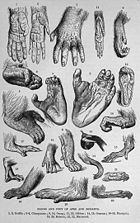 Primates generally have five digits on each limb (pentadactyly), with keratin nails on the end of each finger. The bottom sides of the hands and feet have sensitive pads
on the fingertips
. Most have opposable thumbs
, a characteristic primate feature; however, opposing thumbs are not limited to this order (opossums, for example, also have them). Thumbs allow some species to use tools
. In primates, the combination of opposing thumbs, short fingernails (rather than claws) and long, inward-closing fingers is a relict
of the ancestral practice of gripping branches, and has, in part, allowed some species to develop brachiation
(swinging by the arms from tree limb to tree limb) as a significant means of locomotion. Prosimians have clawlike nails on the second toe of each foot, called toilet-claw
s, which they use for grooming.
The primate collar bone
is retained as prominent element of the pectoral girdle; this allows the shoulder joint
broad mobility. Apes have more mobile shoulder joints and arms due to the dorsal position of the scapula
, broad ribcages that are flatter front-to-back, and a shorter, less mobile spine compared to Old World monkeys (with lower vertebrae greatly reduced, resulting in tail loss in some species). Old World monkeys are unlike apes in that most have tails. The only primate family with fully prehensile tail
s are the New World atelids
, including the howler
, spider
, woolly spider and woolly monkey
s (New World capuchin
s have partially prehensile tails).
Primates show an evolutionary trend towards a reduced snout
. Technically, Old World monkeys are distinguished from New World monkeys by the structure of the nose, and from apes by the arrangement of their teeth
. In New World monkeys the nostrils face sideways; in Old World monkeys, they face downwards. There is a considerably varied dental pattern in primates and although some have lost most of their incisor
s, all retain at least one lower incisor. In most strepsirhines, the lower incisors and canines form a toothcomb
, which is used in grooming and sometimes foraging, and the first lower premolar is shaped like a canine. Old World monkeys have eight premolar
s, compared with twelve in New World monkeys. The Old World species are divided into apes and monkeys depending on the number of cusps
on their molars
; apes have five, Old World monkeys have four, although humans may have 4 or 5. The main hominid molar cusp (hypocone
) evolved in early primate history, while the cusp of the corresponding primitive lower molar (paraconid) was lost. Prosimians are distinguished by their immobilized upper lips, the moist tip of their nose and forward-facing lower front teeth.
The evolution of color vision in primates
is unique among most eutheria
n mammal
s. While the remote vertebrate
ancestors of the primates possessed three color vision (trichromaticism), the nocturnal, warm-blooded
, mammalian ancestors lost one of three cones in the retina
during the Mesozoic
era. Fish, reptiles and birds are therefore trichromatic or tetrachromatic while all mammals, with the exception of some primates and marsupial
s, are dichromats or monochromats (totally color blind). Nocturnal primates, such as the night monkey
s and bush babies
, are often monochromatic. Catarrhines are routinely trichromatic due to a gene duplication
of the red-green opsin
gene at the base of their lineage, 30 to 40 million years ago. Platyrrhines, on the other hand, are trichromatic in a few cases only. Specifically, individual females must be heterozygous for two allele
s of the opsin gene (red and green) located on the same locus
of the X chromosome
. Males, therefore, can only be dichromatic, while females can be either dichromatic or trichromatic. Color vision in strepsirrhines is not as well understood; however, research indicates a range of color vision similar to that found in platyrrhines.
Like catarrhines, howler monkeys (a family of platyrrhines) show routine trichromatism that has been traced to an evolutionarily recent gene duplication
. Howler monkeys are one of the most specialized leaf-eaters of the New World monkeys; fruits are not a major part of their diet, and the type of leaves they prefer to consume (young, nutritive, and digestible) are detectable only by a red-green signal. Field work exploring the dietary preferences of howler monkeys suggests that routine trichromaticism was environmentally selected for.
 Sexual dimorphism
, the variation between individuals of different sex in the same species, is often exhibited in simian
s, though to a greater degree in Old World species (apes and some monkeys) than New World species. Recent studies involve comparing DNA to examine both the variation in the expression of the dimorphism among primates and the fundamental causes of sexual dimorphism. Primates usually have dimorphism in body mass
and canine tooth size along with pelage and skin color. The dimorphism can be attributed to and affected by different factors, including mating system
, size, habitat and diet.
Comparative analyses have generated a more complete understanding of the relationship between sexual selection
, natural selection
, and mating systems in primates. Studies have shown that dimorphism is the product of changes in both male and female traits. Ontogenetic scaling, where relative extension of a common growth trajectory occurs, may give some insight into the relationship between sexual dimorphism and growth patterns. Some evidence from the fossil record suggests that there was convergent evolution
of dimorphism, and some extinct hominids probably had greater dimorphism than any living primate.
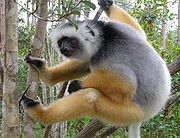 Primate species move by brachiation
, bipedalism, leaping
, arboreal and terrestrial quadruped
alism, climbing
, knuckle-walking
or by a combination of these methods. Several prosimians are primarily vertical clingers and leapers. These include many bushbabies
, all indriids
(i.e., sifaka
s, avahis and indri
s), sportive lemur
s, and all tarsier
s. Other prosimians are arboreal quadrupeds and climbers. Some are also terrestrial quadrupeds, while some are leapers. Most monkeys are both arboreal and terrestrial quadrupeds and climbers. Gibbon
s, muriqui
s and spider monkey
s all brachiate extensively, with gibbons sometimes doing so in remarkably acrobatic fashion. Woolly monkey
s also brachiate at times. Orangutan
s use a similar form of locomotion called quadramanous climbing, in which they use their arms and legs to carry their heavy bodies through the trees. Chimpanzee
s and gorilla
s knuckle walk, and can move bipedally for short distances. Although numerous species, such as australopithecine
s and early hominids
, have exhibited fully bipedal locomotion, humans are the only extant species with this trait.
stated that social systems
of non-human primates are best classified by the amount of movement by females occurring between groups. He proposed four categories:
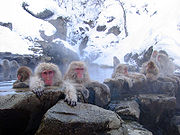
Other systems are known to occur as well. For example, with howler monkey
s both the males and females typically transfer from their natal group on reaching sexual maturity, resulting in groups in which neither the males nor females are typically related. Some prosimians, colobine
monkeys and callitrichid
monkeys use this system.
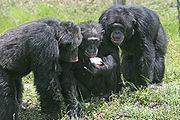 Primatologist Jane Goodall
, who studied in the Gombe Stream National Park, noted fission-fusion societies
in chimpanzees. There is fission where the main group splits up to forage during the day, then fusion when the group returns at night to sleep as a group. This social structure can also be observed in the Hamadryas baboon
, spider monkey
s and the bonobo
. The gelada
has a similar social structure in which many smaller groups come together to form temporary herds of up to 600 monkeys.
These social systems are affected by three main ecological factors: distribution of resources, group size
and predation. Within a social group there is a balance between cooperation and competition. Cooperative behaviors include social grooming
(removing skin parasites
and cleaning wounds), food sharing, and collective defense against predators or of a territory. Aggressive behaviors often signal competition for availability of food, sleeping sites or mates. Aggression is also used in establishing dominance hierarchies
.
of Africa several species coordinate anti-predator behavior. These include the Diana monkey
, Campbell's mona monkey
, lesser spot-nosed monkey
, western red colobus
, king colobus
and sooty mangabey
, which coordinate anti-predator alarm calls. Among the predators of these monkeys is the common chimpanzee
.
The red-tailed monkey
associates with several species, including the Western red colobus, blue monkey
, Wolf's mona monkey
, mantled guereza
, black crested mangabey
and Allen's swamp monkey
. Several of these species are preyed upon by the common chimpanzee.
In South America, squirrel monkey
s associate with capuchin monkey
s. This may have more to do with foraging benefits to the squirrel monkeys than anti-predation benefits.
and conspecifics; and they can learn to use symbols and understand aspects of human language including some relational syntax and concepts of number and numerical sequence. Research in primate cognition explores problem solving, memory, social interaction, a theory of mind, and numerical, spatial, and abstract concepts. Comparative studies show a trend towards higher intelligence going from prosimians to New World monkeys to Old World monkeys, and significantly higher average cognitive abilities in the great apes. However, there is a great deal of variation in each group (e.g., among New World monkeys, both spider
and capuchin monkey
s have scored highly by some measures), as well as in the results of different studies.
Lemur
s, loris
es, tarsier
s, and New World monkeys rely on olfactory signals
for many aspects of social and reproductive behavior. Specialized glands are used to mark territories with pheromone
s, which are detected by the vomeronasal organ
; this process forms a large part of the communication behavior of these primates. In Old World monkeys and apes this ability is mostly vestigial, having regressed as trichromatic eyes evolved to become the main sensory organ. Primates also use vocalizations, gestures, and facial expressions to convey psychological state.
by their mothers (with the exception of some human cultures and various zoo raised primates which are fed formula) and rely on them for grooming and transportation. In some species, infants are protected and transported by males in the group, particularly males who may be their fathers. Other relatives of the infant, such as siblings and aunts, may participate in its care as well. Most primate mothers cease ovulation while breastfeeding an infant; once the infant is weaned
the mother can reproduce again. This often leads to weaning conflict with infants who attempt to continue breastfeeding.
Primates have a longer juvenile
period between weaning and sexual maturity than other mammals of similar size. During the juvenile period, primates are more susceptible than adults to predation
and starvation
; they gain experience in feeding and avoiding predators during this time They learn social and fighting skills, often through playing.
Primates, especially females, have longer lifespans than other similarly sized mammals. Late in life, female catarrhine primates appear to undergo a cessation of reproductive function known as menopause
; other groups are less studied.
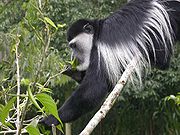 Primates exploit a variety of food sources. It has been said that many characteristics of modern primates, including humans, derive from an early ancestor's practice of taking most of its food from the tropical canopy. Most primates include fruit in their diets to obtain easily digested carbohydrate
s and lipid
s for energy. However, they require other foods, such as leaves or insects, for amino acid
s, vitamin
s and mineral
s. Primates in the suborder Strepsirrhini
(non-tarsier prosimians) are able to synthesize vitamin C
, like most other mammals, while primates of the suborder Haplorrhini
(tarsiers, monkeys and apes) have lost this ability, and require the vitamin in their diet.
Many primates have anatomical specializations that enable them to exploit particular foods, such as fruit, leaves, gum or insect
s. For example, leaf eaters such as howler monkey
s, black-and-white colobus
es and sportive lemur
s have extended digestive tracts which enable them to absorb nutrients from leaves that can be difficult to digest. Marmoset
s, which are gum eaters, have strong incisor
teeth, enabling them to open tree bark to get to the gum, and claws rather than nails, enabling them to cling to trees while feeding. The aye-aye
combines rodent-like teeth with a long, thin middle finger to fill the same ecological niche as a woodpecker. It taps on trees to find insect larvae, then gnaws holes in the wood and inserts its elongated middle finger to pull the larvae out. Some species have additional specializations. For example, the grey-cheeked mangabey
has thick enamel
on its teeth, enabling it to open hard fruits and seeds that other monkeys cannot.
The gelada
is the only primate species that feeds primarily on grass. Tarsier
s are the only extant obligate carnivorous primates, exclusively eating insects, crustaceans, small vertebrates and snakes (including venomous
species). Capuchin monkey
s, on the other hand, can exploit many different types of food, including fruit, leaves, flowers, buds, nectar, seeds, insects and other invertebrate
s, bird eggs, and small vertebrate
s such as birds, lizard
s, squirrel
s and bat
s. The common chimpanzee
has a varied diet that includes predation on other primate species, such as the western red colobus
monkey.
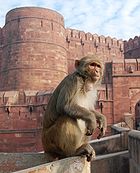 Primates evolved from arboreal animals, and many species live most of their lives in trees. Most primate species live in tropical rain forests. The number of primate species within tropical areas has been shown to be positively correlated
to the amount of rainfall and the amount of rain forest area. Accounting for 25% to 40% of the fruit-eating animals
(by weight
) within tropical rainforests, primates play an important ecological
role by dispersing seeds of many tree species.
Some species are partially terrestrial
, such as baboon
s and patas monkey
s, and a few species are fully terrestrial, such as gelada
s and human
s. Non-human primates live in a diverse number of forested habitats in the tropical latitudes of Africa, India, Southeast Asia, and South America, including rainforest
s, mangrove
forests, and montane
forests. There are some examples of non-human primates that live outside of the tropics; the mountain-dwelling Japanese macaque
lives in the north of Honshū
where there is snow-cover eight months of the year; the Barbary macaque
lives in the Atlas Mountains
of Algeria and Morocco. Primate habitats span a range of altitudes: the black snub-nosed monkey
has been found living in the Hengduan Mountains at altitudes of 4,700 meters (15,400 ft), the mountain gorilla
can be found at 4,200 meters (13,200 ft) crossing the Virunga Mountains
, and the gelada has been found at elevations of up to 5000 metres (16,404.2 ft) in the Ethiopian Highlands
. Although most species are generally shy of water, a few are good swimmers and are comfortable in swamps and watery areas, including the proboscis monkey
, De Brazza's monkey
and Allen's swamp monkey
, which has developed small webbing between its fingers. Some primates, such as the rhesus macaque
and gray langur
s, can exploit human-modified environments and even live in cities.
. Viruses such as Herpesviridae
(most notably Herpes B Virus
), Poxviridae
, measles
, ebola
, rabies
, the Marburg virus
and viral hepatitis
can be transmitted to humans; in some cases the viruses produce potentially fatal diseases in both humans and non-human primates.
s and protected in law by the United Nations
Universal Declaration of Human Rights
. The legal status of NHPs, on the other hand, is the subject of much debate, with organizations such as the Great Ape Project
(GAP) campaigning to award at least some of them legal rights. In June 2008, Spain became the first country in the world to recognize the rights of some NHPs when its parliament's cross-party environmental committee urged the country to comply with GAP's recommendations, which are that chimpanzees, bonobos, orangutans, and gorillas not be used for animal experiments.
 Many species of NHP are kept as pets by humans. GAP estimates that around 3,000 NHPs live as exotic pets in the United States, while the Humane Society of the United States
puts the figure much higher, at around 15,000. The expanding Chinese middle class has increased demand for NHPs as exotic pets in recent years. Although NHP import for the pet trade was banned in the U.S. in 1975, smuggling still occurs along the United States – Mexico border, with prices ranging from US$
3000 for monkeys to $30,000 for apes.
Primates are used as model organism
s in laboratories and have been used in space missions
. They serve as service animal
s for disabled humans. Capuchin monkey
s can be trained to assist quadriplegic humans; their intelligence, memory, and manual dexterity make them ideal helpers.
NHPs are kept in zoo
s around the globe. Historically, zoos were primarily a form of entertainment, but more recently have shifted their focus to conservation, education and research. Many zoos now feature naturalistic exhibits and educational material for the public; in the United States many participate in the Species Survival Plan
(SSP), developed by the Association of Zoos and Aquariums
(AZA), to maximize genetic diversity
through captive breeding. Zoos and other animal welfare
supporters generally oppose animal rights initiatives and the GAP's insistence that all NHPs be released from captivity for two primary reasons. First, captive-born primates lack the knowledge and experience to survive in the wild if released. Second, zoos provide living space for primates and other animals threatened with extinction in the wild.
, ophthalmology
studies, and toxicity studies. Rhesus macaque
s are often used, as are other macaque
s, African green monkeys
, chimpanzee
s, baboon
s, squirrel monkey
s, and marmoset
s, both wild-caught and purpose-bred. In 2005, GAP reported that 1,280 of the 3,100 NHPs living in captivity in the United States were used for experiments. In 2004, the European Union
used around 10,000 NHPs in such experiments; in 2005 in Great Britain, 4,652 experiments were conducted on 3,115 NHPs. Governments of many nations have strict care requirements of NHPs kept in captivity. In the US, federal guidelines extensively regulate aspects of NHP housing, feeding, enrichment, and breeding. European groups such as the European Coalition to End Animal Experiments are seeking a ban on all NHP use in experiments as part of the European Union's review of animal testing legislation.
, forest fragmentation
, monkey drive
s (resulting from primate crop raiding), and primate hunting for use in medicines, as pets, and for food. Large-scale tropical forest clearing is widely regarded as the process that most threatens primates. More than 90% of primate species occur in tropical forests. The main cause of forest loss is clearing for agriculture, although commercial logging, subsistence
harvesting of timber, mining, and dam construction also contribute to tropical forest destruction. In Indonesia large areas of lowland forest have been cleared to increase palm oil
production, and one analysis of satellite imagery concluded that during 1998 and 1999 there was a loss of 1,000 Sumatran orangutan
s per year in the Leuser Ecosystem
alone. Primates with a large body size (over 5 kg) are at increased extinction risk due to their greater profitability to poachers
compared to smaller primates. They reach sexual maturity later and have a longer period between births. Populations therefore recover more slowly after being depleted by poaching or the pet trade. Data for some African cities show that half of all protein consumed in urban areas comes from the bushmeat
trade. Endangered primates such as guenon
s and the drill
are hunted at levels that far exceed sustainable levels. This is due to their large body size, ease of transport and profitability per animal. As farming encroaches on forest habitats, primates feed on the crops, causing the farmers large economic losses. Primate crop raiding gives locals a negative impression of primates, hindering conservation efforts.
Madagascar
, home to five endemic primate families, has experienced the greatest extinction of the recent past; since human settlement 1,500 years ago, at least eight classes and fifteen of the larger species have become extinct due to hunting and habitat destruction. Among the primates wiped out were Archaeoindris
(a lemur larger than a silverback gorilla) and the families Palaeopropithecidae and Archaeolemuridae.
In Asia, Hinduism, Buddhism, and Islam prohibit eating primate meat; however, primates are still hunted for food. Some smaller traditional religions allow the consumption of primate meat. The pet trade and traditional medicine also increase demand for illegal hunting. The rhesus macaque
, a model organism
, was protected after excessive trapping threatened its numbers in the 1960s; the program was so effective that they are now viewed as a pest throughout their range.
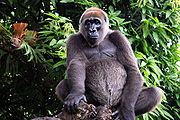 In Central and South America forest fragmentation and hunting are the two main problems for primates. Large tracts of forest are now rare in Central America. This increases the amount of forest vulnerable to edge effect
s such as farmland encroachment, lower levels of humidity and a change in plant life. Movement restriction results in a greater amount of inbreeding, which can cause deleterious effects leading to a population bottleneck
, whereby a significant percentage of the population is lost.
There are 21 critically endangered primates, 7 of which have remained on the IUCN's "The World's 25 Most Endangered Primates
" list since the year 2000: the silky sifaka
, Delacour's langur
, the white-headed langur
, the gray-shanked douc
, the Tonkin snub-nosed monkey, the Cross River gorilla
and the Sumatran orangutan
. Miss Waldron's red colobus
was recently declared extinct when no trace of the subspecies could be found from 1993 to 1999. A few hunters have found and killed individuals since then, but the subspecies' prospects remain bleak.
Mammal
Mammals are members of a class of air-breathing vertebrate animals characterised by the possession of endothermy, hair, three middle ear bones, and mammary glands functional in mothers with young...
of the order
Order (biology)
In scientific classification used in biology, the order is# a taxonomic rank used in the classification of organisms. Other well-known ranks are life, domain, kingdom, phylum, class, family, genus, and species, with order fitting in between class and family...
Primates (p ; Latin
Latin
Latin is an Italic language originally spoken in Latium and Ancient Rome. It, along with most European languages, is a descendant of the ancient Proto-Indo-European language. Although it is considered a dead language, a number of scholars and members of the Christian clergy speak it fluently, and...
: "prime, first rank"), which contains prosimians and simian
Simian
The simians are the "higher primates" familiar to most people: the Old World monkeys and apes, including humans, , and the New World monkeys or platyrrhines. Simians tend to be larger than the "lower primates" or prosimians.- Classification and evolution :The simians are split into three groups...
s. Primates arose from ancestors that lived in the trees of tropical forests; many primate characteristics represent adaptations to life in this challenging three-dimensional environment. All but a few primate species remain at least partly arboreal.
With the exception of humans, who inhabit every continent, most primates live in tropical or subtropical regions of the Americas, Africa and Asia. Primates range in size from Madame Berthe's mouse lemur
Madame Berthe's Mouse Lemur
Madame Berthe's mouse lemur or Berthe's mouse lemur is the smallest of the mouse lemurs and the smallest primate in the world; the average body length is and seasonal weight is around...
, which weighs only 30 grams (1 oz), to the mountain gorilla
Mountain Gorilla
The Mountain Gorilla is one of the two subspecies of the Eastern Gorilla. There are two populations. One is found in the Virunga volcanic mountains of Central Africa, within three National Parks: Mgahinga, in south-west Uganda; Volcanoes, in north-west Rwanda; and Virunga in the eastern Democratic...
, weighing 200 kilograms (440.9 lb). According to fossil evidence, the primitive ancestors of primates may have existed in the late Cretaceous
Cretaceous
The Cretaceous , derived from the Latin "creta" , usually abbreviated K for its German translation Kreide , is a geologic period and system from circa to million years ago. In the geologic timescale, the Cretaceous follows the Jurassic period and is followed by the Paleogene period of the...
period around 65 million years ago; the oldest known primate is the Late Paleocene
Paleocene
The Paleocene or Palaeocene, the "early recent", is a geologic epoch that lasted from about . It is the first epoch of the Palaeogene Period in the modern Cenozoic Era...
Plesiadapis
Plesiadapis
Plesiadapis is one of the oldest known primate-like mammal species which existed about 58-55 million years ago in North America and Europe. Plesiadapis literally means "near-Adapis", which is a reference to the Eocene lemuriform, Adapis...
, c. 55–58 million years ago. Molecular clock
Molecular clock
The molecular clock is a technique in molecular evolution that uses fossil constraints and rates of molecular change to deduce the time in geologic history when two species or other taxa diverged. It is used to estimate the time of occurrence of events called speciation or radiation...
studies suggest that the primate branch may be even older, originating in the mid-Cretaceous period around 85 mya.
Order Primates has traditionally been divided into two main groupings: prosimian
Prosimian
Prosimians are a grouping of mammals defined as being primates, but not monkeys or apes. They include, among others, lemurs, bushbabies, and tarsiers. They are considered to have characteristics that are more primitive than those of monkeys and apes. Prosimians are the only primates native to...
s and anthropoid
Simian
The simians are the "higher primates" familiar to most people: the Old World monkeys and apes, including humans, , and the New World monkeys or platyrrhines. Simians tend to be larger than the "lower primates" or prosimians.- Classification and evolution :The simians are split into three groups...
s (simians). Prosimians have characteristics more like those of the earliest primates, and include the lemur
Lemur
Lemurs are a clade of strepsirrhine primates endemic to the island of Madagascar. They are named after the lemures of Roman mythology due to the ghostly vocalizations, reflective eyes, and the nocturnal habits of some species...
s of Madagascar
Madagascar
The Republic of Madagascar is an island country located in the Indian Ocean off the southeastern coast of Africa...
, lorisiforms
Lorisiformes
Lorisiformes are a group of primates found throughout Africa and Asia. Members of this infraorder include the galagos and the lorises. As strepsirrhines, they are related to the lemurs.* Order Primates** Suborder Strepsirrhini: non-tarsier prosimians...
and tarsier
Tarsier
Tarsiers are haplorrhine primates of the genus Tarsius, a genus in the family Tarsiidae, which is itself the lone extant family within the infraorder Tarsiiformes...
s. Simians include the monkeys, apes and human
Homo
Homo may refer to:*the Greek prefix ὅμο-, meaning "the same"*the Latin for man, human being*Homo, the taxonomical genus including modern humans...
s. More recently, taxonomists
Taxonomy
Taxonomy is the science of identifying and naming species, and arranging them into a classification. The field of taxonomy, sometimes referred to as "biological taxonomy", revolves around the description and use of taxonomic units, known as taxa...
have preferred to split primates into the suborder Strepsirrhini
Strepsirrhini
The clade Strepsirrhini is one of the two suborders of primates. Madagascar's only non-human primates are strepsirrhines, and others can be found in southeast Asia and Africa...
, or curly-nosed primates, consisting of non-tarsier prosimians, and the suborder Haplorhini, or dry-nosed primates, consisting of tarsiers and the simians. Simians are divided into two groups: platyrrhine ("flat nosed") or New World monkey
New World monkey
New World monkeys are the five families of primates that are found in Central and South America: Callitrichidae, Cebidae, Aotidae, Pitheciidae, and Atelidae. The five families are ranked together as the Platyrrhini parvorder and the Ceboidea superfamily, which are essentially synonymous since...
s of South and Central America and catarrhine
Catarrhini
Catarrhini is one of the two subdivisions of the higher primates . It contains the Old World monkeys and the apes, which in turn are further divided into the lesser apes or gibbons and the great apes, consisting of the orangutans, gorillas, chimpanzees, bonobos, and humans...
(narrow nosed) monkeys and ape
Ape
Apes are Old World anthropoid mammals, more specifically a clade of tailless catarrhine primates, belonging to the biological superfamily Hominoidea. The apes are native to Africa and South-east Asia, although in relatively recent times humans have spread all over the world...
s of Africa and southeastern Asia. New World monkeys include the capuchin
Capuchin monkey
The capuchins are New World monkeys of the genus Cebus. The range of capuchin monkeys includes Central America and South America as far south as northern Argentina...
, howler
Howler monkey
Howler monkeys are among the largest of the New World monkeys. Fifteen species are currently recognised. Previously classified in the family Cebidae, they are now placed in the family Atelidae. These monkeys are native to South and Central American forests...
and squirrel monkey
Squirrel monkey
The squirrel monkeys are the New World monkeys of the genus Saimiri. They are the only genus in the subfamily Saimirinae.Squirrel monkeys live in the tropical forests of Central and South America in the canopy layer. Most species have parapatric or allopatric ranges in the Amazon, while S...
s; catarrhines consist of Old World monkey
Old World monkey
The Old World monkeys or Cercopithecidae are a group of primates, falling in the superfamily Cercopithecoidea in the clade Catarrhini. The Old World monkeys are native to Africa and Asia today, inhabiting a range of environments from tropical rain forest to savanna, shrubland and mountainous...
s (such as baboon
Baboon
Baboons are African and Arabian Old World monkeys belonging to the genus Papio, part of the subfamily Cercopithecinae. There are five species, which are some of the largest non-hominoid members of the primate order; only the mandrill and the drill are larger...
s and macaque
Macaque
The macaques constitute a genus of Old World monkeys of the subfamily Cercopithecinae. - Description :Aside from humans , the macaques are the most widespread primate genus, ranging from Japan to Afghanistan and, in the case of the barbary macaque, to North Africa...
s), gibbon
Gibbon
Gibbons are apes in the family Hylobatidae . The family is divided into four genera based on their diploid chromosome number: Hylobates , Hoolock , Nomascus , and Symphalangus . The extinct Bunopithecus sericus is a gibbon or gibbon-like ape which, until recently, was thought to be closely related...
s and great apes. Humans are the only extant catarrhines that have spread successfully outside of Africa, South Asia, and East Asia, although fossil evidence shows many other species were formerly present in Europe.
Considered generalist
Generalist and specialist species
A generalist species is able to thrive in a wide variety of environmental conditions and can make use of a variety of different resources . A specialist species can only thrive in a narrow range of environmental conditions or has a limited diet. Most organisms do not all fit neatly into either...
mammals, primates exhibit a wide range of characteristics. Some primates (including some great apes and baboons) are primarily terrestrial rather than arboreal, but all species possess adaptations for climbing trees. Locomotion techniques used include leaping from tree to tree, walking on two or four limbs, knuckle-walking, and swinging between branches of trees (known as brachiation
Brachiation
Brachiation is a form of arboreal locomotion in which primates swing from tree limb to tree limb using only their arms.- Brachiators :...
). Primates are characterized by large brains relative to other mammals, as well as an increased reliance on stereoscopic
Stereopsis
Stereopsis refers to impression of depth that is perceived when a scene is viewed with both eyes by someone with normal binocular vision. Binocular viewing of a scene creates two slightly different images of the scene in the two eyes due the the eyes' different positions on the head...
vision at the expense of smell, the dominant sensory system in most mammals. These features are more developed in monkeys and apes and noticeably less so in lorises and lemurs. Three-color vision has developed in some primates. Most also have opposable thumbs
Thumb
The thumb is the first digit of the hand. When a person is standing in the medical anatomical position , the thumb is the lateral-most digit...
and some have prehensile
Prehensility
Prehensility is the quality of an appendage or organ that has adapted for grasping or holding. The word is derived from the Latin term prehendere, meaning "to grasp."-Examples:Appendages that can become prehensile include:...
tails. Many species are sexually dimorphic
Sexual dimorphism
Sexual dimorphism is a phenotypic difference between males and females of the same species. Examples of such differences include differences in morphology, ornamentation, and behavior.-Examples:-Ornamentation / coloration:...
, which means males and females have different physical traits, including body mass, canine tooth size, and coloration. Primates have slower rates of development than other similarly sized mammals and reach maturity later but have longer lifespans. Depending on the species, adults may live in solitude, in mated pairs, or in groups of up to hundreds of members.
Historical and modern terminology
The relationships among the different groups of primates were not clearly understood until relatively recently, so that commonly used terms are somewhat confused. For example, "ape" has been used either as an alternative for "monkey" or for any tailless, relatively humanlike primate.Sir Wilfrid Le Gros Clark
Wilfrid Le Gros Clark
Sir Wilfrid Edward Le Gros Clark was a British anatomist surgeon, primatologist and palaeoanthropologist, today best remembered for his contribution to the study of human evolution....
was one of the primatologists who developed the idea that there were trends in primate evolution, and that the living members of the order could be arranged in an ascending series leading to humans. Commonly used names for groups of primates, for example "prosimian
Prosimian
Prosimians are a grouping of mammals defined as being primates, but not monkeys or apes. They include, among others, lemurs, bushbabies, and tarsiers. They are considered to have characteristics that are more primitive than those of monkeys and apes. Prosimians are the only primates native to...
s", "monkey
Monkey
A monkey is a primate, either an Old World monkey or a New World monkey. There are about 260 known living species of monkey. Many are arboreal, although there are species that live primarily on the ground, such as baboons. Monkeys are generally considered to be intelligent. Unlike apes, monkeys...
s", "lesser apes" and "great apes", reflect this arrangement. According to our current understanding of the evolutionary history of the primates, several of these groups are paraphyletic
Paraphyly
A group of taxa is said to be paraphyletic if the group consists of all the descendants of a hypothetical closest common ancestor minus one or more monophyletic groups of descendants...
, meaning that although all the species in the group descend from a common ancestor, the group does not include all the descendants of that ancestor.
By contrast with approaches such as those of Le Gros Clark, modern classifications typically use groups which are monophyletic
Monophyly
In common cladistic usage, a monophyletic group is a taxon which forms a clade, meaning that it contains all the descendants of the possibly hypothetical closest common ancestor of the members of the group. The term is synonymous with the uncommon term holophyly...
, since they include all the descendants of a common ancestor. The diagram below shows one currently accepted classification of the primates, with groups with commonly used names shown on the right.
All the groups which have scientific names are monophyletic (i.e. they are clade
Clade
A clade is a group consisting of a species and all its descendants. In the terms of biological systematics, a clade is a single "branch" on the "tree of life". The idea that such a "natural group" of organisms should be grouped together and given a taxonomic name is central to biological...
s), so that the scientific classification reflects evolutionary history. Some of the traditional groups shown on the right, which form an "ascending series", are paraphyletic:
- "prosimians" contain two monophyletic groups, the suborder Strepsirrhini (lemurs, lorises and allies), as well as the tarsiers, which are a sister group to the infraorder Simiiformes
- "monkeys" consist of two monophyletic groups, New World monkeys and Old World monkeys, but exclude hominoids (superfamily Hominoidea)
- "apes" as a whole, and the "great apes" in particular, are not monophyletic because they exclude humans.
Thus the two sets of groups, and hence names, do not match, which causes problems in relating scientific names to common names. Consider the superfamily Hominoidea. In terms of the common names on the right, this group consists of apes and humans, and there is no single common name for all the members of the group. One possibility is to create a new common name, in this case "hominoids". Another possibility is to expand the use of one of the traditional terms. For example, in a 2005 book, the vertebrate
Vertebrate
Vertebrates are animals that are members of the subphylum Vertebrata . Vertebrates are the largest group of chordates, with currently about 58,000 species described. Vertebrates include the jawless fishes, bony fishes, sharks and rays, amphibians, reptiles, mammals, and birds...
palaeontologist Benton wrote "The apes, Hominoidea, today include the gibbons and orang-utan ... the gorilla and chimpanzee ... and humans", thereby using "apes" to mean "hominoids". The group traditionally called "apes" must then be called the "nonhuman apes".
, there is no consensus as to which approach to follow, whether to accept traditional paraphyletic common names or whether to use monophyletic names, either new ones or adaptations of old ones. Both approaches will be found in biological sources, often in the same work. Thus although Benton defines "apes" to include humans, he also repeatedly uses "ape-like" to mean "like an ape rather than a human", and when discussing the reaction of others to a new fossil writes of "claims that Orrorin ... was an ape rather than a human".
Evolutionary history
OrderOrder (biology)
In scientific classification used in biology, the order is# a taxonomic rank used in the classification of organisms. Other well-known ranks are life, domain, kingdom, phylum, class, family, genus, and species, with order fitting in between class and family...
Primates is part of the clade Euarchontoglires
Euarchontoglires
Euarchontoglires is a clade of mammals, the living members of which are rodents, lagomorphs, treeshrews, colugos and primates .-Evolutionary relationships:...
, which is nested within the clade Eutheria
Eutheria
Eutheria is a group of mammals consisting of placental mammals plus all extinct mammals that are more closely related to living placentals than to living marsupials . They are distinguished from noneutherians by various features of the feet, ankles, jaws and teeth...
of Class Mammal
Mammal
Mammals are members of a class of air-breathing vertebrate animals characterised by the possession of endothermy, hair, three middle ear bones, and mammary glands functional in mothers with young...
ia. Recent molecular genetic research on primates, colugo
Colugo
Colugos are arboreal gliding mammals found in South-east Asia. There are just two extant species, which make up the entire family Cynocephalidae and order Dermoptera. They are the most capable of all gliding mammals, using flaps of extra skin between their legs to glide from higher to lower...
s, and treeshrew
Treeshrew
The treeshrews are small mammals native to the tropical forests of Southeast Asia. They make up the families Tupaiidae, the treeshrews, and Ptilocercidae, the pen-tailed treeshrews, and the entire order Scandentia. There are 20 species in 5 genera...
s has shown that the two species of colugos are more closely related to primates than treeshrews, even though treeshrews were at one time considered primates. These three orders make up the clade
Clade
A clade is a group consisting of a species and all its descendants. In the terms of biological systematics, a clade is a single "branch" on the "tree of life". The idea that such a "natural group" of organisms should be grouped together and given a taxonomic name is central to biological...
Euarchonta
Euarchonta
The Euarchonta are a grandorder of mammals containing four orders: the Dermoptera or colugos, the Scandentia or treeshrews, the extinct Plesiadapiformes, and the Primates....
. The combination of this clade with the clade Glires
Glires
Glires is a clade consisting of rodents and lagomorphs . This hypothesis that these form a monophyletic group has been long debated based on morphological evidence, although recent morphological studies strongly support monophyly of Glires...
(composed of Rodent
Rodent
Rodentia is an order of mammals also known as rodents, characterised by two continuously growing incisors in the upper and lower jaws which must be kept short by gnawing....
ia and Lagomorpha
Lagomorpha
The lagomorphs are the members of the taxonomic order Lagomorpha, of which there are two living families, the Leporidae , and the Ochotonidae...
) forms the clade Euarchontoglires. Variously, both Euarchonta and Euarchontoglires are ranked as superorders. Some scientists consider Dermoptera a suborder of Primates and call the "true" primates the suborder Euprimates.
Evolution
The primate lineage is thought to go back at least 65 mya (million years ago), even though the oldest known primate from the fossil record is PlesiadapisPlesiadapis
Plesiadapis is one of the oldest known primate-like mammal species which existed about 58-55 million years ago in North America and Europe. Plesiadapis literally means "near-Adapis", which is a reference to the Eocene lemuriform, Adapis...
(c. 55–58 mya) from the Late Paleocene. Other studies, including molecular clock studies, have estimated the origin of the primate branch to have been in the mid-Cretaceous period, around 85 mya.
By modern cladistic
Cladistics
Cladistics is a method of classifying species of organisms into groups called clades, which consist of an ancestor organism and all its descendants . For example, birds, dinosaurs, crocodiles, and all descendants of their most recent common ancestor form a clade...
reckoning, Order Primates is monophyletic
Clade
A clade is a group consisting of a species and all its descendants. In the terms of biological systematics, a clade is a single "branch" on the "tree of life". The idea that such a "natural group" of organisms should be grouped together and given a taxonomic name is central to biological...
. Suborder Strepsirrhini
Strepsirrhini
The clade Strepsirrhini is one of the two suborders of primates. Madagascar's only non-human primates are strepsirrhines, and others can be found in southeast Asia and Africa...
, the curly-nosed or "wet-nosed
Rhinarium
The rhinarium is the moist, naked surface around the nostrils of the nose in most mammals. In actual scientific usage it is typically called a "wet snout" or "wet nose" from its moist and shiny appearance...
" primates, is generally thought to have split off from the primitive primate line about 63 mya, although earlier dates are also supported. The seven strepsirhine families are the five related lemur
Lemur
Lemurs are a clade of strepsirrhine primates endemic to the island of Madagascar. They are named after the lemures of Roman mythology due to the ghostly vocalizations, reflective eyes, and the nocturnal habits of some species...
families and the two remaining families that include the lorisids
Lorisidae
Lorisidae is a family of strepsirrhine primates. The lorisids are all slim arboreal animals and include the lorises, pottos and angwantibos. Lorisids live in tropical, central Africa as well as in south and southeast Asia....
and the galago
Galago
Galagos , also known as bushbabies, bush babies or nagapies , are small, nocturnal primates native to continental Africa, and make up the family Galagidae...
s. Older classification schemes wrap Lepilemuridae
Sportive lemur
The sportive lemurs are the medium sized primates that make up the Lepilemuridae family. The family consists of only one extant genus, Lepilemur, as well as the extinct genus Megaladapis. They are closely related to the other lemurs and exclusively live on the island of Madagascar...
into Lemuridae
Lemuridae
Lemuridae is a family of prosimian primates native to Madagascar, and one of five families commonly known as lemurs. These animals were thought to be the evolutionary predecessors of monkeys and apes, but this is no longer considered correct...
and Galagidae
Galago
Galagos , also known as bushbabies, bush babies or nagapies , are small, nocturnal primates native to continental Africa, and make up the family Galagidae...
into Lorisidae
Lorisidae
Lorisidae is a family of strepsirrhine primates. The lorisids are all slim arboreal animals and include the lorises, pottos and angwantibos. Lorisids live in tropical, central Africa as well as in south and southeast Asia....
, yielding a four-one family distribution instead of five-two as presented here. During the Eocene
Eocene
The Eocene Epoch, lasting from about 56 to 34 million years ago , is a major division of the geologic timescale and the second epoch of the Paleogene Period in the Cenozoic Era. The Eocene spans the time from the end of the Palaeocene Epoch to the beginning of the Oligocene Epoch. The start of the...
, most of the northern continents were dominated by two groups, the adapiforms and the omomyid
Omomyid
Omomyids are a diverse group of early primates that radiated during the Eocene epoch between about 55 and 34 million years ago . Fossils of omomyids are found in North America, Europe, Asia, and possibly Africa...
s. The former are considered members of Strepsirrhini, but did not have a toothcomb
Toothcomb
A toothcomb is an anatomical structure found in strepsirrhine primates, which includes lemurs, lorises and galagos. A toothcomb consists of long, flat forward-angled teeth, and includes the lower incisors and the canine teeth...
like modern lemurs; recent analysis has suggested Darwinius masillae fits into this grouping. The latter was related closely to tarsiers, monkeys, and apes. It is unclear exactly how these two groups relate to extant primates. Omomyids perished about 30 mya, while adapids survived until about 10 mya.
Rafting event
Oceanic dispersal is a type of biological dispersal that occurs when organisms transfer from one land mass to another by way of a sea crossing on large clumps of floating vegetation. Such matted clumps of vegetation are often seen floating down major rivers in the tropics and washing out to sea,...
between 50 and 80 million years ago. Other colonization options have been examined, such as multiple colonizations from Africa and India, but none are supported by the genetic and molecular evidence.
Until recently the aye-aye
Aye-aye
The aye-aye is a lemur, a strepsirrhine primate native to Madagascar that combines rodent-like teeth and a special thin middle finger to fill the same ecological niche as a woodpecker...
has been difficult to place within Strepsirrhini. Theories had been proposed that its family, Daubentoniidae
Aye-aye
The aye-aye is a lemur, a strepsirrhine primate native to Madagascar that combines rodent-like teeth and a special thin middle finger to fill the same ecological niche as a woodpecker...
, was either a lemuriform primate (meaning its ancestors split from the lemur line more recently than lemurs and lorises split) or a sister group to all the other strepsirrhines. In 2008, the aye-aye family was confirmed to be most closely related to the other Malagasy lemurs, likely having descended from the same ancestral population that colonized the island.
Suborder Haplorhini, the simple-nosed or "dry-nosed" primates, is composed of two sister clades. Prosimian
Prosimian
Prosimians are a grouping of mammals defined as being primates, but not monkeys or apes. They include, among others, lemurs, bushbabies, and tarsiers. They are considered to have characteristics that are more primitive than those of monkeys and apes. Prosimians are the only primates native to...
tarsiers in the family Tarsiidae
Tarsier
Tarsiers are haplorrhine primates of the genus Tarsius, a genus in the family Tarsiidae, which is itself the lone extant family within the infraorder Tarsiiformes...
(monotypic in its own infraorder Tarsiiformes
Tarsier
Tarsiers are haplorrhine primates of the genus Tarsius, a genus in the family Tarsiidae, which is itself the lone extant family within the infraorder Tarsiiformes...
), represent the most basal
Basal (phylogenetics)
In phylogenetics, a basal clade is the earliest clade to branch in a larger clade; it appears at the base of a cladogram.A basal group forms an outgroup to the rest of the clade, such as in the following example:...
division, originating about 58 mya. The infraorder Simiiformes
Simian
The simians are the "higher primates" familiar to most people: the Old World monkeys and apes, including humans, , and the New World monkeys or platyrrhines. Simians tend to be larger than the "lower primates" or prosimians.- Classification and evolution :The simians are split into three groups...
emerged about 40 mya, and contains two clades, both parvorders: Platyrrhini, which developed in South America, consisting of New World monkey
New World monkey
New World monkeys are the five families of primates that are found in Central and South America: Callitrichidae, Cebidae, Aotidae, Pitheciidae, and Atelidae. The five families are ranked together as the Platyrrhini parvorder and the Ceboidea superfamily, which are essentially synonymous since...
s, and Catarrhini
Catarrhini
Catarrhini is one of the two subdivisions of the higher primates . It contains the Old World monkeys and the apes, which in turn are further divided into the lesser apes or gibbons and the great apes, consisting of the orangutans, gorillas, chimpanzees, bonobos, and humans...
, which developed in Africa, consisting of Old World monkey
Old World monkey
The Old World monkeys or Cercopithecidae are a group of primates, falling in the superfamily Cercopithecoidea in the clade Catarrhini. The Old World monkeys are native to Africa and Asia today, inhabiting a range of environments from tropical rain forest to savanna, shrubland and mountainous...
s, human
Human
Humans are the only living species in the Homo genus...
s and the other ape
Ape
Apes are Old World anthropoid mammals, more specifically a clade of tailless catarrhine primates, belonging to the biological superfamily Hominoidea. The apes are native to Africa and South-east Asia, although in relatively recent times humans have spread all over the world...
s. A third clade, which included the eosimiids, developed in Asia but went extinct millions of years ago.
As in the case of lemurs, the origin of New World monkeys is unclear. Molecular studies of concatenated nuclear sequences have yielded a widely varying estimated date of divergence between platyrrhines and catarrhines, ranging from 33 to 70 mya, while studies based on mitochondrial sequences produce a narrower range of 35 to 43 mya. It is possible that anthropoid primates traversed the Atlantic ocean from Africa to South America during the Eocene
Eocene
The Eocene Epoch, lasting from about 56 to 34 million years ago , is a major division of the geologic timescale and the second epoch of the Paleogene Period in the Cenozoic Era. The Eocene spans the time from the end of the Palaeocene Epoch to the beginning of the Oligocene Epoch. The start of the...
by island hopping
Island hopping
Island hopping is a term that refers to the means of crossing an ocean by a series of shorter journeys between islands, as opposed to a single journey directly across the ocean to the destination.- Forms :...
, facilitated by Atlantic Ocean ridges
Mid-Atlantic Ridge
The Mid-Atlantic Ridge is a mid-ocean ridge, a divergent tectonic plate boundary located along the floor of the Atlantic Ocean, and part of the longest mountain range in the world. It separates the Eurasian Plate and North American Plate in the North Atlantic, and the African Plate from the South...
and a lowered sea level. Alternatively, a single rafting event may explain this transoceanic colonization. Due to continental drift
Continental drift
Continental drift is the movement of the Earth's continents relative to each other. The hypothesis that continents 'drift' was first put forward by Abraham Ortelius in 1596 and was fully developed by Alfred Wegener in 1912...
, the Atlantic Ocean was not nearly as wide at the time as it is today. Research suggests that a small 1 kg (2.2 lb) primate could have survived 13 days on a raft of vegetation. Given estimated current and wind speeds, this would have provided enough time to make the voyage between the continents.
Miocene
The Miocene is a geological epoch of the Neogene Period and extends from about . The Miocene was named by Sir Charles Lyell. Its name comes from the Greek words and and means "less recent" because it has 18% fewer modern sea invertebrates than the Pliocene. The Miocene follows the Oligocene...
. Soon after, the lorises and tarsiers made the same journey. The first hominid fossils were discovered in Northern Africa and date back 5–8 mya. Old World monkeys disappeared from Europe about 1.8 mya. Molecular and fossil studies generally show that modern humans originated in Africa 100,000–200,000 years ago.
Although primates are well studied in comparison to other animal groups, several new species have been recently discovered
Primates discovered in the 2000s
This page is a list of species of the order Primates described in the 2000s. See also parent page Mammals discovered in the 2000s.-Rio Acari Marmoset Callithrix acariensis and Manicore Marmoset C. manicorensis:...
, and genetic tests have revealed previously unrecognised species in known populations. Primate Taxonomy listed about 350 species of primates in 2001; the author, Colin Groves
Colin Groves
Colin Peter Groves is Professor of Biological Anthropology at the Australian National University in Canberra, Australia.Born in England on 24 June 1942, Colin Groves completed a Bachelor of Science at University College London in 1963, and a Doctor of Philosophy at the Royal Free Hospital School of...
, increased that number to 376 for his contribution to the third edition of Mammal Species of the World
Mammal Species of the World
Mammal Species of the World, now in its 3rd edition, is a standard reference work in zoology giving descriptions and bibliographic data for the known species of mammals.An updated Third Edition of Mammal Species of the World was published late in 2005:...
(MSW3). However, publications since the taxonomy in MSW3 was compiled in 2003 have pushed the number to 424 species, or 658 including subspecies.
Classification of living primates
- Order Primates
- Suborder StrepsirrhiniStrepsirrhiniThe clade Strepsirrhini is one of the two suborders of primates. Madagascar's only non-human primates are strepsirrhines, and others can be found in southeast Asia and Africa...
: non-tarsier prosimians- Infraorder Lemuriformes
- Family CheirogaleidaeCheirogaleidaeCheirogaleidae is the family of strepsirrhine primates that contains the various dwarf and mouse lemurs. Like all other lemurs, cheirogaleids live exclusively on the island of Madagascar.-Characteristics:...
: dwarf lemurs and mouse-lemurs (32 species) - Family DaubentoniidaeAye-ayeThe aye-aye is a lemur, a strepsirrhine primate native to Madagascar that combines rodent-like teeth and a special thin middle finger to fill the same ecological niche as a woodpecker...
: aye-aye (1 species) - Family LemuridaeLemuridaeLemuridae is a family of prosimian primates native to Madagascar, and one of five families commonly known as lemurs. These animals were thought to be the evolutionary predecessors of monkeys and apes, but this is no longer considered correct...
: lemurs (22 species) - Family Lepilemuridae: sportive lemurs (26 species)
- Family IndriidaeIndriidaeThe Indriidae are a family of strepsirrhine primates. They are medium to large sized lemurs with only four teeth in the toothcomb instead of the usual six...
: woolly lemurs and allies (19 species)
- Family Cheirogaleidae
- Infraorder LorisiformesLorisiformesLorisiformes are a group of primates found throughout Africa and Asia. Members of this infraorder include the galagos and the lorises. As strepsirrhines, they are related to the lemurs.* Order Primates** Suborder Strepsirrhini: non-tarsier prosimians...
- Family LorisidaeLorisidaeLorisidae is a family of strepsirrhine primates. The lorisids are all slim arboreal animals and include the lorises, pottos and angwantibos. Lorisids live in tropical, central Africa as well as in south and southeast Asia....
: lorises, pottos and allies (9 species) - Family Galagidae: galagos (19 species)
- Family Lorisidae
- Infraorder Lemuriformes
- Suborder Haplorhini: tarsiers, monkeys and apes
- Infraorder TarsiiformesTarsiiformesTarsiiformes are a group of primates that was once ranged across Europe, northern Africa, Asia, and North America, but today all living species are found in the islands of Southeast Asia. Tarsiers are the only living members of the infraorder, and also include the extinct Tarsius eocaenus from the...
- Family TarsiidaeTarsierTarsiers are haplorrhine primates of the genus Tarsius, a genus in the family Tarsiidae, which is itself the lone extant family within the infraorder Tarsiiformes...
: tarsiers (9 species)
- Family Tarsiidae
- Infraorder Simiiformes
- Parvorder Platyrrhini: New World monkeys
- Family Callitrichidae: marmosets and tamarins (42 species)
- Family CebidaeCebidaeThe Cebidae is one of the five families of New World monkeys now recognised. It includes the capuchin monkeys and squirrel monkeys. These species are found throughout tropical and subtropical South and Central America.-Characteristics:...
: capuchins and squirrel monkeys (17 species) - Family Aotidae: night or owl monkeys (douroucoulis) (10 species)
- Family PitheciidaePitheciidaeThe Pitheciidae are one of the five families of New World monkeys now recognised. Formerly they were included in the family Atelidae. The family includes the titis, saki monkeys and uakaris...
: titis, sakis and uakaris (42 species) - Family AtelidaeAtelidaeAtelidae is one of the five families of New World monkeys now recognised. It was formerly included in the family Cebidae. Atelids are generally larger monkeys; the family includes the howler, spider, woolly and woolly spider monkeys...
: howler, spider, woolly spider and woolly monkeys (28 species)
- Parvorder CatarrhiniCatarrhiniCatarrhini is one of the two subdivisions of the higher primates . It contains the Old World monkeys and the apes, which in turn are further divided into the lesser apes or gibbons and the great apes, consisting of the orangutans, gorillas, chimpanzees, bonobos, and humans...
- Superfamily CercopithecoideaOld World monkeyThe Old World monkeys or Cercopithecidae are a group of primates, falling in the superfamily Cercopithecoidea in the clade Catarrhini. The Old World monkeys are native to Africa and Asia today, inhabiting a range of environments from tropical rain forest to savanna, shrubland and mountainous...
- Family CercopithecidaeOld World monkeyThe Old World monkeys or Cercopithecidae are a group of primates, falling in the superfamily Cercopithecoidea in the clade Catarrhini. The Old World monkeys are native to Africa and Asia today, inhabiting a range of environments from tropical rain forest to savanna, shrubland and mountainous...
: Old World monkeys (135 species)
- Family Cercopithecidae
- Superfamily Hominoidea
- Family Hylobatidae: gibbons or "lesser apes" (13 species)
- Family HominidaeHominidaeThe Hominidae or include them .), as the term is used here, form a taxonomic family, including four extant genera: chimpanzees , gorillas , humans , and orangutans ....
: great apes, including humans (7 species)
- Superfamily Cercopithecoidea
- Parvorder Platyrrhini: New World monkeys
- Infraorder Tarsiiformes
- Suborder Strepsirrhini
10th edition of Systema Naturae
The 10th edition of Systema Naturae was a book written by Carl Linnaeus and published in two volumes in 1758 and 1759, which marks the starting point of zoological nomenclature...
of his book Systema Naturae
Systema Naturae
The book was one of the major works of the Swedish botanist, zoologist and physician Carolus Linnaeus. The first edition was published in 1735...
, for the genera Homo
Homo (genus)
Homo is the genus that includes modern humans and species closely related to them. The genus is estimated to be about 2.3 to 2.4 million years old, evolving from australopithecine ancestors with the appearance of Homo habilis....
(humans), Simia
Simia
In his Systema Naturae of 1758, Carolus Linnaeus divided the Order Primates into four genera: Homo, Simia, Lemur, and Vespertilio. His Vespertilio included all bats, and has since been moved from Primates to Chiroptera...
(other apes and monkeys), Lemur (prosimians) and Vespertilio
Vespertilio
Vespertilio is a genus of bats in the Vespertilionidae family. Species within this genus are:*Parti-coloured bat *Asian Parti-colored Bat -References:...
(bats). In the first edition of the same book (1735), he had used the name Anthropomorpha
Anthropomorpha
Anthropomorpha is a defunct taxon which contained the manlike, or anthropoid, apes.The order was established by Carl Linnaeus in the first edition of his book Systema Naturae for genera Homo , Simia and Bradypus...
for Homo, Simia and Bradypus (sloths). In 1839, Henri Marie Ducrotay de Blainville
Henri Marie Ducrotay de Blainville
Henri Marie Ducrotay de Blainville was a French zoologist and anatomist.Blainville was born at Arques, near Dieppe. In about 1796 he went to Paris to study painting, but he ultimately devoted himself to natural history, and attracted the attention of Georges Cuvier, for whom he occasionally...
, following Linnaeus and imitating his nomenclature, established the orders Secundates
Secundates
An obsolete order of Mammals created by Henri-Marie Ducrotay de Blainville in 1839, imitating Linnean nomenclature . It included the suborders Chiroptera, Insectivora and Carnivora.-References:...
(including the suborders Chiroptera
Bat
Bats are mammals of the order Chiroptera "hand" and pteron "wing") whose forelimbs form webbed wings, making them the only mammals naturally capable of true and sustained flight. By contrast, other mammals said to fly, such as flying squirrels, gliding possums, and colugos, glide rather than fly,...
, Insectivora
Insectivora
The order Insectivora is a now-abandoned biological grouping within the class of mammals...
and Carnivora
Carnivora
The diverse order Carnivora |Latin]] carō "flesh", + vorāre "to devour") includes over 260 species of placental mammals. Its members are formally referred to as carnivorans, while the word "carnivore" can refer to any meat-eating animal...
), Tertiates
Tertiates
An obsolete order of Mammals created by Henri-Marie Ducrotay de Blainville in 1839, imitating Linnean nomenclature . It included the suborder Glires.-References:...
(or Glires
Glires
Glires is a clade consisting of rodents and lagomorphs . This hypothesis that these form a monophyletic group has been long debated based on morphological evidence, although recent morphological studies strongly support monophyly of Glires...
) and Quaternates
Quaternates
An obsolete order of Mammals created by Henri-Marie Ducrotay de Blainville in 1839, imitating Linnean nomenclature . It included the suborders Gravigrada, Pachydermata and Ruminantia.-References:...
(including Gravigrada
Gravigrada
Gravigrada is the name of a suborder of Mammals established by the French naturalist Henri-Marie Ducrotay de Blainville in 1839, within the order Quaternates...
, Pachydermata
Pachydermata
Pachydermata is an obsolete order of mammals described by Gottlieb Storr, Georges Cuvier and others, at one time recognized by many systematists...
and Ruminantia
Ruminantia
Ruminantia includes many of the well-known large grazing or browsing mammals: among them cattle, goats, sheep, deer, and antelope. All members of the Ruminantia are ruminants: they digest food in two steps, chewing and swallowing in the normal way to begin with, and then regurgitating the...
), but these new taxa were not accepted.
Before Anderson and Jones introduced the classification of Strepsirhini and Haplorhini in 1984, (followed by McKenna and Bell's 1997 work Classification of Mammals: Above the species level), the Primates were divided into two superfamilies: Prosimii and Anthropoidea. Prosimii included all of the prosimian
Prosimian
Prosimians are a grouping of mammals defined as being primates, but not monkeys or apes. They include, among others, lemurs, bushbabies, and tarsiers. They are considered to have characteristics that are more primitive than those of monkeys and apes. Prosimians are the only primates native to...
s: Strepsirrhini plus the tarsier
Tarsier
Tarsiers are haplorrhine primates of the genus Tarsius, a genus in the family Tarsiidae, which is itself the lone extant family within the infraorder Tarsiiformes...
s. Anthropoidea contained all of the simian
Simian
The simians are the "higher primates" familiar to most people: the Old World monkeys and apes, including humans, , and the New World monkeys or platyrrhines. Simians tend to be larger than the "lower primates" or prosimians.- Classification and evolution :The simians are split into three groups...
s.
Hybrids
Primate hybrids usually arise in captivity, but there have also been examples in the wild. Hybridization occurs where two species' range overlap to form hybrid zoneHybrid zone
A hybrid zone exists where the ranges of two interbreeding species meet. For a hybrid zone to be stable, the offspring produced by the cross have to be less fit than members of the parent species, although this condition does not need to be met in the very first hybrid generation...
s; hybrids may be created by humans when animals are placed in zoos or due to environmental pressures such as predation. Intergeneric hybridizations, hybrids of different genera, have also been found in the wild. Although they belong to genera that have been distinct for several million years, interbreeding still occurs between the gelada
Gelada
The gelada , sometimes called the gelada baboon, is a species of Old World monkey found only in the Ethiopian Highlands, with large populations in the Semien Mountains...
and the Hamadryas baboon
Hamadryas Baboon
The Hamadryas baboon is a species of baboon from the Old World monkey family. It is the northernmost of all the baboons; being native to the Horn of Africa and the southwestern tip of the Arabian Peninsula. These regions provide habitats with the advantage for this species of fewer natural...
.
Distinguishing features
Primates have diversified in arboreal habitats (trees and bushes) and possess many characteristics that are adaptations to this environment. They are distinguished by:- retention of the collar boneClavicleIn human anatomy, the clavicle or collar bone is a long bone of short length that serves as a strut between the scapula and the sternum. It is the only long bone in body that lies horizontally...
in the pectoral girdle; - shoulder jointsGlenohumeral jointThe glenohumeral joint, or shoulder joint, is a multiaxial synovial ball and socket joint and involves articulation between the glenoid fossa of the scapula and the head of the humerus...
which allow high degrees of movement in all directions; - five digits on the fore and hind limbs with opposableThumbThe thumb is the first digit of the hand. When a person is standing in the medical anatomical position , the thumb is the lateral-most digit...
thumbs and big toes; - nailsNail (anatomy)A nail is a horn-like envelope covering the dorsal aspect of the terminal phalanges of fingers and toes in humans, most non-human primates, and a few other mammals. Nails are similar to claws, which are found on numerous other animals....
on the fingers and toes (in most species); - a flat nail on the halluxHalluxIn tetrapods, the hallux is the innermost toe of the foot. Despite its name it may not be the longest toe on the foot of some individuals...
(in all extant species); - sensitive tactile pads on the ends of the digits;
- orbitsOrbit (anatomy)In anatomy, the orbit is the cavity or socket of the skull in which the eye and its appendages are situated. "Orbit" can refer to the bony socket, or it can also be used to imply the contents...
encircled in bone; - a trend towards a reduced snout and flattened face, attributed to a reliance on vision at the expense of olfactionOlfactionOlfaction is the sense of smell. This sense is mediated by specialized sensory cells of the nasal cavity of vertebrates, and, by analogy, sensory cells of the antennae of invertebrates...
(most notably in haplorrhines, and less so in strepsirrhines); - a complex visual system with stereoscopic visionStereopsisStereopsis refers to impression of depth that is perceived when a scene is viewed with both eyes by someone with normal binocular vision. Binocular viewing of a scene creates two slightly different images of the scene in the two eyes due the the eyes' different positions on the head...
, high visual acuityVisual acuityVisual acuity is acuteness or clearness of vision, which is dependent on the sharpness of the retinal focus within the eye and the sensitivity of the interpretative faculty of the brain....
and color visionColor visionColor vision is the capacity of an organism or machine to distinguish objects based on the wavelengths of the light they reflect, emit, or transmit...
; - a brain having a well-developed cerebellum with posterior lobePosterior lobe of cerebellumThe posterior lobe of cerebellum is the portion of the cerebellum caudal to the primary fissure.It is sometimes equated to the "neocerebellum", since phylogenetically it is the newest part of the cerebellum. It plays an important role in fine motor coordination, specifically in the inhibition of...
and a calcarine fissureCalcarine fissureThe calcarine fissure is an anatomical landmark located at the caudal end of the medial surface of the brain. Its name comes from the Latin "calcar" meaning "spur."-Anatomy:...
; - a large brain in comparison to body size, especially in simians;
- differentiation of an enlarged cerebral cortexCerebral cortexThe cerebral cortex is a sheet of neural tissue that is outermost to the cerebrum of the mammalian brain. It plays a key role in memory, attention, perceptual awareness, thought, language, and consciousness. It is constituted of up to six horizontal layers, each of which has a different...
; - reduced number of teeth compared to primitive mammals;
- three kinds of teeth;
- a well-developed cecumCecumThe cecum or caecum is a pouch, connecting the ileum with the ascending colon of the large intestine. It is separated from the ileum by the ileocecal valve or Bauhin's valve, and is considered to be the beginning of the large intestine. It is also separated from the colon by the cecocolic...
; - two pectoral mammary glandMammary glandA mammary gland is an organ in mammals that produces milk to feed young offspring. Mammals get their name from the word "mammary". In ruminants such as cows, goats, and deer, the mammary glands are contained in their udders...
s; - typically one young per pregnancy;
- a pendulous penis and scrotal testes;
- a long gestationGestationGestation is the carrying of an embryo or fetus inside a female viviparous animal. Mammals during pregnancy can have one or more gestations at the same time ....
and developmental period; and - a trend towards holding the torso upright leading to bipedalism.
Not all primates exhibit these anatomical traits, nor is every trait unique to primates. For example, other mammals have collar bones, three kinds of teeth and a pendulous penis, while spider monkey
Spider monkey
Spider monkeys of the genus Ateles are New World monkeys in the subfamily Atelinae, family Atelidae. Like other atelines, they are found in tropical forests of Central and South America, from southern Mexico to Brazil...
s have greatly reduced thumbs, ruffed lemur
Ruffed lemur
The ruffed lemurs of the genus Varecia are strepsirrhine primates and the largest extant lemurs within the family Lemuridae. Like all living lemurs, they are found only on the island of Madagascar...
s have six mammary glands and strepsirrhines generally have longer snouts and a strong sense of smell.
In regard to behavior, primates are frequently highly social
Social behavior
In physics, physiology and sociology, social behavior is behavior directed towards society, or taking place between, members of the same species. Behavior such as predation which involves members of different species is not social...
, with flexible dominance hierarchies. New World species form monogamous
Monogamy
Monogamy /Gr. μονός+γάμος - one+marriage/ a form of marriage in which an individual has only one spouse at any one time. In current usage monogamy often refers to having one sexual partner irrespective of marriage or reproduction...
pair bond
Pair bond
In biology, a pair bond is the strong affinity that develops in some species between the males and females in a pair, potentially leading to breeding. Pair-bonding is a term coined in the 1940s that is frequently used in sociobiology and evolutionary psychology circles...
s, and show substantial paternal care
Father
A father, Pop, Dad, or Papa, is defined as a male parent of any type of offspring. The adjective "paternal" refers to father, parallel to "maternal" for mother...
of their young, unlike most Old World monkeys.
Anatomy, physiology, and morphology
Primates have forward-facing eyes on the front of the skull; binocular visionBinocular vision
Binocular vision is vision in which both eyes are used together. The word binocular comes from two Latin roots, bini for double, and oculus for eye. Having two eyes confers at least four advantages over having one. First, it gives a creature a spare eye in case one is damaged. Second, it gives a...
allows accurate distance perception, useful for the brachiating
Brachiation
Brachiation is a form of arboreal locomotion in which primates swing from tree limb to tree limb using only their arms.- Brachiators :...
ancestors of all great apes. There is a bony ridge
Supraorbital ridge
The supraorbital ridge, or brow ridge, refer to a bony ridge located above the eye sockets of all primates. In Homo sapiens sapiens the eyebrows are located on their lower margin.Other terms in use are:* supraorbital arch...
above the eye sockets; this ridge reinforces weaker bones in the face which are put under strain during chewing. Strepsirrhines
Strepsirrhini
The clade Strepsirrhini is one of the two suborders of primates. Madagascar's only non-human primates are strepsirrhines, and others can be found in southeast Asia and Africa...
have a postorbital bar
Postorbital bar
The postorbital bar is a bone which runs around the eyesocket of strepsirrhine primates. This is in contrast to the higher primates, haplorrhine, which have evolved fully enclosed sockets to protect their eyes....
, a bone which runs around the eye socket, to protect their eyes; in contrast, the higher primates, haplorrhines
Haplorrhini
The haplorhines, the "dry-nosed" primates , are members of the Haplorhini clade: the prosimian tarsiers and the anthropoids...
, have evolved fully enclosed sockets.
The primate skull has a large domed cranium
Skull
The skull is a bony structure in the head of many animals that supports the structures of the face and forms a cavity for the brain.The skull is composed of two parts: the cranium and the mandible. A skull without a mandible is only a cranium. Animals that have skulls are called craniates...
which is particularly prominent in anthropoids
Simian
The simians are the "higher primates" familiar to most people: the Old World monkeys and apes, including humans, , and the New World monkeys or platyrrhines. Simians tend to be larger than the "lower primates" or prosimians.- Classification and evolution :The simians are split into three groups...
. The cranium protects the large brain, a distinguishing characteristic of this group. The endocranial volume (the volume within the skull) is three times greater in humans than in the greatest non-human primate, reflecting a larger brain size. The mean endocranial volume is 1201 cubic centimeters in humans, 469 cm3 in gorillas, 400 cm3 in chimpanzees and 397 cm3 in orangutans. The primary evolutionary trend of primates has been the elaboration of the brain, in particular the neocortex
Neocortex
The neocortex , also called the neopallium and isocortex , is a part of the brain of mammals. It is the outer layer of the cerebral hemispheres, and made up of six layers, labelled I to VI...
(a part of the cerebral cortex
Cerebral cortex
The cerebral cortex is a sheet of neural tissue that is outermost to the cerebrum of the mammalian brain. It plays a key role in memory, attention, perceptual awareness, thought, language, and consciousness. It is constituted of up to six horizontal layers, each of which has a different...
), which is involved with sensory perception
Sense
Senses are physiological capacities of organisms that provide inputs for perception. The senses and their operation, classification, and theory are overlapping topics studied by a variety of fields, most notably neuroscience, cognitive psychology , and philosophy of perception...
, generation of motor commands
Motor cortex
Motor cortex is a term that describes regions of the cerebral cortex involved in the planning, control, and execution of voluntary motor functions.-Anatomy of the motor cortex :The motor cortex can be divided into four main parts:...
, spatial reasoning, conscious thought
Consciousness
Consciousness is a term that refers to the relationship between the mind and the world with which it interacts. It has been defined as: subjectivity, awareness, the ability to experience or to feel, wakefulness, having a sense of selfhood, and the executive control system of the mind...
and, in humans, language
Language
Language may refer either to the specifically human capacity for acquiring and using complex systems of communication, or to a specific instance of such a system of complex communication...
. While other mammals rely heavily on their sense of smell
Olfaction
Olfaction is the sense of smell. This sense is mediated by specialized sensory cells of the nasal cavity of vertebrates, and, by analogy, sensory cells of the antennae of invertebrates...
, the arboreal life of primates has led to a tactile
Somatosensory system
The somatosensory system is a diverse sensory system composed of the receptors and processing centres to produce the sensory modalities such as touch, temperature, proprioception , and nociception . The sensory receptors cover the skin and epithelia, skeletal muscles, bones and joints, internal...
, visually
Visual perception
Visual perception is the ability to interpret information and surroundings from the effects of visible light reaching the eye. The resulting perception is also known as eyesight, sight, or vision...
dominant sensory system, a reduction in the olfactory region of the brain and increasingly complex social behavior.
Tactile pad
A tactile pad is an area of skin that is particularly sensitive to pressure, temperature, or pain. Tactile pads are characterized by high concentrations of free nerve endings. In primates, the last phalanges in the fingers and toes have tactile pads, allowing very accurate manipulation of objects....
on the fingertips
Distal phalanges
The distal or terminal phalanges are the terminal limb bones located at the tip of the digits...
. Most have opposable thumbs
Thumb
The thumb is the first digit of the hand. When a person is standing in the medical anatomical position , the thumb is the lateral-most digit...
, a characteristic primate feature; however, opposing thumbs are not limited to this order (opossums, for example, also have them). Thumbs allow some species to use tools
Tool use by animals
Tools are used by some animals, particularly primates, to perform simple tasks such as the acquisition of food, or grooming. Originally thought to be a skill only possessed by humans, tool use requires some level of intelligence. Primates have been observed exploiting sticks and stones to...
. In primates, the combination of opposing thumbs, short fingernails (rather than claws) and long, inward-closing fingers is a relict
Relict
A relict is a surviving remnant of a natural phenomenon.* In biology a relict is an organism that at an earlier time was abundant in a large area but now occurs at only one or a few small areas....
of the ancestral practice of gripping branches, and has, in part, allowed some species to develop brachiation
Brachiation
Brachiation is a form of arboreal locomotion in which primates swing from tree limb to tree limb using only their arms.- Brachiators :...
(swinging by the arms from tree limb to tree limb) as a significant means of locomotion. Prosimians have clawlike nails on the second toe of each foot, called toilet-claw
Toilet-claw
A toilet-claw is the specialized claw or nail on the foot of certain primates, used for personal grooming. All prosimians have a toilet claw, but the digit that is specialized in this manner varies. Tarsiers have a toilet claw on toe two and toe three...
s, which they use for grooming.
The primate collar bone
Clavicle
In human anatomy, the clavicle or collar bone is a long bone of short length that serves as a strut between the scapula and the sternum. It is the only long bone in body that lies horizontally...
is retained as prominent element of the pectoral girdle; this allows the shoulder joint
Glenohumeral joint
The glenohumeral joint, or shoulder joint, is a multiaxial synovial ball and socket joint and involves articulation between the glenoid fossa of the scapula and the head of the humerus...
broad mobility. Apes have more mobile shoulder joints and arms due to the dorsal position of the scapula
Scapula
In anatomy, the scapula , omo, or shoulder blade, is the bone that connects the humerus with the clavicle ....
, broad ribcages that are flatter front-to-back, and a shorter, less mobile spine compared to Old World monkeys (with lower vertebrae greatly reduced, resulting in tail loss in some species). Old World monkeys are unlike apes in that most have tails. The only primate family with fully prehensile tail
Prehensile tail
A prehensile tail is the tail of an animal that has adapted to be able to grasp and/or hold objects. Fully prehensile tails can be used to hold and manipulate objects, and in particular to aid arboreal creatures in finding and eating food in the trees...
s are the New World atelids
Atelidae
Atelidae is one of the five families of New World monkeys now recognised. It was formerly included in the family Cebidae. Atelids are generally larger monkeys; the family includes the howler, spider, woolly and woolly spider monkeys...
, including the howler
Howler monkey
Howler monkeys are among the largest of the New World monkeys. Fifteen species are currently recognised. Previously classified in the family Cebidae, they are now placed in the family Atelidae. These monkeys are native to South and Central American forests...
, spider
Spider monkey
Spider monkeys of the genus Ateles are New World monkeys in the subfamily Atelinae, family Atelidae. Like other atelines, they are found in tropical forests of Central and South America, from southern Mexico to Brazil...
, woolly spider and woolly monkey
Woolly monkey
The woolly monkeys are the genus Lagothrix of New World monkeys, usually placed in the family Atelidae.There are four species of woolly monkey. All originate from the rainforests of South America...
s (New World capuchin
Capuchin monkey
The capuchins are New World monkeys of the genus Cebus. The range of capuchin monkeys includes Central America and South America as far south as northern Argentina...
s have partially prehensile tails).
Primates show an evolutionary trend towards a reduced snout
Snout
The snout, or muzzle, is the protruding portion of an animal's face, consisting of its nose, mouth, and jaw.-Terminology:The term "muzzle", used as a noun, can be ambiguous...
. Technically, Old World monkeys are distinguished from New World monkeys by the structure of the nose, and from apes by the arrangement of their teeth
Dentition
Dentition pertains to the development of teeth and their arrangement in the mouth. In particular, the characteristic arrangement, kind, and number of teeth in a given species at a given age...
. In New World monkeys the nostrils face sideways; in Old World monkeys, they face downwards. There is a considerably varied dental pattern in primates and although some have lost most of their incisor
Incisor
Incisors are the first kind of tooth in heterodont mammals. They are located in the premaxilla above and mandible below.-Function:...
s, all retain at least one lower incisor. In most strepsirhines, the lower incisors and canines form a toothcomb
Toothcomb
A toothcomb is an anatomical structure found in strepsirrhine primates, which includes lemurs, lorises and galagos. A toothcomb consists of long, flat forward-angled teeth, and includes the lower incisors and the canine teeth...
, which is used in grooming and sometimes foraging, and the first lower premolar is shaped like a canine. Old World monkeys have eight premolar
Premolar
The premolar teeth or bicuspids are transitional teeth located between the canine and molar teeth. In humans, there are two premolars per quadrant, making eight premolars total in the mouth. They have at least two cusps. Premolars can be considered as a 'transitional tooth' during chewing, or...
s, compared with twelve in New World monkeys. The Old World species are divided into apes and monkeys depending on the number of cusps
Cusp (dentistry)
A cusp is an occlusal or incisal eminence on a tooth.Canine teeth, otherwise known as cuspids, each possess a single cusp, while premolars, otherwise known as bicuspids, possess two each. Molars normally possess either four or five cusps...
on their molars
Molar (tooth)
Molars are the rearmost and most complicated kind of tooth in most mammals. In many mammals they grind food; hence the Latin name mola, "millstone"....
; apes have five, Old World monkeys have four, although humans may have 4 or 5. The main hominid molar cusp (hypocone
Hypocone
The hypocone is the name for a main cusp found on the molars of the upper dentition of hominids. It is found on the distal lingual side of the tooth. It fits into the grooves of the lower dentition and is an adaptation for the overall grinding and tearing of foods using the occlusal of the tooth...
) evolved in early primate history, while the cusp of the corresponding primitive lower molar (paraconid) was lost. Prosimians are distinguished by their immobilized upper lips, the moist tip of their nose and forward-facing lower front teeth.
The evolution of color vision in primates
Evolution of color vision in primates
The evolution of color vision in primates is unique compared to most eutherian mammals. A remote vertebrate ancestor of primates possessed tetrachromacy, but nocturnal, warm-blooded, mammalian ancestors lost two of four cones in the retina at the time of dinosaurs...
is unique among most eutheria
Eutheria
Eutheria is a group of mammals consisting of placental mammals plus all extinct mammals that are more closely related to living placentals than to living marsupials . They are distinguished from noneutherians by various features of the feet, ankles, jaws and teeth...
n mammal
Mammal
Mammals are members of a class of air-breathing vertebrate animals characterised by the possession of endothermy, hair, three middle ear bones, and mammary glands functional in mothers with young...
s. While the remote vertebrate
Vertebrate
Vertebrates are animals that are members of the subphylum Vertebrata . Vertebrates are the largest group of chordates, with currently about 58,000 species described. Vertebrates include the jawless fishes, bony fishes, sharks and rays, amphibians, reptiles, mammals, and birds...
ancestors of the primates possessed three color vision (trichromaticism), the nocturnal, warm-blooded
Warm-blooded
The term warm-blooded is a colloquial term to describe animal species which have a relatively higher blood temperature, and maintain thermal homeostasis primarily through internal metabolic processes...
, mammalian ancestors lost one of three cones in the retina
Retina
The vertebrate retina is a light-sensitive tissue lining the inner surface of the eye. The optics of the eye create an image of the visual world on the retina, which serves much the same function as the film in a camera. Light striking the retina initiates a cascade of chemical and electrical...
during the Mesozoic
Mesozoic
The Mesozoic era is an interval of geological time from about 250 million years ago to about 65 million years ago. It is often referred to as the age of reptiles because reptiles, namely dinosaurs, were the dominant terrestrial and marine vertebrates of the time...
era. Fish, reptiles and birds are therefore trichromatic or tetrachromatic while all mammals, with the exception of some primates and marsupial
Marsupial
Marsupials are an infraclass of mammals, characterized by giving birth to relatively undeveloped young. Close to 70% of the 334 extant species occur in Australia, New Guinea, and nearby islands, with the remaining 100 found in the Americas, primarily in South America, but with thirteen in Central...
s, are dichromats or monochromats (totally color blind). Nocturnal primates, such as the night monkey
Night monkey
The night monkeys, also known as the owl monkeys or douroucoulis, are the members of the genus Aotus of New World monkeys . They are widely distributed in the forests of Central and South America, from Panama south to Paraguay and northern Argentina...
s and bush babies
Galago
Galagos , also known as bushbabies, bush babies or nagapies , are small, nocturnal primates native to continental Africa, and make up the family Galagidae...
, are often monochromatic. Catarrhines are routinely trichromatic due to a gene duplication
Gene duplication
Gene duplication is any duplication of a region of DNA that contains a gene; it may occur as an error in homologous recombination, a retrotransposition event, or duplication of an entire chromosome.The second copy of the gene is often free from selective pressure — that is, mutations of it have no...
of the red-green opsin
Opsin
Opsins are a group of light-sensitive 35–55 kDa membrane-bound G protein-coupled receptors of the retinylidene protein family found in photoreceptor cells of the retina. Five classical groups of opsins are involved in vision, mediating the conversion of a photon of light into an electrochemical...
gene at the base of their lineage, 30 to 40 million years ago. Platyrrhines, on the other hand, are trichromatic in a few cases only. Specifically, individual females must be heterozygous for two allele
Allele
An allele is one of two or more forms of a gene or a genetic locus . "Allel" is an abbreviation of allelomorph. Sometimes, different alleles can result in different observable phenotypic traits, such as different pigmentation...
s of the opsin gene (red and green) located on the same locus
Locus (genetics)
In the fields of genetics and genetic computation, a locus is the specific location of a gene or DNA sequence on a chromosome. A variant of the DNA sequence at a given locus is called an allele. The ordered list of loci known for a particular genome is called a genetic map...
of the X chromosome
X chromosome
The X chromosome is one of the two sex-determining chromosomes in many animal species, including mammals and is common in both males and females. It is a part of the XY sex-determination system and X0 sex-determination system...
. Males, therefore, can only be dichromatic, while females can be either dichromatic or trichromatic. Color vision in strepsirrhines is not as well understood; however, research indicates a range of color vision similar to that found in platyrrhines.
Like catarrhines, howler monkeys (a family of platyrrhines) show routine trichromatism that has been traced to an evolutionarily recent gene duplication
Gene duplication
Gene duplication is any duplication of a region of DNA that contains a gene; it may occur as an error in homologous recombination, a retrotransposition event, or duplication of an entire chromosome.The second copy of the gene is often free from selective pressure — that is, mutations of it have no...
. Howler monkeys are one of the most specialized leaf-eaters of the New World monkeys; fruits are not a major part of their diet, and the type of leaves they prefer to consume (young, nutritive, and digestible) are detectable only by a red-green signal. Field work exploring the dietary preferences of howler monkeys suggests that routine trichromaticism was environmentally selected for.
Sexual dimorphism
Sexual dimorphism
Sexual dimorphism is a phenotypic difference between males and females of the same species. Examples of such differences include differences in morphology, ornamentation, and behavior.-Examples:-Ornamentation / coloration:...
, the variation between individuals of different sex in the same species, is often exhibited in simian
Simian
The simians are the "higher primates" familiar to most people: the Old World monkeys and apes, including humans, , and the New World monkeys or platyrrhines. Simians tend to be larger than the "lower primates" or prosimians.- Classification and evolution :The simians are split into three groups...
s, though to a greater degree in Old World species (apes and some monkeys) than New World species. Recent studies involve comparing DNA to examine both the variation in the expression of the dimorphism among primates and the fundamental causes of sexual dimorphism. Primates usually have dimorphism in body mass
Body weight
The term body weight is used in daily English speech as well as in the contexts of biological and medical sciences to describe the mass of an organism's body. Body weight is measured in kilograms throughout the world, although in some countries it is still measured in pounds or stones and pounds...
and canine tooth size along with pelage and skin color. The dimorphism can be attributed to and affected by different factors, including mating system
Mating system
A mating system is a way in which a group is structured in relation to sexual behaviour. The precise meaning depends upon the context. With respect to higher animals, it specifies which males mate with which females, under which circumstances; recognised animal mating systems include monogamy,...
, size, habitat and diet.
Comparative analyses have generated a more complete understanding of the relationship between sexual selection
Sexual selection
Sexual selection, a concept introduced by Charles Darwin in his 1859 book On the Origin of Species, is a significant element of his theory of natural selection...
, natural selection
Natural selection
Natural selection is the nonrandom process by which biologic traits become either more or less common in a population as a function of differential reproduction of their bearers. It is a key mechanism of evolution....
, and mating systems in primates. Studies have shown that dimorphism is the product of changes in both male and female traits. Ontogenetic scaling, where relative extension of a common growth trajectory occurs, may give some insight into the relationship between sexual dimorphism and growth patterns. Some evidence from the fossil record suggests that there was convergent evolution
Convergent evolution
Convergent evolution describes the acquisition of the same biological trait in unrelated lineages.The wing is a classic example of convergent evolution in action. Although their last common ancestor did not have wings, both birds and bats do, and are capable of powered flight. The wings are...
of dimorphism, and some extinct hominids probably had greater dimorphism than any living primate.
Locomotion
Brachiation
Brachiation is a form of arboreal locomotion in which primates swing from tree limb to tree limb using only their arms.- Brachiators :...
, bipedalism, leaping
Jumping
Jumping or leaping is a form of locomotion or movement in which an organism or non-living mechanical system propels itself through the air along a ballistic trajectory...
, arboreal and terrestrial quadruped
Quadruped
Quadrupedalism is a form of land animal locomotion using four limbs or legs. An animal or machine that usually moves in a quadrupedal manner is known as a quadruped, meaning "four feet"...
alism, climbing
Arboreal locomotion
Arboreal locomotion is the locomotion of animals in trees. In every habitat in which trees are present, animals have evolved to move in them. Some animals may only scale trees occasionally, while others are exclusively arboreal. These habitats pose numerous mechanical challenges to animals...
, knuckle-walking
Knuckle-walking
Knuckle-walking is a form of quadrupedal walking in which the forelimbs hold the fingers in a partially flexed posture that allows body weight to press down on the ground through the knuckles....
or by a combination of these methods. Several prosimians are primarily vertical clingers and leapers. These include many bushbabies
Galago
Galagos , also known as bushbabies, bush babies or nagapies , are small, nocturnal primates native to continental Africa, and make up the family Galagidae...
, all indriids
Indriidae
The Indriidae are a family of strepsirrhine primates. They are medium to large sized lemurs with only four teeth in the toothcomb instead of the usual six...
(i.e., sifaka
Sifaka
Sifakas are a genus of lemur from the family Indriidae within the order Primates. Their name of the family is an onomatopoeia of their characteristic "shi-fak" alarm call. Like all lemurs, they are found only on the island of Madagascar...
s, avahis and indri
Indri
The indri , also called the babakoto, is one of the largest living lemurs. It is a diurnal tree-dweller related to the sifakas and, like all lemuroids, it is native to Madagascar.- Etymology :...
s), sportive lemur
Sportive lemur
The sportive lemurs are the medium sized primates that make up the Lepilemuridae family. The family consists of only one extant genus, Lepilemur, as well as the extinct genus Megaladapis. They are closely related to the other lemurs and exclusively live on the island of Madagascar...
s, and all tarsier
Tarsier
Tarsiers are haplorrhine primates of the genus Tarsius, a genus in the family Tarsiidae, which is itself the lone extant family within the infraorder Tarsiiformes...
s. Other prosimians are arboreal quadrupeds and climbers. Some are also terrestrial quadrupeds, while some are leapers. Most monkeys are both arboreal and terrestrial quadrupeds and climbers. Gibbon
Gibbon
Gibbons are apes in the family Hylobatidae . The family is divided into four genera based on their diploid chromosome number: Hylobates , Hoolock , Nomascus , and Symphalangus . The extinct Bunopithecus sericus is a gibbon or gibbon-like ape which, until recently, was thought to be closely related...
s, muriqui
Muriqui
The muriquis, also known as woolly spider monkeys, are the monkeys of the genus Brachyteles. They are closely related to both the spider monkeys and the woolly monkeys. There are two species, the southern and northern muriqui...
s and spider monkey
Spider monkey
Spider monkeys of the genus Ateles are New World monkeys in the subfamily Atelinae, family Atelidae. Like other atelines, they are found in tropical forests of Central and South America, from southern Mexico to Brazil...
s all brachiate extensively, with gibbons sometimes doing so in remarkably acrobatic fashion. Woolly monkey
Woolly monkey
The woolly monkeys are the genus Lagothrix of New World monkeys, usually placed in the family Atelidae.There are four species of woolly monkey. All originate from the rainforests of South America...
s also brachiate at times. Orangutan
Orangutan
Orangutans are the only exclusively Asian genus of extant great ape. The largest living arboreal animals, they have proportionally longer arms than the other, more terrestrial, great apes. They are among the most intelligent primates and use a variety of sophisticated tools, also making sleeping...
s use a similar form of locomotion called quadramanous climbing, in which they use their arms and legs to carry their heavy bodies through the trees. Chimpanzee
Chimpanzee
Chimpanzee, sometimes colloquially chimp, is the common name for the two extant species of ape in the genus Pan. The Congo River forms the boundary between the native habitat of the two species:...
s and gorilla
Gorilla
Gorillas are the largest extant species of primates. They are ground-dwelling, predominantly herbivorous apes that inhabit the forests of central Africa. Gorillas are divided into two species and either four or five subspecies...
s knuckle walk, and can move bipedally for short distances. Although numerous species, such as australopithecine
Australopithecine
The term australopithecine refers generally to any species in the related genera Australopithecus or Paranthropus. These species occurred in the Plio-Pleistocene era, and were bipedal and dentally similar to humans, but with a brain size not much larger than modern apes, lacking the...
s and early hominids
Homo (genus)
Homo is the genus that includes modern humans and species closely related to them. The genus is estimated to be about 2.3 to 2.4 million years old, evolving from australopithecine ancestors with the appearance of Homo habilis....
, have exhibited fully bipedal locomotion, humans are the only extant species with this trait.
Social systems
Richard WranghamRichard Wrangham
Richard W. Wrangham is a British primatologist. He is the Ruth Moore Professor of Biological Anthropology at Harvard University and his research group is now part of the newly established Department of Human Evolutionary Biology....
stated that social systems
Social structure
Social structure is a term used in the social sciences to refer to patterned social arrangements in society that are both emergent from and determinant of the actions of the individuals. The usage of the term "social structure" has changed over time and may reflect the various levels of analysis...
of non-human primates are best classified by the amount of movement by females occurring between groups. He proposed four categories:
- Female transfer systems – females move away from the group in which they were born. Females of a group will not be closely related whereas males will have remained with their natal groups, and this close association may be influential in social behavior. The groups formed are generally quite small. This organization can be seen in chimpanzees, where the males, who are typically related, will cooperate in defense of the group's territory. Among New World Monkeys, spider monkeySpider monkeySpider monkeys of the genus Ateles are New World monkeys in the subfamily Atelinae, family Atelidae. Like other atelines, they are found in tropical forests of Central and South America, from southern Mexico to Brazil...
s and muriquiMuriquiThe muriquis, also known as woolly spider monkeys, are the monkeys of the genus Brachyteles. They are closely related to both the spider monkeys and the woolly monkeys. There are two species, the southern and northern muriqui...
s use this system.
- Male transfer systems – while the females remain in their natal groups, the males will emigrate as adolescents. PolygynousPolygynyPolygyny is a form of marriage in which a man has two or more wives at the same time. In countries where the practice is illegal, the man is referred to as a bigamist or a polygamist...
and multi-male societies are classed in this category. Group sizes are usually larger. This system is common among the ring-tailed lemurRing-tailed LemurThe ring-tailed lemur is a large strepsirrhine primate and the most recognized lemur due to its long, black and white ringed tail. It belongs to Lemuridae, one of five lemur families. It is the only member of the Lemur genus. Like all lemurs it is endemic to the island of Madagascar...
, capuchin monkeyCapuchin monkeyThe capuchins are New World monkeys of the genus Cebus. The range of capuchin monkeys includes Central America and South America as far south as northern Argentina...
s and cercopithecine monkeysCercopithecinaeThe Cercopithecinae are a subfamily of the Old World monkeys, that includes in its roughly 71 species the baboons, the macaques and the vervet monkeys...
. - Monogamous species – a male–female bond, sometimes accompanied by a juvenile offspring. There is shared responsibility of parental care and territorial defense. The offspring leaves the parents' territory during adolescence. GibbonGibbonGibbons are apes in the family Hylobatidae . The family is divided into four genera based on their diploid chromosome number: Hylobates , Hoolock , Nomascus , and Symphalangus . The extinct Bunopithecus sericus is a gibbon or gibbon-like ape which, until recently, was thought to be closely related...
s essentially use this system, although "monogamy" in this context does not necessarily mean absolute sexual fidelity. - Solitary species – often males who defend territories that include the home ranges of several females. This type of organization is found in the prosimians such as the slow lorisSlow lorisSlow lorises are a group of five species of strepsirrhine primates which make up the genus Nycticebus. Found in South and Southeast Asia, they range from Northeast India in the west to the Philippines in the east, and from the Yunnan province in China in the north to the island of Java in the south...
. OrangutanOrangutanOrangutans are the only exclusively Asian genus of extant great ape. The largest living arboreal animals, they have proportionally longer arms than the other, more terrestrial, great apes. They are among the most intelligent primates and use a variety of sophisticated tools, also making sleeping...
s do not defend their territory but effectively have this organization.
Other systems are known to occur as well. For example, with howler monkey
Howler monkey
Howler monkeys are among the largest of the New World monkeys. Fifteen species are currently recognised. Previously classified in the family Cebidae, they are now placed in the family Atelidae. These monkeys are native to South and Central American forests...
s both the males and females typically transfer from their natal group on reaching sexual maturity, resulting in groups in which neither the males nor females are typically related. Some prosimians, colobine
Colobinae
Colobinae is a subfamily of the Old World monkey family that includes 59 species in 10 genera, including the skunk-like black-and-white colobus, the large-nosed proboscis monkey, and the gray langurs. Some classifications split the colobine monkeys into two tribes, while others split them into...
monkeys and callitrichid
Callitrichinae
The Callitrichidae is one of five families of New World monkeys. The family includes several genera, including the marmosets, tamarins, and lion tamarins...
monkeys use this system.
Jane Goodall
Dame Jane Morris Goodall, DBE , is a British primatologist, ethologist, anthropologist, and UN Messenger of Peace. Considered to be the world's foremost expert on chimpanzees, Goodall is best known for her 45-year study of social and family interactions of wild chimpanzees in Gombe Stream National...
, who studied in the Gombe Stream National Park, noted fission-fusion societies
Fission-fusion society
In primatology, a fission-fusion society is one in which the social group, e.g. bonobo collectives of 100-strong, sleep in one locality together, but forage in small groups going off in different directions during the day. This form of social organization occurs in several other species of...
in chimpanzees. There is fission where the main group splits up to forage during the day, then fusion when the group returns at night to sleep as a group. This social structure can also be observed in the Hamadryas baboon
Hamadryas Baboon
The Hamadryas baboon is a species of baboon from the Old World monkey family. It is the northernmost of all the baboons; being native to the Horn of Africa and the southwestern tip of the Arabian Peninsula. These regions provide habitats with the advantage for this species of fewer natural...
, spider monkey
Spider monkey
Spider monkeys of the genus Ateles are New World monkeys in the subfamily Atelinae, family Atelidae. Like other atelines, they are found in tropical forests of Central and South America, from southern Mexico to Brazil...
s and the bonobo
Bonobo
The bonobo , Pan paniscus, previously called the pygmy chimpanzee and less often, the dwarf or gracile chimpanzee, is a great ape and one of the two species making up the genus Pan. The other species in genus Pan is Pan troglodytes, or the common chimpanzee...
. The gelada
Gelada
The gelada , sometimes called the gelada baboon, is a species of Old World monkey found only in the Ethiopian Highlands, with large populations in the Semien Mountains...
has a similar social structure in which many smaller groups come together to form temporary herds of up to 600 monkeys.
These social systems are affected by three main ecological factors: distribution of resources, group size
Group size measures
Many animals, including humans, tend to live in groups, herds, flocks, bands, packs, shoals, or colonies of conspecific individuals. The size of these groups, as expressed by the number of participant individuals, is an important aspect of their social environment...
and predation. Within a social group there is a balance between cooperation and competition. Cooperative behaviors include social grooming
Social grooming
In social animals, including humans, social grooming or allogrooming is an activity in which individuals in a group clean or maintain one another's body or appearance. It is a major social activity, and a means by which animals who live in proximity can bond and reinforce social structures, family...
(removing skin parasites
Parasitism
Parasitism is a type of symbiotic relationship between organisms of different species where one organism, the parasite, benefits at the expense of the other, the host. Traditionally parasite referred to organisms with lifestages that needed more than one host . These are now called macroparasites...
and cleaning wounds), food sharing, and collective defense against predators or of a territory. Aggressive behaviors often signal competition for availability of food, sleeping sites or mates. Aggression is also used in establishing dominance hierarchies
Dominance hierarchy
A dominance hierarchy is the organization of individuals in a group that occurs when competition for resources leads to aggression...
.
Interspecific associations
Several species of primates are known to associate in the wild. Some of these associations have been extensively studied. In the Tai ForestTaï National Park
Taï National Park is a national park in Côte d'Ivoire containing one of the last areas of primary rainforest in West Africa. It was inscribed as a World Heritage Site in 1982 due to the breadth of its flora and fauna...
of Africa several species coordinate anti-predator behavior. These include the Diana monkey
Diana Monkey
The Diana monkey is an Old World monkey found in West Africa, from Sierra Leone to Côte d'Ivoire.The Diana monkey ranges from 40 to 55 cm in length, excluding its tail, which is of a uniform 3–4 cm diameter and 50–75 cm long. Adults weigh between 4–7 kg...
, Campbell's mona monkey
Campbell's Mona Monkey
Campbell's mona monkey , also known as Campbell's guenon and Campbell's monkey, is a species of primate in the Cercopithecidae family...
, lesser spot-nosed monkey
Lesser Spot-nosed Monkey
The lesser spot-nosed monkey, lesser spot-nosed guenon, lesser white-nosed guenon, or lesser white-nosed monkey is a species of primate in the Cercopithecidae family. It is found in Benin, Ivory Coast, Ghana, Guinea, Liberia, Sierra Leone, Togo, possibly Gambia, possibly Guinea-Bissau, and...
, western red colobus
Western Red Colobus
The western red colobus is a species of Old World monkey found in West African forests from Senegal to Ghana. All other species of red colobuses have formerly been considered subspecies of P. badius. It is often hunted by the common chimpanzee...
, king colobus
King Colobus
The king colobus , also known as the western black-and-white colobus, is a species of Old World monkey, found in lowland and mountain rain forests in a region stretching between Gambia and Côte d'Ivoire within Africa. It eats mainly leaves, but also fruits and flowers. Though it is arboreal, it...
and sooty mangabey
Sooty Mangabey
The sooty mangabey is an Old World monkey found in forests from Senegal east to Ghana. It is famous for being believed to be the monkey that HIV-2 might have originated in before jumping species...
, which coordinate anti-predator alarm calls. Among the predators of these monkeys is the common chimpanzee
Common Chimpanzee
The common chimpanzee , also known as the robust chimpanzee, is a great ape. Colloquially, the common chimpanzee is often called the chimpanzee , though technically this term refers to both species in the genus Pan: the common chimpanzee and the closely related bonobo, formerly called the pygmy...
.
The red-tailed monkey
Red-tailed Monkey
The red-tailed monkey, black-cheeked white-nosed monkey, red-tailed guenon, redtail monkey, or Schmidt's guenon is a species of primate in the Cercopithecidae family. It is found in Angola, Cameroon, Central African Republic, Democratic Republic of the Congo, Kenya, Rwanda, Sudan, Tanzania,...
associates with several species, including the Western red colobus, blue monkey
Blue Monkey
The blue monkey or diademed monkey is a species of Old World monkey native to Central and East Africa, ranging from the upper Congo River basin east to the Great Rift Valley and south to northern Angola and Zambia...
, Wolf's mona monkey
Wolf's Mona Monkey
The Wolf's mona monkey , also called Wolf's guenon, is a colorful Old World monkey in the Cercopithecidae family. It is found in central Africa, primarily between the Democratic Republic of the Congo and Uganda. It lives in primary and secondary lowland rainforest and swamp forest.-Taxonomy:Wolf's...
, mantled guereza
Mantled Guereza
The mantled guereza , also known simply as the guereza, the eastern black-and-white colobus, or the Abyssinian black-and-white colobus, is a black and white colobus monkey, a kind of Old World monkey...
, black crested mangabey
Black Crested Mangabey
The Black crested mangabey is a species of primate in the Cercopithecidae family. It is found in Angola and Democratic Republic of the Congo. Its natural habitat is subtropical or tropical dry forests. It is threatened by habitat loss....
and Allen's swamp monkey
Allen's Swamp Monkey
Allen's swamp monkey is a primate species that is categorized in its own genus Allenopithecus in the Old World monkey family...
. Several of these species are preyed upon by the common chimpanzee.
In South America, squirrel monkey
Squirrel monkey
The squirrel monkeys are the New World monkeys of the genus Saimiri. They are the only genus in the subfamily Saimirinae.Squirrel monkeys live in the tropical forests of Central and South America in the canopy layer. Most species have parapatric or allopatric ranges in the Amazon, while S...
s associate with capuchin monkey
Capuchin monkey
The capuchins are New World monkeys of the genus Cebus. The range of capuchin monkeys includes Central America and South America as far south as northern Argentina...
s. This may have more to do with foraging benefits to the squirrel monkeys than anti-predation benefits.
Cognition and communication
Primates have advanced cognitive abilities: some make tools and use them to acquire food and for social displays; some have sophisticated hunting strategies requiring cooperation, influence and rank; they are status conscious, manipulative and capable of deception; they can recognise kinKinship
Kinship is a relationship between any entities that share a genealogical origin, through either biological, cultural, or historical descent. And descent groups, lineages, etc. are treated in their own subsections....
and conspecifics; and they can learn to use symbols and understand aspects of human language including some relational syntax and concepts of number and numerical sequence. Research in primate cognition explores problem solving, memory, social interaction, a theory of mind, and numerical, spatial, and abstract concepts. Comparative studies show a trend towards higher intelligence going from prosimians to New World monkeys to Old World monkeys, and significantly higher average cognitive abilities in the great apes. However, there is a great deal of variation in each group (e.g., among New World monkeys, both spider
Spider monkey
Spider monkeys of the genus Ateles are New World monkeys in the subfamily Atelinae, family Atelidae. Like other atelines, they are found in tropical forests of Central and South America, from southern Mexico to Brazil...
and capuchin monkey
Capuchin monkey
The capuchins are New World monkeys of the genus Cebus. The range of capuchin monkeys includes Central America and South America as far south as northern Argentina...
s have scored highly by some measures), as well as in the results of different studies.
Lemur
Lemur
Lemurs are a clade of strepsirrhine primates endemic to the island of Madagascar. They are named after the lemures of Roman mythology due to the ghostly vocalizations, reflective eyes, and the nocturnal habits of some species...
s, loris
Loris
Loris is the common name for the strepsirrhine primates of the subfamily Lorisinae in family Lorisidae. Loris is one genus in this subfamily and includes the slender lorises, while Nycticebus is the genus for the slow lorises....
es, tarsier
Tarsier
Tarsiers are haplorrhine primates of the genus Tarsius, a genus in the family Tarsiidae, which is itself the lone extant family within the infraorder Tarsiiformes...
s, and New World monkeys rely on olfactory signals
Olfaction
Olfaction is the sense of smell. This sense is mediated by specialized sensory cells of the nasal cavity of vertebrates, and, by analogy, sensory cells of the antennae of invertebrates...
for many aspects of social and reproductive behavior. Specialized glands are used to mark territories with pheromone
Pheromone
A pheromone is a secreted or excreted chemical factor that triggers a social response in members of the same species. Pheromones are chemicals capable of acting outside the body of the secreting individual to impact the behavior of the receiving individual...
s, which are detected by the vomeronasal organ
Vomeronasal organ
The vomeronasal organ , or Jacobson's organ, is an auxiliary olfactory sense organ that is found in many animals. It was discovered by Frederik Ruysch and later by Ludwig Jacobson in 1813....
; this process forms a large part of the communication behavior of these primates. In Old World monkeys and apes this ability is mostly vestigial, having regressed as trichromatic eyes evolved to become the main sensory organ. Primates also use vocalizations, gestures, and facial expressions to convey psychological state.
Life history
Primates have slower rates of development than other mammals. All primate infants are breastfedBreastfeeding
Breastfeeding is the feeding of an infant or young child with breast milk directly from female human breasts rather than from a baby bottle or other container. Babies have a sucking reflex that enables them to suck and swallow milk. It is recommended that mothers breastfeed for six months or...
by their mothers (with the exception of some human cultures and various zoo raised primates which are fed formula) and rely on them for grooming and transportation. In some species, infants are protected and transported by males in the group, particularly males who may be their fathers. Other relatives of the infant, such as siblings and aunts, may participate in its care as well. Most primate mothers cease ovulation while breastfeeding an infant; once the infant is weaned
Weaning
Weaning is the process of gradually introducing a mammal infant, either human or animal, to what will be its adult diet and withdrawing the supply of its mother's milk.The process takes place only in mammals, as only mammals produce milk...
the mother can reproduce again. This often leads to weaning conflict with infants who attempt to continue breastfeeding.
Primates have a longer juvenile
Juvenile (organism)
A juvenile is an individual organism that has not yet reached its adult form, sexual maturity or size. Juveniles sometimes look very different from the adult form, particularly in terms of their colour...
period between weaning and sexual maturity than other mammals of similar size. During the juvenile period, primates are more susceptible than adults to predation
Predation
In ecology, predation describes a biological interaction where a predator feeds on its prey . Predators may or may not kill their prey prior to feeding on them, but the act of predation always results in the death of its prey and the eventual absorption of the prey's tissue through consumption...
and starvation
Starvation
Starvation is a severe deficiency in caloric energy, nutrient and vitamin intake. It is the most extreme form of malnutrition. In humans, prolonged starvation can cause permanent organ damage and eventually, death...
; they gain experience in feeding and avoiding predators during this time They learn social and fighting skills, often through playing.
Primates, especially females, have longer lifespans than other similarly sized mammals. Late in life, female catarrhine primates appear to undergo a cessation of reproductive function known as menopause
Menopause
Menopause is a term used to describe the permanent cessation of the primary functions of the human ovaries: the ripening and release of ova and the release of hormones that cause both the creation of the uterine lining and the subsequent shedding of the uterine lining...
; other groups are less studied.
Diet and feeding
Carbohydrate
A carbohydrate is an organic compound with the empirical formula ; that is, consists only of carbon, hydrogen, and oxygen, with a hydrogen:oxygen atom ratio of 2:1 . However, there are exceptions to this. One common example would be deoxyribose, a component of DNA, which has the empirical...
s and lipid
Lipid
Lipids constitute a broad group of naturally occurring molecules that include fats, waxes, sterols, fat-soluble vitamins , monoglycerides, diglycerides, triglycerides, phospholipids, and others...
s for energy. However, they require other foods, such as leaves or insects, for amino acid
Amino acid
Amino acids are molecules containing an amine group, a carboxylic acid group and a side-chain that varies between different amino acids. The key elements of an amino acid are carbon, hydrogen, oxygen, and nitrogen...
s, vitamin
Vitamin
A vitamin is an organic compound required as a nutrient in tiny amounts by an organism. In other words, an organic chemical compound is called a vitamin when it cannot be synthesized in sufficient quantities by an organism, and must be obtained from the diet. Thus, the term is conditional both on...
s and mineral
Mineral
A mineral is a naturally occurring solid chemical substance formed through biogeochemical processes, having characteristic chemical composition, highly ordered atomic structure, and specific physical properties. By comparison, a rock is an aggregate of minerals and/or mineraloids and does not...
s. Primates in the suborder Strepsirrhini
Strepsirrhini
The clade Strepsirrhini is one of the two suborders of primates. Madagascar's only non-human primates are strepsirrhines, and others can be found in southeast Asia and Africa...
(non-tarsier prosimians) are able to synthesize vitamin C
Vitamin C
Vitamin C or L-ascorbic acid or L-ascorbate is an essential nutrient for humans and certain other animal species. In living organisms ascorbate acts as an antioxidant by protecting the body against oxidative stress...
, like most other mammals, while primates of the suborder Haplorrhini
Haplorrhini
The haplorhines, the "dry-nosed" primates , are members of the Haplorhini clade: the prosimian tarsiers and the anthropoids...
(tarsiers, monkeys and apes) have lost this ability, and require the vitamin in their diet.
Many primates have anatomical specializations that enable them to exploit particular foods, such as fruit, leaves, gum or insect
Insect
Insects are a class of living creatures within the arthropods that have a chitinous exoskeleton, a three-part body , three pairs of jointed legs, compound eyes, and two antennae...
s. For example, leaf eaters such as howler monkey
Howler monkey
Howler monkeys are among the largest of the New World monkeys. Fifteen species are currently recognised. Previously classified in the family Cebidae, they are now placed in the family Atelidae. These monkeys are native to South and Central American forests...
s, black-and-white colobus
Black-and-white colobus
Black-and-white colobuses are Old World monkeys of the genus Colobus, native to Africa. They are closely related to the brown colobus monkeys of genus Piliocolobus. The word "colobus" comes from Greek κολοβός kolobós , and is so named because its thumb is a stump.Colobuses are herbivorous, eating...
es and sportive lemur
Sportive lemur
The sportive lemurs are the medium sized primates that make up the Lepilemuridae family. The family consists of only one extant genus, Lepilemur, as well as the extinct genus Megaladapis. They are closely related to the other lemurs and exclusively live on the island of Madagascar...
s have extended digestive tracts which enable them to absorb nutrients from leaves that can be difficult to digest. Marmoset
Marmoset
Marmosets are the 22 New World monkey species of the genera Callithrix, Cebuella, Callibella, and Mico. All four genera are part of the biological family Callitrichidae. The term marmoset is also used in reference to the Goeldi's Monkey, Callimico goeldii, which is closely related.Most marmosets...
s, which are gum eaters, have strong incisor
Incisor
Incisors are the first kind of tooth in heterodont mammals. They are located in the premaxilla above and mandible below.-Function:...
teeth, enabling them to open tree bark to get to the gum, and claws rather than nails, enabling them to cling to trees while feeding. The aye-aye
Aye-aye
The aye-aye is a lemur, a strepsirrhine primate native to Madagascar that combines rodent-like teeth and a special thin middle finger to fill the same ecological niche as a woodpecker...
combines rodent-like teeth with a long, thin middle finger to fill the same ecological niche as a woodpecker. It taps on trees to find insect larvae, then gnaws holes in the wood and inserts its elongated middle finger to pull the larvae out. Some species have additional specializations. For example, the grey-cheeked mangabey
Grey-cheeked Mangabey
The grey-cheeked mangabey is an Old World monkey found in the forests of Central Africa. It ranges from Cameroon down to Gabon. The grey-cheeked mangabey is a dark monkey, looking in shape overall like a small, hairy baboon. Its thick brown fur is almost black in its forest home, with a slightly...
has thick enamel
Tooth enamel
Tooth enamel, along with dentin, cementum, and dental pulp is one of the four major tissues that make up the tooth in vertebrates. It is the hardest and most highly mineralized substance in the human body. Tooth enamel is also found in the dermal denticles of sharks...
on its teeth, enabling it to open hard fruits and seeds that other monkeys cannot.
The gelada
Gelada
The gelada , sometimes called the gelada baboon, is a species of Old World monkey found only in the Ethiopian Highlands, with large populations in the Semien Mountains...
is the only primate species that feeds primarily on grass. Tarsier
Tarsier
Tarsiers are haplorrhine primates of the genus Tarsius, a genus in the family Tarsiidae, which is itself the lone extant family within the infraorder Tarsiiformes...
s are the only extant obligate carnivorous primates, exclusively eating insects, crustaceans, small vertebrates and snakes (including venomous
Venomous snake
"Poisonous snake" redirects here. For true poisonous snakes, see Rhabdophis.Venomous snakes are snakes which have venom glands and specialized teeth for the injection of venom...
species). Capuchin monkey
Capuchin monkey
The capuchins are New World monkeys of the genus Cebus. The range of capuchin monkeys includes Central America and South America as far south as northern Argentina...
s, on the other hand, can exploit many different types of food, including fruit, leaves, flowers, buds, nectar, seeds, insects and other invertebrate
Invertebrate
An invertebrate is an animal without a backbone. The group includes 97% of all animal species – all animals except those in the chordate subphylum Vertebrata .Invertebrates form a paraphyletic group...
s, bird eggs, and small vertebrate
Vertebrate
Vertebrates are animals that are members of the subphylum Vertebrata . Vertebrates are the largest group of chordates, with currently about 58,000 species described. Vertebrates include the jawless fishes, bony fishes, sharks and rays, amphibians, reptiles, mammals, and birds...
s such as birds, lizard
Lizard
Lizards are a widespread group of squamate reptiles, with nearly 3800 species, ranging across all continents except Antarctica as well as most oceanic island chains...
s, squirrel
Squirrel
Squirrels belong to a large family of small or medium-sized rodents called the Sciuridae. The family includes tree squirrels, ground squirrels, chipmunks, marmots , flying squirrels, and prairie dogs. Squirrels are indigenous to the Americas, Eurasia, and Africa and have been introduced to Australia...
s and bat
Bat
Bats are mammals of the order Chiroptera "hand" and pteron "wing") whose forelimbs form webbed wings, making them the only mammals naturally capable of true and sustained flight. By contrast, other mammals said to fly, such as flying squirrels, gliding possums, and colugos, glide rather than fly,...
s. The common chimpanzee
Common Chimpanzee
The common chimpanzee , also known as the robust chimpanzee, is a great ape. Colloquially, the common chimpanzee is often called the chimpanzee , though technically this term refers to both species in the genus Pan: the common chimpanzee and the closely related bonobo, formerly called the pygmy...
has a varied diet that includes predation on other primate species, such as the western red colobus
Western Red Colobus
The western red colobus is a species of Old World monkey found in West African forests from Senegal to Ghana. All other species of red colobuses have formerly been considered subspecies of P. badius. It is often hunted by the common chimpanzee...
monkey.
Habitat and distribution
Correlation
In statistics, dependence refers to any statistical relationship between two random variables or two sets of data. Correlation refers to any of a broad class of statistical relationships involving dependence....
to the amount of rainfall and the amount of rain forest area. Accounting for 25% to 40% of the fruit-eating animals
Frugivore
A frugivore is a fruit eater. It can be any type of herbivore or omnivore where fruit is a preferred food type. Because approximately 20% of all mammalian herbivores also eat fruit, frugivory is considered to be common among mammals. Since frugivores eat a lot of fruit they are highly dependent...
(by weight
Biomass
Biomass, as a renewable energy source, is biological material from living, or recently living organisms. As an energy source, biomass can either be used directly, or converted into other energy products such as biofuel....
) within tropical rainforests, primates play an important ecological
Ecology
Ecology is the scientific study of the relations that living organisms have with respect to each other and their natural environment. Variables of interest to ecologists include the composition, distribution, amount , number, and changing states of organisms within and among ecosystems...
role by dispersing seeds of many tree species.
Some species are partially terrestrial
Terrestrial animal
Terrestrial animals are animals that live predominantly or entirely on land , as compared with aquatic animals, which live predominantly or entirely in the water , or amphibians, which rely on a combination of aquatic and terrestrial habitats...
, such as baboon
Baboon
Baboons are African and Arabian Old World monkeys belonging to the genus Papio, part of the subfamily Cercopithecinae. There are five species, which are some of the largest non-hominoid members of the primate order; only the mandrill and the drill are larger...
s and patas monkey
Patas Monkey
The patas monkey , also known as the Wadi monkey or Hussar monkey, is a ground-dwelling monkey distributed over semi-arid areas of West Africa, and into East Africa. It is the only species classified in the genus Erythrocebus...
s, and a few species are fully terrestrial, such as gelada
Gelada
The gelada , sometimes called the gelada baboon, is a species of Old World monkey found only in the Ethiopian Highlands, with large populations in the Semien Mountains...
s and human
Human
Humans are the only living species in the Homo genus...
s. Non-human primates live in a diverse number of forested habitats in the tropical latitudes of Africa, India, Southeast Asia, and South America, including rainforest
Rainforest
Rainforests are forests characterized by high rainfall, with definitions based on a minimum normal annual rainfall of 1750-2000 mm...
s, mangrove
Mangrove
Mangroves are various kinds of trees up to medium height and shrubs that grow in saline coastal sediment habitats in the tropics and subtropics – mainly between latitudes N and S...
forests, and montane
Montane
In biogeography, montane is the highland area located below the subalpine zone. Montane regions generally have cooler temperatures and often have higher rainfall than the adjacent lowland regions, and are frequently home to distinct communities of plants and animals.The term "montane" means "of the...
forests. There are some examples of non-human primates that live outside of the tropics; the mountain-dwelling Japanese macaque
Japanese Macaque
The Japanese macaque , historically known as saru , but now known as Nihonzaru to distinguish it from other primates, is a terrestrial Old World monkey species native to Japan....
lives in the north of Honshū
Honshu
is the largest island of Japan. The nation's main island, it is south of Hokkaido across the Tsugaru Strait, north of Shikoku across the Inland Sea, and northeast of Kyushu across the Kanmon Strait...
where there is snow-cover eight months of the year; the Barbary macaque
Barbary Macaque
The Barbary Macaque , or Common macaque, is a macaque with no tail. Found in the Atlas Mountains of Algeria and Morocco with a small population, of unknown origin, in Gibraltar, the Barbary Macaque is one of the best-known Old World monkey species. Besides humans, they are the only primates that...
lives in the Atlas Mountains
Atlas Mountains
The Atlas Mountains is a mountain range across a northern stretch of Africa extending about through Morocco, Algeria, and Tunisia. The highest peak is Toubkal, with an elevation of in southwestern Morocco. The Atlas ranges separate the Mediterranean and Atlantic coastlines from the Sahara Desert...
of Algeria and Morocco. Primate habitats span a range of altitudes: the black snub-nosed monkey
Black Snub-nosed Monkey
The black snub-nosed monkey , also known as the Yunnan snub-nosed monkey, is an endangered species of primate in the Cercopithecidae family. It is endemic to China, where it is known to the locals as the Yunnan golden hair monkey and the black golden hair monkey...
has been found living in the Hengduan Mountains at altitudes of 4,700 meters (15,400 ft), the mountain gorilla
Mountain Gorilla
The Mountain Gorilla is one of the two subspecies of the Eastern Gorilla. There are two populations. One is found in the Virunga volcanic mountains of Central Africa, within three National Parks: Mgahinga, in south-west Uganda; Volcanoes, in north-west Rwanda; and Virunga in the eastern Democratic...
can be found at 4,200 meters (13,200 ft) crossing the Virunga Mountains
Virunga Mountains
The Virunga Mountains are a chain of volcanoes in East Africa, along the northern border of Rwanda, the Democratic Republic of the Congo and Uganda. The mountain range is a branch of the Albertine Rift, a part of the Great Rift Valley. They are located between Lake Edward and Lake Kivu...
, and the gelada has been found at elevations of up to 5000 metres (16,404.2 ft) in the Ethiopian Highlands
Ethiopian Highlands
The Ethiopian Highlands are a rugged mass of mountains in Ethiopia, Eritrea , and northern Somalia in the Horn of Africa...
. Although most species are generally shy of water, a few are good swimmers and are comfortable in swamps and watery areas, including the proboscis monkey
Proboscis Monkey
The proboscis monkey or long-nosed monkey, known as the bekantan in Malay, is a reddish-brown arboreal Old World monkey that is endemic to the south-east Asian island of Borneo...
, De Brazza's monkey
De Brazza's Monkey
De Brazza's monkey is an Old World monkey endemic to the wetlands of central Africa.- Taxonomy :Locally known as swamp monkeys, these primates are named after the Italian-French explorer Pierre Savorgnan de Brazza. They were given the species name neglectus because of their skill in hiding from...
and Allen's swamp monkey
Allen's Swamp Monkey
Allen's swamp monkey is a primate species that is categorized in its own genus Allenopithecus in the Old World monkey family...
, which has developed small webbing between its fingers. Some primates, such as the rhesus macaque
Rhesus Macaque
The Rhesus macaque , also called the Rhesus monkey, is one of the best-known species of Old World monkeys. It is listed as Least Concern in the IUCN Red List of Threatened Species in view of its wide distribution, presumed large population, and its tolerance of a broad range of habitats...
and gray langur
Gray langur
Gray langurs or Hanuman langurs, the most widespread langurs of South Asia, are a group of Old World monkeys constituting the entirety of the genus Semnopithecus. All taxa have traditionally been placed in the single species Semnopithecus entellus...
s, can exploit human-modified environments and even live in cities.
Interactions between humans and other primates
Close interactions between humans and non-human primates (NHPs) can create pathways for the transmission of zoonotic diseasesZoonosis
A zoonosis or zoonoseis any infectious disease that can be transmitted from non-human animals to humans or from humans to non-human animals . In a study of 1415 pathogens known to affect humans, 61% were zoonotic...
. Viruses such as Herpesviridae
Herpesviridae
The Herpesviridae are a large family of DNA viruses that cause diseases in animals, including humans. The members of this family are also known as herpesviruses. The family name is derived from the Greek word herpein , referring to the latent, recurring infections typical of this group of viruses...
(most notably Herpes B Virus
Herpes B Virus
Herpes Simian B virus is the endemic simplexvirus of macaque monkeys. B virus is an alphaherpesvirus, which consists of a subset of herpesviruses that travel within hosts using the peripheral nerves...
), Poxviridae
Poxviridae
Poxviruses are viruses that can, as a family, infect both vertebrate and invertebrate animals.Four genera of poxviruses may infect humans: orthopox, parapox, yatapox, molluscipox....
, measles
Measles
Measles, also known as rubeola or morbilli, is an infection of the respiratory system caused by a virus, specifically a paramyxovirus of the genus Morbillivirus. Morbilliviruses, like other paramyxoviruses, are enveloped, single-stranded, negative-sense RNA viruses...
, ebola
Ebola
Ebola virus disease is the name for the human disease which may be caused by any of the four known ebolaviruses. These four viruses are: Bundibugyo virus , Ebola virus , Sudan virus , and Taï Forest virus...
, rabies
Rabies
Rabies is a viral disease that causes acute encephalitis in warm-blooded animals. It is zoonotic , most commonly by a bite from an infected animal. For a human, rabies is almost invariably fatal if post-exposure prophylaxis is not administered prior to the onset of severe symptoms...
, the Marburg virus
Marburg virus
Marburg virus disease is the name for the human disease caused by any of the two marburgviruses Marburg virus and Ravn virus...
and viral hepatitis
Viral hepatitis
Viral hepatitis is liver inflammation due to a viral infection. It may present in acute or chronic forms. The most common causes of viral hepatitis are the five unrelated hepatotropic viruses Hepatitis A, Hepatitis B, Hepatitis C, Hepatitis D, and Hepatitis E...
can be transmitted to humans; in some cases the viruses produce potentially fatal diseases in both humans and non-human primates.
Legal and social status
Only humans are recognized as personPerson
A person is a human being, or an entity that has certain capacities or attributes strongly associated with being human , for example in a particular moral or legal context...
s and protected in law by the United Nations
United Nations
The United Nations is an international organization whose stated aims are facilitating cooperation in international law, international security, economic development, social progress, human rights, and achievement of world peace...
Universal Declaration of Human Rights
Universal Declaration of Human Rights
The Universal Declaration of Human Rights is a declaration adopted by the United Nations General Assembly . The Declaration arose directly from the experience of the Second World War and represents the first global expression of rights to which all human beings are inherently entitled...
. The legal status of NHPs, on the other hand, is the subject of much debate, with organizations such as the Great Ape Project
Great Ape Project
The Great Ape Project , founded in 1994, is an international organization of primatologists, anthropologists, ethicists, and other experts who advocate a United Nations Declaration of the Rights of Great Apes that would confer basic legal rights on non-human great apes: chimpanzees, bonobos,...
(GAP) campaigning to award at least some of them legal rights. In June 2008, Spain became the first country in the world to recognize the rights of some NHPs when its parliament's cross-party environmental committee urged the country to comply with GAP's recommendations, which are that chimpanzees, bonobos, orangutans, and gorillas not be used for animal experiments.
Humane Society of the United States
The Humane Society of the United States , based in Washington, D.C., is the largest animal advocacy organization in the world. In 2009, HSUS reported assets of over US$160 million....
puts the figure much higher, at around 15,000. The expanding Chinese middle class has increased demand for NHPs as exotic pets in recent years. Although NHP import for the pet trade was banned in the U.S. in 1975, smuggling still occurs along the United States – Mexico border, with prices ranging from US$
United States dollar
The United States dollar , also referred to as the American dollar, is the official currency of the United States of America. It is divided into 100 smaller units called cents or pennies....
3000 for monkeys to $30,000 for apes.
Primates are used as model organism
Model organism
A model organism is a non-human species that is extensively studied to understand particular biological phenomena, with the expectation that discoveries made in the organism model will provide insight into the workings of other organisms. Model organisms are in vivo models and are widely used to...
s in laboratories and have been used in space missions
Monkeys in space
Before humans went into space, several animals were launched into space, including numerous monkeys, so that scientists could investigate the biological effects of space travel. The United States launched flights containing primate cargo primarily between 1948-1961 with one flight in 1969 and one...
. They serve as service animal
Service animal
Service animals are animals that have been trained to perform tasks that assist people with disabilities. Service animals may also be referred to as "assistance animals," "assist animals," "support animals," or "helper animals" depending on country....
s for disabled humans. Capuchin monkey
Capuchin monkey
The capuchins are New World monkeys of the genus Cebus. The range of capuchin monkeys includes Central America and South America as far south as northern Argentina...
s can be trained to assist quadriplegic humans; their intelligence, memory, and manual dexterity make them ideal helpers.
NHPs are kept in zoo
Zoo
A zoological garden, zoological park, menagerie, or zoo is a facility in which animals are confined within enclosures, displayed to the public, and in which they may also be bred....
s around the globe. Historically, zoos were primarily a form of entertainment, but more recently have shifted their focus to conservation, education and research. Many zoos now feature naturalistic exhibits and educational material for the public; in the United States many participate in the Species Survival Plan
Species Survival Plan
The American Species Survival Plan or SSP program was developed in 1981 by the Association of Zoos and Aquariums to help ensure the survival of selected species in zoos and aquariums, most of which are threatened or endangered in the wild....
(SSP), developed by the Association of Zoos and Aquariums
Association of Zoos and Aquariums
The Association of Zoos and Aquariums was founded in 1924 and is a nonprofit organization dedicated to the advancement of zoos and public aquariums in the areas of conservation, education, science, and recreation.The AZA headquarters is located in Silver...
(AZA), to maximize genetic diversity
Genetic diversity
Genetic diversity, the level of biodiversity, refers to the total number of genetic characteristics in the genetic makeup of a species. It is distinguished from genetic variability, which describes the tendency of genetic characteristics to vary....
through captive breeding. Zoos and other animal welfare
Animal welfare
Animal welfare is the physical and psychological well-being of animals.The term animal welfare can also mean human concern for animal welfare or a position in a debate on animal ethics and animal rights...
supporters generally oppose animal rights initiatives and the GAP's insistence that all NHPs be released from captivity for two primary reasons. First, captive-born primates lack the knowledge and experience to survive in the wild if released. Second, zoos provide living space for primates and other animals threatened with extinction in the wild.
Role in scientific research
Thousands of non-human primates are used around the world in research because of their psychological and physiological similarity to humans. In particular, the brains and eyes of NHPs more closely parallel human anatomy than those of any other animals. NHPs are commonly used in preclinical trials, neuroscienceNeuroscience
Neuroscience is the scientific study of the nervous system. Traditionally, neuroscience has been seen as a branch of biology. However, it is currently an interdisciplinary science that collaborates with other fields such as chemistry, computer science, engineering, linguistics, mathematics,...
, ophthalmology
Ophthalmology
Ophthalmology is the branch of medicine that deals with the anatomy, physiology and diseases of the eye. An ophthalmologist is a specialist in medical and surgical eye problems...
studies, and toxicity studies. Rhesus macaque
Rhesus Macaque
The Rhesus macaque , also called the Rhesus monkey, is one of the best-known species of Old World monkeys. It is listed as Least Concern in the IUCN Red List of Threatened Species in view of its wide distribution, presumed large population, and its tolerance of a broad range of habitats...
s are often used, as are other macaque
Macaque
The macaques constitute a genus of Old World monkeys of the subfamily Cercopithecinae. - Description :Aside from humans , the macaques are the most widespread primate genus, ranging from Japan to Afghanistan and, in the case of the barbary macaque, to North Africa...
s, African green monkeys
Chlorocebus
Chlorocebus is a genus of medium-sized primates from the family of Old World monkeys. There are six species currently recognized, although some classify them all as a single species with numerous subspecies...
, chimpanzee
Chimpanzee
Chimpanzee, sometimes colloquially chimp, is the common name for the two extant species of ape in the genus Pan. The Congo River forms the boundary between the native habitat of the two species:...
s, baboon
Baboon
Baboons are African and Arabian Old World monkeys belonging to the genus Papio, part of the subfamily Cercopithecinae. There are five species, which are some of the largest non-hominoid members of the primate order; only the mandrill and the drill are larger...
s, squirrel monkey
Squirrel monkey
The squirrel monkeys are the New World monkeys of the genus Saimiri. They are the only genus in the subfamily Saimirinae.Squirrel monkeys live in the tropical forests of Central and South America in the canopy layer. Most species have parapatric or allopatric ranges in the Amazon, while S...
s, and marmoset
Marmoset
Marmosets are the 22 New World monkey species of the genera Callithrix, Cebuella, Callibella, and Mico. All four genera are part of the biological family Callitrichidae. The term marmoset is also used in reference to the Goeldi's Monkey, Callimico goeldii, which is closely related.Most marmosets...
s, both wild-caught and purpose-bred. In 2005, GAP reported that 1,280 of the 3,100 NHPs living in captivity in the United States were used for experiments. In 2004, the European Union
European Union
The European Union is an economic and political union of 27 independent member states which are located primarily in Europe. The EU traces its origins from the European Coal and Steel Community and the European Economic Community , formed by six countries in 1958...
used around 10,000 NHPs in such experiments; in 2005 in Great Britain, 4,652 experiments were conducted on 3,115 NHPs. Governments of many nations have strict care requirements of NHPs kept in captivity. In the US, federal guidelines extensively regulate aspects of NHP housing, feeding, enrichment, and breeding. European groups such as the European Coalition to End Animal Experiments are seeking a ban on all NHP use in experiments as part of the European Union's review of animal testing legislation.
Conservation
The International Union for Conservation of Nature (IUCN) lists more than a third of primates as critically endangered or vulnerable. Trade is regulated, as all species are listed by CITES in Appendix II, except 50 species and subspecies listed in Appendix I, which gain full protection from trade. Common threats to primate species include deforestationDeforestation
Deforestation is the removal of a forest or stand of trees where the land is thereafter converted to a nonforest use. Examples of deforestation include conversion of forestland to farms, ranches, or urban use....
, forest fragmentation
Forest fragmentation
Forest fragmentation is a form of habitat fragmentation, occurring when forests are cut down in a manner that leaves relatively small, isolated patches of forest known as forest fragments or forest remnants. The intervening matrix that separates the remaining woodland patches can be natural open...
, monkey drive
Monkey drive
A monkey drive is an operation where large numbers of wild monkeys are rounded up and killed in order to protect agriculture such as crops, planted rice, banana and citrus fruit trees. Monkey drives have been reported in Sierra Leone, where they were supported by the government.In 1965, Gerald...
s (resulting from primate crop raiding), and primate hunting for use in medicines, as pets, and for food. Large-scale tropical forest clearing is widely regarded as the process that most threatens primates. More than 90% of primate species occur in tropical forests. The main cause of forest loss is clearing for agriculture, although commercial logging, subsistence
Subsistence agriculture
Subsistence agriculture is self-sufficiency farming in which the farmers focus on growing enough food to feed their families. The typical subsistence farm has a range of crops and animals needed by the family to eat and clothe themselves during the year. Planting decisions are made with an eye...
harvesting of timber, mining, and dam construction also contribute to tropical forest destruction. In Indonesia large areas of lowland forest have been cleared to increase palm oil
Palm oil
Palm oil, coconut oil and palm kernel oil are edible plant oils derived from the fruits of palm trees. Palm oil is extracted from the pulp of the fruit of the oil palm Elaeis guineensis; palm kernel oil is derived from the kernel of the oil palm and coconut oil is derived from the kernel of the...
production, and one analysis of satellite imagery concluded that during 1998 and 1999 there was a loss of 1,000 Sumatran orangutan
Sumatran Orangutan
The Sumatran orangutan is one of the two species of orangutans. Found only on the island of Sumatra, in Indonesia, it is rarer and smaller than the Bornean orangutan. The Sumatran orangutan grows to about tall and in males...
s per year in the Leuser Ecosystem
Leuser Ecosystem
The Leuser Ecosystem is an area of forest located in the provinces of Aceh and North Sumatra on the island of Sumatra in Indonesia. Covering more than 2.6 million hectares it is one of the richest expanses of tropical rain forest in Southeast Asia and is the last place on earth where sumatran...
alone.
Poaching
Poaching is the illegal taking of wild plants or animals contrary to local and international conservation and wildlife management laws. Violations of hunting laws and regulations are normally punishable by law and, collectively, such violations are known as poaching.It may be illegal and in...
compared to smaller primates. They reach sexual maturity later and have a longer period between births. Populations therefore recover more slowly after being depleted by poaching or the pet trade. Data for some African cities show that half of all protein consumed in urban areas comes from the bushmeat
Bushmeat
Bushmeat initially referred to the hunting of wild animals in West and Central Africa and is a calque from the French viande de brousse. Today the term is commonly used for meat of terrestrial wild animals, killed for subsistence or commercial purposes throughout the humid tropics of the Americas,...
trade. Endangered primates such as guenon
Guenon
The guenons are the genus Cercopithecus of Old World monkeys. Not all the members of this genus have the word "guenon" in their common names, and because of changes in scientific classification, some monkeys in other genera may have common names that do include the word "guenon"...
s and the drill
Drill (mammal)
The Drill is a primate of the family Cercopithecidae , closely related to the Baboons and even more closely to the Mandrill.-Description:...
are hunted at levels that far exceed sustainable levels. This is due to their large body size, ease of transport and profitability per animal. As farming encroaches on forest habitats, primates feed on the crops, causing the farmers large economic losses. Primate crop raiding gives locals a negative impression of primates, hindering conservation efforts.
Madagascar
Madagascar
The Republic of Madagascar is an island country located in the Indian Ocean off the southeastern coast of Africa...
, home to five endemic primate families, has experienced the greatest extinction of the recent past; since human settlement 1,500 years ago, at least eight classes and fifteen of the larger species have become extinct due to hunting and habitat destruction. Among the primates wiped out were Archaeoindris
Archaeoindris
Archaeoindris fontoynonti is an extinct species of Malagasy lemur that was the largest primate to evolve on Madagascar. It weighed about and measured around 1.5m in height, more than a silverback gorilla. Archaeoindris is one of eight known members of the Palaeopropithecinae subfamily...
(a lemur larger than a silverback gorilla) and the families Palaeopropithecidae and Archaeolemuridae.
In Asia, Hinduism, Buddhism, and Islam prohibit eating primate meat; however, primates are still hunted for food. Some smaller traditional religions allow the consumption of primate meat. The pet trade and traditional medicine also increase demand for illegal hunting. The rhesus macaque
Rhesus Macaque
The Rhesus macaque , also called the Rhesus monkey, is one of the best-known species of Old World monkeys. It is listed as Least Concern in the IUCN Red List of Threatened Species in view of its wide distribution, presumed large population, and its tolerance of a broad range of habitats...
, a model organism
Model organism
A model organism is a non-human species that is extensively studied to understand particular biological phenomena, with the expectation that discoveries made in the organism model will provide insight into the workings of other organisms. Model organisms are in vivo models and are widely used to...
, was protected after excessive trapping threatened its numbers in the 1960s; the program was so effective that they are now viewed as a pest throughout their range.
Edge effect
The edge effect in ecology is the effect of the juxtaposition or placing side by side of contrasting environments on an ecosystem.This term is commonly used in conjunction with the boundary between natural habitats, especially forests, and disturbed or developed land. Edge effects are especially...
s such as farmland encroachment, lower levels of humidity and a change in plant life. Movement restriction results in a greater amount of inbreeding, which can cause deleterious effects leading to a population bottleneck
Population bottleneck
A population bottleneck is an evolutionary event in which a significant percentage of a population or species is killed or otherwise prevented from reproducing....
, whereby a significant percentage of the population is lost.
There are 21 critically endangered primates, 7 of which have remained on the IUCN's "The World's 25 Most Endangered Primates
The World's 25 Most Endangered Primates
The World's 25 Most Endangered Primates is a list of highly endangered primate species selected and published by the International Union for Conservation of Nature Species Survival Commission Primate Specialist Group , the International Primatological Society , and Conservation International...
" list since the year 2000: the silky sifaka
Silky Sifaka
The silky sifaka , or silky simpona, is a large lemur characterized by long, silky white fur. It has a very restricted range in northeastern Madagascar, where it is known locally as the simpona...
, Delacour's langur
Delacour's Langur
The Delacour's langur, or Delacour's lutung, is a critically endangered species of lutung endemic to Vietnam. It is considered to be one of the world's most endangered primate species...
, the white-headed langur
White-headed Langur
The white-headed langur is a critically endangered langur from Cat Ba Island, Vietnam , and Guangxi, China . Both taxa are overall blackish, but the crown, cheeks and neck are yellowish in T. p. poliocephalus, while they, as suggested by its scientific name, are white in T. p...
, the gray-shanked douc
Gray-shanked Douc
The gray-shanked douc langur is a douc species native to the Vietnamese provinces of Quang Nam, Quảng Ngãi, Binh Dinh, Kon Tum, and Gia Lai. The total population is estimated at 550 to 700 individuals.-Physical description:...
, the Tonkin snub-nosed monkey, the Cross River gorilla
Cross River Gorilla
The Cross River gorilla is a subspecies of the western gorilla that can be found on the border between Nigeria and Cameroon, in both tropical and subtropical moist broadleaf forests which are also home to the Nigeria-Cameroon Chimpanzee, another subspecies of great ape...
and the Sumatran orangutan
Sumatran Orangutan
The Sumatran orangutan is one of the two species of orangutans. Found only on the island of Sumatra, in Indonesia, it is rarer and smaller than the Bornean orangutan. The Sumatran orangutan grows to about tall and in males...
. Miss Waldron's red colobus
Miss Waldron's Red Colobus
Miss Waldron's red colobus is a subspecies of the western red colobus native to West Africa. It has not been officially sighted since 1978 and was considered extinct in 2000. However, new evidence suggests that a very small number of these monkeys may be living in the southeast corner of Ivory Coast...
was recently declared extinct when no trace of the subspecies could be found from 1993 to 1999. A few hunters have found and killed individuals since then, but the subspecies' prospects remain bleak.
See also
- List of primates
- List of fossil primates
- Human evolutionHuman evolutionHuman evolution refers to the evolutionary history of the genus Homo, including the emergence of Homo sapiens as a distinct species and as a unique category of hominids and mammals...
- Arboreal theoryArboreal theoryThis theory is proposed by Wood Jones .The arboreal theory claims that primates evolved from their ancestors by adapting to arboreal life....
- PrimatologyPrimatologyPrimatology is the scientific study of primates. It is a diverse discipline and researchers can be found in academic departments of anatomy, anthropology, biology, medicine, psychology, veterinary sciences and zoology, as well as in animal sanctuaries, biomedical research facilities, museums and zoos...
- Simian shelfSimian shelfThe simian shelf is a bony thickening on the front of the ape mandible. Its function is to reinforce the jaw, though it also has the effect of considerably reducing the movement of the tongue by restricting the area available for muscles....
Footnotes
Humans inhabit every continent if one includes the scientific and meteorological stations in Antarctica.Article 6: Everyone has the right to recognition everywhere as a person before the law.External links
- Primate Info Net
- Primates at Animal Diversity WebAnimal Diversity WebAnimal Diversity Web is an online database that collects the natural history, classification, species characteristics, conservation biology, and distribution information of thousands of species of animals...
- Primate Research Institute, Kyoto UniversityKyoto University, or is a national university located in Kyoto, Japan. It is the second oldest Japanese university, and formerly one of Japan's Imperial Universities.- History :...
- High-Resolution Cytoarchitectural Primate Brain Atlases
- EUPRIM-Net: European Primate Network
- PrimateImages: Natural History Collection
- Tree of Life web project