

Paleogene

Encyclopedia
The Paleogene is a geologic period and system that began 65.5 ± 0.3 and ended 23.03 ± 0.05 million years ago and comprises the first part of the Cenozoic
Era
. Lasting 42 million years, the Paleogene is most notable as being the time in which mammal
s evolved
from relatively small, simple forms into a large group of diverse animal
s in the wake of the Cretaceous–Tertiary extinction event that ended the preceding Cretaceous
Period. Bird
s also evolved considerably during this period, changing into roughly modern forms.
This period consists of the Paleocene
, Eocene
, and Oligocene
Epochs
. The end of the Paleocene (55.5/54.8 Mya) was marked by one of the most significant periods of global change during the Cenozoic, the Paleocene-Eocene Thermal Maximum
, which upset oceanic and atmospheric circulation and led to the extinction of numerous deep-sea benthic foraminifera
and on land, a major turnover in mammals. The Paleogene follows the Cretaceous Period and is followed by the Miocene
Epoch of the Neogene
Period. The terms 'Paleogene System' (formal) and 'lower Tertiary System' (informal) are applied to the rocks deposited during the 'Paleogene Period'. The somewhat confusing terminology seems to be due to attempts to deal with the comparatively fine subdivisions of time possible in the relatively recent geologic past, when more information is preserved. By dividing the Tertiary
Period into two periods instead of five epochs, the periods are more closely comparable to the duration of 'periods' in the Mesozoic
and Paleozoic
Eras.
, which significantly cooled oceanic water temperatures.
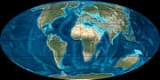
The continents during the Paleogene continued to drift
closer to their current positions. India
was in the process of colliding with Asia, subsequently forming the Himalayas
. The Atlantic Ocean
continued to widen by a few centimeters each year. Africa was moving north to meet with Europe and form the Mediterranean
, while South America was moving closer to North America (they would later connect via the Isthmus of Panama
). Inland seas retreated from North America
early in the period. Australia had also separated from Antarctica and was drifting towards Southeast Asia.
s began a rapid diversification during this period. After the K-T extinction, which saw the demise of the dinosaur
s, they transformed from a few small and generalized forms and began to evolve into most of the modern varieties we see today. Some of these mammals would evolve into large forms that would dominate the land, while others would become capable of living in marine
, specialized terrestrial, and airborne environments. Some mammals took to the oceans and became modern cetaceans, while others took to the trees and became primate
s, the group to which humans belong. Birds, which were already well established by the end of the Cretaceous
, also experienced an adaptive radiation as they took over the skies left empty by the now extinct Pterosaur
s. Most other branches of life
remained relatively unchanged in comparison to birds and mammals during this period.
As the Earth began to cool, tropical plants were less numerous and were now restricted to equatorial regions. Deciduous plants became more common, which could survive through the seasonal climate the world was now experiencing. Grasslands also began to replace many forests because they could survive better in the drier climate.
oil exploration, where it is usually referred to as the "Lower Tertiary". These rock formations represent the current cutting edge of deep-water oil discovery.
Lower Tertiary rock formations encountered in the Gulf of Mexico oil industry tend to be comparatively high temperature and high pressure reservoirs, often with high sand content (70%+) or under very thick salt
sediment layers.
Lower Tertiary explorations to date include (partial list):
Cenozoic
The Cenozoic era is the current and most recent of the three Phanerozoic geological eras and covers the period from 65.5 mya to the present. The era began in the wake of the Cretaceous–Tertiary extinction event at the end of the Cretaceous that saw the demise of the last non-avian dinosaurs and...
Era
Era
An era is a commonly used word for long period of time. When used in science, for example geology, eras denote clearly defined periods of time of arbitrary but well defined length, such as for example the Mesozoic era from 252 Ma–66 Ma, delimited by a start event and an end event. When used in...
. Lasting 42 million years, the Paleogene is most notable as being the time in which mammal
Mammal
Mammals are members of a class of air-breathing vertebrate animals characterised by the possession of endothermy, hair, three middle ear bones, and mammary glands functional in mothers with young...
s evolved
Evolution
Evolution is any change across successive generations in the heritable characteristics of biological populations. Evolutionary processes give rise to diversity at every level of biological organisation, including species, individual organisms and molecules such as DNA and proteins.Life on Earth...
from relatively small, simple forms into a large group of diverse animal
Animal
Animals are a major group of multicellular, eukaryotic organisms of the kingdom Animalia or Metazoa. Their body plan eventually becomes fixed as they develop, although some undergo a process of metamorphosis later on in their life. Most animals are motile, meaning they can move spontaneously and...
s in the wake of the Cretaceous–Tertiary extinction event that ended the preceding Cretaceous
Cretaceous
The Cretaceous , derived from the Latin "creta" , usually abbreviated K for its German translation Kreide , is a geologic period and system from circa to million years ago. In the geologic timescale, the Cretaceous follows the Jurassic period and is followed by the Paleogene period of the...
Period. Bird
Bird
Birds are feathered, winged, bipedal, endothermic , egg-laying, vertebrate animals. Around 10,000 living species and 188 families makes them the most speciose class of tetrapod vertebrates. They inhabit ecosystems across the globe, from the Arctic to the Antarctic. Extant birds range in size from...
s also evolved considerably during this period, changing into roughly modern forms.
This period consists of the Paleocene
Paleocene
The Paleocene or Palaeocene, the "early recent", is a geologic epoch that lasted from about . It is the first epoch of the Palaeogene Period in the modern Cenozoic Era...
, Eocene
Eocene
The Eocene Epoch, lasting from about 56 to 34 million years ago , is a major division of the geologic timescale and the second epoch of the Paleogene Period in the Cenozoic Era. The Eocene spans the time from the end of the Palaeocene Epoch to the beginning of the Oligocene Epoch. The start of the...
, and Oligocene
Oligocene
The Oligocene is a geologic epoch of the Paleogene Period and extends from about 34 million to 23 million years before the present . As with other older geologic periods, the rock beds that define the period are well identified but the exact dates of the start and end of the period are slightly...
Epochs
Epoch (geology)
An epoch is a subdivision of the geologic timescale based on rock layering. In order, the higher subdivisions are periods, eras and eons. We are currently living in the Holocene epoch...
. The end of the Paleocene (55.5/54.8 Mya) was marked by one of the most significant periods of global change during the Cenozoic, the Paleocene-Eocene Thermal Maximum
Paleocene-Eocene Thermal Maximum
The most extreme change in Earth surface conditions during the Cenozoic Era began at the temporal boundary between the Paleocene and Eocene epochs . This event, the Paleocene–Eocene Thermal Maximum , was associated with rapid global...
, which upset oceanic and atmospheric circulation and led to the extinction of numerous deep-sea benthic foraminifera
Foraminifera
The Foraminifera , or forams for short, are a large group of amoeboid protists which are among the commonest plankton species. They have reticulating pseudopods, fine strands of cytoplasm that branch and merge to form a dynamic net...
and on land, a major turnover in mammals. The Paleogene follows the Cretaceous Period and is followed by the Miocene
Miocene
The Miocene is a geological epoch of the Neogene Period and extends from about . The Miocene was named by Sir Charles Lyell. Its name comes from the Greek words and and means "less recent" because it has 18% fewer modern sea invertebrates than the Pliocene. The Miocene follows the Oligocene...
Epoch of the Neogene
Neogene
The Neogene is a geologic period and system in the International Commission on Stratigraphy Geologic Timescale starting 23.03 ± 0.05 million years ago and ending 2.588 million years ago...
Period. The terms 'Paleogene System' (formal) and 'lower Tertiary System' (informal) are applied to the rocks deposited during the 'Paleogene Period'. The somewhat confusing terminology seems to be due to attempts to deal with the comparatively fine subdivisions of time possible in the relatively recent geologic past, when more information is preserved. By dividing the Tertiary
Tertiary
The Tertiary is a deprecated term for a geologic period 65 million to 2.6 million years ago. The Tertiary covered the time span between the superseded Secondary period and the Quaternary...
Period into two periods instead of five epochs, the periods are more closely comparable to the duration of 'periods' in the Mesozoic
Mesozoic
The Mesozoic era is an interval of geological time from about 250 million years ago to about 65 million years ago. It is often referred to as the age of reptiles because reptiles, namely dinosaurs, were the dominant terrestrial and marine vertebrates of the time...
and Paleozoic
Paleozoic
The Paleozoic era is the earliest of three geologic eras of the Phanerozoic eon, spanning from roughly...
Eras.
Climate and Geography
The global climate during the Paleogene departed from the hot and humid conditions of the late Mesozoic era and began a cooling and drying trend which, although having been periodically disrupted by warm periods such as the Paleocene–Eocene Thermal Maximum, persists today. The trend was partly caused by the formation of the Antarctic Circumpolar CurrentAntarctic Circumpolar Current
The Antarctic Circumpolar Current is an ocean current that flows from west to east around Antarctica. An alternative name for the ACC is the West Wind Drift. The ACC is the dominant circulation feature of the Southern Ocean and, at approximately 125 Sverdrups, the largest ocean current...
, which significantly cooled oceanic water temperatures.
The continents during the Paleogene continued to drift
Plate tectonics
Plate tectonics is a scientific theory that describes the large scale motions of Earth's lithosphere...
closer to their current positions. India
India
India , officially the Republic of India , is a country in South Asia. It is the seventh-largest country by geographical area, the second-most populous country with over 1.2 billion people, and the most populous democracy in the world...
was in the process of colliding with Asia, subsequently forming the Himalayas
Himalayas
The Himalaya Range or Himalaya Mountains Sanskrit: Devanagari: हिमालय, literally "abode of snow"), usually called the Himalayas or Himalaya for short, is a mountain range in Asia, separating the Indian subcontinent from the Tibetan Plateau...
. The Atlantic Ocean
Atlantic Ocean
The Atlantic Ocean is the second-largest of the world's oceanic divisions. With a total area of about , it covers approximately 20% of the Earth's surface and about 26% of its water surface area...
continued to widen by a few centimeters each year. Africa was moving north to meet with Europe and form the Mediterranean
Mediterranean Sea
The Mediterranean Sea is a sea connected to the Atlantic Ocean surrounded by the Mediterranean region and almost completely enclosed by land: on the north by Anatolia and Europe, on the south by North Africa, and on the east by the Levant...
, while South America was moving closer to North America (they would later connect via the Isthmus of Panama
Isthmus of Panama
The Isthmus of Panama, also historically known as the Isthmus of Darien, is the narrow strip of land that lies between the Caribbean Sea and the Pacific Ocean, linking North and South America. It contains the country of Panama and the Panama Canal...
). Inland seas retreated from North America
North America
North America is a continent wholly within the Northern Hemisphere and almost wholly within the Western Hemisphere. It is also considered a northern subcontinent of the Americas...
early in the period. Australia had also separated from Antarctica and was drifting towards Southeast Asia.
Flora and Fauna
MammalMammal
Mammals are members of a class of air-breathing vertebrate animals characterised by the possession of endothermy, hair, three middle ear bones, and mammary glands functional in mothers with young...
s began a rapid diversification during this period. After the K-T extinction, which saw the demise of the dinosaur
Dinosaur
Dinosaurs are a diverse group of animals of the clade and superorder Dinosauria. They were the dominant terrestrial vertebrates for over 160 million years, from the late Triassic period until the end of the Cretaceous , when the Cretaceous–Paleogene extinction event led to the extinction of...
s, they transformed from a few small and generalized forms and began to evolve into most of the modern varieties we see today. Some of these mammals would evolve into large forms that would dominate the land, while others would become capable of living in marine
Ocean
An ocean is a major body of saline water, and a principal component of the hydrosphere. Approximately 71% of the Earth's surface is covered by ocean, a continuous body of water that is customarily divided into several principal oceans and smaller seas.More than half of this area is over 3,000...
, specialized terrestrial, and airborne environments. Some mammals took to the oceans and became modern cetaceans, while others took to the trees and became primate
Primate
A primate is a mammal of the order Primates , which contains prosimians and simians. Primates arose from ancestors that lived in the trees of tropical forests; many primate characteristics represent adaptations to life in this challenging three-dimensional environment...
s, the group to which humans belong. Birds, which were already well established by the end of the Cretaceous
Cretaceous
The Cretaceous , derived from the Latin "creta" , usually abbreviated K for its German translation Kreide , is a geologic period and system from circa to million years ago. In the geologic timescale, the Cretaceous follows the Jurassic period and is followed by the Paleogene period of the...
, also experienced an adaptive radiation as they took over the skies left empty by the now extinct Pterosaur
Pterosaur
Pterosaurs were flying reptiles of the clade or order Pterosauria. They existed from the late Triassic to the end of the Cretaceous Period . Pterosaurs are the earliest vertebrates known to have evolved powered flight...
s. Most other branches of life
Life
Life is a characteristic that distinguishes objects that have signaling and self-sustaining processes from those that do not, either because such functions have ceased , or else because they lack such functions and are classified as inanimate...
remained relatively unchanged in comparison to birds and mammals during this period.
As the Earth began to cool, tropical plants were less numerous and were now restricted to equatorial regions. Deciduous plants became more common, which could survive through the seasonal climate the world was now experiencing. Grasslands also began to replace many forests because they could survive better in the drier climate.
Oil industry relevance
The Paleogene is notable in the context of offshore oil drilling, and especially in Gulf of MexicoGulf of Mexico
The Gulf of Mexico is a partially landlocked ocean basin largely surrounded by the North American continent and the island of Cuba. It is bounded on the northeast, north and northwest by the Gulf Coast of the United States, on the southwest and south by Mexico, and on the southeast by Cuba. In...
oil exploration, where it is usually referred to as the "Lower Tertiary". These rock formations represent the current cutting edge of deep-water oil discovery.
Lower Tertiary rock formations encountered in the Gulf of Mexico oil industry tend to be comparatively high temperature and high pressure reservoirs, often with high sand content (70%+) or under very thick salt
Salt
In chemistry, salts are ionic compounds that result from the neutralization reaction of an acid and a base. They are composed of cations and anions so that the product is electrically neutral...
sediment layers.
Lower Tertiary explorations to date include (partial list):
- Kaskida Oil FieldKaskida Oil FieldThe Kaskida Oil Field is an offshore oil field located in the Keathley Canyon block 292 of the United States sector of the Gulf of Mexico, south-west of New Orleans, Louisiana...
- Tiber Oil Field
- Jack 2Jack 2Jack 2 is a test well in the deep waters of the Gulf of Mexico that successfully extracted oil from the lower Tertiary area of the Gulf in the second quarter of 2006. The field owners Chevron, Devon Energy and Norway's Statoil drilled to about below the sea floor, the wellhead being below...