

Indri

Encyclopedia
The indri also called the babakoto, is one of the largest living lemur
s. It is a diurnal
tree-dweller related to the sifaka
s and, like all lemuroids, it is native to Madagascar
.
name for the animal, endrina. An oft-repeated, but probably incorrect story is that the name comes from indry ˈiɳɖʐʲ, meaning "there" or "there it is." French
naturalist Pierre Sonnerat
, who first described the animal, supposedly heard a Malagasy point out the animal and took the word to be its name. The Malagasy name for the animal is bəbəˈkut. Babakoto is most commonly translated as "ancestor" or "father", but several translations are possible. "Koto" is a Malagasy word for "little boy", and "baba" is a term for "father", so the word "babakoto" may be translated as "father of a little boy." The father-son dynamic of many of the babakoto origin myths helps to explain the Malagasy name.
, the indri is the largest lemur still in existence. It has a head-body length of 64–72 cm (2.1–2.4 ft) and can reach nearly 120 cm (3.9 ft) with legs fully extended. It can weigh between 6 and 9.5 kg (13.2 and 20.9 lb), though the average is on the lower end of the range.
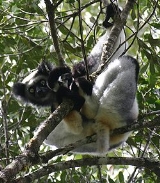
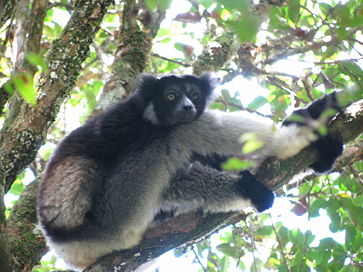
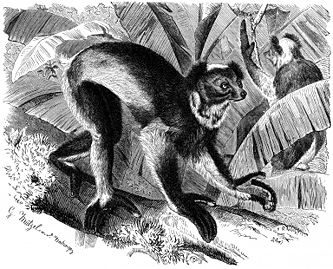
The indri is a vertical clinger and leaper and thus holds its body upright when traveling through trees or resting in branches. It has long, muscular legs which it uses to propel itself from trunk to trunk. Its large greenish eyes and black face are framed by round, fuzzy ears that some say give it the appearance of a teddy bear. Unlike any other living lemur, the indri has only a rudimentary tail. The silky fur is mostly black with white patches along the limbs, neck, crown, and lower back. Different populations of the species show wide variations in color, with some northern populations consisting of mostly or entirely black individuals. The face is bare with pale black skin, and it is sometimes fringed with white fur.
Due to these color variations, Colin Groves
listed two subspecies of the indri in 2005: The dark Indri indri indri from the northern part of its range and the relatively pale Indri indri variegatus from the southern part. Later editions of Lemurs of Madagascar by Russell Mittermeier
et al. do not recognize this classification, and recent genetic
and morphological
work suggests the variation in the indri is clinal.
 The indri practices long-term monogamy
, seeking a new partner only after the death of a mate. It lives in small groups consisting of the mated male and female and their maturing offspring. In the more fragmented forests of their range, the indri may live in larger groups with several generations. Habitat fragmentation
limits the mobility and capacity of these large groups to break into smaller units.
 The indri is well known for its loud, distinctive songs, which can last from 45 seconds to more than 3 minutes. Song duration and structure varies among and even within groups, but most songs have the following three-phase pattern.
Usually, a "roar sequence" lasting for several seconds will precede the more characteristic vocalizations. All members of the group (except the very young) participate in this roar, but the song proper is dominated by the adult pair. They follow the roar with a "long note sequence", characterized by notes of up to 5 seconds in duration. After this is the "descending phrase sequence". The wails begin on a high note and become progressively lower-pitched. It is common here for two or more indri to coordinate the timing of their descending notes to form a duet.
Different indri groups typically sing sequentially, responding to one another. As well as solidifying contacts between groups, the songs may communicate territorial defense and boundaries, environmental conditions, reproductive potential of the group members, and warning signals. The indri may sing after disturbances such as thunder, airplanes, bird calls, and other lemur calls. A group will sing almost every day, up to seven times daily. The peak singing hours are between 7 and 11 AM. Daily frequency of song is highest in November and December (near breeding season), when the indri are even heard during the night.
Several other indri vocalizations have been identified. The "roar" is also used as a warning signal for aerial predators such as hawks. The indri emit a "hoot" or "honk" to warn of terrestrial predators such as the fossa
. Other vocal categories include the "grunt", "kiss", "wheeze", and "hum". The purpose of these is still not entirely clear.
and primarily folivorous
. It prefers young, tender leaves but will also eat seeds, fruits, and flowers. Female indri seem to have greater preference for immature leaves than males do and will spend more time foraging among them. A wide variety of plant species are consumed, with members of the laurel family
featuring prominently in the diet. The indri consumes little non-tree vegetation.
To feed, the indri plucks off a leaf or other plant part with its teeth. It uses its hands to pull tree branches closer to its mouth.
and montane
forests along the eastern coast of Madagascar, from the Réserve Spéciale d’Anjanaharibe-Sud in the north to the Mangoro River in the south. They are absent from the Masoala Peninsula
and the Marojejy National Park, even though both regions are connected to forests where indri do occur less than 40 km away.
 Across Madagascar, the indri is revered and protected by fady (taboo
s). There are countless variations on the legend of the indri's origins, but they all treat it as a sacred animal, not to be hunted or harmed.
According to one origin myth, a boy went into the forest to collect honey, was stung by bees, and fell from a tree. An indri caught him and carried him to safety.
Most legends establish a closer relationship between the indri and humans. In some regions it is believed that there were two brothers who lived together in the forest until one of them decided to leave and cultivate the land. That brother became the first human, and the brother who stayed in the forest became the first indri. The indri cries in mourning for his brother who went astray.
Another legend tells of a man who went hunting in the forest and did not return. His absence worried his son, who went out looking for him. When the son also disappeared, the rest of the villagers ventured into the forest seeking the two but discovered only two large lemurs sitting in the trees: the first indri. The boy and his father had transformed. In some versions it is only the son who transforms, and the wailing of the babakoto is analogous to the father’s wailing for his lost son.
In all of the babakoto origin myths, there is some connection of the lemur with humanity, usually through common ancestry. It is easy to see why the indri is so closely identified with humans. Its long legs, large upright body, lack of a prominent tail, vocalizations, and complex systems of communication are all reminiscent of human traits.
Another human-like characteristic of the indri is its behavior in the sun. Like its sifaka
relatives, the indri frequently engages in what has been described as sun-bathing or sun-worshipping. As the sun rises each morning, it will sit and face it from a tree branch with its legs crossed, back straight, hands low with palms facing out or resting on its knees, and eyes half-closed. Biologists are hesitant to call this behavior sun worship, as the term may be overly anthropomorphic. However, many Malagasy people do believe that the indri worships the sun.
's 1961 BBC series Zoo Quest to Madagascar
The indri is an endangered species. The primary threats to its existence are habitat destruction
and fragmentation
due to slash and burn
agriculture, fuelwood gathering, and logging. This kind of destruction occurs even in protected areas.
The indri is also widely hunted, despite the many origin myths and traditional taboos (fady) which hold it sacred. Cultural erosion and immigration
are partly to blame for the breakdown of traditional beliefs. In some cases, Malagasy people who resent the protective fady find ways to circumvent them. People whose fady forbid them from eating the indri may still hunt the lemurs and sell their flesh, and those forbidden to kill the indri may still purchase and consume them. Indri meat is prized as a delicacy in some regions.
Lemur
Lemurs are a clade of strepsirrhine primates endemic to the island of Madagascar. They are named after the lemures of Roman mythology due to the ghostly vocalizations, reflective eyes, and the nocturnal habits of some species...
s. It is a diurnal
Diurnal animal
Diurnality is a plant or animal behavior characterized by activity during the day and sleeping at night.-In animals:Animals that are not diurnal might be nocturnal or crepuscular . Many animal species are diurnal, including many mammals, insects, reptiles and birds...
tree-dweller related to the sifaka
Sifaka
Sifakas are a genus of lemur from the family Indriidae within the order Primates. Their name of the family is an onomatopoeia of their characteristic "shi-fak" alarm call. Like all lemurs, they are found only on the island of Madagascar...
s and, like all lemuroids, it is native to Madagascar
Madagascar
The Republic of Madagascar is an island country located in the Indian Ocean off the southeastern coast of Africa...
.
Etymology
The name "indri" most likely comes from a native MalagasyMalagasy language
Malagasy is the national language of Madagascar, a member of the Austronesian family of languages. Most people in Madagascar speak it as a first language as do some people of Malagasy descent elsewhere.-History:...
name for the animal, endrina. An oft-repeated, but probably incorrect story is that the name comes from indry ˈiɳɖʐʲ, meaning "there" or "there it is." French
France
The French Republic , The French Republic , The French Republic , (commonly known as France , is a unitary semi-presidential republic in Western Europe with several overseas territories and islands located on other continents and in the Indian, Pacific, and Atlantic oceans. Metropolitan France...
naturalist Pierre Sonnerat
Pierre Sonnerat
Pierre Sonnerat was a French naturalist and explorer.Sonnerat was the nephew of the botanist Pierre Poivre. He made several voyages to southeast Asia, visiting the Philippines and Moluccas between 1769 and 1772, and India and China from 1774 to 1781. He was the first person to give a scientific...
, who first described the animal, supposedly heard a Malagasy point out the animal and took the word to be its name. The Malagasy name for the animal is bəbəˈkut. Babakoto is most commonly translated as "ancestor" or "father", but several translations are possible. "Koto" is a Malagasy word for "little boy", and "baba" is a term for "father", so the word "babakoto" may be translated as "father of a little boy." The father-son dynamic of many of the babakoto origin myths helps to explain the Malagasy name.
Physical characteristics
Along with the diademed sifakaDiademed Sifaka
The diademed sifaka , or diademed simpona, is an endangered species of sifaka, one of the lemurs endemic to certain rainforests in eastern Madagascar. This species is one of the world's largest living lemurs, with a total adult length of approximately 105 centimetres , half of which is tail...
, the indri is the largest lemur still in existence. It has a head-body length of 64–72 cm (2.1–2.4 ft) and can reach nearly 120 cm (3.9 ft) with legs fully extended. It can weigh between 6 and 9.5 kg (13.2 and 20.9 lb), though the average is on the lower end of the range.
The indri is a vertical clinger and leaper and thus holds its body upright when traveling through trees or resting in branches. It has long, muscular legs which it uses to propel itself from trunk to trunk. Its large greenish eyes and black face are framed by round, fuzzy ears that some say give it the appearance of a teddy bear. Unlike any other living lemur, the indri has only a rudimentary tail. The silky fur is mostly black with white patches along the limbs, neck, crown, and lower back. Different populations of the species show wide variations in color, with some northern populations consisting of mostly or entirely black individuals. The face is bare with pale black skin, and it is sometimes fringed with white fur.
Due to these color variations, Colin Groves
Colin Groves
Colin Peter Groves is Professor of Biological Anthropology at the Australian National University in Canberra, Australia.Born in England on 24 June 1942, Colin Groves completed a Bachelor of Science at University College London in 1963, and a Doctor of Philosophy at the Royal Free Hospital School of...
listed two subspecies of the indri in 2005: The dark Indri indri indri from the northern part of its range and the relatively pale Indri indri variegatus from the southern part. Later editions of Lemurs of Madagascar by Russell Mittermeier
Russell Mittermeier
Russell Alan Mittermeier is a primatologist, herpetologist and biological anthropologist. He has written several books for both popular and scientist audiences, and has authored some 300 scientific papers.-Biography:...
et al. do not recognize this classification, and recent genetic
Genetics
Genetics , a discipline of biology, is the science of genes, heredity, and variation in living organisms....
and morphological
Morphology (biology)
In biology, morphology is a branch of bioscience dealing with the study of the form and structure of organisms and their specific structural features....
work suggests the variation in the indri is clinal.
Behavior
Monogamy
Monogamy /Gr. μονός+γάμος - one+marriage/ a form of marriage in which an individual has only one spouse at any one time. In current usage monogamy often refers to having one sexual partner irrespective of marriage or reproduction...
, seeking a new partner only after the death of a mate. It lives in small groups consisting of the mated male and female and their maturing offspring. In the more fragmented forests of their range, the indri may live in larger groups with several generations. Habitat fragmentation
Habitat fragmentation
Habitat fragmentation as the name implies, describes the emergence of discontinuities in an organism's preferred environment , causing population fragmentation...
limits the mobility and capacity of these large groups to break into smaller units.
Reproduction
Female indri bear offspring every two to three years, with a gestation period of approximately 60 days. The single infant is usually born in May or June. The mother is the primary caregiver, though the father assists, remaining with his mate and offspring. Infants are born mostly or completely black and begin to show white coloration (if any) by two or three months of age. The infant will cling to its mother's belly until it is four or five months old, at which time it is ready to move onto her back. The indri begins to demonstrate independence at eight months, but it will not be fully independent from its mother until it is at least two years old. The indri reaches reproductive maturity between seven and nine years of age: a relatively slow rate.Communication
Usually, a "roar sequence" lasting for several seconds will precede the more characteristic vocalizations. All members of the group (except the very young) participate in this roar, but the song proper is dominated by the adult pair. They follow the roar with a "long note sequence", characterized by notes of up to 5 seconds in duration. After this is the "descending phrase sequence". The wails begin on a high note and become progressively lower-pitched. It is common here for two or more indri to coordinate the timing of their descending notes to form a duet.
Different indri groups typically sing sequentially, responding to one another. As well as solidifying contacts between groups, the songs may communicate territorial defense and boundaries, environmental conditions, reproductive potential of the group members, and warning signals. The indri may sing after disturbances such as thunder, airplanes, bird calls, and other lemur calls. A group will sing almost every day, up to seven times daily. The peak singing hours are between 7 and 11 AM. Daily frequency of song is highest in November and December (near breeding season), when the indri are even heard during the night.
Several other indri vocalizations have been identified. The "roar" is also used as a warning signal for aerial predators such as hawks. The indri emit a "hoot" or "honk" to warn of terrestrial predators such as the fossa
Fossa (animal)
The fossa is a cat-like, carnivorous mammal that is endemic to Madagascar. It is a member of the Eupleridae, a family of carnivorans closely related to the mongoose family . Its classification has been controversial because its physical traits resemble those of cats, yet other traits suggest a...
. Other vocal categories include the "grunt", "kiss", "wheeze", and "hum". The purpose of these is still not entirely clear.
Diet and feeding
The indri is herbivorousHerbivore
Herbivores are organisms that are anatomically and physiologically adapted to eat plant-based foods. Herbivory is a form of consumption in which an organism principally eats autotrophs such as plants, algae and photosynthesizing bacteria. More generally, organisms that feed on autotrophs in...
and primarily folivorous
Folivore
In zoology, a folivore is a herbivore that specializes in eating leaves. Mature leaves contain a high proportion of hard-to-digest cellulose, less energy than other types of foods, and often toxic compounds. For this reason folivorous animals tend to have long digestive tracts and slow metabolisms....
. It prefers young, tender leaves but will also eat seeds, fruits, and flowers. Female indri seem to have greater preference for immature leaves than males do and will spend more time foraging among them. A wide variety of plant species are consumed, with members of the laurel family
Lauraceae
The Lauraceae or Laurel family comprises a group of flowering plants included in the order Laurales. The family contains about 55 genera and over 3500, perhaps as many as 4000, species world-wide, mostly from warm or tropical regions, especially Southeast Asia and South America...
featuring prominently in the diet. The indri consumes little non-tree vegetation.
To feed, the indri plucks off a leaf or other plant part with its teeth. It uses its hands to pull tree branches closer to its mouth.
Distribution
This lemur inhabits the lowlandMadagascar lowland forests
The Madagascar lowland forests are a tropical moist broadleaf forest ecoregion, found on the eastern coast of the island of Madagascar.-Setting:...
and montane
Montane
In biogeography, montane is the highland area located below the subalpine zone. Montane regions generally have cooler temperatures and often have higher rainfall than the adjacent lowland regions, and are frequently home to distinct communities of plants and animals.The term "montane" means "of the...
forests along the eastern coast of Madagascar, from the Réserve Spéciale d’Anjanaharibe-Sud in the north to the Mangoro River in the south. They are absent from the Masoala Peninsula
Geography of Madagascar
Madagascar is an island in the Indian Ocean off the eastern coast of southern Africa, east of Mozambique. It is the fourth largest island in the world. The highest point is Maromokotro, in the Tsaratanana Massif region in the north of the island, at . The capital Antananarivo is in the Hauts...
and the Marojejy National Park, even though both regions are connected to forests where indri do occur less than 40 km away.
Mythology
Taboo
A taboo is a strong social prohibition relating to any area of human activity or social custom that is sacred and or forbidden based on moral judgment, religious beliefs and or scientific consensus. Breaking the taboo is usually considered objectionable or abhorrent by society...
s). There are countless variations on the legend of the indri's origins, but they all treat it as a sacred animal, not to be hunted or harmed.
According to one origin myth, a boy went into the forest to collect honey, was stung by bees, and fell from a tree. An indri caught him and carried him to safety.
Most legends establish a closer relationship between the indri and humans. In some regions it is believed that there were two brothers who lived together in the forest until one of them decided to leave and cultivate the land. That brother became the first human, and the brother who stayed in the forest became the first indri. The indri cries in mourning for his brother who went astray.
Another legend tells of a man who went hunting in the forest and did not return. His absence worried his son, who went out looking for him. When the son also disappeared, the rest of the villagers ventured into the forest seeking the two but discovered only two large lemurs sitting in the trees: the first indri. The boy and his father had transformed. In some versions it is only the son who transforms, and the wailing of the babakoto is analogous to the father’s wailing for his lost son.
In all of the babakoto origin myths, there is some connection of the lemur with humanity, usually through common ancestry. It is easy to see why the indri is so closely identified with humans. Its long legs, large upright body, lack of a prominent tail, vocalizations, and complex systems of communication are all reminiscent of human traits.
Another human-like characteristic of the indri is its behavior in the sun. Like its sifaka
Sifaka
Sifakas are a genus of lemur from the family Indriidae within the order Primates. Their name of the family is an onomatopoeia of their characteristic "shi-fak" alarm call. Like all lemurs, they are found only on the island of Madagascar...
relatives, the indri frequently engages in what has been described as sun-bathing or sun-worshipping. As the sun rises each morning, it will sit and face it from a tree branch with its legs crossed, back straight, hands low with palms facing out or resting on its knees, and eyes half-closed. Biologists are hesitant to call this behavior sun worship, as the term may be overly anthropomorphic. However, many Malagasy people do believe that the indri worships the sun.
Conservation
The first film of indri was obtained by using tape lures, on an expedition forming the basis of David AttenboroughDavid Attenborough
Sir David Frederick Attenborough OM, CH, CVO, CBE, FRS, FZS, FSA is a British broadcaster and naturalist. His career as the face and voice of natural history programmes has endured for more than 50 years...
's 1961 BBC series Zoo Quest to Madagascar
Zoo Quest
Zoo Quest was a series of multi-part nature documentaries broadcast on BBC television between 1954 and 1963. It was the first major programme to feature David Attenborough....
The indri is an endangered species. The primary threats to its existence are habitat destruction
Habitat destruction
Habitat destruction is the process in which natural habitat is rendered functionally unable to support the species present. In this process, the organisms that previously used the site are displaced or destroyed, reducing biodiversity. Habitat destruction by human activity mainly for the purpose of...
and fragmentation
Habitat fragmentation
Habitat fragmentation as the name implies, describes the emergence of discontinuities in an organism's preferred environment , causing population fragmentation...
due to slash and burn
Slash and burn
Slash-and-burn is an agricultural technique which involves cutting and burning of forests or woodlands to create fields. It is subsistence agriculture that typically uses little technology or other tools. It is typically part of shifting cultivation agriculture, and of transhumance livestock...
agriculture, fuelwood gathering, and logging. This kind of destruction occurs even in protected areas.
The indri is also widely hunted, despite the many origin myths and traditional taboos (fady) which hold it sacred. Cultural erosion and immigration
Immigration
Immigration is the act of foreigners passing or coming into a country for the purpose of permanent residence...
are partly to blame for the breakdown of traditional beliefs. In some cases, Malagasy people who resent the protective fady find ways to circumvent them. People whose fady forbid them from eating the indri may still hunt the lemurs and sell their flesh, and those forbidden to kill the indri may still purchase and consume them. Indri meat is prized as a delicacy in some regions.