


Somatosensory system

Encyclopedia
The somatosensory system is a diverse sensory system
composed of the receptors and processing centres to produce the sensory modalities such as touch, temperature
, proprioception
(body position), and nociception
(pain). The sensory receptors cover the skin
and epithelia, skeletal muscle
s, bone
s and joint
s, internal organ
s, and the cardiovascular system. While touch (also, more formally, tactition; adjectival form: "tactile" or "somatosensory") is considered one of the five traditional sense
s, the impression of touch is formed from several modalities. In medicine, the colloquial term touch is usually replaced with somatic senses to better reflect the variety of mechanisms involved.
The system reacts to diverse stimuli
using different receptors: thermoreceptors, nociceptors, mechanoreceptors and chemoreceptors. Transmission of information from the receptors passes via sensory nerve
s through tracts in the spinal cord
and into the brain. Processing primarily occurs in the primary somatosensory area
in the parietal lobe
of the cerebral cortex
.
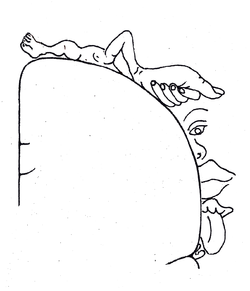 At its simplest, the system works when activity in a sensory neuron
is triggered by a specific stimulus such as heat; this signal eventually passes to an area in the brain uniquely attributed to that area on the body—this allows the processed stimulus to be felt at the correct location. The point-to-point mapping of the body surfaces in the brain is called a homunculus
and is essential in the creation of a body image
. This brain-surface ("cortical") map is not immutable, however. Dramatic shifts can occur in response to stroke or injury.
's body (and other vertebrates). It consists both of sensory receptors and sensory (afferent
) neurons in the periphery (skin, muscle and organs for example), to deeper neurones within the central nervous system
.
by afferent
neurones. There are a number of different types of afferent
neurones which vary in their size, structure and properties. Generally there is a correlation between the type of sensory modality detected and the type of afferent neurone involved. For example, slow, thin, unmyelinated neurones conduct pain whereas faster, thicker, myelinated neurones conduct casual touch.
. One major target within the brain
is the postcentral gyrus
in the cerebral cortex
. This is the target for neurons of the Dorsal Column Medial Lemniscal pathway and the Ventral Spinothalamic pathway. Note that many ascending somatosensory pathways include synapses in either the thalamus or the reticular formation before they reach the cortex. Other ascending pathways, particularly those involved with control of posture
are projected to the cerebellum
. These include the ventral
and dorsal spinocerebellar tract
s. Another important target for afferent
somatosensory neurons which enter the spinal cord
are those neurons involved with local segmental reflexes.
of the parietal lobe
. The postcentral gyrus is the location of the primary somatosensory area, the main sensory receptive area for the sense of touch. Like other sensory areas, there is a map of sensory space called a homunculus
at this location. For the primary somatosensory cortex, this is called the sensory homunculus. Areas of this part of the human brain
map to certain areas of the body, dependent on the amount or importance of somatosensory input from that area. For example, there is a large area of cortex devoted to sensation in the hands, while the back has a much smaller area. Somatosensory information involved with proprioception
and posture also targets an entirely different part of the brain, the cerebellum
.
Initiation of somatosensation begins with activation of a physical "receptor". These somatosensory receptors tend to lie in skin, organs or muscle. The structure of these receptors is broadly similar in all cases, consisting of either a "free nerve ending
" or a nerve ending embedded in a specialised capsule. They can be activated by movement (mechanoreceptor
), pressure (mechanoreceptor
), chemical (chemoreceptor) and/or temperature. Another activation is by vibration
s generated as a finger scans across a surface. This is the means by which we can sense fine textures in which the spatial scale is less than 200 µm
. Such vibrations are around 250 Hz, which is the optimal frequency sensitivity of Pacinian corpuscle
s. In each case, the general principle of activation is similar; the stimulus causes depolarisation of the nerve ending and then an action potential
is initiated. This action potential
then (usually) travels inward towards the spinal cord
.
involving peripheral nerves of the somatosensory system.
This may present as numbness or paresthesia
.
Evaluation of any suspected disease of the somatosensory system is included in a neurological examination of the peripheral nervous system
The new research area of haptic technology can provide touch sensation in virtual and real environments. This new discipline has started to provide critical insights into touch capabilities. In the field of speech therapy, tactile feedback has begun to be used to treat speech disorders.
Sensory system
A sensory system is a part of the nervous system responsible for processing sensory information. A sensory system consists of sensory receptors, neural pathways, and parts of the brain involved in sensory perception. Commonly recognized sensory systems are those for vision, hearing, somatic...
composed of the receptors and processing centres to produce the sensory modalities such as touch, temperature
Temperature
Temperature is a physical property of matter that quantitatively expresses the common notions of hot and cold. Objects of low temperature are cold, while various degrees of higher temperatures are referred to as warm or hot...
, proprioception
Proprioception
Proprioception , from Latin proprius, meaning "one's own" and perception, is the sense of the relative position of neighbouring parts of the body and strength of effort being employed in movement...
(body position), and nociception
Nociception
Nociception is defined as "the neural processes of encoding and processing noxious stimuli." It is the afferent activity produced in the peripheral and central nervous system by stimuli that have the potential to damage tissue...
(pain). The sensory receptors cover the skin
Skin
-Dermis:The dermis is the layer of skin beneath the epidermis that consists of connective tissue and cushions the body from stress and strain. The dermis is tightly connected to the epidermis by a basement membrane. It also harbors many Mechanoreceptors that provide the sense of touch and heat...
and epithelia, skeletal muscle
Skeletal muscle
Skeletal muscle is a form of striated muscle tissue existing under control of the somatic nervous system- i.e. it is voluntarily controlled. It is one of three major muscle types, the others being cardiac and smooth muscle...
s, bone
Bone
Bones are rigid organs that constitute part of the endoskeleton of vertebrates. They support, and protect the various organs of the body, produce red and white blood cells and store minerals. Bone tissue is a type of dense connective tissue...
s and joint
Joint
A joint is the location at which two or more bones make contact. They are constructed to allow movement and provide mechanical support, and are classified structurally and functionally.-Classification:...
s, internal organ
Organ (anatomy)
In biology, an organ is a collection of tissues joined in structural unit to serve a common function. Usually there is a main tissue and sporadic tissues . The main tissue is the one that is unique for the specific organ. For example, main tissue in the heart is the myocardium, while sporadic are...
s, and the cardiovascular system. While touch (also, more formally, tactition; adjectival form: "tactile" or "somatosensory") is considered one of the five traditional sense
Sense
Senses are physiological capacities of organisms that provide inputs for perception. The senses and their operation, classification, and theory are overlapping topics studied by a variety of fields, most notably neuroscience, cognitive psychology , and philosophy of perception...
s, the impression of touch is formed from several modalities. In medicine, the colloquial term touch is usually replaced with somatic senses to better reflect the variety of mechanisms involved.
The system reacts to diverse stimuli
Stimulus (physiology)
In physiology, a stimulus is a detectable change in the internal or external environment. The ability of an organism or organ to respond to external stimuli is called sensitivity....
using different receptors: thermoreceptors, nociceptors, mechanoreceptors and chemoreceptors. Transmission of information from the receptors passes via sensory nerve
Sensory nerve
Sensory nerves are nerves that receive sensory stimuli, such as how something feels and if it is painful, smooth, rough, etc.They are made up of nerve fibers, called sensory fibers .Sensory neurons are neurons that are activated by sensory input Sensory nerves are nerves that receive sensory...
s through tracts in the spinal cord
Spinal cord
The spinal cord is a long, thin, tubular bundle of nervous tissue and support cells that extends from the brain . The brain and spinal cord together make up the central nervous system...
and into the brain. Processing primarily occurs in the primary somatosensory area
Postcentral gyrus
The lateral postcentral gyrus is a prominent structure in the parietal lobe of the human brain and an important landmark. It is the location of primary somatosensory cortex, the main sensory receptive area for the sense of touch...
in the parietal lobe
Parietal lobe
The parietal lobe is a part of the Brain positioned above the occipital lobe and behind the frontal lobe.The parietal lobe integrates sensory information from different modalities, particularly determining spatial sense and navigation. For example, it comprises somatosensory cortex and the...
of the cerebral cortex
Cerebral cortex
The cerebral cortex is a sheet of neural tissue that is outermost to the cerebrum of the mammalian brain. It plays a key role in memory, attention, perceptual awareness, thought, language, and consciousness. It is constituted of up to six horizontal layers, each of which has a different...
.
Neuron
A neuron is an electrically excitable cell that processes and transmits information by electrical and chemical signaling. Chemical signaling occurs via synapses, specialized connections with other cells. Neurons connect to each other to form networks. Neurons are the core components of the nervous...
is triggered by a specific stimulus such as heat; this signal eventually passes to an area in the brain uniquely attributed to that area on the body—this allows the processed stimulus to be felt at the correct location. The point-to-point mapping of the body surfaces in the brain is called a homunculus
Homunculus
Homunculus is a term used, generally, in various fields of study to refer to any representation of a human being. Historically, it referred specifically to the concept of a miniature though fully formed human body, for example, in the studies of alchemy and preformationism...
and is essential in the creation of a body image
Body image
Body image refers to a person's perception of the aesthetics and sexual attractiveness of their own body. The phrase body image was first coined by the Austrian neurologist and psychoanalyst Paul Schilder in his masterpiece The Image and Appearance of the Human Body...
. This brain-surface ("cortical") map is not immutable, however. Dramatic shifts can occur in response to stroke or injury.
Anatomy
The somatosensory system is spread through all major parts of a mammalMammal
Mammals are members of a class of air-breathing vertebrate animals characterised by the possession of endothermy, hair, three middle ear bones, and mammary glands functional in mothers with young...
's body (and other vertebrates). It consists both of sensory receptors and sensory (afferent
Afferent
Afferent is an anatomical term with the following meanings:*Conveying towards a center, for example the afferent arterioles conveying blood towards the Bowman's capsule in the Kidney. Opposite to Efferent.*Something that so conducts, see Afferent nerve fiber...
) neurons in the periphery (skin, muscle and organs for example), to deeper neurones within the central nervous system
Central nervous system
The central nervous system is the part of the nervous system that integrates the information that it receives from, and coordinates the activity of, all parts of the bodies of bilaterian animals—that is, all multicellular animals except sponges and radially symmetric animals such as jellyfish...
.
General somatosensory pathway
A somatosensory pathway will typically have three long neurons: primary, secondary and tertiary (or first, second, and third).- The first neuron always has its cell body in the dorsal root ganglionDorsal root ganglionIn anatomy and neuroscience, a dorsal root ganglion is a nodule on a dorsal root that contains cell bodies of neurons in afferent spinal nerves.-Unique unipolar structure:...
of the spinal nerveSpinal nerveThe term spinal nerve generally refers to a mixed spinal nerve, which carries motor, sensory, and autonomic signals between the spinal cord and the body...
(if sensation is in head or neck, it will be the trigeminal nerve gangliaTrigeminal ganglionThe trigeminal ganglion is a sensory ganglion of the trigeminal nerve that occupies a cavity in the dura mater, covering the trigeminal impression near the apex of the petrous part of the temporal bone.-Relations:It is somewhat crescentic in shape, with its convexity...
or the ganglia of other sensory cranial nervesCranial nervesCranial nerves are nerves that emerge directly from the brain, in contrast to spinal nerves, which emerge from segments of the spinal cord. In humans, there are traditionally twelve pairs of cranial nerves...
). - The second neuron has its cell body either in the spinal cord or in the brainstem. This neuron's ascending axons will cross (decussate) to the opposite side either in the spinal cordSpinal cordThe spinal cord is a long, thin, tubular bundle of nervous tissue and support cells that extends from the brain . The brain and spinal cord together make up the central nervous system...
or in the brainstem. The axons of many of these neurones terminate in the thalamusThalamusThe thalamus is a midline paired symmetrical structure within the brains of vertebrates, including humans. It is situated between the cerebral cortex and midbrain, both in terms of location and neurological connections...
(for example the ventral posterior nucleusVentral posterior nucleusThe ventral posterior nucleus is the somato-sensory relay nucleus in thalamus of the brain.-Input and output:The ventral posterior nucleus receives neuronal input from the medial lemniscus, spinal lemniscus, spinothalamic tracts, and trigeminothalamic tract...
, VPN), others terminate in the reticular systemReticular activating systemThe reticular activating system is an area of the brain responsible for regulating arousal and sleep-wake transitions.- History and Etymology :...
or the cerebellumCerebellumThe cerebellum is a region of the brain that plays an important role in motor control. It may also be involved in some cognitive functions such as attention and language, and in regulating fear and pleasure responses, but its movement-related functions are the most solidly established...
. - In the case of touch and certain types of pain, the third neuron has its cell body in the VPN of the thalamus and ends in the postcentral gyrusPostcentral gyrusThe lateral postcentral gyrus is a prominent structure in the parietal lobe of the human brain and an important landmark. It is the location of primary somatosensory cortex, the main sensory receptive area for the sense of touch...
of the parietal lobeParietal lobeThe parietal lobe is a part of the Brain positioned above the occipital lobe and behind the frontal lobe.The parietal lobe integrates sensory information from different modalities, particularly determining spatial sense and navigation. For example, it comprises somatosensory cortex and the...
.
Periphery
In the periphery, the somatosensory system detects various stimuli by sensory receptors, e.g. by mechanoreceptors for tactile sensation and nociceptors for pain sensation. The sensory information (touch, pain, temperature etc.,) is then conveyed to the central nervous systemCentral nervous system
The central nervous system is the part of the nervous system that integrates the information that it receives from, and coordinates the activity of, all parts of the bodies of bilaterian animals—that is, all multicellular animals except sponges and radially symmetric animals such as jellyfish...
by afferent
Afferent
Afferent is an anatomical term with the following meanings:*Conveying towards a center, for example the afferent arterioles conveying blood towards the Bowman's capsule in the Kidney. Opposite to Efferent.*Something that so conducts, see Afferent nerve fiber...
neurones. There are a number of different types of afferent
Afferent
Afferent is an anatomical term with the following meanings:*Conveying towards a center, for example the afferent arterioles conveying blood towards the Bowman's capsule in the Kidney. Opposite to Efferent.*Something that so conducts, see Afferent nerve fiber...
neurones which vary in their size, structure and properties. Generally there is a correlation between the type of sensory modality detected and the type of afferent neurone involved. For example, slow, thin, unmyelinated neurones conduct pain whereas faster, thicker, myelinated neurones conduct casual touch.
Spinal cord
In the spinal cord, the somatosensory system includes ascending pathways from the body to the brainBrain
The brain is the center of the nervous system in all vertebrate and most invertebrate animals—only a few primitive invertebrates such as sponges, jellyfish, sea squirts and starfishes do not have one. It is located in the head, usually close to primary sensory apparatus such as vision, hearing,...
. One major target within the brain
Brain
The brain is the center of the nervous system in all vertebrate and most invertebrate animals—only a few primitive invertebrates such as sponges, jellyfish, sea squirts and starfishes do not have one. It is located in the head, usually close to primary sensory apparatus such as vision, hearing,...
is the postcentral gyrus
Postcentral gyrus
The lateral postcentral gyrus is a prominent structure in the parietal lobe of the human brain and an important landmark. It is the location of primary somatosensory cortex, the main sensory receptive area for the sense of touch...
in the cerebral cortex
Cerebral cortex
The cerebral cortex is a sheet of neural tissue that is outermost to the cerebrum of the mammalian brain. It plays a key role in memory, attention, perceptual awareness, thought, language, and consciousness. It is constituted of up to six horizontal layers, each of which has a different...
. This is the target for neurons of the Dorsal Column Medial Lemniscal pathway and the Ventral Spinothalamic pathway. Note that many ascending somatosensory pathways include synapses in either the thalamus or the reticular formation before they reach the cortex. Other ascending pathways, particularly those involved with control of posture
Human position
Human positions refers to the different positions that the human body can take.There are several synonyms that refer to the human position, often used interchangeably, but having specific flavors....
are projected to the cerebellum
Cerebellum
The cerebellum is a region of the brain that plays an important role in motor control. It may also be involved in some cognitive functions such as attention and language, and in regulating fear and pleasure responses, but its movement-related functions are the most solidly established...
. These include the ventral
Ventral spinocerebellar tract
The ventral spinocerebellar tract conveys proprioceptive information from the body to the cerebellum. It is part of the somatosensory system and runs in parallel with the dorsal spinocerebellar tract...
and dorsal spinocerebellar tract
Dorsal spinocerebellar tract
The dorsal spinocerebellar tract conveys inconscient proprioceptive information from the body to the cerebellum....
s. Another important target for afferent
Afferent
Afferent is an anatomical term with the following meanings:*Conveying towards a center, for example the afferent arterioles conveying blood towards the Bowman's capsule in the Kidney. Opposite to Efferent.*Something that so conducts, see Afferent nerve fiber...
somatosensory neurons which enter the spinal cord
Spinal cord
The spinal cord is a long, thin, tubular bundle of nervous tissue and support cells that extends from the brain . The brain and spinal cord together make up the central nervous system...
are those neurons involved with local segmental reflexes.
Brain
The primary somatosensory area in the human cortex is located in the postcentral gyrusPostcentral gyrus
The lateral postcentral gyrus is a prominent structure in the parietal lobe of the human brain and an important landmark. It is the location of primary somatosensory cortex, the main sensory receptive area for the sense of touch...
of the parietal lobe
Parietal lobe
The parietal lobe is a part of the Brain positioned above the occipital lobe and behind the frontal lobe.The parietal lobe integrates sensory information from different modalities, particularly determining spatial sense and navigation. For example, it comprises somatosensory cortex and the...
. The postcentral gyrus is the location of the primary somatosensory area, the main sensory receptive area for the sense of touch. Like other sensory areas, there is a map of sensory space called a homunculus
Homunculus
Homunculus is a term used, generally, in various fields of study to refer to any representation of a human being. Historically, it referred specifically to the concept of a miniature though fully formed human body, for example, in the studies of alchemy and preformationism...
at this location. For the primary somatosensory cortex, this is called the sensory homunculus. Areas of this part of the human brain
Human brain
The human brain has the same general structure as the brains of other mammals, but is over three times larger than the brain of a typical mammal with an equivalent body size. Estimates for the number of neurons in the human brain range from 80 to 120 billion...
map to certain areas of the body, dependent on the amount or importance of somatosensory input from that area. For example, there is a large area of cortex devoted to sensation in the hands, while the back has a much smaller area. Somatosensory information involved with proprioception
Proprioception
Proprioception , from Latin proprius, meaning "one's own" and perception, is the sense of the relative position of neighbouring parts of the body and strength of effort being employed in movement...
and posture also targets an entirely different part of the brain, the cerebellum
Cerebellum
The cerebellum is a region of the brain that plays an important role in motor control. It may also be involved in some cognitive functions such as attention and language, and in regulating fear and pleasure responses, but its movement-related functions are the most solidly established...
.
Physiology
Initiation of somatosensation begins with activation of a physical "receptor". These somatosensory receptors tend to lie in skin, organs or muscle. The structure of these receptors is broadly similar in all cases, consisting of either a "free nerve ending
Free nerve ending
A free nerve ending is an unspecialized, afferent nerve ending, meaning it brings information from the body's periphery toward the brain. They function as cutaneous receptors and are essentially used by vertebrates to detect pain.-Structure:...
" or a nerve ending embedded in a specialised capsule. They can be activated by movement (mechanoreceptor
Mechanoreceptor
A mechanoreceptor is a sensory receptor that responds to mechanical pressure or distortion. There are four main types in the glabrous skin of humans: Pacinian corpuscles, Meissner's corpuscles, Merkel's discs, and Ruffini corpuscles...
), pressure (mechanoreceptor
Mechanoreceptor
A mechanoreceptor is a sensory receptor that responds to mechanical pressure or distortion. There are four main types in the glabrous skin of humans: Pacinian corpuscles, Meissner's corpuscles, Merkel's discs, and Ruffini corpuscles...
), chemical (chemoreceptor) and/or temperature. Another activation is by vibration
Vibration
Vibration refers to mechanical oscillations about an equilibrium point. The oscillations may be periodic such as the motion of a pendulum or random such as the movement of a tire on a gravel road.Vibration is occasionally "desirable"...
s generated as a finger scans across a surface. This is the means by which we can sense fine textures in which the spatial scale is less than 200 µm
Micrometre
A micrometer , is by definition 1×10⁻⁶ of a meter .In plain English, it means one-millionth of a meter . Its unit symbol in the International System of Units is μm...
. Such vibrations are around 250 Hz, which is the optimal frequency sensitivity of Pacinian corpuscle
Pacinian corpuscle
Lamellar corpuscles or Pacinian corpuscles are one of the four major types of mechanoreceptor. They are nerve endings in the skin, responsible for sensitivity to vibration and pressure. Vibrational role may be used to detect surface, e.g., rough vs...
s. In each case, the general principle of activation is similar; the stimulus causes depolarisation of the nerve ending and then an action potential
Action potential
In physiology, an action potential is a short-lasting event in which the electrical membrane potential of a cell rapidly rises and falls, following a consistent trajectory. Action potentials occur in several types of animal cells, called excitable cells, which include neurons, muscle cells, and...
is initiated. This action potential
Action potential
In physiology, an action potential is a short-lasting event in which the electrical membrane potential of a cell rapidly rises and falls, following a consistent trajectory. Action potentials occur in several types of animal cells, called excitable cells, which include neurons, muscle cells, and...
then (usually) travels inward towards the spinal cord
Spinal cord
The spinal cord is a long, thin, tubular bundle of nervous tissue and support cells that extends from the brain . The brain and spinal cord together make up the central nervous system...
.
Diseases
A somatosensory deficiency may be caused by a peripheral neuropathyPeripheral neuropathy
Peripheral neuropathy is the term for damage to nerves of the peripheral nervous system, which may be caused either by diseases of or trauma to the nerve or the side-effects of systemic illness....
involving peripheral nerves of the somatosensory system.
This may present as numbness or paresthesia
Paresthesia
Paresthesia , spelled "paraesthesia" in British English, is a sensation of tingling, burning, pricking, or numbness of a person's skin with no apparent long-term physical effect. It is more generally known as the feeling of "pins and needles" or of a limb "falling asleep"...
.
Evaluation of any suspected disease of the somatosensory system is included in a neurological examination of the peripheral nervous system
Technology
The new research area of haptic technology can provide touch sensation in virtual and real environments. This new discipline has started to provide critical insights into touch capabilities. In the field of speech therapy, tactile feedback has begun to be used to treat speech disorders.
See also
- AllochiriaAllochiriaAllochiria is associated to spatial transpositions, usually symmetrical, of stimuli from one side of the body to the opposite one. It is a neurological disorder in which the patient responds to stimuli presented to one side of their body as if the stimuli had been presented at the opposite side...
- Cell signalling
- Cellular Cognition
- Muscle spindleMuscle spindleMuscle spindles are sensory receptors within the belly of a muscle, which primarily detect changes in the length of this muscle. They convey length information to the central nervous system via sensory neurons. This information can be processed by the brain to determine the position of body parts...
- Special sensesSpecial sensesIn medicine and anatomy, the special senses are the senses that have specialized organs devoted to them:*vision *hearing and balance *smell *taste...
- VibrateseVibrateseVibratese is a method of communication through touch. It was developed by F. A. Geldard, 1957. It is a tactile system based on both practical considerations and on results from a set of controlled psychophysical experiments. Vibratese was composed of 45 basic elements, the tactile equivalent of...
, method of communication through touch - Somatosensory Rehabilitation of PainSomatosensory Rehabilitation of PainThe Somatosensory Rehabilitation of Pain, is a method, who’s aim is to treat conditions of a reduced sense of touch or sensation in order to decrease neuropathic pain. Neuropathic pain, with a prevalency of 6.9 % of the general population, represents an important public health problem. i.e. Carpal...
- Two-point discrimination threshold
- Phantom limbPhantom limbA phantom limb is the sensation that an amputated or missing limb is still attached to the body and is moving appropriately with other body parts. 2 out of 3 combat veterans report this feeling. Approximately 60 to 80% of individuals with an amputation experience phantom sensations in their...