


Frond

Encyclopedia
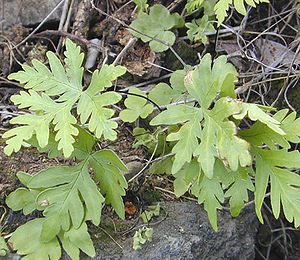
Leaf
A leaf is an organ of a vascular plant, as defined in botanical terms, and in particular in plant morphology. Foliage is a mass noun that refers to leaves as a feature of plants....
. In both common usage and botanical nomenclature, the leaves of fern
Fern
A fern is any one of a group of about 12,000 species of plants belonging to the botanical group known as Pteridophyta. Unlike mosses, they have xylem and phloem . They have stems, leaves, and roots like other vascular plants...
s are referred to as fronds and some botanists restrict the term to this group. Other botanists allow the term frond to also apply to the large leaves of cycad
Cycad
Cycads are seed plants typically characterized by a stout and woody trunk with a crown of large, hard and stiff, evergreen leaves. They usually have pinnate leaves. The individual plants are either all male or all female . Cycads vary in size from having a trunk that is only a few centimeters...
s and palms (Arecaceae
Arecaceae
Arecaceae or Palmae , are a family of flowering plants, the only family in the monocot order Arecales. There are roughly 202 currently known genera with around 2600 species, most of which are restricted to tropical, subtropical, and warm temperate climates...
)
When most people use the word frond they mean a large, compound leaf, but if the term is used botanically to refer to the leaves of ferns, it may be applied to smaller and undivided leaves.
Fronds, like all leaves, usually have a stalk called the petiole supporting a flattened blade, sometimes called a lamina. However, fronds are often described using distinctively different terms. The petiole
Petiole (botany)
In botany, the petiole is the stalk attaching the leaf blade to the stem. The petiole usually has the same internal structure as the stem. Outgrowths appearing on each side of the petiole are called stipules. Leaves lacking a petiole are called sessile, or clasping when they partly surround the...
of a frond is called a stipe
Stipe (botany)
In botany, a stipe is a stalk that supports some other structure. The precise meaning is different depending on which taxonomic group is being described....
and the continuation of the stipe into the blade portion is called the rachis. The blades may be simple (undivided), pinnatifid (deeply incised, but not truly compound), pinnate
Pinnate
Pinnate is a term used to describe feather-like or multi-divided features arising from both sides of a common axis in plant or animal structures, and comes from the Latin word pinna meaning "feather", "wing", or "fin". A similar term is pectinate, which refers to a comb-like arrangement of parts...
(compound with the leaflets arranged along a rachis to resemble a feather). If a frond is pinnate, the segments of the blade are called pinnae (singular: pinna) and the stalks bearing the pinnae are called petiolules (The main vein or mid-rib of a pinna is sometimes called a costa (pl., costae).
If a frond is divided into pinnae, the frond is called once pinnate. In some fronds the pinna are further divided into segments, creating a bipinnate frond. The segments into which each pinna are divided are called pinnules. Rarely, a frond may even be tripinnate, in which case the pinnule divisions are known as ultimate segments.
Pinnae may be arranged along the rachis either directly opposite one another or alternating up the stem. The arrangement may change from the base of a blade to the tip, as in the example of Blechnum shown below (from base to tip: pinnae opposite to alternate, and pinnatisect to pinnatifid).
Some fronds are not pinnately compound (or simple), but may be palmate
Leaf shape
In botany, leaf shape is characterised with the following terms :* Acicular : Slender and pointed, needle-like* Acuminate : Tapering to a long point...
or bifurcate. Some ferns, like members of the group Ophioglossales have a unique arrangement.
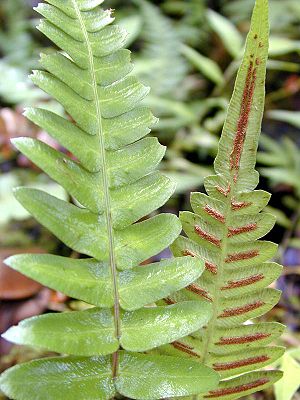
Sorus
A sorus is a cluster of sporangia .In fungi and lichens, the sorus is surrounded by an external layer. In some red algae it may take the form of a depression into the thallus....
(pl., sori). Associated with each sorus in many species is a membranous protective structure called an indusium: an outgrowth of the blade surface that may partly cover the sporangia. Fronds may bear hairs, scales, glands, and, in some species, bulblets for vegetative reproduction.
Fern fronds, as with all leaves, arise from the stem, either directly, or on an outgrowth from the stem termed a phyllopodium. The stem of a typical (leptosporangiate) fern is subterranean or horizontal on the surface of the ground. These stems are called rhizomes. Many fern fronds are initially coiled into a "fiddle-head" or "crozier" (see circinate vernation
Vernation
Vernation is the formation of new leaves or fronds. In plant anatomy, it is the arrangement of leaves in a bud....
) although cycad and palm fronds do not have this type of vernation.
Some fern species feature frond dimorphism
Frond dimorphism
Frond dimorphism refers to a difference in ferns between the fertile and sterile fronds. Since ferns, unlike flowering plants, bear spores on the leaf blade itself, this may affect the form of the frond itself...
, in which fertile and sterile fronds differ in appearance and structure.