

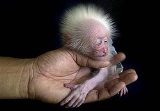
Catarrhini

Encyclopedia
Catarrhini is one of the two subdivisions of the higher primates
(the other being the New World monkey
s). It contains the Old World monkey
s and the ape
s, which in turn are further divided into the lesser apes or gibbon
s and the great apes
, consisting of the orangutan
s, gorilla
s, chimpanzee
s, bonobo
s, and human
s. They are all native to Africa
and Asia
.
Like the platyrrhines (with the exception of the genus Aotus), the catarrhines are diurnal.
Apes do not have tails. The tails of Old World Monkeys are not prehensile, but serve as balancing organs. Catarrhines have flat finger- and toenails. They have prehensile (grasping) hands, and all but humans also have prehensile feet. Their dental formula is .
Most species show considerable sexual dimorphism
and do not form a pair bond
. Most, but not all, species live in social groups.
of Pakistan
. These hills lock away many primate mysteries. One of these mysteries was uncovered in 2001, when the early primate Bugtilemur
was discovered and led to the assumption that lemur
s came from Asia, not Africa. The three primates called Bugtipithecus inexpectans, Phileosimias kamali, and Phileosimias brahuiorum all date back to the Oligocene
some 30 million years ago - when monkeys dominated only Africa. These were small lemur-like catarrhines that prospered in an ancient tropical rainforest. Possibly these Asian catarrhines led nowhere in evolution, a side branch from Eosimias. Other possible new catarrhines fossils have been uncovered in China, Thailand, and Burma.
Simian
The simians are the "higher primates" familiar to most people: the Old World monkeys and apes, including humans, , and the New World monkeys or platyrrhines. Simians tend to be larger than the "lower primates" or prosimians.- Classification and evolution :The simians are split into three groups...
(the other being the New World monkey
New World monkey
New World monkeys are the five families of primates that are found in Central and South America: Callitrichidae, Cebidae, Aotidae, Pitheciidae, and Atelidae. The five families are ranked together as the Platyrrhini parvorder and the Ceboidea superfamily, which are essentially synonymous since...
s). It contains the Old World monkey
Old World monkey
The Old World monkeys or Cercopithecidae are a group of primates, falling in the superfamily Cercopithecoidea in the clade Catarrhini. The Old World monkeys are native to Africa and Asia today, inhabiting a range of environments from tropical rain forest to savanna, shrubland and mountainous...
s and the ape
Ape
Apes are Old World anthropoid mammals, more specifically a clade of tailless catarrhine primates, belonging to the biological superfamily Hominoidea. The apes are native to Africa and South-east Asia, although in relatively recent times humans have spread all over the world...
s, which in turn are further divided into the lesser apes or gibbon
Gibbon
Gibbons are apes in the family Hylobatidae . The family is divided into four genera based on their diploid chromosome number: Hylobates , Hoolock , Nomascus , and Symphalangus . The extinct Bunopithecus sericus is a gibbon or gibbon-like ape which, until recently, was thought to be closely related...
s and the great apes
Hominidae
The Hominidae or include them .), as the term is used here, form a taxonomic family, including four extant genera: chimpanzees , gorillas , humans , and orangutans ....
, consisting of the orangutan
Orangutan
Orangutans are the only exclusively Asian genus of extant great ape. The largest living arboreal animals, they have proportionally longer arms than the other, more terrestrial, great apes. They are among the most intelligent primates and use a variety of sophisticated tools, also making sleeping...
s, gorilla
Gorilla
Gorillas are the largest extant species of primates. They are ground-dwelling, predominantly herbivorous apes that inhabit the forests of central Africa. Gorillas are divided into two species and either four or five subspecies...
s, chimpanzee
Chimpanzee
Chimpanzee, sometimes colloquially chimp, is the common name for the two extant species of ape in the genus Pan. The Congo River forms the boundary between the native habitat of the two species:...
s, bonobo
Bonobo
The bonobo , Pan paniscus, previously called the pygmy chimpanzee and less often, the dwarf or gracile chimpanzee, is a great ape and one of the two species making up the genus Pan. The other species in genus Pan is Pan troglodytes, or the common chimpanzee...
s, and human
Human
Humans are the only living species in the Homo genus...
s. They are all native to Africa
Africa
Africa is the world's second largest and second most populous continent, after Asia. At about 30.2 million km² including adjacent islands, it covers 6% of the Earth's total surface area and 20.4% of the total land area...
and Asia
Asia
Asia is the world's largest and most populous continent, located primarily in the eastern and northern hemispheres. It covers 8.7% of the Earth's total surface area and with approximately 3.879 billion people, it hosts 60% of the world's current human population...
.
Description
The name Catarrhini means drooping nose or downward nosed, and refers to their narrow, downward pointing nostrils, in contrast with the outward pointing nostrils of the New World monkeys (Platyrrhini).Like the platyrrhines (with the exception of the genus Aotus), the catarrhines are diurnal.
Apes do not have tails. The tails of Old World Monkeys are not prehensile, but serve as balancing organs. Catarrhines have flat finger- and toenails. They have prehensile (grasping) hands, and all but humans also have prehensile feet. Their dental formula is .
Most species show considerable sexual dimorphism
Sexual dimorphism
Sexual dimorphism is a phenotypic difference between males and females of the same species. Examples of such differences include differences in morphology, ornamentation, and behavior.-Examples:-Ornamentation / coloration:...
and do not form a pair bond
Pair bond
In biology, a pair bond is the strong affinity that develops in some species between the males and females in a pair, potentially leading to breeding. Pair-bonding is a term coined in the 1940s that is frequently used in sociobiology and evolutionary psychology circles...
. Most, but not all, species live in social groups.
Classification and evolution
The apes and Old World monkeys split from their New World monkey kin about 35 million years ago. The major catarrhine division occurred about 25 mya, with the gibbons separating from the great apes (including humans) about 15-19 mya.- ORDER PRIMATESPrimateA primate is a mammal of the order Primates , which contains prosimians and simians. Primates arose from ancestors that lived in the trees of tropical forests; many primate characteristics represent adaptations to life in this challenging three-dimensional environment...
- Suborder StrepsirrhiniStrepsirrhiniThe clade Strepsirrhini is one of the two suborders of primates. Madagascar's only non-human primates are strepsirrhines, and others can be found in southeast Asia and Africa...
: lemurs, lorises, etc. - Suborder HaplorrhiniHaplorrhiniThe haplorhines, the "dry-nosed" primates , are members of the Haplorhini clade: the prosimian tarsiers and the anthropoids...
: tarsiers, monkeys and apes- Infraorder TarsiiformesTarsiiformesTarsiiformes are a group of primates that was once ranged across Europe, northern Africa, Asia, and North America, but today all living species are found in the islands of Southeast Asia. Tarsiers are the only living members of the infraorder, and also include the extinct Tarsius eocaenus from the...
- Family TarsiidaeTarsierTarsiers are haplorrhine primates of the genus Tarsius, a genus in the family Tarsiidae, which is itself the lone extant family within the infraorder Tarsiiformes...
: tarsiers
- Family Tarsiidae
- Infraorder SimiiformesSimianThe simians are the "higher primates" familiar to most people: the Old World monkeys and apes, including humans, , and the New World monkeys or platyrrhines. Simians tend to be larger than the "lower primates" or prosimians.- Classification and evolution :The simians are split into three groups...
: simians, or higher primates- Parvorder Catarrhini
- Superfamily CercopithecoideaOld World monkeyThe Old World monkeys or Cercopithecidae are a group of primates, falling in the superfamily Cercopithecoidea in the clade Catarrhini. The Old World monkeys are native to Africa and Asia today, inhabiting a range of environments from tropical rain forest to savanna, shrubland and mountainous...
- Family CercopithecidaeOld World monkeyThe Old World monkeys or Cercopithecidae are a group of primates, falling in the superfamily Cercopithecoidea in the clade Catarrhini. The Old World monkeys are native to Africa and Asia today, inhabiting a range of environments from tropical rain forest to savanna, shrubland and mountainous...
: Old World monkeys
- Family Cercopithecidae
- Superfamily †Propliopithecoidea
- Family †Propliopithecidae (includes AegyptopithecusAegyptopithecusAegyptopithecus zeuxis means “linking Egyptian ape”. It was discovered by E. Simons in 1965. There is controversy over whether or not Aegyptopithecus should be a genus on its own or whether it should be moved into the genus Propliopithecus. If Aegyptopithecus is placed in its own genus, then there...
)
- Family †Propliopithecidae (includes Aegyptopithecus
- Superfamily †Saadanioidea
- Family †Saadaniidae
- Superfamily Hominoidea
- Family Hylobatidae: gibbons
- Family HominidaeHominidaeThe Hominidae or include them .), as the term is used here, form a taxonomic family, including four extant genera: chimpanzees , gorillas , humans , and orangutans ....
: great apes (including humans)
- Superfamily Cercopithecoidea
- Parvorder Platyrrhini: New World monkeys
- Parvorder Catarrhini
- Infraorder Tarsiiformes
- Suborder Strepsirrhini
Late Asian catarrhines
In May 2005, three new primate fossils were discovered in the Bugti HillsBugti Hills
Bugti Hills are a range of hills in eastern Balochistan, Pakistan. It includes the tribal tract called Bugti country.30 million years ago the Haplorrhinies: Bugtipithecus inexpectans, Phileosimias kamali and Phileosimias brahuiorum, similar to today's lemurs, lived in rainforests on the Bugti...
of Pakistan
Pakistan
Pakistan , officially the Islamic Republic of Pakistan is a sovereign state in South Asia. It has a coastline along the Arabian Sea and the Gulf of Oman in the south and is bordered by Afghanistan and Iran in the west, India in the east and China in the far northeast. In the north, Tajikistan...
. These hills lock away many primate mysteries. One of these mysteries was uncovered in 2001, when the early primate Bugtilemur
Bugtilemur
Bugtilemur is an extinct genus of Strepsirhine primate tentatively placed within family Cheirogaleidae, which includes the dwarf and mouse lemurs of Madagascar. It is represented by only one species, B. mathesoni, which was found in the Chitarwata Formation of Pakistan...
was discovered and led to the assumption that lemur
Lemur
Lemurs are a clade of strepsirrhine primates endemic to the island of Madagascar. They are named after the lemures of Roman mythology due to the ghostly vocalizations, reflective eyes, and the nocturnal habits of some species...
s came from Asia, not Africa. The three primates called Bugtipithecus inexpectans, Phileosimias kamali, and Phileosimias brahuiorum all date back to the Oligocene
Oligocene
The Oligocene is a geologic epoch of the Paleogene Period and extends from about 34 million to 23 million years before the present . As with other older geologic periods, the rock beds that define the period are well identified but the exact dates of the start and end of the period are slightly...
some 30 million years ago - when monkeys dominated only Africa. These were small lemur-like catarrhines that prospered in an ancient tropical rainforest. Possibly these Asian catarrhines led nowhere in evolution, a side branch from Eosimias. Other possible new catarrhines fossils have been uncovered in China, Thailand, and Burma.