
All Topics  
Legume

 
Legume

   Email Print
   Bookmark   Link


Legume


A legume is a plant
Plant

Plants are Life organisms belonging to the Kingdom Plantae. They include familiar organisms such as trees, herbs, bushes, grasses, vines, ferns, mosses, and green algae....
 in the family Fabaceae
Fabaceae

Fabaceae or Leguminosae is a large and economically important family of flowering plants, which is commonly known as the legume family, pea family, bean family or pulse family....
 (or Leguminosae), or a fruit
Fruit

The term fruit has different meanings dependent on context, and the term is not synonymous in food preparation and biology. In botany, which is the scientific study of plants, fruits are the ripened Ovary of flowering plants....
 of these specific plants.


Discussion
Ask a question about 'Legume'
Start a new discussion about 'Legume'
Answer questions from other users
Full Discussion Forum


Encyclopedia


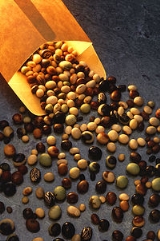
Soybeanvarieties
Doperwt Rijserwt Peulen Pisum Sativum
A legume is a plant
Plant

Plants are Life organisms belonging to the Kingdom Plantae. They include familiar organisms such as trees, herbs, bushes, grasses, vines, ferns, mosses, and green algae....
 in the family Fabaceae
Fabaceae

Fabaceae or Leguminosae is a large and economically important family of flowering plants, which is commonly known as the legume family, pea family, bean family or pulse family....
 (or Leguminosae), or a fruit
Fruit

The term fruit has different meanings dependent on context, and the term is not synonymous in food preparation and biology. In botany, which is the scientific study of plants, fruits are the ripened Ovary of flowering plants....
 of these specific plants. A legume fruit is a simple dry fruit
Fruit

The term fruit has different meanings dependent on context, and the term is not synonymous in food preparation and biology. In botany, which is the scientific study of plants, fruits are the ripened Ovary of flowering plants....
 that develops from a simple carpel and usually dehisces
Dehiscence (botany)

Dehiscence is the spontaneous opening at maturity of a plant structure, such as a fruit, anther, or sporangium, to release its contents....
 (opens along a seam) on two sides. A common name for this type of fruit is a "pod", although pod is also applied to a few other fruit types, such as vanilla
Vanilla

Vanilla is a flavoring derived from orchids of the genus Vanilla native to Mexico. Etymologically, vanilla derives from the Spanish language word "", little pod....
. Well-known legumes include alfalfa
Alfalfa

Alfalfa is a flowering plant in the pea family Fabaceae cultivated as an important forage crop. In the United Kingdom, Australia and New Zealand it is known as lucerne and as lucerne grass in south Asia....
, clover
Clover

Clover , or trefoil, is a genus of about 300 species of plants in the pea family Fabaceae. The genus has a cosmopolitan distribution; the highest diversity is found in the temperate Northern Hemisphere, but many species also occur in South America and Africa, including at high altitudes on mountains in the tropics....
, pea
Pea

A pea is most commonly the small spherical seed or the seed-pod of the legume Pisum sativum. Each pod contains several peas. Although treated as a vegetable in cooking, it is botanically a fruit....
s, bean
Bean

Bean is a common name for large plant seeds of several genus of the Family Fabaceae used for human food or animal feed.The whole young pods of bean plants, if picked before the pods ripen and dry, can be tender enough to eat whole, whether cooked or raw....
s, lentil
Lentil

The lentil or daal or pulse is a bushy annual plant of the Fabaceae family, grown for its lens-shaped seeds. It is about 15 inches tall and the seeds grow in pods, usually with two seeds in each....
s, lupin
Lupin

Lupin, often spelled lupine in North America, is the common name for members of the genus Lupinus in the legume family . The genus comprises between 200-600 species, with major centers of diversity in South America and western North America - ) and - in the Mediterranean region and Africa....
s, mesquite
Mesquite

Mesquite is a legume plant of the Prosopis genus found in Northern Mexico and the United States from the U.S.-Mexico border in Texas up to southwestern Kansas and from southeastern California and southwestern Utah to the southern limits of the Sonoran desert....
, carob, and peanut
Peanut

The peanut, or groundnut , is a species in the legume Fabaceae native to South America, Mexico and Central America. It is an annual plant herbaceous plant growing to 30 to 50 cm tall....
s.

History


The term legume is derived from the Latin
Latin

Latin is an Italic language, historically spoken in Latium and Ancient Rome. Through the Military history of the Roman Empire, Latin spread throughout the Mediterranean and a large part of Europe....
 word legumen (with the same meaning as the English term), which is in turn believed to come from the verb legere "to gather." English borrowed the term from the French
French language

French is a Romance language spoken around the world by around 80 million people as first language, by 190 million as second language, and by about another 200 million people as an acquired tongue, with significant speakers in 54 countries....
 "légume," which, however, has a wider meaning in the modern language and refers to any kind of vegetable
Vegetable

The term "vegetable" generally means the Eating parts of plants. The definition of the word is traditional rather than scientific, however, and therefore the usage of the word is somewhat arbitrary and subjective, as it is determined by individual cultural customs of food selection and food preparation....
; the English word legume being translated in French by the word légumineuse.

The history of legumes
Bean

Bean is a common name for large plant seeds of several genus of the Family Fabaceae used for human food or animal feed.The whole young pods of bean plants, if picked before the pods ripen and dry, can be tender enough to eat whole, whether cooked or raw....
 is tied in closely with that of human civilization, appearing early in Asia
Asia

Asia is the world's largest and most populous continent. It covers 8.6% of the Earth's total surface area and, with over 4 billion people, it contains more than 60% of the world's current human population....
, the Americas
Americas

The Americas are the region of the Western hemisphere that consists of the continents of North America and South America with their associated islands and regions....
 (the common bean
Common bean

The common bean, Phaseolus vulgaris, is an herbaceous annual plant domesticated independently in ancient Mesoamerica and the Andes, and now grown worldwide for its edible bean, popular both dry and as a green bean....
, several varieties), and Europe
Europe

Europe is, conventionally, one of the world's seven continents. Comprising the westernmost peninsula of Eurasia, Europe is generally divided from Asia to its east by the water divide of the Ural Mountains, the Ural , the Caspian Sea, and by the Caucasus Mountains to the southeast....
 (broad beans) by 6,000 BCE, where they became a staple, essential for supplementing protein where there was not enough meat. Also included are some grains in this grouping

Fixation of nitrogen in the soil

Legume plants are noteworthy for their ability to fix atmospheric nitrogen
Nitrogen fixation

Nitrogen fixation is the process by which nitrogen is taken from its relatively inert molecular form in the Earth's atmosphere and converted into nitrogen compounds ....
, thanks to a symbiotic relationship with certain bacteria
Bacteria

The Bacteria are a large group of unicellular microorganisms. Typically a few micrometres in length, bacteria have a wide range of shapes, ranging from spheres to rods and spirals....
 known as rhizobia
Rhizobia

Rhizobia are soil bacterium that Nitrogen fixation nitrogen after becoming established inside root nodules of legumes . Rhizobia require a plant host; they cannot independently fix nitrogen....
 found in root nodules of these plants. The ability to form this symbiosis reduces fertilizer
Fertilizer

Fertilizers are chemical compounds given to plants to promote growth; they are usually applied either through the soil, for uptake by plant roots, or by foliar feeding, for uptake through leaves....
 costs for farmers and gardeners who grow legumes, and allows legumes to be used in a crop rotation
Crop rotation

Crop rotation or Crop sequencing is the practice of growing a series of dissimilar types of Crop in the same area in sequential seasons for various benefits such as to avoid the build up of pathogens and pests that often occurs when one species is continuously cropped....
 to replenish soil that has been depleted of nitrogen
Nitrogen

Nitrogen is a chemical element that has the symbol N and atomic number 7 and atomic mass 14.00674?. Elemental nitrogen is a colorless, odorless, tasteless and mostly inert diatomic gas at standard conditions, constituting 78% by volume of Earth's atmosphere....
.

Legume seed and foliage have a comparatively higher protein
Protein

Proteins are organic compounds made of amino acids arranged in a linear chain and joined together by peptide bonds between the carboxyl and amino groups of adjacent amino acid Residue ....
 content than non-legume material, probably due to the additional nitrogen that legumes receive through nitrogen-fixation symbiosis. This high protein content makes them desirable crops in agriculture
Agriculture

Agriculture refers to the production of food and goods through farming and forestry. Agriculture was the key development that led to the rise of civilization, with the animal husbandry of domestication animals and plants creating food surpluses that enabled the development of more Population density and Social stratification societies....
.

Uses by humans

Peanut 9417
Trifoliumrepensflowers
Farmed legumes can belong to many agricultural classes, including forage
Forage

Forage is plant material eaten by grazing livestock.Historically the term forage has meant only plants eaten by the animals directly as pasture, crop residue, or immature cereal crops, but it is also used more loosely to include similar plants cut for fodder and carried to the animals, especially as hay or silage....
, grain
Cereal

Cereals, or cereal grains, are mostly Poaceae cultivated for their edible brans or fruit seeds . Cereal grains are grown in greater quantities and provide more energy worldwide than any other type of crop; they are therefore staple foods....
, blooms, pharmaceutical/industrial, fallow/green manure, and timber species. Most commercially farmed species fill two or more roles simultaneously.

Forage legumes are of two broad types. Some, like alfalfa
Alfalfa

Alfalfa is a flowering plant in the pea family Fabaceae cultivated as an important forage crop. In the United Kingdom, Australia and New Zealand it is known as lucerne and as lucerne grass in south Asia....
, clover
Clover

Clover , or trefoil, is a genus of about 300 species of plants in the pea family Fabaceae. The genus has a cosmopolitan distribution; the highest diversity is found in the temperate Northern Hemisphere, but many species also occur in South America and Africa, including at high altitudes on mountains in the tropics....
, vetch, stylo, or Arachis
Arachis

Arachis is a genus of about 70 species of annual and perennial flowering plants in the pea family , native to South America. At least one species, the Peanut , is a major food crop species of global importance; some of the other species are cultivated for food to a small extent in South America....
, are sown in pasture
Pasture

Pasture is land with herbaceous vegetation cover used for grazing of ungulate livestock as part of a farm or ranch. Prior to the advent of factory farming, pasture was the primary source of food for grazing animals such as cattle and horses....
 and grazed by livestock. Other forage legumes such as Leucaena
Leucaena

Leucaena is a genus of about 24 species of leguminous trees and shrubs, distributed from Texas in the United States to Peru. It belongs to subfamily Mimosoideae of the legume family Fabaceae....
 or Albizia
Albizia

Albizia is a genus of about 150 species of mostly fast-growing subtropical and tropical trees and shrubs in the Subfamily Mimosoideae of the legume family, Fabaceae....
 are woody shrub or tree species that are either broken down by livestock or regularly cut by humans to provide livestock feed.

Grain legumes are cultivated for their seed
Seed

A seed is a small Plant embryogenesis plant enclosed in a covering called the seed coat, usually with some Food storage. It is the product of the ripened ovule of gymnosperm and angiosperm plants which occurs after fertilization and some growth within the mother plant....
s, and are also called pulses
Pulse (legume)

Pulses are annual leguminous crops yielding from one to twelve grains or seeds of variable size, shape and color within a pod, according to the Food and Agricultural Organization of the United Nations ....
. The seeds are used for human and animal consumption or for the production of oils for industrial uses. Grain legumes include bean
Bean

Bean is a common name for large plant seeds of several genus of the Family Fabaceae used for human food or animal feed.The whole young pods of bean plants, if picked before the pods ripen and dry, can be tender enough to eat whole, whether cooked or raw....
s, lentil
Lentil

The lentil or daal or pulse is a bushy annual plant of the Fabaceae family, grown for its lens-shaped seeds. It is about 15 inches tall and the seeds grow in pods, usually with two seeds in each....
s, lupin
Lupin

Lupin, often spelled lupine in North America, is the common name for members of the genus Lupinus in the legume family . The genus comprises between 200-600 species, with major centers of diversity in South America and western North America - ) and - in the Mediterranean region and Africa....
s, pea
Pea

A pea is most commonly the small spherical seed or the seed-pod of the legume Pisum sativum. Each pod contains several peas. Although treated as a vegetable in cooking, it is botanically a fruit....
s, and peanut
Peanut

The peanut, or groundnut , is a species in the legume Fabaceae native to South America, Mexico and Central America. It is an annual plant herbaceous plant growing to 30 to 50 cm tall....
s.

Bloom legume species include species such as lupin
Lupin

Lupin, often spelled lupine in North America, is the common name for members of the genus Lupinus in the legume family . The genus comprises between 200-600 species, with major centers of diversity in South America and western North America - ) and - in the Mediterranean region and Africa....
, which are farmed commercially for their blooms as well as being popular in gardens worldwide.

Industrial farmed legumes include Indigofera
Indigofera

Indigofera is a large genus of about 700 species of flowering plants belonging to the family Fabaceae. They occur throughout the tropical and subtropical regions of the world, with a few species reaching the temperate zone in eastern Asia....
 and Acacia
Acacia

Acacia is a genus of shrubs and trees belonging to the subfamily Mimosoideae of the family Fabaceae, first described in Africa by the Sweden botanist Carolus Linnaeus in 1773....
 species, which are cultivated for dye and food gum production respectively.

Fallow/green manure legume species are cultivated to be tilled back into the soil in order to exploit the high nitrogen levels found in most legumes. Numerous legumes are farmed for this purpose including Leucaena
Leucaena

Leucaena is a genus of about 24 species of leguminous trees and shrubs, distributed from Texas in the United States to Peru. It belongs to subfamily Mimosoideae of the legume family Fabaceae....
, Cyamopsis, and Sesbania
Sesbania

Sesbania is a genus from the family Fabaceae with some aquatic species. Notable species include the Rattlebox , Spiny Sesbania , and Sesbania sesban, which is used in cooking....
 species.

Various legume species are farmed for timber production worldwide, including numerous Acacia
Acacia

Acacia is a genus of shrubs and trees belonging to the subfamily Mimosoideae of the family Fabaceae, first described in Africa by the Sweden botanist Carolus Linnaeus in 1773....
 species, Erythroxylum species and Castanospermum australe.

See also

  • Pulse (legume)
    Pulse (legume)

    Pulses are annual leguminous crops yielding from one to twelve grains or seeds of variable size, shape and color within a pod, according to the Food and Agricultural Organization of the United Nations ....


External links

  • - European association for grain legume research
  • - Geography, classification, genetic resources and breeding
  • - International Legume Database & Information Service
  • from LegumeChef.com
  • The significance of Vavilov’s scientific expeditions and ideas for development and use of legume genetic resources