


Seed dispersal

Encyclopedia
Seed dispersal is the movement or transport of seed
s away from the parent plant. Plants have limited mobility and consequently rely upon a variety of dispersal vectors to transport their propagules, including both abiotic and biotic
vectors. Seeds can be dispersed away from the parent plant individually or collectively, as well as dispersed in both space and time. The patterns of seed dispersal are determined in large part by the dispersal mechanism and this has important implications for the demographic and genetic structure of plant populations, as well as migration patterns and species
interactions. There are five main modes of seed dispersal: gravity, wind, ballistic, water and by animals. Some plants are serotinous and only disperse their seeds in response to an environmental stimulus.
and seedling predators and pathogens, which often target the high concentrations of seeds beneath adults. Competition
with adult plants may also be lower when seeds are transported away from their parent.
Seed dispersal also allows plants to reach specific habitats that are favorable for survival, a hypothesis known as directed dispersal. For example, Ocotea endresiana (Lauraceae) is a tree species from Latin America which is dispersed by several species of birds, including the three-wattled bellbird
. Male bellbird
s perch on dead trees in order to attract mates, and often defecate seeds beneath these perches where the seeds have a high chance of survival because of high light conditions and escape from fungal pathogens.
In the case of fleshy-fruited plants, seed-dispersal in animal guts (endozoochory) often enhances the amount, the speed, and the asynchrony of germination, which can have important plant benefits .
Seeds dispersed by ants (myrmecochory
) are not only dispersed to short distances but are also buried underground by the ants. These seeds can thus avoid adverse environmental effects such as fire or drought, reach nutrient-rich microsites and survive longer than other seeds. These features are peculiar to myrmecochory, which may thus provide additional benefits not present in other dispersal modes.
Finally, at another scale, seed dispersal may allow plants to colonize vacant habitats and even new geographic regions.
s, coconut
s and passionfruit and those with harder shells often roll away from the plant to gain further distance. Gravity dispersal also allows for later transmission by water or animal.
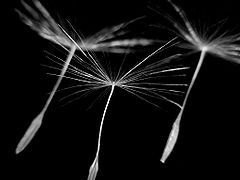 Wind dispersal is one of the more primitive means of dispersal. Wind dispersal can take on one of two primary forms: seeds can float on the breeze or alternatively, they can flutter to the ground. The classic examples of these dispersal mechanisms include dandelions, which have a feathery pappus
attached to their seeds and can be dispersed long distances, and maples
, which have winged seeds (samara
) and flutter to the ground. An important constraint on wind dispersal is the need for abundant seed production to maximise the likelihood of a seed landing in a site suitable for germination
. There are also strong evolutionary constraints on this dispersal mechanism. For instance, Cody and Overton (1996) found that species in the Asteraceae on islands tended to have reduced dispersal capabilities (i.e., larger seed
mass
and smaller pappus) relative to the same species on the mainland. Reliance on wind dispersal is common among many weed
y or ruderal species. Unusual mechanisms of wind dispersal include tumbleweed
s.
) and some terrestrial (ground
) plant
species use hydrochory, or seed dispersal through water. Seeds can travel for extremely long distances, depending on the specific mode of water
dispersal.
The water lily
is an example of such a plant
. Water lilies' flower
s make a fruit
that floats in the water
for a while and then drops down to the bottom to take root
on the floor of the pond
.
The seeds of palm trees can also be dispersed by water. If they grow near ocean
s, the seeds can be transported by ocean current
s over long distances, allowing the seeds to be dispersed as far as other continent
s. This is the road the palm trees use to move its seeds (coconut
s) to their new home..
Mangrove
trees live right in the water
. Their seed
s fall from the tree
and grow root
s as soon as they touch any kind of soil. During low tide, they might fall in soil instead of water
and start growing right where they fell. If the water level is high, however, they can be carried far away from where they fell. Mangrove trees often make little island
s as dirt and other things collect in their root
s, making little bodies of land.
tissues and often the fruits are shaped such that seeds are flung away from the parent plant
. While ballistic dispersal does not often achieve the same distance as animal-dispersed seeds, many ballistic dispersed seeds also have a form of secondary dispersal. Some common examples of species employing ballistic dispersal include the aptly named Touch-me-nots (Impatiens
spp., Balsaminaceae
) whose fruits explosively dehisce and squirting cucumbers (Ecballium elaterium
, Cucurbitaceae
) that discharge their seeds in a mucilaginous stream of liquid.
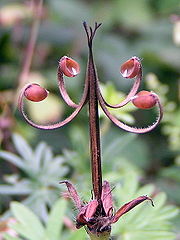
Geranium species have a fruit capsule of five cells which end in cups that hold the seed. The cups are joined to a long beak-like column, and when the fruit is ripe, it springs open casting away the seeds like a catapult.
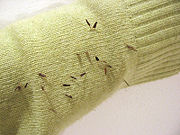 Animals can disperse plant seeds in several ways. Seeds can be transported on the outside of vertebrate animals (mostly mammals), a process known as epizoochory. Plant species transported externally by animals can have a variety of adaptations for dispersal, including adhesive mucus, and a variety of hooks, spines and barbs. A typical example of an epizoochorous plant is Trifolium angustifolium, a species of Old World
clover
which adheres to animal fur by means of stiff hair
s covering the seed
. Epizoochorous plants tend to be herbaceous plants, with many representative species in the families Apiaceae
and Asteraceae
. However, epizoochory is a relatively rare dispersal syndrome for plants as a whole; the percentage of plant species with seeds adapted for transport on the outside of animals is estimated to be below 5%. Nevertheless, epizoochorous transport can be highly effective if seeds attach to wide-ranging animals. This form of seed dispersal has been implicated in rapid plant migration and the spread of invasive species.
Seed dispersal via ingestion by vertebrate animals (mostly birds and mammals), or endozoochory, is the dispersal mechanism for most tree species. Endozoochory is generally a coevolved mutualistic relationship in which a plant surrounds seeds with an edible, nutritious fruit as a good food for animals that consume it. Birds and mammals are the most important seed dispersers, but a wide variety of other animals, including turtles and fish, can transport viable seeds. The exact percentage of tree species dispersed by endozoochory varies between habitats, but can range to over 90% in some tropical rainforests. Seed dispersal by animals in tropical rainforests has received much attention, and this interaction is considered an important force shaping the ecology and evolution of vertebrate and tree populations. In the tropics, large animal seed dispersers (such as tapirs, chimpanzees and hornbills) may disperse large seeds with few other seed dispersal agents. The extinction of these large frugivore
s from poaching and habitat loss may have negative effects on the tree populations that depend on them for seed dispersal.
Seed dispersal by ants (myrmecochory
) is a dispersal mechanism of many shrubs of the southern hemisphere or understorey herbs of the northern hemisphere. Seeds of myrmecochorous plants have a lipid-rich attachment called the elaiosome
, which attracts ants. Ants carry such seeds into their colonies, feed the elaiosome to their larvae and discard the otherwise intact seed in an underground chamber. Myrmecochory is thus a coevolved mutualistic relationship between plants and seed-disperser ants. Myrmecochory has independently evolved at least 100 times in flowering plants and is estimated to be present in at least 11 000 species, but likely up to 23 000 or 9% of all species of flowering plants. Myrmecochorous plants are most frequent in the fynbos vegetation of the Cape Floristic Region of South Africa, the kwongan vegetation and other dry habitat types of Australia, dry forests and grasslands of the Mediterranean region and northern temperate forests of western Eurasia and eastern North America, where up to 30-40% of understorey herbs are myrmecochorous.
Seed predators, which include many rodents (such as squirrels) and some birds (such as jays) may also disperse seeds by hoarding the seeds in hidden caches. The seeds in caches are usually well-protected from other seed predators and if left uneaten will grow into new plants. Finally, seeds may be secondarily dispersed from seeds deposited by primary animal dispersers. For example, dung beetles are known to disperse seeds from clumps of feces in the process of collecting dung to feed their larvae.
. On the other hand dispersal by humans also acts on smaller, regional scales and drive the dynamics of existing biological populations. Humans may disperse seeds by many various means and some surprisingly high distances have been repeatedly measured. Examples are: dispersal on human clothes (up to 250m), on shoes (up to 5 km) or by cars (regularly ~ 250m, singles cases > 100 km).
and recruitment limitation. Seed dispersal is essential in allowing forest migration
.
Seed
A seed is a small embryonic plant enclosed in a covering called the seed coat, usually with some stored food. It is the product of the ripened ovule of gymnosperm and angiosperm plants which occurs after fertilization and some growth within the mother plant...
s away from the parent plant. Plants have limited mobility and consequently rely upon a variety of dispersal vectors to transport their propagules, including both abiotic and biotic
Biotic component
Biotic components are the living things that shape an ecosystem. A biotic factor is any living component that affects another organism, including animals that consume the organism in question, and the living food that the organism consumes. Each biotic factor needs energy to do work and food for...
vectors. Seeds can be dispersed away from the parent plant individually or collectively, as well as dispersed in both space and time. The patterns of seed dispersal are determined in large part by the dispersal mechanism and this has important implications for the demographic and genetic structure of plant populations, as well as migration patterns and species
Species
In biology, a species is one of the basic units of biological classification and a taxonomic rank. A species is often defined as a group of organisms capable of interbreeding and producing fertile offspring. While in many cases this definition is adequate, more precise or differing measures are...
interactions. There are five main modes of seed dispersal: gravity, wind, ballistic, water and by animals. Some plants are serotinous and only disperse their seeds in response to an environmental stimulus.
Benefits of seed dispersal
Seed dispersal is likely to have several benefits for plant species. First, seed survival is often higher away from the parent plant. This higher survival may result from the actions of density-dependent seedSeed predation
Seed predation, often referred to as granivory, is a type of plant-animal interaction in which granivores feed on the seeds of plants as a main or exclusive food source, in many cases leaving the seeds damaged and not viable...
and seedling predators and pathogens, which often target the high concentrations of seeds beneath adults. Competition
Competition (biology)
Competition is an interaction between organisms or species, in which the fitness of one is lowered by the presence of another. Limited supply of at least one resource used by both is required. Competition both within and between species is an important topic in ecology, especially community ecology...
with adult plants may also be lower when seeds are transported away from their parent.
Seed dispersal also allows plants to reach specific habitats that are favorable for survival, a hypothesis known as directed dispersal. For example, Ocotea endresiana (Lauraceae) is a tree species from Latin America which is dispersed by several species of birds, including the three-wattled bellbird
Three-wattled bellbird
The Three-wattled Bellbird is a Central American migratory bird of the cotinga family.-Overview:One of four species of bellbird that live in Central and South America, the Three-wattled Bellbird is between and long...
. Male bellbird
Bellbird
Bellbird is a name given to several kinds of bird, noted for their far-carrying bell-like call:* Neotropical bellbirds * Crested Bellbird * New Zealand Bellbird...
s perch on dead trees in order to attract mates, and often defecate seeds beneath these perches where the seeds have a high chance of survival because of high light conditions and escape from fungal pathogens.
In the case of fleshy-fruited plants, seed-dispersal in animal guts (endozoochory) often enhances the amount, the speed, and the asynchrony of germination, which can have important plant benefits .
Seeds dispersed by ants (myrmecochory
Myrmecochory
Myrmecochory is seed dispersal by ants, an ecologically significant ant-plant interaction with worldwide distribution. Myrmecochorous plants produce seeds with elaiosomes, a term encompassing various external appendages or "food bodies" rich in lipids, amino acid, or other nutrients that are...
) are not only dispersed to short distances but are also buried underground by the ants. These seeds can thus avoid adverse environmental effects such as fire or drought, reach nutrient-rich microsites and survive longer than other seeds. These features are peculiar to myrmecochory, which may thus provide additional benefits not present in other dispersal modes.
Finally, at another scale, seed dispersal may allow plants to colonize vacant habitats and even new geographic regions.
Gravity
Gravity is a simple means of achieving seed dispersal. The effect of gravity on heavier fruits causes them to fall from the plant when ripe. Fruits exhibiting this type of dispersal include appleApple
The apple is the pomaceous fruit of the apple tree, species Malus domestica in the rose family . It is one of the most widely cultivated tree fruits, and the most widely known of the many members of genus Malus that are used by humans. Apple grow on small, deciduous trees that blossom in the spring...
s, coconut
Coconut
The coconut palm, Cocos nucifera, is a member of the family Arecaceae . It is the only accepted species in the genus Cocos. The term coconut can refer to the entire coconut palm, the seed, or the fruit, which is not a botanical nut. The spelling cocoanut is an old-fashioned form of the word...
s and passionfruit and those with harder shells often roll away from the plant to gain further distance. Gravity dispersal also allows for later transmission by water or animal.
Wind
Pappus (flower structure)
The pappus is the modified calyx, the part of an individual disk, ray or ligule floret surrounding the base of the corolla, in flower heads of the plant family Asteraceae. The pappus may be composed of bristles , awns, scales, or may be absent. In some species, the pappus is too small to see...
attached to their seeds and can be dispersed long distances, and maples
Maples
-People:* Chauncy Maples , British Anglican missionary and bishop in Africa* John Maples, Baron Maples , British politician* Marla Maples , American actress, former wife of Donald Trump...
, which have winged seeds (samara
Samara (fruit)
A samara is a type of fruit in which a flattened wing of fibrous, papery tissue develops from the ovary wall. A samara is a simple dry fruit and indehiscent . It is a winged achene...
) and flutter to the ground. An important constraint on wind dispersal is the need for abundant seed production to maximise the likelihood of a seed landing in a site suitable for germination
Germination
Germination is the process in which a plant or fungus emerges from a seed or spore, respectively, and begins growth. The most common example of germination is the sprouting of a seedling from a seed of an angiosperm or gymnosperm. However the growth of a sporeling from a spore, for example the...
. There are also strong evolutionary constraints on this dispersal mechanism. For instance, Cody and Overton (1996) found that species in the Asteraceae on islands tended to have reduced dispersal capabilities (i.e., larger seed
Seed
A seed is a small embryonic plant enclosed in a covering called the seed coat, usually with some stored food. It is the product of the ripened ovule of gymnosperm and angiosperm plants which occurs after fertilization and some growth within the mother plant...
mass
Mass
Mass can be defined as a quantitive measure of the resistance an object has to change in its velocity.In physics, mass commonly refers to any of the following three properties of matter, which have been shown experimentally to be equivalent:...
and smaller pappus) relative to the same species on the mainland. Reliance on wind dispersal is common among many weed
Weed
A weed in a general sense is a plant that is considered by the user of the term to be a nuisance, and normally applied to unwanted plants in human-controlled settings, especially farm fields and gardens, but also lawns, parks, woods, and other areas. More specifically, the term is often used to...
y or ruderal species. Unusual mechanisms of wind dispersal include tumbleweed
Tumbleweed
A tumbleweed is the above-ground part of a plant that, once mature and dry, disengages from the root and tumbles away in the wind. Usually, the tumbleweed is the entire plant apart from the roots, but in a few species it is a flower cluster. The tumbleweed habit is most common in steppe and desert...
s.
Water
Many aquatic (waterWater
Water is a chemical substance with the chemical formula H2O. A water molecule contains one oxygen and two hydrogen atoms connected by covalent bonds. Water is a liquid at ambient conditions, but it often co-exists on Earth with its solid state, ice, and gaseous state . Water also exists in a...
) and some terrestrial (ground
Soil
Soil is a natural body consisting of layers of mineral constituents of variable thicknesses, which differ from the parent materials in their morphological, physical, chemical, and mineralogical characteristics...
) plant
Plant
Plants are living organisms belonging to the kingdom Plantae. Precise definitions of the kingdom vary, but as the term is used here, plants include familiar organisms such as trees, flowers, herbs, bushes, grasses, vines, ferns, mosses, and green algae. The group is also called green plants or...
species use hydrochory, or seed dispersal through water. Seeds can travel for extremely long distances, depending on the specific mode of water
Water
Water is a chemical substance with the chemical formula H2O. A water molecule contains one oxygen and two hydrogen atoms connected by covalent bonds. Water is a liquid at ambient conditions, but it often co-exists on Earth with its solid state, ice, and gaseous state . Water also exists in a...
dispersal.
The water lily
Nymphaeaceae
Nymphaeaceae is a family of flowering plants. Members of this family are commonly called water lilies and live in freshwater areas in temperate and tropical climates around the world. The family contains eight genera. There are about 70 species of water lilies around the world. The genus...
is an example of such a plant
Plant
Plants are living organisms belonging to the kingdom Plantae. Precise definitions of the kingdom vary, but as the term is used here, plants include familiar organisms such as trees, flowers, herbs, bushes, grasses, vines, ferns, mosses, and green algae. The group is also called green plants or...
. Water lilies' flower
Flower
A flower, sometimes known as a bloom or blossom, is the reproductive structure found in flowering plants . The biological function of a flower is to effect reproduction, usually by providing a mechanism for the union of sperm with eggs...
s make a fruit
Fruit
In broad terms, a fruit is a structure of a plant that contains its seeds.The term has different meanings dependent on context. In non-technical usage, such as food preparation, fruit normally means the fleshy seed-associated structures of certain plants that are sweet and edible in the raw state,...
that floats in the water
Water
Water is a chemical substance with the chemical formula H2O. A water molecule contains one oxygen and two hydrogen atoms connected by covalent bonds. Water is a liquid at ambient conditions, but it often co-exists on Earth with its solid state, ice, and gaseous state . Water also exists in a...
for a while and then drops down to the bottom to take root
Root
In vascular plants, the root is the organ of a plant that typically lies below the surface of the soil. This is not always the case, however, since a root can also be aerial or aerating . Furthermore, a stem normally occurring below ground is not exceptional either...
on the floor of the pond
Pond
A pond is a body of standing water, either natural or man-made, that is usually smaller than a lake. A wide variety of man-made bodies of water are classified as ponds, including water gardens, water features and koi ponds; all designed for aesthetic ornamentation as landscape or architectural...
.
The seeds of palm trees can also be dispersed by water. If they grow near ocean
Ocean
An ocean is a major body of saline water, and a principal component of the hydrosphere. Approximately 71% of the Earth's surface is covered by ocean, a continuous body of water that is customarily divided into several principal oceans and smaller seas.More than half of this area is over 3,000...
s, the seeds can be transported by ocean current
Ocean current
An ocean current is a continuous, directed movement of ocean water generated by the forces acting upon this mean flow, such as breaking waves, wind, Coriolis effect, cabbeling, temperature and salinity differences and tides caused by the gravitational pull of the Moon and the Sun...
s over long distances, allowing the seeds to be dispersed as far as other continent
Continent
A continent is one of several very large landmasses on Earth. They are generally identified by convention rather than any strict criteria, with seven regions commonly regarded as continents—they are : Asia, Africa, North America, South America, Antarctica, Europe, and Australia.Plate tectonics is...
s. This is the road the palm trees use to move its seeds (coconut
Coconut
The coconut palm, Cocos nucifera, is a member of the family Arecaceae . It is the only accepted species in the genus Cocos. The term coconut can refer to the entire coconut palm, the seed, or the fruit, which is not a botanical nut. The spelling cocoanut is an old-fashioned form of the word...
s) to their new home..
Mangrove
Mangrove
Mangroves are various kinds of trees up to medium height and shrubs that grow in saline coastal sediment habitats in the tropics and subtropics – mainly between latitudes N and S...
trees live right in the water
Water
Water is a chemical substance with the chemical formula H2O. A water molecule contains one oxygen and two hydrogen atoms connected by covalent bonds. Water is a liquid at ambient conditions, but it often co-exists on Earth with its solid state, ice, and gaseous state . Water also exists in a...
. Their seed
Seed
A seed is a small embryonic plant enclosed in a covering called the seed coat, usually with some stored food. It is the product of the ripened ovule of gymnosperm and angiosperm plants which occurs after fertilization and some growth within the mother plant...
s fall from the tree
Tree
A tree is a perennial woody plant. It is most often defined as a woody plant that has many secondary branches supported clear of the ground on a single main stem or trunk with clear apical dominance. A minimum height specification at maturity is cited by some authors, varying from 3 m to...
and grow root
Root
In vascular plants, the root is the organ of a plant that typically lies below the surface of the soil. This is not always the case, however, since a root can also be aerial or aerating . Furthermore, a stem normally occurring below ground is not exceptional either...
s as soon as they touch any kind of soil. During low tide, they might fall in soil instead of water
Water
Water is a chemical substance with the chemical formula H2O. A water molecule contains one oxygen and two hydrogen atoms connected by covalent bonds. Water is a liquid at ambient conditions, but it often co-exists on Earth with its solid state, ice, and gaseous state . Water also exists in a...
and start growing right where they fell. If the water level is high, however, they can be carried far away from where they fell. Mangrove trees often make little island
Island
An island or isle is any piece of sub-continental land that is surrounded by water. Very small islands such as emergent land features on atolls can be called islets, cays or keys. An island in a river or lake may be called an eyot , or holm...
s as dirt and other things collect in their root
Root
In vascular plants, the root is the organ of a plant that typically lies below the surface of the soil. This is not always the case, however, since a root can also be aerial or aerating . Furthermore, a stem normally occurring below ground is not exceptional either...
s, making little bodies of land.
Ballistic
Self-dispersal, or autochory, is the physical and often explosive discharge of seeds from the fruit. The seeds are typically ejected from the fruit by elastic contraction of the fruitFruit
In broad terms, a fruit is a structure of a plant that contains its seeds.The term has different meanings dependent on context. In non-technical usage, such as food preparation, fruit normally means the fleshy seed-associated structures of certain plants that are sweet and edible in the raw state,...
tissues and often the fruits are shaped such that seeds are flung away from the parent plant
Plant
Plants are living organisms belonging to the kingdom Plantae. Precise definitions of the kingdom vary, but as the term is used here, plants include familiar organisms such as trees, flowers, herbs, bushes, grasses, vines, ferns, mosses, and green algae. The group is also called green plants or...
. While ballistic dispersal does not often achieve the same distance as animal-dispersed seeds, many ballistic dispersed seeds also have a form of secondary dispersal. Some common examples of species employing ballistic dispersal include the aptly named Touch-me-nots (Impatiens
Impatiens
Impatiens is a genus of about 850–1,000 species of flowering plants, widely distributed throughout the Northern Hemisphere and tropics. Together with the puzzling Hydrocera triflora, this genus makes up the family Balsaminaceae...
spp., Balsaminaceae
Balsaminaceae
Balsaminaceae are a family of dicotyledonous plants, comprising two genera and 850+ species, all but one of which belong to the genus Impatiens...
) whose fruits explosively dehisce and squirting cucumbers (Ecballium elaterium
Ecballium elaterium
Ecballium elaterium, also called the squirting cucumber or exploding cucumber, is a plant in the cucumber family. It gets its unusual name from the fact that, when ripe, it squirts a stream of mucilaginous liquid containing its seeds, which can be seen with the naked eye...
, Cucurbitaceae
Cucurbitaceae
The plant family Cucurbitaceae consists of various squashes, melons, and gourds, including crops such as cucumber, pumpkins, luffas, and watermelons...
) that discharge their seeds in a mucilaginous stream of liquid.
Geranium species have a fruit capsule of five cells which end in cups that hold the seed. The cups are joined to a long beak-like column, and when the fruit is ripe, it springs open casting away the seeds like a catapult.
Dispersal by animals
Old World
The Old World consists of those parts of the world known to classical antiquity and the European Middle Ages. It is used in the context of, and contrast with, the "New World" ....
clover
Clover
Clover , or trefoil, is a genus of about 300 species of plants in the leguminous pea family Fabaceae. The genus has a cosmopolitan distribution; the highest diversity is found in the temperate Northern Hemisphere, but many species also occur in South America and Africa, including at high altitudes...
which adheres to animal fur by means of stiff hair
Hair
Hair is a filamentous biomaterial, that grows from follicles found in the dermis. Found exclusively in mammals, hair is one of the defining characteristics of the mammalian class....
s covering the seed
Seed
A seed is a small embryonic plant enclosed in a covering called the seed coat, usually with some stored food. It is the product of the ripened ovule of gymnosperm and angiosperm plants which occurs after fertilization and some growth within the mother plant...
. Epizoochorous plants tend to be herbaceous plants, with many representative species in the families Apiaceae
Apiaceae
The Apiaceae , commonly known as carrot or parsley family, is a group of mostly aromatic plants with hollow stems. The family is large, with more than 3,700 species spread across 434 genera, it is the sixteenth largest family of flowering plants...
and Asteraceae
Asteraceae
The Asteraceae or Compositae , is an exceedingly large and widespread family of vascular plants. The group has more than 22,750 currently accepted species, spread across 1620 genera and 12 subfamilies...
. However, epizoochory is a relatively rare dispersal syndrome for plants as a whole; the percentage of plant species with seeds adapted for transport on the outside of animals is estimated to be below 5%. Nevertheless, epizoochorous transport can be highly effective if seeds attach to wide-ranging animals. This form of seed dispersal has been implicated in rapid plant migration and the spread of invasive species.
Seed dispersal via ingestion by vertebrate animals (mostly birds and mammals), or endozoochory, is the dispersal mechanism for most tree species. Endozoochory is generally a coevolved mutualistic relationship in which a plant surrounds seeds with an edible, nutritious fruit as a good food for animals that consume it. Birds and mammals are the most important seed dispersers, but a wide variety of other animals, including turtles and fish, can transport viable seeds. The exact percentage of tree species dispersed by endozoochory varies between habitats, but can range to over 90% in some tropical rainforests. Seed dispersal by animals in tropical rainforests has received much attention, and this interaction is considered an important force shaping the ecology and evolution of vertebrate and tree populations. In the tropics, large animal seed dispersers (such as tapirs, chimpanzees and hornbills) may disperse large seeds with few other seed dispersal agents. The extinction of these large frugivore
Frugivore
A frugivore is a fruit eater. It can be any type of herbivore or omnivore where fruit is a preferred food type. Because approximately 20% of all mammalian herbivores also eat fruit, frugivory is considered to be common among mammals. Since frugivores eat a lot of fruit they are highly dependent...
s from poaching and habitat loss may have negative effects on the tree populations that depend on them for seed dispersal.
Seed dispersal by ants (myrmecochory
Myrmecochory
Myrmecochory is seed dispersal by ants, an ecologically significant ant-plant interaction with worldwide distribution. Myrmecochorous plants produce seeds with elaiosomes, a term encompassing various external appendages or "food bodies" rich in lipids, amino acid, or other nutrients that are...
) is a dispersal mechanism of many shrubs of the southern hemisphere or understorey herbs of the northern hemisphere. Seeds of myrmecochorous plants have a lipid-rich attachment called the elaiosome
Elaiosome
Elaiosomes are fleshy structures that are attached to the seeds of many plant species. The elaiosome is rich in lipids and proteins, and may be variously shaped. Many plants have elaiosomes to attract ants, which take the seed to their nest and feed the elaiosome to their larvae...
, which attracts ants. Ants carry such seeds into their colonies, feed the elaiosome to their larvae and discard the otherwise intact seed in an underground chamber. Myrmecochory is thus a coevolved mutualistic relationship between plants and seed-disperser ants. Myrmecochory has independently evolved at least 100 times in flowering plants and is estimated to be present in at least 11 000 species, but likely up to 23 000 or 9% of all species of flowering plants. Myrmecochorous plants are most frequent in the fynbos vegetation of the Cape Floristic Region of South Africa, the kwongan vegetation and other dry habitat types of Australia, dry forests and grasslands of the Mediterranean region and northern temperate forests of western Eurasia and eastern North America, where up to 30-40% of understorey herbs are myrmecochorous.
Seed predators, which include many rodents (such as squirrels) and some birds (such as jays) may also disperse seeds by hoarding the seeds in hidden caches. The seeds in caches are usually well-protected from other seed predators and if left uneaten will grow into new plants. Finally, seeds may be secondarily dispersed from seeds deposited by primary animal dispersers. For example, dung beetles are known to disperse seeds from clumps of feces in the process of collecting dung to feed their larvae.
Dispersal by humans
Dispersal by humans used to be seen as a form of dispersal by animals. Recent research points out that human dispersers differ from animal dispersers by a much higher mobility based on the technical means of human transport. Dispersal by humans on the one hand may act on large geographical scales and lead to invasive speciesInvasive species
"Invasive species", or invasive exotics, is a nomenclature term and categorization phrase used for flora and fauna, and for specific restoration-preservation processes in native habitats, with several definitions....
. On the other hand dispersal by humans also acts on smaller, regional scales and drive the dynamics of existing biological populations. Humans may disperse seeds by many various means and some surprisingly high distances have been repeatedly measured. Examples are: dispersal on human clothes (up to 250m), on shoes (up to 5 km) or by cars (regularly ~ 250m, singles cases > 100 km).
Consequences of seed dispersal
Seed dispersal has many consequences for the ecology and evolution of plants. Dispersal is necessary for species migrations, and in recent times dispersal ability is an important factor in whether or not a species transported to a new habitat by humans will become an invasive species. Dispersal is also predicted to play a major role in the origin and maintenance of species diversity. For example, myrmecochory increased the rate of diversification more than twofold in plant groups in which it has evolved because myrmecochorous lineages contain more than twice as many species as their non-myrmecochorous sister groups. Dispersal of seeds away from the parent organism has a central role in two major theories for how biodiversity is maintained in natural ecosystems, the Janzen-Connell hypothesisJanzen-Connell hypothesis
The Janzen-Connell hypothesis is a widely accepted explanation for the maintenance of tree species biodiversity in tropical rainforests. It was published independently in the early 1970s by Daniel Janzen and Joseph Connell...
and recruitment limitation. Seed dispersal is essential in allowing forest migration
Forest migration
Forest migration is the movement of large seed plant dominated communities in geographical space over time.The emphasis of forest migration is placed on the movement of the tree communities that make up the forest community. Though an individual tree is permanently fixed in a location, tree...
.
See also
- Biological dispersalBiological dispersalBiological dispersal refers to species movement away from an existing population or away from the parent organism. Through simply moving from one habitat patch to another, the dispersal of an individual has consequences not only for individual fitness, but also for population dynamics, population...
- DisturbanceDisturbanceIn ecology, a disturbance is a temporary change in average environmental conditions that causes a pronounced change in an ecosystem. Outside disturbance forces often act quickly and with great effect, sometimes resulting in the removal of large amounts of biomass...
- DormancyDormancyDormancy is a period in an organism's life cycle when growth, development, and physical activity are temporarily stopped. This minimizes metabolic activity and therefore helps an organism to conserve energy. Dormancy tends to be closely associated with environmental conditions...
- 'dispersal in time' - ElaiosomeElaiosomeElaiosomes are fleshy structures that are attached to the seeds of many plant species. The elaiosome is rich in lipids and proteins, and may be variously shaped. Many plants have elaiosomes to attract ants, which take the seed to their nest and feed the elaiosome to their larvae...
- Gene flowGene flowIn population genetics, gene flow is the transfer of alleles of genes from one population to another.Migration into or out of a population may be responsible for a marked change in allele frequencies...
- Habitat fragmentationHabitat fragmentationHabitat fragmentation as the name implies, describes the emergence of discontinuities in an organism's preferred environment , causing population fragmentation...
- Island hoppingIsland hoppingIsland hopping is a term that refers to the means of crossing an ocean by a series of shorter journeys between islands, as opposed to a single journey directly across the ocean to the destination.- Forms :...
- Landscape ecologyLandscape ecologyLandscape ecology is the science of studying and improving relationships between urban development and ecological processes in the environment and particular ecosystems...
- MetapopulationMetapopulationA metapopulation consists of a group of spatially separated populations of the same species which interact at some level. The term metapopulation was coined by Richard Levins in 1970 to describe a model of population dynamics of insect pests in agricultural fields, but the idea has been most...
- MyrmecochoryMyrmecochoryMyrmecochory is seed dispersal by ants, an ecologically significant ant-plant interaction with worldwide distribution. Myrmecochorous plants produce seeds with elaiosomes, a term encompassing various external appendages or "food bodies" rich in lipids, amino acid, or other nutrients that are...
- Population ecologyPopulation ecologyPopulation ecology is a sub-field of ecology that deals with the dynamics of species populations and how these populations interact with the environment. It is the study of how the population sizes of species living together in groups change over time and space....
- Population modelingPopulation modelingA population model is a type of mathematical model that is applied to the study of population dynamics.Models allow a better understanding of how complex interactions and processes work. Modeling of dynamic interactions in nature can provide a manageable way of understanding how numbers change over...
- Rafting eventRafting eventOceanic dispersal is a type of biological dispersal that occurs when organisms transfer from one land mass to another by way of a sea crossing on large clumps of floating vegetation. Such matted clumps of vegetation are often seen floating down major rivers in the tropics and washing out to sea,...