

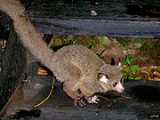
Galago

Encyclopedia
Galagos ɡəˈleɪɡoʊz, also known as bushbabies, bush babies or nagapies (meaning "little night monkeys" in Afrikaans
), are small, nocturnal primate
s native to continental Africa
, and make up the family
Galagidae (also sometimes called Galagonidae). They are sometimes included as a subfamily within the Lorisidae
or Loridae.
According to some accounts, the name bush baby comes from either the animal's cries or appearance. The South African name nagapie comes from the fact they are almost exclusively seen at night.
, and long tails that help them balance. They have nails on most of their digits, except for the second toe of the hindfoot, which bears a 'toilet' claw for grooming. Their diet is a mixture of insects and other small animals, fruit, and tree gums. They have pectinate ("comb-like") incisors, and the dental formula
:
Galagos have remarkable jumping
abilities, including the ability to jump up to 2 metres (6.6 ft) vertically. This is thought to be due to elastic energy storage in tendons of the lower leg, allowing far greater jumps than otherwise possible for an animal of their size.
After a gestation
period of 110–133 days, young galagos are born with half-closed eyes and are initially unable to move about independently. After a few days (6–8 days), the mother carries the infant in her mouth, and places it on branches while feeding.
Females maintain their territory but share them with their offspring. Males leave their mothers' territories after puberty but females remain, forming social groups consisting of closely related females and their young. Adult males maintain separate territories, which overlap with those of the female social groups; generally, one adult male mates with all the females in an area. Males who have not established such territories sometimes form small bachelor groups.
While their keeping as pets is not advised (like many other non-human primates, they are considered likely sources of zoonoses, diseases that can cross species barriers) it is certainly done. Equally, they are highly likely to attract attention from customs officials on importation into many countries. Reports from veterinary and zoological sources indicate captive lifetimes of 12 to 16.5 years, suggesting a natural lifetime of the order of a decade.
Galagos communicate both by calling to each other, and by marking their paths with urine. At the end of the night, group members use a special rallying call and gather to sleep in a nest made of leaves, a group of branches, or a hole in a tree.
.png) FAMILY GALAGIDAE - galagos, or bushbabies
FAMILY GALAGIDAE - galagos, or bushbabies
}Galago demidoff group (also referred to as "dwarf galagos")
, Otolemur garnettii, is in progress. As it is a 'primitive' primate, the sequence will be particularly useful in bridging the sequences of higher primates (macaque
, chimp
, human
) to close non-primates such as rodents. The 2x planned coverage will not be sufficient to create a full genome assembly, but will provide comparative data across most of the human assembly.
Afrikaans
Afrikaans is a West Germanic language, spoken natively in South Africa and Namibia. It is a daughter language of Dutch, originating in its 17th century dialects, collectively referred to as Cape Dutch .Afrikaans is a daughter language of Dutch; see , , , , , .Afrikaans was historically called Cape...
), are small, nocturnal primate
Primate
A primate is a mammal of the order Primates , which contains prosimians and simians. Primates arose from ancestors that lived in the trees of tropical forests; many primate characteristics represent adaptations to life in this challenging three-dimensional environment...
s native to continental Africa
Africa
Africa is the world's second largest and second most populous continent, after Asia. At about 30.2 million km² including adjacent islands, it covers 6% of the Earth's total surface area and 20.4% of the total land area...
, and make up the family
Family (biology)
In biological classification, family is* a taxonomic rank. Other well-known ranks are life, domain, kingdom, phylum, class, order, genus, and species, with family fitting between order and genus. As for the other well-known ranks, there is the option of an immediately lower rank, indicated by the...
Galagidae (also sometimes called Galagonidae). They are sometimes included as a subfamily within the Lorisidae
Lorisidae
Lorisidae is a family of strepsirrhine primates. The lorisids are all slim arboreal animals and include the lorises, pottos and angwantibos. Lorisids live in tropical, central Africa as well as in south and southeast Asia....
or Loridae.
According to some accounts, the name bush baby comes from either the animal's cries or appearance. The South African name nagapie comes from the fact they are almost exclusively seen at night.
Characteristics
Galagos have large eyes that give them good night vision, strong hind limbs, acute hearingHearing (sense)
Hearing is the ability to perceive sound by detecting vibrations through an organ such as the ear. It is one of the traditional five senses...
, and long tails that help them balance. They have nails on most of their digits, except for the second toe of the hindfoot, which bears a 'toilet' claw for grooming. Their diet is a mixture of insects and other small animals, fruit, and tree gums. They have pectinate ("comb-like") incisors, and the dental formula
Dentition
Dentition pertains to the development of teeth and their arrangement in the mouth. In particular, the characteristic arrangement, kind, and number of teeth in a given species at a given age...
:
Galagos have remarkable jumping
Jumping
Jumping or leaping is a form of locomotion or movement in which an organism or non-living mechanical system propels itself through the air along a ballistic trajectory...
abilities, including the ability to jump up to 2 metres (6.6 ft) vertically. This is thought to be due to elastic energy storage in tendons of the lower leg, allowing far greater jumps than otherwise possible for an animal of their size.
After a gestation
Gestation
Gestation is the carrying of an embryo or fetus inside a female viviparous animal. Mammals during pregnancy can have one or more gestations at the same time ....
period of 110–133 days, young galagos are born with half-closed eyes and are initially unable to move about independently. After a few days (6–8 days), the mother carries the infant in her mouth, and places it on branches while feeding.
Females maintain their territory but share them with their offspring. Males leave their mothers' territories after puberty but females remain, forming social groups consisting of closely related females and their young. Adult males maintain separate territories, which overlap with those of the female social groups; generally, one adult male mates with all the females in an area. Males who have not established such territories sometimes form small bachelor groups.
While their keeping as pets is not advised (like many other non-human primates, they are considered likely sources of zoonoses, diseases that can cross species barriers) it is certainly done. Equally, they are highly likely to attract attention from customs officials on importation into many countries. Reports from veterinary and zoological sources indicate captive lifetimes of 12 to 16.5 years, suggesting a natural lifetime of the order of a decade.
Galagos communicate both by calling to each other, and by marking their paths with urine. At the end of the night, group members use a special rallying call and gather to sleep in a nest made of leaves, a group of branches, or a hole in a tree.
Classification
There has been much recent study of the Galagidae. Several new species have been discovered, and they are now grouped into three genera, with the two former members of the now defunct genus Galagoides returned to their original genus Galago:- Genus Otolemur, greater galagos, or thick-tailed bushbabies
- Brown greater galagoBrown Greater GalagoThe brown greater galago is a nocturnal primate, the largest in the family of galagos.-Physical characteristics:This species has a rounded head with a short, wide snout, very large ears and relatively small eyes...
, Otolemur crassicaudatus - Silvery greater galagoSilvery Greater GalagoThe silvery greater galago is a nocturnal primate from the galago family. It is usually found in Brachystegia woodland, from Angola to Tanzania, western Kenya and Rwanda....
, Otolemur monteiri - Northern greater galagoNorthern Greater GalagoThe northern greater galago , also known as Garnett's greater galago, is a prosimian primate endemic to Africa.A low-coverage genomic sequence of the northern greater galago, was completed in 2006...
, Otolemur garnettii
- Brown greater galago
- Genus Euoticus, needle-clawed bushbabies
- Southern needle-clawed bushbabySouthern Needle-clawed BushbabyThe southern needle-clawed bushbaby is a species of primate in the Galagidae family. It is found in Cameroon, Central African Republic, Republic of the Congo, Equatorial Guinea, Gabon, possibly Angola, and possibly Democratic Republic of the Congo. Its natural habitat is subtropical or tropical...
, Euoticus elegantulus - Northern needle-clawed bushbabyNorthern Needle-clawed BushbabyThe northern needle-clawed bushbaby is a species of primate in the Galagidae family. It is found in Cameroon, Equatorial Guinea, and Nigeria. Habitat- It is found in tropical forest and secondary forest. The species is threatened by logging companys....
, Euoticus pallidus
- Southern needle-clawed bushbaby
- Genus Galago, lesser galagos, or lesser bushbabies
- Galago senegalensis group
- Senegal bushbabySenegal BushbabyThe Senegal bushbaby , also known as the Senegal galago, the lesser galago or the lesser bush baby, is a small, nocturnal primate, a member of the galago family Galagidae....
, Galago senegalensis - Mohol bushbabyMohol BushbabyThe mohol bushbaby is a species of primate in the Galagidae family. It is found in Angola, Botswana, Burundi, Democratic Republic of the Congo, Malawi, Mozambique, Namibia, Rwanda, South Africa, Swaziland, Tanzania, Zambia, and Zimbabwe.Surprisingly, breeding populations of this species are to be...
, Galago moholi - Somali bushbabySomali BushbabyThe Somali bushbaby ,, or the Somali lesser galago, as it is also known, is a species of nocturnal, arboreal primate in the Galagidae family. It is found in Ethiopia, Kenya, and Somalia. It is threatened by habitat loss....
, Galago gallarum
- Senegal bushbaby
- Galago matschiei group
- Dusky bushbabyDusky BushbabyThe dusky bushbaby is a species of primate in the Galagidae family. It is found in Burundi, Democratic Republic of the Congo, Uganda, and possibly Rwanda....
, Galago matschiei
- Dusky bushbaby
- Galago alleni group
- Bioko Allen's bushbabyBioko Allen's BushbabyThe Bioko Allen's bushbaby is a species of primate in the Galagidae family. It is found in Angola, Cameroon, Central African Republic, Republic of the Congo, Equatorial Guinea, Gabon, and Nigeria. Its natural habitat is subtropical or tropical dry forests....
, Galago alleni - Cross River bushbabyCross River BushbabyThe Cross River bushbaby is a species of primate in the Galagidae family. It lives in northwestern Camaroon and southeastern Nigeria. Its head and body length is 7 inches with a 10 inch tail....
, Galago cameronensis - Gabon bushbabyGabon BushbabyThe Gabon bushbaby is a species of primate in the Galagidae family. It lives in Camaroon, Gabon and the Congo Republic. Its head and body length is 8.5 inches with a 10 inch tail, and it weighs about 10 ounces. It lives in evergreen tropical rainforests and eats primarily fallen fruit, but also...
, Galago gabonensis
- Bioko Allen's bushbaby
- Galago zanzibaricus group
- Zanzibar bushbabyZanzibar BushbabyThe Zanzibar bushbaby is a primate of the Galagidae family. An adult typically weighs 100–300 grams and is 34–39.5 centimetres long...
, Galago zanzibaricus - Grant's bushbabyGrant's BushbabyGrant's bushbaby , also known as Grant's lesser bushbaby or the Mozambique lesser bushbaby is a species of primate in the Galagidae family. It is found in Malawi, Mozambique, Tanzania, and Zimbabwe. Its natural habitat is subtropical or tropical dry forests....
, Galago granti - Malawi bushbabyMalawi BushbabyThe Malawi bushbaby is a species of primate in the Galagidae family. It lives in southern Malawi and the neighboring region in Mozambique....
, Galago nyasae
- Zanzibar bushbaby
- Galago orinus group
- Uluguru bushbabyUluguru BushbabyThe Uluguru bushbaby is a species of primate in the Galagidae family. It is endemic to Tanzania....
, Galago orinus - Rondo bushbabyRondo BushbabyThe rondo bushbaby is a species of primate in the Galagidae family. It is endemic to Tanzania. Its natural habitat is subtropical or tropical dry forests. It is threatened by habitat loss...
, Galago rondoensis
- Uluguru bushbaby
- Galago senegalensis group
}Galago demidoff group (also referred to as "dwarf galagos")
-
-
- Prince Demidoff's bushbabyPrince Demidoff's BushbabyPrince Demidoff's bushbaby , also known as Prince Demidoff's Galago, is a species of primate in the Galagidae Family...
, Galago demidoff - Thomas's bushbabyThomas's BushbabyThomas's bushbaby is a species of primate in the Galagidae family. It is found in Angola, Burundi, Cameroon, Democratic Republic of the Congo, Equatorial Guinea, Gabon, Kenya, Malawi, Nigeria, Rwanda, Tanzania, and Uganda....
, Galago thomasi
- Prince Demidoff's bushbaby
-
Genomics
A low-coverage genomic sequence of the northern greater galagoNorthern Greater Galago
The northern greater galago , also known as Garnett's greater galago, is a prosimian primate endemic to Africa.A low-coverage genomic sequence of the northern greater galago, was completed in 2006...
, Otolemur garnettii, is in progress. As it is a 'primitive' primate, the sequence will be particularly useful in bridging the sequences of higher primates (macaque
Macaque
The macaques constitute a genus of Old World monkeys of the subfamily Cercopithecinae. - Description :Aside from humans , the macaques are the most widespread primate genus, ranging from Japan to Afghanistan and, in the case of the barbary macaque, to North Africa...
, chimp
Chimpanzee
Chimpanzee, sometimes colloquially chimp, is the common name for the two extant species of ape in the genus Pan. The Congo River forms the boundary between the native habitat of the two species:...
, human
Human
Humans are the only living species in the Homo genus...
) to close non-primates such as rodents. The 2x planned coverage will not be sufficient to create a full genome assembly, but will provide comparative data across most of the human assembly.