
Documentary films constitute a broad category of nonfictional motion pictures intended to document some aspect of reality, primarily for the purposes of instruction or maintaining a historical record. A 'documentary film' was originally shot on
film stockFilm stock is photographic film on which filmmaking of motion pictures are shot and reproduced. The equivalent in television production is video tape.-1889–1899:...
— the only medium available — but now includes
videoVideo is the technology of electronically capturing, recording, processing, storing, transmitting, and reconstructing a sequence of still images representing scenes in motion.- History :...
and
digitalNew media is a broad term in media studies that emerged in the latter part of the 20th century. For example, new media holds out a possibility of on-demand access to content any time, anywhere, on any digital device, as well as interactive user feedback, creative participation and community...
productions that can be either
direct-to-videoDirect-to-video is a term used to describe a film that has been released to the public on home video formats without being released in film theaters or broadcast on television...
, made as a
television programA television program , also called television show, is a segment of content which is intended to be broadcast on television. It may be a one-time production or part of a periodically recurring series...
or released for screening in cinemas. "Documentary" has been described as a "filmmaking practice, a cinematic tradition, and mode of audience reception" that is continually evolving and is without clear boundaries.
Defining 'documentary'
In popular myth, the word 'documentary' was coined by Scottish documentarian
John GriersonJohn Grierson was a pioneering Scottish documentary maker, often considered the father of British and Canadian documentary film. According to popular myth, in 1926, Grierson coined the term "documentary" to describe a non-fiction film.-Early life:Grierson was born in Deanston, near Doune, Scotland...
in his review of Robert Flaherty's film
Moana (1926), published in the
New York SunThe Sun was a New York newspaper that was published from 1833 until 1950. It was considered a serious paper, like the city's two more successful broadsheets, The New York Times and the New York Herald Tribune...
on 8 February 1926, written by "The Moviegoer" (a pen name for Grierson).
Grierson's principles of documentary were that cinema's potential for observing life could be exploited in a new art form; that the "original" actor and "original" scene are better guides than their fiction counterparts to interpreting the modern world; and that materials "thus taken from the raw" can be more real than the acted article. In this regard, Grierson's views align with Vertov's contempt for dramatic fiction as "bourgeois excess", though with considerably more subtlety. Grierson's definition of documentary as "creative treatment of actuality" has gained some acceptance, though it presents philosophical questions about documentaries containing stagings and reenactments.
In his essays, Soviet film-maker
Dziga VertovDavid Abelevich Kaufman , better known by his pseudonym Dziga Vertov , was a Soviet pioneer documentary film, newsreel director and cinema theorist...
argued for presenting "life as it is" (that is, life filmed surreptitiously) and "life caught unawares" (life provoked or surprised by the camera).
The American film critic
Pare LorentzPare Lorentz was an American filmmaker known for his movies about the New Deal. Born Leonard MacTaggart Lorentz in Clarksburg, West Virginia, he was educated at Wesleyan College and West Virginia University. As a young film critic in New York and Hollywood, Lorentz spoke out against censorship in...
defines a documentary film as "a
factualA fact is something that has really occurred or is actually the case. The usual test for a statement of fact is verifiability, that is whether it can be shown to correspond to experience. Standard reference works are often used to check facts...
filmA film, also called a movie or motion picture, is a series of still or moving images. It is produced by recording photographic images with cameras, or by creating images using animation techniques or visual effects...
which is dramatic." Others further state that a documentary stands out from the other types of non-fiction films for providing an opinion, and a specific message, along with the facts it presents.
Documentary PracticeDocumentary practice is the process of creating documentary projects. It refers to what people do with media devices, content, form, and production strategies in order to address the creative, ethical, and conceptual problems and choices that arise as they make documentary films or other similar...
is the complex process of creating documentary projects. It refers to what people do with media devices, content, form, and production strategies in order to address the creative, ethical, and conceptual problems and choices that arise as they make documentaries.
There are clear connections in terms of practice with magazine and newspaper feature-writing and indeed to non-fiction literature. Many of the generic forms of documentary, for example the biopic or profile; or the observational piece. These generic forms are explored on the University of Winchester Journalism Department 'features web' where 'long form journalism' is classified by genre or content, rather than in terms of production as film, radio or 'print'.
Pre-1900
Early film (pre-1900) was dominated by the novelty of showing an event. They were single-shot moments captured on film: a train entering a station, a boat docking, or factory workers leaving work. These short films were called "actuality" films; the term "documentary" was not coined until 1926. Many of the first films, such as those made by
Auguste and Louis LumièreThe Lumière brothers, Auguste Marie Louis Nicolas and Louis Jean , were among the earliest filmmakers in history...
, were a minute or less in length, due to technological limitations.
Films showing many people (for example, leaving a factory) were often made for commercial reasons: the people being filmed were eager to see, for payment, the film showing them. One notable film clocked in at over an hour and a half,
The Corbett-Fitzsimmons FightThe Corbett-Fitzsimmons Fight is an 1897 documentary film directed by Enoch J. Rector depicting a boxing match between James J. Corbett and Bob Fitzsimmons in Carson City, Nevada on St. Patrick's Day the same year. Originally running at over 100 minutes, it was the longest film that had ever been...
. Using pioneering film-looping technology,
Enoch J. RectorEnoch J. Rector was an American boxing film promoter and early cinema technician. He was a partner in Woodville Latham's Kinetoscope Exhibition Company during the mid-1890s, working with Latham and his sons Otway and Grey, as well as fellow cinema technicians William Kennedy Laurie Dickson and...
presented the entirety of a famous 1897 prize-fight on cinema screens across the country.
The French surgeon
Eugène-Louis DoyenEugène-Louis Doyen was a French surgeon who was a native of Reims. He was the son of Octave Doyen , who served as mayor of Reims....
started a series of surgical films sometime before July 1898. Until 1906, the year of his last film, Doyen recorded more than 60 operations. As Doyen said that his first films taught him how to correct professional errors he had been unaware of. For scientific purposes, after 1906 Doyen combined 15 of his films into three compilations, two of which survive, the six-film series
Extirpation des tumeurs encapsulées (1906), and the four-film
Les Opérations sur la cavité crânienne (1911). These and five other of Doyen's films survive.
Between July 1898 and 1901 the
RomaniaRomania is a country located at the crossroads of Central and Southeastern Europe, on the Lower Danube, within and outside the Carpathian arch, bordering on the Black Sea...
n professor
Gheorghe MarinescuGheorghe Marinescu was a Romanian neurologist, founder of the Romanian School of Neurology.After the attendance of Medicine at the Bucharest University, Marinescu received most of his medical education as preparator at the laboratory of histology at the Brâncoveanu Hospital and as assistant at...
made several science films in his
neurologyNeurology is a medical specialty dealing with disorders of the nervous system. Specifically, it deals with the diagnosis and treatment of all categories of disease involving the central, peripheral, and autonomic nervous systems, including their coverings, blood vessels, and all effector tissue,...
clinic in
BucharestBucharest is the capital municipality, cultural, industrial, and financial centre of Romania. It is the largest city in Romania, located in the southeast of the country, at , and lies on the banks of the Dâmbovița River....
:
The walking troubles of organic hemiplegy (1898),
The walking troubles of organic paraplegies (1899),
A case of hysteric hemiplegy healed through hypnosis (1899),
The walking troubles of progressive locomotion ataxy (1900) and
Illnesses of the muscles (1901). All these short films have been preserved. The professor called his works "studies with the help of the cinematograph", and published the results, along with several consecutive frames, in issues of "La Semaine Médicale" magazine from
ParisParis is the capital and largest city in France, situated on the river Seine, in northern France, at the heart of the Île-de-France region...
, between 1899 and 1902. In 1924, Auguste Lumiere recognized the merits of Marinescu's science films: "I've seen your scientific reports about the usage of the cinematograph in studies of nervous illnesses, when I was still receiving "La Semaine Médicale", but back then I had other concerns, which left me no spare time to begin biological studies. I must say I forgot those works and I am thankful to you that you reminded them to me. Unfortunately, not many scientists have followed your way."
1900–1920
Travelogue filmsTravelogue films, a form of virtual tourism or travel documentary, have been providing information and entertainment about distant parts of the world since the late 19th century.-History:...
were very popular in the early part of the 20th century. They were often referred to by distributors as "scenics." Scenics were among the most popular sort of films at the time. An important early film to move beyond the concept of the scenic was
In the Land of the Head HuntersIn the Land of the Head Hunters is a 1914 silent film fictionalizing the world of the Kwakwaka'wakw peoples of the Queen Charlotte Strait region of the Central Coast of British Columbia, Canada, written and directed by Edward S. Curtis and acted entirely by Kwakwaka'wakw natives...
(1914), which embraced
primitivismPrimitivism is a Western art movement that borrows visual forms from non-Western or prehistoric peoples, such as Paul Gauguin's inclusion of Tahitian motifs in paintings and ceramics...
and
exoticismExoticism is a trend in art and design, influenced by some ethnic groups or civilizations since the late 19th-century. In music exoticism is a genre in which the rhythms, melodies, or instrumentation are designed to evoke the atmosphere of far-off lands or ancient times Exoticism (from 'exotic')...
in a staged story presented as truthful re-enactments of the life of
Native AmericansFirst Nations is a term that collectively refers to various Aboriginal peoples in Canada who are neither Inuit nor Métis. There are currently over 630 recognised First Nations governments or bands spread across Canada, roughly half of which are in the provinces of Ontario and British Columbia. The...
.
Contemplation is a separate area.
PathéPathé or Pathé Frères is the name of various French businesses founded and originally run by the Pathé Brothers of France.-History:...
is the best-known global manufacturer of such films of the early 20th century. A vivid example is
Moscow clad in snowMoscow Clad in Snow is a 1909 short silent documentary film directed by Joseph-Louis Mundwiller about winter Moscow 1908.- Plot :The film is in four parts. First, the camera pans the Kremlin and Marshal's Bridge. Sleds are parked in rows. Horse-drawn sleighs run up and down a busy street. Next, we...
(1909).
Early color motion picture processes such as
KinemacolorKinemacolor was the first successful color motion picture process, used commercially from 1908 to 1914. It was invented by George Albert Smith of Brighton, England in 1906. He was influenced by the work of William Norman Lascelles Davidson. It was launched by Charles Urban's Urban Trading Co. of...
and
PrizmaThe Prizma Color system was a technique of color motion picture photography, invented in 1913 by William Van Doren Kelley and Charles Raleigh. Initially, it was a two-color additive color system, similar to its predecessor, Kinemacolor...
color used travelogues to promote the new color process. In contrast,
TechnicolorTechnicolor is a color motion picture process invented in 1916 and improved over several decades.It was the second major process, after Britain's Kinemacolor, and the most widely used color process in Hollywood from 1922 to 1952...
concentrated primarily on getting their process adopted by Hollywood studios for fictional feature films.
Also during this period
Frank HurleyJames Francis "Frank" Hurley, OBE was an Australian photographer and adventurer. He participated in a number of expeditions to Antarctica and served as an official photographer with Australian forces during both world wars.His artistic style produced many memorable images but he also used staged...
's documentary film,
South (1919), about the
Imperial Trans-Antarctic ExpeditionThe Imperial Trans-Antarctic Expedition , also known as the Endurance Expedition, is considered the last major expedition of the Heroic Age of Antarctic Exploration. Conceived by Sir Ernest Shackleton, the expedition was an attempt to make the first land crossing of the Antarctic continent...
was released. It documented the failed Antarctic expedition led by
Ernest ShackletonSir Ernest Henry Shackleton, CVO, OBE was a notable explorer from County Kildare, Ireland, who was one of the principal figures of the period known as the Heroic Age of Antarctic Exploration...
in 1914.
Romanticism
With
Robert J. FlahertyRobert Joseph Flaherty, F.R.G.S. was an American filmmaker who directed and produced the first commercially successful feature length documentary film, Nanook of the North...
's
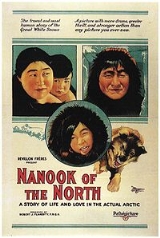
Nanook of the NorthNanook of the North is a 1922 silent documentary film by Robert J. Flaherty. In the tradition of what would later be called salvage ethnography, Flaherty captured the struggles of the Inuk Nanook and his family in the Canadian arctic...
in 1922, documentary film embraced
romanticismRomanticism was an artistic, literary and intellectual movement that originated in the second half of the 18th century in Europe, and gained strength in reaction to the Industrial Revolution...
; Flaherty filmed a number of heavily staged romantic films during this time period, often showing how his subjects would have lived 100 years earlier and not how they lived right then. For instance, in
Nanook of the North Flaherty did not allow his subjects to shoot a walrus with a nearby shotgun, but had them use a harpoon instead. Some of Flaherty's staging, such as building a roofless
iglooAn igloo or snowhouse is a type of shelter built of snow, originally built by the Inuit....
for interior shots, was done to accommodate the filming technology of the time.
Paramount PicturesParamount Pictures Corporation is an American film production and distribution company, located at 5555 Melrose Avenue in Hollywood. Founded in 1912 and currently owned by media conglomerate Viacom, it is America's oldest existing film studio; it is also the last major film studio still...
tried to repeat the success of Flaherty's
Nanook and
Moana with two romanticized documentaries,
GrassGrass: A Nation's Battle for Life is a silent documentary film which follows a branch of the Bakhtiari tribe of Persia as they and their herds make their seasonal journey to better pastures. It is considered one of the earliest ethnographic documentary films. It was written by Richard Carver and...
(1925) and
ChangChang: A Drama of the Wilderness is a documentary film about a poor farmer in Issan and his daily struggle for survival in the jungle. The two directors of Chang, Merian C. Cooper and Ernest B...
(1927), both directed by Merian Cooper and Ernest Schoedsack.
The city symphony
The continental, or realist, tradition focused on humans within human-made environments, and included the so-called "city symphony" films such as
Walter RuttmannWalter Ruttmann was a German film director and along with Hans Richter and Viking Eggeling was an early German practitioner of experimental film....
's
Berlin, Symphony of a City (of which Grierson noted in an article that
Berlin represented what a documentary should
not be),
Alberto CavalcantiAlberto de Almeida Cavalcanti was a Brazilian-born film director and producer.-Early life:Cavalcanti was born in Rio de Janeiro, the son of a prominent mathematician. He was a precociously intelligent child, and by the age of 15 was studying law at university. Following an argument with a...
's
Rien que les heuresRien que les heures is a 1926 experimental silent film by Brazilian director Alberto Cavalcanti showing the life of Paris through one day in 45 minutes...
, and
Dziga VertovDavid Abelevich Kaufman , better known by his pseudonym Dziga Vertov , was a Soviet pioneer documentary film, newsreel director and cinema theorist...
's
Man with the Movie Camera. These films tend to feature people as products of their environment, and lean towards the avant-garde.
Kino-Pravda
Dziga VertovDavid Abelevich Kaufman , better known by his pseudonym Dziga Vertov , was a Soviet pioneer documentary film, newsreel director and cinema theorist...
was central to the
SovietThe Soviet Union , officially the Union of Soviet Socialist Republics , was a constitutionally socialist state that existed in Eurasia between 1922 and 1991....
Kino-PravdaKino-Pravda was a newsreel series by Dziga Vertov, Elizaveta Svilova, and Mikhail Kaufman.Working mainly during the 1920s, Vertov promoted the concept of kino-pravda, or film-truth, through his newsreel series. His driving vision was to capture fragments of actuality which, when organized...
(literally, "cinematic truth") newsreel series of the 1920s. Vertov believed the camera — with its varied lenses, shot-counter shot editing, time-lapse, ability to slow motion, stop motion and fast-motion — could render reality more accurately than the human eye, and made a film philosophy out of it.
Newsreel tradition
The
newsreelA newsreel was a form of short documentary film prevalent in the first half of the 20th century, regularly released in a public presentation place and containing filmed news stories and items of topical interest. It was a source of news, current affairs and entertainment for millions of moviegoers...
tradition is important in documentary film; newsreels were also sometimes staged but were usually re-enactments of events that had already happened, not attempts to steer events as they were in the process of happening. For instance, much of the battle footage from the early 20th century was staged; the cameramen would usually arrive on site after a major battle and re-enact scenes to film them.
1920s–1940s
The propagandist tradition consists of films made with the explicit purpose of persuading an audience of a point. One of the most notorious
propaganda filmThe term propaganda can be defined as the ability to produce and spread fertile messages that, once sown, will germinate in large human cultures.” However, in the 20th century, a “new” propaganda emerged, which revolved around political organizations and their need to communicate messages that...
s is
Leni RiefenstahlHelene Bertha Amalie "Leni" Riefenstahl was a German film director, actress and dancer widely noted for her aesthetics and innovations as a filmmaker. Her most famous film was Triumph des Willens , a propaganda film made at the 1934 Nuremberg congress of the Nazi Party...
's film
Triumph of the WillTriumph of the Will is a propaganda film made by Leni Riefenstahl. It chronicles the 1934 Nazi Party Congress in Nuremberg, which was attended by more than 700,000 Nazi supporters. The film contains excerpts from speeches given by various Nazi leaders at the Congress, including portions of...
(1935), which chronicled the 1934
Nazi Party CongressThe Nuremberg Rally was the annual rally of the NSDAP in Germany, held from 1923 to 1938. Especially after Hitler's rise to power in 1933, they were large Nazi propaganda events...
and was commissioned by
Adolf HitlerAdolf Hitler was an Austrian-born German politician and the leader of the National Socialist German Workers Party , commonly referred to as the Nazi Party). He was Chancellor of Germany from 1933 to 1945, and head of state from 1934 to 1945...
. Leftist filmmakers
Joris IvensJoris Ivens was a Dutch documentary filmmaker and committed communist.-Early life and career:...
and
Henri StorckHenri Storck was a Belgian author, film-maker and documentarist.In 1933, he directed, with Joris Ivens, Misère au Borinage, a film about the miners in the Borinage area. In 1938, with Andre Thirifays and Pierre Vermeylen, he founded the Cinémathèque Royale de Belgique...
directed
BorinageThe Borinage is an area in the Walloon province of Hainaut. The provincial capital Mons is located in the east of the Borinage. In French the inhabitants are called Borains...
(1931) about the Belgian coal mining region.
Luis BuñuelLuis Buñuel Portolés was a Spanish-born filmmaker — later a naturalized citizen of Mexico — who worked in Spain, Mexico, France and the US..-Early years:...
directed a "
surrealistSurrealism is a cultural movement that began in the early 1920s, and is best known for the visual artworks and writings of the group members....
" documentary
Las Hurdes (1933).
Pare LorentzPare Lorentz was an American filmmaker known for his movies about the New Deal. Born Leonard MacTaggart Lorentz in Clarksburg, West Virginia, he was educated at Wesleyan College and West Virginia University. As a young film critic in New York and Hollywood, Lorentz spoke out against censorship in...
's
The Plow That Broke the PlainsThe Plow That Broke the Plains is a short documentary film which shows what happened to the Great Plains region of the United States and Canada when uncontrolled agricultural farming led to the Dust Bowl...
(1936) and
The RiverThe River is a 1938 short documentary film which shows the importance of the Mississippi River to the United States, and how farming and timber practices had caused topsoil to be swept down the river and into the Gulf of Mexico, leading to catastrophic floods and impoverishing farmers...
(1938) and
Willard Van DykeWillard Van Dyke was an American filmmaker and photographer who believed that photography could have a major influence on the world....
's
The City (1939) are notable
New DealThe New Deal was a series of economic programs implemented in the United States between 1933 and 1936. They were passed by the U.S. Congress during the first term of President Franklin D. Roosevelt. The programs were Roosevelt's responses to the Great Depression, and focused on what historians call...
productions, each presenting complex combinations of social and ecological awareness, government propaganda, and leftist viewpoints.
Frank CapraFrank Russell Capra was a Sicilian-born American film director. He emigrated to the U.S. when he was six, and eventually became a creative force behind major award-winning films during the 1930s and 1940s...
's
Why We FightWhy We Fight is a series of seven war information training films commissioned by the United States government during World War II whose purpose was to show American soldiers the reason for U.S. involvement in the war. Later on they were also shown to the general U.S...
(1942–1944) series was a newsreel series in the United States, commissioned by the government to convince the U.S. public that it was time to go to war.
Constance Bennett-Early life:She was born in New York City, the daughter of actor Richard Bennett and actress Adrienne Morrison, whose father was the stage actor Lewis Morrison , a wealthy performer of English and Spanish ancestry...
and her husband
Henri de la FalaiseHenry de La Falaise, Marquis de La Coudraye, born James Henry Le Bailly de La Falaise , was a French nobleman, translator, film director, film producer, sometimes actor and war hero who was best known for his high-profile marriages to two leading Hollywood actresses.His actual surname was Le...
produced two feature length documentaries,
Legong: Dance of the Virgins (1935) filmed in
BaliBali is an Indonesian island located in the westernmost end of the Lesser Sunda Islands, lying between Java to the west and Lombok to the east...
, and
Kilou the Killer Tiger (1936) filmed in
IndochinaThe Indochinese peninsula, is a region in Southeast Asia. It lies roughly southwest of China, and east of India. The name has its origins in the French, Indochine, as a combination of the names of "China" and "India", and was adopted when French colonizers in Vietnam began expanding their territory...
.
In Canada the
Film BoardThe National Film Board of Canada is Canada's twelve-time Academy Award-winning public film producer and distributor. An agency of the Government of Canada, the NFB produces and distributes documentary, animation, alternative drama and digital media productions...
, set up by John Grierson, was created for the same propaganda reasons. It also created newsreels that were seen by their national governments as legitimate counter-propaganda to the psychological warfare of Nazi Germany (orchestrated by
Joseph GoebbelsPaul Joseph Goebbels was a German politician and Reich Minister of Propaganda in Nazi Germany from 1933 to 1945. As one of Adolf Hitler's closest associates and most devout followers, he was known for his zealous oratory and anti-Semitism...
).
In Britain, a number of different filmmakers came together under John Grierson. They became known as the
Documentary Film MovementThe Documentary Film Movement is the name given to the group of British film-makers, led by John Grierson, who were influential in British film culture in the 1930s and 1940s.-Principles:...
. Grierson,
Alberto CavalcantiAlberto de Almeida Cavalcanti was a Brazilian-born film director and producer.-Early life:Cavalcanti was born in Rio de Janeiro, the son of a prominent mathematician. He was a precociously intelligent child, and by the age of 15 was studying law at university. Following an argument with a...
,
Harry WattHarry Watt was a Scottish documentary and feature film director, who began his career working for John Grierson and Robert Flaherty. His 1959 film The Siege of Pinchgut was entered into the 9th Berlin International Film Festival...
,
Basil WrightBasil Wright, , was a documentary filmmaker, film historian, film critic and teacher.-Biography:...
, and
Humphrey JenningsFrank Humphrey Sinkler Jennings was an English documentary filmmaker and one of the founders of the Mass Observation organization...
amongst others succeeded in blending propaganda, information, and education with a more poetic aesthetic approach to documentary. Examples of their work include
Drifters (
John GriersonJohn Grierson was a pioneering Scottish documentary maker, often considered the father of British and Canadian documentary film. According to popular myth, in 1926, Grierson coined the term "documentary" to describe a non-fiction film.-Early life:Grierson was born in Deanston, near Doune, Scotland...
),
Song of CeylonThe Song of Ceylon is a 1934 British documentary film directed by Basil Wright and produced by John Grierson for the Ceylon Tea Propaganda Board....
(
Basil WrightBasil Wright, , was a documentary filmmaker, film historian, film critic and teacher.-Biography:...
),
Fires Were StartedFires Were Started is a British film written and directed by Humphrey Jennings, filmed in documentary style showing the lives of firefighters through the Blitz in World War II...
and
A Diary for TimothyA Diary for Timothy is a British documentary film directed by Humphrey Jennings. It was produced by Basil Wright for the Crown Film Unit....
(
Humphrey JenningsFrank Humphrey Sinkler Jennings was an English documentary filmmaker and one of the founders of the Mass Observation organization...
). Their work involved poets such as
W. H. AudenWystan Hugh Auden , who published as W. H. Auden, was an Anglo-American poet,The first definition of "Anglo-American" in the OED is: "Of, belonging to, or involving both England and America." See also the definition "English in origin or birth, American by settlement or citizenship" in See also...
, composers such as
Benjamin BrittenEdward Benjamin Britten, Baron Britten, OM CH was an English composer, conductor, and pianist. He showed talent from an early age, and first came to public attention with the a cappella choral work A Boy Was Born in 1934. With the premiere of his opera Peter Grimes in 1945, he leapt to...
, and writers such as
J. B. PriestleyJohn Boynton Priestley, OM , known as J. B. Priestley, was an English novelist, playwright and broadcaster. He published 26 novels, notably The Good Companions , as well as numerous dramas such as An Inspector Calls...
. Among the best known films of the movement are
Night MailNight Mail is a 1936 documentary film about a London, Midland and Scottish Railway mail train from London to Scotland, produced by the GPO Film Unit. A poem by English poet W. H. Auden was written for it, used in the closing few minutes, as was music by Benjamin Britten...
and
Coal Face.
Cinéma-vérité
Cinéma véritéCinéma vérité is a style of documentary filmmaking, combining naturalistic techniques with stylized cinematic devices of editing and camerawork, staged set-ups, and the use of the camera to provoke subjects. It is also known for taking a provocative stance toward its topics.There are subtle yet...
(or the closely related
direct cinemaDirect Cinema is a documentary genre that originated between 1958 and 1962 in North America, principally in the Canadian province of Quebec and the United States...
) was dependent on some technical advances in order to exist: light, quiet and reliable cameras, and portable sync sound.
Cinéma vérité and similar documentary traditions can thus be seen, in a broader perspective, as a reaction against studio-based film production constraints. Shooting on location, with smaller crews, would also happen in the
French New WaveThe New Wave was a blanket term coined by critics for a group of French filmmakers of the late 1950s and 1960s, influenced by Italian Neorealism and classical Hollywood cinema. Although never a formally organized movement, the New Wave filmmakers were linked by their self-conscious rejection of...
, the filmmakers taking advantage of advances in technology allowing smaller, handheld cameras and synchronized sound to film events on location as they unfolded.
Although the terms are sometimes used interchangeably, there are important differences between cinéma vérité (
Jean RouchJean Rouch was a French filmmaker and anthropologist.He is considered to be one of the founders of the cinéma vérité in France, which shared the aesthetics of the direct cinema spearheaded by Richard Leacock, D.A. Pennebaker and Albert and David Maysles...
) and the North American "
Direct CinemaDirect Cinema is a documentary genre that originated between 1958 and 1962 in North America, principally in the Canadian province of Quebec and the United States...
" (or more accurately "Cinéma direct"), pioneered by, among others, Canadians
Allan KingAllan Winton King, OC was a Canadian film director.-Life:During the Depression, King attended Henry Hudson Elementary School in Kitsilano, Vancouver...
, Michel Brault and
Pierre PerraultPierre Perrault was a Québécois documentary film director. He directed 20 films between 1963 and 1996. He was one of the most important filmmakers in Canada although largely unknown outside of Québec...
, and Americans
Robert DrewRobert Lincoln Drew is an American documentary filmmaker known as a pioneer of cinéma vérité, or direct cinema, in the United States....
,
Richard LeacockRichard Leacock was a British-born documentary film director and one of the pioneers of Direct Cinema and Cinéma vérité.-Early life and career:...
,
Frederick WisemanFrederick Wiseman is an American documentary filmmaker. He came to documentary filmmaking after first being trained as a lawyer...
and
Albert and David MayslesAlbert and David Maysles were a documentary filmmaking team whose cinéma vérité works include Salesman , Gimme Shelter and Grey Gardens . Their 1964 film on The Beatles forms the backbone of the DVD, The Beatles: The First U.S. Visit...
.
The directors of the movement take different viewpoints on their degree of involvement with their subjects. Kopple and Pennebaker, for instance, choose non-involvement (or at least no overt involvement), and Perrault, Rouch, Koenig, and Kroitor favor direct involvement or even provocation when they deem it necessary.
The films
PrimaryPrimary is a 1960 Direct Cinema documentary film about the 1960 Wisconsin Primary election between John F. Kennedy and Hubert Humphrey for the United States Democratic Party nomination for President of the United States....
and
Crisis: Behind a Presidential CommitmentCrisis: Behind a Presidential Commitment is a 1963 cinéma vérité documentary film directed by Robert Drew. The film centers on the University of Alabama integration crisis of June 1963. Drew and the other filmmakers, such as D. A. Pennebaker and Richard Leacock, were given access to all the key...
(both produced by
Robert DrewRobert Lincoln Drew is an American documentary filmmaker known as a pioneer of cinéma vérité, or direct cinema, in the United States....
),
Harlan County, USAHarlan County, USA is an Oscar-winning 1976 documentary film covering the "Brookside Strike" or "Bloody Harlan", an effort of 180 coal miners and their wives against the Duke Power Company-owned Eastover Coal Company's Brookside Mine and Prep Plant in Harlan County, Kentucky in 1973...
(directed by
Barbara KoppleBarbara Kopple is an American film director, primarily known for her work in documentary film.-Biography:She grew up in Scarsdale, New York, the daughter of a textile executive and studied psychology at Northeastern University, after which she worked with the Maysles Brothers.Kopple has won two...
),
Dont Look BackDont Look Back is a 1967 documentary film by D.A. Pennebaker that covers Bob Dylan's 1965 concert tour in the United Kingdom.In 1998, the film was selected for preservation in the United States National Film Registry by the Library of Congress as being "culturally, historically, or aesthetically...
(
D. A. PennebakerDonn Alan Pennebaker is an American documentary filmmaker and one of the pioneers of Direct Cinema/Cinéma vérité. Performing arts and politics are his primary subjects.-Biography:...
),
Lonely BoyLonely Boy is a 1962 cinema verite documentary about former teen sensation Paul Anka. The film takes its name from Anka's hit song, Lonely Boy, which he performs to screaming fans in the film...
(
Wolf KoenigWolf Koenig is a Canadian film director, producer, animator, cinematographer, and a pioneer in Direct Cinema at the NFB.-Early life:...
and
Roman KroitorRoman Kroitor is a Canadian filmmaker who is known as an early practitioner of Cinéma vérité, as co-founder of IMAX, and as creator of the Sandde hand-drawn stereoscopic animation system...
) are all frequently deemed
cinéma véritéCinéma vérité is a style of documentary filmmaking, combining naturalistic techniques with stylized cinematic devices of editing and camerawork, staged set-ups, and the use of the camera to provoke subjects. It is also known for taking a provocative stance toward its topics.There are subtle yet...
films.
The fundamentals of the style include following a person during a crisis with a moving, often handheld, camera to capture more personal reactions. There are no sit-down interviews, and the
shooting ratioThe shooting ratio in filmmaking and television production is the ratio between the total duration of its footage shot and that which results from its final final cut....
(the amount of film shot to the finished product) is very high, often reaching 80 to one. From there, editors find and sculpt the work into a film. The editors of the movement — such as
Werner Nold, Charlotte Zwerin, Muffie Myers, Susan Froemke, and Ellen Hovde — are often overlooked, but their input to the films was so vital that they were often given co-director credits.
Famous cinéma vérité/direct cinema films include
Les RaquetteursLes raquetteurs is a 1958 Direct Cinema documentary film co-directed by Michel Brault and Gilles Groulx. The film explores life in rural Quebec, at a convention of snowshoers in Sherbrooke, Quebec in February of 1958...
,
Showman,
SalesmanSalesman is a 1969 direct cinema documentary film directed by brothers Albert and David Maysles, and Charlotte Zwerin.-Synopsis:The documentary follows four salesmen as they travel across New England and Southeast Florida trying to sell expensive Bibles door-to-door in low-income neighborhoods and...
,
Near Death,
The Children Were Watching, and
Grey Gardens.
Political weapons
In the 1960s and 1970s, documentary film was often conceived as a political weapon against
neocolonialismNeocolonialism is the practice of using capitalism, globalization, and cultural forces to control a country in lieu of direct military or political control...
and
capitalismCapitalism is an economic system that became dominant in the Western world following the demise of feudalism. There is no consensus on the precise definition nor on how the term should be used as a historical category...
in general, especially in
Latin AmericaLatin America is a region of the Americas where Romance languages – particularly Spanish and Portuguese, and variably French – are primarily spoken. Latin America has an area of approximately 21,069,500 km² , almost 3.9% of the Earth's surface or 14.1% of its land surface area...
, but also in a changing
QuebecQuebec or is a province in east-central Canada. It is the only Canadian province with a predominantly French-speaking population and the only one whose sole official language is French at the provincial level....
society.
La Hora de los hornos (
The Hour of the FurnacesThe Hour of the Furnaces is a 1968 film directed by Octavio Getino and Fernando Solanas. It addresses the politics of the 'Third worldist' films and Latin-American manifesto of the late 1960s.- Reception :...
, from 1968), directed by
Octavio GetinoOctavio Getino is an Argentine film director who is best known for co-founding, along with Fernando Solanas, the Grupo Cine Liberación and the school of Third Cinema....
and Fernando E. Solanas, influenced a whole generation of filmmakers. Among the many political documentaries early 1970s; "Chile: A Special Report," a public television's first in depth expository look of the September 1973 overthrow of the legitimate Salvador Allende, Chilean government by the Pinochet armed forces, who ruled by terror. With the support of the Nixon administration, produced by documentarians Ari Martinez and José Garcia.
Modern documentaries
Box officeA box office is a place where tickets are sold to the public for admission to an event. Patrons may perform the transaction at a countertop, through an unblocked hole through a wall or window, or at a wicket....
analysts have noted that this film genre has become increasingly successful in theatrical release with films such as
Fahrenheit 9/11Fahrenheit 9/11 is a 2004 documentary film by American filmmaker and political commentator Michael Moore. The film takes a critical look at the presidency of George W. Bush, the War on Terror, and its coverage in the news media...
,
Super Size MeSuper Size Me is a 2004 American documentary film directed by and starring Morgan Spurlock, an American independent filmmaker. Spurlock's film follows a 30-day period from February 1 to March 2, 2003 during which he eats only McDonald's food...
,
Food, Inc.Food, Inc. is a 2008 American documentary film directed by Emmy Award-winning filmmaker Robert Kenner. The film examines corporate farming in the United States, concluding that agribusiness produces food that is unhealthy, in a way that is environmentally harmful and abusive of both animals and...
,
Earth,
March of the PenguinsMarch of the Penguins is a 2005 French nature documentary film. It was directed and co-written by Luc Jacquet, and co-produced by Bonne Pioche and the National Geographic Society. The film depicts the yearly journey of the emperor penguins of Antarctica...
,
ReligulousReligulous is a 2008 American comic documentary film written by and starring comedian Bill Maher and directed by Larry Charles. The title of the film is a portmanteau derived from the words "religion" and "ridiculous"; the documentary examines and mocks organized religion and religious...
, and
An Inconvenient TruthAn Inconvenient Truth is a 2006 documentary film directed by Davis Guggenheim about former United States Vice President Al Gore's campaign to educate citizens about global warming via a comprehensive slide show that, by his own estimate, he has given more than a thousand times.Premiering at the...
among the most prominent examples. Compared to dramatic narrative films, documentaries typically have far lower budgets which makes them attractive to film companies because even a limited theatrical release can be highly profitable.
The nature of documentary films has expanded in the past 20 years from the cinema verité style introduced in the 1960s in which the use of portable camera and sound equipment allowed an intimate relationship between filmmaker and subject. The line blurs between documentary and narrative and some works are very personal, such as the late
Marlon RiggsMarlon Troy Riggs was a gay African-American filmmaker, educator, poet, and gay rights activist. He produced, wrote, and directed several television documentaries, including Ethnic Notions, Tongues Untied, Color Adjustment, and Black Is. ....
's
Tongues Untied (1989) and
Black Is...Black Ain't (1995), which mix expressive, poetic, and rhetorical elements and stresses subjectivities rather than historical materials.
Historical documentaries, such as the landmark 14-hour
Eyes on the PrizeEyes on the Prize is a 14-hour documentary series about the African-American Civil Rights Movement. The series was produced in two-stages: Eyes on the Prize: America's Civil Rights Years 1954–1964 consists of the first six episodes covering the time period between the Brown v. Board decision and...
: America's Civil Rights Years (1986 – Part 1 and 1989 – Part 2) by Henry Hampton,
Four Little Girls (1997) by
Spike LeeShelton Jackson "Spike" Lee is an American film director, producer, writer, and actor. His production company, 40 Acres & A Mule Filmworks, has produced over 35 films since 1983....
, and
The Civil War by
Ken BurnsKenneth Lauren "Ken" Burns is an American director and producer of documentary films, known for his style of using archival footage and photographs...
, UNESCO awarded independent film on slavery
500 Years Later500 Years Later is the title of an independent documentary film directed by Owen 'Alik Shahadah, written by M. K. Asante, Jr. released in 2005. It won five international film festival awards in the category of Best Documentary...
, expressed not only a distinctive voice but also a perspective and point of views. Some films such as
The Thin Blue LineThe Thin Blue Line is a 1988 documentary film by Errol Morris, depicting the story of Randall Dale Adams, a man convicted and sentenced to die for a murder he did not commit. Adams' case was reviewed and he was released from prison approximately a year after the film's release.-Synopsis:The film...
by
Errol MorrisErrol Mark Morris is an American director. In 2003, The Guardian put him seventh in its list of the world's 40 best directors. Also in 2003, his film The Fog of War: Eleven Lessons from the Life of Robert S. McNamara won the Academy Award for Best Documentary Feature.-Early life and...
incorporated stylized re-enactments, and
Michael MooreMichael Francis Moore is an American filmmaker, author, social critic and activist. He is the director and producer of Fahrenheit 9/11, which is the highest-grossing documentary of all time. His films Bowling for Columbine and Sicko also place in the top ten highest-grossing documentaries...
's
Roger & MeRoger & Me is a 1989 American documentary film directed by Michael Moore. Moore portrays the regional negative economic impact of General Motors CEO Roger Smith's summary action of closing several auto plants in Flint, Michigan, costing 30,000 people their jobs at the time and economically...
placed far more interpretive control with the director. The commercial success of these documentaries may derive from this narrative shift in the documentary form, leading some critics to question whether such films can truly be called documentaries; critics sometimes refer to these works as "mondo films" or "docu-ganda." However, directorial manipulation of documentary subjects has been noted since the work of Flaherty, and may be endemic to the form due to problematic ontological foundations.
Although the increasing popularity of the documentary genre, and the advent of
DVDA DVD is an optical disc storage media format, invented and developed by Philips, Sony, Toshiba, and Panasonic in 1995. DVDs offer higher storage capacity than Compact Discs while having the same dimensions....
s, has made documentaries financially more viable, funding for documentary film production remains elusive. Within the past decade the largest exhibition opportunities have emerged from within the broadcast market, making filmmakers beholden to the tastes and influences of the broadcasters who have become their largest funding source.
Modern documentaries have some overlap with television forms, with the development of "
reality televisionReality television is a genre of television programming that presents purportedly unscripted dramatic or humorous situations, documents actual events, and usually features ordinary people instead of professional actors, sometimes in a contest or other situation where a prize is awarded...
" that occasionally verges on the documentary but more often veers to the fictional or staged. The
making-of documentary shows how a
movieA film, also called a movie or motion picture, is a series of still or moving images. It is produced by recording photographic images with cameras, or by creating images using animation techniques or visual effects...
or a computer game was produced. Usually made for promotional purposes, it is closer to an advertisement than a classic documentary.
Modern lightweight digital video cameras and computer-based editing have greatly aided documentary makers, as has the dramatic drop in equipment prices. The first film to take full advantage of this change was
Martin KunertMartin Kunert is a founding partner of Booya Studios and a feature film and television writer, director and producer. In 2004, Kunert conceived and directed the critically acclaimed documentary Voices of Iraq, made by sending 150 DV cameras to Iraqis to film their own lives...
and
Eric ManesEric Manes is a writer and producer in the film and television industry. As a producer, Manes made the groundbreaking documentary Voices of Iraq.-Biography:...
'
Voices of IraqVoices of Iraq is a 2004 documentary film about Iraq, created by distributing cameras to the subjects of a film, thus enabling subjects to film themselves...
, where 150 DV cameras were sent to Iraq during the war and passed out to Iraqis to record themselves.
Documentaries without words
Films in the documentary form without words have been made. From 1982, the
Qatsi trilogyThe Qatsi trilogy is the informal name given to a series of three films produced by Godfrey Reggio and scored by Philip Glass:* Koyaanisqatsi: Life out of balance * Powaqqatsi: Life in transformation * Naqoyqatsi: Life as war...
and the similar
BarakaBaraka is a 1992 non-narrative film directed by Ron Fricke. The title Baraka is a word that means blessing in a multitude of languages....
could be described as visual tone poems, with music related to the images, but no spoken content.
KoyaanisqatsiKoyaanisqatsi also known as Koyaanisqatsi: Life Out of Balance, is a 1982 film directed by Godfrey Reggio with music composed by Philip Glass and cinematography by Ron Fricke....
(part of the Qatsi trilogy) consists primarily of
slow motionSlow motion is an effect in film-making whereby time appears to be slowed down. It was invented by the Austrian priest August Musger....
and
time-lapseTime-lapse photography is a cinematography technique whereby the frequency at which film frames are captured is much lower than that which will be used to play the sequence back. When replayed at normal speed, time appears to be moving faster and thus lapsing...
photography of cities and many natural landscapes across the
United StatesThe United States of America is a federal constitutional republic comprising fifty states and a federal district...
.
Baraka tries to capture the great pulse of humanity as it flocks and swarms in daily activity and religious ceremonies.
BodysongBodysong is a 2003 documentary about human life and the human condition directed by Simon Pummell.The entire film has no dialogue, and is set to a score composed by Jonny Greenwood . The Bodysong soundtrack album was Greenwood's first solo release.- Plot :The film opens with scenes of birth...
was made in 2003 and won a British Independent Film Award for "Best British Documentary".
The 2004 film
Genesis shows animal and plant life in states of expansion, decay, sex, and death, with some, but little, narration.
Compilation films
Compilation films were pioneered in 1927 by
Esfir SchubEsfir Ilyichna Shub , also referred as Esther Shub, was a pioneering Soviet filmmaker.Born in Surazh, Chernigov Governorate, part of Left-bank Ukraine within the Russian Empire, Shub began her career in film as a re-editor for Goskino; she edited several Western films according to Goskino...
with
The Fall of the Romanov Dynasty. More recent examples include
Point of OrderPoint of Order! is a 1964 documentary film about the Senate Army-McCarthy Hearings of 1954. The hearings were broadcast live on television in their entirety and also recorded via kinescope...
(1964), directed by
Emile de AntonioEmile de Antonio was a director and producer of documentary films, usually detailing political or social events circa 1960s–1980s...
about the McCarthy hearings and
The Atomic CafeThe Atomic Cafe is an American documentary film produced and directed by Jayne Loader, Kevin Rafferty, and Pierce Rafferty.-Synopsis:The film covers the beginnings of the era of nuclear warfare, created from a broad range of archival film from the 1940s, 1950s and early 1960s - including newsreel...
which is made entirely out of found footage that various agencies of the U.S. government made about the safety of nuclear radiation (for example,, telling troops at one point that it's safe to be irradiated as long as they keep their eyes and mouths shut). Similarly,
The Last Cigarette combines the testimony of various
tobaccoTobacco is an agricultural product processed from the leaves of plants in the genus Nicotiana. It can be consumed, used as a pesticide and, in the form of nicotine tartrate, used in some medicines...
company executives before the U.S. Congress with archival propaganda extolling the virtues of smoking.
See also
- Animated documentary
The animated documentary is a genre of film which combines the genres of animation and documentary. This genre should not be confused with documentaries about movie and TV animation history that feature excerpts.- History :...
- Citizen media
The term citizen media refers to forms of content produced by private citizens who are otherwise not professional journalists. Citizen journalism, participatory media and democratic media are related principles.-Principles of citizen media:...
- Concert film
A concert movie, or concert film, is a type of documentary film, the subject of which is an extended live performance or concert by a musician ....
- Docudrama
In film, television programming and staged theatre, docudrama is a documentary-style genre that features dramatized re-enactments of actual historical events. As a neologism, the term is often confused with docufiction....
- Docufiction
Docufiction is a neologism which refers to the cinematographic combination of documentary and fiction. More precisely, it is a documentary contaminated with fictional elements, in real time, filmed when the events take place, and in which someone - the character - plays his own role in real life...
- Documentary film festivals
Documentary film festivals are film festivals devoted solely to documentary film, which is a broad category of visual expression that is based on the attempt, in one fashion or another, to "document" reality....
- Documentary mode
Documentary mode is a conceptual scheme developed by American documentary theorist Bill Nichols that seeks to distinguish particular traits and conventions of various documentary film styles. Nichols identifies six different documentary 'modes' in his schema: poetic, expository, observational,...
- Documentary Practice
Documentary practice is the process of creating documentary projects. It refers to what people do with media devices, content, form, and production strategies in order to address the creative, ethical, and conceptual problems and choices that arise as they make documentary films or other similar...
- Ethnofiction
Ethnofiction is a neologism which refers to an ethnographic docufiction sub-genre, a blend of documentary and fiction film in the area of visual anthropology. It is a film style in which the portrayed characters play their own roles as members of an ethnic or social group.Jean Rouch is considered...
- Ethnographic film
An ethnographic film is a documentary film related to the methods of ethnology. It emerged in the 1960s as an important tool for research in the domain of visual anthropology, when filming human groups in society...
- Filmmaking
Filmmaking is the process of making a film, from an initial story, idea, or commission, through scriptwriting, casting, shooting, directing, editing, and screening the finished product before an audience that may result in a theatrical release or television program...
- List of documentaries
- List of motion picture-related topics
- Lists of directors and producers of documentaries
- Mockumentary
A mockumentary , is a type of film or television show in which fictitious events are presented in documentary format. These productions are often used to analyze or comment on current events and issues by using a fictitious setting, or to parody the documentary form itself...
- Mondo film
A mondo film is an exploitation documentary film, sometimes resembling a pseudo-documentary, usually depicting sensational topics, scenes, and situations...
- Nature documentary
A natural history film or wildlife film is a documentary film about animals, plants, or other non-human living creatures, usually concentrating on film taken in their natural habitat...
- Participatory video
Participatory video is a form of participatory media in which a group or community creates their own film. The idea behind this is that making a video is easy and accessible, and is a great way of bringing people together to explore issues, voice concerns or simply to be creative and tell stories...
- Political Cinema
Political cinema in the narrow sense of the term is a cinema which portrays current or historical events or social conditions in a partisan way in order to inform or to agitate the spectator...
- Public-access television
Public-access television is a form of non-commercial mass media where ordinary people can create content television programming which is cablecast through cable TV specialty channels...
- Reality film
Reality film or reality movie describes a genre of films that have resulted from reality television, such as The Real Cancun, MTV's film version of The Real World, which was originally titled Spring Break: The Reality Movie...
- Actuality film
The actuality film is a non-fiction film genre that like the documentary film uses footage of real events, places, and things, yet unlike the documentary is not structured into a larger argument, picture of the phenomenon or coherent whole. In practice, actuality films preceded the emergence of the...
- Rockumentary
The term rockumentary is a neologism denoting a documentary about rock music or its musicians. The term was used by Bill Drake in the 1969 History of Rock & Roll radio broadcast, and by Rob Reiner in the 1984 mockumentary film This Is Spinal Tap....
- Travel documentary
A travel documentary is a documentary film or television program that describes travel in general or tourist attractions in a non-commercial way....
- Visual anthropology
Visual anthropology is a subfield of cultural anthropology that is concerned, in part, with the study and production of ethnographic photography, film and, since the mid-1990s, new media...
- Web documentary
A web documentary, interactive documentary or multimedia documentary is a documentary production that differs from the more traditional forms—video, audio, photographic—by applying a full complement of multimedia tools...
- Women's Cinema
The term women's cinema usually refers to films made by women. Above all, it designates the work of women film directors and, to a lesser degree, the work of other women behind the camera such as cinematographers and screenwriters...
Some Documentary Film Awards
- Academy Award for Documentary Feature
The Academy Award for Documentary Feature is among the most prestigious awards for documentary films.- Winners and nominees:Following the Academy's practice, films are listed below by the award year...
- Joris Ivens Award, International Documentary Film Festival Amsterdam (IDFA), (named after Joris Ivens
Joris Ivens was a Dutch documentary filmmaker and committed communist.-Early life and career:...
)
- Grand Prize Visions du Réel
Visions du Réel is an international documentary film festival held in April each year in Nyon, Switzerland. Established in 1969 as the Nyon International Documentary Film Festival, the event adopted its current name in 1995....
Sources and bibliography
- Aitken, Ian (ed.). Encyclopedia of the Documentary Film. New York: Routledge
Routledge is a British publishing house which has operated under a succession of company names and latterly as an academic imprint. Its origins may be traced back to the 19th-century London bookseller George Routledge...
, 2005. ISBN 978-1-57958-445-0.
- Barnouw, Erik
Erik Barnouw was a U.S. historian of radio and television broadcasting.According to the Scribner Encyclopia of American Lives, Erik Barnouw was born in Den Haag in the Netherlands, the son of Adriaan , and Ann Eliza Barnouw...
. Documentary: A History of the Non-Fiction Film, 2nd rev. ed. New York: Oxford University PressOxford University Press is the largest university press in the world. It is a department of the University of Oxford and is governed by a group of 15 academics appointed by the Vice-Chancellor known as the Delegates of the Press. They are headed by the Secretary to the Delegates, who serves as...
, 1993. ISBN 978-0-19-507898-5. Still a useful introduction.
- Ron Burnett
Ron Burnett is the author of Cultures of Vision: Images, Media and the Imaginary, and How Images Think. He is the editor of Explorations in Film Theory. Burnett is the President of Emily Carr University of Art and Design. He is the author of over 150 published articles and book chapters...
. "Reflections on the Documentary Cinema"
- Burton, Julianne (ed.). The Social Documentary in Latin America. Pittsburgh, Penn.: University of Pittsburgh Press
The University of Pittsburgh Press is a scholarly publishing house and a major American university press, part of the University of Pittsburgh. The university and the press are located in Pittsburgh, Pennsylvania, in the United States....
, 1990. ISBN 978-0-8229-3621-3.
- Dawson, Jonathan. "Dziga Vertov".
- Ellis, Jack C., and Betsy A. McLane. "A New History of Documentary Film". New York: Continuum International, 2005. ISBN 978-0-8264-1750-3, ISBN 978-0-8264-1751-0.
- Goldsmith, David A.
David A. Goldsmith lives and works in the UK and Italy. His career in television spans the vast technological changes: from film to videotape; from black & white to colour; from terrestrial to satellite; from the UK’s three national networks to the plethora of channels today; from analogue to...
The Documentary Makers: Interviews with 15 of the Best in the Business. Hove, East Sussex: RotoVision, 2003. ISBN 978-2-88046-730-2.
- Klotman, Phyllis R. and Culter, Janet K.(eds.). Struggles for Representation – African American Documentary Film and Video Bloomington and Indianapolis, IN: Indiana University Press, 1999. ISBN 978-0-253-21347-1.
- Leach, Jim, and Jeannette Sloniowski (eds.). Candid Eyes: Essays on Canadian Documentaries. Toronto; Buffalo: University of Toronto Press
University of Toronto Press is Canada's leading scholarly publisher and one of the largest university presses in North America. Founded in 1901, UTP has published over 6,500 books, with well over 3,500 of these still in print....
, 2003. ISBN 978-0-8020-4732-8, ISBN 978-0-8020-8299-2.
- Nichols, Bill
Bill Nichols is an American historian and theoretician of documentary film. His study Representing Reality: Issues and Concepts in Documentary covers the theory of documentary film, a topic neglected by mainstream film theory...
. Introduction to Documentary, Bloomington, Ind.: Indiana University PressIndiana University Press, also known as IU Press, is an academic publisher at Indiana University that specializes in the humanities and social sciences. It was founded in 1950. Its headquarters are located in Bloomington, Indiana....
, 2001. ISBN 978-0-253-33954-6, ISBN 978-0-253-21469-0.
- Nichols, Bill. Representing Reality: Issues and Concepts in Documentary. Bloomington, Ind.: Indiana University Press, 1991. ISBN 978-0-253-34060-3, ISBN 978-0-253-20681-7.
- Nornes, Markus. Forest of Pressure: Ogawa Shinsuke and Postwar Japanese Documentary. Minneapolis: University of Minnesota Press
The University of Minnesota Press is a university press that is part of the University of Minnesota.Founded in 1925, the University of Minnesota Press is best known for its books in social and cultural thought, critical theory, race and ethnic studies, urbanism, feminist criticism, and media...
, 2007. ISBN 978-0-8166-4907-5, ISBN 978-0-8166-4908-2.
- Nornes, Markus. Japanese Documentary Film: The Meiji Era through Hiroshima. Minneapolis: University of Minnesota Press, 2003. ISBN 978-0-8166-4045-4, ISBN 978-0-8166-4046-1.
- Rotha, Paul
Paul Rotha was a British documentary film-maker, film historian and critic. He was educated at Highgate School....
, Documentary diary; An Informal History of the British Documentary Film, 1928–1939. New York: Hill and Wang, 1973. ISBN 978-0-8090-3933-3.
- Saunders, Dave. Direct Cinema: Observational Documentary and the Politics of the Sixties. London: Wallflower Press, 2007. ISBN 978-1-905674-16-9, ISBN 978-1-905674-15-2.
- Saunders, Dave. Documentary: The Routledge Film Guidebook. London: Routledge, 2010.
- Tobias, Michael. The Search for Reality – the Art of Documentary Filmmaking. Studio City, CA: Michael Wiese Productions 1997. ISBN 0-941188-62-0
- Walker, Janet, and Diane Waldeman (eds.). Feminism and Documentary. Minneapolis: University of Minnesota Press, 1999. ISBN 978-0-8166-3006-6, ISBN 978-0-8166-3007-3.
- Wyver, John. The Moving Image: An International History of Film, Television & Radio. Oxford: Basil Blackwell
Sir Basil Blackwell was born Henry Blackwell in Oxford, England. He was the son of the founder of Blackwell's bookshop in Oxford, which went on to become the Blackwell's family publishing and bookshop empire, located on Broad Street in central Oxford...
Ltd. in association with the British Film InstituteThe British Film Institute is a charitable organisation established by Royal Charter to:-Cinemas:The BFI runs the BFI Southbank and IMAX theatre, both located on the south bank of the River Thames in London...
, 1989. ISBN 978-0-631-15529-4.
- Murdoch.edu, Documentary – reading list
Ethnographic film
- Emilie de Brigard, "The History of Ethnographic Film", in Principles of Visual Anthropology, ed. Paul Hockings. Berlin and New York: Mouton de Gruyter, 1995, pp. 13–43.
- Leslie Devereaux, "Cultures, Disciplines, Cinemas", in Fields of Vision. Essays in Film Studies, Visual Anthropology and Photography, ed. Leslie Devereaux & Roger Hillman. Berkeley: University of California Press, 1995, pp. 329–339.
- Faye Ginsburg, Lila Abu-Lughod and Brian Larkin (eds.), Media Worlds: Anthropology on New Terrain. Berkeley, CA: University of California Press
University of California Press, also known as UC Press, is a publishing house associated with the University of California that engages in academic publishing. It was founded in 1893 to publish books and papers for the faculty of the University of California, established 25 years earlier in 1868...
, 2002. ISBN 978-0-520-23231-0.
- Anna Grimshaw, The Ethnographer’s Eye: Ways of Seeing in Modern Anthropology. Cambridge, UK: Cambridge University Press
Cambridge University Press is the publishing business of the University of Cambridge. Granted letters patent by Henry VIII in 1534, it is the world's oldest publishing house, and the second largest university press in the world...
, 2001. ISBN 978-0-521-77310-2.
- Karl G. Heider
Karl Heider is an American visual anthropologist.-Early life and education:Heider was born in Northampton, Massachusetts. Heider is the son of psychologists Fritz and Grace Heider. He had two brothers; John and Stephan....
, Ethnographic Film. Austin: University of Texas PressThe University of Texas Press is a university press that is part of the University of Texas at Austin. Established in 1950, the Press publishes scholarly books in several areas, including Latin American studies, Texana, anthropology, U.S...
, 1994.
- Luc de Heusch
Luc de Heusch is a Belgian filmmaker, writer, and anthropologist, professor emeritus at the Free University of Brussels.- Life :...
, Cinéma et Sciences Sociales, Paris: UNESCOThe United Nations Educational, Scientific and Cultural Organization is a specialized agency of the United Nations...
, 1962. Published in English as The Cinema and Social Science. A Survey of Ethnographic and Sociological Films. UNESCO, 1962.
- Fredric Jameson
Fredric Jameson is an American literary critic and Marxist political theorist. He is best known for his analysis of contemporary cultural trends—he once described postmodernism as the spatialization of culture under the pressure of organized capitalism...
, Signatures of the Visible. New York & London: Routledge, 1990.
- Pierre-L. Jordan, Premier Contact-Premier Regard, Marseille: Musées de Marseille. Images en Manoeuvres Editions, 1992.
- André Leroi-Gourhan
André Leroi-Gourhan was a French archaeologist, paleontologist, paleoanthropologist, and anthropologist with an interest in technology and aesthetics and a penchant for philosophical reflection.- Biography :...
, "Cinéma et Sciences Humaines. Le Film Ethnologique Existe-t-il?", Revue de Géographie Humaine et d'Ethnologie 3 (1948), pp. 42–50.
- David MacDougall, Transcultural Cinema. Princeton, NJ: Princeton University Press
-Further reading:* "". Artforum International, 2005.-External links:* * * * *...
, 1998. ISBN 978-0-691-01234-6.
- David MacDougall, "Whose Story Is It?", in Ethnographic Film Aesthetics and Narrative Traditions, ed. Peter I. Crawford and Jan K. Simonsen. Aarhus, Intervention Press, 1992, pp. 25–42.
- Fatimah Tobing Rony, The Third Eye: Race, Cinema and Ethnographic Spectacle. Durham, NC: Duke University Press
Duke University Press is an academic publisher of books and journals, and a unit of Duke University. It publishes approximately 120 books annually and more than 40 journals, as well as offering five electronic collections...
, 1996. ISBN 978-0-8223-1840-8.
- Georges Sadoul
Georges Sadoul was a French journalist and cinema writer.Once a surrealist, he became a communist in 1932. He was a journalist of the Lettres Françaises....
, Histoire Générale du Cinéma. Vol. 1, L'Invention du Cinéma 1832–1897. Paris: Denöel, 1977, pp. 73–110.
- Pierre Sorlin, Sociologie du Cinéma, Paris: Aubier Montaigne, 1977, pp. 7–74.
- Charles Warren, "Introduction, with a Brief History of Nonfiction Film", in Beyond Document. Essays on Nonfiction Film, ed. Charles Warren. Hanover and London: Wesleyan University Press
Wesleyan University Press is a university press that is part of Wesleyan University in Middletown, Connecticut. The Press is currently directed by Suzanna Tamminen, a published poet and essayist...
, 1996, pp. 1–22.
- Ismail Xavier, "Cinema: Revelação e Engano", in O Olhar, ed. Adauto Novaes. São Paulo: Companhia das Letras, 1993, pp. 367–384.
External links
- Berkeley.edu, Documentary Classics – Videography of essential documentary films via UC Berkeley Media Resources Center
- Documentary.org, International Documentary Association