
All Topics  
Aye-aye


   Email Print
   Bookmark   Link


Aye-aye


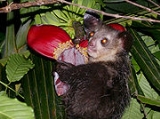
The Aye-aye (Daubentonia madagascariensis) is a strepsirrhine native to Madagascar
Madagascar

Madagascar, or Republic of Madagascar , is an island nation in the Indian Ocean off the southeastern coast of Africa. The main island, also called Madagascar, is the List of islands by area, and is home to 5% of the world's plant and animal species, of which more than 80% are Endemism to Madagascar....
 that combines rodent
Rodent

Rodentia is an Order of mammals also known as rodents, characterised by two continuously growing Incisors#The_Rodent_incisor in the upper and lower jaws which must be kept short by gnawing....
-like teeth with a long, thin middle finger to fill the same ecological niche as a woodpecker
Woodpecker

Woodpeckers are near passerine birds of the order Piciformes. They are one subfamily in the family Picidae, which also includes the piculets and wrynecks....
. It is the world's largest nocturnal primate, and is characterized by its unusual method of finding food; it taps on trees to find grubs, then gnaws holes in the wood and inserts its elongated middle finger to pull the grubs out.


Discussion
Ask a question about 'Aye-aye'
Start a new discussion about 'Aye-aye'
Answer questions from other users
Full Discussion Forum


Recent Posts


Encyclopedia


The Aye-aye (Daubentonia madagascariensis) is a strepsirrhine native to Madagascar
Madagascar

Madagascar, or Republic of Madagascar , is an island nation in the Indian Ocean off the southeastern coast of Africa. The main island, also called Madagascar, is the List of islands by area, and is home to 5% of the world's plant and animal species, of which more than 80% are Endemism to Madagascar....
 that combines rodent
Rodent

Rodentia is an Order of mammals also known as rodents, characterised by two continuously growing Incisors#The_Rodent_incisor in the upper and lower jaws which must be kept short by gnawing....
-like teeth with a long, thin middle finger to fill the same ecological niche as a woodpecker
Woodpecker

Woodpeckers are near passerine birds of the order Piciformes. They are one subfamily in the family Picidae, which also includes the piculets and wrynecks....
. It is the world's largest nocturnal primate, and is characterized by its unusual method of finding food; it taps on trees to find grubs, then gnaws holes in the wood and inserts its elongated middle finger to pull the grubs out. The only other animals known to find food in this way is the Striped Possum
Striped Possum

The Striped Possum is a member of the Petauridae family , one of the marsupial families. It is found in Australia and on the island of New Guinea, as well as several other small islands in the area....
. From an ecological point of view the Aye-aye fills the niche of a woodpecker as it is capable of penetrating wood to extract the invertebrates within.

Daubentonia is the only genus
Genus

A genus is a low-level taxonomic rank used in the classification of living and fossil organisms. The taxonomic ranks are domain , kingdom , phylum, class , order , family , genus, and species....
 in the family
Family (biology)

In biological classification, family is a taxonomic rank. Exact details of formal nomenclature depend on the Nomenclature Codes which applies....
 Daubentoniidae and infraorder Chiromyiformes. The Aye-aye is the only extant member of the genus (although it is currently classified as Near Threatened
Near Threatened

Near Threatened is a conservation status assigned to species or lower taxa that may be considered threatened species with extinction in the near future, although it does not currently qualify for the threatened status....
 by the IUCN); a second species, Daubentonia robusta, appears to have become extinct at some point within the last 1000 years.

Physical characteristics

The Aye-aye is the world's largest nocturnal prosimian
Prosimian

Prosimians are a group of mammals that includes all primates except monkeys and apes. They include, among others, lemurs, the Aye-aye, bushbaby, and tarsiers....
, and dwells predominantly in forest canopies. It weighs about 2.5 kilograms, with the female weighing in slightly less (by an average of 100 grams) than males. Other than weight and sex organs, aye-ayes exhibit no sexual dimorphism
Sexual dimorphism

Sexual dimorphism is the systematic difference in form between individuals of different sex in the same species. Examples include color , size, and the presence or absence of parts of the body used in courtship displays or fights, such as ornamental feathers, horns, antlers or tusks....
 of any kind. They all grow from 30-37 cm from head to body, with a 44-53 cm tail.

The adult Aye-aye has black or dark brown fur covered by white guard hair
Guard hair

Guard hairs are the longest, most coarse hairs in a mammal's coat, forming the topcoat . They taper to a point and protect the undercoat from the elements....
s at the neck. The tail is bushy and shaped like that of a squirrel
Squirrel

File:Eichh?rnchen D?sseldorf Hofgarten edit.jpgA squirrel is one of many small or medium-sized rodents in the family Sciuridae. In the English language-speaking world, squirrel commonly refers to members of this family's genus Sciurus and Tamiasciurus, which are tree squirrels with large bushy tails, indigenous to Asia, the America...
. The Aye-aye's face is also rodent-like, the shape of a raccoon
Raccoon

Procyon is a genus of nocturnal mammals, comprising three species commonly known as raccoons, in the family Procyonidae. The most widespread species, the Raccoon , is often known simply as "the" raccoon, as the two other raccoon species in the genus are native only to the tropics and are considerably lesser-known....
's, and mouses bright, beady, luminous eyes. Its incisors are very large, and grow continuously throughout its lifespan. These features contrast its monkey-like body, and are the likely cause of why scientists originally deemed it to be a rodent.

The Aye-aye's hands are arguably its most unusual feature. Much like other primates, it possesses opposable thumbs
Thumb

The thumb is the Human_anatomical_terms#Anatomical_directions-most finger of the hand. The English adjective for thumb is pollical....
, but both the hallux
Hallux

The hallux, commonly referred to as the big toe , although it may not be the longest toe on the foot of some people, is the innermost toe of the foot....
 and the finger
Finger

A finger is a type of digit , an organ of manipulation and sensation found in the hands of humans and other primates.Normally humans have five digits, termed phalanges, on each hand ....
s are long and slender, and appear to be in a curved position somewhat similar to that of a fairy-tale witch
Witchcraft

Witchcraft, in various historical, anthropological, religious and mythological contexts, is the use of certain kinds of supernatural or Magic powers....
 when the muscle
MUSCLE

MUSCLE is public domain, multiple sequence alignment software for protein and nucleotide sequences.MUSCLE is integrated into UGENE bioinformatics tool as a plugin....
s are relaxed. The middle finger can be up to three times longer than the others.

Gestation
Gestation

Gestation is the carrying of an embryo or fetus inside a female viviparous animal. Mammals during mammalian pregnancy can have one or more gestations at the same time ....
 for the Aye-aye lasts from 5 to 5 1/3 months. Births can occur at any time during the year, and females often wait 2-3 years between births. The infant takes about 7 months to be weaned, and stays with its mother for two years. The Aye-aye matures quickly; males rarely take more than 1 1/2 years to mature, and females take about an extra year. Lifespan is not known, but the world record is 23 years in captivity.

Habitat

The Aye-aye lives primarily on the east coast of Madagascar. Its natural habitat is rainforest
Rainforest

Rainforests are forests characterized by high rainfall, with definitions setting minimum normal annual rainfall between 1750?2000 mm . The monsoon trough, alternately known as the intertropical convergence zone, plays a significant role in creating Earth's tropical rain forests....
 or deciduous
Deciduous

Deciduous means falling off at maturity or tending to fall off and is typically used in reference to trees or shrubs that lose their leaves seasonally and to the shedding of other plant structures such as petals after flowering or fruit when ripe....
 forest, but many live in cultivated areas due to deforesting. Rainforest Aye-ayes, the most common, dwell in canopy areas, and are usually sighted upwards of 700 meters altitude. The Aye-aye sleeps during the day in nests built in the forks of trees.

Behavior


Social interaction

The Aye-aye is classically considered 'solitary', but recent research suggests that they are more social than once thought. It usually sticks to foraging in its own personal home range, or territory. The home ranges of males often overlap and the males can be very social with each other. Female home ranges never overlap, though a male's home range often overlaps that of several females. The male Aye-Aye live in large areas that are up to while female have smaller living space that goes up to . Regular scent marking with their cheeks, neck and genitals is a way that aye-ayes let others know of their presence and repel intruders from their territory. Like many other prosimians, the female Aye-aye is dominant to the male. The Aye-aye is not monogamous by any means, and often competes with each other for mates. Males are very aggressive in this regard, and sometimes even pull other males off a female during mating. Outside of mating, males and females interact only occasionally, usually while foraging.

After impregnating a female, the male usually stays in close proximity until the infant is born and has matured a bit. The father will sometimes share food with the infant, but otherwise infants' primary source of social interaction is with their mothers. Mothers and infants often wrestle, chase, and play "peek-a-boo" for entertainment. After 13 weeks, infants are usually ready to interact with other young Aye-ayes, usually by play-fighting.

Foraging

Ayeaye, Daubentonia Madagascariensis, Joseph Wolf
The Aye-aye begins foraging
Foraging

Foraging theory is a branch of behavioral ecology that studies the foraging behavior of animals in response to the environment in which the animal lives....
 anywhere between 30 minutes before or 3 hours after sunset. Up to 80% of the night is spent foraging in the canopy, separated by occasional rest periods. The monkey-like body of the Aye-aye enables it to move vertically with ease. It climbs trees by making successive vertical leaps, much like a squirrel. Horizontal movement is more difficult, but the Aye-aye rarely descends to jump to another tree, and can often cross up to 4 kilometers a night.

Infants are fully dextrous
Dextrous

Dextrous deals with ability or the right side * Dexterity - ability* See relative direction for the right sideDextrous can also mean:*USS Dextrous...
 within a month of birth. At first they can only climb on a branch hanging upside down, but they gradually work their way up to the various acrobatic feats that adults can perform. Curiously, walking and running on the ground is often hardest for an Aye-aye to master.

Diet
The Aye-aye commonly eats nuts, and also grubs, fruits, nectar, seeds, and fungi, classifying it as an omnivore
Omnivore

Omnivores are species that eating both plants and animals as their primary food source. They are opportunistic, general feeders not specifically adapted to eat and digest either meat or plant material exclusively....
. It often picks fruit off trees as it moves through the canopy, often barely stopping to do so. An Aye-aye not lucky enough to live in its natural habitat will often steal coconuts, mangoes, sugar cane, lychees and eggs from villages and plantations. Aye-ayes chew a hole into wood and get grubs out of that hole with their elongated and bony middle fingers.

Social foraging
Though foraging is mostly solitary, it will occasionally forage in groups. Individual movements within the group are coordinated using both sound (vocalisations) and scent signals.

History

The original meaning of the name Aye-aye has been lost, as the originating language is extinct. There is a hypothesis that the word "aye aye" signifies simply a cry of alarm to alert others to the presence of this animal, which many Malagasy
Malagasy people

The Malagasy ethnic group forms the vast majority of the population of Madagascar. They are divided into two subgroups: the "Highlander" Merina, Sihanaka and Betsileo of the central plateaux around Antananarivo, Alaotra and Fianarantsoa, and the c?tiers elsewhere in the country....
 consider an ill omen.

With D. robusta's extermination, the D. madagascariensis Aye-aye was thought to be extinct. However, it was later rediscovered in 1961. Six individuals were transported to Nosy Mangabe
Nosy Mangabe

Nosy Mangabe is a small island reserve located in Antongil Bay about 2 km offshore from the town of Maroantsetra in eastern Madagascar. 520ha in size, it is accessible by small boat and is part of the larger Masoala National Park complex....
, an island near Maroantsetra
Maroantsetra

Maroantsetra is a market town and domestic seaport in Toamasina Province, Madagascar. It is located on the Bay of Antongil near .Maroantsetra is the main point of access to Masoala National Park and the Nosy Mangabe special reserve, and the headquarters of the park authority....
 in eastern Madagascar. Recent research shows that the Aye-aye is more widespread than was previously thought, but is still endangered.

There are several Aye-ayes kept in zoos. The largest collection of Aye-ayes and the most successful breeding program is at the Duke Lemur Center
Duke Lemur Center

In 1966, a prosimian colony of approximately 90 individuals was relocated from the Center for Prosimian Biology at Yale University to Duke University, and thus began the Duke Lemur Center ....
 at Duke University
Duke University

Duke University is a private university research university located in Durham, North Carolina, North Carolina, United States. Founded by Methodism and Religious Society of Friends in the present-day town of Trinity, North Carolina in 1838, the school moved to Durham in 1892....
 with a current population of 22 individuals. Several also reside outside of the US at various locations.

The Aye-aye was once thought to be a type of squirrel
Squirrel

File:Eichh?rnchen D?sseldorf Hofgarten edit.jpgA squirrel is one of many small or medium-sized rodents in the family Sciuridae. In the English language-speaking world, squirrel commonly refers to members of this family's genus Sciurus and Tamiasciurus, which are tree squirrels with large bushy tails, indigenous to Asia, the America...
 that lived underground, using its long finger to capture insects and worms.

Superstition and public controversy

The Aye-aye is an endangered species not only because its habitat is being destroyed, but also due to native superstition. Besides being a general nuisance in villages, ancient Malagasy legend said that the Aye-aye was a symbol of death. It is viewed as a good omen in some areas, however, but these areas are a minority.

Researchers in Madagascar report remarkable fearlessness in the Aye-aye; some accounts tell of individual animals strolling nonchalantly in village streets or even walking right up to naturalists in the rainforest and sniffing their shoes. Therefore, it is no wonder that displaced animals often raid coconut plantations or steal food in villages. It is not unlike the Common Raccoon
Raccoon

Procyon is a genus of nocturnal mammals, comprising three species commonly known as raccoons, in the family Procyonidae. The most widespread species, the Raccoon , is often known simply as "the" raccoon, as the two other raccoon species in the genus are native only to the tropics and are considerably lesser-known....
 in this regard.

However, public contempt goes beyond this. The Aye-aye is often viewed as a harbinger of evil and killed on sight. Others believe that should one point its long middle finger at you, you were condemned to death. Some say the appearance of an Aye-aye in a village predicts the death of a villager, and the only way to prevent this is to kill the Aye-aye. The Sakalava
Sakalava

The Sakalava is a traditional name for a group of people of Madagascar numbering approximately 700,000 in population. They occupy the Western edge of the island from Toliara in the south to Sambirano in the north....
 people go so far as to claim Aye-ayes sneak into houses through the thatched roofs and murder the sleeping occupants by using their middle finger to puncture the victim's aorta
Aorta

The aorta is the largest artery in the human body, originating from the left ventricle of the heart and bringing oxygenated blood to all parts of the body in the systemic circulation....
.

Incidents of Aye-aye killings increase every year as its forest habitats are destroyed and it is forced to raid plantations and villages. Because of the superstition surrounding it, this often ends in death. On the other hand, the superstition can prevent people from hunting them for food.

Classification

  • ORDER PRIMATES
    • Suborder Strepsirrhini
      Strepsirrhini

      The clade Strepsirrhini is one of the two suborders of primates. One of the most distinguishing characteristic of these 118 species is their wet noses, and it is this feature for which the grouping is named....
      : non-tarsier prosimians
      • Infraorder Lemuriformes
      • Infraorder Chiromyiformes
        • Family Daubentoniidae
          • Genus Daubentonia
            • Aye-aye, Daubentonia madagascariensis
            • Giant Aye-aye
              Giant Aye-aye

              The Giant Aye-aye is an extinct relative of the Aye-aye. It lived in Madagascar. It appears to have disappeared less than 1000 years ago, but is entirely unknown in life, and only known from subfossil remains....
               (Daubentonia robusta, extinct)
      • Infraorder Lorisiformes
        Lorisiformes

        Lorisiformes are a group of primates found throughout Africa and Asia. Members of this infraorder include the galagos and the lorises. As strepsirrhines, they are related to the lemurs and the Aye-aye, but it is currently unknown if the Aye-aye is more closely related to the lemurs, or represents a form ancestral to both Lemurifores and the L...


External links

  • ARKive -
  • - a photo of an aye-aye eating a ramie nut