
|
|
|
|
Hibernation
|
| |
|
| |
Hibernation is a state of inactivity and metabolic depression in animals, characterized by lower body temperature, slower breathing, and lower metabolic rate. Hibernating animals conserve energy, especially during winter when food is short, tapping energy reserves, body fat, at a slow rate. It is the animal's slowed metabolic rate which leads to a reduction in body temperature and not the other way around.
Hibernation may last several days or weeks depending on species, ambient temperature, and time of year.

Discussion
Ask a question about 'Hibernation'
Start a new discussion about 'Hibernation'
Answer questions from other users
|
Encyclopedia
Hibernation is a state of inactivity and metabolic depression in animals, characterized by lower body temperature, slower breathing, and lower metabolic rate. Hibernating animals conserve energy, especially during winter when food is short, tapping energy reserves, body fat, at a slow rate. It is the animal's slowed metabolic rate which leads to a reduction in body temperature and not the other way around.
Hibernation may last several days or weeks depending on species, ambient temperature, and time of year. The typical winter season for a hibernator is characterized by periods of hibernation interrupted by sporadic euthermic arousals wherein body temperature is restored to typical levels. It has been shown that at least the arctic ground squirrel builds a need for sleep during hibernation, more slowly than normally, and must occasionally warm up in order to sleep.
Hibernating animals
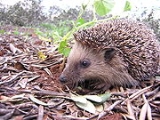
Animals that hibernate include bats, some species of ground squirrels and other rodents, mouse lemurs, the West European Hedgehog and other insectivores, monotremes and marsupials. Even some rattlesnakes, such as the Western Diamondback, are known to hibernate in caves every winter. Historically, Pliny the Elder believed that swallows hibernated, and ornithologist Gilbert White pointed to anecdotal evidence in The Natural History of Selborne that indicated as much. Birds typically do not hibernate, instead utilizing torpor. However the Common Poorwill does hibernate. Many experts believe that the processes of daily torpor and hibernation form a continuum.
One animal that some famously consider a hibernator is the bear, although bears do not go into "true hibernation". During a bear's winter sleep state, the degree of metabolic depression is much less than that observed in smaller mammals. Many prefer to use the term "denning". The bear's body temperature remains relatively stable (depressed from to approximately ) and it can be easily aroused. Some reptile species are said to brumate, or undergo brumation, but the connection to this phenomenon with hibernation is not clear.
Hibernating ground squirrels may have core body temperatures as low as , maintaining sub-zero body temperature for more than three weeks at a time.
Before entering hibernation most species eat a large amount of food and store energy in fat deposits in order to survive the winter. Some species of mammals hibernate while gestating young, which are born shortly after the mother stops hibernating.
Hibernating animals get their energy by a biochemical process known as gluconeogenesis.
For a couple of generations during the 20th century it was thought that basking sharks settled to the floor of the North Sea and hibernated; however, research by Dr David Sims in 2003 dispelled this hypothesis, showing that the sharks actively traveled huge distances throughout the seasons, tracking the areas with the highest quantity of plankton.
The epaulette sharks have been documented to be able to survive for long periods of time without oxygen, even being left high and dry, and at temperatures of up to . Other animals able to survive long periods without oxygen include the goldfish, the red-eared slider turtle, the wood frog, and the bar-headed goose.
Until recently no primate, and no tropical mammal, was known to hibernate. However, animal physiologist Kathrin Dausmann of Philipps University of Marburg, Germany, and coworkers presented evidence in the 24 June 2004 edition of Nature that the Fat-tailed Dwarf Lemur of Madagascar hibernates in tree holes for seven months of the year. This is interesting because Malagasy winter temperatures sometimes rise to over , so hibernation is not exclusively an adaptation to low ambient temperatures. The hibernation of this lemur is strongly dependent on the thermal behavior of its tree hole: if the hole is poorly insulated, the lemur's body temperature fluctuates widely, passively following the ambient temperature; if well insulated, the body temperature stays fairly constant and the animal undergoes regular spells of arousal. Dausmann found that hypometabolism in hibernating animals is not necessarily coupled to a low body temperature.
Noise and vibration from snowmobiles, all-terrain vehicles (ATV) and the like is said to sometimes awaken hibernating animals, who may suffer severely or die as a result of premature awakening in times of food shortage.
Artificial hibernation There are many research projects currently investigating how to achieve "induced hibernation" in humans. The ability for humans to hibernate would be useful for a number of reasons, such as saving the lives of seriously ill or injured people by temporarily putting them in a state of hibernation until treatment can be given (compare induced coma). NASA is also interested in possibly putting astronauts in hibernation when going on very long space journeys, making it possible one day to visit far away stars.
See also
External links
-
- : Body Temperatures Below 0 °C in an Arctic Hibernator
- : ESA Advanced Concepts Team
-
- : Human hibernation project - freezing for 50 years
- : Brain hibernation project
|
| |
|
|