
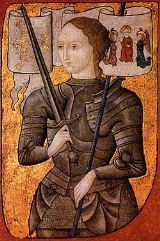
Saint Joan of Arc, nicknamed "
The Maid of Orléans" , is a national
heroA hero , in Greek mythology and folklore, was originally a demigod, their cult being one of the most distinctive features of ancient Greek religion...
ine of France and a Roman Catholic
saintA saint is a holy person. In various religions, saints are people who are believed to have exceptional holiness.In Christian usage, "saint" refers to any believer who is "in Christ", and in whom Christ dwells, whether in heaven or in earth...
. A
peasantA peasant is an agricultural worker who generally tend to be poor and homeless-Etymology:The word is derived from 15th century French païsant meaning one from the pays, or countryside, ultimately from the Latin pagus, or outlying administrative district.- Position in society :Peasants typically...
girl born in eastern France who claimed divine guidance, she led the French army to several important victories during the
Hundred Years' WarThe Hundred Years' War was a series of separate wars waged from 1337 to 1453 by the House of Valois and the House of Plantagenet, also known as the House of Anjou, for the French throne, which had become vacant upon the extinction of the senior Capetian line of French kings...
, which paved the way for the coronation of
Charles VIICharles VII , called the Victorious or the Well-Served , was King of France from 1422 to his death, though he was initially opposed by Henry VI of England, whose Regent, the Duke of Bedford, ruled much of France including the capital, Paris...
. She was captured by the
BurgundiansThe Burgundian party was a political allegiance in France that formed during the reign of Charles VI during the latter half of the Hundred Years' War...
, sold to the English, tried by an
ecclesiastical courtAn ecclesiastical court is any of certain courts having jurisdiction mainly in spiritual or religious matters. In the Middle Ages in many areas of Europe these courts had much wider powers than before the development of nation states...
, and burned at the stake when she was 19 years old. Twenty-five years after the execution,
Pope Callixtus IIIPope Callixtus III , né Alfons de Borja, was Pope from April 8, 1455 to his death in 1458.-Biography:...
examined the trial, pronounced her innocent and declared her a
martyrA martyr is somebody who suffers persecution and death for refusing to renounce, or accept, a belief or cause, usually religious.-Meaning:...
. Joan of Arc was
beatifiedBeatification is a recognition accorded by the Catholic Church of a dead person's entrance into Heaven and capacity to intercede on behalf of individuals who pray in his or her name . Beatification is the third of the four steps in the canonization process...
in 1909 and
canonizedCanonization is the act by which a Christian church declares a deceased person to be a saint, upon which declaration the person is included in the canon, or list, of recognized saints. Originally, individuals were recognized as saints without any formal process...
in 1920. She is – along with St. Denis, St. Martin of Tours, St. Louis IX, and St. Theresa of Lisieux – one of the
patron saintA patron saint is a saint who is regarded as the intercessor and advocate in heaven of a nation, place, craft, activity, class, clan, family, or person...
s of France.
Joan asserted that she had visions from God that instructed her to recover her homeland from
EnglishThe Kingdom of England was, from 927 to 1707, a sovereign state to the northwest of continental Europe. At its height, the Kingdom of England spanned the southern two-thirds of the island of Great Britain and several smaller outlying islands; what today comprises the legal jurisdiction of England...
domination late in the
Hundred Years' WarThe Hundred Years' War was a series of separate wars waged from 1337 to 1453 by the House of Valois and the House of Plantagenet, also known as the House of Anjou, for the French throne, which had become vacant upon the extinction of the senior Capetian line of French kings...
. The uncrowned King Charles VII sent her to the
siege of OrléansThe Siege of Orléans marked a turning point in the Hundred Years' War between France and England. This was Joan of Arc's first major military victory and the first major French success to follow the crushing defeat at Agincourt in 1415. The outset of this siege marked the pinnacle of English power...
as part of a relief mission. She gained prominence when she overcame the dismissive attitude of veteran commanders and lifted the siege in only nine days. Several more swift victories led to Charles VII's coronation at
ReimsReims , a city in the Champagne-Ardenne region of France, lies east-northeast of Paris. Founded by the Gauls, it became a major city during the period of the Roman Empire....
and settled the disputed succession to the throne.
Down to the present day, Joan of Arc has remained a significant figure in Western culture. From
NapoleonNapoleon Bonaparte was a French military and political leader during the latter stages of the French Revolution.As Napoleon I, he was Emperor of the French from 1804 to 1815...
onward, French politicians of all leanings have invoked her memory. Famous writers and composers who have created works about her include:
ShakespeareWilliam Shakespeare was an English poet and playwright, widely regarded as the greatest writer in the English language and the world's pre-eminent dramatist. He is often called England's national poet and the "Bard of Avon"...
(
Henry VI, Part 1Henry VI, Part 1 or The First Part of Henry the Sixt is a history play by William Shakespeare, and possibly Thomas Nashe, believed to have been written in 1591, and set during the lifetime of King Henry VI of England...
),
VoltaireFrançois-Marie Arouet , better known by the pen name Voltaire , was a French Enlightenment writer, historian and philosopher famous for his wit and for his advocacy of civil liberties, including freedom of religion, free trade and separation of church and state...
(
The Maid of OrleansThe Maiden of Orleans is a satirical poem by François-Marie Arouet, better known by his pen name, Voltaire. It was first properly published in 1899, but Voltaire had written it over a century beforehand; while he had started writing the text in 1730, he never fully completed it. It was translated...
poem),
SchillerJohann Christoph Friedrich von Schiller was a German poet, philosopher, historian, and playwright. During the last seventeen years of his life , Schiller struck up a productive, if complicated, friendship with already famous and influential Johann Wolfgang von Goethe...
(
The Maid of OrleansThe Maid of Orleans is a tragedy by Friedrich Schiller, written in 1801 in Leipzig. During his lifetime, it was one of Schiller's most frequently-performed pieces.-Plot:...
play),
VerdiGiuseppe Fortunino Francesco Verdi was an Italian Romantic composer, mainly of opera. He was one of the most influential composers of the 19th century...
(
Giovanna d'ArcoGiovanna d'Arco is an operatic dramma lirico with a prologue and three acts by Giuseppe Verdi to an Italian libretto by Temistocle Solera....
),
TchaikovskyPyotr Ilyich Tchaikovsky Pyotr Ilyich Tchaikovsky Pyotr Ilyich Tchaikovsky (Russian: Пётр Ильи́ч Чайко́вский ; often "Peter Ilich Tchaikovsky" in English. His names are also transliterated "Piotr" or "Petr"; "Ilitsch", "Il'ich" or "Illyich"; and "Tschaikowski", "Tschaikowsky", "Chajkovskij"...
(
The Maid of Orleans opera),
Mark TwainSamuel Langhorne Clemens , better known by his pen name Mark Twain, was an American author and humorist...
(
Personal Recollections of Joan of ArcMark Twain's work on Joan of Arc is titled in full, Personal Recollections of Joan of Arc, by the Sieur Louis de Conte, who is identified further as Joan's page and secretary...
),
Arthur HoneggerArthur Honegger was a Swiss composer, who was born in France and lived a large part of his life in Paris. He was a member of Les six. His most frequently performed work is probably the orchestral work Pacific 231, which is interpreted as imitating the sound of a steam locomotive.-Biography:Born...
(
Jeanne d'Arc au bûcherJeanne d'Arc au bûcher is an oratorio by Arthur Honegger, originally commissioned by Ida Rubinstein. The drama takes place during the heroine's trial and execution, with flashbacks to her younger days...
),
Jean AnouilhJean Marie Lucien Pierre Anouilh was a French dramatist whose career spanned five decades. Though his work ranged from high drama to absurdist farce, Anouilh is best known for his 1943 play Antigone, an adaptation of Sophocles' Classical drama, that was seen as an attack on Marshal Pétain's...
(
L'AlouetteL'Alouette is a 1952 play by Jean Anouilh about Joan of Arc. It was presented on Broadway in English in 1955, starring Julie Harris as Joan and Boris Karloff as Pierre Cauchon. It was produced by Kermit Bloomgarden.The English adaptation was by Lillian Hellman and the incidental music was by...
),
Bertolt BrechtBertolt Brecht was a German poet, playwright, and theatre director.An influential theatre practitioner of the 20th century, Brecht made equally significant contributions to dramaturgy and theatrical production, the latter particularly through the seismic impact of the tours undertaken by the...
(
Saint Joan of the StockyardsSaint Joan of the Stockyards is a play written by the German modernist playwright Bertolt Brecht between 1929 and 1931, after the success of his musical The Threepenny Opera and during the period of his radical experimental work with the Lehrstücke. It is based on the musical that he co-authored...
),
George Bernard ShawGeorge Bernard Shaw was an Irish playwright and a co-founder of the London School of Economics. Although his first profitable writing was music and literary criticism, in which capacity he wrote many highly articulate pieces of journalism, his main talent was for drama, and he wrote more than 60...
(
Saint JoanSaint Joan is a play by George Bernard Shaw, based on the life and trial of Joan of Arc. Published not long after the canonization of Joan of Arc by the Roman Catholic Church, the play dramatises what is known of her life based on the substantial records of her trial. Shaw studied the transcripts...
) and
Maxwell AndersonJames Maxwell Anderson was an American playwright, author, poet, journalist and lyricist.-Early years:Anderson was born in Atlantic, Pennsylvania, the second of eight children to William Lincoln "Link" Anderson, a Baptist minister, and Charlotte Perrimela Stephenson, both of Scots and Irish descent...
(
Joan of LorraineJoan of Lorraine is a 1946 play-within-a-play by Maxwell Anderson. It is about an acting company who stages a dramatization of the story of Joan of Arc and the effect that the story has on them. As in the musical Man of La Mancha, most of the actors in the drama play two or more roles...
).
Depictions of herJoan of Arc has inspired artistic and cultural works for nearly six centuries. The following lists cover various media to include items of historic interest, enduring works of high art, and recent representations in popular culture. The entries represent portrayals that a reader has a reasonable...
continue in film, theatre, television, video games, music and performance.
Background
The historian
Kelly DeVriesKelly DeVries is an American historian specializing in the warfare of the Middle Ages.DeVries is Professor of History at Loyola University Maryland...
describes the period preceding her appearance in the following terms: "If anything could have discouraged her, the state of France in 1429 should have." The
Hundred Years' WarThe Hundred Years' War was a series of separate wars waged from 1337 to 1453 by the House of Valois and the House of Plantagenet, also known as the House of Anjou, for the French throne, which had become vacant upon the extinction of the senior Capetian line of French kings...
had begun in 1337 as a
succession dispute over the French throneThe English claims to the French throne have a long and complex history between the 1340s and the 19th century.From 1340 to 1801, with only brief intervals in 1360-1369 and 1420–1422, the kings and queens of England, and after the Acts of Union in 1707 the kings and queens of Great Britain, also...
with intermittent periods of relative peace. Nearly all the fighting had taken place in France, and the English army's use of
chevauchéeA chevauchée was a raiding method of medieval warfare for weakening the enemy, focusing mainly on wreaking havoc, burning and pillaging enemy territory, in order to reduce the productivity of a region; as opposed to siege warfare or wars of conquest...
tactics (similar to
scorched earthA scorched earth policy is a military strategy or operational method which involves destroying anything that might be useful to the enemy while advancing through or withdrawing from an area...
strategies) had devastated the economy. The
French populationThis article discusses human demography in Europe during the Middle Ages, including population trends and movements. Demographic changes helped to shape and define the Middle Ages...
had not recovered from the
Black DeathThe Black Death was one of the most devastating pandemics in human history, peaking in Europe between 1348 and 1350. Of several competing theories, the dominant explanation for the Black Death is the plague theory, which attributes the outbreak to the bacterium Yersinia pestis. Thought to have...
of the previous century and its merchants were isolated from foreign markets. At the outset of Jeanne d'Arc's appearance, the English had nearly achieved their goal of a dual monarchy under English control and the French army had not achieved any major victories for a generation. In DeVries's words, "The kingdom of France was not even a shadow of its thirteenth-century prototype."
The French king at the time of Joan's birth,
Charles VICharles VI , called the Beloved and the Mad , was the King of France from 1380 to 1422, as a member of the House of Valois. His bouts with madness, which seem to have begun in 1392, led to quarrels among the French royal family, which were exploited by the neighbouring powers of England and Burgundy...
, suffered bouts of insanity and was often unable to rule. The king's brother Duke
Louis of OrléansLouis I was Duke of Orléans from 1392 to his death. He was also Count of Valois, Duke of Touraine , Count of Blois , Angoulême , Périgord, Dreux, and Soissons....
and the king's cousin John the Fearless,
Duke of BurgundyDuke of Burgundy was a title borne by the rulers of the Duchy of Burgundy, a small portion of traditional lands of Burgundians west of river Saône which in 843 was allotted to Charles the Bald's kingdom of West Franks...
, quarreled over the regency of France and the guardianship of the royal children. This dispute escalated to accusations of an extramarital affair with Queen
Isabeau of BavariaIsabeau of Bavaria was Queen consort of France as spouse of King Charles VI of France, a member of the Valois Dynasty...
and the kidnappings of the royal children.. The matter climaxed with the assassination of the Duke of Orléans in 1407, on the orders of the Duke of Burgundy.
The factions which were loyal to these two men became known as the
ArmagnacsThe Armagnac party was prominent in French politics and warfare during the Hundred Years' War. It was allied with the supporters of Charles, Duke of Orléans against John the Fearless after Charles' father Louis of Orléans was killed at the orders of the Duke of Burgundy in 1407...
and the
BurgundiansThe Burgundian party was a political allegiance in France that formed during the reign of Charles VI during the latter half of the Hundred Years' War...
.
Henry V of EnglandHenry V was King of England from 1413 until his death at the age of 35 in 1422. He was the second monarch belonging to the House of Lancaster....
took advantage of this turmoil to invade France, winning a dramatic
victory at AgincourtThe Battle of Agincourt was a major English victory against a numerically superior French army in the Hundred Years' War. The battle occurred on Friday, 25 October 1415 , near modern-day Azincourt, in northern France...
in 1415, and capturing many northern French towns. The future French king,
Charles VIICharles VII , called the Victorious or the Well-Served , was King of France from 1422 to his death, though he was initially opposed by Henry VI of England, whose Regent, the Duke of Bedford, ruled much of France including the capital, Paris...
, assumed the title of Dauphin – the heir to the throne – at the age of fourteen, after all four of his older brothers died in succession. His first significant official act was to conclude a peace treaty with Burgundy in 1419. This ended in disaster when Armagnac partisans assassinated John the Fearless during a meeting under Charles's guarantee of protection. The new duke of Burgundy,
Philip the GoodPhilip the Good KG , also Philip III, Duke of Burgundy was Duke of Burgundy from 1419 until his death. He was a member of a cadet line of the Valois dynasty . During his reign Burgundy reached the height of its prosperity and prestige and became a leading center of the arts...
, blamed Charles for the murder and entered into an alliance with the English. Large sections of France were conquered.
In 1420, Queen Isabeau of Bavaria concluded the
Treaty of TroyesThe Treaty of Troyes was an agreement that Henry V of England and his heirs would inherit the throne of France upon the death of King Charles VI of France. It was signed in the French city of Troyes on 21 May 1420 in the aftermath of the Battle of Agincourt...
, which granted the succession of the French throne to Henry V and his heirs instead of her son Charles. This agreement revived rumors about her alleged affair with the late duke of Orléans and raised fresh suspicions that the Dauphin was illegitimate rather than the son of the king. Henry V and Charles VI died within two months of each other in 1422, leaving an infant,
Henry VI of EnglandHenry VI was King of England from 1422 to 1461 and again from 1470 to 1471, and disputed King of France from 1422 to 1453. Until 1437, his realm was governed by regents. Contemporaneous accounts described him as peaceful and pious, not suited for the violent dynastic civil wars, known as the Wars...
, the nominal monarch of both kingdoms. Henry V's brother, John of Lancaster, 1st Duke of Bedford, acted as
regentA regent, from the Latin regens "one who reigns", is a person selected to act as head of state because the ruler is a minor, not present, or debilitated. Currently there are only two ruling Regencies in the world, sovereign Liechtenstein and the Malaysian constitutive state of Terengganu...
.
By the beginning of 1429, nearly all of northern France and some parts of the southwest were under foreign control. The English controlled Paris while the Burgundians controlled Rheims, the latter city being the traditional site of French coronations. This was an important consideration since neither claimant to the throne of France had yet been officially crowned. The English had laid siege to Orléans, one of the few remaining loyal French cities and a strategic position along the
LoireLoire is an administrative department in the east-central part of France occupying the River Loire's upper reaches.-History:Loire was created in 1793 when after just 3½ years the young Rhône-et-Loire department was split into two. This was a response to counter-Revolutionary activities in Lyon...
River which made it the last obstacle to an assault on the remainder of the French heartland. In the words of one modern historian, "On the fate of Orléans hung that of the entire kingdom." No one was optimistic that the city could long withstand the siege.
Life
Joan was born the daughter of
Jacques d'ArcJacques d'Arc was the father of Joan of Arc. He was a farmer in the village of Domrémy in Lorraine. He held the post of doyen, a local post that collected taxes and organized the village defense. He was born at Ceffonds. He married Isabelle de Vouthon , called Romée, in 1405...
and
Isabelle RoméeIsabelle Romée, also known as Isabelle de Vouthon and Isabelle d'Arc and Ysabeau Romee, was the mother of Joan of Arc. She was a native of Vouthon-Bas, a village near Domrémy-la-Pucelle where she and her husband Jacques d'Arc settled. Together they owned about of land and a modest house...
. in
DomrémyDomrémy-la-Pucelle is a commune in the Vosges department in Lorraine in northeastern France.The village, originally named Domrémy, is the birthplace of Joan of Arc. It has since been renamed Domrémy-la-Pucelle after Joan's nickname, la Pucelle d'Orléans .-Geography:Domrémy is positioned along the...
, a village which was then in the
duchy of BarBar was a historic duchy of both the Holy Roman Empire and the crown of France, though later totally incorporated with Lorraine into France in 1766. The duchy of Bar includes the "pays" of Barrois.- History :...
(later annexed to the province of Lorraine and renamed Domrémy-la-Pucelle). Joan's parents owned about 50 acres (20 hectares) of land and her father supplemented his farming work with a minor position as a village official, collecting taxes and heading the local watch. They lived in an isolated patch of eastern France that remained loyal to the French crown despite being surrounded by Burgundian lands. Several local raids occurred during her childhood and on one occasion her village was burned.
Joan said she was about 19 at her trial, so she must have been born around the year 1412. She later testified that she experienced her first vision around 1424 at the age of 12 years, when she was out alone in a field and saw visions of figures she identified as
Saint MichaelMichael , Micha'el or Mîkhā'ēl; , Mikhaḗl; or Míchaël; , Mīkhā'īl) is an archangel in Jewish, Christian, and Islamic teachings. Roman Catholics, Anglicans, and Lutherans refer to him as Saint Michael the Archangel and also simply as Saint Michael...
,
Saint CatherineSaint Catherine of Alexandria, also known as Saint Catherine of the Wheel and The Great Martyr Saint Catherine is, according to tradition, a Christian saint and virgin, who was martyred in the early 4th century at the hands of the pagan emperor Maxentius...
, and Saint Margaret, who told her to drive out the English and bring the Dauphin to Rheims for his coronation. She said she cried when they left, as they were so beautiful.
At the age of 16, she asked a kinsman, Durand Lassois, to bring her to nearby
VaucouleursVaucouleurs is a commune in the Meuse department.Joan of Arc stayed in Vaucouleurs for several months during 1428 and 1429 while she sought permission to visit the royal court of Charles VII of France.* Distance from Paris: -External links:* *...
where she petitioned the garrison commander, Count
Robert de BaudricourtRobert de Baudricourt , Seigneur de Baudricourt, Blaise, Buxy and Sorcy was a minor figure of 15th century French nobility. The son of the Chamberlain of the Duke of Bar, his principal claim to fame is to have been the first stepping stone in the career of Joan of Arc.-External links:*...
, for permission to visit the royal French court at
ChinonChinon is a commune in the Indre-et-Loire department in central France well known for Château de Chinon.In the Middle Ages, Chinon developed especially during the reign of Henry II . The castle was rebuilt and extended, becoming one of his favorite residences...
. Baudricourt's sarcastic response did not deter her. She returned the following January and gained support from two men of standing:
Jean de MetzJean de Metz was a French nobleman who is known primarily for his role in the exploits of Joan of Arc.-Biography:...
and Bertrand de Poulengy. Under their auspices, she gained a second meeting where she made a remarkable prediction about a
military reversalThe Battle of the Herrings was a military action near the town of Rouvray in France, just north of Orléans, which took place on 12 February 1429 during the siege of Orléans. The immediate cause of the battle was an attempt by French forces, led by Charles of Bourbon, Count of Clermont, to intercept...
near Orléans.
Rise
Robert de Baudricourt granted her an escort to visit Chinon after news from the front confirmed her prediction. She made the journey through hostile Burgundian territory in male disguise. Upon arriving at the Royal Court she impressed Charles VII during a private conference. During this time Charles's mother-in-law
Yolande of AragonYolande of Aragon, , was a throne claimant and titular queen regnant of Aragon, titular queen consort of Naples, Duchess of Anjou, Countess of Provence, and regent of Provence during the minority of her son...
was financing a relief expedition to
Orléans-Prehistory and Roman:Cenabum was a Gallic stronghold, one of the principal towns of the Carnutes tribe where the Druids held their annual assembly. It was conquered and destroyed by Julius Caesar in 52 BC, then rebuilt under the Roman Empire...
. Joan asked for permission to travel with the army and wear the equipment of a knight. She depended on donated items for her armor, horse, sword, banner, and other items utilized by her entourage. Historian Stephen W. Richey explains her attraction to the Royal Court by pointing out that they may have viewed her as the only source of hope for a regime that was near collapse:
Upon her arrival, Joan effectively turned the longstanding Anglo-French conflict into a religious war. But this course of action was not without its risks. Charles' advisers were worried that unless Joan's orthodoxy could be established beyond doubt – that she was not a heretic or a sorceress – Charles' enemies could easily make the claim that his kingdom was a gift from the Devil. To circumvent this possibility, the Dauphin ordered background inquiries and a theological examination at
PoitiersPoitiers is a city on the Clain river in west central France. It is a commune and the capital of the Vienne department and of the Poitou-Charentes region. The centre is picturesque and its streets are interesting for predominant remains of historical architecture, especially from the Romanesque...
to verify her morality. In April 1429, the commission of inquiry "declared her to be of irreproachable life, a good Christian, possessed of the virtues of humility, honesty and simplicity." The theologians at Poitiers did not pass judgment on her divine inspiration; rather, they informed the Dauphin that there was a 'favorable presumption' to be made on the divine nature of her mission. This was enough for Charles, but they put the ball back in his court by stating that he had an obligation to put Joan to the test. 'To doubt or abandon her without suspicion of evil would be to repudiate the
Holy SpiritHoly Spirit is a term introduced in English translations of the Hebrew Bible, but understood differently in the main Abrahamic religions.While the general concept of a "Spirit" that permeates the cosmos has been used in various religions Holy Spirit is a term introduced in English translations of...
and to become unworthy of God's aid', they declared. The test for the truth of her claims would be the raising of the siege of
Orléans-Prehistory and Roman:Cenabum was a Gallic stronghold, one of the principal towns of the Carnutes tribe where the Druids held their annual assembly. It was conquered and destroyed by Julius Caesar in 52 BC, then rebuilt under the Roman Empire...
.
She arrived at the
siege of OrléansThe Siege of Orléans marked a turning point in the Hundred Years' War between France and England. This was Joan of Arc's first major military victory and the first major French success to follow the crushing defeat at Agincourt in 1415. The outset of this siege marked the pinnacle of English power...
on 29 April 1429, but
Jean d'OrléansJohn of Orléans, Count of Dunois was the illegitimate son of Louis d'Orléans by Mariette d'Enghien.The term "Bastard of Orléans" John of Orléans, Count of Dunois (French born "Jean Levieux Valois des Orléans" better known as Jean d'Orléans, comte de Dunois, also known as John of Orléans and...
, the acting head of the Orléans ducal family, initially excluded her from war councils and failed to inform her when the army engaged the enemy. This did not prevent her from being present at most councils and battles. The extent of her actual military leadership is a subject of historical debate. Traditional historians such as Édouard Perroy conclude that she was a standard bearer whose primary effect was on morale. This type of analysis usually relies on the condemnation trial testimony, where she stated that she preferred her standard to her sword. Recent scholarship that focuses on the nullification trial testimony asserts that the army's commanders esteemed her as a skilled tactician and a successful strategist. Stephen W. Richey's opinion is one example:
"She proceeded to lead the army in an astounding series of victories that reversed the tide of the war." In either case, historians agree that the army enjoyed remarkable success during her brief career.
Leadership
Joan of Arc rejected the cautious strategy that had characterized French leadership during previous campaigns. During the five months of siege before her arrival, the defenders of Orléans had attempted only one aggressive move and that had ended in disaster. On 4 May the French attacked and captured the outlying fortress of Saint Loup, which she followed on 5 May with a march to a second fortress called Saint Jean le Blanc, which was found deserted. The next day she opposed Jean d'Orleans at a war council where she demanded another assault on the enemy. D'Orleans ordered the city gates locked to prevent another battle, but she summoned the townsmen and common soldiers and forced the mayor to unlock a gate. With the aid of only one captain she rode out and captured the fortress of Saint Augustins. That evening she learned she had been excluded from a war council where the leaders had decided to wait for reinforcements before acting again. Disregarding this decision, she insisted on attacking the main English stronghold called
"les Tourelles" on 7 May. Contemporaries acknowledged her as the heroine of the engagement after she was wounded in the neck by an arrow but returned to lead the final charge.
| "...the Maiden lets you know that here, in eight days, she has chased the English out of all the places they held on the river Loire by attack or other means: they are dead or prisoners or discouraged in battle. Believe what you have heard about the earl of Suffolk, the lord la Pole and his brother, the lord Talbot, the lord Scales, and Sir Fastolf; many more knights and captains than these are defeated." |
Her Letter to the citizens of TournaiTournai is a Walloon city and municipality of Belgium located 85 kilometres southwest of Brussels, on the river Scheldt, in the province of Hainaut.... , 25 June 1429; Quicherat V, pp. 125–126, trans. Wikipedia. |
The sudden victory at Orléans led to many proposals for further offensive action. The English expected an attempt to recapture Paris or an attack on Normandy. In the aftermath of the unexpected victory, Joan persuaded Charles VII to grant her co-command of the army with Duke
John II of AlençonJohn II of Alençon was the son of John I of Alençon and Marie of Brittany. He succeeded his father as Duke of Alençon and Count of Perche as a minor in 1415, after the latter's death at the Battle of Agincourt.He saw action as a young man at the Battle of Verneuil on 17 August 1424, and was...
and gained royal permission for her plan to recapture nearby bridges along the Loire as a prelude to an advance on Rheims and the coronation of Charles VII. This was a bold proposal because Reims was roughly twice as far away as Paris and deep within enemy territory.
The army recovered
JargeauThe Battle of Jargeau took place on June 11 - 12, 1429. It was Joan of Arc's first offensive battle. Shortly after relieving the siege at Orléans, French forces recaptured the neighboring district along the Loire river...
on 12 June,
Meung-sur-LoireThe Battle of Meung-sur-Loire took place on 15 June 1429. It was one of Joan of Arc's battles following relief of the siege at Orléans. This campaign was the first sustained French offensive in a generation in the Hundred Years' War.-Background:...
on 15 June, and Beaugency on 17 June. The Duke of Alençon agreed to all of Joan's decisions. Other commanders including Jean d'Orléans had been impressed with her performance at Orléans and became her supporters. Alençon credited her with saving his life at Jargeau, where she warned him of an imminent artillery attack. During the same battle she withstood a blow from a stone cannonball to her helmet as she climbed a scaling ladder. An expected English relief force arrived in the area on 18 June under the command of Sir
John FastolfSir John Fastolf KG was an English knight during the Hundred Years War, who has enjoyed a more lasting reputation as in some part being the prototype of Shakespeare's Sir John Falstaff...
. The
battle at PatayThe Battle of Patay was the culminating engagement of the Loire Campaign of the Hundred Years' War between the French and English in north-central France. It was a decisive victory for the French and turned the tide of the war. This victory was to the French what Agincourt was to the English...
might be compared to
AgincourtThe Battle of Agincourt was a major English victory against a numerically superior French army in the Hundred Years' War. The battle occurred on Friday, 25 October 1415 , near modern-day Azincourt, in northern France...
in reverse. The French vanguard attacked before the English
archersThe English longbow, also called the Welsh longbow, is a powerful type of medieval longbow about 6 ft long used by the English and Welsh for hunting and as a weapon in medieval warfare...
could finish defensive preparations. A rout ensued that decimated the main body of the English army and killed or captured most of its commanders. Fastolf escaped with a small band of soldiers and became the scapegoat for the humiliating English defeat. The French suffered minimal losses.
The French army set out for Reims from Gien-sur-Loire on 29 June and accepted the conditional surrender of the Burgundian-held city of
AuxerreAuxerre is a commune in the Bourgogne region in north-central France, between Paris and Dijon. It is the capital of the Yonne department.Auxerre's population today is about 45,000...
on 3 July. The other towns in their path returned to French allegiance without resistance.
TroyesTroyes is a commune and the capital of the Aube department in north-central France. It is located on the Seine river about southeast of Paris. Many half-timbered houses survive in the old town...
, the site of the treaty that had tried to disinherit Charles VII, capitulated after a bloodless four-day siege. The army was in short supply of food by the time it reached Troyes. But the army was in luck: a wandering friar named Brother Richard had been preaching about the end of the world at Troyes and had convinced local residents to
plant beans, a crop with an early harvest. The hungry army arrived as the beans ripened.
| "Prince of Burgundy, I pray of you — I beg and humbly supplicate — that you make no more war with the holy kingdom of France. Withdraw your people swiftly from certain places and fortresses of this holy kingdom, and on behalf of the gentle king of France I say he is ready to make peace with you, by his honor." |
| "Her Letter to Philip the Good, Duke of Burgundy, 17 July 1429; Quicherat V, pp. 126–127, trans. Wikipedia. |
Reims opened its gates to the army on 16 July. The coronation took place the following morning. Although Joan and the duke of Alençon urged a prompt march on Paris, the royal court preferred a negotiated truce with the duke of Burgundy. Duke Philip the Good broke the agreement, using it as a stalling tactic to reinforce the defense of Paris. The French army marched through towns near Paris during the interim and accepted more peaceful surrenders. The Duke of Bedford headed an English force and confronted the French army in a standoff on 15 August. The French assault at Paris ensued on 8 September. Despite a wound to the leg from a crossbow bolt, Joan continued directing the troops until the day's fighting ended. The following morning she received a royal order to withdraw. Most historians blame French
Grand ChamberlainThe Grand Chamberlain of France was one of the Great Officers of the Crown of France, a member of the Maison du Roi , and one of the Great Offices of the Maison du Roi during the Ancien Régime...
Georges de la TrémoilleGeorges de la Trémoille was count of de Guînes from 1398 to 1446 and Grand Chamberlain of France to King Charles VII of France. He sought reconciliation between Philip, Duke of Burgundy and Charles VII during their estrangement in the latter part of the Hundred Years' War...
for the political blunders which followed the coronation. In October Joan
took Saint-Pierre-le-MoûtierThe Siege of Saint-Pierre-le-Moûtier was a venture of the so-called Lancastrian War. The small town, however, was heavily fortified and had a deep moat. According to Joan of Arc's bodyguard Jean d'Aulon, the initial assault had failed...
and was granted nobility.
Capture
After
a minor action at La-Charité-sur-LoireThe Siege of La Charité was incited by the order of Charles VII to Joan of Arc after the warlord Perrinet Gressard seized the town in 1423....
in November and December, Joan traveled to
CompiègneCompiègne is a city in northern France. It is designated municipally as a commune within the département of Oise.The city is located along the Oise River...
the following April to help defend the city against an
English and Burgundian siegeThe Siege of Compiègne was Joan of Arc's final military action. Her career as a leader ended with her capture during a skirmish outside the town on 23 May 1430...
. A skirmish on 23 May 1430 led to her capture, when her force attempted to attack the Burgundian's camp at Margny. When she ordered a retreat into the nearby fortifications of Compiègne after the advance of an additional force of 6,000 Burgundians, she assumed the place of honor as the last to leave the field. Burgundians surrounded the rear guard, and she was unhorsed by an
archerArchery is the art, practice, or skill of propelling arrows with the use of a bow, from Latin arcus. Archery has historically been used for hunting and combat; in modern times, however, its main use is that of a recreational activity...
and initially refused to surrender.
| "It is true that the king has made a truce with the duke of Burgundy for fifteen days and that the duke is to turn over the city of Paris at the end of fifteen days. Yet you should not marvel if I do not enter that city so quickly. I am not content with these truces and do not know if I will keep them, but if I hold them it will only be to guard the king's honor: no matter how much they abuse the royal blood, I will keep and maintain the royal army in case they make no peace at the end of those fifteen days." |
| Her Letter to the citizens of Rheims, 5 August 1429; Quicherat I, p. 246, trans. Wikipedia. |
It was customary
for a captive's family to ransom a
prisoner of warA prisoner of war or enemy prisoner of war is a person, whether civilian or combatant, who is held in custody by an enemy power during or immediately after an armed conflict...
. Joan was in an unusual circumstance. Many historians condemn King
Charles VIICharles VII , called the Victorious or the Well-Served , was King of France from 1422 to his death, though he was initially opposed by Henry VI of England, whose Regent, the Duke of Bedford, ruled much of France including the capital, Paris...
for failing to intervene. She attempted several escapes, on one occasion jumping from her 70 foot (21 m) tower in
VermandoisVermandois was a French county, that appears in the Merovingian period. In the tenth century, it was organised around two castellan domains: St Quentin and Péronne . Pepin I of Vermandois, the earliest of its hereditary counts, was descended in direct male line from the emperor Charlemagne...
to the soft earth of a dry moat, after which she was moved to the Burgundian town of Arras. The English government eventually purchased her from Duke Philip of Burgundy. Bishop
Pierre CauchonPierre Cauchon , bishop of Beauvais. A strong partisan of English interests in France during the latter years of the Hundred Years' War, his role in arranging Joan of Arc's downfall led most subsequent observers to condemn his extension of secular politics into an ecclesiastical trial...
of
BeauvaisBeauvais is a city approximately by highway north of central Paris, in the northern French region of Picardie. It currently has a population of over 60,000 inhabitants.- History :...
, an English partisan, assumed a prominent role in these negotiations and her later trial.
Trial
The trial for
heresyChristian heresy refers to non-orthodox practices and beliefs that were deemed to be heretical by one or more of the Christian churches. In Western Christianity, the term "heresy" most commonly refers to those beliefs which were declared to be anathema by the Catholic Church prior to the schism of...
was politically motivated. The Duke of Bedford claimed the throne of France on behalf of his nephew Henry VI. Joan had been responsible for the rival coronation, hence condemning her was an attempt to undermine her king's legitimacy. Legal proceedings commenced on 9 January 1431 at
RouenRouen , in northern France on the River Seine, is the capital of the Haute-Normandie region and the historic capital city of Normandy. Once one of the largest and most prosperous cities of medieval Europe , it was the seat of the Exchequer of Normandy in the Middle Ages...
, the seat of the English occupation government. The procedure was irregular on a number of points.
To summarize some major problems: Under ecclesiastical law, Bishop Cauchon lacked
jurisdictionJurisdiction is the practical authority granted to a formally constituted legal body or to a political leader to deal with and make pronouncements on legal matters and, by implication, to administer justice within a defined area of responsibility...
over the case. He owed his appointment to his partisan support of the English government which financed the trial. Clerical notary Nicolas Bailly, commissioned to collect testimony against Joan, could find no adverse evidence. Without such evidence the court lacked grounds to initiate a trial. Opening a trial anyway, the court also violated ecclesiastical law in denying her right to a legal adviser. Upon the opening of the first public examination Joan complained that those present were all partisans against her and asked for "ecclesiastics of the French side" to be invited.
The trial record demonstrates her remarkable intellect. The transcript's most famous exchange is an exercise in subtlety. "Asked if she knew she was in God's grace, she answered: 'If I am not, may God put me there; and if I am, may God so keep me.'" The question is a scholarly trap. Church doctrine held that no one could be certain of being in God's grace. If she had answered yes, then she would have convicted herself of heresy. If she had answered no, then she would have confessed her own guilt. Notary Boisguillaume later testified that at the moment the court heard this reply, "Those who were interrogating her were stupefied." In the twentieth century
George Bernard ShawGeorge Bernard Shaw was an Irish playwright and a co-founder of the London School of Economics. Although his first profitable writing was music and literary criticism, in which capacity he wrote many highly articulate pieces of journalism, his main talent was for drama, and he wrote more than 60...
found this dialogue so compelling that sections of his play
Saint JoanSaint Joan is a play by George Bernard Shaw, based on the life and trial of Joan of Arc. Published not long after the canonization of Joan of Arc by the Roman Catholic Church, the play dramatises what is known of her life based on the substantial records of her trial. Shaw studied the transcripts...
are literal translations of the trial record.
Several court functionaries later testified that significant portions of the transcript were altered in her disfavor. Many clerics served under compulsion, including the inquisitor, Jean LeMaitre, and a few even received death threats from the English. Under
InquisitorialThe Inquisition, Inquisitio Haereticae Pravitatis , was the "fight against heretics" by several institutions within the justice-system of the Roman Catholic Church. It started in the 12th century, with the introduction of torture in the persecution of heresy...
guidelines, Joan should have been confined to an
ecclesiasticalToday, ecclesiology usually refers to the theological study of the Christian church. However when the word was coined in the late 1830s, it was defined as the science of the building and decoration of churches and it is still, though rarely, used in this sense.In its theological sense, ecclesiology...
prison under the supervision of female guards (i.e., nuns). Instead, the English kept her in a secular prison guarded by their own soldiers. Bishop Cauchon denied Joan's appeals to the Council of Basel and the
popeThe Pope is the Bishop of Rome, a position that makes him the leader of the worldwide Catholic Church . In the Catholic Church, the Pope is regarded as the successor of Saint Peter, the Apostle...
, which should have stopped his proceeding.
The twelve articles of accusation that summarize the court's finding contradict the already doctored court record. The illiterate defendant signed an
abjurationAbjuration is the solemn repudiation, abandonment, or renunciation by or upon oath, often the renunciation of citizenship or some other right or privilege. .-Abjuration of the realm:...
document she did not understand under threat of immediate execution. The court substituted a different abjuration in the official record.
Execution
HeresyHeresy is a controversial or novel change to a system of beliefs, especially a religion, that conflicts with established dogma. It is distinct from apostasy, which is the formal denunciation of one's religion, principles or cause, and blasphemy, which is irreverence toward religion...
was a capital crime only for a repeat offense. Joan agreed to wear feminine clothing when she abjured. A few days later she told a tribunal member that "a great English lord had entered her prison and tried to take her by force." She resumed male attire either as a defense against molestation or, in the testimony of Jean Massieu, because her dress had been stolen and she was left with nothing else to wear.
In terms of doctrine, she had been safe to disguise herself as a page during her journey through enemy territory and she was safe to wear armor during battle. The
Chronique de la Pucelle states that it deterred molestation while she was camped in the field. Clergy who later testified at the posthumous rehabilitation trial affirmed that she continued to wear male clothing in prison to deter molestation and rape. Preservation of
chastityChastity refers to the sexual behavior of a man or woman acceptable to the moral standards and guidelines of a culture, civilization, or religion....
was another justifiable reason for cross-dressing: her apparel would have slowed an assailant, and men would be less likely to think of her as a sex object in any case. She referred the court to the Poitiers inquiry when questioned on the matter. The Poitiers record no longer survives but circumstances indicate the Poitiers clerics had approved her practice. In other words, she had a mission to do a man's work so it was fitting that she dress the part. She also kept her hair cut short through her military campaigns and while in prison. Her supporters, such as the theologian
Jean GersonJean Charlier de Gerson , French scholar, educator, reformer, and poet, Chancellor of the University of Paris, a guiding light of the conciliar movement and one of the most prominent theologians at the Council of Constance, was born at the village of Gerson, in the bishopric of Reims in...
, defended her hairstyle, as did Inquisitor Brehal later during the Rehabilitation trial.
Nonetheless, at the trial in 1431 she was condemned and sentenced to die.
Eyewitnesses described the scene of the execution by burning on 30 May 1431. Tied to a tall pillar in the Vieux-Marché in Rouen, she asked two of the clergy, Fr Martin Ladvenu and Fr Isambart de la Pierre, to hold a
crucifixA crucifix is an independent image of Jesus on the cross with a representation of Jesus' body, referred to in English as the corpus , as distinct from a cross with no body....
before her. A peasant also constructed a small cross which she put in the front of her dress. After she expired, the English raked back the coals to expose her charred body so that no one could claim she had escaped alive, then burned the body twice more to reduce it to ashes and prevent any collection of relics. They cast her remains into the
SeineThe Seine is a -long river and an important commercial waterway within the Paris Basin in the north of France. It rises at Saint-Seine near Dijon in northeastern France in the Langres plateau, flowing through Paris and into the English Channel at Le Havre . It is navigable by ocean-going vessels...
. The executioner, Geoffroy Therage, later stated that he "...greatly feared to be damned."
Posthumous events
The Hundred Years' War continued for twenty-two years after her death. Charles VII succeeded in retaining legitimacy as the king of France in spite of a rival coronation held for Henry VI in December 1431 on the boy's tenth birthday. Before England could rebuild its military leadership and force of longbowmen, lost in 1429, the country lost its alliance with Burgundy at the Treaty of Arras in 1435. The Duke of Bedford died the same year and Henry VI became the youngest king of England to rule without a regent; his weak leadership was probably the most important factor in ending the conflict. Kelly DeVries argues that Joan of Arc's aggressive use of artillery and frontal assaults influenced French tactics for the rest of the war.
In 1452, during the posthumous investigation into her execution, the Church declared that a religious play in her honor at Orléans would allow attendees to gain an
indulgenceIn Catholic theology, an indulgence is the full or partial remission of temporal punishment due for sins which have already been forgiven. The indulgence is granted by the Catholic Church after the sinner has confessed and received absolution...
(remission of temporal punishment for sin) by making a
pilgrimageA pilgrimage is a journey or search of great moral or spiritual significance. Typically, it is a journey to a shrine or other location of importance to a person's beliefs and faith...
to the event.
Retrial
A posthumous retrial opened after the war ended.
Pope Callixtus IIIPope Callixtus III , né Alfons de Borja, was Pope from April 8, 1455 to his death in 1458.-Biography:...
authorized this proceeding, also known as the "nullification trial", at the request of Inquisitor-General
Jean BrehalJean Bréhal was the inquisitor-general of France who led the effort to rehabilitate Joan of Arc.*...
and Joan's mother Isabelle Romée. The aim of the trial was to investigate whether the trial of condemnation and its verdict had been handled justly and according to canon law. Investigations started with an inquest by a priest, Guillaume Bouille. Brehal conducted an investigation in 1452. A formal appeal followed in November 1455. The appellate process involved clergy from throughout Europe and observed standard court procedure. A panel of theologians analyzed testimony from 115 witnesses. Brehal drew up his final summary in June 1456, which describes Joan as a martyr and implicated the late Pierre Cauchon with heresy for having convicted an innocent woman in pursuit of a
secularSecularism is the principle of separation between government institutions and the persons mandated to represent the State from religious institutions and religious dignitaries...
vendetta.
The technical reason for her execution had been a Biblical clothing law. The nullification trial reversed the conviction in part because the condemnation proceeding had failed to consider the doctrinal exceptions to that stricture.
The appellate court declared her innocent on 7 July 1456.
Canonization
She became a symbol of the
Catholic LeagueThe Catholic League of France, sometimes referred to by contemporary Roman Catholics as the Holy League, a major player in the French Wars of Religion, was formed by Duke Henry of Guise in 1576...
during the 16th century.
When
Félix DupanloupFélix Antoine Philibert Dupanloup was a French ecclesiastic.-Biography:He was born at Saint-Félix, in Haute-Savoie. In his earliest years he was confided to the care of his brother, a priest in the diocese of Chambéry. In 1810 he was sent to a pensionnat ecclésiastique at Paris...
was made bishop of Orléans in 1849, he pronounced a fervid
panegyricA panegyric is a formal public speech, or written verse, delivered in high praise of a person or thing, a generally highly studied and discriminating eulogy, not expected to be critical. It is derived from the Greek πανηγυρικός meaning "a speech fit for a general assembly"...
on Joan of Arc, which attracted attention in England as well as France and he led the efforts which culminated in Joan of Arc's beatification in 1909.
Pope Benedict XVPope Benedict XV , born Giacomo Paolo Giovanni Battista della Chiesa, reigned as Pope from 3 September 1914 to 22 January 1922...
canonized Joan on 16 May 1920. As Saint Joan of Arc, she has become one of the most popular saints of the Roman Catholic Church.
Legacy
Joan of Arc became a semi-legendary figure for the four centuries after her death. The main sources of information about her were chronicles. Five original manuscripts of her condemnation trial surfaced in old archives during the 19th century. Soon historians also located the complete records of her rehabilitation trial, which contained sworn testimony from 115 witnesses, and the original French notes for the Latin condemnation trial transcript. Various contemporary letters also emerged, three of which carry the signature
"Jehanne" in the unsteady hand of a person learning to write. This unusual wealth of primary source material is one reason DeVries declares, "No person of the Middle Ages, male or female, has been the subject of more study."
Joan of Arc came from an obscure village and rose to prominence when she was a teenager, and she did so as an uneducated peasant. The French and English kings had justified the ongoing war through competing interpretations of the thousand-year-old
Salic lawSalic law was a body of traditional law codified for governing the Salian Franks in the early Middle Ages during the reign of King Clovis I in the 6th century...
. The conflict had been an inheritance feud between monarchs. She gave meaning to appeals such as that of squire Jean de Metz when he asked, "Must the king be driven from the kingdom; and are we to be English?" In the words of Stephen Richey, "She turned what had been a dry dynastic squabble that left the common people unmoved except for their own suffering into a passionately popular war of national liberation." Richey also expresses the breadth of her subsequent appeal:
Joan of Arc was not a feminist. She operated within a religious tradition that believed an exceptional person from any level of society might receive a divine calling. She expelled women from the French army and may have struck one stubborn camp follower with the flat of a sword. Nonetheless, some of her most significant aid came from women. King Charles VII's mother-in-law, Yolande of Aragon, confirmed Joan's virginity and financed her departure to Orléans. Joan of Luxembourg, aunt to the count of Luxembourg who held custody of her after Compiègne, alleviated her conditions of captivity and may have delayed her sale to the English. Finally,
Anne of BurgundyAnne of Burgundy, Duchess of Bedford was a daughter of John the Fearless, Duke of Burgundy and his wife Margaret of Bavaria.-Marriage:...
, the duchess of Bedford and wife to the regent of England, declared Joan a virgin during pretrial inquiries. For technical reasons this prevented the court from charging her with
witchcraftWitchcraft, in historical, anthropological, religious, and mythological contexts, is the alleged use of supernatural or magical powers. A witch is a practitioner of witchcraft...
. Ultimately this provided part of the basis for her vindication and sainthood. From
Christine de PizanChristine de Pizan was a Venetian-born late medieval author who challenged misogyny and stereotypes prevalent in the male-dominated medieval culture. As a poet, she was well known and highly regarded in her own day; she completed 41 works during her 30 year career , and can be regarded as...
to the present, women have looked to her as a positive example of a brave and active female.
Joan of Arc has been a political symbol in France since the time of Napoleon.
LiberalsClassical liberalism is the philosophy committed to the ideal of limited government, constitutionalism, rule of law, due process, and liberty of individuals including freedom of religion, speech, press, assembly, and free markets....
emphasised her humble origins. Early
conservativesConservatism is a political and social philosophy that promotes the maintenance of traditional institutions and supports, at the most, minimal and gradual change in society. Some conservatives seek to preserve things as they are, emphasizing stability and continuity, while others oppose modernism...
stressed her support of the monarchy. Later conservatives recalled her nationalism. During World War II, both the
Vichy RegimeVichy France, Vichy Regime, or Vichy Government, are common terms used to describe the government of France that collaborated with the Axis powers from July 1940 to August 1944. This government succeeded the Third Republic and preceded the Provisional Government of the French Republic...
and the
French ResistanceThe French Resistance is the name used to denote the collection of French resistance movements that fought against the Nazi German occupation of France and against the collaborationist Vichy régime during World War II...
used her image: Vichy propaganda remembered her campaign against the English with posters that showed British warplanes bombing Rouen and the ominous caption:
"They Always Return to the Scene of Their Crimes." The resistance emphasised her fight against foreign occupation and her origins in the province of
LorraineMoselle is a department in the east of France named after the river Moselle.- History :Moselle is one of the original 83 departments created during the French Revolution on March 4, 1790...
, which had fallen under
NaziNazism, the common short form name of National Socialism was the ideology and practice of the Nazi Party and of Nazi Germany...
control.
Three separate vessels of the
French NavyThe French Navy, officially the Marine nationale and often called La Royale is the maritime arm of the French military. It includes a full range of fighting vessels, from patrol boats to a nuclear powered aircraft carrier and 10 nuclear-powered submarines, four of which are capable of launching...
have been named after her, including a helicopter carrier which was retired from active service on 7 June 2010. At present the controversial French far-right political party
Front National holds rallies at her statues, reproduces her likeness in party publications, and uses a tricolor flame partly symbolic of her martyrdom as its emblem. This party's opponents sometimes satirize its appropriation of her image. The French civic holiday in her honour is the second Sunday of May.
Traditionalist CatholicTraditionalist Catholics are Roman Catholics who believe that there should be a restoration of many or all of the liturgical forms, public and private devotions and presentations of Catholic teachings which prevailed in the Catholic Church before the Second Vatican Council...
s, in France and elsewhere, also use her as a symbol of inspiration, often comparing the 1988 excommunication of Archbishop
Marcel LefebvreMarcel François Marie Joseph Lefebvre was a French Roman Catholic archbishop. Following a career as an Apostolic Delegate for West Africa and Superior General of the Holy Ghost Fathers, he took the lead in opposing the changes within the Church associated with the Second Vatican Council.In 1970,...
(founder of the
Society of St. Pius XThe Society of Saint Pius X is an international Traditionalist Catholic organisation, founded in 1970 by the French archbishop Marcel Lefebvre...
and a dissident against the Vatican II reforms), to her excommunication.
Philippe-Alexandre Le Brun de CharmettesPhilippe-Alexandre Le Brun de Charmettes was a French historian, poet, translator and official.De Charmettes was born in Bordeaux ....
is the first historian who wrote Joan of Arc's complete history in 1817, in an attempt to restore her family's reputation from Joan's status as a relapsed heretic.
His interest in Joan came at a time when France was still struggling to define its new identity after the
RevolutionThe French Revolution , sometimes distinguished as the 'Great French Revolution' , was a period of radical social and political upheaval in France and Europe. The absolute monarchy that had ruled France for centuries collapsed in three years...
and the
Napoleonic warsThe Napoleonic Wars were a series of wars declared against Napoleon's French Empire by opposing coalitions that ran from 1803 to 1815. As a continuation of the wars sparked by the French Revolution of 1789, they revolutionised European armies and played out on an unprecedented scale, mainly due to...
. The national
ethosEthos is a Greek word meaning "character" that is used to describe the guiding beliefs or ideals that characterize a community, nation, or ideology. The Greeks also used this word to refer to the power of music to influence its hearer's emotions, behaviors, and even morals. Early Greek stories of...
was in search of non-controversial heroes. A staunch supporter of King and country, Joan of Arc was an acceptable symbol to the monarchists. As a patriot and the daughter of commoners, she was seen as one prototype of the low-born volunteers (the
soldats de l'an II) who had victoriously fought for revolutionary France in 1802 and as such could be claimed by the Republicans. As a religious martyr, she was also popular in the powerful Catholic community. De Charmette's
Orléanide, today largely forgotten, was another attempt to magnify the national
ethos as writers like
VirgilPublius Vergilius Maro, usually called Virgil or Vergil in English , was an ancient Roman poet of the Augustan period. He is known for three major works of Latin literature, the Eclogues , the Georgics, and the epic Aeneid...
(the
AeneidThe Aeneid is a Latin epic poem, written by Virgil between 29 and 19 BC, that tells the legendary story of Aeneas, a Trojan who travelled to Italy, where he became the ancestor of the Romans. It is composed of roughly 10,000 lines in dactylic hexameter...
), or
CamoensLuís Vaz de Camões is considered Portugal's and the Portuguese language's greatest poet. His mastery of verse has been compared to that of Shakespeare, Vondel, Homer, Virgil and Dante. He wrote a considerable amount of lyrical poetry and drama but is best remembered for his epic work Os Lusíadas...
(the Lusiad) had done for Rome and Portugal.
Visions
Joan of Arc's religious visions have remained an ongoing topic of interest. The consensus among scholars is that her faith was sincere. She identified Saint Margaret,
Saint CatherineSaint Catherine of Alexandria, also known as Saint Catherine of the Wheel and The Great Martyr Saint Catherine is, according to tradition, a Christian saint and virgin, who was martyred in the early 4th century at the hands of the pagan emperor Maxentius...
, and
Saint MichaelMichael , Micha'el or Mîkhā'ēl; , Mikhaḗl; or Míchaël; , Mīkhā'īl) is an archangel in Jewish, Christian, and Islamic teachings. Roman Catholics, Anglicans, and Lutherans refer to him as Saint Michael the Archangel and also simply as Saint Michael...
as the source of her
revelationIn religion and theology, revelation is the revealing or disclosing, through active or passive communication with a supernatural or a divine entity...
s, although there is some ambiguity as to which of several identically named saints she intended. Some Catholics regard her visions as divine inspiration.
Analysis of her visions is problematic since the main source of information on this topic is the condemnation trial transcript in which she defied customary courtroom procedure about a witness's oath and specifically refused to answer every question about her visions. She complained that a standard witness oath would conflict with an oath she had previously sworn to maintain confidentiality about meetings with her king. It remains unknown to what extent the surviving record may represent the fabrications of corrupt court officials or her own possible fabrications to protect state secrets. Some historians sidestep speculation about the visions by asserting that her belief in her calling is more relevant than questions about the visions' ultimate origin.
Documents from her own era and historians prior to the twentieth century generally assume that she was both healthy and sane.
A number of more recent scholars attempted to explain her visions in psychiatric or neurological terms. Potential diagnoses have included
epilepsyEpilepsy is a common chronic neurological disorder characterized by seizures. These seizures are transient signs and/or symptoms of abnormal, excessive or hypersynchronous neuronal activity in the brain.About 50 million people worldwide have epilepsy, and nearly two out of every three new cases...
,
migraineMigraine is a chronic neurological disorder characterized by moderate to severe headaches, and nausea...
,
tuberculosisTuberculosis, MTB, or TB is a common, and in many cases lethal, infectious disease caused by various strains of mycobacteria, usually Mycobacterium tuberculosis. Tuberculosis usually attacks the lungs but can also affect other parts of the body...
, and
schizophreniaSchizophrenia is a mental disorder characterized by a disintegration of thought processes and of emotional responsiveness. It most commonly manifests itself as auditory hallucinations, paranoid or bizarre delusions, or disorganized speech and thinking, and it is accompanied by significant social...
. None of the putative diagnoses have gained consensus support, possibly due to the limited amount of information available about Joan's life. Two experts who analyse a temporal lobe tuberculoma hypothesis in the medical journal
Neuropsychobiology express their misgivings this way:
In response to another such theory alleging that she suffered from bovine tuberculosis as a result of drinking
unpasteurizedPasteurization is a process of heating a food, usually liquid, to a specific temperature for a definite length of time, and then cooling it immediately. This process slows microbial growth in food...
milk, historian Régine Pernoud wrote that if drinking unpasteurized milk could produce such potential benefits for the nation, then the French government should stop mandating the pasteurization of milk.
The fact that Joan of Arc gained favor in the court of King Charles VII has been suggested as evidence against mental illness hypotheses. The argument suggests that Charles VII would have been able to recognize "madness" because his own father, Charles VI, suffered from it. Charles VI was popularly known as "Charles the Mad", and much of the political and military decline that France had suffered during his reign could be attributed to the power vacuum that his episodes of insanity had produced. The previous king had believed he was made of glass, a delusion no courtier had mistaken for a religious awakening. Fears that King Charles VII would manifest the same insanity may have factored into the attempt to disinherit him at Troyes. This stigma was so persistent that contemporaries of the next generation would attribute to inherited madness the breakdown that England's King
Henry VIHenry VI was King of England from 1422 to 1461 and again from 1470 to 1471, and disputed King of France from 1422 to 1453. Until 1437, his realm was governed by regents. Contemporaneous accounts described him as peaceful and pious, not suited for the violent dynastic civil wars, known as the Wars...
was to suffer in 1453: Henry VI was nephew to Charles VII and grandson to Charles VI. Upon Joan's arrival at Chinon the royal counselor Jacques Gélu cautioned,
The court of Charles VII was shrewd and skeptical on the subject of mental health.
Also potentially relevant is the fact that she displayed none of the objective symptoms that can accompany the mental illnesses which have been suggested, such as Schizophrenia. She remained astute to the end of her life and the rehabilitation trial testimony frequently marvels at her astuteness:
Her subtle replies under interrogation even forced the court to stop holding public sessions.
Although mental illness does not necessarily include severe cognitive impairment, nonetheless the various psychiatric conditions which have been specifically suggested to explain Joan's experiences would include certain detrimental symptoms which are among the diagnostic criteria. For example, in the case of Schizophrenia the American Psychiatric Association's "Diagnostic and Statistical Manual of Mental Disorders" lists detrimental and noticeable side effects such as disorganized speech, disorganized or catatonic behavior, affective flattening, alogia, and avolition, among other effects. As noted farther above, these symptoms do not appear to have been present in Joan's case.
Some psychiatrists have also urged that a distinction should be made between different types of experiences. Ralph Hoffman, professor of psychology at Yale University, argues that visionary and creative states including
"hearing voices" are not necessarily signs of mental illness. He lists Joan of Arc's case as a possible example of what Hoffman describes as an "inspired voice", without elaborating on the term.
Alleged relics disproven
In 1867, a jar was found in a Paris pharmacy with the inscription "Remains found under the stake of Joan of Arc, virgin of Orleans". They consisted of a charred human rib, carbonized wood, a piece of linen and a cat femur — explained as the practice of throwing black cats onto the pyre of witches. They are now in the Museum of Art and History in Chinon museum. In 2006, Philippe Charlier, a forensic scientist at Raymond Poincaré Hospital (
GarchesGarches is a commune in the western suburbs of Paris, France. It is located from the centre of Paris.Garches has remained largely residential, but is also the location of the Hôpital Raymond Poincaré , which specialises in traumatology, road accidents and physiotherapy.-19 January Monument:The...
) was authorized to study the relics.
Carbon-14 testsRadiocarbon dating is a radiometric dating method that uses the naturally occurring radioisotope carbon-14 to estimate the age of carbon-bearing materials up to about 58,000 to 62,000 years. Raw, i.e. uncalibrated, radiocarbon ages are usually reported in radiocarbon years "Before Present" ,...
and spectrometry were performed, and the results show that the remains come from an
EgyptEgypt , officially the Arab Republic of Egypt, Arabic: , is a country mainly in North Africa, with the Sinai Peninsula forming a land bridge in Southwest Asia. Egypt is thus a transcontinental country, and a major power in Africa, the Mediterranean Basin, the Middle East and the Muslim world...
ian
mummyA mummy is a body, human or animal, whose skin and organs have been preserved by either intentional or incidental exposure to chemicals, extreme coldness , very low humidity, or lack of air when bodies are submerged in bogs, so that the recovered body will not decay further if kept in cool and dry...
from the sixth to the third century BC. The charred appearance comes from the embalming substances, not from combustion. Large amounts of pine pollen were also found, consistent with the presence of resin used in mummification and some unburned linen was found to be similar to that used to wrap mummies. The famous perfumers
GuerlainGuerlain is a French perfume house, among the oldest in the world. It has a large and loyal customer following, and is held in high esteem in the perfume industry...
and
Jean Patou- Early life :Patou was born in Normandy, France in 1880. Patou's family's business was tanning and furs. Patou worked with his uncle in Normandy, then moved to Paris in 1910, intent on becoming a couturier.-1910s - World War I and later:...
said that they could smell vanilla in the remains, also consistent with mummification. Apparently the mummy was part of the ingredients of medieval
pharmacopoeiaPharmacopoeia, pharmacopeia, or pharmacopoea, , in its modern technical sense, is a book containing directions for the identification of samples and the preparation of compound medicines, and published by the authority of a government or a medical or pharmaceutical society.In a broader sense it is...
and it was relabeled in a time of French nationalism.
Revisionist theories
The accuracy of the standard accounts of the life of Joan of Arc has been questioned by revisionist authors. These issues are covered in a separate Wikipedia article, Alternative historical interpretations of Joan of Arc.
See also
- Joanna of Flanders
Joanna of Flanders , also known as, Countess Jeanne, Jehanne de Montfort, and Jeanne la Flamme, was consort Duchess of Brittany by her marriage to John IV, Duke of Brittany...
- Charles VII of France
Charles VII , called the Victorious or the Well-Served , was King of France from 1422 to his death, though he was initially opposed by Henry VI of England, whose Regent, the Duke of Bedford, ruled much of France including the capital, Paris...
- Henry V of England
Henry V was King of England from 1413 until his death at the age of 35 in 1422. He was the second monarch belonging to the House of Lancaster....
- Charles VI of France
Charles VI , called the Beloved and the Mad , was the King of France from 1380 to 1422, as a member of the House of Valois. His bouts with madness, which seem to have begun in 1392, led to quarrels among the French royal family, which were exploited by the neighbouring powers of England and Burgundy...
- Yolande of Aragon
Yolande of Aragon, , was a throne claimant and titular queen regnant of Aragon, titular queen consort of Naples, Duchess of Anjou, Countess of Provence, and regent of Provence during the minority of her son...
- Marie of Anjou
Marie of Anjou was the Queen consort of King Charles VII of France from 1422 to 1461. Her mother, Yolande of Aragon, played a leading role in the last phase of the Hundred Years' War.-Family:...
- Maid of Lorraine prophecies
For some years before and around the time of activity of Joan of Arc, a number of vague prophecies concerning a young Maid who would save France were circulating. The prophecies were attributed to several sources, including St. Bede the Venerable, Euglide of Hungary, and Merlin. Some of these spoke...
- John the Fearless
- Philip the Good
- Gilles de Rais
Gilles de Montmorency-Laval , Baron de Rais, was a Breton knight, a leader in the French army and a companion-in-arms of Joan of Arc. He is best known as a prolific serial killer of children...
- Jean d'Aulon
Jean d'Aulon served as Joan of Arc's bodyguard, a position which is often attributed to Gilles De Rais. He served as her squire, or bursar, and was captured at the same time she was. Despite this, he managed to survive, to die in September, 1458....
- Françoise de Cezelli
Francoise spelt her name GAZELLI There is a statue of her in Leucate Village. There is a paragraph engraved next to it , in which she appeals to the commanders of the French garrison in 1589...
- List of women warriors in folklore
- The Fifteen Decisive Battles of the World
The Fifteen Decisive Battles of the World: from Marathon to Waterloo is a book written by Sir Edward Shepherd Creasy and published in 1851. This book tells the story of the fifteen military engagements which, according to the author, had a significant impact on world history.-Chapters:Each...
, a book describing 15 military engagementGenerally, a battle is a conceptual component in the hierarchy of combat in warfare between two or more armed forces, or combatants. In a battle, each combatant will seek to defeat the others, with defeat determined by the conditions of a military campaign...
s which, in the opinion of the author, had a significant impact on world historyMacro-historical analysis seeks out large, long-term trends in world history, searching for ultimate patterns through a comparison of proximate details. For example, a macro-historical study might examine Japanese feudalism and European feudalism in order to decide whether feudal structures are an...
. The Siege of Orléans is included.
- Joan of Arc
Joan of Arc is a public artwork by Paul Dubois, located at Meridian Hill Park in Washington, D.C., United States of America. Joan of Arc was originally surveyed as part of the Smithsonian's Save Outdoor Sculpture! survey in 1994.-Description:...
, a sculpture in Washington, D.C.
External links