

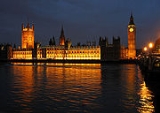
Westminster

Encyclopedia
Westminster is an area of central London
, within the City of Westminster
, England
. It lies on the north bank of the River Thames
, southwest of the City of London
and 0.5 mile (0.80467 km) southwest of Charing Cross
. It has a large concentration of London
's historic and prestigious landmarks and visitor attractions, including Buckingham Palace
, Westminster Cathedral
, and Westminster Abbey
.
Historically
a part of Middlesex
, the name Westminster was the ancient description for the area around Westminster Abbey – the West Minster, or monastery church, that gave the area its name – which has been the seat of the government of England (and later the British government) for almost a thousand years. Westminster is the location of the Palace of Westminster
, a UNESCO World Heritage Site
which houses the Parliament of the United Kingdom
.
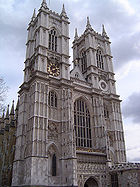 The name Westminster describes the area around Westminster Abbey
and Palace of Westminster
. Its name derives from the West Minster, or monastery church, west of the City of London's St Paul's. The area has been the seat of the government of England
for almost a thousand years. The name is also used for the larger City of Westminster
which covers a wider geographical area; and, since 1965, has included the former boroughs of Marylebone
and Paddington
.
"Westminster" is thus often used as a metonym
for Parliament and the political community of the United Kingdom
generally. The civil service is similarly referred to by the area it inhabits, "Whitehall", and "Westminster" is consequently also used in reference to the Westminster System
, the parliamentary model of democratic government that has evolved in the United Kingdom
. The Westminster System is used with some adaptation in many other nations, particularly in the Commonwealth of Nations
and other parts of the former British Empire
.
The term Westminster Village, sometimes used in the context of British politics, does not refer to a geographical area at all; employed especially in the phrase Westminster Village gossip, it denotes a supposedly close social circle of Members of Parliament, political journalists, so-called spin doctors
and others connected to events in the Palace of Westminster.
.jpg) The historic core of Westminster is the former Thorney Island
The historic core of Westminster is the former Thorney Island
on which Westminster Abbey was built. The Abbey became the traditional venue of the coronation
of the kings and queens of England. The nearby Palace of Westminster
came to be the principal royal residence after the Norman conquest of England
in 1066, and later housed the developing Parliament
and law courts
of England. It can be said that London thus has developed two distinct focal points: an economic one in the City of London; and a political and cultural one in Westminster, where the Royal Court had its home. This division is still very apparent today.
The monarchy later moved to the Palace of Whitehall
a little towards the north-east. The law courts have since moved to the Royal Courts of Justice
, close to the border of the City of London. The area is still the centre of government, with Parliament now located in the Palace of Westminster and most of the major Government ministries situated in Westminster, centred on Whitehall
.
Close to the Palace of Westminster and Westminster Abbey is Westminster School
, one of the English public schools
. Three of the four campuses of the University of Westminster
are within the greater London borough of the City of Westminster
, although none in the ancient area of Westminster.
The area has a substantial residential population, a surprisingly large proportion of which is a traditional London working class
community living in council and Peabody Trust
estates at the back of Westminster Abbey and off Millbank
.
Central London
Central London is the innermost part of London, England. There is no official or commonly accepted definition of its area, but its characteristics are understood to include a high density built environment, high land values, an elevated daytime population and a concentration of regionally,...
, within the City of Westminster
City of Westminster
The City of Westminster is a London borough occupying much of the central area of London, England, including most of the West End. It is located to the west of and adjoining the ancient City of London, directly to the east of the Royal Borough of Kensington and Chelsea, and its southern boundary...
, England
England
England is a country that is part of the United Kingdom. It shares land borders with Scotland to the north and Wales to the west; the Irish Sea is to the north west, the Celtic Sea to the south west, with the North Sea to the east and the English Channel to the south separating it from continental...
. It lies on the north bank of the River Thames
River Thames
The River Thames flows through southern England. It is the longest river entirely in England and the second longest in the United Kingdom. While it is best known because its lower reaches flow through central London, the river flows alongside several other towns and cities, including Oxford,...
, southwest of the City of London
City of London
The City of London is a small area within Greater London, England. It is the historic core of London around which the modern conurbation grew and has held city status since time immemorial. The City’s boundaries have remained almost unchanged since the Middle Ages, and it is now only a tiny part of...
and 0.5 mile (0.80467 km) southwest of Charing Cross
Charing Cross
Charing Cross denotes the junction of Strand, Whitehall and Cockspur Street, just south of Trafalgar Square in central London, England. It is named after the now demolished Eleanor cross that stood there, in what was once the hamlet of Charing. The site of the cross is now occupied by an equestrian...
. It has a large concentration of London
London
London is the capital city of :England and the :United Kingdom, the largest metropolitan area in the United Kingdom, and the largest urban zone in the European Union by most measures. Located on the River Thames, London has been a major settlement for two millennia, its history going back to its...
's historic and prestigious landmarks and visitor attractions, including Buckingham Palace
Buckingham Palace
Buckingham Palace, in London, is the principal residence and office of the British monarch. Located in the City of Westminster, the palace is a setting for state occasions and royal hospitality...
, Westminster Cathedral
Westminster Cathedral
Westminster Cathedral in London is the mother church of the Catholic community in England and Wales and the Metropolitan Church and Cathedral of the Archbishop of Westminster...
, and Westminster Abbey
Westminster Abbey
The Collegiate Church of St Peter at Westminster, popularly known as Westminster Abbey, is a large, mainly Gothic church, in the City of Westminster, London, United Kingdom, located just to the west of the Palace of Westminster. It is the traditional place of coronation and burial site for English,...
.
Historically
Historic counties of England
The historic counties of England are subdivisions of England established for administration by the Normans and in most cases based on earlier Anglo-Saxon kingdoms and shires...
a part of Middlesex
Middlesex
Middlesex is one of the historic counties of England and the second smallest by area. The low-lying county contained the wealthy and politically independent City of London on its southern boundary and was dominated by it from a very early time...
, the name Westminster was the ancient description for the area around Westminster Abbey – the West Minster, or monastery church, that gave the area its name – which has been the seat of the government of England (and later the British government) for almost a thousand years. Westminster is the location of the Palace of Westminster
Palace of Westminster
The Palace of Westminster, also known as the Houses of Parliament or Westminster Palace, is the meeting place of the two houses of the Parliament of the United Kingdom—the House of Lords and the House of Commons...
, a UNESCO World Heritage Site
World Heritage Site
A UNESCO World Heritage Site is a place that is listed by the UNESCO as of special cultural or physical significance...
which houses the Parliament of the United Kingdom
Parliament of the United Kingdom
The Parliament of the United Kingdom of Great Britain and Northern Ireland is the supreme legislative body in the United Kingdom, British Crown dependencies and British overseas territories, located in London...
.
Toponomy
Westminster Abbey
The Collegiate Church of St Peter at Westminster, popularly known as Westminster Abbey, is a large, mainly Gothic church, in the City of Westminster, London, United Kingdom, located just to the west of the Palace of Westminster. It is the traditional place of coronation and burial site for English,...
and Palace of Westminster
Palace of Westminster
The Palace of Westminster, also known as the Houses of Parliament or Westminster Palace, is the meeting place of the two houses of the Parliament of the United Kingdom—the House of Lords and the House of Commons...
. Its name derives from the West Minster, or monastery church, west of the City of London's St Paul's. The area has been the seat of the government of England
England
England is a country that is part of the United Kingdom. It shares land borders with Scotland to the north and Wales to the west; the Irish Sea is to the north west, the Celtic Sea to the south west, with the North Sea to the east and the English Channel to the south separating it from continental...
for almost a thousand years. The name is also used for the larger City of Westminster
City of Westminster
The City of Westminster is a London borough occupying much of the central area of London, England, including most of the West End. It is located to the west of and adjoining the ancient City of London, directly to the east of the Royal Borough of Kensington and Chelsea, and its southern boundary...
which covers a wider geographical area; and, since 1965, has included the former boroughs of Marylebone
Marylebone
Marylebone is an affluent inner-city area of central London, located within the City of Westminster. It is sometimes written as St. Marylebone or Mary-le-bone....
and Paddington
Paddington
Paddington is a district within the City of Westminster, in central London, England. Formerly a metropolitan borough, it was integrated with Westminster and Greater London in 1965...
.
"Westminster" is thus often used as a metonym
Metonymy
Metonymy is a figure of speech used in rhetoric in which a thing or concept is not called by its own name, but by the name of something intimately associated with that thing or concept...
for Parliament and the political community of the United Kingdom
United Kingdom
The United Kingdom of Great Britain and Northern IrelandIn the United Kingdom and Dependencies, other languages have been officially recognised as legitimate autochthonous languages under the European Charter for Regional or Minority Languages...
generally. The civil service is similarly referred to by the area it inhabits, "Whitehall", and "Westminster" is consequently also used in reference to the Westminster System
Westminster System
The Westminster system is a democratic parliamentary system of government modelled after the politics of the United Kingdom. This term comes from the Palace of Westminster, the seat of the Parliament of the United Kingdom....
, the parliamentary model of democratic government that has evolved in the United Kingdom
United Kingdom
The United Kingdom of Great Britain and Northern IrelandIn the United Kingdom and Dependencies, other languages have been officially recognised as legitimate autochthonous languages under the European Charter for Regional or Minority Languages...
. The Westminster System is used with some adaptation in many other nations, particularly in the Commonwealth of Nations
Commonwealth of Nations
The Commonwealth of Nations, normally referred to as the Commonwealth and formerly known as the British Commonwealth, is an intergovernmental organisation of fifty-four independent member states...
and other parts of the former British Empire
British Empire
The British Empire comprised the dominions, colonies, protectorates, mandates and other territories ruled or administered by the United Kingdom. It originated with the overseas colonies and trading posts established by England in the late 16th and early 17th centuries. At its height, it was the...
.
The term Westminster Village, sometimes used in the context of British politics, does not refer to a geographical area at all; employed especially in the phrase Westminster Village gossip, it denotes a supposedly close social circle of Members of Parliament, political journalists, so-called spin doctors
Spin (public relations)
In public relations, spin is a form of propaganda, achieved through providing an interpretation of an event or campaign to persuade public opinion in favor or against a certain organization or public figure...
and others connected to events in the Palace of Westminster.
History
Thorney Island (London)
Thorney Island was the eyot on the Thames, upstream of mediæval London, where Westminster Abbey and the Palace of Westminster were built...
on which Westminster Abbey was built. The Abbey became the traditional venue of the coronation
Coronation
A coronation is a ceremony marking the formal investiture of a monarch and/or their consort with regal power, usually involving the placement of a crown upon their head and the presentation of other items of regalia...
of the kings and queens of England. The nearby Palace of Westminster
Palace of Westminster
The Palace of Westminster, also known as the Houses of Parliament or Westminster Palace, is the meeting place of the two houses of the Parliament of the United Kingdom—the House of Lords and the House of Commons...
came to be the principal royal residence after the Norman conquest of England
Norman conquest of England
The Norman conquest of England began on 28 September 1066 with the invasion of England by William, Duke of Normandy. William became known as William the Conqueror after his victory at the Battle of Hastings on 14 October 1066, defeating King Harold II of England...
in 1066, and later housed the developing Parliament
Parliament of England
The Parliament of England was the legislature of the Kingdom of England. In 1066, William of Normandy introduced a feudal system, by which he sought the advice of a council of tenants-in-chief and ecclesiastics before making laws...
and law courts
Courts of England and Wales
Her Majesty's Courts of Justice of England and Wales are the civil and criminal courts responsible for the administration of justice in England and Wales; they apply the law of England and Wales and are established under Acts of the Parliament of the United Kingdom.The United Kingdom does not have...
of England. It can be said that London thus has developed two distinct focal points: an economic one in the City of London; and a political and cultural one in Westminster, where the Royal Court had its home. This division is still very apparent today.
The monarchy later moved to the Palace of Whitehall
Palace of Whitehall
The Palace of Whitehall was the main residence of the English monarchs in London from 1530 until 1698 when all except Inigo Jones's 1622 Banqueting House was destroyed by fire...
a little towards the north-east. The law courts have since moved to the Royal Courts of Justice
Royal Courts of Justice
The Royal Courts of Justice, commonly called the Law Courts, is the building in London which houses the Court of Appeal of England and Wales and the High Court of Justice of England and Wales...
, close to the border of the City of London. The area is still the centre of government, with Parliament now located in the Palace of Westminster and most of the major Government ministries situated in Westminster, centred on Whitehall
Whitehall
Whitehall is a road in Westminster, in London, England. It is the main artery running north from Parliament Square, towards Charing Cross at the southern end of Trafalgar Square...
.
Close to the Palace of Westminster and Westminster Abbey is Westminster School
Westminster School
The Royal College of St. Peter in Westminster, almost always known as Westminster School, is one of Britain's leading independent schools, with the highest Oxford and Cambridge acceptance rate of any secondary school or college in Britain...
, one of the English public schools
Public School (UK)
A public school, in common British usage, is a school that is neither administered nor financed by the state or from taxpayer contributions, and is instead funded by a combination of endowments, tuition fees and charitable contributions, usually existing as a non profit-making charitable trust...
. Three of the four campuses of the University of Westminster
University of Westminster
The University of Westminster is a public research university located in London, United Kingdom. Its origins go back to the foundation of the Royal Polytechnic Institution in 1838, and it was awarded university status in 1992.The university's headquarters and original campus are based on Regent...
are within the greater London borough of the City of Westminster
City of Westminster
The City of Westminster is a London borough occupying much of the central area of London, England, including most of the West End. It is located to the west of and adjoining the ancient City of London, directly to the east of the Royal Borough of Kensington and Chelsea, and its southern boundary...
, although none in the ancient area of Westminster.
The area has a substantial residential population, a surprisingly large proportion of which is a traditional London working class
Working class
Working class is a term used in the social sciences and in ordinary conversation to describe those employed in lower tier jobs , often extending to those in unemployment or otherwise possessing below-average incomes...
community living in council and Peabody Trust
Peabody Trust
Peabody Trust , founded in 1862, is one of London's oldest and largest housing associations with over 19,000 properties. It also a charity and urban regeneration agency...
estates at the back of Westminster Abbey and off Millbank
Millbank
Millbank is an area of central London in the City of Westminster. Millbank is located by the River Thames, east of Pimlico and south of Westminster...
.
External links
- Westminster Borough Council
- Westminster Walks - from Findlay Muirhead's 1927 guidebook to London and its Environs
- Westminster, by Sir Walter Besant and Geraldine Edith Mitton and A. Murray Smith, 1902, from Project GutenbergProject GutenbergProject Gutenberg is a volunteer effort to digitize and archive cultural works, to "encourage the creation and distribution of eBooks". Founded in 1971 by Michael S. Hart, it is the oldest digital library. Most of the items in its collection are the full texts of public domain books...
- Palmer's Village, a deserted village in Westminster