
See Also

Palace of Westminster

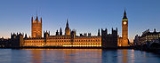
The Palace of Westminster, also known as the Houses of Parliament or Westminster Palace, in London London

London is the capital [i] city of England [i] and of the United Kingdom [i]. ... 

, England England

England is the largest and most populous constituent country [i] of the United Kingdom [i]. ... 

 is where the two Houses of the Parliament of the United Kingdom Parliament of the United Kingdom

The Parliament of the United Kingdom of Great Britain and Northern Ireland is the supreme legislative body [i] ... 

  meet to conduct their business. The Palace lies on the north bank of the River Thames River Thames

The Thames is a river [i] flowing through southern England [i], in its lower reaches flowing through London [i] ... 

 in the London London

London is the capital [i] city of England [i] and of the United Kingdom [i]. ... 

 borough London borough

The administrative area of Greater London [i] contains 32 London boroughs, of which 12 make up Inner London [i] ... 

 of the City of Westminster City of Westminster

The City of Westminster is a London borough [i] with city status [i], ... 

, close by other government buildings in Whitehall Whitehall

Whitehall is a road in Westminster [i] in London [i], the capital of the United Kingdom [i]. ... 

. Coordinates: The oldest part of the Palace still in existence, Westminster Hall, dates from 1097. The palace Palace

In English [i] a palace is the home of a head of state [i] or other high-ranking public figure [i] ... 

 originally served as a royal residence but no monarch has lived in it since the 16th century.

Discussions

  Discussion Features

   Ask a question about 'Palace of Westminster'

   Start a new discussion about 'Palace of Westminster'

   Answer questions about 'Palace of Westminster'

   'Palace of Westminster' discussion forum

Timeline

1265   In Westminster Westminster

Westminster is a district within the City of Westminster [i] in London [i], England [i]. ... 

, the first elected Election

An election is a decision making [i] process where people vote [i] for preferred political candidates [i] ... 

 English England

England is the largest and most populous constituent country [i] of the United Kingdom [i]. ... 

 parliament Parliament

A parliament is a legislature [i], especially in those countries whose system of government is based on ... 

 (De Montfort's Parliament) conducts its first meeting in the Palace of Westminster, now also known as the Houses of Parliament.

1298   A fire causes severe damage to the Palace of Westminster.

1605   Gunpowder Plot Gunpowder Plot

The Gunpowder Plot of 1605 [i] was a failed attempt by a group of provincial English [i] Catholics [i] ... 

: A plot by to blow up the English Houses of Parliament Palace of Westminster

The Palace of Westminster, also known as the Houses of Parliament or Westminster Palace, in ... 

 is foiled when Sir Thomas Knyvet, a justice of the peace, finds Guy Fawkes Guy Fawkes

Guy Fawkes , also known as Guido Fawkes, born in York [i], was an English [i] soldier [i] ... 

 in a cellar below the Parliament building and orders a search of the area. Records show 36 barrels (1800 weight each, total 1 metric tonne) of gunpowder Gunpowder

Gunpowder, whether black powder [i] or smokeless powder [i], is a substance that burns [i] ... 

 were found and Fawkes was arrested for trying to kill King James I of England James I of England

James VI of Scotland/James I of England and Ireland was King of England [i] ... 

 and the members who were scheduled to sit together in Parliament the next day.

1852   New Palace of Westminster opened in Britain United Kingdom

The United Kingdom of Great Britain and Northern Ireland is a country and sovereign state [i] tha ... 

1974   A bomb explodes at the Houses of Parliament Palace of Westminster

The Palace of Westminster, also known as the Houses of Parliament or Westminster Palace, in ... 

 in London London

London is the capital [i] city of England [i] and of the United Kingdom [i]. ... 

, damaging Westminster Hall Palace of Westminster

The Palace of Westminster, also known as the Houses of Parliament or Westminster Palace, in ... 

. The Irish Republican Army Irish Republican Army

An ideogram or ideograph is a graphical symbol that represents an idea [i], rather than a group of lett ... 

 claims responsibility for planting the bomb.

2004   Security at the Palace of Westminster is compromised, when the House of Commons is stormed by a small group of protestors during a debate about fox hunting Fox hunting

Fox hunting is often thought of as a primarily British [i] activity in which trained dogs ... 

.


Encyclopedia


The Palace of Westminster, also known as the Houses of Parliament or Westminster Palace, in London London

London is the capital [i] city of England [i] and of the United Kingdom [i]. ... 

, England England

England is the largest and most populous constituent country [i] of the United Kingdom [i]. ... 

 is where the two Houses of the Parliament of the United Kingdom Parliament of the United Kingdom

The Parliament of the United Kingdom of Great Britain and Northern Ireland is the supreme legislative body [i] ... 

  meet to conduct their business. The Palace lies on the north bank of the River Thames River Thames

The Thames is a river [i] flowing through southern England [i], in its lower reaches flowing through London [i] ... 

 in the London London

London is the capital [i] city of England [i] and of the United Kingdom [i]. ... 

 borough London borough

The administrative area of Greater London [i] contains 32 London boroughs, of which 12 make up Inner London [i] ... 

 of the City of Westminster City of Westminster

The City of Westminster is a London borough [i] with city status [i], ... 

, close by other government buildings in Whitehall Whitehall

Whitehall is a road in Westminster [i] in London [i], the capital of the United Kingdom [i]. ... 

. Coordinates:

The oldest part of the Palace still in existence, Westminster Hall, dates from 1097. The palace Palace

In English [i] a palace is the home of a head of state [i] or other high-ranking public figure [i] ... 

 originally served as a royal residence but no monarch has lived in it since the 16th century. Most of the present structure dates from the 19th century, when the Palace was rebuilt after it was almost entirely destroyed by a fire in 1834. The architect responsible for rebuilding the Palace was Sir Charles Barry Charles Barry

Sir Charles Barry was an English [i] architect [i], best known for his role in the rebuilding of ... 

 with Augustus Welby Pugin. The building is an example of Gothic revival Gothic Revival architecture

The Gothic Revival was an architectural movement [i] which originated in mid-18th ce ... 

. One of the Palace's most famous features is the clock tower Clock Tower, Palace of Westminster

The Clock Tower is a turret clock [i] structure at the north-eastern end of the Houses of Parliament [i] ... 

, a tourist attraction that houses the famous bell Big Ben. The latter name is often used, erroneously, for the clock itself, which is actually part of St Stephen's Tower.

The Palace contains over 1,000 rooms, the most important of which are the Chambers of the House of Lords and of the House of Commons. The Palace also includes committee rooms, libraries, lobbies, dining-rooms, bars and gymnasiums. It is the site of important state ceremonies, most notably the State Opening of Parliament State Opening of Parliament

In the United Kingdom [i], the State Opening of Parliament is an annual event held usually in October or ... 

. The Palace is very closely associated with the two Houses, as shown by the use of the word "Westminster" to refer to "Parliament". Parliamentary offices overspill into nearby buildings such as Portcullis House Portcullis House

|-
| |-
| |}
Portcullis House is a building in Westminster [i], London [i], used as offices for members of Parliament [i] ... 

, and Norman Shaw Buildings.

History


The Palace of Westminster was strategically important during the Middle Ages Middle Ages

The Middle Ages formed the middle period in a traditional schematic division of European history [i] ... 

, as it was located on the banks of the River Thames. Buildings have occupied the site since at least Saxon Anglo-Saxons

Anglo-Saxons is a collective term usually used to describe culturally and linguistically related groups ... 

 times. Known in mediæval times as Thorney Island, the site may have been first used for a royal residence by Canute the Great Canute the Great

Canute I, or Canute the Great was a Danish [i] king of England [i], Denmark [i] a ... 

 . The penultimate Saxon monarch of England, St Edward the Confessor Edward the Confessor

Edward the Confessor or Eadweard III was the penultimate Anglo-Saxon [i] King of England [i] ... 

, built a royal palace in Thorney Island just west of the City of London at about the same time as he built Westminster Abbey Westminster Abbey

The Collegiate Church of St Peter, Westminster, which is almost always referred to as Westminster Abb... 

 . Thorney Island and the surrounding area soon became known as Westminster . After the Norman Conquest Norman conquest of England

The Norman conquest of England was the invasion [i] of the Kingdom of England [i] by William the Conqueror [i] ... 

  King William I William I of England

William of Normandy ruled as the Duke of Normandy [i] from 1035 [i] to 1087 [i] and as King of England [i] ... 

 established himself at the Tower of London Tower of London

The Tower of London is a dominating landmark in central London [i]in the London Borough of Tower Hamlets [i]... 

, but later moved to Westminster. Neither the buildings used by the Saxons nor those used by William I survive. The oldest existing parts of the Palace date from the reign of William I's successor, King William II William II of England

William II was the third son of William the Conqueror [i] and was King of England [i]... 

.

The Palace of Westminster was the monarch's principal residence in the late Mediaeval Middle Ages

The Middle Ages formed the middle period in a traditional schematic division of European history [i] ... 

 period. The predecessor of Parliament, the Curia Regis , met in Westminster Hall . The Model Parliament, the first official Parliament of England, met in the Palace in 1295. Since then, almost all Parliaments have met in the Palace. However, some Parliaments have met in other locations.


Westminster remained the monarch's chief London residence until a fire destroyed part of the structure in 1529. In 1530 King Henry VIII Henry VIII of England

Henry VIII was King of England [i] and Lord of Ireland [i] from ... 

 acquired York Palace Palace of Whitehall

The Palace of Whitehall was the main residence of the English monarchs [i] in London [i] ... 

 from Thomas Cardinal Wolsey Thomas Cardinal Wolsey

Thomas Wolsey, , born Thomas Wulcy in Ipswich, Suffolk, England [i], was a powerful English [i] ... 

, a powerful minister who had lost the King's favour. Renaming it the Palace of Whitehall, Henry VIII used it as his principal residence. Although Westminster officially remained a royal palace, it was used by the two Houses of Parliament and as a law court.

Because it was originally a royal residence, the Palace did not include any purpose-built chambers for the two Houses. Important state ceremonies, including the State Opening of Parliament, were held in the Painted Chamber. The House of Lords usually met in the White Chamber. The House of Commons, however, did not have a chamber of its own; it sometimes held its debates in the Chapter House of Westminster Abbey. The Commons acquired a permanent home in the Palace — St Stephen's Chapel, a former royal chapel, but only during the reign of Henry VIII's successor, King Edward VI Edward VI of England

Edward VI became King of England [i] and Ireland [i] on 28 January [i] 1547 [i], at jus ... 

. The Chantries Act 1547 dissolved the religious order of the Canons of St Stephen's ; thus the Chapel was left for the Commons' use. Alterations were made to St Stephen's Chapel for the convenience of the lower House.

On 16 October 1834, most of the Palace was destroyed by fire Burning of Parliament

Over the course of history there have been a number of parliament buildings engulfed by flames.... 

. Only Westminster Hall, the Jewel Tower Jewel Tower

The Jewel Tower in London [i] is one of only two surviving sections of the medieval royal Palace of Westminster [i] ... 

, the crypt of St Stephen's Chapel and the cloister Cloister

A cloister is a part of cathedral [i], monastic [i] and abbey [i] architecture. ... 

s survived. A Royal Commission was appointed to study the rebuilding of the Palace and decided that it should be rebuilt on the same site, and that its style should be either Gothic Gothic architecture

Gothic architecture is a style of architecture [i], particularly associated with cathedral [i]s and othe ... 

 or Elizabethan Tudor style architecture

The Tudor style in English architecture [i] is the final development of medieval architecture during the ... 

. A heated public debate over the proposed styles ensued.
In 1836, after studying 97 rival proposals, the Royal Commission chose Charles Barry Charles Barry

Sir Charles Barry was an English [i] architect [i], best known for his role in the rebuilding of ... 

's plan for a Gothic style palace. The foundation stone was laid in 1840; the Lords' Chamber was completed in 1847, and the Commons' Chamber in 1852 . Although most of the work had been carried out by 1860, construction was not finished until a decade afterwards.

The Palace of Westminster continued to function normally until 1940. In 1941, the Commons' Chamber was destroyed by German Germany

Germany , officially the Federal Republic of Germany , is a country [i] in central Europe [i]. ... 

 bombs in the course of the Second World War World War II

World War II, or the Second World War, was a worldwide [i] conflict [i] fought betwe ... 

. Sir Giles Gilbert Scott Giles Gilbert Scott

Sir Giles Gilbert Scott, OM [i], FRIBA [i] was an English [i]... 

 was commissioned as architect for the rebuilding of the Chamber; he chose to preserve the essential features of Sir Charles Barry's design. Work on the Commons' Chamber was completed by 1950.

Exterior


Sir Charles Barry's design for the Palace of Westminster uses the Perpendicular Gothic style, which was popular during the 15th century and returned during the Gothic revival of the 19th century. Barry was himself a classical architect, but he was aided by the Gothic architect Augustus Pugin. Westminster Hall, which was built in the 11th century and survived the fire of 1834, was incorporated in Barry's design. Pugin was displeased with the result of the work, especially with the symmetrical layout designed by Barry; he famously remarked, "All Grecian, sir; Tudor details on a classic body."

Stonework


The stonework of the building was originally Anston, a sand-coloured magnesian limestone Limestone

Limestone is a sedimentary rock [i] composed largely of the mineral [i] calcite [i] . ... 

 quarried in the village of Anston in South Yorkshire South Yorkshire

South Yorkshire is a metropolitan [i] and ceremonial [i] ... 

. The stone, however, soon began to decay due to pollution Pollution

Pollution is the release of chemical, physical, biological or radioactive contaminants to the environment [i]... 

. Although such defects were clear as early as 1849, nothing was done for the remainder of the 19th century. During the 1910s, however, it became clear that some of the stonework had to be replaced.

In 1928 it was deemed necessary to use Clipsham Stone, a honey-coloured limestone from Rutland Rutland

Rutland is traditionally England [i]'s smallest county [i] and is bounde ... 

, to replace the decayed Anston. The project began in the 1930s but was halted due to the Second World War, and completed only during the 1950s. By the 1960s pollution had once again begun to take its toll. A stone conservation and restoration programme began in 1981, and ended in 1994.

Towers


Sir Charles Barry's Palace of Westminster includes several towers. The tallest is the 98 m Victoria Tower Victoria Tower

Victoria Tower is the square tower at the south end of the Palace of Westminster [i] in London [i], England [i] ... 

, a square tower at the south-western end of the Palace. The tower was named after the reigning monarch at the time of the reconstruction of the Palace, Queen Victoria Victoria of the United Kingdom

Victoria was the Queen [i] of the United Kingdom of Great Britain and Ireland [i] ... 

. The tower is home to the House of Lords' Record Office, which, despite its name, has custody of the records of both Houses of Parliament. Atop the Victoria Tower is an iron flagstaff, from which the Royal Standard Royal Standard

Royal Standards
| align="center" colspan="2"|
... 

  or the Union Flag Union Flag

|}... 

 is flown. At the base of the Victoria Tower is the Sovereign's Entrance to the Palace. The monarch uses this entrance whenever entering the Palace of Westminster for the State Opening of Parliament State Opening of Parliament

In the United Kingdom [i], the State Opening of Parliament is an annual event held usually in October or ... 

 or for any other official ceremony.

Over the middle of the Palace lies the Central Tower. The Central Tower is 91 m tall, making it the shortest of the three principal towers of the Palace. Unlike the other towers, the Central Tower possesses a spire. It stands immediately above the Central Lobby, and is octagonally shaped. Its function was originally as a high-level air intake.

A small tower is positioned at the front of the Palace, between Westminster Hall and Old Palace Yard, and contains the main entrance to the House of Commons at its base, known as St. Stephen's entrance.

At the north-western end of the Palace is the most famous of the towers, St Stephen's Tower, the Clock Tower which is 96 m tall. The Clock Tower houses a large clock known as the Great Clock of Westminster. On each of the four sides of the tower is a large clock face. The tower also houses five bells, which strike the Westminster Chimes Westminster Quarters

The Westminster Quarters is the most common name for a melody used by a set of clock [i] bell [i] ... 

 every quarter hour. The largest and most famous of the bells is Big Ben , which strikes the hour. This is the third heaviest bell in England, weighing 13 tons 10 cwt 99 lb . Although the term "Big Ben" properly refers only to the bell, it is often colloquially applied to the whole tower.

Grounds


There are a number of small gardens surrounding the Palace of Westminster. Victoria Tower Gardens Victoria Tower Gardens

Victoria Tower Gardens is a public park [i] along the north bank of the River Thames [i] in London [i]. ... 

 is open as a public park along the side of the river River Thames

The Thames is a river [i] flowing through southern England [i], in its lower reaches flowing through London [i] ... 

 south of the palace. Black Rod's Garden  is closed to the public and is used as a private entrance. Old Palace Yard, in front of the Palace, is paved over and covered in concrete security blocks . Cromwell Green , New Palace Yard and Speaker's Green  are all private and closed to the public. College Green College Green

College Green, previously called Hoggen Green, is a three sided 'square' in the centre of Dublin.... 

, opposite the House of Lords, is a small triangular green used for television interviews with politicians.


The Palace of Westminster includes approximately 1,100 rooms, 100 staircases, and 3 miles of passageways. The building includes four floors; the ground floor includes offices, dining rooms, and bars. The 'first floor' houses the main rooms of the Palace, including the Chambers, the lobbies, and the libraries. The Robing Room, the Royal Gallery, the Prince's Chamber, the Lords' Chamber, the Peers' Lobby, the Central Lobby, the Members' Lobby, and the Commons' Chamber all lie in a straight line on this floor, from south to north, in the order noted. The top two floors are used for committee rooms and offices.

Formerly, the Palace was controlled by the Lord Great Chamberlain, as it was a royal residence Palace

In English [i] a palace is the home of a head of state [i] or other high-ranking public figure [i] ... 

. In 1965, however, it was decided that each House should control its own rooms. The Speaker and Lord Chancellor exercise control on behalf of their respective Houses. The Lord Great Chamberlain retains custody of certain ceremonial rooms.

Lords Chamber


The Chamber of the House of Lords is located in the southern part of the Palace of Westminster. The lavishly decorated room measures 14 by 24 m . The benches in the Chamber, as well as other furnishings in the Lords' side of the Palace, are coloured red. The upper part of the Chamber is decorated by stained glass windows and by six allegorical frescoes representing religion, chivalry and law.
The upper part, or the viewing gallery, features a small curtain, around ten inches high. This was constructed in the 1920s to hide the ankles and lower legs of viewing women; fashion was becoming increasingly promiscuous, as they saw it, and the sight of bare legs was deemed unsuitable for Lords.

At one end of the Chamber are the ornate gold Canopy and Throne; although the Sovereign may theoretically occupy the Throne during any sitting, he or she attends only the State Opening of Parliament. Other members of the Royal Family who attend the State Opening use Chairs of State next to the Throne. In front of the Throne is the Woolsack Woolsack

The Woolsack is the seat of the Lord Speaker [i] in the House of Lords [i], the Upper House [i] of Parliament [i] ... 

, a backless and armless red cushion stuffed with wool Wool

Wool is the fibre derived from the fur [i] of animals of the Caprinae [i] family, principally sheep [i] ... 

, representing the historical importance of the wool trade. The Woolsack is used by the officer presiding over the House . The House's mace Ceremonial mace

The ceremonial mace is a highly ornamented staff of metal and wood, carried before a sovereign [i] ... 

, which represents royal authority, is placed on the back of the Woolsack. In front of the Woolsack are the Judges' Woolsack and the Table of the House .

Members of the House occupy red benches on three sides of the Chamber. The benches on the Lord Chancellor's right form the Spiritual Side and those to his left form the Temporal Side. The Lords Spiritual  all occupy the Spiritual Side. The Lords Temporal  sit according to party affiliation: members of the Government party sit on the Spiritual Side, whilst those of the Opposition sit on the Temporal Side. Some peers, who have no party affiliation, sit on the benches in the middle of the House opposite the Woolsack; they are accordingly known as cross-benchers.

The Lords' Chamber is the site of important ceremonies, the most important of which is the State Opening of Parliament, which occurs at the beginning of each annual parliamentary session. The Sovereign, seated on the Throne, delivers the Speech from the Throne Speech from the Throne

The Speech from the Throne is an event in certain monarchies [i] in which the monarch [i] reads a prepar ... 

, outlining the Government's legislative agenda for the forthcoming parliamentary session. The Commons do not enter the Chamber; instead, they watch the proceedings from the Bar of the House, just inside the Chamber. A similar ceremony is held at the end of a parliamentary session; the Sovereign, however, does not normally attend, and is instead represented by a group of Lords Commissioners.

Commons Chamber


The Chamber of the House of Commons, which was opened in 1950 after the Victorian chamber had been destroyed in 1941 is at the northern end of the Palace of Westminster. The Chamber measures 14 by 21 m . It is far more austere than the grand Lords' Chamber; the benches, as well as other furnishings in the Commons side of the Palace, are coloured green. It is illegal for a member of the public to sit on the green benches. Other parliaments in Commonwealth Commonwealth of Nations

The Commonwealth of Nations, usually known as the Commonwealth, is a voluntary association [i] of ... 

 nations have copied the colour scheme under which the Lower House is associated with green, and the Upper House with red.

At one end of the Chamber is the Speaker Speaker of the British House of Commons

In the United Kingdom [i], the Speaker of the House of Commons is the presiding officer of the House of Commons [i]... 

's Chair, a present to Parliament from Australia Australia

Australia, officially the Commonwealth of Australia, is a country in the Southern Hemisphere [i] c ... 

. In front of the Speaker's Chair is the Table of the House, at which the clerks sit, and on which is placed the Commons' ceremonial mace. The dispatch boxes, which front bench MPs often lean on or rest notes on during Questions and speeches, are a gift from New Zealand New Zealand

New Zealand is a country in the south-western Pacific Ocean [i] consisting of two large islands and many ... 

. There are green benches on either side of the house; members of the Government party occupy benches on the Speaker's right, whilst those of the Opposition occupy benches on the Speaker's left. There are no cross-benches as in the House of Lords. The Chamber is relatively small, and can accommodate only 427 of the 646 Members of Parliament. During Prime Minister's Questions and in major debates Members of Parliament stand at either end of the House.

By tradition, the British Sovereign does not enter the Chamber of the House of Commons. The last monarch to enter the Chamber was King Charles I Charles I of England

[i] [[1625]... 

 ; he sought to arrest five Members of Parliament on charges of high treason. When the King asked the Speaker, William Lenthall, if he had any knowledge of the whereabouts of these individuals, Lenthall famously replied: "May it please your Majesty, I have neither eyes to see nor tongue to speak in this place but as the House is pleased to direct me, whose servant I am here."

The two red lines on the floor of the House of Commons are, by tradition, two sword lengths and one foot apart. Protocol dictates that MPs may not cross these lines when speaking. Historically, this was to prevent disputes in the house from devolving into duels.

Westminster Hall


Westminster Hall, the oldest existing part of the Palace of Westminster, was erected in 1097. The roof was originally supported by pillars but, during the reign of King Richard II Richard II of England

Richard II was the son of Edward the Black Prince [i], Prince of Wales [i], and Joan "The Fair Maid of Kent" [i] ... 

, it was replaced by a hammerbeam roof Hammerbeam roof

Hammerbeam roof, in architecture [i], the name given to a Gothic [i] open timber [i] ... 

 designed by Henry Yevele and Hugh Herland. Westminster Hall is one of the largest halls in Europe with an unsupported roof; it measures 21 by 73 m . An Essex legend has it that the oak timber came from woods in Thundersley, Essex.

Westminster Hall has served numerous functions. It was primarily used for judicial purposes, housing three of the most important courts in the land: the Court of King's Bench, the Court of Common Pleas, and the Court of Chancery. In 1873, these courts were amalgamated into the High Court of Justice, which continued to meet in Westminster Hall until it moved to the Royal Courts of Justice Royal Courts of Justice

The Royal Courts of Justice, commonly called the Law Courts, is a building in London [i] that hous ... 

 in 1882. In addition to regular courts, Westminster Hall also housed important state trials, including impeachment Impeachment

In the constitution [i]s of several countries, impeachment is the first of two stages in a specific proc ... 

 trials and the trial of King Charles I at the end of the English Civil War English Civil War

The English Civil War was a series of armed conflicts and political machinations which took place betwee... 

.

Westminster Hall has also served ceremonial functions. From the twelfth century to the nineteenth, coronation banquet Coronation Banquet

Sorry, no overview for this topic 

s honouring new monarchs were held here. The last coronation banquet was that of King George IV George IV of the United Kingdom

George IV was king [i] of the United Kingdom of Great Britain and Ireland [i] and Hanover [i] ... 

 ; his successor, William IV William IV of the United Kingdom

William IV was King of the United Kingdom [i] and of Hanover [i] from 26 June [i] 1830 [i] un ... 

, abandoned the idea because he deemed it too expensive. Westminster Hall has also been used for lyings-in-state Lying in state

Lying in state is a term used to describe the tradition in which a coffin [i] is placed on view to allow ... 

 during state funeral State funeral

A state funeral is a public funeral ceremony held to honour heads of state [i] or other important people ... 

s and ceremonial funerals. Such an honour is usually reserved for the Sovereign and for their consorts; the only non-royals to receive it in the twentieth century were Frederick Sleigh Roberts, 1st Earl Roberts Frederick Roberts, 1st Earl Roberts

Field Marshal [i] Frederick Sleigh Roberts, 1st Earl Roberts, VC [i], KG [i] ... 

  and Sir Winston Churchill Winston Churchill

Sir Winston Leonard Spencer-Churchill, KG [i], OM [i], CH [i] ... 

 . The most recent lying-in-state was that of Queen Elizabeth The Queen Mother Elizabeth Bowes-Lyon

The Lady Elizabeth Bowes-Lyon was the Queen Consort [i] of King George VI [i] ... 

 in 2002.

In 1999 and 2003, the staff of the Palace were given special permission to return the Hall to its original purpose, by the holding of two Grand Parties there.

The two Houses have presented ceremonial Addresses to the Crown in Westminster Hall on important public occasions. For example, Addresses have been presented at Elizabeth II Elizabeth II of the United Kingdom

}
|-
|
|}
Elizabeth II is the Queen [i] of 16 independent sovereign [i] state [i] ... 

's Silver Jubilee and Golden Jubilee , the 300th anniversary of the Glorious Revolution Glorious Revolution

The Glorious Revolution was the overthrow of James II of England [i] in 1688 [i] by a union of Parliamentarians [i]... 

 , and the fiftieth anniversary of the end of the Second World War .

Under reforms made in 1999, the House of Commons uses a specially converted room next to Westminster Hall as an additional debating chamber. The room is shaped like an elongated horseshoe; it stands in contrast with the main Chamber, in which the benches are placed opposite each other. This pattern is meant to reflect the non-partisan nature of the debates held in Westminster Hall. Westminster Hall sittings occur thrice each week; important or controversial matters are not usually discussed.

Other rooms


There are several other important rooms that lie on the first floor of the Palace. At the extreme southern end of the Palace is the Robing Room, the room in which the Sovereign prepares for the State Opening of Parliament by donning official robes and wearing the Imperial State Crown Imperial State Crown

The Imperial State Crown is one of the British Crown Jewels [i].
... 

. Paintings by William Dyce William Dyce

William Dyce was a distinguished Scottish artist.
... 

 in the Robing Room depict scenes from the legend of King Arthur King Arthur

King Arthur is an important figure in the mythology [i] of Great Britain [i], where he appears as the id ... 

. Immediately next to the Robing Room is the Royal Gallery, which is sometimes used by foreign dignitaries who wish to address both Houses. The walls are decorated by two enormous paintings by Daniel Maclise Daniel Maclise

[i]
... 

: "The Death of Nelson" and "The Meeting of Wellington and Blücher" .

To the immediate south of the Lords Chamber is the Prince's Chamber, a small ante-room used by Members of the Lords. The Prince's Chamber is decorated with paintings of members of the Tudor dynasty Tudor dynasty

The Tuhdor dynasty or House of Tudor was a series of five monarchs of Welsh [i] origin who ... 

. To the immediate north of the Lord's Chamber is the Peers' Lobby, where Lords informally discuss or negotiate matters during sittings of the House.

The centrepiece of the Palace of Westminster is the octagonal Central Lobby, which lies immediately beyond the Peers' Lobby. The lobby, which lies immediately below the Central Tower, is adorned with statues of statesmen and with mosaic Mosaic

Mosaic is the art [i] of decoration with small pieces of colored glass, stone or other material. ... 

s representing the United Kingdom's constituent nations' patron saints: St George Saint George

Saint George was a soldier [i] of the Roman Empire [i] who later became a Christian [i] martyr [i]. ... 

 for England, St Andrew Saint Andrew

Saint Andrew [i] , called in the Orthodox [i] tradition Protocletos, or the Firs ... 

 for Scotland, St David Saint David

Saint David was a church official, later regarded as a saint [i] and as the patron saint [i] of Wales [i] ... 

 for Wales, and St Patrick Saint Patrick

Saint Patrick was a missionary [i] and is regarded as the patron saint [i] of Ireland [i] . ... 

 for Ireland . Constituents may meet their Members of Parliament in the Central Lobby. Beyond the Central Lobby, next to the Commons Chamber, lies the Members' Lobby, in which Members of Parliament hold discussions or negotiations. The Members' Lobby contains statues of several former Prime Ministers, including David Lloyd George David Lloyd George

David Lloyd George, 1st Earl Lloyd George of Dwyfor, OM [i], PC [i] ... 

, Sir Winston Churchill Winston Churchill

Sir Winston Leonard Spencer-Churchill, KG [i], OM [i], CH [i] ... 

, and Clement Attlee Clement Attlee

Clement Richard Attlee, 1st Earl Attlee, KG [i], OM [i], CH [i] ... 

.

There are two suites of libraries on the Principal Floor, overlooking the river, for the House of Lords and House of Commons Library.

The Palace of Westminster also includes state apartments for the presiding officers of the two Houses. The official residence Official residence

An official residence is the residence [i] at which heads of state [i], heads of government [i], guberna ... 

 of the Speaker stands at the northern end of the Palace, whilst the Lord Chancellor's apartments are at the southern end. Each day, the Speaker and Lord Chancellor take part in formal processions from their apartments to their respective Chambers.

Security


The Gentleman Usher of the Black Rod oversees security for the House of Lords, whilst the Serjeant at Arms Serjeant-at-Arms

A Serjeant at Arms is an officer appointed by a deliberative body [i], usually a legislature [i], to kee ... 

 does the same for the House of Commons. These officers, however, have primarily ceremonial roles outside the actual chambers of their respective Houses. Security is the responsibility of the Palace of Westminster Division of the Metropolitan Police, the police force for the Greater London Greater London

Greater London is the top level administrative subdivision covering London [i], England [i].
... 

 area. Tradition still dictates that only the Serjeant at Arms may enter the Commons chamber whilst armed.


Probably the most famous attempt to breach the security of the Palace of Westminster was the Gunpowder Plot Gunpowder Plot

The Gunpowder Plot of 1605 [i] was a failed attempt by a group of provincial English [i] Catholics [i] ... 

 of 1605. The plot was an attempt by Roman Catholic Roman Catholic Church

The Roman Catholic Church or Catholic Church is the Christian [i] Church [i] ... 

 extremists to cause an explosion in the Palace of Westminster during the State Opening of Parliament, thereby killing the Protestant King James I James I of England

James VI of Scotland/James I of England and Ireland was King of England [i] ... 

, his family, and most of the aristocracy. The plot was discovered, however, when a Roman Catholic nobleman, William Parker, 4th Baron Monteagle, received an anonymous letter warning him not to attend the State Opening. The authorities conducted a search of the Palace, discovered the gunpowder, as well as one of the conspirators, Guy Fawkes Guy Fawkes

Guy Fawkes , also known as Guido Fawkes, born in York [i], was an English [i] soldier [i] ... 

. The conspirators were later tried for high treason in Westminster Hall, and were hanged, drawn and quartered Hanging, drawing and quartering

* Jacques Clment [i], the murderer of Henri III [i]
... 

. Since 1605, the Yeomen of the Guard Yeomen of the Guard

The Queen's Body Guard of the Yeomen of the Guard are a bodyguard [i] of the British Monarch [i] ... 

 have conducted a ceremonial search of the Palace's cellars prior to each State Opening of Parliament.

The previous Palace of Westminster was also the site of a prime ministerial assassination in 1812. Whilst in the lobby of the House of Commons, on his way to a parliamentary inquiry, Spencer Perceval Spencer Perceval

Spencer Perceval was a British [i] statesman and Prime Minister [i] ... 

 was shot and killed by John Bellingham. Perceval remains the only British Prime Minister to have been assassinated.

On the 17 June1974 a 20 pound bomb planted by the Provisional IRA Provisional Irish Republican Army

he Provisional Irish Republican Army is an Irish Republican [i] paramilitary [i] organisation which, un ... 

 exploded in Westminster Hall. In 1979 Airey Neave Airey Neave

[i], [[Order of the British Empire|OBE]... 

, a prominent Conservative politician, was killed by a car bomb Car bomb

A car bomb is an improvised explosive device [i] that is placed in a car or other vehicle and then exploded [i] ... 

 as he drove out of the Palace's new car park. Both the Irish National Liberation Army and the Provisional IRA claimed responsibility for the murder; security forces believe the former were responsible. With rising concern about the possibility of a truck full of explosives being driven into the building , a series of concrete blocks was placed in the roadway in 2003.


The Palace has also been the site of a number of acts of politically motivated "direct action". In 1970 a canister of tear gas CS gas

CS or 2-chlorobenzalmalononitrile is a substance that is used as a riot control agent [i] and is u ... 

 was thrown into the Chamber of the House of Commons to protest against conditions in Northern Ireland. In 1978 manure Manure

Manure is organic matter [i] used as fertilizer [i] in agriculture [i]. ... 

 was thrown. Concern about such attacks and a possible chemical or biological attack led to the construction of a glass screen across the Strangers' Gallery in early 2004.

The new barrier did not cover the front three rows, which are termed the "Distinguished Strangers' Gallery" and in May of that year protesters from Fathers 4 Justice Fathers 4 Justice

Fathers 4 Justice is an international fathers' rights [i] pressure group [i] founded and focused primari ... 

 attacked Prime Minister Tony Blair with flour bombs Fathers 4 Justice House of Commons Protest

Sorry, no overview for this topic 

 from this part. In September, five protesters opposed to the proposed ban on fox hunting Fox hunting

Fox hunting is often thought of as a primarily British [i] activity in which trained dogs ... 

 disrupted the proceedings of the House of Commons by running into the Chamber.

Despite the recent security breaches, members of the public continue to have access to the Gallery. Visitors are heavily vetted.

Large numbers of heavily armed police guard the building and security checks take place before people are allowed to enter the building. When ministers are present their personal security also attend.

Culture and tourism

The exterior of the Palace of Westminster — especially the Clock Tower — is one of the most visited tourist attractions in London. The United Nations Educational, Scientific and Cultural Organization UNESCO

UNESCO is a specialized agency of the United Nations [i] established in 1945. ... 

  classifies the Palace of Westminster along with neighbouring Westminster Abbey Westminster Abbey

The Collegiate Church of St Peter, Westminster, which is almost always referred to as Westminster Abb... 

 and St. Margaret's St. Margaret's, Westminster

The Anglican [i] church of St Margaret's, Westminster is the parish church [i] of the British [i]... 

 as a World Heritage Site World Heritage Site

A UNESCO World Heritage Site is a specific site that has been nominated and confirmed for inclusion on ... 

. It is also a Grade I listed building Listed building

In the United Kingdom [i] the term 'listed building' refers to a building or other structure officially ... 

. There is no casual access to the interior, but it may be seen in a number of ways:

  • Viewing debates from the public galleries of the House of Commons or the House of Lords: UK residents may obtain tickets in advance from their MP. It is also possible for both UK residents and overseas visitors to queue for admission on the day, but capacity is limited and there is no guarantee of admission. Only a very small part of the Palace's interior may be seen. Either House may exclude "strangers" if it desires to sit in private.
  • Tours during Parliamentary sessions: UK residents may apply to their MP or a peer for a place on a guided tour of Parliament while it is in session. British educational institutions may also arrange a tour through their MP. The system for issuing overseas visitors with permits to tour the Palace while Parliament is in session has been suspended temporarily.
  • Summer opening: tours are available during a two-month period during the summer when Parliament is not sitting. These tours are open to both UK residents and overseas visitors. Advance bookings are recommended.
  • Television Viewing: live broadcasts of Parliamentary sessions can be viewed on BBC Parliament, recorded footage is shown whilst Parliament is not in session.


Since 1 August 2005, under a provision of the Serious Organised Crime and Police Act 2005 it has been illegal to hold a protest, without the prior permission of the Metropolitan Police, within a designated area extending half a mile around the Palace.

See also


  • Jewel Tower Jewel Tower

    The Jewel Tower in London [i] is one of only two surviving sections of the medieval royal Palace of Westminster [i] ... 

     - the only surviving part of the medieval palace other than Westminster Hall

References


  • Bradley, Simon, and Pevsner, Nikolaus. . The Buildings of England: London 6: Westminster. New Haven, Connecticut: Yale University Press.
  • Cooke, Sir Robert. . The Palace of Westminster. London: Burton Skira.
  • Fell, Sir Bryan, and K. R. MacKenzie. The Houses of Parliament: A Guide to the Palace of Westminster. . London: Her Majesty's Stationery Office.
  • Jones, Christopher. . The Great Palace: The Story of Parliament. London: British Broadcasting Corporation.
  • Port, M. H. . The Houses of Parliament. New Haven, Connecticut: Yale University Press.
  • Riding, Christine, and Jacqueline Riding. . "The Houses of Parliament: History Art Architecture." London: Merrell.


External links