


Duke of Normandy

Encyclopedia
The Duke of Normandy is the title of the reigning monarch of the British Crown Dependancies of the Bailiwick of Guernsey and the Bailiwick of Jersey. The title traces its roots to the Duchy of Normandy (of which the Channel Islands
are remnants). Whether the reigning sovereign is a male or female, they are always titled as the "Duke of Normandy".
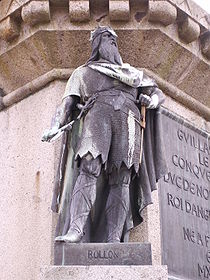 The fiefdom of Normandy
was created in 911 for the Viking
leader Rollo
(also known as Rolf).
After participating in many Viking incursions along the Seine, culminating in the siege of Paris
in 886, Rollo was finally defeated by King Charles the Simple
. With the Treaty of St.-Claire-sur-Epte, Rollo
accepted to become a vassal to Charles III of France, converted to Christianity
and was baptized with the name Robert. Charles then granted Rollo territories around Rouen
, which came to be called Normandy after the Northmen (Latin Normanni).
Rollo and his immediate successors were styled as "counts" of Normandy. Some later medieval
sources refer to them by the title dux
, the Latin word from which the English word "duke
" is derived; however, Rollo's great-grandson Richard II was the first to assuredly be styled "Duke of Normandy".
Although certain titles were used interchangeably during this period, the title of "duke" was typically reserved for the highest rank of feudal
nobility — those who either owed homage and fealty directly to kings or who were independent sovereigns
primarily distinguished from kings by not having dukes as vassals.
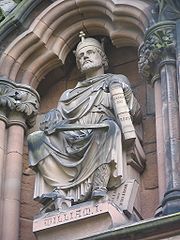 William the Conqueror
added the Kingdom of England
to his realm in the Norman Conquest
of 1066. This created a problematic situation wherein William and his descendants were king in England but a vassal to the king in France. Much of the contention which later arose around the title Duke of Normandy (as well as other French ducal titles during the Angevin period
) stems from this fundamentally irreconcilable situation.
After the death of William the Conqueror, his eldest son Robert Curthose
became Duke of Normandy while a younger son, William Rufus
, became the English king. In 1106, Robert was deposed by William II's successor (and Robert and William's younger brother) Henry I
again uniting the titles.
confiscated the Duchy of Normandy held by King John of England
and subsumed it into the crown lands. Only the Channel Islands
remained under John's control. In 1259, Henry III of England
recognised the legality of French possession of mainland Normandy under the Treaty of Paris
.
English monarchs made subsequent attempts to reclaim their former continental possessions, particularly during the Hundred Years' War
, and even claimed the throne of France
itself.
With the Treaty of Troyes
in 1420, Henry V of England
temporarily regained all territories formerly held by the Plantagenets, including Normandy, and was made regent and heir of France. His son, Henry VI
inherited both Kingdoms in 1422 and afterwards English monarchs included King of France among their list of titles
and included the Royal Arms of France
in their own armorial achievements
, even after they had lost their French possessions (except for Calais) after 1450.
British claims to the throne of France and other French claims were not formally abandoned until 1801, when George III and Parliament
, in the Act of Union
, joined the Kingdom of Great Britain
with the Kingdom of Ireland
and used the opportunity to drop the obsolete claim on France. By this time, the French monarchy itself had already been overthrown with the establishment of the French Republic in 1792. The French revolution also brought an end to the Duchy of Normandy as a political entity, as it was replaced by several départements.
(except for Chausey
under French sovereignty) remain Crown dependencies
of the British Crown
in the present era. Unlike the Isle of Man, these islands have no specific title pertaining to them. The Loyal Toast
in the Channel Islands is La Reine, notre Duc or The Queen, our Duke (or when the monarch is male, The King, our Duke), as the islands were formerly part of the Duchy of Normandy, the rest of which was renounced in 1259.
According to the British monarchy's official website, "In the Channel Islands The Queen is known as The Duke of Normandy. At official functions, islanders raise the loyal toast to 'The Duke of Normandy, our Queen'." It goes on to say that "In 1106, William's youngest son Henry I seized the Duchy of Normandy from his brother Robert; since that time, the English Sovereign has always held the title Duke of Normandy... While the islands today retain autonomy in government, they owe allegiance to The Queen in her role as Duke of Normandy."
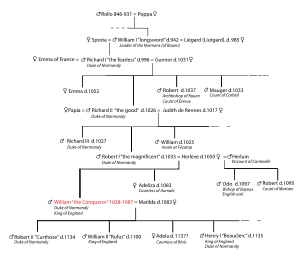
House of Plantagenet
. Thereafter, the ducal title was held by several French princes.
In 1332, King Philip VI gave the Duchy in appanage
to his son John, who became king as John II
in 1350. He in turn gave the Duchy in appanage to his son Charles, who became king as Charles V
in 1364. In 1465, Louis XI
gave the Duchy to his brother Charles de Valois, Duke of Berry
; when he died in 1466, the Duchy was again subsumed into the crown lands and remained a permanent part of it.
The future James II & VII
was created "Duke of Normandy" by King Louis XIV of France, 31 December 1660. This was a few months after the restoration of his brother Charles II to the English and Irish thrones (Charles II had been crowned King of Scotland in 1651), and probably was done as a political gesture of support for James - since his brother also would have claimed the title "Duke of Normandy".
Channel Islands
The Channel Islands are an archipelago of British Crown Dependencies in the English Channel, off the French coast of Normandy. They include two separate bailiwicks: the Bailiwick of Guernsey and the Bailiwick of Jersey...
are remnants). Whether the reigning sovereign is a male or female, they are always titled as the "Duke of Normandy".
Rollo the Viking
Duchy of Normandy
The Duchy of Normandy stems from various Danish, Norwegian, Hiberno-Norse, Orkney Viking and Anglo-Danish invasions of France in the 9th century...
was created in 911 for the Viking
Viking
The term Viking is customarily used to refer to the Norse explorers, warriors, merchants, and pirates who raided, traded, explored and settled in wide areas of Europe, Asia and the North Atlantic islands from the late 8th to the mid-11th century.These Norsemen used their famed longships to...
leader Rollo
Rollo of Normandy
Rollo , baptised Robert and so sometimes numbered Robert I to distinguish him from his descendants, was a Norse nobleman of Norwegian or Danish descent and founder and first ruler of the Viking principality in what soon became known as Normandy...
(also known as Rolf).
After participating in many Viking incursions along the Seine, culminating in the siege of Paris
Paris
Paris is the capital and largest city in France, situated on the river Seine, in northern France, at the heart of the Île-de-France region...
in 886, Rollo was finally defeated by King Charles the Simple
Charles the Simple
Charles III , called the Simple or the Straightforward , was the undisputed King of France from 898 until 922 and the King of Lotharingia from 911 until 919/23...
. With the Treaty of St.-Claire-sur-Epte, Rollo
Rollo of Normandy
Rollo , baptised Robert and so sometimes numbered Robert I to distinguish him from his descendants, was a Norse nobleman of Norwegian or Danish descent and founder and first ruler of the Viking principality in what soon became known as Normandy...
accepted to become a vassal to Charles III of France, converted to Christianity
Christianity
Christianity is a monotheistic religion based on the life and teachings of Jesus as presented in canonical gospels and other New Testament writings...
and was baptized with the name Robert. Charles then granted Rollo territories around Rouen
Rouen
Rouen , in northern France on the River Seine, is the capital of the Haute-Normandie region and the historic capital city of Normandy. Once one of the largest and most prosperous cities of medieval Europe , it was the seat of the Exchequer of Normandy in the Middle Ages...
, which came to be called Normandy after the Northmen (Latin Normanni).
Rollo and his immediate successors were styled as "counts" of Normandy. Some later medieval
Middle Ages
The Middle Ages is a periodization of European history from the 5th century to the 15th century. The Middle Ages follows the fall of the Western Roman Empire in 476 and precedes the Early Modern Era. It is the middle period of a three-period division of Western history: Classic, Medieval and Modern...
sources refer to them by the title dux
Dux
Dux is Latin for leader and later for Duke and its variant forms ....
, the Latin word from which the English word "duke
Duke
A duke or duchess is a member of the nobility, historically of highest rank below the monarch, and historically controlling a duchy...
" is derived; however, Rollo's great-grandson Richard II was the first to assuredly be styled "Duke of Normandy".
Although certain titles were used interchangeably during this period, the title of "duke" was typically reserved for the highest rank of feudal
Feudalism
Feudalism was a set of legal and military customs in medieval Europe that flourished between the 9th and 15th centuries, which, broadly defined, was a system for ordering society around relationships derived from the holding of land in exchange for service or labour.Although derived from the...
nobility — those who either owed homage and fealty directly to kings or who were independent sovereigns
Sovereignty
Sovereignty is the quality of having supreme, independent authority over a geographic area, such as a territory. It can be found in a power to rule and make law that rests on a political fact for which no purely legal explanation can be provided...
primarily distinguished from kings by not having dukes as vassals.
William the Conqueror
William I of England
William I , also known as William the Conqueror , was the first Norman King of England from Christmas 1066 until his death. He was also Duke of Normandy from 3 July 1035 until his death, under the name William II...
added the Kingdom of England
Kingdom of England
The Kingdom of England was, from 927 to 1707, a sovereign state to the northwest of continental Europe. At its height, the Kingdom of England spanned the southern two-thirds of the island of Great Britain and several smaller outlying islands; what today comprises the legal jurisdiction of England...
to his realm in the Norman Conquest
Norman conquest of England
The Norman conquest of England began on 28 September 1066 with the invasion of England by William, Duke of Normandy. William became known as William the Conqueror after his victory at the Battle of Hastings on 14 October 1066, defeating King Harold II of England...
of 1066. This created a problematic situation wherein William and his descendants were king in England but a vassal to the king in France. Much of the contention which later arose around the title Duke of Normandy (as well as other French ducal titles during the Angevin period
Angevin Empire
The term Angevin Empire is a modern term describing the collection of states once ruled by the Angevin Plantagenet dynasty.The Plantagenets ruled over an area stretching from the Pyrenees to Ireland during the 12th and early 13th centuries, located north of Moorish Iberia. This "empire" extended...
) stems from this fundamentally irreconcilable situation.
After the death of William the Conqueror, his eldest son Robert Curthose
Robert III, Duke of Normandy
Robert Curthose , sometimes numbered Robert II or Robert III, was the Duke of Normandy from 1087 until 1106 and an unsuccessful claimant to the throne of the Kingdom of England...
became Duke of Normandy while a younger son, William Rufus
William II of England
William II , the third son of William I of England, was King of England from 1087 until 1100, with powers over Normandy, and influence in Scotland. He was less successful in extending control into Wales...
, became the English king. In 1106, Robert was deposed by William II's successor (and Robert and William's younger brother) Henry I
Henry I of England
Henry I was the fourth son of William I of England. He succeeded his elder brother William II as King of England in 1100 and defeated his eldest brother, Robert Curthose, to become Duke of Normandy in 1106...
again uniting the titles.
International contention
In 1204, King Philip II of FrancePhilip II of France
Philip II Augustus was the King of France from 1180 until his death. A member of the House of Capet, Philip Augustus was born at Gonesse in the Val-d'Oise, the son of Louis VII and his third wife, Adela of Champagne...
confiscated the Duchy of Normandy held by King John of England
John of England
John , also known as John Lackland , was King of England from 6 April 1199 until his death...
and subsumed it into the crown lands. Only the Channel Islands
Channel Islands
The Channel Islands are an archipelago of British Crown Dependencies in the English Channel, off the French coast of Normandy. They include two separate bailiwicks: the Bailiwick of Guernsey and the Bailiwick of Jersey...
remained under John's control. In 1259, Henry III of England
Henry III of England
Henry III was the son and successor of John as King of England, reigning for 56 years from 1216 until his death. His contemporaries knew him as Henry of Winchester. He was the first child king in England since the reign of Æthelred the Unready...
recognised the legality of French possession of mainland Normandy under the Treaty of Paris
Treaty of Paris (1259)
The Treaty of Paris was a treaty between Louis IX of France and Henry III of England, agreed to on December 4, 1259....
.
English monarchs made subsequent attempts to reclaim their former continental possessions, particularly during the Hundred Years' War
Hundred Years' War
The Hundred Years' War was a series of separate wars waged from 1337 to 1453 by the House of Valois and the House of Plantagenet, also known as the House of Anjou, for the French throne, which had become vacant upon the extinction of the senior Capetian line of French kings...
, and even claimed the throne of France
English claims to the French throne
The English claims to the French throne have a long and complex history between the 1340s and the 19th century.From 1340 to 1801, with only brief intervals in 1360-1369 and 1420–1422, the kings and queens of England, and after the Acts of Union in 1707 the kings and queens of Great Britain, also...
itself.
With the Treaty of Troyes
Treaty of Troyes
The Treaty of Troyes was an agreement that Henry V of England and his heirs would inherit the throne of France upon the death of King Charles VI of France. It was signed in the French city of Troyes on 21 May 1420 in the aftermath of the Battle of Agincourt...
in 1420, Henry V of England
Henry V of England
Henry V was King of England from 1413 until his death at the age of 35 in 1422. He was the second monarch belonging to the House of Lancaster....
temporarily regained all territories formerly held by the Plantagenets, including Normandy, and was made regent and heir of France. His son, Henry VI
Henry VI of England
Henry VI was King of England from 1422 to 1461 and again from 1470 to 1471, and disputed King of France from 1422 to 1453. Until 1437, his realm was governed by regents. Contemporaneous accounts described him as peaceful and pious, not suited for the violent dynastic civil wars, known as the Wars...
inherited both Kingdoms in 1422 and afterwards English monarchs included King of France among their list of titles
Style of the British Sovereign
The precise style of British Sovereigns has varied over the years. style is officially proclaimed in two languages:* in English: * in Latin: -Highness, Grace and Majesty:From about the 12th century onwards, English Sovereigns used the style "Highness"...
and included the Royal Arms of France
Coat of arms of France
The current emblem of France has been a symbol of France since 1953, although it does not have any legal status as an official coat of arms. It appears on the cover of French passports and was adopted originally by the French Foreign Ministry as a symbol for use by diplomatic and consular missions...
in their own armorial achievements
Coat of arms
A coat of arms is a unique heraldic design on a shield or escutcheon or on a surcoat or tabard used to cover and protect armour and to identify the wearer. Thus the term is often stated as "coat-armour", because it was anciently displayed on the front of a coat of cloth...
, even after they had lost their French possessions (except for Calais) after 1450.
British claims to the throne of France and other French claims were not formally abandoned until 1801, when George III and Parliament
Parliament of the United Kingdom
The Parliament of the United Kingdom of Great Britain and Northern Ireland is the supreme legislative body in the United Kingdom, British Crown dependencies and British overseas territories, located in London...
, in the Act of Union
Act of Union 1800
The Acts of Union 1800 describe two complementary Acts, namely:* the Union with Ireland Act 1800 , an Act of the Parliament of Great Britain, and...
, joined the Kingdom of Great Britain
Kingdom of Great Britain
The former Kingdom of Great Britain, sometimes described as the 'United Kingdom of Great Britain', That the Two Kingdoms of Scotland and England, shall upon the 1st May next ensuing the date hereof, and forever after, be United into One Kingdom by the Name of GREAT BRITAIN. was a sovereign...
with the Kingdom of Ireland
Kingdom of Ireland
The Kingdom of Ireland refers to the country of Ireland in the period between the proclamation of Henry VIII as King of Ireland by the Crown of Ireland Act 1542 and the Act of Union in 1800. It replaced the Lordship of Ireland, which had been created in 1171...
and used the opportunity to drop the obsolete claim on France. By this time, the French monarchy itself had already been overthrown with the establishment of the French Republic in 1792. The French revolution also brought an end to the Duchy of Normandy as a political entity, as it was replaced by several départements.
Channel Islands
Although the British monarchy relinquished claims to continental Normandy and other French claims in 1801, the Channel IslandsChannel Islands
The Channel Islands are an archipelago of British Crown Dependencies in the English Channel, off the French coast of Normandy. They include two separate bailiwicks: the Bailiwick of Guernsey and the Bailiwick of Jersey...
(except for Chausey
Chausey
Chausey is a group of small islands, islets and rocks off the coast of Normandy, in the English Channel. It lies from Granville, and forms a quartier of the Granville commune, in the Manche département...
under French sovereignty) remain Crown dependencies
Crown dependency
The Crown Dependencies are British possessions of the Crown, as opposed to overseas territories of the United Kingdom. They comprise the Channel Island Bailiwicks of Jersey and Guernsey in the English Channel, and the Isle of Man in the Irish Sea....
of the British Crown
The Crown
The Crown is a corporation sole that in the Commonwealth realms and any provincial or state sub-divisions thereof represents the legal embodiment of governance, whether executive, legislative, or judicial...
in the present era. Unlike the Isle of Man, these islands have no specific title pertaining to them. The Loyal Toast
Loyal toast
A loyal toast is a salute given to the head of state of the country in which a formal gathering is being given, or by expatriates of that country, whether or not the particular head of state is present. It is usually a matter of protocol at state and military occasions, and a display of patriotic...
in the Channel Islands is La Reine, notre Duc or The Queen, our Duke (or when the monarch is male, The King, our Duke), as the islands were formerly part of the Duchy of Normandy, the rest of which was renounced in 1259.
According to the British monarchy's official website, "In the Channel Islands The Queen is known as The Duke of Normandy. At official functions, islanders raise the loyal toast to 'The Duke of Normandy, our Queen'." It goes on to say that "In 1106, William's youngest son Henry I seized the Duchy of Normandy from his brother Robert; since that time, the English Sovereign has always held the title Duke of Normandy... While the islands today retain autonomy in government, they owe allegiance to The Queen in her role as Duke of Normandy."
List of Dukes of Normandy
- Kings of England indicated by an asterisk (*)
Early Dukes of Normandy (911-1204)
- RolloRolloRollo has multiple meanings. It may mean:a first name*Rollo Armstrong, member of British dance act Faithless* Rollo May, American psychologist...
911-927 - William I Longsword 927-942
- Richard I 942-996
- Richard II the GoodRichard II, Duke of NormandyRichard II , called the Good , was the eldest son and heir of Richard I the Fearless and Gunnora.-Biography:...
996-1027 - Richard IIIRichard III, Duke of NormandyRichard III was the eldest son of Richard II, who died in 1027. Before succeeding his father, perhaps about 1020, he had been sent by his father in command of a large army, to attack bishop/count Hugh of Chalon in order to rescue his brother-in-law, Reginald, later Count of Burgundy, whom the...
1027 - Robert I The Magnificent 1027-1035
- William II the Conqueror* 1035-1087
- Robert II Curthose 1087-1106
- William Rufus* as regentRegentA regent, from the Latin regens "one who reigns", is a person selected to act as head of state because the ruler is a minor, not present, or debilitated. Currently there are only two ruling Regencies in the world, sovereign Liechtenstein and the Malaysian constitutive state of Terengganu...
1096-1100 - William ClitoWilliam ClitoWilliam Clito was the son of Robert Curthose, Duke of Normandy, by his marriage with Sibylla of Conversano...
as claimant 1106-1134
- William Rufus* as regent
- Henry I BeauclerkHenry I of EnglandHenry I was the fourth son of William I of England. He succeeded his elder brother William II as King of England in 1100 and defeated his eldest brother, Robert Curthose, to become Duke of Normandy in 1106...
* 1106-1135- William III AthelingWilliam AdelinWilliam , surnamed Adelin , was the son of Henry I of England by his wife Matilda of Scotland, and was thus heir-apparent to the throne. His early death without issue caused a succession crisis.William was born in Winchester...
(Under his father, Henry I)
- William III Atheling
- Stephen of BloisStephen of EnglandStephen , often referred to as Stephen of Blois , was a grandson of William the Conqueror. He was King of England from 1135 to his death, and also the Count of Boulogne by right of his wife. Stephen's reign was marked by the Anarchy, a civil war with his cousin and rival, the Empress Matilda...
* 1135-1144
House of Plantagenet
- Geoffrey Plantagenet 1144-1150
- Henry IIHenry II of EnglandHenry II ruled as King of England , Count of Anjou, Count of Maine, Duke of Normandy, Duke of Aquitaine, Duke of Gascony, Count of Nantes, Lord of Ireland and, at various times, controlled parts of Wales, Scotland and western France. Henry, the great-grandson of William the Conqueror, was the...
* 1150-1189- Henry the Young KingHenry the Young KingHenry, known as the Young King was the second of five sons of King Henry II of England and Eleanor of Aquitaine but the first to survive infancy. He was officially King of England; Duke of Normandy, Count of Anjou and Maine.-Early life:Little is known of the young prince Henry before the events...
* as junior duke 1170–1183
- Henry the Young King
- Richard IV LionheartRichard I of EnglandRichard I was King of England from 6 July 1189 until his death. He also ruled as Duke of Normandy, Duke of Aquitaine, Duke of Gascony, Lord of Cyprus, Count of Anjou, Count of Maine, Count of Nantes, and Overlord of Brittany at various times during the same period...
* 1189-1199 - John I LacklandJohn of EnglandJohn , also known as John Lackland , was King of England from 6 April 1199 until his death...
* 1199-1216, lost mainland Normandy in 1204 but retained the Channel Islands - Henry IIIHenry III of EnglandHenry III was the son and successor of John as King of England, reigning for 56 years from 1216 until his death. His contemporaries knew him as Henry of Winchester. He was the first child king in England since the reign of Æthelred the Unready...
* 1216–1259, renounced mainland Normandy by treaty
Dukes of Normandy proper (1204-1792)
In 1204, the King of France confiscated the Duchy of Normandy (with only the Channel Islands remaining under English control) and subsumed it into the crown lands of FranceCrown lands of France
The crown lands, crown estate, royal domain or domaine royal of France refers to the lands, fiefs and rights directly possessed by the kings of France...
. Thereafter, the ducal title was held by several French princes.
In 1332, King Philip VI gave the Duchy in appanage
Appanage
An apanage or appanage or is the grant of an estate, titles, offices, or other things of value to the younger male children of a sovereign, who would otherwise have no inheritance under the system of primogeniture...
to his son John, who became king as John II
John II of France
John II , called John the Good , was the King of France from 1350 until his death. He was the second sovereign of the House of Valois and is perhaps best remembered as the king who was vanquished at the Battle of Poitiers and taken as a captive to England.The son of Philip VI and Joan the Lame,...
in 1350. He in turn gave the Duchy in appanage to his son Charles, who became king as Charles V
Charles V of France
Charles V , called the Wise, was King of France from 1364 to his death in 1380 and a member of the House of Valois...
in 1364. In 1465, Louis XI
Louis XI of France
Louis XI , called the Prudent , was the King of France from 1461 to 1483. He was the son of Charles VII of France and Mary of Anjou, a member of the House of Valois....
gave the Duchy to his brother Charles de Valois, Duke of Berry
Charles de Valois, Duc de Berry
Charles de Valois, Duke of Berry was a son of Charles VII, King of France. He spent most of his life in conflict with his elder brother, King Louis XI of France.-Life:...
; when he died in 1466, the Duchy was again subsumed into the crown lands and remained a permanent part of it.
The future James II & VII
James II of England
James II & VII was King of England and King of Ireland as James II and King of Scotland as James VII, from 6 February 1685. He was the last Catholic monarch to reign over the Kingdoms of England, Scotland, and Ireland...
was created "Duke of Normandy" by King Louis XIV of France, 31 December 1660. This was a few months after the restoration of his brother Charles II to the English and Irish thrones (Charles II had been crowned King of Scotland in 1651), and probably was done as a political gesture of support for James - since his brother also would have claimed the title "Duke of Normandy".