

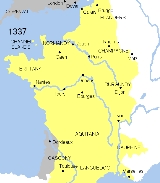
English claims to the French throne

Encyclopedia
The English claims to the French throne have a long and complex history between the 1340s and the 19th century.
From 1340 to 1801, with only brief intervals in 1360-1369 and 1420–1422, the kings and queens of England
, and after the Acts of Union
in 1707 the kings and queens of Great Britain
, also bore the title of King or Queen of France.
The Kingdom of England
was ruled by the French Plantagenet dynasty when this title was first adopted in 1340 by King Edward III
, who claimed the throne of France after the death of his uncle Charles IV of France
, thereby precipitating the Hundred Years' War
. At the time of Charles IV's death in 1328, Edward was his nearest male relative through Edward's mother Isabella of France
. Since the election of Hugh Capet in 987, the French crown had always passed based on male-line relations (father to son until 1316). There was no precedent for someone succeeding to the French throne based on his maternal ancestry, nor had there needed to be. There had been no shortage of sons and brothers for more than three centuries from the inception of the House of Capet
until the early 14th century, when new precedents concerning female inheritance finally had to be introduced. On the death of Philip IV the Fair's son Louis X
in 1316, immediately followed by that of his posthumous son John I
, it had to be decided whether his young daughter Joan
or his brother Philip
would succeed to the throne. This was later said to have been based on the 5th century Salic law
but some researchers assert that the Salic Law was rediscovered later and used to cloak the 1316 decision with an additional aura of authenticity.
At the time of Charles's death in 1328, there was once again a dispute over the succession. Although it had come to be accepted that a woman could not possess the French throne in her own right, Edward III, the nephew of the deceased king, based his claim on the theory that a woman could transmit a right of inheritance to her son. This claim was rejected, however, and the throne was given to the male line heir, Philip, Count of Valois
, a first cousin to the deceased king. At the time, Edward accepted this result, and paid homage to Philip VI for his Duchy of Guyenne
. Disputes over the next 12 years over the precise nature of Edward III's feudal obligations to Philip in Guyenne led to open war in 1337, and to the revival of Edward's claims to the French throne in 1340, when he claimed the title of King of France.
Edward continued to use this title until the Treaty of Brétigny
on May 8, 1360, when he abandoned his claims in return for substantial lands in France. After the resumption of hostilities between the English and the French in 1369, however, Edward resumed his claim and the title of King of France. His successors also used the title until the Treaty of Troyes
on May 21, 1420, in which the English recognised Charles VI
as King of France, but with his new son-in-law King Henry V of England
as his heir (disinheriting Charles VI's son, the Dauphin Charles
). Henry V then adopted the title Heir of France instead.
Henry V and Charles VI died within two months of each other in 1422, and Henry V's infant son (Charles VI's grandson) Henry VI
became King of France. He was the only English king who was de facto King of France, rather than using the style as a mere title of pretense. However, by 1429 Charles VII
, with the support of Jeanne d'Arc, had been crowned at Reims and begun to push the English out of northern France. In 1435, an end to the French civil war between Burgundians and Armagnacs allowed Charles to return to Paris the following year, and by 1453 the English had been driven out of their last strongholds in Normandy and Guyenne. The only French territory left to the English was Calais
, which was held until 1558.
on the part of Henry VI of England
in 1453 and the subsequent outbreak of the Wars of the Roses
(1455–1487), the English were no longer in any position to pursue their claim to the French throne and lost all their land on the continent, except for Calais.
Calais was ruled by eight more English Kings and Queens of France until 1558:
on January 7, 1558. Mary and Philip continued, however, to be styled Queen and King of France for the rest of her reign, as did Mary I's half-sister and successor Elizabeth I
, despite her abandonment of her claims to Calais in the Treaty of Cateau-Cambrésis of 1559.
. The thrones of England and Scotland were joined in a dynastic union
until 1707. The seven monarchs of this period continued to use the style King/Queen of France, though their claim was merely nominal. None of them was willing to engage in military campaigns for France against the actual Kings of France Henry IV
, Louis XIII
and Louis XIV of France
. Indeed, Charles I
married a sister of Louis XIII, and his son Charles II
spent much of his exile during the Interregnum
in France (at which time, even if not formally abandoning his claim for its throne, he certainly did not emphasize it).
with the Kingdom of Scotland
to a new Kingdom of Great Britain
. The Kingdom had four Monarchs until 1801. They also styled themselves Queen/King of France; however, none of them actually questioned the rights of Louis XIV and his successors Louis XV
, Louis XVI
, Louis XVII
and Louis XVIII
:
overthrew the monarchy on September 21, 1792 and replaced it with the French First Republic
. During the peace negotiations at the Conference of Lille, lasting from July to November 1797, the French delegates demanded that the King of Great Britain abandon the title of King of France as a condition of peace.
In 1800, the Act of Union
joined the Kingdom of Great Britain
with the Kingdom of Ireland
to a new United Kingdom of Great Britain and Ireland
. George III chose to drop his claim to the French throne, whereupon the fleurs de lis, part of the coat of arms
of all claimant Kings of France since the time of Edward III, were also removed from the British royal arms. Britain recognised the French Republic by the Treaty of Amiens
of 1802.
The change was not acknowledged by then current Jacobite claimant
Cardinal Henry Benedict Stuart
. He continued to formally style himself King of England, Scotland, France and Ireland until his death on July 13, 1807.
pretender
s were James II of England and his successors, continuing to be styled "Kings of England, Scotland, France and Ireland" past their deposition in 1689. All four pretenders continued to actively claim the title King of France as well as that of King of England, Scotland and Ireland from 1689 till 1807:
Several of these pretenders, notably James II for the last 12 years of his life and his son, the Old Pretender, until the Treaty of Utrecht
in 1713, were actually pensioners of Louis XIV at the very time they were claiming his title.
From 1340 to 1801, with only brief intervals in 1360-1369 and 1420–1422, the kings and queens of England
Kingdom of England
The Kingdom of England was, from 927 to 1707, a sovereign state to the northwest of continental Europe. At its height, the Kingdom of England spanned the southern two-thirds of the island of Great Britain and several smaller outlying islands; what today comprises the legal jurisdiction of England...
, and after the Acts of Union
Acts of Union 1707
The Acts of Union were two Parliamentary Acts - the Union with Scotland Act passed in 1706 by the Parliament of England, and the Union with England Act passed in 1707 by the Parliament of Scotland - which put into effect the terms of the Treaty of Union that had been agreed on 22 July 1706,...
in 1707 the kings and queens of Great Britain
Kingdom of Great Britain
The former Kingdom of Great Britain, sometimes described as the 'United Kingdom of Great Britain', That the Two Kingdoms of Scotland and England, shall upon the 1st May next ensuing the date hereof, and forever after, be United into One Kingdom by the Name of GREAT BRITAIN. was a sovereign...
, also bore the title of King or Queen of France.
The Kingdom of England
Kingdom of England
The Kingdom of England was, from 927 to 1707, a sovereign state to the northwest of continental Europe. At its height, the Kingdom of England spanned the southern two-thirds of the island of Great Britain and several smaller outlying islands; what today comprises the legal jurisdiction of England...
was ruled by the French Plantagenet dynasty when this title was first adopted in 1340 by King Edward III
Edward III of England
Edward III was King of England from 1327 until his death and is noted for his military success. Restoring royal authority after the disastrous reign of his father, Edward II, Edward III went on to transform the Kingdom of England into one of the most formidable military powers in Europe...
, who claimed the throne of France after the death of his uncle Charles IV of France
Charles IV of France
Charles IV, known as the Fair , was the King of France and of Navarre and Count of Champagne from 1322 to his death: he was the last French king of the senior Capetian lineage....
, thereby precipitating the Hundred Years' War
Hundred Years' War
The Hundred Years' War was a series of separate wars waged from 1337 to 1453 by the House of Valois and the House of Plantagenet, also known as the House of Anjou, for the French throne, which had become vacant upon the extinction of the senior Capetian line of French kings...
. At the time of Charles IV's death in 1328, Edward was his nearest male relative through Edward's mother Isabella of France
Isabella of France
Isabella of France , sometimes described as the She-wolf of France, was Queen consort of England as the wife of Edward II of England. She was the youngest surviving child and only surviving daughter of Philip IV of France and Joan I of Navarre...
. Since the election of Hugh Capet in 987, the French crown had always passed based on male-line relations (father to son until 1316). There was no precedent for someone succeeding to the French throne based on his maternal ancestry, nor had there needed to be. There had been no shortage of sons and brothers for more than three centuries from the inception of the House of Capet
House of Capet
The House of Capet, or The Direct Capetian Dynasty, , also called The House of France , or simply the Capets, which ruled the Kingdom of France from 987 to 1328, was the most senior line of the Capetian dynasty – itself a derivative dynasty from the Robertians. As rulers of France, the dynasty...
until the early 14th century, when new precedents concerning female inheritance finally had to be introduced. On the death of Philip IV the Fair's son Louis X
Louis X of France
Louis X of France, , called the Quarreler, the Headstrong, or the Stubborn was the King of Navarre from 1305 and King of France from 1314 until his death...
in 1316, immediately followed by that of his posthumous son John I
John I of France
John I , called the Posthumous, was King of France and Navarre, and Count of Champagne, as the son and successor of Louis the Headstrong, for the five days he lived...
, it had to be decided whether his young daughter Joan
Joan II of Navarre
Joan II was Queen of Navarre from 1328 until her death. She was the only daughter of Margaret of Burgundy, first wife of King Louis X of France...
or his brother Philip
Philip V of France
Philip the Tall was King of France as Philip V and, as Philip II, King of Navarre and Count of Champagne. He reigned from 1316 to his death and was the penultimate monarch of the House of Capet. Considered a wise and politically astute ruler, Philip took the throne under questionable...
would succeed to the throne. This was later said to have been based on the 5th century Salic law
Salic law
Salic law was a body of traditional law codified for governing the Salian Franks in the early Middle Ages during the reign of King Clovis I in the 6th century...
but some researchers assert that the Salic Law was rediscovered later and used to cloak the 1316 decision with an additional aura of authenticity.
At the time of Charles's death in 1328, there was once again a dispute over the succession. Although it had come to be accepted that a woman could not possess the French throne in her own right, Edward III, the nephew of the deceased king, based his claim on the theory that a woman could transmit a right of inheritance to her son. This claim was rejected, however, and the throne was given to the male line heir, Philip, Count of Valois
Philip VI of France
Philip VI , known as the Fortunate and of Valois, was the King of France from 1328 to his death. He was also Count of Anjou, Maine, and Valois from 1325 to 1328...
, a first cousin to the deceased king. At the time, Edward accepted this result, and paid homage to Philip VI for his Duchy of Guyenne
Guyenne
Guyenne or Guienne , , ; Occitan Guiana ) is a vaguely defined historic region of south-western France. The Province of Guyenne, sometimes called the Province of Guyenne and Gascony, was a large province of pre-revolutionary France....
. Disputes over the next 12 years over the precise nature of Edward III's feudal obligations to Philip in Guyenne led to open war in 1337, and to the revival of Edward's claims to the French throne in 1340, when he claimed the title of King of France.
Edward continued to use this title until the Treaty of Brétigny
Treaty of Brétigny
The Treaty of Brétigny was a treaty signed on May 9, 1360, between King Edward III of England and King John II of France. In retrospect it is seen as having marked the end of the first phase of the Hundred Years' War —as well as the height of English hegemony on the Continent.It was signed...
on May 8, 1360, when he abandoned his claims in return for substantial lands in France. After the resumption of hostilities between the English and the French in 1369, however, Edward resumed his claim and the title of King of France. His successors also used the title until the Treaty of Troyes
Treaty of Troyes
The Treaty of Troyes was an agreement that Henry V of England and his heirs would inherit the throne of France upon the death of King Charles VI of France. It was signed in the French city of Troyes on 21 May 1420 in the aftermath of the Battle of Agincourt...
on May 21, 1420, in which the English recognised Charles VI
Charles VI of France
Charles VI , called the Beloved and the Mad , was the King of France from 1380 to 1422, as a member of the House of Valois. His bouts with madness, which seem to have begun in 1392, led to quarrels among the French royal family, which were exploited by the neighbouring powers of England and Burgundy...
as King of France, but with his new son-in-law King Henry V of England
Henry V of England
Henry V was King of England from 1413 until his death at the age of 35 in 1422. He was the second monarch belonging to the House of Lancaster....
as his heir (disinheriting Charles VI's son, the Dauphin Charles
Charles VII of France
Charles VII , called the Victorious or the Well-Served , was King of France from 1422 to his death, though he was initially opposed by Henry VI of England, whose Regent, the Duke of Bedford, ruled much of France including the capital, Paris...
). Henry V then adopted the title Heir of France instead.
Henry V and Charles VI died within two months of each other in 1422, and Henry V's infant son (Charles VI's grandson) Henry VI
Henry VI of England
Henry VI was King of England from 1422 to 1461 and again from 1470 to 1471, and disputed King of France from 1422 to 1453. Until 1437, his realm was governed by regents. Contemporaneous accounts described him as peaceful and pious, not suited for the violent dynastic civil wars, known as the Wars...
became King of France. He was the only English king who was de facto King of France, rather than using the style as a mere title of pretense. However, by 1429 Charles VII
Charles VII of France
Charles VII , called the Victorious or the Well-Served , was King of France from 1422 to his death, though he was initially opposed by Henry VI of England, whose Regent, the Duke of Bedford, ruled much of France including the capital, Paris...
, with the support of Jeanne d'Arc, had been crowned at Reims and begun to push the English out of northern France. In 1435, an end to the French civil war between Burgundians and Armagnacs allowed Charles to return to Paris the following year, and by 1453 the English had been driven out of their last strongholds in Normandy and Guyenne. The only French territory left to the English was Calais
Calais
Calais is a town in Northern France in the department of Pas-de-Calais, of which it is a sub-prefecture. Although Calais is by far the largest city in Pas-de-Calais, the department's capital is its third-largest city of Arras....
, which was held until 1558.
"Kings of France" (1340)
- Edward III, King of EnglandEdward III of EnglandEdward III was King of England from 1327 until his death and is noted for his military success. Restoring royal authority after the disastrous reign of his father, Edward II, Edward III went on to transform the Kingdom of England into one of the most formidable military powers in Europe...
(reigned, first term January 24, 1340 - May 8, 1360).
"Kings of France" (title resumed 1369)
- Edward III, King of EnglandEdward III of EnglandEdward III was King of England from 1327 until his death and is noted for his military success. Restoring royal authority after the disastrous reign of his father, Edward II, Edward III went on to transform the Kingdom of England into one of the most formidable military powers in Europe...
(reigned, second term 1369 - June 21, 1377). - Richard II, King of EnglandRichard II of EnglandRichard II was King of England, a member of the House of Plantagenet and the last of its main-line kings. He ruled from 1377 until he was deposed in 1399. Richard was a son of Edward, the Black Prince, and was born during the reign of his grandfather, Edward III...
(reigned June 22, 1377 - September 30, 1399). - Henry IV, King of EnglandHenry IV of EnglandHenry IV was King of England and Lord of Ireland . He was the ninth King of England of the House of Plantagenet and also asserted his grandfather's claim to the title King of France. He was born at Bolingbroke Castle in Lincolnshire, hence his other name, Henry Bolingbroke...
(reigned September 30, 1399 - March 20, 1413). - Henry V, King of EnglandHenry V of EnglandHenry V was King of England from 1413 until his death at the age of 35 in 1422. He was the second monarch belonging to the House of Lancaster....
(reigned March 21, 1413 - May 21, 1420).
Heir of France de jure (1420)
- Henry V, King of EnglandHenry V of EnglandHenry V was King of England from 1413 until his death at the age of 35 in 1422. He was the second monarch belonging to the House of Lancaster....
(term May 21, 1420 - August 31, 1422) - Henry VI, King of EnglandHenry VI of EnglandHenry VI was King of England from 1422 to 1461 and again from 1470 to 1471, and disputed King of France from 1422 to 1453. Until 1437, his realm was governed by regents. Contemporaneous accounts described him as peaceful and pious, not suited for the violent dynastic civil wars, known as the Wars...
(term August 31 - October 21, 1422). Succeeded as King of France upon the death of Charles VI, according to the Treaty of TroyesTreaty of TroyesThe Treaty of Troyes was an agreement that Henry V of England and his heirs would inherit the throne of France upon the death of King Charles VI of France. It was signed in the French city of Troyes on 21 May 1420 in the aftermath of the Battle of Agincourt...
.
Kings of France (1422)
- Henry VI, King of EnglandHenry VI of EnglandHenry VI was King of England from 1422 to 1461 and again from 1470 to 1471, and disputed King of France from 1422 to 1453. Until 1437, his realm was governed by regents. Contemporaneous accounts described him as peaceful and pious, not suited for the violent dynastic civil wars, known as the Wars...
(reigned, from England, October 21, 1422 - March 4, 1461; October 31, 1470 - April 11, 1471) was de facto King of northern France (crowned December 16, 1431) from 1422 to 1453. The de facto King of southern France was Charles VIICharles VII of FranceCharles VII , called the Victorious or the Well-Served , was King of France from 1422 to his death, though he was initially opposed by Henry VI of England, whose Regent, the Duke of Bedford, ruled much of France including the capital, Paris...
since 1422. Henry, though deposed in England by Edward IV on March 4, 1461, continued to be recognized as King by supporters of the House of LancasterHouse of LancasterThe House of Lancaster was a branch of the royal House of Plantagenet. It was one of the opposing factions involved in the Wars of the Roses, an intermittent civil war which affected England and Wales during the 15th century...
, and was briefly restored to the English throne in 1470.
Rulers of Calais
Following an episode of insanityInsanity
Insanity, craziness or madness is a spectrum of behaviors characterized by certain abnormal mental or behavioral patterns. Insanity may manifest as violations of societal norms, including becoming a danger to themselves and others, though not all such acts are considered insanity...
on the part of Henry VI of England
Henry VI of England
Henry VI was King of England from 1422 to 1461 and again from 1470 to 1471, and disputed King of France from 1422 to 1453. Until 1437, his realm was governed by regents. Contemporaneous accounts described him as peaceful and pious, not suited for the violent dynastic civil wars, known as the Wars...
in 1453 and the subsequent outbreak of the Wars of the Roses
Wars of the Roses
The Wars of the Roses were a series of dynastic civil wars for the throne of England fought between supporters of two rival branches of the royal House of Plantagenet: the houses of Lancaster and York...
(1455–1487), the English were no longer in any position to pursue their claim to the French throne and lost all their land on the continent, except for Calais.
Calais was ruled by eight more English Kings and Queens of France until 1558:
- Edward IV of EnglandEdward IV of EnglandEdward IV was King of England from 4 March 1461 until 3 October 1470, and again from 11 April 1471 until his death. He was the first Yorkist King of England...
(March 4, 1461 - 30 October 1470; 11 April 1471 - April 9, 1483). - Edward V of EnglandEdward V of EnglandEdward V was King of England from 9 April 1483 until his deposition two months later. His reign was dominated by the influence of his uncle Richard, Duke of Gloucester, who succeeded him as Richard III...
(April 9 - June 25, 1483). - Richard III of EnglandRichard III of EnglandRichard III was King of England for two years, from 1483 until his death in 1485 during the Battle of Bosworth Field. He was the last king of the House of York and the last of the Plantagenet dynasty...
(June 25, 1483 - August 22, 1485). - Henry VII of EnglandHenry VII of EnglandHenry VII was King of England and Lord of Ireland from his seizing the crown on 22 August 1485 until his death on 21 April 1509, as the first monarch of the House of Tudor....
(August 22, 1485 - April 21, 1509). - Henry VIII of EnglandHenry VIII of EnglandHenry VIII was King of England from 21 April 1509 until his death. He was Lord, and later King, of Ireland, as well as continuing the nominal claim by the English monarchs to the Kingdom of France...
(April 21, 1509 - January 28, 1547). - Edward VI of EnglandEdward VI of EnglandEdward VI was the King of England and Ireland from 28 January 1547 until his death. He was crowned on 20 February at the age of nine. The son of Henry VIII and Jane Seymour, Edward was the third monarch of the Tudor dynasty and England's first monarch who was raised as a Protestant...
(January 28, 1547 - July 6, 1553). - Lady Jane GreyLady Jane GreyLady Jane Grey , also known as The Nine Days' Queen, was an English noblewoman who was de facto monarch of England from 10 July until 19 July 1553 and was subsequently executed...
(July 6/10 - July 19, 1553), de facto monarch. - Mary I of EnglandMary I of EnglandMary I was queen regnant of England and Ireland from July 1553 until her death.She was the only surviving child born of the ill-fated marriage of Henry VIII and his first wife Catherine of Aragon. Her younger half-brother, Edward VI, succeeded Henry in 1547...
(July 19, 1553 - January 7, 1558). - Philip of EnglandPhilip II of SpainPhilip II was King of Spain, Portugal, Naples, Sicily, and, while married to Mary I, King of England and Ireland. He was lord of the Seventeen Provinces from 1556 until 1581, holding various titles for the individual territories such as duke or count....
(jure uxorisJure uxorisJure uxoris is a Latin term that means "by right of his wife" or "in right of a wife". It is commonly used to refer to a title held by a man whose wife holds it in her own right. In other words, he acquired the title simply by being her husband....
; July 25, 1554 - January 7, 1558).
Rest of Tudor claimants
Ill feeling between the two nations continued well into the 16th century. Calais was captured by French troops under Francis, Duke of GuiseFrancis, Duke of Guise
Francis de Lorraine II, Prince of Joinville, Duke of Guise, Duke of Aumale , called Balafré , was a French soldier and politician.-Early life:...
on January 7, 1558. Mary and Philip continued, however, to be styled Queen and King of France for the rest of her reign, as did Mary I's half-sister and successor Elizabeth I
Elizabeth I of England
Elizabeth I was queen regnant of England and Ireland from 17 November 1558 until her death. Sometimes called The Virgin Queen, Gloriana, or Good Queen Bess, Elizabeth was the fifth and last monarch of the Tudor dynasty...
, despite her abandonment of her claims to Calais in the Treaty of Cateau-Cambrésis of 1559.
- Mary IMary I of EnglandMary I was queen regnant of England and Ireland from July 1553 until her death.She was the only surviving child born of the ill-fated marriage of Henry VIII and his first wife Catherine of Aragon. Her younger half-brother, Edward VI, succeeded Henry in 1547...
and Philip of EnglandPhilip II of SpainPhilip II was King of Spain, Portugal, Naples, Sicily, and, while married to Mary I, King of England and Ireland. He was lord of the Seventeen Provinces from 1556 until 1581, holding various titles for the individual territories such as duke or count....
(January 7 - November 17, 1558) - Elizabeth I of EnglandElizabeth I of EnglandElizabeth I was queen regnant of England and Ireland from 17 November 1558 until her death. Sometimes called The Virgin Queen, Gloriana, or Good Queen Bess, Elizabeth was the fifth and last monarch of the Tudor dynasty...
(November 17, 1558 - March 24, 1603)
The Stuart dynasty claimants
Elizabeth died childless. Her successor was her cousin James VI of ScotlandJames I of England
James VI and I was King of Scots as James VI from 24 July 1567 and King of England and Ireland as James I from the union of the English and Scottish crowns on 24 March 1603...
. The thrones of England and Scotland were joined in a dynastic union
Dynastic union
A dynastic union is the combination by which two different states are governed by the same dynasty, while their boundaries, their laws and their interests remain distinct...
until 1707. The seven monarchs of this period continued to use the style King/Queen of France, though their claim was merely nominal. None of them was willing to engage in military campaigns for France against the actual Kings of France Henry IV
Henry IV of France
Henry IV , Henri-Quatre, was King of France from 1589 to 1610 and King of Navarre from 1572 to 1610. He was the first monarch of the Bourbon branch of the Capetian dynasty in France....
, Louis XIII
Louis XIII of France
Louis XIII was a Bourbon monarch who ruled as King of France and of Navarre from 1610 to 1643.Louis was only eight years old when he succeeded his father. His mother, Marie de Medici, acted as regent during Louis' minority...
and Louis XIV of France
Louis XIV of France
Louis XIV , known as Louis the Great or the Sun King , was a Bourbon monarch who ruled as King of France and Navarre. His reign, from 1643 to his death in 1715, began at the age of four and lasted seventy-two years, three months, and eighteen days...
. Indeed, Charles I
Charles I of England
Charles I was King of England, King of Scotland, and King of Ireland from 27 March 1625 until his execution in 1649. Charles engaged in a struggle for power with the Parliament of England, attempting to obtain royal revenue whilst Parliament sought to curb his Royal prerogative which Charles...
married a sister of Louis XIII, and his son Charles II
Charles II of England
Charles II was monarch of the three kingdoms of England, Scotland, and Ireland.Charles II's father, King Charles I, was executed at Whitehall on 30 January 1649, at the climax of the English Civil War...
spent much of his exile during the Interregnum
English Interregnum
The English Interregnum was the period of parliamentary and military rule by the Lord Protector Oliver Cromwell under the Commonwealth of England after the English Civil War...
in France (at which time, even if not formally abandoning his claim for its throne, he certainly did not emphasize it).
- James I of England and VI of ScotlandJames I of EnglandJames VI and I was King of Scots as James VI from 24 July 1567 and King of England and Ireland as James I from the union of the English and Scottish crowns on 24 March 1603...
(March 24, 1603 - March 27, 1625). - Charles I of England and ScotlandCharles I of EnglandCharles I was King of England, King of Scotland, and King of Ireland from 27 March 1625 until his execution in 1649. Charles engaged in a struggle for power with the Parliament of England, attempting to obtain royal revenue whilst Parliament sought to curb his Royal prerogative which Charles...
(March 27, 1625 - January 30, 1649). - Charles II of England and ScotlandCharles II of EnglandCharles II was monarch of the three kingdoms of England, Scotland, and Ireland.Charles II's father, King Charles I, was executed at Whitehall on 30 January 1649, at the climax of the English Civil War...
(January 30, 1649 - February 6, 1685). - James II of England and VII of ScotlandJames II of EnglandJames II & VII was King of England and King of Ireland as James II and King of Scotland as James VII, from 6 February 1685. He was the last Catholic monarch to reign over the Kingdoms of England, Scotland, and Ireland...
(February 6, 1685 - February 12, 1689). - Mary II of England and ScotlandMary II of EnglandMary II was joint Sovereign of England, Scotland, and Ireland with her husband and first cousin, William III and II, from 1689 until her death. William and Mary, both Protestants, became king and queen regnant, respectively, following the Glorious Revolution, which resulted in the deposition of...
(February 13, 1689 - December 28, 1694). - William III of England and II of ScotlandWilliam III of EnglandWilliam III & II was a sovereign Prince of Orange of the House of Orange-Nassau by birth. From 1672 he governed as Stadtholder William III of Orange over Holland, Zeeland, Utrecht, Guelders, and Overijssel of the Dutch Republic. From 1689 he reigned as William III over England and Ireland...
(February 13, 1689 - March 8, 1702). - Anne of England and ScotlandAnne of Great BritainAnne ascended the thrones of England, Scotland and Ireland on 8 March 1702. On 1 May 1707, under the Act of Union, two of her realms, England and Scotland, were united as a single sovereign state, the Kingdom of Great Britain.Anne's Catholic father, James II and VII, was deposed during the...
(March 8, 1702 - May 1, 1707).
The claimants of Great Britain
The Act of Union 1707 declared the joining of the Kingdom of EnglandKingdom of England
The Kingdom of England was, from 927 to 1707, a sovereign state to the northwest of continental Europe. At its height, the Kingdom of England spanned the southern two-thirds of the island of Great Britain and several smaller outlying islands; what today comprises the legal jurisdiction of England...
with the Kingdom of Scotland
Kingdom of Scotland
The Kingdom of Scotland was a Sovereign state in North-West Europe that existed from 843 until 1707. It occupied the northern third of the island of Great Britain and shared a land border to the south with the Kingdom of England...
to a new Kingdom of Great Britain
Kingdom of Great Britain
The former Kingdom of Great Britain, sometimes described as the 'United Kingdom of Great Britain', That the Two Kingdoms of Scotland and England, shall upon the 1st May next ensuing the date hereof, and forever after, be United into One Kingdom by the Name of GREAT BRITAIN. was a sovereign...
. The Kingdom had four Monarchs until 1801. They also styled themselves Queen/King of France; however, none of them actually questioned the rights of Louis XIV and his successors Louis XV
Louis XV of France
Louis XV was a Bourbon monarch who ruled as King of France and of Navarre from 1 September 1715 until his death. He succeeded his great-grandfather at the age of five, his first cousin Philippe II, Duke of Orléans, served as Regent of the kingdom until Louis's majority in 1723...
, Louis XVI
Louis XVI of France
Louis XVI was a Bourbon monarch who ruled as King of France and Navarre until 1791, and then as King of the French from 1791 to 1792, before being executed in 1793....
, Louis XVII
Louis XVII of France
Louis XVII , from birth to 1789 known as Louis-Charles, Duke of Normandy; then from 1789 to 1791 as Louis-Charles, Dauphin of France; and from 1791 to 1793 as Louis-Charles, Prince Royal of France, was the son of King Louis XVI of France and Queen Marie Antoinette...
and Louis XVIII
Louis XVIII of France
Louis XVIII , known as "the Unavoidable", was King of France and of Navarre from 1814 to 1824, omitting the Hundred Days in 1815...
:
- Anne of Great BritainAnne of Great BritainAnne ascended the thrones of England, Scotland and Ireland on 8 March 1702. On 1 May 1707, under the Act of Union, two of her realms, England and Scotland, were united as a single sovereign state, the Kingdom of Great Britain.Anne's Catholic father, James II and VII, was deposed during the...
(May 1, 1707 - August 1, 1714). - George I of Great BritainGeorge I of Great BritainGeorge I was King of Great Britain and Ireland from 1 August 1714 until his death, and ruler of the Duchy and Electorate of Brunswick-Lüneburg in the Holy Roman Empire from 1698....
(August 1, 1714 - June 11, 1727). - George II of Great BritainGeorge II of Great BritainGeorge II was King of Great Britain and Ireland, Duke of Brunswick-Lüneburg and Archtreasurer and Prince-elector of the Holy Roman Empire from 11 June 1727 until his death.George was the last British monarch born outside Great Britain. He was born and brought up in Northern Germany...
(June 11, 1727 - October 25, 1760). - George III of Great Britain (October 25, 1760 - January 1, 1801).
Ending the claim
The French RevolutionFrench Revolution
The French Revolution , sometimes distinguished as the 'Great French Revolution' , was a period of radical social and political upheaval in France and Europe. The absolute monarchy that had ruled France for centuries collapsed in three years...
overthrew the monarchy on September 21, 1792 and replaced it with the French First Republic
French First Republic
The French First Republic was founded on 22 September 1792, by the newly established National Convention. The First Republic lasted until the declaration of the First French Empire in 1804 under Napoleon I...
. During the peace negotiations at the Conference of Lille, lasting from July to November 1797, the French delegates demanded that the King of Great Britain abandon the title of King of France as a condition of peace.
In 1800, the Act of Union
Act of Union 1800
The Acts of Union 1800 describe two complementary Acts, namely:* the Union with Ireland Act 1800 , an Act of the Parliament of Great Britain, and...
joined the Kingdom of Great Britain
Kingdom of Great Britain
The former Kingdom of Great Britain, sometimes described as the 'United Kingdom of Great Britain', That the Two Kingdoms of Scotland and England, shall upon the 1st May next ensuing the date hereof, and forever after, be United into One Kingdom by the Name of GREAT BRITAIN. was a sovereign...
with the Kingdom of Ireland
Kingdom of Ireland
The Kingdom of Ireland refers to the country of Ireland in the period between the proclamation of Henry VIII as King of Ireland by the Crown of Ireland Act 1542 and the Act of Union in 1800. It replaced the Lordship of Ireland, which had been created in 1171...
to a new United Kingdom of Great Britain and Ireland
United Kingdom of Great Britain and Ireland
The United Kingdom of Great Britain and Ireland was the formal name of the United Kingdom during the period when what is now the Republic of Ireland formed a part of it....
. George III chose to drop his claim to the French throne, whereupon the fleurs de lis, part of the coat of arms
Heraldry
Heraldry is the profession, study, or art of creating, granting, and blazoning arms and ruling on questions of rank or protocol, as exercised by an officer of arms. Heraldry comes from Anglo-Norman herald, from the Germanic compound harja-waldaz, "army commander"...
of all claimant Kings of France since the time of Edward III, were also removed from the British royal arms. Britain recognised the French Republic by the Treaty of Amiens
Treaty of Amiens
The Treaty of Amiens temporarily ended hostilities between the French Republic and the United Kingdom during the French Revolutionary Wars. It was signed in the city of Amiens on 25 March 1802 , by Joseph Bonaparte and the Marquess Cornwallis as a "Definitive Treaty of Peace"...
of 1802.
The change was not acknowledged by then current Jacobite claimant
Jacobitism
Jacobitism was the political movement in Britain dedicated to the restoration of the Stuart kings to the thrones of England, Scotland, later the Kingdom of Great Britain, and the Kingdom of Ireland...
Cardinal Henry Benedict Stuart
Henry Benedict Stuart
Henry Benedict Stuart was a Roman Catholic Cardinal, as well as the fourth and final Jacobite heir to publicly claim the thrones of England, Scotland, and Ireland. Unlike his father, James Francis Edward Stuart, and brother, Charles Edward Stuart, Henry made no effort to seize the throne...
. He continued to formally style himself King of England, Scotland, France and Ireland until his death on July 13, 1807.
The Jacobite pretenders
The JacobiteJacobitism
Jacobitism was the political movement in Britain dedicated to the restoration of the Stuart kings to the thrones of England, Scotland, later the Kingdom of Great Britain, and the Kingdom of Ireland...
pretender
Pretender
A pretender is one who claims entitlement to an unavailable position of honour or rank. Most often it refers to a former monarch, or descendant thereof, whose throne is occupied or claimed by a rival, or has been abolished....
s were James II of England and his successors, continuing to be styled "Kings of England, Scotland, France and Ireland" past their deposition in 1689. All four pretenders continued to actively claim the title King of France as well as that of King of England, Scotland and Ireland from 1689 till 1807:
- James II and VIIJames II of EnglandJames II & VII was King of England and King of Ireland as James II and King of Scotland as James VII, from 6 February 1685. He was the last Catholic monarch to reign over the Kingdoms of England, Scotland, and Ireland...
(February 12, 1689 – September 16, 1701). - James Francis Edward StuartJames Francis Edward StuartJames Francis Edward, Prince of Wales was the son of the deposed James II of England...
(September 16, 1701 – January 1, 1766), styled James III and VIII, also known as the Chevalier de St. George or as the Old Pretender. - Charles Edward StuartCharles Edward StuartPrince Charles Edward Louis John Casimir Sylvester Severino Maria Stuart commonly known as Bonnie Prince Charlie or The Young Pretender was the second Jacobite pretender to the thrones of Great Britain , and Ireland...
(January 1, 1766 – January 31, 1788), styled Charles III, also known as Bonnie Prince Charlie, the Young Chevalier, or as the Young Pretender. - Henry Benedict StuartHenry Benedict StuartHenry Benedict Stuart was a Roman Catholic Cardinal, as well as the fourth and final Jacobite heir to publicly claim the thrones of England, Scotland, and Ireland. Unlike his father, James Francis Edward Stuart, and brother, Charles Edward Stuart, Henry made no effort to seize the throne...
(January 31, 1788 – July 13, 1807), styled Henry IX and I.
Several of these pretenders, notably James II for the last 12 years of his life and his son, the Old Pretender, until the Treaty of Utrecht
Treaty of Utrecht
The Treaty of Utrecht, which established the Peace of Utrecht, comprises a series of individual peace treaties, rather than a single document, signed by the belligerents in the War of Spanish Succession, in the Dutch city of Utrecht in March and April 1713...
in 1713, were actually pensioners of Louis XIV at the very time they were claiming his title.
The Jacobite successors
The Jacobite succession has continued since 1807 but none of the eight subsequent holders of the claims has actively pursued them. They continue to be customarily known as "King (or Queen) of France" by the Jacobites.- Charles Emmanuel IV of SardiniaCharles Emmanuel IV of SardiniaCharles Emmanuel IV was King of Sardinia from 1796 to 1802. He abdicated in favour of his brother Victor Emmanuel I...
(July 13, 1807 – October 6, 1819), descended from the youngest daughter of Charles ICharles I of EnglandCharles I was King of England, King of Scotland, and King of Ireland from 27 March 1625 until his execution in 1649. Charles engaged in a struggle for power with the Parliament of England, attempting to obtain royal revenue whilst Parliament sought to curb his Royal prerogative which Charles...
. - Victor Emmanuel I of SardiniaVictor Emmanuel I of SardiniaVictor Emmanuel I was the Duke of Savoy and King of Sardinia from 1802 to 1821, and Jacobite Pretender from 1819 until his death.-Biography:...
(October 6, 1819 – January 10, 1824), his brother. - Maria Beatrice, Princess of Sardinia and later by marriage Duchess of ModenaModenaModena is a city and comune on the south side of the Po Valley, in the Province of Modena in the Emilia-Romagna region of Italy....
(January 10, 1824 – September 15, 1840), his daughter. - Francis V, Duke of ModenaFrancis V, Duke of ModenaFrancesco Ferdinando Geminiano von Habsburg-Lothringen, known as Francis V of Modena , Archduke of Austria-Este, Royal Prince of Hungary and Bohemia, was Duke of Modena, Reggio, and Mirandola, Duke of Guastalla , Duke of Massa and Prince of Carrara from 1846 to 1859...
(September 15, 1840 – November 20, 1875), her son. - Maria Theresia, Princess of Modena and later Queen consortQueen consortA queen consort is the wife of a reigning king. A queen consort usually shares her husband's rank and holds the feminine equivalent of the king's monarchical titles. Historically, queens consort do not share the king regnant's political and military powers. Most queens in history were queens consort...
of BavariaBavariaBavaria, formally the Free State of Bavaria is a state of Germany, located in the southeast of Germany. With an area of , it is the largest state by area, forming almost 20% of the total land area of Germany...
(November 20, 1875 – February 3, 1919), his niece. - Rupprecht, Crown Prince of BavariaRupprecht, Crown Prince of BavariaRupprecht or Rupert, Crown Prince of Bavaria was the last Bavarian Crown Prince.His full title was His Royal Highness Rupprecht Maria Luitpold Ferdinand, Crown Prince of Bavaria, Duke of Bavaria, of Franconia and in Swabia, Count Palatine of the Rhine...
(February 3, 1919 – August 2, 1955), her son. - Albrecht, Duke of BavariaAlbrecht, Duke of BavariaAlbrecht Luitpold Ferdinand Michael, Duke of Bavaria, of Franconia and in Swabia, Count Palatine of the Rhine , was the son of Rupprecht, Crown Prince of Bavaria and his first wife, Duchess Marie Gabrielle in Bavaria. He was the one surviving child from that marriage...
(August 2, 1955 – July 8, 1996), his son. - Franz, Duke of BavariaFranz, Duke of BavariaFranz Bonaventura Adalbert Maria Herzog von Bayern , styled as His Royal Highness The Duke of Bavaria, is head of the Wittelsbach family, the former ruling family of the Kingdom of Bavaria...
(since July 8, 1996), his son.
Failed claimants
In addition two failed claimants to the throne of England were also styled King of France. They are usually omitted from regnal lists.- Lambert SimnelLambert SimnelLambert Simnel was a pretender to the throne of England. His claim to be the Earl of Warwick in 1487 threatened the newly established reign of King Henry VII .-Early life:...
, impersonating Edward Plantagenet, 17th Earl of WarwickEdward Plantagenet, 17th Earl of WarwickEdward Plantagenet, 17th Earl of Warwick was the son of George Plantagenet, 1st Duke of Clarence and a potential claimant to the English throne during the reigns of both Richard III and his successor, Henry VII...
. Styled "Edward VI, King of England and France" (May 24 - June 16, 1487). Captured in the Battle of Stoke FieldBattle of Stoke FieldThe Battle of Stoke Field may be considered the last battle of the Wars of the Roses, since it was to be the last engagement in which a Lancastrian king faced an army of Yorkist supporters, under the pretender Lambert Simnel...
by Henry VII. - James Scott, 1st Duke of MonmouthJames Scott, 1st Duke of MonmouthJames Scott, 1st Duke of Monmouth, 1st Duke of Buccleuch, KG, PC , was an English nobleman. Originally called James Crofts or James Fitzroy, he was born in Rotterdam in the Netherlands, the eldest illegitimate son of Charles II and his mistress, Lucy Walter...
. Styled "King of England, Scotland, France and Ireland" (June 20 - July 6, 1685). Captured in the Battle of SedgemoorBattle of SedgemoorThe Battle of Sedgemoor was fought on 6 July 1685 and took place at Westonzoyland near Bridgwater in Somerset, England.It was the final battle of the Monmouth Rebellion and followed a series of skirmishes around south west England between the forces of James Scott, 1st Duke of Monmouth and the...
by James II/VII.
Dominion of Canada
It is sometimes suggested that the presence of French (blue on yellow) fleurs-de-lis in the coat of arms of the Dominion of Canada expresses the claim, after their removal from the British sovereign's arms in 1801. The committee designing the arms in 1921 is said to have intended "The meaning of the design" to include "a daughter country inheriting the arms of the four mother countries" (namely England, Scotland, Ireland, and France). The current coat of arms continues to use the fleur-de-lis.See also
- Mary, Queen of Scots & Francis II of FranceFrancis II of FranceFrancis II was aged 15 when he succeeded to the throne of France after the accidental death of his father, King Henry II, in 1559. He reigned for 18 months before he died in December 1560...
(Auld AllianceAuld AllianceThe Auld Alliance was an alliance between the kingdoms of Scotland and France. It played a significant role in the relations between Scotland, France and England from its beginning in 1295 until the 1560 Treaty of Edinburgh. The alliance was renewed by all the French and Scottish monarchs of that...
claim compounding the English claim) - Style of the British sovereignStyle of the British SovereignThe precise style of British Sovereigns has varied over the years. style is officially proclaimed in two languages:* in English: * in Latin: -Highness, Grace and Majesty:From about the 12th century onwards, English Sovereigns used the style "Highness"...
- Salic lawSalic lawSalic law was a body of traditional law codified for governing the Salian Franks in the early Middle Ages during the reign of King Clovis I in the 6th century...
- France – United Kingdom relations
- Franco-British unionFranco-British UnionA Franco-British Union is a concept for a union between the two independent sovereign states of the United Kingdom of Great Britain and France, known as the French Republic...