

Heptarchy

Encyclopedia
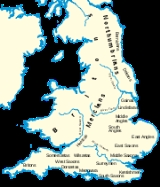
The Heptarchy is a collective name applied to the Anglo-Saxon
kingdoms of south, east, and central Great Britain
during late antiquity
and the early Middle Ages
, conventionally identified as seven: Northumbria
, Mercia
, East Anglia
, Essex
, Kent
, Sussex
and Wessex
. The Anglo-Saxon kingdoms eventually unified into the Kingdom of England
.
The term has been in use since the 16th century, but the initial idea that there were seven Anglo-Saxon kingdoms is attributed to the English
historian
Henry of Huntingdon
in the 12th century and was first used in his Historia Anglorum.
The heptarchy does not include any of the Sub-Roman
Brython
ic realms such as Elmet
, Rheged
, Strathclyde
, Ebrauc, Bryneich and Gododdin
, and during the same period, what are now Ireland
, Scotland
and Wales
were also divided into comparable petty kingdom
s.
.
Though heptarchy implies the existence of seven kingdoms, the number fluctuated, as kinglets contended for supremacy at various times within the conventional period. In the late sixth century the king of Kent was a prominent lord in the south; in the seventh century the rulers of Northumbria
and Wessex
were powerful; in the eighth century Mercia
achieved hegemony over the other surviving kingdoms. Yet as late as the reigns of Eadwig and Edgar
(955–75), it was still possible to speak of separate kingdoms within the English population.
In reality the end of the Heptarchy was a gradual process. The 9th century Viking raids that led to the establishment of a Danish-controlled enclave at York
, and ultimately to the Danelaw
, gained considerable advantage from the petty rivalries between the old kingdoms. The need to unite against the common enemy was recognised, so that by the time Alfred
of Wessex resisted the Danes in the late 9th century, he did so essentially as the leader of an Anglo-Saxon nation. Successive kings of Wessex (and especially Athelstan) progressively reinforced the English unitary state, until, with the simultaneous dissolution of Mercia and submission of Northumbria upon Edgar's succession in 959, the old constituent kingdoms in effect became consolidated into one.
Recent research has revealed that some of the Heptarchy kingdoms (notably Essex and Sussex) did not achieve the same status as the others. Conversely, there also existed alongside the seven kingdoms a number of other political divisions which played a more significant role than previously thought. Such were the kingdoms (or sub-kingdoms) of: Bernicia
and Deira within Northumbria; Lindsey
in present-day Lincolnshire
; the Hwicce
in the southwest Midlands; the Magonsæte
or Magonset, a sub-kingdom of Mercia in what is now Herefordshire
; the Wihtwara, a Jutish kingdom on the Isle of Wight
, originally as important as the Cantwara of Kent
; the Middle Angles
, a group of tribes based around modern Leicestershire
, later conquered by the Mercians; the Hæstingas (around the town of Hastings
in Sussex
); and the Gewisse, a Saxon tribe in what is now southern Hampshire
later developing into the kingdom of Wessex
.
Certainly the term Heptarchy has been considered unsatisfactory since the early 20th century, and many professional historians no longer use it, feeling that it does not accurately describe the period to which it refers. However, it is still sometimes used as a label of convenience for a phase in the development of England.
in Anglo-Saxon England
were:
The other main kingdoms which were conquered by others entirely at some point in their history are:
heptarchy. The Kingdom of Essex
, for instance, was assigned a red shield with three notched swords (or "seaxes"). This coat was used by the counties
of Essex
and Middlesex
until 1910, when the Middlesex County Council
applied for a formal grant from the College of Arms
(The Times, 1910). Middlesex was granted a red shield with three notched swords and a "Saxon Crown". The Essex County Council was granted the arms without the crown in 1932.
Anglo-Saxons
Anglo-Saxon is a term used by historians to designate the Germanic tribes who invaded and settled the south and east of Great Britain beginning in the early 5th century AD, and the period from their creation of the English nation to the Norman conquest. The Anglo-Saxon Era denotes the period of...
kingdoms of south, east, and central Great Britain
Great Britain
Great Britain or Britain is an island situated to the northwest of Continental Europe. It is the ninth largest island in the world, and the largest European island, as well as the largest of the British Isles...
during late antiquity
Late Antiquity
Late Antiquity is a periodization used by historians to describe the time of transition from Classical Antiquity to the Middle Ages, in both mainland Europe and the Mediterranean world. Precise boundaries for the period are a matter of debate, but noted historian of the period Peter Brown proposed...
and the early Middle Ages
Early Middle Ages
The Early Middle Ages was the period of European history lasting from the 5th century to approximately 1000. The Early Middle Ages followed the decline of the Western Roman Empire and preceded the High Middle Ages...
, conventionally identified as seven: Northumbria
Northumbria
Northumbria was a medieval kingdom of the Angles, in what is now Northern England and South-East Scotland, becoming subsequently an earldom in a united Anglo-Saxon kingdom of England. The name reflects the approximate southern limit to the kingdom's territory, the Humber Estuary.Northumbria was...
, Mercia
Mercia
Mercia was one of the kingdoms of the Anglo-Saxon Heptarchy. It was centred on the valley of the River Trent and its tributaries in the region now known as the English Midlands...
, East Anglia
Kingdom of the East Angles
The Kingdom of East Anglia, also known as the Kingdom of the East Angles , was a small independent Anglo-Saxon kingdom that comprised what are now the English counties of Norfolk and Suffolk and perhaps the eastern part of the Fens...
, Essex
Kingdom of Essex
The Kingdom of Essex or Kingdom of the East Saxons was one of the seven traditional kingdoms of the so-called Anglo-Saxon Heptarchy. It was founded in the 6th century and covered the territory later occupied by the counties of Essex, Hertfordshire, Middlesex and Kent. Kings of Essex were...
, Kent
Kingdom of Kent
The Kingdom of Kent was a Jutish colony and later independent kingdom in what is now south east England. It was founded at an unknown date in the 5th century by Jutes, members of a Germanic people from continental Europe, some of whom settled in Britain after the withdrawal of the Romans...
, Sussex
Kingdom of Sussex
The Kingdom of Sussex or Kingdom of the South Saxons was a Saxon colony and later independent kingdom of the Saxons, on the south coast of England. Its boundaries coincided in general with those of the earlier kingdom of the Regnenses and the later county of Sussex. A large part of its territory...
and Wessex
Wessex
The Kingdom of Wessex or Kingdom of the West Saxons was an Anglo-Saxon kingdom of the West Saxons, in South West England, from the 6th century, until the emergence of a united English state in the 10th century, under the Wessex dynasty. It was to be an earldom after Canute the Great's conquest...
. The Anglo-Saxon kingdoms eventually unified into the Kingdom of England
Kingdom of England
The Kingdom of England was, from 927 to 1707, a sovereign state to the northwest of continental Europe. At its height, the Kingdom of England spanned the southern two-thirds of the island of Great Britain and several smaller outlying islands; what today comprises the legal jurisdiction of England...
.
The term has been in use since the 16th century, but the initial idea that there were seven Anglo-Saxon kingdoms is attributed to the English
English people
The English are a nation and ethnic group native to England, who speak English. The English identity is of early mediaeval origin, when they were known in Old English as the Anglecynn. England is now a country of the United Kingdom, and the majority of English people in England are British Citizens...
historian
Historian
A historian is a person who studies and writes about the past and is regarded as an authority on it. Historians are concerned with the continuous, methodical narrative and research of past events as relating to the human race; as well as the study of all history in time. If the individual is...
Henry of Huntingdon
Henry of Huntingdon
Henry of Huntingdon , the son of a canon in the diocese of Lincoln, was a 12th century English historian, the author of a history of England, Historia anglorum, "the most important Anglo-Norman historian to emerge from the secular clergy". He served as archdeacon of Huntingdon...
in the 12th century and was first used in his Historia Anglorum.
The heptarchy does not include any of the Sub-Roman
Sub-Roman Britain
Sub-Roman Britain is a term derived from an archaeological label for the material culture of Britain in Late Antiquity: the term "Sub-Roman" was invented to describe the potsherds in sites of the 5th century and the 6th century, initially with an implication of decay of locally-made wares from a...
Brython
Brython
The Britons were the Celtic people culturally dominating Great Britain from the Iron Age through the Early Middle Ages. They spoke the Insular Celtic language known as British or Brythonic...
ic realms such as Elmet
Elmet
Elmet was an independent Brythonic kingdom covering a broad area of what later became the West Riding of Yorkshire during the Early Middle Ages, between approximately the 5th century and early 7th century. Although its precise boundaries are unclear, it appears to have been bordered by the River...
, Rheged
Rheged
Rheged is described in poetic sources as one of the kingdoms of the Hen Ogledd , the Brythonic-speaking region of what is now northern England and southern Scotland, during the Early Middle Ages...
, Strathclyde
Kingdom of Strathclyde
Strathclyde , originally Brythonic Ystrad Clud, was one of the early medieval kingdoms of the celtic people called the Britons in the Hen Ogledd, the Brythonic-speaking parts of what is now southern Scotland and northern England. The kingdom developed during the post-Roman period...
, Ebrauc, Bryneich and Gododdin
Gododdin
The Gododdin were a Brittonic people of north-eastern Britain in the sub-Roman period, the area known as the Hen Ogledd or Old North...
, and during the same period, what are now Ireland
Ireland
Ireland is an island to the northwest of continental Europe. It is the third-largest island in Europe and the twentieth-largest island on Earth...
, Scotland
Scotland
Scotland is a country that is part of the United Kingdom. Occupying the northern third of the island of Great Britain, it shares a border with England to the south and is bounded by the North Sea to the east, the Atlantic Ocean to the north and west, and the North Channel and Irish Sea to the...
and Wales
Wales
Wales is a country that is part of the United Kingdom and the island of Great Britain, bordered by England to its east and the Atlantic Ocean and Irish Sea to its west. It has a population of three million, and a total area of 20,779 km²...
were also divided into comparable petty kingdom
Petty kingdom
A petty kingdom is one of a number of small kingdoms, described as minor or "petty" by contrast to an empire or unified kingdom that either preceded or succeeded it...
s.
Unification
By convention the label is considered to cover the period from AD 500 to AD 850, often referred to as the Dark Ages, which approximately represents the period following the departure of Roman legions from Britain until the unification of the kingdoms under Egbert of WessexEgbert of Wessex
Egbert was King of Wessex from 802 until his death in 839. His father was Ealhmund of Kent...
.
Though heptarchy implies the existence of seven kingdoms, the number fluctuated, as kinglets contended for supremacy at various times within the conventional period. In the late sixth century the king of Kent was a prominent lord in the south; in the seventh century the rulers of Northumbria
Northumbria
Northumbria was a medieval kingdom of the Angles, in what is now Northern England and South-East Scotland, becoming subsequently an earldom in a united Anglo-Saxon kingdom of England. The name reflects the approximate southern limit to the kingdom's territory, the Humber Estuary.Northumbria was...
and Wessex
Wessex
The Kingdom of Wessex or Kingdom of the West Saxons was an Anglo-Saxon kingdom of the West Saxons, in South West England, from the 6th century, until the emergence of a united English state in the 10th century, under the Wessex dynasty. It was to be an earldom after Canute the Great's conquest...
were powerful; in the eighth century Mercia
Mercia
Mercia was one of the kingdoms of the Anglo-Saxon Heptarchy. It was centred on the valley of the River Trent and its tributaries in the region now known as the English Midlands...
achieved hegemony over the other surviving kingdoms. Yet as late as the reigns of Eadwig and Edgar
Edgar of England
Edgar the Peaceful, or Edgar I , also called the Peaceable, was a king of England . Edgar was the younger son of Edmund I of England.-Accession:...
(955–75), it was still possible to speak of separate kingdoms within the English population.
In reality the end of the Heptarchy was a gradual process. The 9th century Viking raids that led to the establishment of a Danish-controlled enclave at York
York
York is a walled city, situated at the confluence of the Rivers Ouse and Foss in North Yorkshire, England. The city has a rich heritage and has provided the backdrop to major political events throughout much of its two millennia of existence...
, and ultimately to the Danelaw
Danelaw
The Danelaw, as recorded in the Anglo-Saxon Chronicle , is a historical name given to the part of England in which the laws of the "Danes" held sway and dominated those of the Anglo-Saxons. It is contrasted with "West Saxon law" and "Mercian law". The term has been extended by modern historians to...
, gained considerable advantage from the petty rivalries between the old kingdoms. The need to unite against the common enemy was recognised, so that by the time Alfred
Alfred the Great
Alfred the Great was King of Wessex from 871 to 899.Alfred is noted for his defence of the Anglo-Saxon kingdoms of southern England against the Vikings, becoming the only English monarch still to be accorded the epithet "the Great". Alfred was the first King of the West Saxons to style himself...
of Wessex resisted the Danes in the late 9th century, he did so essentially as the leader of an Anglo-Saxon nation. Successive kings of Wessex (and especially Athelstan) progressively reinforced the English unitary state, until, with the simultaneous dissolution of Mercia and submission of Northumbria upon Edgar's succession in 959, the old constituent kingdoms in effect became consolidated into one.
Recent research has revealed that some of the Heptarchy kingdoms (notably Essex and Sussex) did not achieve the same status as the others. Conversely, there also existed alongside the seven kingdoms a number of other political divisions which played a more significant role than previously thought. Such were the kingdoms (or sub-kingdoms) of: Bernicia
Bernicia
Bernicia was an Anglo-Saxon kingdom established by Anglian settlers of the 6th century in what is now southeastern Scotland and North East England....
and Deira within Northumbria; Lindsey
Kingdom of Lindsey
Lindsey or Linnuis is the name of a petty Anglo-Saxon kingdom, absorbed into Northumbria in the 7th century.It lay between the Humber and the Wash, forming its inland boundaries from the course of the Witham and Trent rivers , and the Foss Dyke between...
in present-day Lincolnshire
Lincolnshire
Lincolnshire is a county in the east of England. It borders Norfolk to the south east, Cambridgeshire to the south, Rutland to the south west, Leicestershire and Nottinghamshire to the west, South Yorkshire to the north west, and the East Riding of Yorkshire to the north. It also borders...
; the Hwicce
Hwicce
The Hwicce were one of the peoples of Anglo-Saxon England. The exact boundaries of their kingdom are uncertain, though it is likely that they coincided with those of the old Diocese of Worcester, founded in 679–80, the early bishops of which bore the title Episcopus Hwicciorum...
in the southwest Midlands; the Magonsæte
Magonsaete
Magonsæte was a minor sub-kingdom of the greater Anglo-Saxon kingdom of Mercia, thought to be coterminous with the Diocese of Hereford.The British territory of Pengwern was conquered by Oswiu of Northumbria in 656, while he was overlord of the Mercians. Western Pengwern was then occupied by Anglian...
or Magonset, a sub-kingdom of Mercia in what is now Herefordshire
Herefordshire
Herefordshire is a historic and ceremonial county in the West Midlands region of England. For Eurostat purposes it is a NUTS 3 region and is one of three counties that comprise the "Herefordshire, Worcestershire and Gloucestershire" NUTS 2 region. It also forms a unitary district known as the...
; the Wihtwara, a Jutish kingdom on the Isle of Wight
Isle of Wight
The Isle of Wight is a county and the largest island of England, located in the English Channel, on average about 2–4 miles off the south coast of the county of Hampshire, separated from the mainland by a strait called the Solent...
, originally as important as the Cantwara of Kent
Kent
Kent is a county in southeast England, and is one of the home counties. It borders East Sussex, Surrey and Greater London and has a defined boundary with Essex in the middle of the Thames Estuary. The ceremonial county boundaries of Kent include the shire county of Kent and the unitary borough of...
; the Middle Angles
Middle Angles
The Middle Angles were an important ethnic or cultural group within the larger kingdom of Mercia in England in the Anglo-Saxon period.-Origins and territory:...
, a group of tribes based around modern Leicestershire
Leicestershire
Leicestershire is a landlocked county in the English Midlands. It takes its name from the heavily populated City of Leicester, traditionally its administrative centre, although the City of Leicester unitary authority is today administered separately from the rest of Leicestershire...
, later conquered by the Mercians; the Hæstingas (around the town of Hastings
Hastings
Hastings is a town and borough in the county of East Sussex on the south coast of England. The town is located east of the county town of Lewes and south east of London, and has an estimated population of 86,900....
in Sussex
Sussex
Sussex , from the Old English Sūþsēaxe , is an historic county in South East England corresponding roughly in area to the ancient Kingdom of Sussex. It is bounded on the north by Surrey, east by Kent, south by the English Channel, and west by Hampshire, and is divided for local government into West...
); and the Gewisse, a Saxon tribe in what is now southern Hampshire
Hampshire
Hampshire is a county on the southern coast of England in the United Kingdom. The county town of Hampshire is Winchester, a historic cathedral city that was once the capital of England. Hampshire is notable for housing the original birthplaces of the Royal Navy, British Army, and Royal Air Force...
later developing into the kingdom of Wessex
Wessex
The Kingdom of Wessex or Kingdom of the West Saxons was an Anglo-Saxon kingdom of the West Saxons, in South West England, from the 6th century, until the emergence of a united English state in the 10th century, under the Wessex dynasty. It was to be an earldom after Canute the Great's conquest...
.
Certainly the term Heptarchy has been considered unsatisfactory since the early 20th century, and many professional historians no longer use it, feeling that it does not accurately describe the period to which it refers. However, it is still sometimes used as a label of convenience for a phase in the development of England.
Anglo-Saxon England heptarchy
The four main kingdomsMonarchy
A monarchy is a form of government in which the office of head of state is usually held until death or abdication and is often hereditary and includes a royal house. In some cases, the monarch is elected...
in Anglo-Saxon England
England
England is a country that is part of the United Kingdom. It shares land borders with Scotland to the north and Wales to the west; the Irish Sea is to the north west, the Celtic Sea to the south west, with the North Sea to the east and the English Channel to the south separating it from continental...
were:
- WessexWessexThe Kingdom of Wessex or Kingdom of the West Saxons was an Anglo-Saxon kingdom of the West Saxons, in South West England, from the 6th century, until the emergence of a united English state in the 10th century, under the Wessex dynasty. It was to be an earldom after Canute the Great's conquest...
- East AngliaKingdom of the East AnglesThe Kingdom of East Anglia, also known as the Kingdom of the East Angles , was a small independent Anglo-Saxon kingdom that comprised what are now the English counties of Norfolk and Suffolk and perhaps the eastern part of the Fens...
- MerciaMerciaMercia was one of the kingdoms of the Anglo-Saxon Heptarchy. It was centred on the valley of the River Trent and its tributaries in the region now known as the English Midlands...
- NorthumbriaNorthumbriaNorthumbria was a medieval kingdom of the Angles, in what is now Northern England and South-East Scotland, becoming subsequently an earldom in a united Anglo-Saxon kingdom of England. The name reflects the approximate southern limit to the kingdom's territory, the Humber Estuary.Northumbria was...
, including sub-kingdoms BerniciaBerniciaBernicia was an Anglo-Saxon kingdom established by Anglian settlers of the 6th century in what is now southeastern Scotland and North East England....
and Deira
The other main kingdoms which were conquered by others entirely at some point in their history are:
- KentKingdom of KentThe Kingdom of Kent was a Jutish colony and later independent kingdom in what is now south east England. It was founded at an unknown date in the 5th century by Jutes, members of a Germanic people from continental Europe, some of whom settled in Britain after the withdrawal of the Romans...
- SussexKingdom of SussexThe Kingdom of Sussex or Kingdom of the South Saxons was a Saxon colony and later independent kingdom of the Saxons, on the south coast of England. Its boundaries coincided in general with those of the earlier kingdom of the Regnenses and the later county of Sussex. A large part of its territory...
- EssexKingdom of EssexThe Kingdom of Essex or Kingdom of the East Saxons was one of the seven traditional kingdoms of the so-called Anglo-Saxon Heptarchy. It was founded in the 6th century and covered the territory later occupied by the counties of Essex, Hertfordshire, Middlesex and Kent. Kings of Essex were...
Other minor kingdoms and territories
- Isle of Wight, also known as the Wihtwara
- The MeonwaraMeonwaraMeonwara or Meonsæte is the name of a people of probable Jutish origin who colonised what is now known as the Meon Valley, an area in southern Hampshire, England, during the late 5th century and early 6th century.-Area of settlement:...
a Jutish tribe in Hampshire - Surrey
- Kingdom of the Iclingas, a precursor state to Mercia
- LindseyKingdom of LindseyLindsey or Linnuis is the name of a petty Anglo-Saxon kingdom, absorbed into Northumbria in the 7th century.It lay between the Humber and the Wash, forming its inland boundaries from the course of the Witham and Trent rivers , and the Foss Dyke between...
- The HwicceHwicceThe Hwicce were one of the peoples of Anglo-Saxon England. The exact boundaries of their kingdom are uncertain, though it is likely that they coincided with those of the old Diocese of Worcester, founded in 679–80, the early bishops of which bore the title Episcopus Hwicciorum...
- Magonsæte
- Pecsæte
- Wreocensæte
- Tomsæte
- HaestingasHaestingasThe Haestingas, or alternatively Heastingas or Hæstingas, were one of the tribes of Anglo-Saxon Britain. The Kingdom of Haestingas was located in modern-day Sussex, and was one of the minor sub-kingdoms of the Heptarchy.- History :...
- Middle AnglesMiddle AnglesThe Middle Angles were an important ethnic or cultural group within the larger kingdom of Mercia in England in the Anglo-Saxon period.-Origins and territory:...
- DumnoniaDumnoniaDumnonia is the Latinised name for the Brythonic kingdom in sub-Roman Britain between the late 4th and late 8th centuries, located in the farther parts of the south-west peninsula of Great Britain...
(only subject to Wessex at a later date)
Attributed arms
Arms were attributed to the kingdoms of the Anglo-SaxonAnglo-Saxon
Anglo-Saxon may refer to:* Anglo-Saxons, a group that invaded Britain** Old English, their language** Anglo-Saxon England, their history, one of various ships* White Anglo-Saxon Protestant, an ethnicity* Anglo-Saxon economy, modern macroeconomic term...
heptarchy. The Kingdom of Essex
Kingdom of Essex
The Kingdom of Essex or Kingdom of the East Saxons was one of the seven traditional kingdoms of the so-called Anglo-Saxon Heptarchy. It was founded in the 6th century and covered the territory later occupied by the counties of Essex, Hertfordshire, Middlesex and Kent. Kings of Essex were...
, for instance, was assigned a red shield with three notched swords (or "seaxes"). This coat was used by the counties
Historic counties of England
The historic counties of England are subdivisions of England established for administration by the Normans and in most cases based on earlier Anglo-Saxon kingdoms and shires...
of Essex
Essex
Essex is a ceremonial and non-metropolitan county in the East region of England, and one of the home counties. It is located to the northeast of Greater London. It borders with Cambridgeshire and Suffolk to the north, Hertfordshire to the west, Kent to the South and London to the south west...
and Middlesex
Middlesex
Middlesex is one of the historic counties of England and the second smallest by area. The low-lying county contained the wealthy and politically independent City of London on its southern boundary and was dominated by it from a very early time...
until 1910, when the Middlesex County Council
Middlesex County Council
Middlesex County Council was the principal local government body in the administrative county of Middlesex from 1889 to 1965.The county council was created by the Local Government Act 1888, which also removed the most populous part of the county to constitute the County of London...
applied for a formal grant from the College of Arms
College of Arms
The College of Arms, or Heralds’ College, is an office regulating heraldry and granting new armorial bearings for England, Wales and Northern Ireland...
(The Times, 1910). Middlesex was granted a red shield with three notched swords and a "Saxon Crown". The Essex County Council was granted the arms without the crown in 1932.
See also
- History of Anglo-Saxon EnglandHistory of Anglo-Saxon EnglandAnglo-Saxon England refers to the period of the history of that part of Britain, that became known as England, lasting from the end of Roman occupation and establishment of Anglo-Saxon kingdoms in the 5th century until the Norman conquest of England in 1066 by William the Conqueror...
- Related terms : BretwaldaBretwaldaBretwalda is an Old English word, the first record of which comes from the late 9th century Anglo-Saxon Chronicle. It is given to some of the rulers of Anglo-Saxon kingdoms from the 5th century onwards who had achieved overlordship of some or all of the other Anglo-Saxon kingdoms...
, High KingHigh kingA high king is a king who holds a position of seniority over a group of other kings, without the title of Emperor; compare King of Kings.Rulers who have been termed "high king" include:...
for hegemons among Kings - Compare : TetrarchyTetrarchyThe term Tetrarchy describes any system of government where power is divided among four individuals, but usually refers to the tetrarchy instituted by Roman Emperor Diocletian in 293, marking the end of the Crisis of the Third Century and the recovery of the Roman Empire...
- Cornovii (Cornish)Cornovii (Cornish)The Cornovii were a Celtic tribe who inhabited the far South West peninsula of Great Britain, during the Iron Age, Roman and post-Roman periods and gave their name to Cornwall or Kernow....
Further reading
- Stenton, F. M. (1971) Anglo-Saxon England, 3rd edition. Oxford U. P.
- Campbell, J. et al. (1991) The Anglo-Saxons. Harmondsworth: Penguin
External links
- Monarchs of Britain, Encyclopædia BritannicaEncyclopædia BritannicaThe Encyclopædia Britannica , published by Encyclopædia Britannica, Inc., is a general knowledge English-language encyclopaedia that is available in print, as a DVD, and on the Internet. It is written and continuously updated by about 100 full-time editors and more than 4,000 expert...
- http://www.ogdoad.force9.co.uk/alfred/alfhidage.htmThe Burghal HidageBurghal HidageThe Burghal Hidage is an Anglo-Saxon document providing a list of the fortified burhs in Wessex and elsewhere in southern England. It offers an unusually detailed picture of the network of burhs that Alfred the Great designed to defend his kingdom from the predations of Viking invaders.-Burhs and...
- WessexWessexThe Kingdom of Wessex or Kingdom of the West Saxons was an Anglo-Saxon kingdom of the West Saxons, in South West England, from the 6th century, until the emergence of a united English state in the 10th century, under the Wessex dynasty. It was to be an earldom after Canute the Great's conquest...
's fortified burhs]