

Anglo-Saxon settlement of Britain

Encyclopedia
The Anglo-Saxon settlement of Britain was the invasion and migration of Germanic peoples
Germanic peoples
The Germanic peoples are an Indo-European ethno-linguistic group of Northern European origin, identified by their use of the Indo-European Germanic languages which diversified out of Proto-Germanic during the Pre-Roman Iron Age.Originating about 1800 BCE from the Corded Ware Culture on the North...
from continental Europe
Continental Europe
Continental Europe, also referred to as mainland Europe or simply the Continent, is the continent of Europe, explicitly excluding European islands....
to Great Britain
Great Britain
Great Britain or Britain is an island situated to the northwest of Continental Europe. It is the ninth largest island in the world, and the largest European island, as well as the largest of the British Isles...
during the Early Middle Ages
Early Middle Ages
The Early Middle Ages was the period of European history lasting from the 5th century to approximately 1000. The Early Middle Ages followed the decline of the Western Roman Empire and preceded the High Middle Ages...
, specifically the arrival of the Anglo-Saxons
Anglo-Saxons
Anglo-Saxon is a term used by historians to designate the Germanic tribes who invaded and settled the south and east of Great Britain beginning in the early 5th century AD, and the period from their creation of the English nation to the Norman conquest. The Anglo-Saxon Era denotes the period of...
in Britain after the demise of Roman rule in the 5th century.
The stimulus, progression and impact of the Germanic settlement of Britain is subject to considerable disagreement, prompted by varying accounts and evidence. The traditional division of the migrants into Angles
Angles
The Angles is a modern English term for a Germanic people who took their name from the ancestral cultural region of Angeln, a district located in Schleswig-Holstein, Germany...
, Saxons
Saxons
The Saxons were a confederation of Germanic tribes originating on the North German plain. The Saxons earliest known area of settlement is Northern Albingia, an area approximately that of modern Holstein...
and Jutes
Jutes
The Jutes, Iuti, or Iutæ were a Germanic people who, according to Bede, were one of the three most powerful Germanic peoples of their time, the other two being the Saxons and the Angles...
— peoples from Angeln
Angeln
Modern Angeln, also known as Anglia , is a small peninsula in Southern Schleswig in the northern Schleswig-Holstein, Germany, protruding into the Bay of Kiel...
, Saxony
Old Saxony
Old Saxony is the original homeland of the Saxons in the northwest corner of modern Germany and roughly corresponds today with the contemporary Lower Saxony, Westphalia and western Saxony-Anhalt....
and Jutland
Jutland
Jutland , historically also called Cimbria, is the name of the peninsula that juts out in Northern Europe toward the rest of Scandinavia, forming the mainland part of Denmark. It has the North Sea to its west, Kattegat and Skagerrak to its north, the Baltic Sea to its east, and the Danish–German...
— comes from the Historia ecclesiastica gentis Anglorum
Historia ecclesiastica gentis Anglorum
The Historia ecclesiastica gentis Anglorum is a work in Latin by Bede on the history of the Christian Churches in England, and of England generally; its main focus is on the conflict between Roman and Celtic Christianity.It is considered to be one of the most important original references on...
, an 8th-century Latin history written by the Venerable Bede about Christianity in the Kingdom of England
Kingdom of England
The Kingdom of England was, from 927 to 1707, a sovereign state to the northwest of continental Europe. At its height, the Kingdom of England spanned the southern two-thirds of the island of Great Britain and several smaller outlying islands; what today comprises the legal jurisdiction of England...
. Historical and archaeological research in the early 20th century has shown that a wider range of Germanic peoples from the coasts of Frisia
Frisia
Frisia is a coastal region along the southeastern corner of the North Sea, i.e. the German Bight. Frisia is the traditional homeland of the Frisians, a Germanic people who speak Frisian, a language group closely related to the English language...
, Lower Saxony
Lower Saxony
Lower Saxony is a German state situated in north-western Germany and is second in area and fourth in population among the sixteen states of Germany...
, and Sweden also have moved to Britain in this era. The Anglo-Saxons supplanted Celtic culture
Celtic culture
Culture of Celtic Europe and modern Celtic identity*Ancient Celtic culture*Celtic music**Insular art*Celtic music*Gaelic culture**Culture of Ireland**Culture of Scotland**Culture of the Isle of Man*Culture of Wales*Culture of Cornwall*Culture of Brittany...
and society in much of southern and central Britain and contributed to the creation of Anglo-Saxon England and the use of the Old English language
Old English language
Old English or Anglo-Saxon is an early form of the English language that was spoken and written by the Anglo-Saxons and their descendants in parts of what are now England and southeastern Scotland between at least the mid-5th century and the mid-12th century...
.
Background
Slaves were the engine of both the economy and the army in Roman BritainRoman Britain
Roman Britain was the part of the island of Great Britain controlled by the Roman Empire from AD 43 until ca. AD 410.The Romans referred to the imperial province as Britannia, which eventually comprised all of the island of Great Britain south of the fluid frontier with Caledonia...
, as they were throughout the Roman Empire
Roman Empire
The Roman Empire was the post-Republican period of the ancient Roman civilization, characterised by an autocratic form of government and large territorial holdings in Europe and around the Mediterranean....
. Estimates for the prevalence of slavery vary, with some estimating that approximately 30% of the population of the Empire in the 1st century was enslaved. The Germanic region was one of the main sources of slaves. The business of selling slaves was mostly carried out by wholesale dealers who followed the Roman armies. There was a reduction of sources for procurement of slaves after the expansion phase, although around AD 210 there was a significant increase of piracy in the North Sea
North Sea
In the southwest, beyond the Straits of Dover, the North Sea becomes the English Channel connecting to the Atlantic Ocean. In the east, it connects to the Baltic Sea via the Skagerrak and Kattegat, narrow straits that separate Denmark from Norway and Sweden respectively...
which helped the Empire partially resolve the issue. Pirates often attacked whole villages, capturing people for ransom or to sell as slaves.
Under Diocletian, the Ius Colonatus was a reform of the slavery system introduced around AD 286. This provided a set of rights for slaves and improved their living conditions, establishing a system similar to later serfdom
Serfdom
Serfdom is the status of peasants under feudalism, specifically relating to Manorialism. It was a condition of bondage or modified slavery which developed primarily during the High Middle Ages in Europe and lasted to the mid-19th century...
. The owners of slaves paid a tax to prevent the recruitment of their slaves into the army. This led to a Germanization and barbarization of the army, as the tax was used to recruit mercenaries. Britannia
Britannia
Britannia is an ancient term for Great Britain, and also a female personification of the island. The name is Latin, and derives from the Greek form Prettanike or Brettaniai, which originally designated a collection of islands with individual names, including Albion or Great Britain. However, by the...
required approximately 3 to 4 legions
Roman legion
A Roman legion normally indicates the basic ancient Roman army unit recruited specifically from Roman citizens. The organization of legions varied greatly over time but they were typically composed of perhaps 5,000 soldiers, divided into maniples and later into "cohorts"...
to maintain Roman control. After the Battle of Adrianople
Battle of Adrianople
The Battle of Adrianople , sometimes known as the Battle of Hadrianopolis, was fought between a Roman army led by the Roman Emperor Valens and Gothic rebels led by Fritigern...
, the foederati
Foederati
Foederatus is a Latin term whose definition and usage drifted in the time between the early Roman Republic and the end of the Western Roman Empire...
reforms extended the practice of subsidizing entire barbarian tribes in exchange for their providing warriors to fight in the Roman armies. The Hospitalitas reform involved the granting of a third of the land or fees of a region to barbarians who had invaded them. In return, these people declared loyalty to the Emperor and provided military support, while retaining their independence with Roman approval. Some Germanic peoples may have been resident in Britain after these reforms.
Between the third and fifth century many people living around the borders of the empire were displaced by raids by the Huns
Huns
The Huns were a group of nomadic people who, appearing from east of the Volga River, migrated into Europe c. AD 370 and established the vast Hunnic Empire there. Since de Guignes linked them with the Xiongnu, who had been northern neighbours of China 300 years prior to the emergence of the Huns,...
; this was the period of highest movement of Germanic populations towards to the island.
The population of Britain may have decreased after the Roman period by between 1.5 and 3 million people. This reduction may have been caused by environmental changessome reconstructions of historical climatology
Historical climatology
Historical climatology is the study of historical changes in climate and their effect on human history and development. This differs from paleoclimatology which encompasses climate change over the entire history of the earth. The study seeks to define periods in human history where temperature or...
have found a sharp fall-off in 3rd-century and 5th-century temperatures in the northern hemisphereor by diseasethe Plague of Justinian
Plague of Justinian
The Plague of Justinian was a pandemic that afflicted the Eastern Roman Empire , including its capital Constantinople, in 541–542 AD. It was one of the greatest plagues in history. The most commonly accepted cause of the pandemic is bubonic plague, which later became infamous for either causing or...
reached Britain around 544 and is estimated to have killed 50–60% of Europe's population
Medieval demography
This article discusses human demography in Europe during the Middle Ages, including population trends and movements. Demographic changes helped to shape and define the Middle Ages...
over the next century; smallpox
Smallpox
Smallpox was an infectious disease unique to humans, caused by either of two virus variants, Variola major and Variola minor. The disease is also known by the Latin names Variola or Variola vera, which is a derivative of the Latin varius, meaning "spotted", or varus, meaning "pimple"...
left India around AD 600.
Extent of the migrations
It has long been held that the Anglo-SaxonsAnglo-Saxons
Anglo-Saxon is a term used by historians to designate the Germanic tribes who invaded and settled the south and east of Great Britain beginning in the early 5th century AD, and the period from their creation of the English nation to the Norman conquest. The Anglo-Saxon Era denotes the period of...
invaded Sub-Roman Britain
Sub-Roman Britain
Sub-Roman Britain is a term derived from an archaeological label for the material culture of Britain in Late Antiquity: the term "Sub-Roman" was invented to describe the potsherds in sites of the 5th century and the 6th century, initially with an implication of decay of locally-made wares from a...
mostly later Englandin large numbers in the fifth and sixth centuries during the Germanic Migration Period
Migration Period
The Migration Period, also called the Barbarian Invasions , was a period of intensified human migration in Europe that occurred from c. 400 to 800 CE. This period marked the transition from Late Antiquity to the Early Middle Ages...
, substantially displacing the British people. According to the 12th-century Anglo-Norman chronicler Henry of Huntingdon
Henry of Huntingdon
Henry of Huntingdon , the son of a canon in the diocese of Lincoln, was a 12th century English historian, the author of a history of England, Historia anglorum, "the most important Anglo-Norman historian to emerge from the secular clergy". He served as archdeacon of Huntingdon...
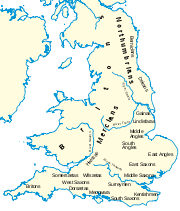
, the first Germanic polity to be created was Kingdom of Kent
Kingdom of Kent
The Kingdom of Kent was a Jutish colony and later independent kingdom in what is now south east England. It was founded at an unknown date in the 5th century by Jutes, members of a Germanic people from continental Europe, some of whom settled in Britain after the withdrawal of the Romans...
in the 6th century, followed by Sussex
Kingdom of Sussex
The Kingdom of Sussex or Kingdom of the South Saxons was a Saxon colony and later independent kingdom of the Saxons, on the south coast of England. Its boundaries coincided in general with those of the earlier kingdom of the Regnenses and the later county of Sussex. A large part of its territory...
, Wessex
Wessex
The Kingdom of Wessex or Kingdom of the West Saxons was an Anglo-Saxon kingdom of the West Saxons, in South West England, from the 6th century, until the emergence of a united English state in the 10th century, under the Wessex dynasty. It was to be an earldom after Canute the Great's conquest...
, Essex
Kingdom of Essex
The Kingdom of Essex or Kingdom of the East Saxons was one of the seven traditional kingdoms of the so-called Anglo-Saxon Heptarchy. It was founded in the 6th century and covered the territory later occupied by the counties of Essex, Hertfordshire, Middlesex and Kent. Kings of Essex were...
, East Anglia
East Anglia
East Anglia is a traditional name for a region of eastern England, named after an ancient Anglo-Saxon kingdom, the Kingdom of the East Angles. The Angles took their name from their homeland Angeln, in northern Germany. East Anglia initially consisted of Norfolk and Suffolk, but upon the marriage of...
, Mercia
Mercia
Mercia was one of the kingdoms of the Anglo-Saxon Heptarchy. It was centred on the valley of the River Trent and its tributaries in the region now known as the English Midlands...
and Northumbria
Northumbria
Northumbria was a medieval kingdom of the Angles, in what is now Northern England and South-East Scotland, becoming subsequently an earldom in a united Anglo-Saxon kingdom of England. The name reflects the approximate southern limit to the kingdom's territory, the Humber Estuary.Northumbria was...
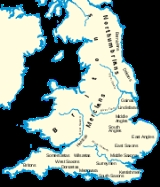
. These seven states were considered by Henry to form a Heptarchy
Heptarchy
The Heptarchy is a collective name applied to the Anglo-Saxon kingdoms of south, east, and central Great Britain during late antiquity and the early Middle Ages, conventionally identified as seven: Northumbria, Mercia, East Anglia, Essex, Kent, Sussex and Wessex...
, although modern historians generally discount it as an over-simplification. Meanwhile, many groups of native Britons even resettled on the continent, principally in Armorica
Armorica
Armorica or Aremorica is the name given in ancient times to the part of Gaul that includes the Brittany peninsula and the territory between the Seine and Loire rivers, extending inland to an indeterminate point and down the Atlantic coast...
(Brittany
Brittany
Brittany is a cultural and administrative region in the north-west of France. Previously a kingdom and then a duchy, Brittany was united to the Kingdom of France in 1532 as a province. Brittany has also been referred to as Less, Lesser or Little Britain...
) in France
France
The French Republic , The French Republic , The French Republic , (commonly known as France , is a unitary semi-presidential republic in Western Europe with several overseas territories and islands located on other continents and in the Indian, Pacific, and Atlantic oceans. Metropolitan France...
and Britonia
Britonia
Britonia is the historical name of a settlement in Galicia which was settled in the late 5th and early 6th centuries AD by Romano-Britons escaping the advancing Anglo-Saxons who were conquering Britain at the time...
in Spanish
Iberian Peninsula
The Iberian Peninsula , sometimes called Iberia, is located in the extreme southwest of Europe and includes the modern-day sovereign states of Spain, Portugal and Andorra, as well as the British Overseas Territory of Gibraltar...
Galicia, the homes of pre-existing Celtic communities.
The Anglo-Saxon historian Frank Stenton
Frank Stenton
Sir Frank Merry Stenton was a 20th century historian of Anglo-Saxon England, and president of the Royal Historical Society . He was the author of Anglo-Saxon England, a volume of the Oxford History of England, first published in 1943 and widely considered a classic history of the period...
, although making considerable allowance for British survival, argued in 1943 that "the greater part of southern England was overrun in the first phase of the war". This interpretation was based on the written sourcesparticularly Gildas
Gildas
Gildas was a 6th-century British cleric. He is one of the best-documented figures of the Christian church in the British Isles during this period. His renowned learning and literary style earned him the designation Gildas Sapiens...
, whose sermon De Excidio et Conquestu Britanniae
De Excidio et Conquestu Britanniae
De Excidio et Conquestu Britanniae is a work by the 6th-century British cleric Gildas. It is a sermon in three parts condemning the acts of Gildas' contemporaries, both secular and religious, whom he blames for the dire state of affairs in sub-Roman Britain...
portrayed the arrival of Germanic people as divine punishment for the sins of the British, but also the later sources such Bede's Ecclesiastical History, the 9th-century Anglo-Saxon Chronicle
Anglo-Saxon Chronicle
The Anglo-Saxon Chronicle is a collection of annals in Old English chronicling the history of the Anglo-Saxons. The original manuscript of the Chronicle was created late in the 9th century, probably in Wessex, during the reign of Alfred the Great...
, and the later Anglo-Norman chroniclersthat cast the arrival of the Anglo-Saxons as a violent event. The placename and linguistic evidence was also considered to support this interpretation, as very few British place-names survived in eastern Britain, very few British Celtic words entered the Old English language and the migration of Brittonic language and peoples from south-western Britain to Armorica, which eventually became Brittany.
According to research led by University College London
University College London
University College London is a public research university located in London, United Kingdom and the oldest and largest constituent college of the federal University of London...
, Anglo-Saxon settlers could have enjoyed a substantial social and economic advantage over the native Celtic Britons
Celt
The Celts were a diverse group of tribal societies in Iron Age and Roman-era Europe who spoke Celtic languages.The earliest archaeological culture commonly accepted as Celtic, or rather Proto-Celtic, was the central European Hallstatt culture , named for the rich grave finds in Hallstatt, Austria....
who lived in what is now England
England
England is a country that is part of the United Kingdom. It shares land borders with Scotland to the north and Wales to the west; the Irish Sea is to the north west, the Celtic Sea to the south west, with the North Sea to the east and the English Channel to the south separating it from continental...
, establishing an apartheid-like culture for more than 300 years from the middle of the 5th century.
The invasion narrative particularly appealed to early English historians, who wanted to further their view that England had developed differently from Europe with a limited monarchy and love of liberty. This, they argued, came from the mass Anglo-Saxon invasions. While this view was never universalEdward Gibbon
Edward Gibbon
Edward Gibbon was an English historian and Member of Parliament...
, for one, believed that there had been a great deal of British survivalit was the dominant paradigm. Though many scholars would now challenge this argument, the traditional view is still held by many others. Lawrence James
Lawrence James
Edwin James Lawrence , most commonly known as Lawrence James, is an English academic, notable for his works as a writer and historian. He has written several works of popular history about the British Empire...
wrote in 2002 that England was "submerged by an Anglo-Saxon current which swept away the Romano-British".
Theories for reduction
The traditional view has been deconstructed to a degree since the 1990s. At the centre of this is a re-estimation of the numbers of Anglo-Saxons arriving in Britain during this period. A lower figure is sometimes accepted, which would mean that it is highly unlikely that the existing British population was substantially displaced by the Anglo-Saxons. The Saxons are thus seen as a ruling elite coexisting with the local population, with "Saxon" graves possibly those of Britons. Many scholars continue to disagree with this interpretation.The traditional view of mass Anglo-Saxon migration and violent invasion is most challenged by the historian and archaeologist Francis Pryor
Francis Pryor
thumb|180px|Francis Pryor discusses the excavation during the filming of a 2007 dig for [[Time Team]] with series editor Michael Douglas ....
who believes that northern European migration to Britain was a slow, peaceful and limited process resulting in an infusion of culture. This view was strongly expressed in his Discovery Channel
Discovery Channel
Discovery Channel is an American satellite and cable specialty channel , founded by John Hendricks and distributed by Discovery Communications. It is a publicly traded company run by CEO David Zaslav...
television program "Britain AD: King Arthur's Britain" and in his book Britain AD: a quest for Arthur, England and the Anglo-Saxons.
Archaeologists have uncovered Celtic artefacts in England dating from later times than the supposed Anglo-Saxon 'apartheid' of Britons was believed to take place. Some areas, such as those around the Pennines
Pennines
The Pennines are a low-rising mountain range, separating the North West of England from Yorkshire and the North East.Often described as the "backbone of England", they form a more-or-less continuous range stretching from the Peak District in Derbyshire, around the northern and eastern edges of...
still retained a strong Celtic culture, a prime example being the speaking of the Cumbric language
Cumbric language
Cumbric was a variety of the Celtic British language spoken during the Early Middle Ages in the Hen Ogledd or "Old North", or what is now northern England and southern Lowland Scotland, the area anciently known as Cumbria. It was closely related to Old Welsh and the other Brythonic languages...
until late into the 12th century and the Cornish language
Cornish language
Cornish is a Brythonic Celtic language and a recognised minority language of the United Kingdom. Along with Welsh and Breton, it is directly descended from the ancient British language spoken throughout much of Britain before the English language came to dominate...
even longer until the 18th century. Celtic traditions and words have survived even until today, such as Cornish, Cumbrian and Lancashire wrestling and many placenames such as Pen-y-Ghent
Pen-y-ghent
Pen-y-ghent is a fell in the Yorkshire Dales. It is one of the Yorkshire Three Peaks, the other two being Ingleborough and Whernside. It lies some 3 km east of Horton in Ribblesdale...
in North Yorkshire.
Linguistic evidence
LinguisticLinguistics
Linguistics is the scientific study of human language. Linguistics can be broadly broken into three categories or subfields of study: language form, language meaning, and language in context....
evidence can be interpreted as a marker of the cultures that have influenced given regions. Study in Old English has shown little evidence of a Celtic language substratum
Substratum
In linguistics, a stratum or strate is a language that influences, or is influenced by another through contact. A substratum is a language which has lower power or prestige than another, while a superstratum is the language that has higher power or prestige. Both substratum and superstratum...
. A recently emerging (2004) diglossia
Diglossia
In linguistics, diglossia refers to a situation in which two dialects or languages are used by a single language community. In addition to the community's everyday or vernacular language variety , a second, highly codified variety is used in certain situations such as literature, formal...
model proposes to explain the substantial changes between Old English and Middle English
Middle English
Middle English is the stage in the history of the English language during the High and Late Middle Ages, or roughly during the four centuries between the late 11th and the late 15th century....
. According to this model, Old English was the written language of the Anglo-Saxon period but a large portion of the population spoke a Celticised English which emerged in Middle English following the Norman conquest and the overthrowing of the Anglo-Saxon elite. Niehues suggests that words from the various Celtic languages can be found in almost all spheres of the English language, ranging from first names and surnames to names of places, to common nouns, and even to a number of verbs. He also points out that there is no general consensus on how large the Celtic contribution to the English lexicon
actually is and whether it is smaller than one would expect or merely not yet fully recognised. Celtic is claimed as a cause in the change from a synthetic language
Synthetic language
In linguistic typology, a synthetic language is a language with a high morpheme-per-word ratio, as opposed to a low morpheme-per-word ratio in what is described as an isolating language...
expressing grammatical relations through suffixes to an analytic one employing word order instead and the use of the progressive tense (e.g., "am reading"). Celtic influence is also used to explain puzzling elements in Englishfor instance, frequent dependence on the semantically neutral verb "to do" ("I don't know", rather than "I know not") and the lack of an external possessor in English, despite its presence in all major European languages except Celtic.
When the Anglo-Saxons arrived in Britain in the 5th century, they had a strong oral tradition but were largely illiterate, save for some use of Germanic runes. They were introduced to Latin script by way of Christian missionaries from the late 7th century onwards. During the Anglo-Saxon period, documents would have been produced in writing offices known as scriptoria
Scriptorium
Scriptorium, literally "a place for writing", is commonly used to refer to a room in medieval European monasteries devoted to the copying of manuscripts by monastic scribes...
in cathedral
Cathedral
A cathedral is a Christian church that contains the seat of a bishop...
s and monasteries. Based on ideas from the remaining Brythonic Celtic communities and possibly Ireland, the scribes developed an Old English script. Manuscripts were then produced, providing us with a written record of the language although Latin
Late Latin
Late Latin is the scholarly name for the written Latin of Late Antiquity. The English dictionary definition of Late Latin dates this period from the 3rd to the 6th centuries AD extending in Spain to the 7th. This somewhat ambiguously defined period fits between Classical Latin and Medieval Latin...
continued to predominate. The use of Old English script diminished after the Norman Conquest, but did not finally die out until the 12th century.
Studies of placenames give clues about the linguistic history of an area. The traditional perspective held that Brythonic language and culture and the political power of the original Britons were displaced in these areas over time, but remained in Wales
Wales
Wales is a country that is part of the United Kingdom and the island of Great Britain, bordered by England to its east and the Atlantic Ocean and Irish Sea to its west. It has a population of three million, and a total area of 20,779 km²...
, Cornwall
Cornwall
Cornwall is a unitary authority and ceremonial county of England, within the United Kingdom. It is bordered to the north and west by the Celtic Sea, to the south by the English Channel, and to the east by the county of Devon, over the River Tamar. Cornwall has a population of , and covers an area of...
, and for a time in the Hen Ogledd
Hen Ogledd
Yr Hen Ogledd is a Welsh term used by scholars to refer to those parts of what is now northern England and southern Scotland in the years between 500 and the Viking invasions of c. 800, with particular interest in the Brythonic-speaking peoples who lived there.The term is derived from heroic...
("Old North"), an area now divided between northern England
Northern England
Northern England, also known as the North of England, the North or the North Country, is a cultural region of England. It is not an official government region, but rather an informal amalgamation of counties. The southern extent of the region is roughly the River Trent, while the North is bordered...
and southern Scotland
Scotland
Scotland is a country that is part of the United Kingdom. Occupying the northern third of the island of Great Britain, it shares a border with England to the south and is bounded by the North Sea to the east, the Atlantic Ocean to the north and west, and the North Channel and Irish Sea to the...
. Some recent research on placenames suggests that some Brythonic-speakers actually survived the Anglo-Saxon conquest in some parts of what is now England, and that Brythonic may have been spoken in north-west Wiltshire after 600, many parts of the west Midlands until the end of the 9th century, and Cumberland until the 12th century.
However, although recent research has demonstrated that there are more Brythonic placenames in English than traditionally thought, it still remains relatively moderate. There are scattered Celtic placenames throughout, increasing towards the west. There are also Celtic river names and topographical names. The placename and linguistic evidence has been explained by the argument that the settlement of Anglo-Saxons being politically and socially dominant in the south and east of Britain, their language and culture also became dominant in those areas. Names with Latin elements suggest continuity of settlement, while some placenames have names of pagan Germanic deities. Names of British origin are usually taken as indicating survival of a British population, though this may not be so. Names such as Walton, based on the Anglo-Saxon word for the British wealh, are also taken as indicating British survival.
Epigraphic evidence, such as Anglo-Saxon runes, provide another source of information on the settlements of the Saxons and others in this period.
Genetic evidence
Recent work analysing the Y chromosomeY chromosome
The Y chromosome is one of the two sex-determining chromosomes in most mammals, including humans. In mammals, it contains the gene SRY, which triggers testis development if present. The human Y chromosome is composed of about 60 million base pairs...
and mitochondrial DNA
Mitochondrial DNA
Mitochondrial DNA is the DNA located in organelles called mitochondria, structures within eukaryotic cells that convert the chemical energy from food into a form that cells can use, adenosine triphosphate...
of people now living in Britain and on the continent has provided some insight into population movements during the sub-Roman period. A 2002 study from University College London was interpreted as showing the possibility of large scale Anglo-Saxon migration to central and eastern England, accounting for 50–100% of the population in Central England. However, a more complete study in 2003 suggests that there may have been substantially less Anglo-Saxon migration to other regions of England and that the transition between England and Wales was more gradual than the earlier study suggested. The study also provides evidence that all areas of the British Isles have some pre-Anglo-Saxon genetic component. It did not identify a discernible difference in the Y chromosomes of the presumed source populations of Anglo-Saxons and the later Danish invaders, thus the survey registered both sets of chromosomes as belonging to the same group. Further, when the study included the samples from Friesland
Friesland
Friesland is a province in the north of the Netherlands and part of the ancient region of Frisia.Until the end of 1996, the province bore Friesland as its official name. In 1997 this Dutch name lost its official status to the Frisian Fryslân...
used by the 2002 study as a source population for Anglo-Saxons, it found no statistically significant difference between those samples and the North German/Danish group. All continental samples were statistically different from British samples. On the other hand the principal components analysis showed that samples from Friesland, although closer to the North German/Danish samples, were somewhat closer to the British samples than the North German/Danish samples were.
Others interpret the genetic evidence above differently. Stephen Oppenheimer
Stephen Oppenheimer
Stephen Oppenheimer is a British paediatrician, geneticist, and writer. He is a member of Green Templeton College, Oxford and an honorary fellow of Liverpool School of Tropical Medicine, and carries out and publishes research in the fields of genetics and human prehistory.-Career:Oppenheimer...
in The Origins of the British and Bryan Sykes
Bryan Sykes
Bryan Sykes is a former Professor of Human Genetics at the University of Oxford and a current Fellow of Wolfson College.Sykes published the first report on retrieving DNA from ancient bone...
in Blood of the Isles suggest that the contribution to the British gene pool from Anglo-Saxons and other late invaders may have been very limited. He states that about two-thirds of English people's ancestors are Paleolithic
Paleolithic
The Paleolithic Age, Era or Period, is a prehistoric period of human history distinguished by the development of the most primitive stone tools discovered , and covers roughly 99% of human technological prehistory...
settlers who migrated from the western European Ice Age refuge in Paleolithic Iberia, comprising three-quarters of British people's ancestors. If true, this would support the idea of an ancient relationship between the populations of Atlantic Europe
Atlantic Europe
Atlantic Europe is a geographical and anthropological term for the western portion of Europe which borders the Atlantic Ocean. The term may refer to the idea of Atlantic Europe as a cultural unit and/or as an biogeographical region....
, though the eastern and southeastern coasts of Great Britain do not belong to this zone. Sykes and Oppenheimer state that even in the east of England
East of England
The East of England is one of the nine official regions of England. It was created in 1994 and was adopted for statistics from 1999. It includes the ceremonial counties of Essex, Hertfordshire, Bedfordshire, Cambridgeshire, Norfolk and Suffolk. Essex has the highest population in the region.Its...
, where there is the best evidence for migration, no more than 10% of paternal lines may be designated as coming from an "Anglo-Saxon" migration event and that in the same English regions 69% of male lines are still of aboriginal origin. Oppenheimer postulates a possible pre-Anglo-Saxon genetic relationship between the modern populations of England (especially the south and east) and the people living on the opposing North Sea
North Sea
In the southwest, beyond the Straits of Dover, the North Sea becomes the English Channel connecting to the Atlantic Ocean. In the east, it connects to the Baltic Sea via the Skagerrak and Kattegat, narrow straits that separate Denmark from Norway and Sweden respectively...
regions, indicating a much older pre-Roman Germanic influence in southern and eastern England. There is some evidence that Y-chromosome Haplogroup I
Haplogroup I (Y-DNA)
In human genetics, Haplogroup I is a Y-chromosome DNA haplogroup, a subgroup of haplogroup IJ, itself a derivative of Haplogroup IJK....
, which occurs at similar frequencies around the North Sea coast, may represent a mesolithic
Mesolithic
The Mesolithic is an archaeological concept used to refer to certain groups of archaeological cultures defined as falling between the Paleolithic and the Neolithic....
colonization rather than an Anglo-Saxon migration as is argued by other researchers. This haplogroup represents a migration from the Balkan refuge that may have travelled along inland European rivers rather than by the Atlantic coast.
Oppenheimer also postulates that the arrival of Germanic languages
Germanic languages
The Germanic languages constitute a sub-branch of the Indo-European language family. The common ancestor of all of the languages in this branch is called Proto-Germanic , which was spoken in approximately the mid-1st millennium BC in Iron Age northern Europe...
in England may be considerably earlier than previously thoughtperhaps pre-Romanand that both mainland and English Belgae
Belgae
The Belgae were a group of tribes living in northern Gaul, on the west bank of the Rhine, in the 3rd century BC, and later also in Britain, and possibly even Ireland...
from Gaul
Gaul
Gaul was a region of Western Europe during the Iron Age and Roman era, encompassing present day France, Luxembourg and Belgium, most of Switzerland, the western part of Northern Italy, as well as the parts of the Netherlands and Germany on the left bank of the Rhine. The Gauls were the speakers of...
may have been Germanic-speaking peoples and represented closely related ethnic groups or a single cross-channel ethnic group. The invasions recorded by Bede would then have been simply the exchange of one Germanic elite for another.
Invasion period kings
The following semi-legendary 5th and 6th century kings are credited with establishing the first Anglo-Saxon kingdoms in England:- Oisc of KentOisc of KentOisc was an early king of Kent who ruled from about 488 to about 516.Little is known about him, and the information that does survive regarding his life is often vague and suspect. He seems to have been the son or the grandson of Hengest, who led the initial Anglo-Saxon conquest and settlement of...
, son of HengestHengestHengist and Horsa are figures of Anglo-Saxon, and subsequently British, legend, which records the two as the Germanic brothers who led the Angle, Saxon, and Jutish armies that conquered the first territories of Great Britain in the 5th century AD...
(d. 516) - Ælle of Sussex (d. 514)
- Icel of Mercia (d. 527)
- Cerdic of WessexCerdic of WessexCerdic was probably the first King of Anglo-Saxon Wessex from 519 to 534, cited by the Anglo-Saxon Chronicle as the founder of the kingdom of Wessex and ancestor of all its subsequent kings...
(d. 534) - Ida of BerniciaIda of BerniciaIda is the first known king of the Anglian kingdom of Bernicia, which he ruled from around 547 until his death in 559. Little is known of his life or reign, but he was regarded as the founder of a line from which later Anglo-Saxon kings in this part of northern England and southern Scotland...
(d. 559) - Wehha of East AngliaWehha of East AngliaWehha was a pagan king of the East Angles who, if he actually existed, ruled the kingdom of East Anglia during the 6th century, at the time the kingdom was being established by migrants from the Jutland peninsula. Early sources identify him as a member of the Wuffingas dynasty, which became...
(d. 571) - Aescwine of EssexAescwine of EssexÆscwine, or Erkenwine, Erchenwine, was reputedly the settler from Old Saxony who in 527 founded the Kingdom of Essex , becoming the first king of the region .Precious little evidence is available for his existence...
(d. 587)
See also
- Migration PeriodMigration PeriodThe Migration Period, also called the Barbarian Invasions , was a period of intensified human migration in Europe that occurred from c. 400 to 800 CE. This period marked the transition from Late Antiquity to the Early Middle Ages...
- Timeline of Anglo-Saxon settlement in Britain
- Wales in the Early Middle AgesWales in the Early Middle AgesThe history of Wales in the early Middle Ages is sketchy, as there is very little written history from the period. Nonetheless, some information may be gleaned from archaeological evidence and what documentary history does exist.-Sub-Roman Britain :...
- History of Anglo-Saxon EnglandHistory of Anglo-Saxon EnglandAnglo-Saxon England refers to the period of the history of that part of Britain, that became known as England, lasting from the end of Roman occupation and establishment of Anglo-Saxon kingdoms in the 5th century until the Norman conquest of England in 1066 by William the Conqueror...
- Settlement of Great Britain and IrelandSettlement of Great Britain and IrelandThe British Isles have experienced a long history of migration from across Europe. Over the millennia, successive waves of immigrants have come to the Isles, a process that is continuing today. The ancient migrations have mainly come via two routes: along the Atlantic coast and from...
- Groans of the BritonsGroans of the BritonsThe Groans of the Britons is the name of the final appeal made by the Britons to the Roman military for assistance against barbarian invasion. The appeal is first referenced in Gildas' 6th-century De Excidio et Conquestu Britanniae; Gildas' account was later repeated in Bede's Historia...
- Battle of Mons BadonicusBattle of Mons BadonicusThe Battle of Mons Badonicus was a battle between a force of Britons and an Anglo-Saxon army, probably sometime between 490 and 517 AD. Though it is believed to have been a major political and military event, there is no certainty about its date, location or the details of the fighting...
- Hengest and Horsa
- VortigernVortigernVortigern , also spelled Vortiger and Vortigen, was a 5th-century warlord in Britain, a leading ruler among the Britons. His existence is considered likely, though information about him is shrouded in legend. He is said to have invited the Saxons to settle in Kent as mercenaries to aid him in...
- Matter of BritainMatter of BritainThe Matter of Britain is a name given collectively to the body of literature and legendary material associated with Great Britain and its legendary kings, particularly King Arthur...
- Anglo-Saxon ChronicleAnglo-Saxon ChronicleThe Anglo-Saxon Chronicle is a collection of annals in Old English chronicling the history of the Anglo-Saxons. The original manuscript of the Chronicle was created late in the 9th century, probably in Wessex, during the reign of Alfred the Great...
- Historia Regum BritanniaeHistoria Regum BritanniaeThe Historia Regum Britanniae is a pseudohistorical account of British history, written c. 1136 by Geoffrey of Monmouth. It chronicles the lives of the kings of the Britons in a chronological narrative spanning a time of two thousand years, beginning with the Trojans founding the British nation...
- Caistor-by-Norwich astragalusCaistor-by-Norwich astragalusThe Caistor-by-Norwich astralagus is a roe deer astragalus found in an urn at Caistor St. Edmund, Norfolk, England. The astralagus is inscribed with a 5th-century Elder Futhark inscription, reading ' "roe"...
- Undley bracteateUndley bracteateThe Undley bracteate is a 5th century bracteate found in Undley Common, near Lakenheath, Suffolk. It bears the earliest known inscription that can be argued to be in Anglo-Frisian Futhorc ....
- Spong HillSpong HillSpong Hill is an Anglo-Saxon cemetery site located at North Elmham in Norfolk, England. The largest Early Anglo-Saxon burial site ever excavated, it contains within it 2259 cremations and 57 inhumations. The site at Spong Hill consisted of two cemeteries, a large cremation cemetery and a smaller,...